Larson_Calculus_10e ch12sec03
MULTIPLE CHOICE
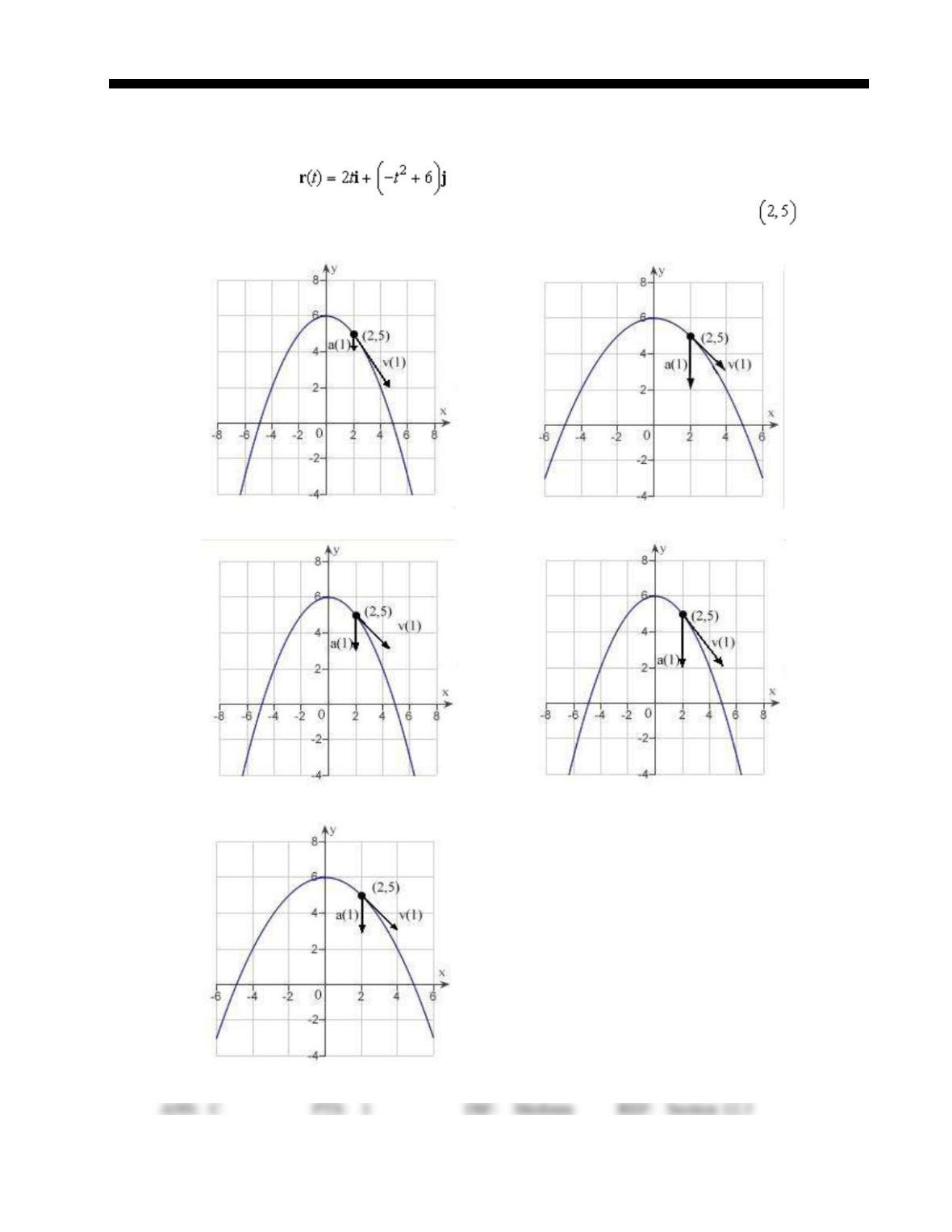
1. The position vector describes the path of an object moving in the xy-plane.
Sketch a graph of the path and sketch the velocity and acceleration vectors at the point .
a.
d.
b.
e.
c.
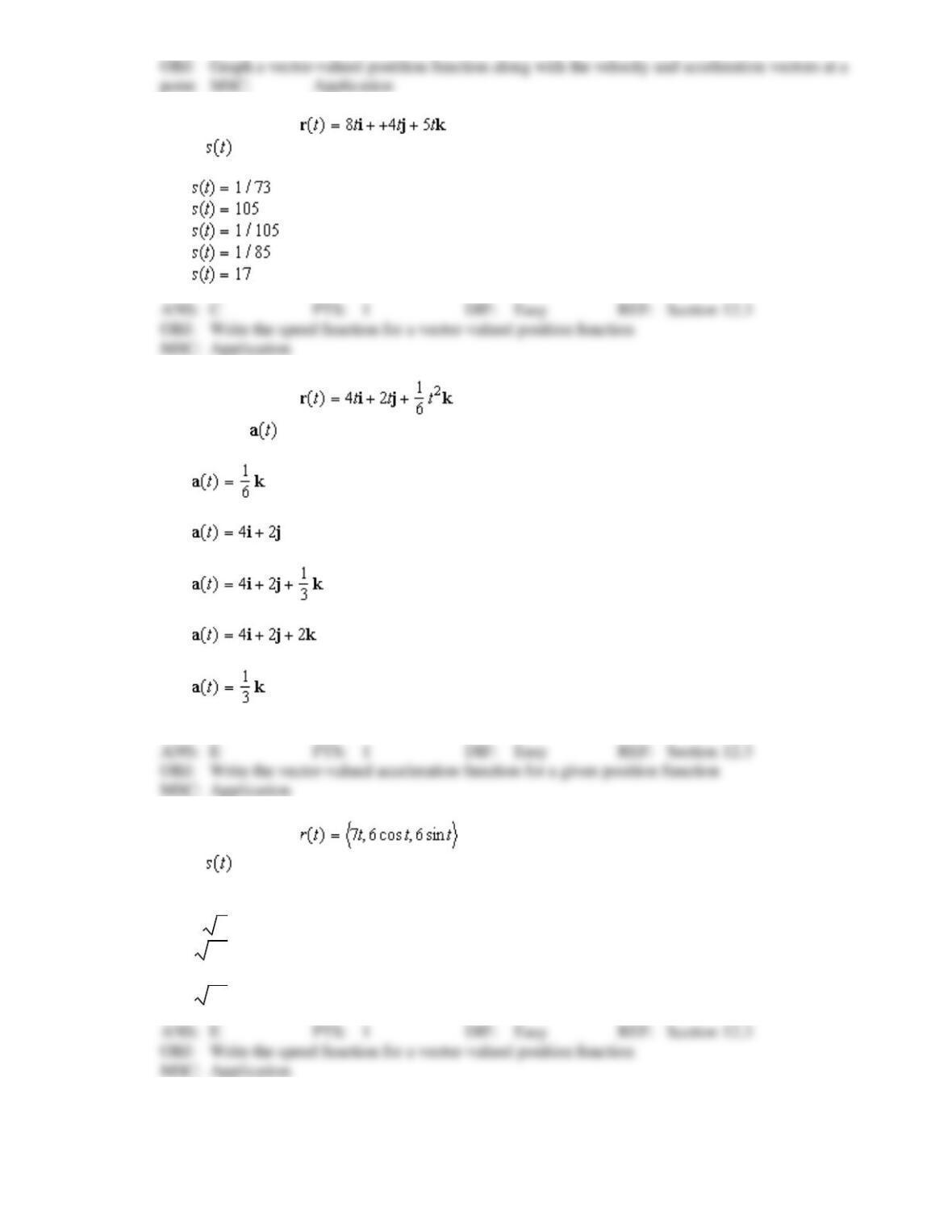
2. The position vector describes the path of an object moving in space. Find the
speed of the object.
a.
b.
c.
d.
e.
3. The position vector describes the path of an object moving in space. Find the
acceleration of the object.
a.
b.
c.
d.
e.
4. The position vector describes the path of an object moving in space. Find the
speed of the object.
a.
21
b.
c.
d.
149
e.
3 7
93
85
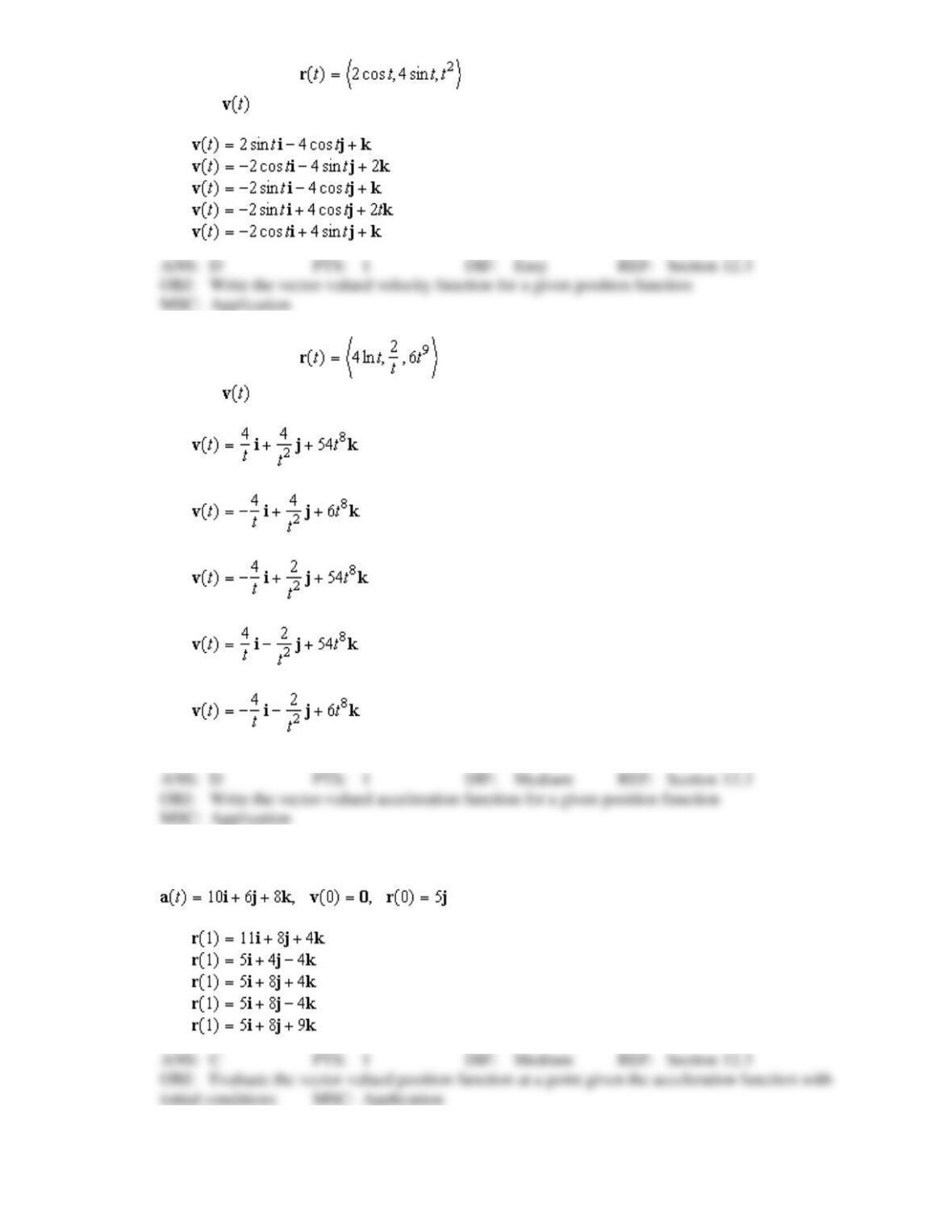
5. The position vector describes the path of an object moving in space. Find the
velocity of the object.
a.
b.
c.
d.
e.
6. The position vector describes the path of an object moving in space. Find the
velocity of the object.
a.
b.
c.
d.
e.
7. Use the given acceleration function and initial conditions to find the position at time t = 1.
a.
b.
c.
d.
e.
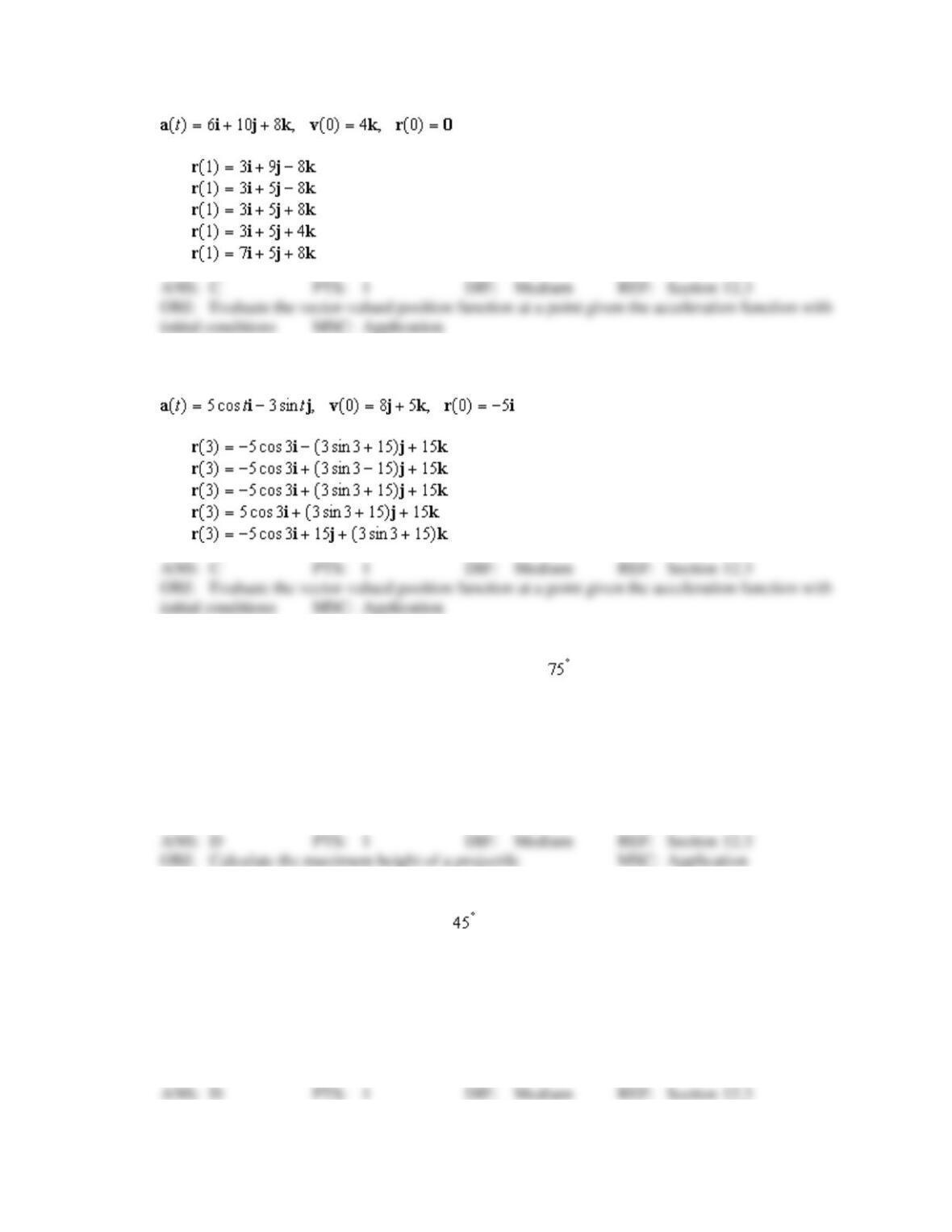
8. Use the given acceleration function and initial conditions to find the position at time t = 1.
a.
b.
c.
d.
e.
9. Use the given acceleration function and initial conditions to find the position at time t = 3.
a.
b.
c.
d.
e.
10. Determine the maximum height of a projectile fired at a height of 6 feet above the ground with an
initial velocity of 700 feet per second and at an angle of above the horizontal. Use the model for
projectile motion, assuming there is no air resistance. Round your answer to three decimal places.
a.
14,289.757 feet
b.
14,292.757 feet
c.
7,146.378 feet
d.
7,149.378 feet
e.
14,298.757 feet
11. Determine the range of a projectile fired at a height of 5 feet above the ground with an initial velocity
of 1000 feet per second and at an angle of above the horizontal. Use the model for projectile
motion, assuming there is no air resistance. Round your answer to three decimal places.
a.
15,627.500 feet
b.
8,137.843 feet
c.
31,252.187 feet
d.
31,254.999 feet
e.
16,268.138 feet
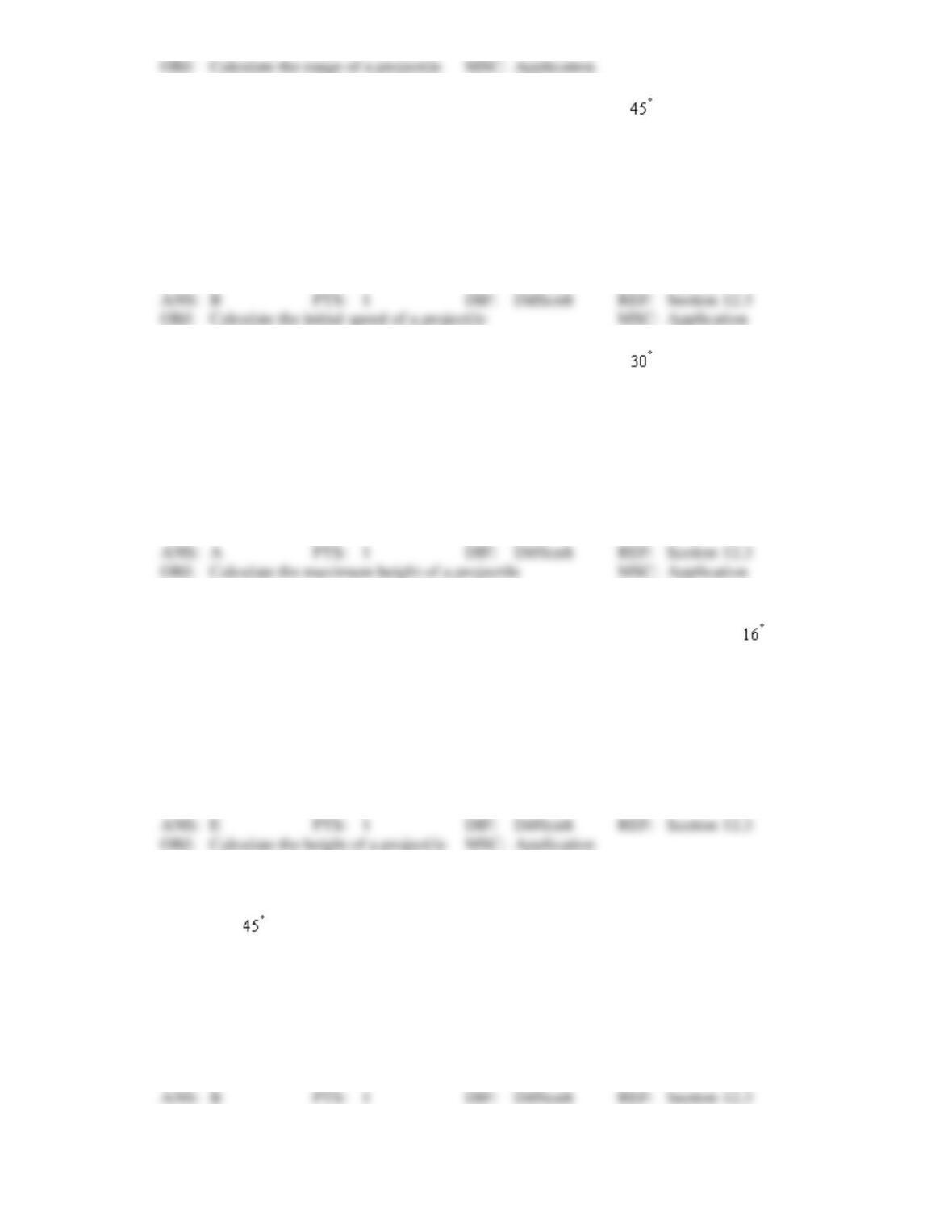
12. A baseball, hit 9 feet above the ground, leaves the bat at an angle of and is caught by an outfielder
9 feet above the ground and 500 feet from home plate. What is the initial speed of the ball? Round
your answer to two decimal places.
a.
31.62 ft/sec
b.
126.49 ft/sec
c.
189.74 ft/sec
d.
158.11 ft/sec
e.
63.25 ft/sec
13. A baseball, hit 5 feet above the ground, leaves the bat at an angle of and its caught by an outfielder
5 feet above the ground and 500 feet from home plate. How high does the ball rise? Round your
answer to the nearest integer.
a.
77 feet
b.
10 feet
c.
167 feet
d.
118 feet
e.
23 feet
14. A baseball player at second base throws a ball 87 feet to the player at first base. The ball is thrown 5
feet above the ground with an initial velocity of 50 miles per hour and at an angle of above the
horizontal. At which height does the player at first base catch the ball? Round your answer to three
decimal places.
a.
7.576 feet
b.
6.676 feet
c.
5.476 feet
d.
6.076 feet
e.
5.576 feet
15. The quarterback of a football team releases a pass at a height of 8 feet above the playing field, and the
football is caught by a receiver 38 yards directly downfield at a height of 4 feet. The pass is released at
an angle of with the horizontal. Find the speed of the football when it is released. Round your
answer to three decimal places.
a.
33.169 feet per second
b.
59.366 feet per second
c.
19.462 feet per second
d.
118.732 feet per second
e.
190.165 feet per second
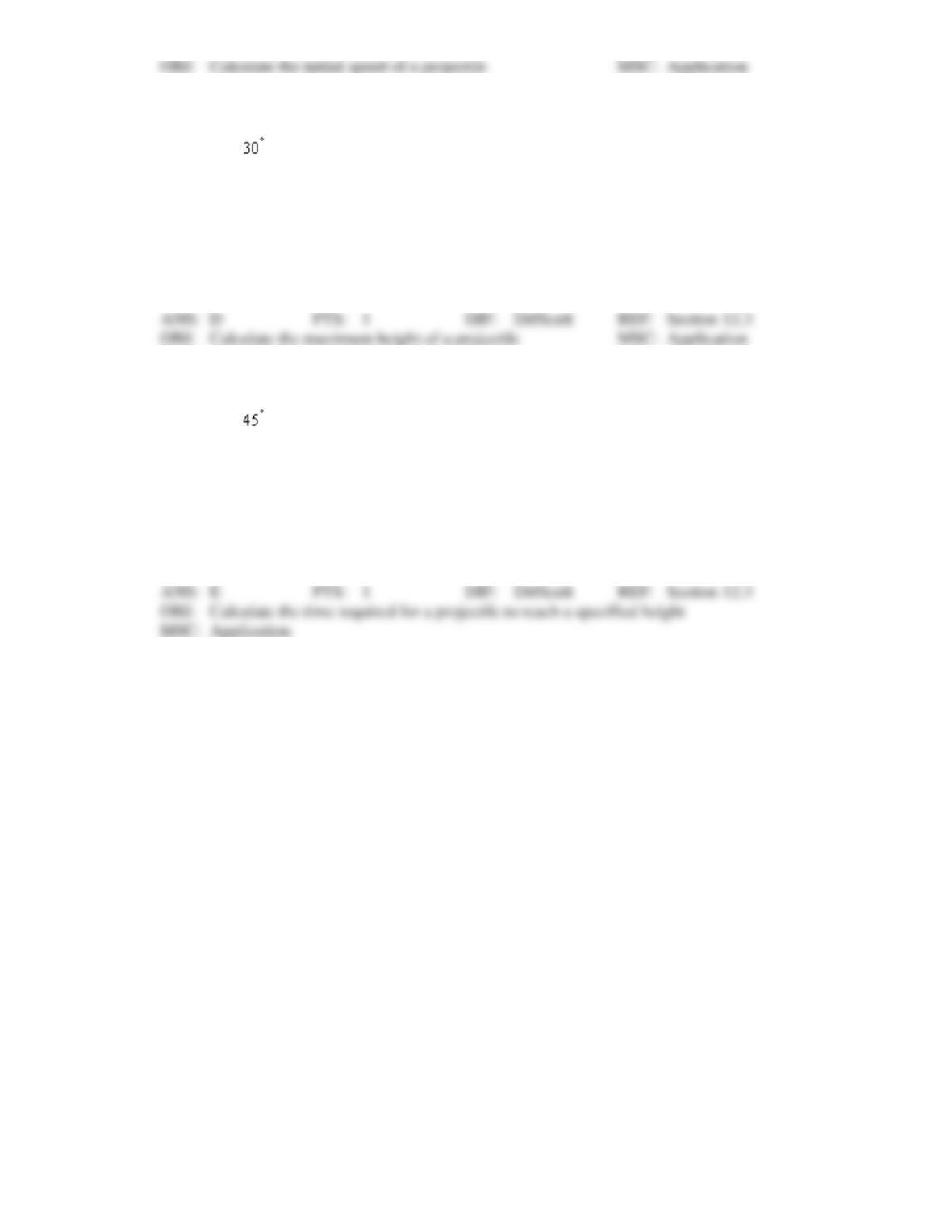
16. The quarterback of a football team releases a pass at a height of 6 feet above the playing field, and the
football is caught by a receiver 42 yards directly downfield at a height of 3 feet. The pass is released at
an angle of with the horizontal. Find the maximum height of the football. Round your answer to
one decimal place.
a.
–295.8 feet
b.
–194.1 feet
c.
–278.9 feet
d.
–224.3 feet
e.
–197.7 feet
17. The quarterback of a football team releases a pass at a height of 6 feet above the playing field, and the
football is caught by a receiver 34 yards directly downfield at a height of 3 feet. The pass is released at
an angle of with the horizontal. Find the time in seconds the receiver has to reach the proper
position after the quarterback releases the football. Round your answer to one decimal place.
a.
0.8 second
b.
4.6 seconds
c.
7.8 seconds
d.
1.3 seconds
e.
2.6 seconds