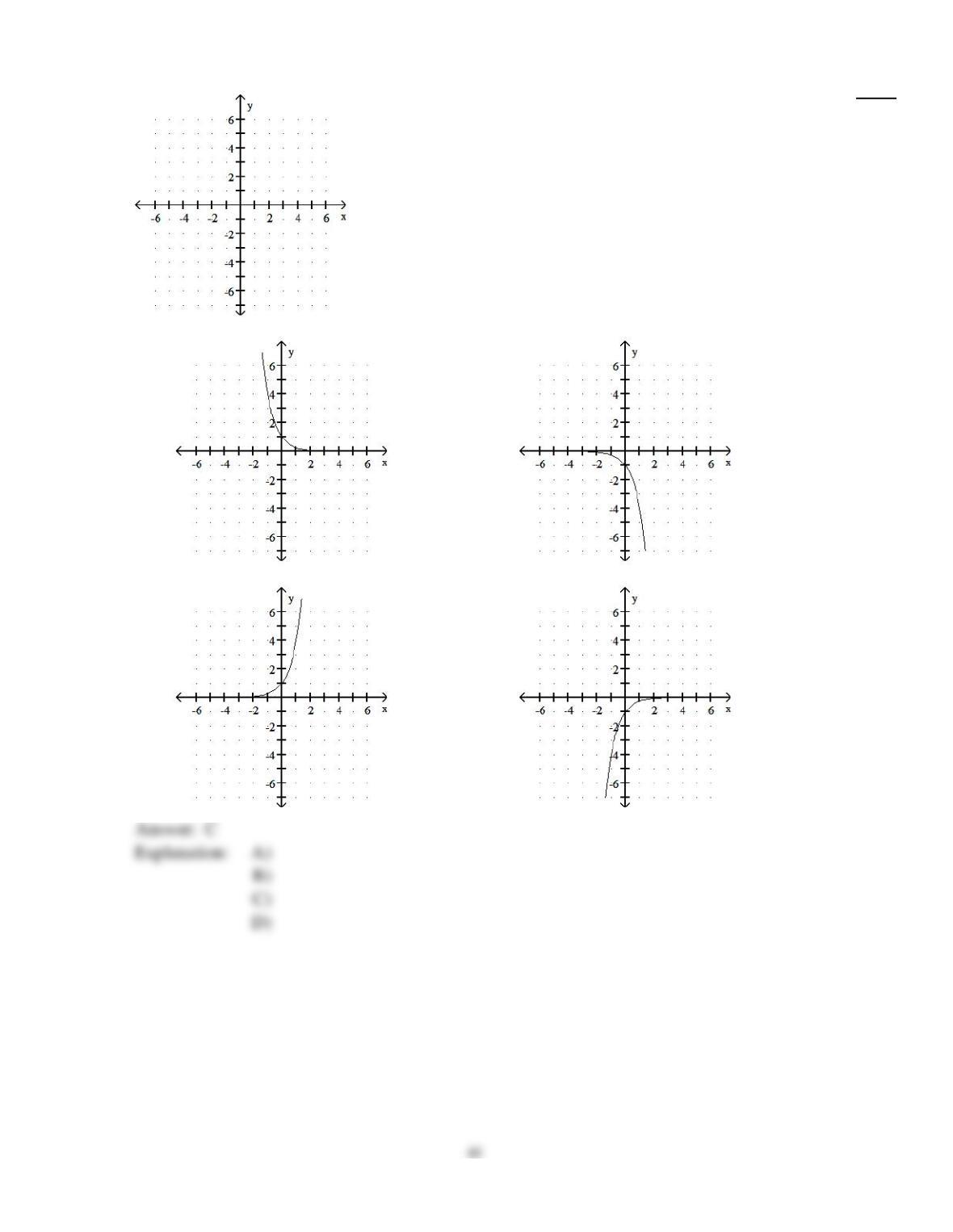
116)
f(x) =4x
116)
A)
B)
C)
D)
Solve the problem.
117)
117)
A sample of 700 g of lead–210 decays to polonium–210 according to the function given by
A(t) =700e–0.032t, where t is time in years. What is the amount of the sample after 10 years?
Round the answer to the nearest gram.
A)
369 g
B)
508 g
C)
964 g
D)
11 g
Solve the exponential equation by taking the logarithm on both sides. Express the solution set in terms of logarithms.
118)
3(x +7) =8
118)
A)
log 3
log 8+ log 7
B)
{log 8– log 3– log 7}
C)
log 8
log 3– 7
D)
log 3
log 8+7
Solve the logarithmic equation. Give an exact answer.
119)
119)
log3 x +log3(x + 8) = 1
A)
{–1+19}
B)
{4 +19}
C)
{–4+19}
D)
{–4–19}
Simplify the expression.
120)
ln e2y
120)
A)
2y
B)
y2
C)
ln(2y)
D)
e2y
Solve.
121)
121)
The value of a particular investment follows a pattern of exponential growth. You invested
money in a money market account. The value of your investment t years after your initial
investment is given by the exponential growth model A =1200e0.049t. When will the account be
worth $1390?
A)
2 years after the initial investment
B)
5 years after the initial investment
C)
4 years after the initial investment
D)
3 years after the initial investment
Provide an appropriate response.
122)
On the decibel scale, the loudness of a sound, in decibels, is given by D = 10 log I
I0, where I is the
intensity of the sound, in watts per meter2, and I0 is the intensity of a sound barely audible to the
human ear. If the intensity of a sound is 108I0, what is its loudness in decibels?
122)
A)
3 decibels
B)
10 decibels
C)
8 decibels
D)
80 decibels
Solve.
123)
The function f(x) =800(0.5)x/60 models the amount in pounds of a particular radioactive material
stored in a concrete vault, where x is the number of years since the material was put into the
vault. Find the amount of radioactive material in the vault after 40 years. Round to the nearest
whole number.
123)
A)
504 pounds
B)
600 pounds
C)
283 pounds
D)
267 pounds
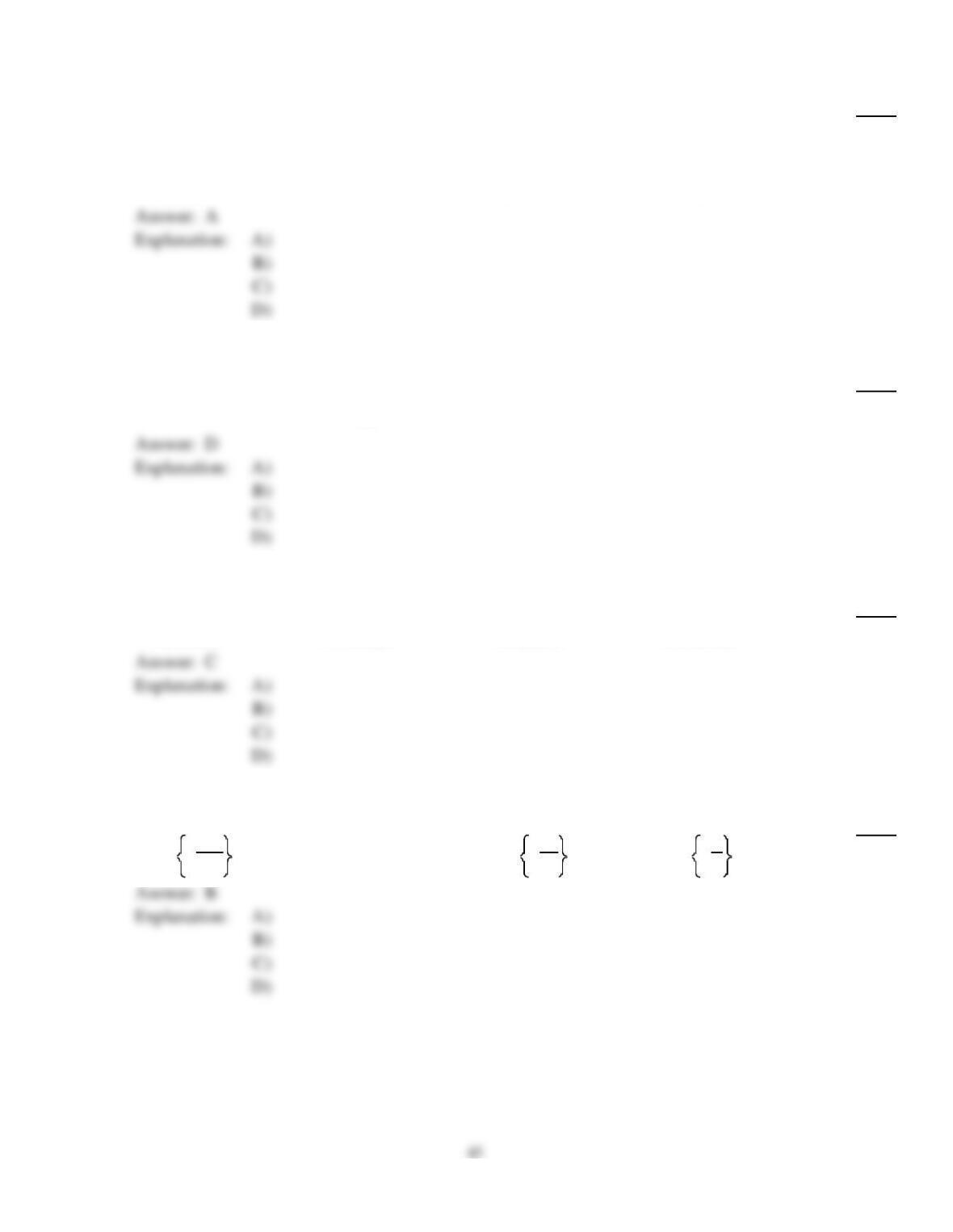
Graph the function by making a table of coordinates.
43
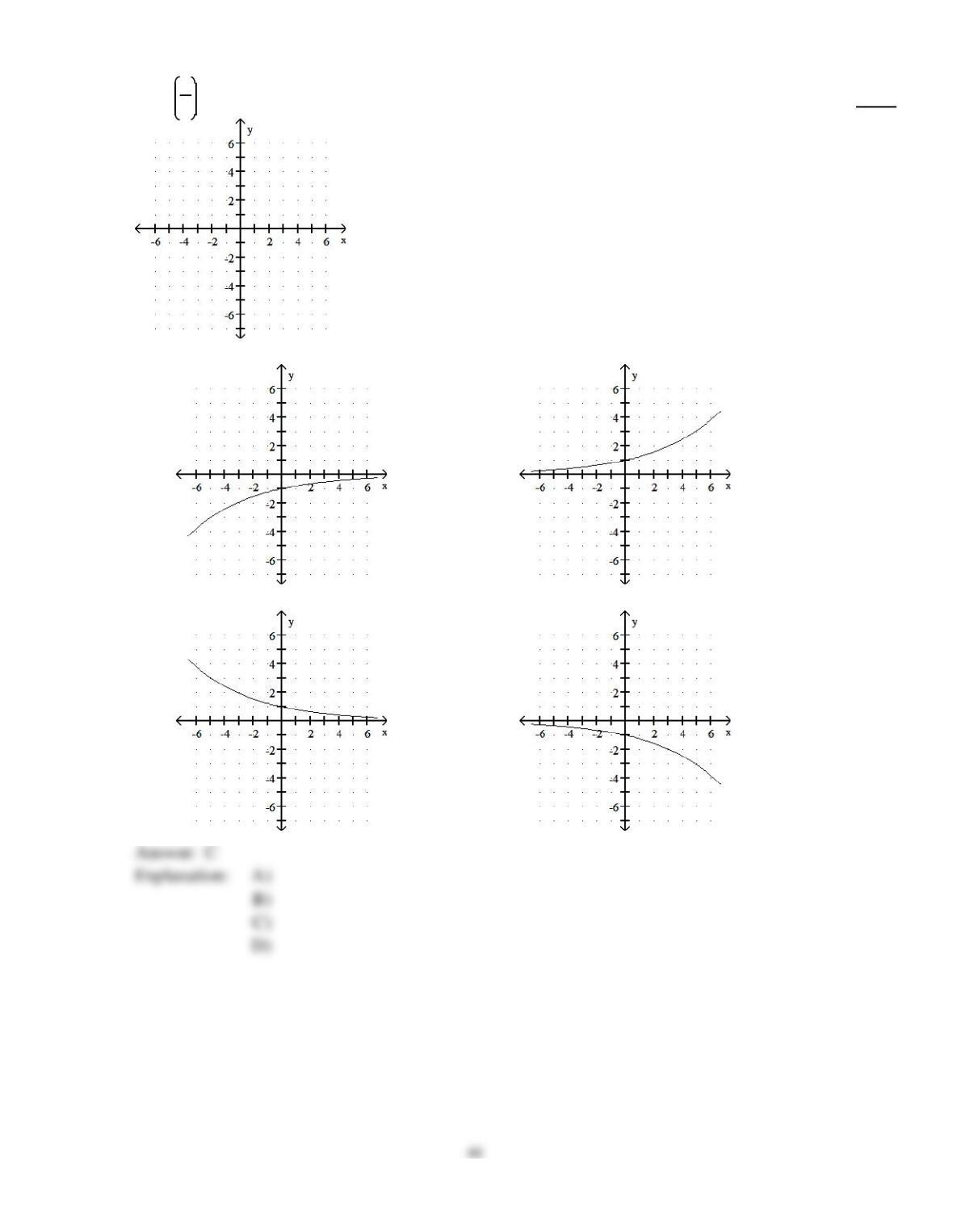
124)
f(x) =4
5
x
124)
A)
B)
C)
D)
Solve.
125)
125)
The pH of a solution ranges from 0 to 14. An acid has a pH less than 7. Pure water is neutral and
has a pH of 7. The pH of a solution is given by pH = – log x where x represents the concentration
of the hydrogen ions in the solution in moles per liter. Find the pH if the hydrogen ion
concentration is 5×
10–12.
A)
11.3
B)
11.7
C)
12.3
D)
12.7
Evaluate the expression without using a calculator.
126)
log7710
126)
A)
7
B)
log710
C)
17
D)
10
Use common logarithms or natural logarithms and a calculator to evaluate to four decimal places
127)
127)
log20
A)
0.8039
B)
0.3821
C)
2.6170
D)
1.7982
Solve the equation.
128)
128)
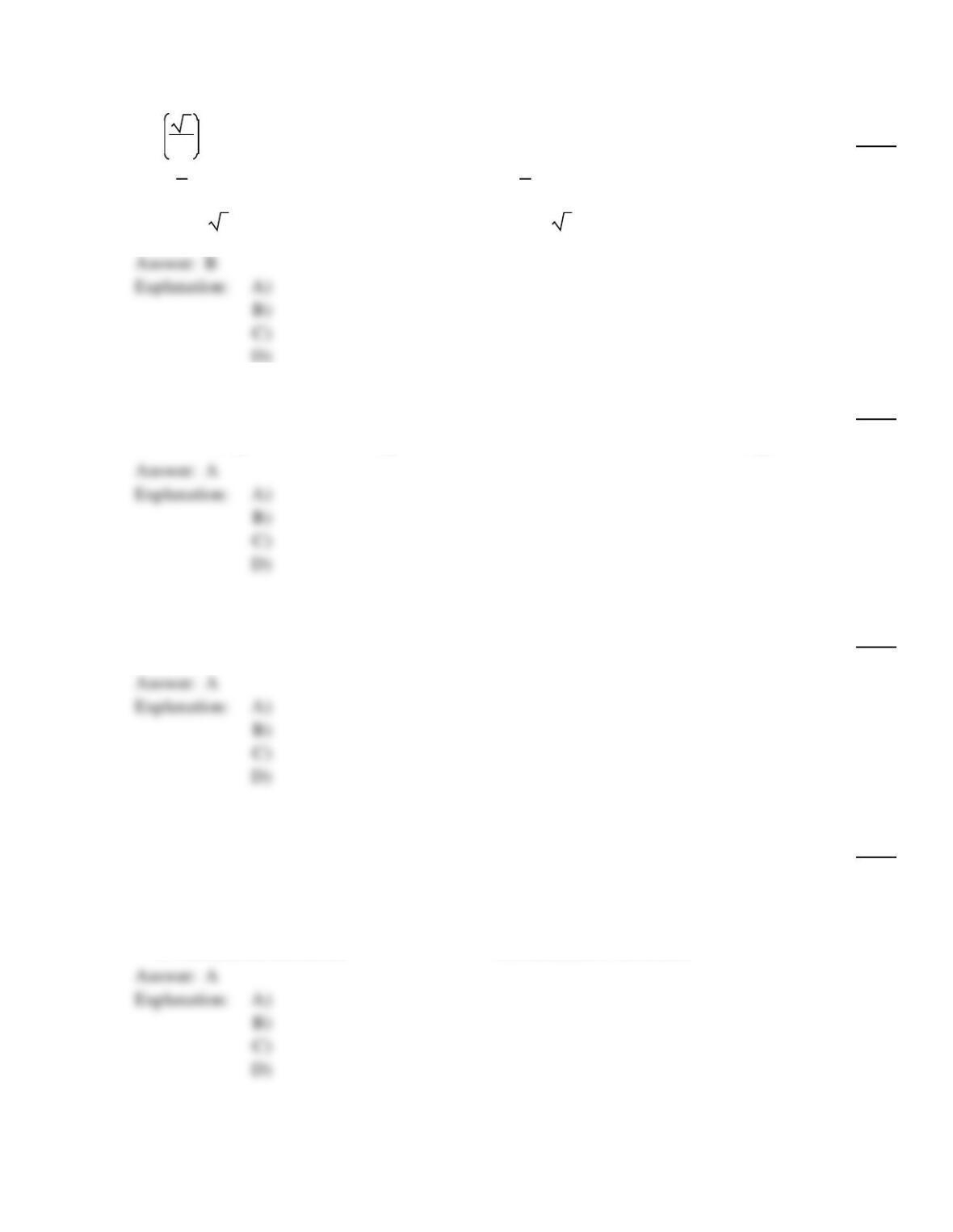
ln(3x –8) – ln(5x) = ln 2
A)
–8
497
B)
C)
–8
97
D)
–8
7
Use properties of logarithms to expand the logarithmic expression as much as possible. Where possible, evaluate
logarithmic expressions without using a calculator.
129)
log2
y
16
129)
A)
1
2log2 y –log216
B)
1
2log2 y –4
C)
log2y–log216
D)
log2y–4log22
130)
log10(100x5)
130)
A)
2+ 5 log10 x
B)
2log10 x
C)
2x
D)
20 + 5 log10 x
Approximate the number using a calculator. Round the answer to three decimal places.
131)
e–0.5
131)
A)
0.607
B)
–1.359
C)
0.907
D)
–0.607
Solve.
132)
132)
The formula y = 1 +1.5 ln(x + 1) models the average number of free–throws a basketball player
can make consecutively during practice as a function of time, where x is the number of
consecutive days the basketball player has practiced for two hours. After 13 days of practice,
what is the average number of consecutive free throws the basketball player makes?
A)
5 consecutive free throws
B)
8 consecutive free throws
C)
9 consecutive free throws
D)
6 consecutive free throws
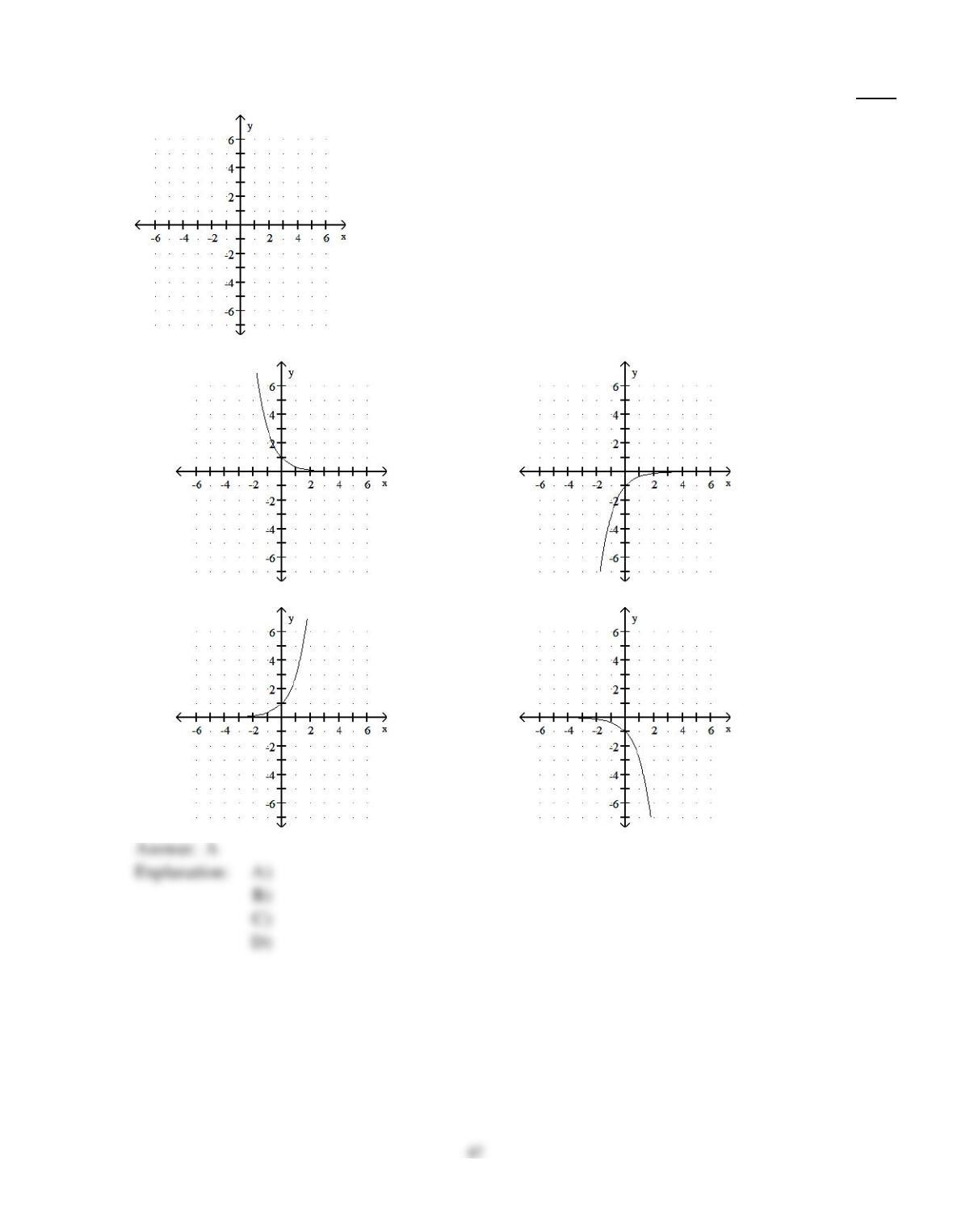
Graph the function.
46
133)
Use the graph of f(x) =3x to obtain the graph of g(x) =3–x.
133)
A)
B)
C)
D)
Find the domain of the logarithmic function. Write your answer in interval notation.
134)
134)
f(x) = log(x – 6)
A)
(–, 0) (0, )
B)
(6, )
C)
(–, 6) (6, )
D)
(–6, )
Use common logarithms or natural logarithms and a calculator to evaluate to four decimal places
135)
135)
log10 8
A)
1.1073
B)
0.9031
C)
1.9031
D)
–0.0969
Evaluate the expression without using a calculator.
136)
5log510
136)
A)
5
B)
15
C)
log510
D)
10
137)
log3
1
27
137)
A)
1
3
B)
9
C)
3
D)
–3
Solve the logarithmic equation. Give an exact answer.
138)
138)
log 4(7x – 3) =log 4(4x + 7)
A)
{4]
B)
4
3
C)
10
3
D)
Solve the exponential equation by taking the logarithm on both sides. Use a calculator to obtain a decimal
approximation, correct to four decimal places, for the solution.
139)
82x =3.7
139)
A)
0.3146
B)
1.2584
C)
0.2359
D)
1.2333
Use properties of logarithms to condense the logarithmic expression. Write the expression as a single logarithm whose
coefficient is 1. Where possible, evaluate logarithmic expressions.
140)
140)
ln x +9 ln y
A)
ln(9xy)
B)
ln(x +9y)
C)
ln(xy9)
D)
ln x
y9
Use properties of logarithms to expand the logarithmic expression as much as possible. Where possible, evaluate
logarithmic expressions without using a calculator.
141)
log2
4y
141)
A)
1
4log2 y
B)
4log2 y
C)
1
2log4 y
D)
1
4log2
4y
Solve the problem.
142)
142)
The formula y = 1 +1.3 ln(x + 1) models the average number of free–throws a basketball player
can make consecutively during practice as a function of time, where x is the number of
consecutive days the basketball player has practiced for two hours. After how many days of
practice can the basketball player make an average of 9 consecutive free throws?
A)
2190 days
B)
2192 days
C)
472 days
D)
470 days
Find the domain of the logarithmic function. Write your answer in interval notation.
143)
f(x) =log4(x – 8)2
143)
A)
(8, )
B)
(–, 8) (8, )
C)
(–, 0) (0, )
D)
(–8, )
Solve the problem.
144)
144)
The first recorded population of a particular country was 21 million, and the population was
recorded as 33 million 15 years later. Write an exponential growth function that describes the
population of this country, in millions, t years after the first recorded population.
A)
A =21e0.040t
B)
A =21e0.166t
C)
A =21e0.030t
D)
A =21e0.436t
145)
145)
Cindy will require $17,000 in 3 years to return to college to get an MBA degree. How much
money should she ask her parents for now so that, if she invests it at 11% compounded
continuously, she will have enough for school? (Round your answer to the nearest dollar.)
A)
$23,646
B)
$12,222
C)
$12,430
D)
$8786
Write the equation in its equivalent logarithmic form.
146)
4x=64
146)
A)
log64x =4
B)
log464 = x
C)
log644= x
D)
logx64 =4
Rewrite the equation in terms of base e. Express the answer in terms of a natural logarithm.
147)
y =10(7.6)x
147)
A)
y =7.6e(ln 10)x
B)
y =7.6 ln e10x
C)
y =10 ln e7.6x
D)
y =10e(ln 7.6)x
Solve the logarithmic equation. Give an exact answer.
148)
148)
log 6(3x + 7) =log 6(3x + 4)
A)
{0}
B)
C)
{3]
D)
11
3
Solve.
149)
The function A =A0e–0.00693x models the amount in pounds of a particular radioactive material
stored in a concrete vault, where x is the number of years since the material was put into the
vault. If 200 pounds of the material are initially put into the vault, how many pounds will be left
after 150 years?
149)
A)
71 lb
B)
150 lb
C)
67 lb
D)
126 lb
Use properties of logarithms to condense the logarithmic expression. Write the expression as a single logarithm whose
coefficient is 1. Where possible, evaluate logarithmic expressions.
150)
150)
3 ln a –9 ln b
A)
ln 3a
9b
B)
ln a3
ln b9
C)
ln a3
b9
D)
ln a
b
12
151)
151)
log63+log62
A)
log66
B)
1log66
C)
log65
D)
1
Write the equation in its equivalent logarithmic form.
152)
23= x
152)
A)
logx2=3
B)
log2x =3
C)
log23= x
D)
log3x =2
Solve the equation.
153)
log16 x =1
4
153)
A)
{2}
B)
1
64
C)
1
2
D)
{4}
Use common logarithms or natural logarithms and a calculator to evaluate to four decimal places
154)
154)
log0.2 18
A)
–0.5568
B)
1.9542
C)
0.5563
D)
–1.7959
Solve the equation.
155)
1960e0.35x=23,520
155)
A)
23,520
0.35 ln 1960
B)
ln 12
0.35
C)
ln 23,520
0.35 ln 1960
D)
ln 12
0.35
Use properties of logarithms to condense the logarithmic expression. Write the expression as a single logarithm whose
coefficient is 1. Where possible, evaluate logarithmic expressions.
156)
156)
9logb y +8logb z
A)
logb(y9z8)
B)
72 logb(yz)
C)
17 logb(yz)
D)
logb(yz)17
Solve the logarithmic equation. Give an exact answer.
157)
157)
log(3x) = log 4+ log(x – 3)
A)
{–12}
B)
1
2
C)
–12
7
D)
{12}
53