58. Which of the following is NOT one of the three key principles of crisis leadership?
a.
Work with your crisis management team.
b.
Play to win and develop a bunker mentality.
c.
Stay engaged and lead from the front.
d.
Focus on the big picture and communicate the vision.
Moderate
p. 436
MGMT.LUSS.16.12-04 – LO: 12–04
United States – BUSPROG: Analytic
AACSB: Analytic – Analytic skills
Conceptual
BLOOMS: Knowledge
59. All of the following are questions that often emerge after a crisis EXCEPT:
a.
What happened?
b.
What are you going to do to ensure it never happens again?
c.
When did it happen?
d.
How did it happen?
c
Moderate
p. 440
MGMT.LUSS.16.12-06 – LO: 12–06
United States – BUSPROG: Analytic
AACSB: Analytic – Analytic skills
Conceptual
BLOOMS: Knowledge
60. A ____ is a printed statement that describes how an organization is responding to a crisis and who is in charge.
a.
press release
b.
benchmark
c.
press kit
d.
bulletin release
a
AACSB: Analytic – Analytic skills
Conceptual
BLOOMS: Knowledge
61. In the event of a crisis, a press kit should include all of the following EXCEPT:
a.
key milestones in the company’s history.
b.
a fact sheet.
c.
a press release related to the current incident.
d.
a copy of financial records showing current earnings.
p. 441
United States – BUSPROG: Analytic
BLOOMS: Knowledge
62. Which of the following is a rule for effective crisis communication?
a.
Provide a plan for how the organization will avoid a repeat in the future.
b.
Assemble all stakeholders together and present the same message.
c.
Keep the crisis leader informed about how the organization is handling the crisis.
d.
Interact with the media only through approved channels.
p. 442, Exhibit 12.3
United States – BUSPROG: Analytic
AACSB: Analytic – Analytic skills
BLOOMS: Knowledge
63. An effective post-crisis evaluation should include all of the following performance indicators EXCEPT:
p. 441
United States – BUSPROG: Analytic
AACSB: Analytic – Analytic skills
BLOOMS: Knowledge
a.
crisis team effectiveness.
b.
learning culture effectiveness.
c.
leadership effectiveness.
d.
effectiveness in dealing with victims and family members.
64. In his book, The Fifth Discipline, Peter Senge makes a compelling case that an organization’s survival is linked to its:
a.
top management.
b.
employees’ dedication.
c.
ability to learn and adapt.
d.
financial resources.
c
Moderate
p. 444
MGMT.LUSS.16.12-07 – LO: 12–07
United States – BUSPROG: Analytic
AACSB: Analytic – Analytic skills
Conceptual
BLOOMS: Knowledge
65. A ____ organization is one that is skilled at creating, acquiring, and transferring knowledge, and at modifying
behavior to reflect new knowledge and insights.
a.
traditional
b.
learning
c.
diverse
d.
dynamic
Easy
p. 444
MGMT.LUSS.16.12-07 – LO: 12–07
United States – BUSPROG: Analytic
Moderate
p. 436
MGMT.LUSS.16.12-04 – LO: 12–04
United States – BUSPROG: Analytic
AACSB: Analytic – Analytic skills
Conceptual
BLOOMS: Knowledge
66. Under which of the following conditions is a learning environment most needed?
a.
A stable environment where change is slow and incremental.
b.
A rapidly changing environment where employee skills and abilities remain unchanged.
c.
An environment with increasing pressure for employees to upgrade their skills and where there are no
guarantees of job security.
d.
In a rapidly changing environment with increasing globalization, competition, and technological shifts.
Moderate
p. 444
MGMT.LUSS.16.12-07 – LO: 12–07
United States – BUSPROG: Analytic
AACSB: Analytic – Analytic skills
Conceptual
BLOOMS: Knowledge
67. Which of the following is an internal source of organizational learning?
a.
Customers.
b.
Competitors.
c.
Academic publications.
d.
Employees.
Easy
p. 445
MGMT.LUSS.16.12-07 – LO: 12–07
United States – BUSPROG: Analytic
AACSB: Analytic – Analytic skills
Conceptual
BLOOMS: Knowledge
68. Which of the following statements concerning organizational knowledge is true?
a.
Organizational knowledge can be easily developed through training sessions.
b.
Organizational knowledge is both tacit and explicit knowledge.
c.
Organizational knowledge could not exist without the sponsorship of top management.
d.
Organizational knowledge has been referred to as discontinuous change.
and abilities
AACSB: Analytic – Analytic skills
Conceptual
BLOOMS: Knowledge
69. Explicit or formal knowledge is:
a.
highly personal.
b.
strongly rooted in action.
c.
the instinct and intuition that an experienced practitioner possesses.
d.
expressed in a system of rules.
Moderate
p. 445
MGMT.LUSS.16.12-07 – LO: 12–07
United States – BUSPROG: Analytic
Conceptual
BLOOMS: Knowledge
70. Tacit knowledge is acquired from
a.
manuals regarding an organization’s culture.
b.
databases acquired from other sources.
c.
intuition based on experience.
d.
genetics.
c
Moderate
p. 445
MGMT.LUSS.16.12-07 – LO: 12–07
United States – BUSPROG: Analytic
AACSB: Analytic – Analytic skills
Conceptual
BLOOMS: Knowledge
71. Which of the following is a characteristic of a traditional organization?
Moderate
p. 445
MGMT.LUSS.16.12-07 – LO: 12–07
United States – BUSPROG: Analytic
AACSB: Analytic – Analytic skills
Conceptual
BLOOMS: Knowledge
a.
Flat and flexible structure.
b.
Changing environment.
c.
Centralized decision making.
d.
Loose, flexible, and adaptive roles.
72. Which of the following is a characteristic of a learning organization?
a.
Strategy is formulated from the top and passed down.
b.
Top-down communication model.
c.
Stable environment.
d.
Changing environment.
p. 447, Exhibit 12.4
United States – BUSPROG: Analytic
AACSB: Analytic – Analytic skills
BLOOMS: Knowledge
73. All of the following are characteristics of traditional organizations EXCEPT:
a.
decentralized decision making.
b.
stable environment.
c.
vertical structure.
d.
rigid culture that is not responsive to change.
p. 447, Exhibit 12.4
United States – BUSPROG: Analytic
p. 447, Exhibit 12.4
United States – BUSPROG: Analytic
AACSB: Analytic – Analytic skills
BLOOMS: Knowledge
74. All of the following are characteristics of learning organizations EXCEPT:
a.
flat and flexible structure.
b.
centralized decision making.
c.
adaptive organizational culture.
d.
strategy is a collaborative effort.
p. 447, Exhibit 12.4
United States – BUSPROG: Analytic
AACSB: Analytic – Analytic skills
BLOOMS: Knowledge
75. Which of the following statements concerning traditional organizations is NOT true?
a.
The traditional organization is rigid and resistant to change.
b.
The vertical structure of traditional organizations are effective when the pace of change is slow.
c.
Network systems facilitate communication and exchange.
d.
Employees of traditional organizations don’t take chances and mistakes are hidden.
p. 447
United States – BUSPROG: Analytic
and abilities
AACSB: Analytic – Analytic skills
BLOOMS: Knowledge
76. In learning organizations:
a.
the horizontal structures are effective under stable environmental conditions.
b.
few strict rules and procedures prescribe how things are done.
c.
rewards are individualized.
d.
the pace of change is slow.
AACSB: Analytic – Analytic skills
BLOOOMS: Knowledge
77. _________ occurs when anticipated or expected changes bear no resemblance to the present or the past.
a.
Organizational knowledge
b.
Benchmarking
c.
Crisis
d.
Discontinuous change
Easy
p. 446
MGMT.LUSS.16.12-08 – LO: 12–08
United States – BUSPROG: Analytic
AACSB: Analytic – Analytic skills
Conceptual
78. Which of the following is NOT one of the guidelines for enhancing organizational learning?
a.
Narrow employees’ scope of reference.
b.
Encourage systems thinking.
c.
Create a shared vision for learning.
d.
Create a climate in where risk taking and failure are tolerated.
a
Easy
p. 449, Exhibit 12.5
MGMT.LUSS.16.12-09 – LO: 12–09
United States – BUSPROG: Analytic
AACSB: Analytic – Analytic skills
Conceptual
BLOOMS: Knowledge
79. Benchmarking:
a.
allows a company to imitate the best practices of others.
b.
is a leader strategy.
p. 447
MGMT.LUSS.16.12-08 – LO: 12–08
United States – BUSPROG: Analytic
AACSB: Analytic – Analytic skills
BLOOMS: Knowledge
c.
yields a comparative advantage.
d.
is not recommended to develop creative thinking skills.
80. The encouragement of systems thinking:
a.
is a task of leaders who seek to enhance organizational learning.
b.
has the best results in traditional organizations.
c.
was a driving force in the 1980s, but has been largely discarded in favor of specialized thinking.
d.
increases efficiency, but appears to deter creativity.
p. 450
United States – BUSPROG: Analytic
AACSB: Analytic – Analytic skills
BLOOMS: Knowledge
81. Which of the following statements concerning an employees’ frame of reference is NOT true?
a.
An employees’ personal frame of reference influences their decision-making.
b.
Exposing employees to different experiences and practices broadens their frame of reference.
c.
Assumptions are only acted on consciously.
d.
A frame of reference influences people’s assumptions.
p. 451
United States – BUSPROG: Analytic
and abilities
AACSB: Analytic – Analytic skills
p. 450
United States – BUSPROG: Analytic
AACSB: Analytic – Analytic skills
BLOOMS: Knowledge
82. Which of the following in NOT a recommendation that leaders can employ to create conditions conducive to learning
and knowledge creation?
a.
Encourage creative thinking.
b.
Build an organizational culture where information flows through as few people as possible.
c.
Provide incentives for learning and innovation.
d.
Encourage systems thinking.
p. 449, Exhibit 12.5
83. Some of the most important inventions or scientific breakthroughs resulted from investigating:
a.
failed outcomes.
b.
venture teams.
c.
frames of reference.
d.
mechanisms that can diffuse knowledge.
p. 450
84. Which of the following statements concerning leaders encouragement of creative thinking is NOT true?
a.
Creative thinking can occur at the individual, group, and organizational level.
b.
People who advocate different ideas are looked on as troublesome.
c.
Flexible structure and adaptive systems can contribute to higher levels of creativity.
d.
Leaders encourage employees to “think outside the box”.
p. 450
85. Explain why crisis leadership competence is an important consideration when hiring new leaders.
86. What are the benefits of having a crisis management plan in advance of a crisis.
87. Briefly describe the three stages of a crisis management plan.
88. Describe the role of top management during a crisis.
89. Describe the five-step process for crisis risk assessment.
90. Describe the importance of effective communication during a crisis.
91. Describe the key characteristics of a learning organization.
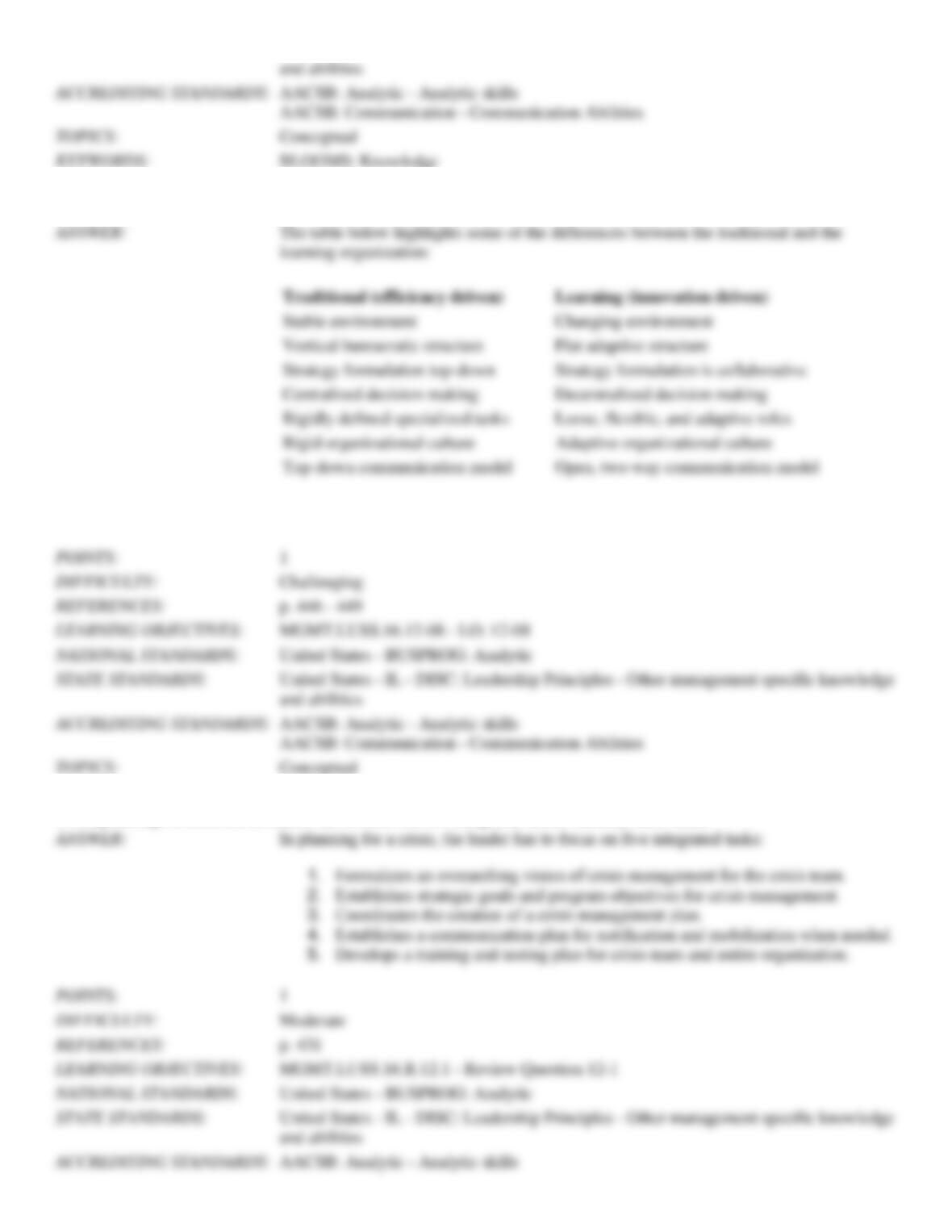
92. Distinguish between the traditional and the learning organization.
93. In planning for a crisis, the leader has to focus on five integrated tasks. Identify these tasks.
94. How has social media affected the way crises are managed in our society today?
95. Describe the significance of having a diversified crisis response team.
96. Pre-crisis planning is about asking and answering three critical questions. What are they?
97. The best indicator of an organization’s readiness to respond to a crisis is how it rates in five areas of assessment. What
are these five areas?
98. Briefly explain what a crisis management plan of action entails.
99. One of the characteristics of a learning organization’s culture is that learning is a multilevel organization-wide
process. What exactly do we mean by this statement?
100. Explain or illustrate how a leader can foster a learning organizational culture by creating a climate where risk taking
and failure are tolerated.
101. What is the difference between a press release and a press kit?