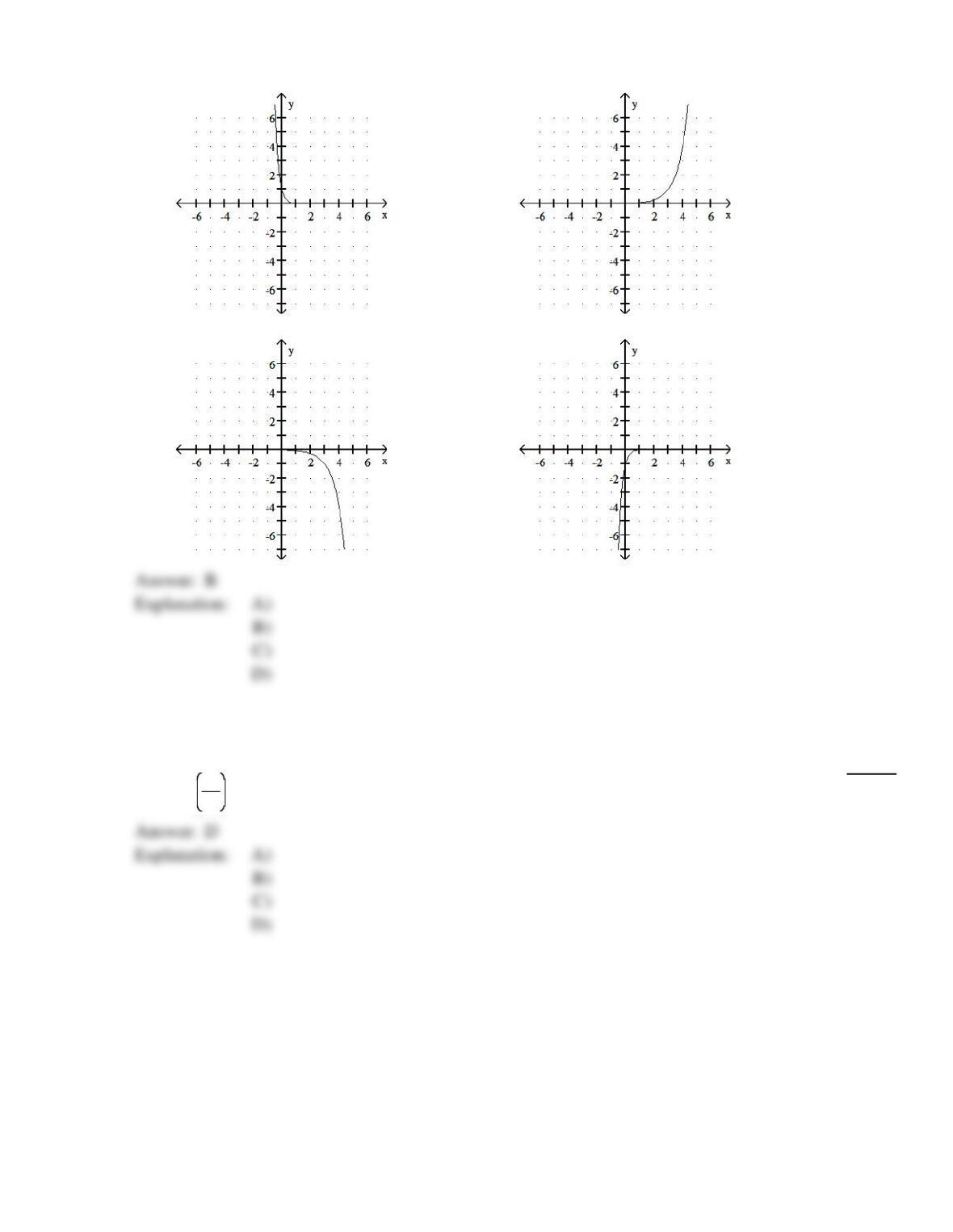
A)
B)
C)
D)
Use properties of logarithms to condense the logarithmic expression. Write the expression as a single logarithm whose
coefficient is 1. Where possible, evaluate logarithmic expressions.
52)
52)
log x + log 15
A)
log x
15
B)
(log x)(log 15)
C)
log(x +15)
D)
log(15x)
21
Solve the problem.
53)
53)
The pH of a solution ranges from 0 to 14. An acid has a pH less than 7. Pure water is neutral and
has a pH of 7. The pH of a solution is given by pH = – log x where x represents the concentration
of the hydrogen ions in the solution in moles per liter. Find the hydrogen ion concentration if the
pH =4.
A)
0.25
B)
1.39
C)
10–4
D)
104
54)
The function D(h) =5e–0.4h can be used to determine the milligrams D of a certain drug in a
patient’s bloodstream h hours after the drug has been given. How many milligrams will be
present after 12 hours? Round the answer to two decimal places.
54)
A)
0.04 mg
B)
607.55 mg
C)
1.62 mg
D)
2.97 mg
Solve the equation.
55)
55)
log5 x +log5(3x –2) = 1
A)
5
3
B)
{–1}
C)
7
4
D)
–1, 5
3
Use properties of logarithms to expand the logarithmic expression as much as possible. Where possible, evaluate
logarithmic expressions without using a calculator.
56)
56)
log4(16x)
A)
2log4 x
B)
2+log4 x
C)
8+log4 x
D)
2x
Provide an appropriate response.
57)
57)
Write in exponential form: log28=3
A)
23=8
B)
28=3
C)
83=2
D)
32=8
Solve the equation by expressing each side as a power of the same base and then equating exponents.
58)
2(1 + 2x) =8
58)
A)
{1}
B)
{2}
C)
{–1}
D)
{4}
Find the domain of the logarithmic function. Write your answer in interval notation.
59)
f(x) =log6(x +7)2
59)
A)
(–
, –7) (–7,
)
B)
(–7,
)
C)
(–
, 0) (0,
)
D)
(7,
)
Evaluate the expression without using a calculator.
60)
log 1
10,000
60)
A)
4
B)
–4
C)
1
10,000
D)
–1
4
61)
ln 8e
61)
A)
1
8
B)
8e
C)
8
D)
e
8
Provide an appropriate response.
62)
Rewrite y =91(0.28)x in terms of base e. Express the answer in terms of a natural logarithm.
62)
A)
y =91e(0.28x)
B)
y =0.28e(ln 91)x
C)
y =91e(ln 0.28)x
D)
y =0.28e(91x)
Solve the exponential equation by taking the logarithm on both sides. Use a calculator to obtain a decimal
approximation, correct to four decimal places, for the solution.
63)
e(x +4) =8
63)
A)
2.4849
B)
–1.8599
C)
–1.9206
D)
–1.5151
Solve the exponential equation by taking the logarithm on both sides. Express the solution set in terms of logarithms.
64)
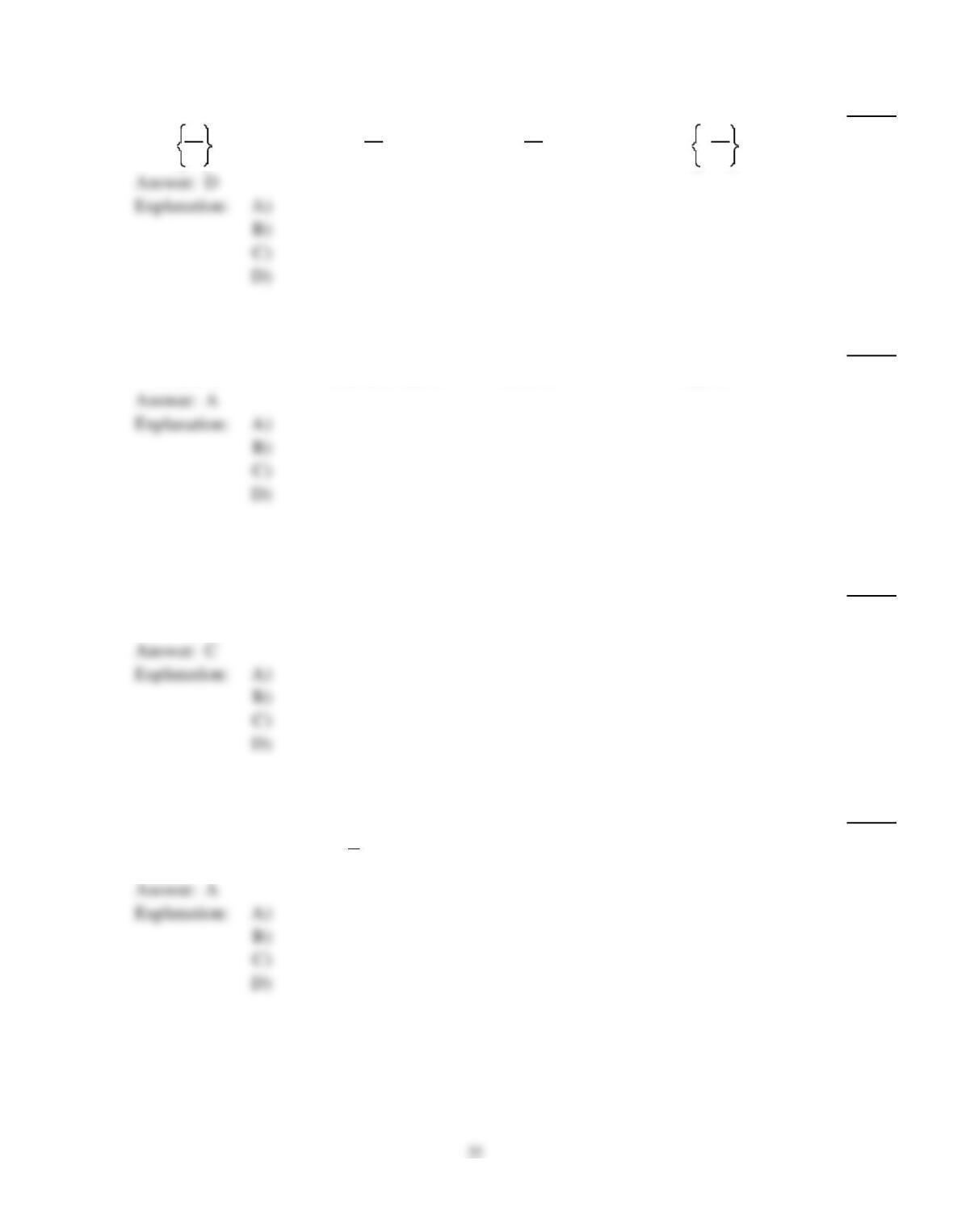
49x =3.2
64)
A)
3.2 log 9
log 4
B)
log 3.2
4 log 9
C)
log 3.2
9 log 4
D)
9 log 3.2
log 4
Solve the equation.
65)
65)
log2(x + 3) = – 3
A)
25
8
B)
{–23
9}
C)
{25
9}
D)
–23
8
Find the domain of the logarithmic function. Write your answer in interval notation.
66)
66)
f(x) =log3(x +2)
A)
(–2,
)
B)
(–
, 0) (0,
)
C)
(3,
)
D)
(2,
)
Use properties of logarithms to expand the logarithmic expression as much as possible. Where possible, evaluate
logarithmic expressions without using a calculator.
67)
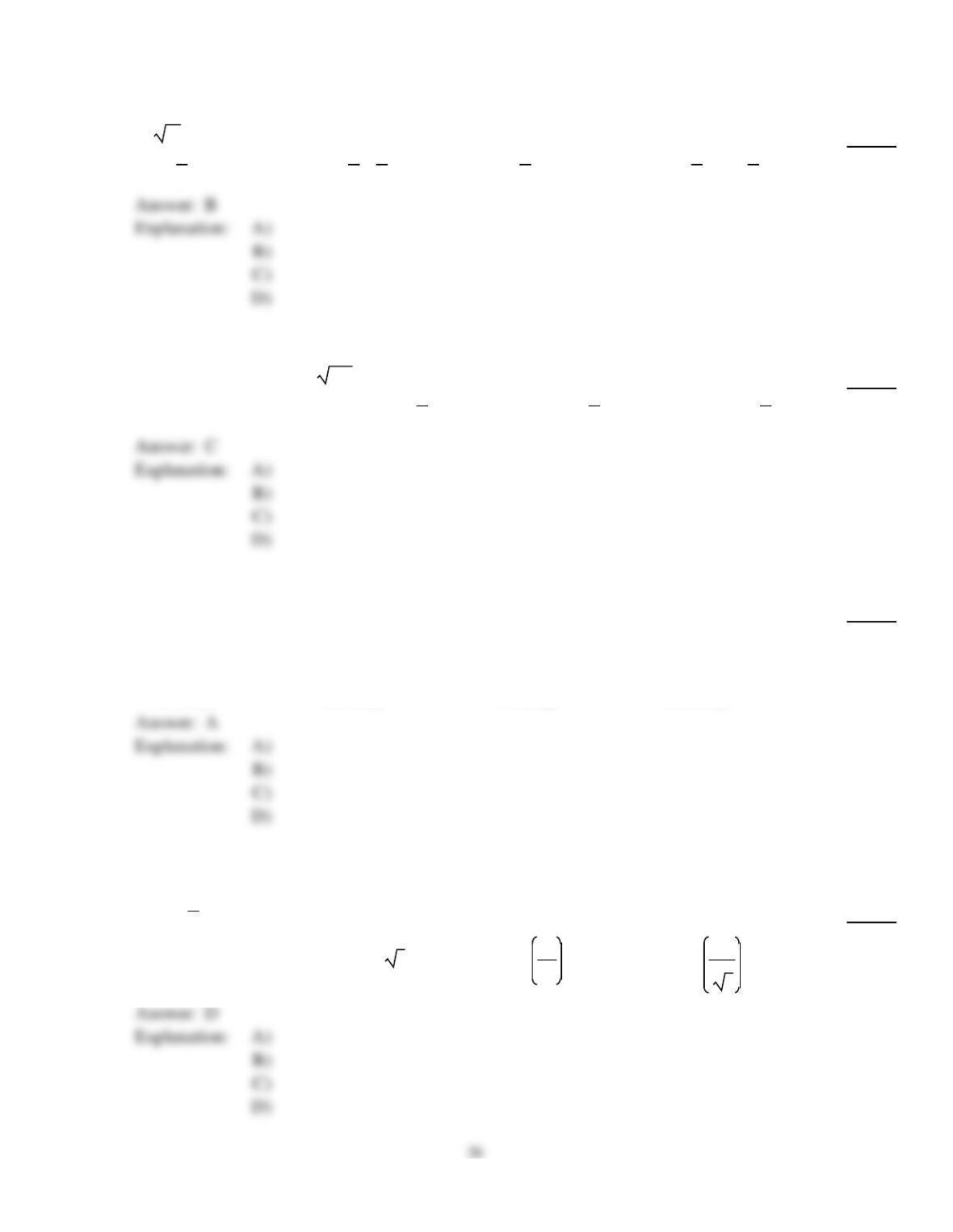
log7x8
67)
A)
7log8 x
B)
7 log x
C)
8log7 x
D)
8log7x8
Evaluate the expression without using a calculator.
68)
68)
log525
A)
2
B)
1
2
C)
10
D)
1
Use properties of logarithms to expand the logarithmic expression as much as possible. Where possible, evaluate
logarithmic expressions without using a calculator.
69)
ln 3ex
69)
A)
1
3+ ln x
B)
1
3+1
3 ln x
C)
1
3 ln(ex)
D)
1
3 ln e +1
3 ln x
Provide an appropriate response.
70)
Write in logarithmic form: 3125 =5
70)
A)
log5125 =3
B)
log1253=1
5
C)
log1255=1
3
D)
log5125 =1
3
Solve the problem.
71)
The function A =A0e–0.0099x models the amount in pounds of a particular radioactive material
stored in a concrete vault, where x is the number of years since the material was put into the
vault. If 900 pounds of the material are placed in the vault, how much time will need to pass for
only 334 pounds to remain?
71)
A)
100 yr
B)
105 yr
C)
200 yr
D)
110 yr
Use properties of logarithms to condense the logarithmic expression. Write the expression as a single logarithm whose
coefficient is 1. Where possible, evaluate logarithmic expressions.
72)
2 ln x –1
4 ln y
72)
A)
ln(x2y4)
B)
ln(x24y)
C)
ln x2
y4
D)
ln x2
4y
Write the equation in its equivalent logarithmic form.
73)
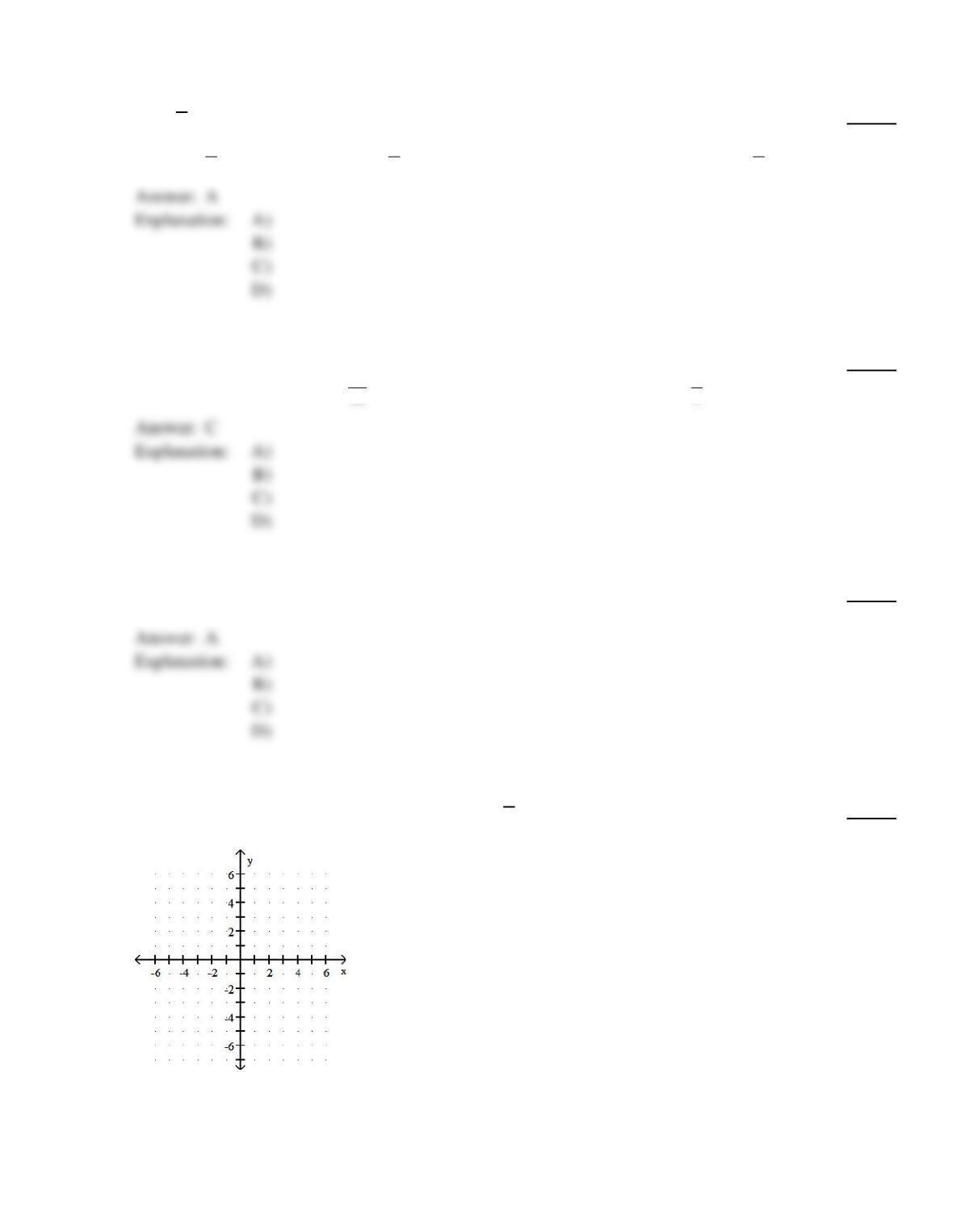
2–2=1
4
73)
A)
log2
1
4= – 2
B)
log– 2
1
4=2
C)
log1/22= – 2
D)
log2–2=1
4
Evaluate the expression without using a calculator.
74)
74)
log 1000
A)
30
B)
3
10
C)
3
D)
1
3
Find the domain of the logarithmic function. Write your answer in interval notation.
75)
75)
f(x) = ln (4– x)
A)
(–
, 4)
B)
(–4,
)
C)
(–
, 0)
D)
(–
, 4) (4,
)
Graph the function.
76)
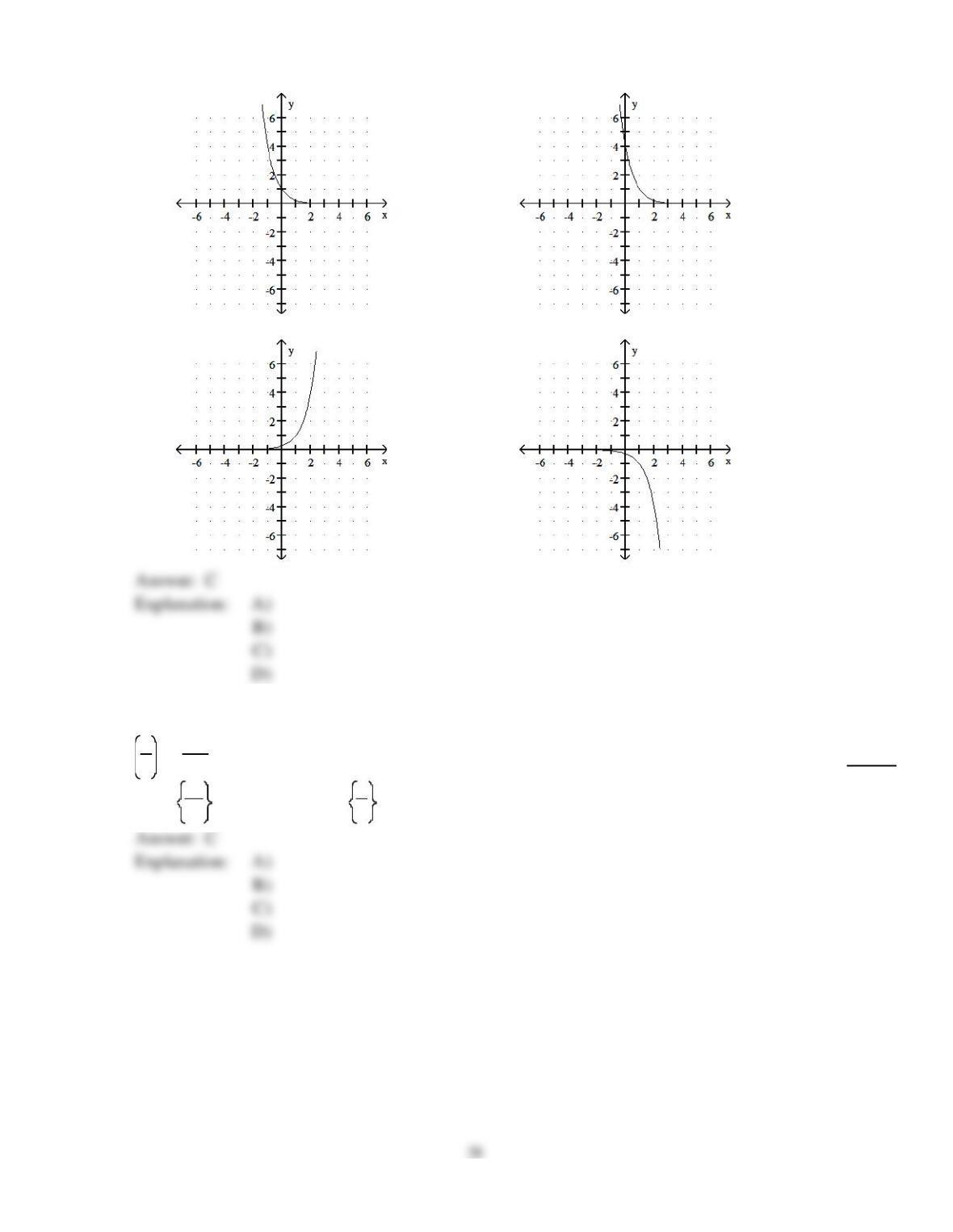
Use the graph of f(x) =4x to obtain the graph of g(x) =1
4·4x.
76)
27
A)
B)
C)
D)
Solve the equation by expressing each side as a power of the same base and then equating exponents.
77)
1
4
x
=1
256
77)
A)
1
64
B)
1
4
C)
{4}
D)
{–4}
Approximate the number using a calculator. Round the answer to three decimal places.
78)
63
78)
A)
10.392
B)
22.274
C)
108.000
D)
27.000
Solve the problem.
79)
79)
The pH of a solution ranges from 0 to 14. An acid has a pH less than 7. Pure water is neutral and
has a pH of 7. The pH of a solution is given by pH = – log x where x represents the concentration
of the hydrogen ions in the solution in moles per liter. Find the hydrogen ion concentration if the
pH =3.4.
A)
2.51 × 10⁻⁴
B)
2.51 × 10⁻³
C)
3.98 × 10⁻³
D)
3.98 × 10⁻⁴
Solve the logarithmic equation. Give an exact answer.
80)
80)
log 2x =5
A)
{32}
B)
ln 5
ln 2
C)
{10}
D)
{25}
Provide an appropriate response.
81)
81)
Find the domain: f(x) =log3(x –8).
A)
(–3,
)
B)
(3,
)
C)
(8,
)
D)
(–8,
)
Write the equation in its equivalent exponential form.
82)
82)
log464 =3
A)
464 =3
B)
43=64
C)
643=4
D)
34=64
D)
Graph the function.
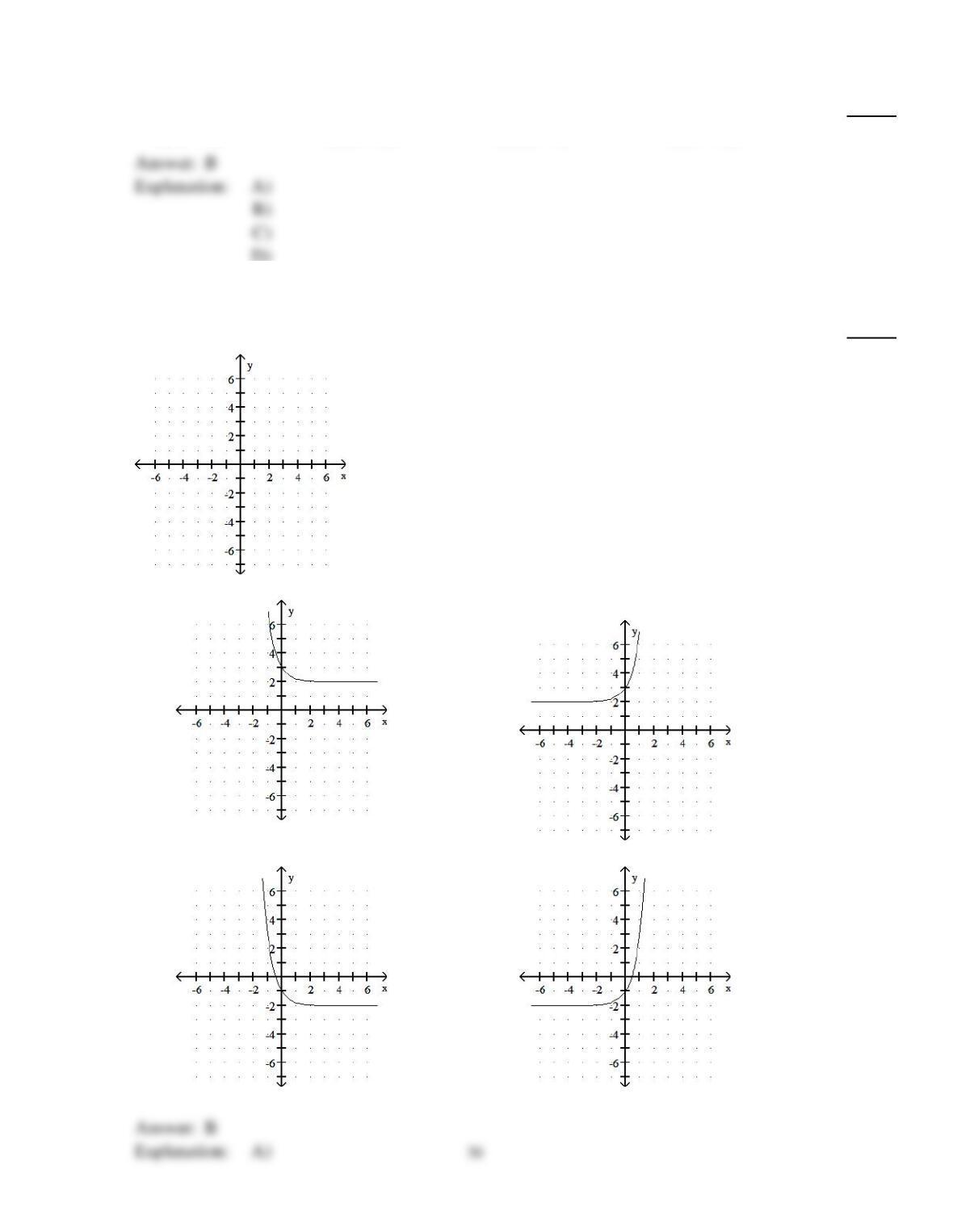
83)
Use the graph of f(x) =5x to obtain the graph of g(x) =5x+ 2.
83)
A)
B)
C)
D)
A)
A)
Solve the logarithmic equation. Give an exact answer.
84)
84)
log85+log8 x = 1
A)
{58}
B)
1
5
C)
5
8
D)
8
5
Solve the equation.
85)
5x=3.41
85)
A)
{ln 3.41 – ln 5}
B)
ln 3.41
ln 5
C)
3.41
ln 5
D)
{ln 3.41}
Solve.
86)
86)
The first recorded population of a particular country was 26 million, and the population was
recorded as 34 million 10 years later. The exponential growth function A =26ekt describes the
population of this country t years since the first recording. Use the fact that 10 years later the
population increased by 8 million to find k to three decimal places.
A)
0.037
B)
0.208
C)
0.678
D)
0.027
Solve the problem.
87)
87)
Larry has $1700 to invest and needs $2300 in 17 years. What annual rate of return is required for
him to accomplish his goal, if interest is compounded continuously? (Round your answer to two
decimals.). Use the formula A = Pert.
A)
3.33%
B)
2.33%
C)
1.78%
D)
1.33%
88)
88)
Larry has $2800 to invest and needs $3300 in 18 years. What annual rate of return will he need to
get in order to accomplish his goal, if interest is compounded continuously? (Round your answer
to two decimals.)
A)
0.91%
B)
2.3%
C)
1.3%
D)
3.3%
Use properties of logarithms to condense the logarithmic expression. Write the expression as a single logarithm whose
coefficient is 1. Where possible, evaluate logarithmic expressions.
89)
89)
4 log x +6 log y
A)
10 log(xy)
B)
log(xy)10
C)
log(x4y6)
D)
24 log(xy)
Approximate the number using a calculator. Round the answer to three decimal places.
90)
5–1.6
90)
A)
0.076
B)
–10.486
C)
–8.000
D)
0.376
Solve the equation by expressing each side as a power of the same base and then equating exponents.
91)
3–x=81
91)
A)
1
4
B)
1
27
C)
{4}
D)
{–4}
Solve.
92)
92)
The population of a certain country is growing at a rate of 2.6% per year. How long will it take for
this country’s population to double? Use the formula t =ln 2
k, which gives the time, t, for a
population with growth rate k, to double. Round to the nearest year.
A)
29 yr
B)
26 yr
C)
28 yr
D)
27 yr
Use properties of logarithms to condense the logarithmic expression. Write the expression as a single logarithm whose
coefficient is 1. Where possible, evaluate logarithmic expressions.
93)
1
2log9 x +log9 y
93)
A)
log9
x
y
B)
log9xy
C)
log9
x
y
D)
log9(y x)
94)
94)
log6(x – 3) –log6(x + 1)
A)
log6–4
B)
log6
x – 3
x – 1
C)
log6
x – 3
x + 1
D)
log6(x2– 2x – 3)
33
Solve the equation.
95)
95)
2 ln(5x) =6
A)
e3
5
B)
{e3/5}
C)
3
ln 5
D)
{e3}
Evaluate the expression without using a calculator.
96)
log10 10
96)
A)
1
10
B)
1
2
C)
10
D)
1
Use the compound interest formulas A = P 1 +r
n
nt and A = Pert to solve.
97)
97)
Find the accumulated value of an investment of $1080 at 6.5% compounded annually for 7 years.
A)
$1575.87
B)
$1571.40
C)
$1501.20
D)
$1678.31
Solve.
98)
The formula S = A (1 + r)t + 1 – 1
r models the value of a retirement account, where A = the
number of dollars added to the retirement account each year, r = the annual interest rate, and
S = the value of the retirement account after t years. If the interest rate is 11%, how much will the
account be worth after 15 years if $200 is added each year? Round to the nearest whole number.
98)
A)
$7838
B)
$3200
C)
$15,311
D)
$1053
34
Solve the exponential equation by taking the logarithm on both sides. Express the solution set in terms of logarithms.
99)
e(x +4) =6
99)
A)
{e6+4}
B)
{ln 6–4}
C)
{e24}
D)
{ln 10}
Use common logarithms or natural logarithms and a calculator to evaluate to four decimal places
100)
100)
log17 48.1
A)
2.9126
B)
1.3671
C)
0.7315
D)
0.4517
Evaluate the expression without using a calculator.
101)
101)
log255
A)
1
B)
10
C)
2
D)
1
2
Use properties of logarithms to expand the logarithmic expression as much as possible. Where possible, evaluate
logarithmic expressions without using a calculator.
102)
log
3x
100
102)
A)
1
3 log x +2
B)
–20x
C)
100x
D)
1
3 log x –2
Evaluate the expression without using a calculator.
103)
103)
log121
A)
1
B)
1
12
C)
0
D)
12
Solve the problem.
104)
104)
The growth in the mouse population at a certain county dump can be modeled by the exponential
function A(t)=224e0.019t, where t is the number of months since the population was first
recorded. Estimate the population after 28 months.
A)
228 mice
B)
389 mice
C)
191 mice
D)
381 mice
105)
105)
How long, to the nearest tenth of a year, will it take for a $2600 investment to double if it is
invested at 6% compounded monthly?Use the formula A = P 1 +r
n
nt.
A)
11.4 yr
B)
11.8 yr
C)
11.6 yr
D)
12 yr
Use the compound interest formulas A = P 1 +r
n
nt and A = Pert to solve.
106)
106)
Find the accumulated value of an investment of $20,000 at 5.75% compounded annually for 7
years.
A)
$27,971.27
B)
$28,050.00
C)
$26,900.00
D)
$29,579.62
Solve the exponential equation by taking the logarithm on both sides. Use a calculator to obtain a decimal
approximation, correct to four decimal places, for the solution.
107)
e2x =6
107)
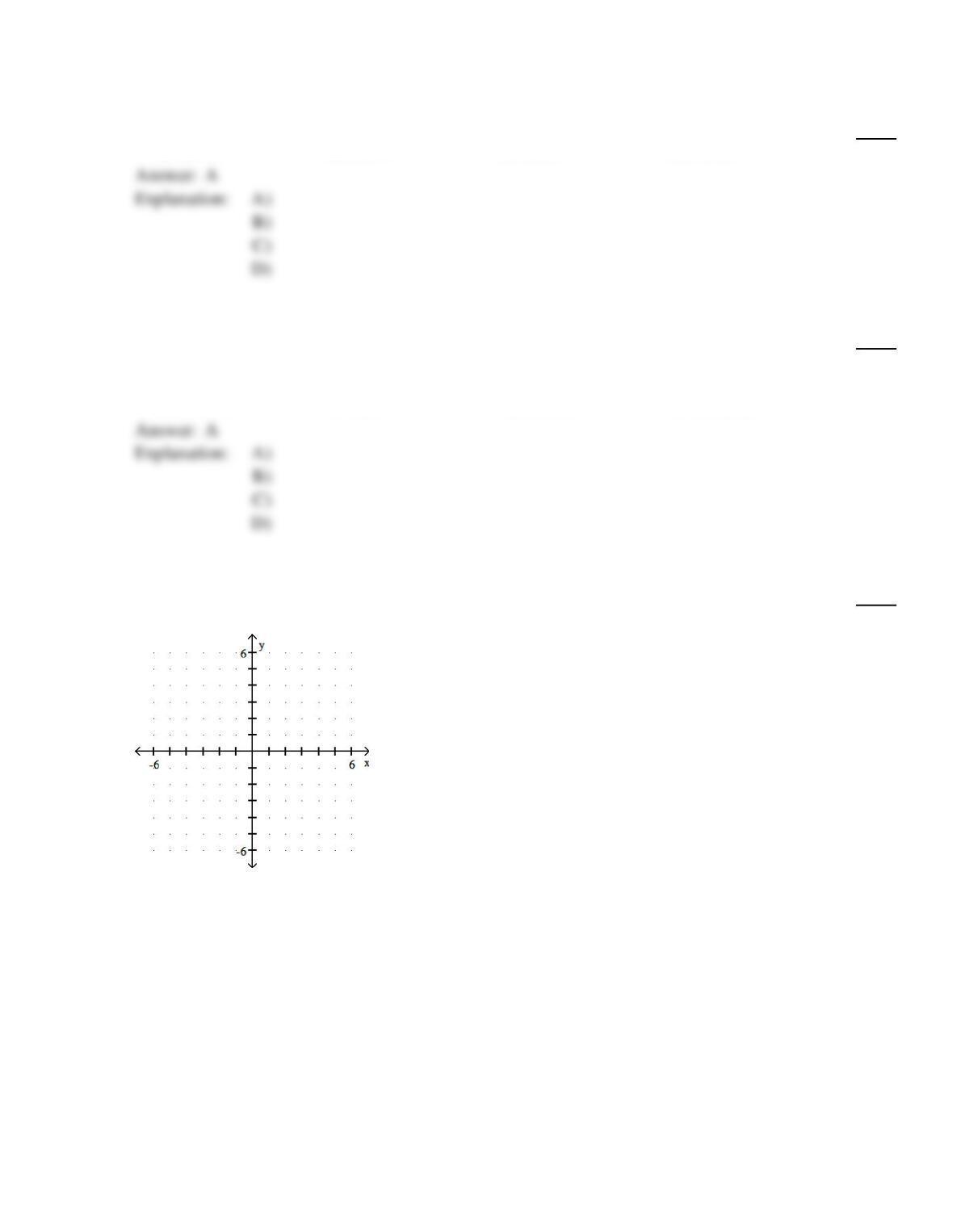
A)
0.8959
B)
0.1155
C)
3.5835
D)
8.1548
Solve.
108)
108)
A city has been growing at a rate of 0.5% annually. If there are currently 4,457,000 residents in the
city, how many (to the nearest ten–thousand) would be living in this city six years from now?
Use the function f(x) =4,457,000(2.7)0.005t.
A)
4,590,000
B)
360,000
C)
4,620,000
D)
12,030,000
Provide an appropriate response.
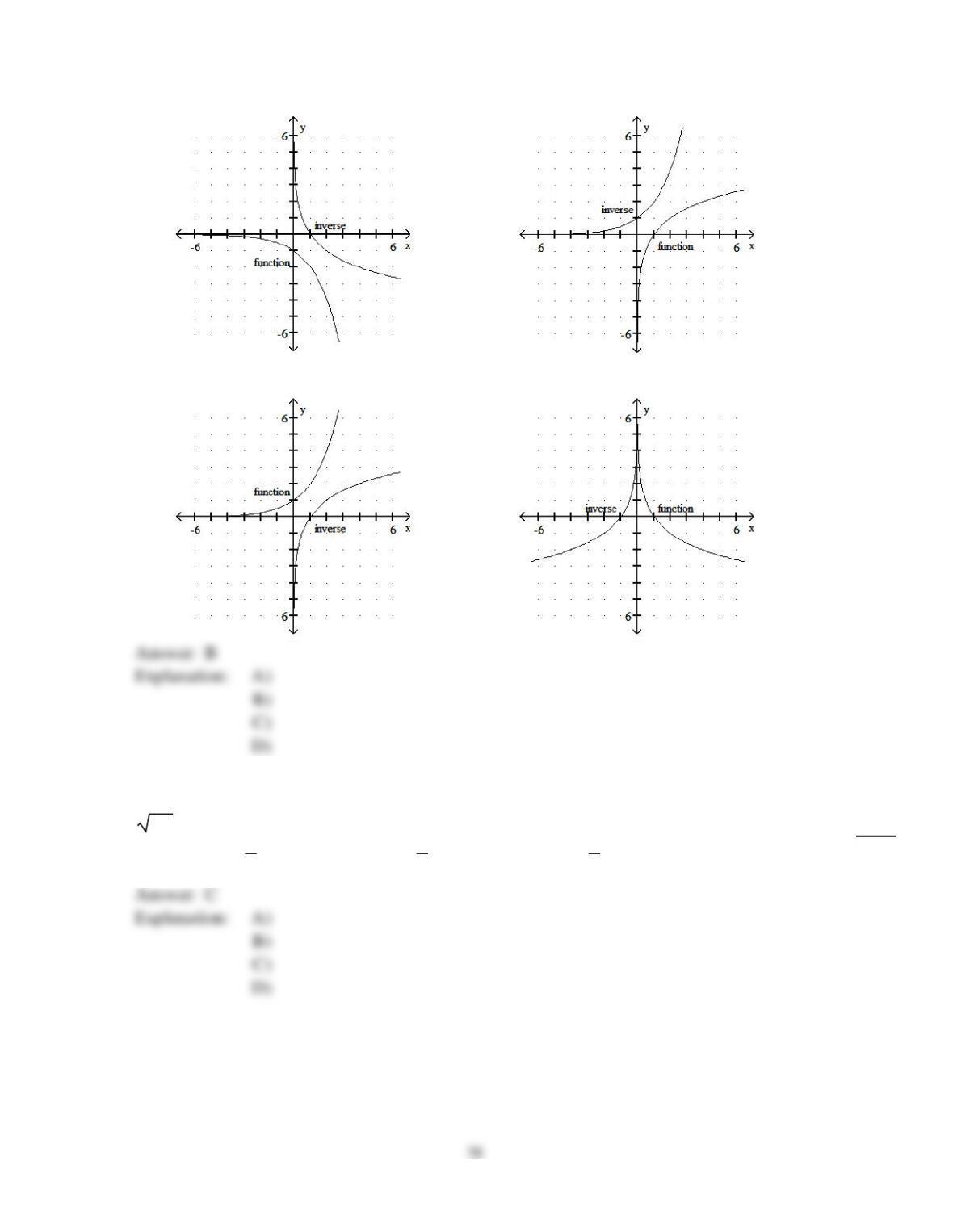
109)
Graph f(x) =2x and g(x) =log 2x in the same rectangular coordinate system. Use the graphs to
determine each function‘s domain and range.
109)
37
A)
Domain of f: (0,
), Range of f: ( ,
)
Domain of g: ( ,
), Range of g: (0,
)
B)
Domain of f: ( ,
), Range of f: (0,
)
Domain of g: (0,
), Range of g: ( ,
)
C)
Domain of f: (0,
), Range of f: ( ,
)
Domain of g: ( ,
), Range of g: (0,
)
D)
Domain of f: ( ,
), Range of f: (0,
)
Domain of g: (0,
), Range of g: ( ,
)
Write the equation in its equivalent logarithmic form.
110)
3125 =5
110)
A)
log1253=1
5
B)
log5125 =1
3
C)
log1255=1
3
D)
log5125 =3
111)
42= y
111)
A)
logy2=4
B)
logy4=2
C)
log4y =2
D)
log2y =4
Solve the problem.
112)
112)
Find out how long it takes a $2800 investment to double if it is invested at 9% compounded
semiannually. Round to the nearest tenth of a year. Use the formula A = P 1 +r
n
nt.
A)
7.7 yr
B)
8.1 yr
C)
7.9 yr
D)
8.3 yr
Write the equation in its equivalent exponential form.
113)
113)
3=logb216
A)
216b=3
B)
3b=216
C)
2163= b
D)
b3=216
Graph the function.
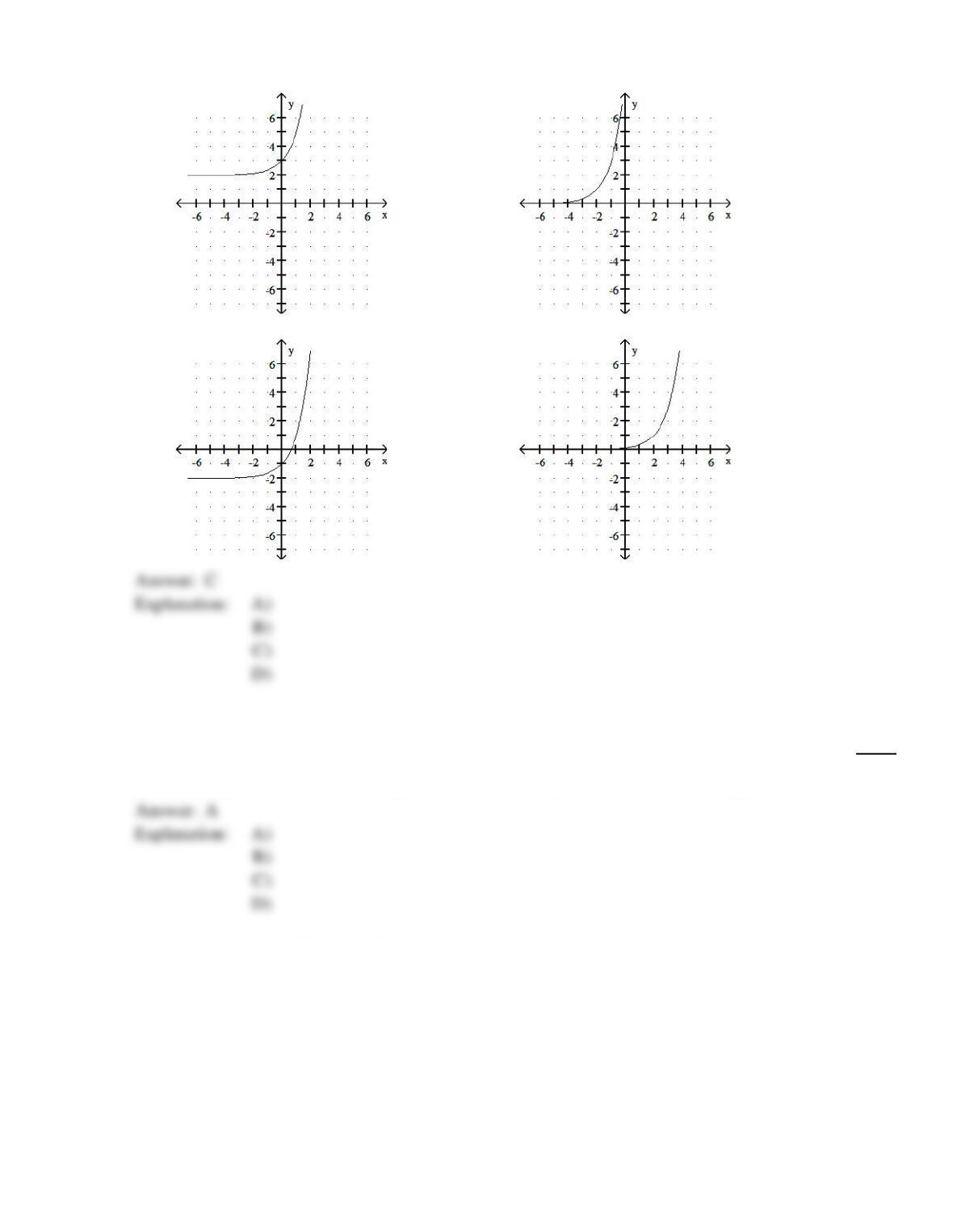
114)
Use the graph of f(x) =3x to obtain the graph of g(x) =3x–2.
114)
39
A)
B)
C)
D)
Solve.
115)
115)
A fossilized leaf contains 26% of its normal amount of carbon 14. How old is the fossil? Use 5600
years as the half–life of carbon 14 and round to the nearest year.
A)
10,863 yr
B)
34,710 yr
C)
2428 yr
D)
26,275 yr
Graph the function by making a table of coordinates.
40