ch12.doc Page 1
Chapter 12
Not-for-Profit Organizations
TRUE/FALSE (CHAPTER 12)
1. FASB Statement No. 117 directs that revenues and expenses be reported in a
statement of financial position.
2. In the statement of activities, FASB Statement No. 117 requires revenues to be
reported as increases in one of the three categories of net assets, depending on
donor-imposed restrictions; however, all expenses should be reported as decreases
in unrestricted net assets.
3. Restricted contributions may be reported as unrestricted if the restriction has been
met in the same period as the contribution is made.
4. FASB Statement No. 95 requires not-for-profits to use the direct method in their
statements of cash flows.
5. In accounting for investments, not-for-profits, like businesses, must report their
investments at fair value and classify the investments as trading, or available-for-
sale, or held-to-maturity.
6. FASB Statement No. 93 makes the recognition of depreciation on plant and
equipment assets optional at the discretion of the not-for-profit.
7. Temporarily restricted funds related to plant and equipment generally account only
for resources restricted to their purchase or construction, not for the plant and
equipment itself, which are typically reported in the unrestricted fund.
8. All not-for-profit organizations, including city-owned museums and two-year
community colleges, must adhere to FASB accounting and financial reporting
standards.
9. FASB standards require not-for-profit organizations to classify their resources into
three categories: unrestricted, temporarily restricted, and permanently restricted.
10. Expenses should be classified as unrestricted or temporarily restricted, consistent
with the classification of the resources used to finance them.
11. Unlike governments, not-for-profits should not recognize contributions of art
collections as revenue unless they capitalize them.
12. Not-for-profits generally should not recognize as revenues contributions that they
have agreed to pass along to other specific beneficiaries.
13. The primary source of authoritative accounting and financial reporting guidance for a
private college is the AICPA.
ch12.doc Page 2
14. Whether a not-for-profit’s resources are classified as restricted or unrestricted
depends on the presence or absence of donor stipulations.
15. Traditional financial ratios, such as measures of liquidity and debt burden, are
seldom useful for assessing the fiscal health of not-for-profits.
ch12.doc Page 3
MULTIPLE CHOICE (CHAPTER 12)
1. The basis of accounting used by not-for-profit organizations in their external
financial reports is
a) Industry-specific basis of accounting.
b) Cash basis of accounting.
c) Modified accrual basis of accounting.
d) Accrual basis of accounting.
2. The FASB requires the balance sheets of not-for-profits to display
a) Net assets in four separate categories—unrestricted, temporarily restricted,
permanently restricted, and restricted by creditors.
b) Three separate funds—unrestricted, temporarily restricted, and permanently
restricted net assets.
c) Six totals—total assets, total liabilities, total net assets, total unrestricted net
assets, total temporarily restricted net assets, and total permanently restricted
net assets.
d) Unrestricted, temporarily restricted, and permanently restricted retained
earnings.
3. The FASB requires external financial reports to provide information about
a) Donor-imposed restrictions on resources.
b) All restrictions on resources.
c) Donor and creditor restrictions on resources.
d) None of the above.
4. Expenses incurred by not-for-profit organizations should be reported as
a) Decreases in one of the three categories of net assets.
b) Decreases in unrestricted net assets.
c) Decreases in temporarily restricted net assets.
d) Decreases in permanently restricted net assets.
5. Revenues of a not-for-profit organization should be reported as
a) Increases in one of the three categories of net assets.
b) Increases in unrestricted net assets.
c) Increases in temporarily restricted net assets.
d) Increases in permanently restricted net assets.
6. Restricted gifts to not-for-profit organizations
a) Must always be shown as an increase in restricted net assets.
b) Must always be shown as an increase in unrestricted net assets.
c) May be shown as an increase in unrestricted net assets if the restriction is met
in the same period.
d) May be shown as an increase in unrestricted net assets at the discretion of
management.
7. The account titled “Resources released from restriction” is reported by a “restricted fund” as a
a) Revenue account.
b) Contra-revenue account.
c) Expense account.
d) Contra-expense account.
ch12.doc Page 4
8. The account titled “Resources released from restriction” is reported by an “unrestricted fund”
as a
a) Revenue account.
b) Contra-revenue account.
c) Expense account.
d) Contra-expense account.
9. The FASB requires that all not-for-profit organizations report expenses
a) By object.
b) By function.
c) By natural classification.
d) By budget code.
10. The National Association for the Preservation of Wildlife received $10,000 from a benefactor
to support the overall objective of the organization. This amount will be recognized as
revenue
a) In the period received.
b) In the period spent.
c) Never, because it is not earned.
d) In the period it becomes susceptible to accrual.
11. Not-for-profit organizations report their cash flows in which of the following categories?
a) Operating, noncapital financing, capital financing, investing.
b) Operating, noncapital financing, investing.
c) Operating, capital financing, investing.
d) Operating, financing, investing.
12. Not-for-profit organizations should report contributions restricted for long-term purposes in
which of the following cash flows categories?
a) Operating
b) Financing.
c) Capital financing.
d) Investing.
13. Not-for-profit organizations should report interest and dividends earned and restricted for
long-term purposes in which of the following cash flows categories?
a) Operating
b) Financing.
c) Capital financing.
d) Investing.
14. Which of the following characteristics most clearly distinguishes an exchange transaction
from a contribution?
a) A contribution is always in cash.
b) An exchange transaction is a reciprocal transfer of resources.
c) An exchange transaction is a nonreciprocal transfer of assets.
d) Contributions of assets always have restrictions attached as to their use.
ch12.doc Page 5
15. Revenue from an exchange transaction may be classified as an increase in which class of net
assets?
a) Unrestricted net assets.
b) Temporarily restricted net assets.
c) Permanently restricted net assets.
d) Any of the above.
16. During the annual fund-raising drive, the Cancer Society raised $900,000 in pledges of
financial support for general operations. By fiscal year-end, the society had collected
$600,000 of the pledges. The society estimates that 10% of the remaining pledges will be
uncollectible. The NET amount of revenue the society should recognize during the current
year from this pledge drive is
a) $900,000.
b) $870,000.
c) $810,000.
d) $600,000.
Use the following information to answer Questions 17 through 20.
United Charities’ annual fund-raising drive in 2013 raised pledges of $1,200,000 of which
$800,000 were collected in 2013 and $200,000 were collected in 2014. United Charities
estimates $150,000 of the remaining pledges will never be collected.
17. The increase in unrestricted net assets in 2013 as a result of the fund-raising drive is
a) $1,200,000.
b) $1,050,000.
c) $800,000.
d) $250,000.
18. The increase in temporarily restricted net assets in 2013 as a result of the fund-raising drive is
a) $1,200,000.
b) $1,050,000.
c) $800,000.
d) $250,000.
19. In 2014, the change in temporarily restricted net assets is
a) $0
b) $200,000 decrease.
c) $200,000 increase.
d) $1,000,000 decrease.
20. In 2014, the change in unrestricted net assets is
a) $0
b) $200,000 increase.
c) $200,000 decrease.
d) $1,000,000 increase.
ch12.doc Page 6
21. In a prior year, United Charities received a $125,000 gift to be used to acquire vans
to provide transportation for physically challenged adults. During the current year,
United acquired two vans at a cost of $75,000 each. The appropriate entry(ies) to
record the acquisition is
a) UNRESTRICTED FUND
Resources released from restriction $125,000
Cash $125,000
RESTRICTED FUND
Fixed assets $150,000
Cash $ 25,000
Resources released from restriction $125,000
b) RESTRICTED FUND
Resources released from restriction $ 125,000
Cash $125,000
UNRESTRICTED FUND
Fixed assets $150,000
Resources released from restriction $125,000
Cash $ 25,000
c) UNRESTRICTED FUND
Fixed assets $150,000
Cash $150,000
d) RESTRICTED FUND
Fixed assets $150,000
Cash $150,000
22. In the current year National Pet Charities, which uses fund-type accounting to
maintain its books and records, received a $30,000 contribution to help educate
people on responsible pet ownership. During the current year, the entry to record
this donation is
a) UNRESTRICTED FUND. No entry.
RESTRICTED FUND. Debit Cash $30,000; Credit Revenues $30,000.
b) UNRESTRICTED FUND. No entry.
RESTRICTED FUND. Debit Cash $30,000; Credit Net assets $30,000.
c) UNRESTICTED FUND. Debit Cash $30,000; Credit Revenues $30,000.
RESTRICTED FUND. No entry.
d) UNRESTRICTED FUND. Debit Cash $30,000; Credit Net assets $30,000.
RESTRICTED FUND. No entry.
23. In the current year a not-for-profit entity received a contribution of $100,000 to use
for scholarships. The entity had budgeted $400,000 for scholarships in the current
year and it disbursed $350,000 for scholarships. The amount the entity can consider
as ‘released from restriction’ in the current year is
a) $0.
b) $100,000.
c) $350,000.
d) $400,000.
ch12.doc Page 7
24. Grace Church, a not-for-profit entity, operates a school in connection with the
church. This year members of the church decided to construct a new wing on the
school with six classrooms. The church hired an architect and a construction
supervisor. The bulk of the labor for construction was donated by church members
who were willing workers but not necessarily skilled carpenters. Materials for the
construction cost $600,000 and the paid labor was $200,000. The fair value of the
completed building is $2 million. When the building is completed what should be the
balance in the asset account “Building” and the account “Contributed revenue”?
a) Building $800,000; Contributed Revenue $0.
b) Building $800,000; Contributed Revenue $1,200,000.
c) Building $2 million; Contributed Revenue $1,200,000.
d) Building $2 million; Contributed Revenue $0.
25. St. Mary’s Extended Care Center, a not-for-profit entity, enjoys the services of a
group of high-school-age people who each agree to work three afternoons a week
for three hours each afternoon performing a variety of patient-related services, such
as writing letters for those who are unable to do so, delivering mail to the patient
rooms, and pushing wheel-chair patients across the grounds. The services rendered
by these young people enhance the quality of life for the residents. They could not
be provided if they were not donated because there are not enough resources to do
so. The past year the young people donated 5,000 hours in total. The services
would have cost $6.00 per hour if they had been purchased but they were worth $10
an hour to St. Mary’s. What is the amount of contributed revenue that should be
recognized by St. Mary’s related to these services?
a) $50,000.
b) $30,000
c) $0.
d) Cannot determine.
26. Simplex Games, a not-for-profit entity organized to provide athletic competition
opportunities for high school students, utilizes a number of volunteers in carrying out
its mission. At the 2014 Games 50 volunteers provided a total of 1,000 hours of service
performing tasks such as picking up litter and delivering water to the athletes. A local CPA
firm donates its services to prepare the annual tax return and other federal and state required
paperwork which must be filed to maintain its status as a tax-exempt organization. During
2014 the CPA firm provided 50 hours of service. If purchased, the CPA services would have
cost $60 per hour and the game workers would have cost $6 per hour. How much contributed
service revenue should Simplex Games recognize in 2014?
a) $9,000.
b) $6,000.
c) $3,000.
d) $0.
27. A not-for-profit art museum that has elected not to capitalize its art collection
receives a donation of a rare piece of Tlinket Indian art. The donor paid $8,000 for
the piece several years ago. Today the piece has an estimated fair value of
$50,000. What entry should the art museum make upon receipt of this donation?
a) Debit Collection items $50,000; Credit Donated revenue $50,000.
b) Debit Collection items $8,000; Credit Donated revenue $8,000.
c) Debit Collection items $50,000; Credit Unrestricted net assets $50,000.
d) No entry required.
ch12.doc Page 8
28. Nelson County Historical museum, a not-for-profit entity that capitalizes its collection
items, received a gift of several Civil War artifacts to be used for display and
research. The donor found these items while cleaning out the closet of an old house.
The fair value is hard to estimate but a dealer in these types of artifacts estimates
their value at $2,000. The entry to record this donation is
a) Debit Collection expense, $2,000; Credit Contributions revenue $2,000.
b) Debit Collection items $2,000; Credit Contributions revenue $2,000.
c) No entry is required because the cost to the donor was $0.
d) No entry required because the value of the items is estimated.
29. Native Art Museum, a not-for-profit entity that elects not to capitalize its collection
items, purchased for $10,000 a wonderful totem pole for display near the door of the
museum. As a result of this transaction, which of the following entries should be
made?
a) Debit Collection items $10,000; Credit Cash $10,000.
b) Debit Collection expense $10,000; Credit Cash $10,000.
c) Debit Unrestricted net assets $10,000; Credit Cash $10,000.
d) No entry is required.
30. Open Air Conservatory, a not-for-profit entity, held a fund-raising drive to raise
money to buy land to provide a habitat for the endangered Sleepy Eagle. A donor
pledged $1 million to the project provided that Open Air Conservatory was able to
raise an additional $1.5 million from other sources. What entry should Open Air
Conservatory make at the time of the $1 million pledge?
a) Debit Pledge receivable $1 million; Credit Unrestricted revenue $1 million.
b) Debit Pledges receivable $1 million; Credit Temporarily restricted revenue $1
million.
c) Debit Pledges receivable $1 million; Credit Temporarily restricted net assets $1
million.
d) No entry is made at the time of the pledge.
31. When should a not-for-profit entity recognize pledge revenue that is contingent upon
raising a matching amount?
a) When the pledge is made.
b) When the cash is received.
c) When the matching funds have been raised.
d) When the project is completed.
32. A donor pledges $100,000 to the Shakespeare Foundation to be used only to
support the summer Shakespeare Theater—an event that has been held every
summer for 38 years. This is an example of a
a) Conditional Contribution.
b) Unconditional contribution.
c) Restricted contribution.
d) Unrestricted contribution.
33. United Charities accepted a contribution from a donor and agreed to transfer the
assets to Aid for Friends, a not-for-profit that provides temporary shelter to the
homeless. United Charities should debit cash or other assets and credit
ch12.doc Page 9
a) Unrestricted revenue.
b) Temporarily restricted revenue.
c) Liability to Aid for Friends.
d) United Charities should not make an entry.
ch12.doc Page 10
34. Music Lovers Foundation, a not-for-profit governed by an independent board, was
founded to support the Northern State University Choir until such time as the state
legislature adequately funds the choir. When the choir is adequately funded by
appropriation, the Foundation may direct resources to other music projects that it
deems acceptable. When Music Lovers accepts a contribution from a donor it
should debit cash and/or other assets and credit
a) Unrestricted revenue.
b) Temporarily restricted revenue.
c) Liability.
d) It should not make an entry.
35. The Save the Animals Foundation received a gift of $500,000 from a donor who
wanted the gift used to acquire habitat for endangered snails. The money may be
invested but all earnings are restricted to habitat acquisition. During the year the
entire gift was invested in corporate securities. At year-end, the securities had a
value of $501,000. The appropriate way to recognize the change in fair value is
a) Debit Investments $1,000; Credit Unrestricted revenue $1,000.
b) Debit Investments $1,000; Credit Temporarily restricted revenue $1,000.
c) Debit Investments $1,000; Credit Permanently restricted revenue $1,000.
d) No entry should be made until the securities are sold.
36. During the year, a not-for-profit entity received $30,000 in dividends and $24,000 in
interest on its investment portfolio. The entity also accrued $6,000 in interest on the
portfolio. The increase in fair value of the portfolio during the year was $8,000. How
much should the entity report as investment earnings during the year?
a) $62,000.
b) $54,000.
c) $8,000.
d) $0.
37. The Friends of the Library (FOL), a not-for-profit entity, received a gift restricted to
the acquisition of a special piece of equipment used to restore books. Late last year
FOL acquired the machine at a total cost of $19,000. The machine is estimated to
have a useful life of eight years and a salvage value of $3,000. In what fund should
FOL make the entry to record the depreciation for the current year?
a) Unrestricted fund.
b) Temporarily restricted fund.
c) Permanently restricted fund.
d) FOL should not recognize depreciation.
38. Which of the following entities should recognize depreciation expense on its
operating statement?
a) Not-for-profit university.
b) Not-for-profit foundation.
c) Not-for-profit hospital.
d) All of the above.
ch12.doc Page 11
39. A not-for-profit would include which of the following financial statements in its basic
financial statements?
a) Statement of financial position and statement of activities.
b) Statement of financial position, statement of activities, and statement of cash
flows.
c) Statement of financial position, statement of activities, statement of cash flows,
and statement of functional expenses.
d) Statement of financial position, statement of activities, and statement of
functional expenses.
Use the following information to answer Questions 40 and 41.
In Year 1, the Expert Gardeners Group receives a $60,000 grant to promote its “Grow–
Ur–Own” green vegetables program among Desert City residents. In Year 2, the group
spends the grant funds for the stipulated purpose.
40. How should receipt of the grant be recorded?
a) Debit Cash; Credit Revenue from contributions (unrestricted fund)
b) Debit Cash; Credit Revenue from contributions (temporarily restricted fund)
c) Debit Cash; Credit Revenue from contributions (permanently restricted fund)
d) No entry required until the grant funds are spent.
41. How should expenditure of the funds be recorded?
a) Debit program expense; Credit Cash (unrestricted fund).
b) Debit Net assets released from restriction; Credit Cash (temporarily restricted
fund).
c) Debit Program expense; Credit Net assets released from restriction (unrestricted
fund).
d) Both b) and c).
42. According to AICPA guidance, a not-for-profit organization (X) is required to
consolidate a related not-for-profit organization (Y) in its financial statements when
a) The relationship results from a merger of X and Y.
b) X has a controlling financial interest in Y through direct or indirect ownership of a
majority voting interest.
c) X can control Y through a contract or affiliation agreement, even though X does
not have a majority ownership or voting interest.
d) Any of the above.
43. The Midwest Circulatory Diseases Society placed an advertisement in prominent
publications in the region. The advertisement provided information about symptoms
of the diseases and offered practical advice for controlling their immediate effects.
The society’s accountants estimate that about 75 percent of the advertising copy was
devoted to information about the disease and the remainder was an appeal for funds.
The advertisement cost $20,000. Using the physical units method of separating joint
costs, how much of the cost of the advertisement should be reported as program
costs?
a) $20,000.
b) $15,000.
c) $10,000.
d) $5,000.
ch12.doc Page 12
44. “Net assets released from restriction” for a not-for-profit organization is comparable
to which of the following for a government?
a) Other financing sources (uses)—Nonreciprocal transfer
b) Expenditures
c) Expenses
d) Unassigned fund balance
45. In a not-for-profit organization, wages and salaries should be recorded
a) As expenses in either a temporarily restricted or an unrestricted fund, depending
on the source of the resources.
b) As expenses in a temporarily restricted fund.
c) As expenses in an unrestricted fund.
d) As expenses in an unrestricted fund, with a credit to net assets released from
restrictions.
PROBLEMS (CHAPTER 12)
1. United Charities, a not-for-profit entity, supports activities for lower-income families.
They have regularly engaged in activities such as providing transportation for
physically challenged individuals, shelters for the temporarily homeless, group meals
for the homeless, and shelters for abused women and children. Record the following
transactions. Your entries should clearly indicate the fund in which the entry is made
or the class of net assets to which the entry will be closed. If no entry is required,
write “No entry required.”
a. United Charities engaged in a fund-raising campaign that resulted in pledges of
$600,000 to support activities of the current year. During the year, United
collected $450,000 on these pledges.
b. A local citizen pledged $50,000 to purchase and equip a van to provide
transportation for physically challenged individuals. This citizen has donated
regularly and there is no reason to believe that this pledge will not be collectible.
c. In prior years, an advocacy group for abused women donated $10,000 to be
used to furnish a “safe–house” for abused women and children. During the
current year renovation of the safe house was completed and furniture was
acquired at a total cost of $25,000.
d. A wealthy benefactor pledged to give $100,000 to United if United successfully
raises a matching amount in a capital asset fund-raising drive being conducted
over a 12-month period.
e. Cash of $60,000 is received from a donor who specifies that the money must be
spent to provide educational activities for children who will be living in the “safe-
house.” It will be next year before the “safe–house” has its first residents.
f. A local attorney has agreed to provide legal services to United on a pro bono
basis. During the current period the attorney provided services for which she
would have billed $1,500.
ch12.doc Page 13
g. Several older housewives provide services at the United Charities group meal
facility. The women work in the kitchen serving meals and cleaning up the
kitchen. If these services were not donated United would have to purchase
them. The cost of the services at the prevailing wage rate for similar employees
would be $50,000 for the current year.
h. Fixed assets belonging to United Charities had an original cost of $370,000, an
estimated salvage value of $70,000, and an estimated useful life of 20 years.
Record depreciation if applicable.
i. Cash of $90,000 is received from a donor who specifies that $30,000 is for use
by United Charities and $60,000 is to be used by Zimbabwe Charities, United’s
sister organization in Africa.
ch12.doc Page 14
2. The Heritage Art Museum, a not-for-profit entity specializing in art items created
by natives of the Pacific Northwest, has a December 31 fiscal year-end. The
museum has a policy of NOT capitalizing collection items. Your entries should
clearly indicate the fund in which the entry is made or to which class of net assets
the account would be closed. If no entry is required, write “No entry required.”
a. During the current year the museum received admissions fees of $500,000 in
cash.
b. Citizens of the local community are encouraged to participate in a program
called “Friends of the Museum.” For a yearly contribution of $25 per family, a
family is entitled to free admission to the museum during the calendar year.
A “friend of the museum” also receives a monthly one-page newsletter
announcing upcoming events. At year-end, there were 1,000 members in
“Friends of the Museum.”
c. During the current year the museum incurred salaries expense of $1 million
of which $40,000 remains unpaid at year-end.
d. During the year the museum incurred operating expenses of $450,000 of
which $30,000 remains unpaid at year-end. Of the $450,000, $50,000 was
used to buy supplies and $20,000 of supplies remain on hand at year-end.
e. Office equipment owned by the museum has a historical cost of $140,000
and a salvage value of $20,000 and is being depreciated over 8 years on the
straight-line basis.
f. During the year the museum conducted a fund-raising drive to raise money to
acquire new art items for the museum. The museum received pledges of
$200,000 of which the museum had collected $160,000 by year-end and
expected to ultimately collect another $20,000.
g. The museum had a small portfolio of investments in equity securities.. At the
beginning of the year the portfolio had a fair value of $60,000. During the
year the Museum collected $3,000 in dividends on the securities. At year-
end the portfolio had a market value of $62,000.
h. During the year a citizen died and willed his wonderful collection of native art
to the museum. The appraised value of the collection was $600,000.
i. To balance its collection, the museum sold two of its collection items for
$250,000, which approximates fair value. These items had a historical cost
to the museum of $10,000.
j. The proceeds of the sale and additional cash were used to acquire two new
items at a cost of $310,000.
ch12.doc Page 15
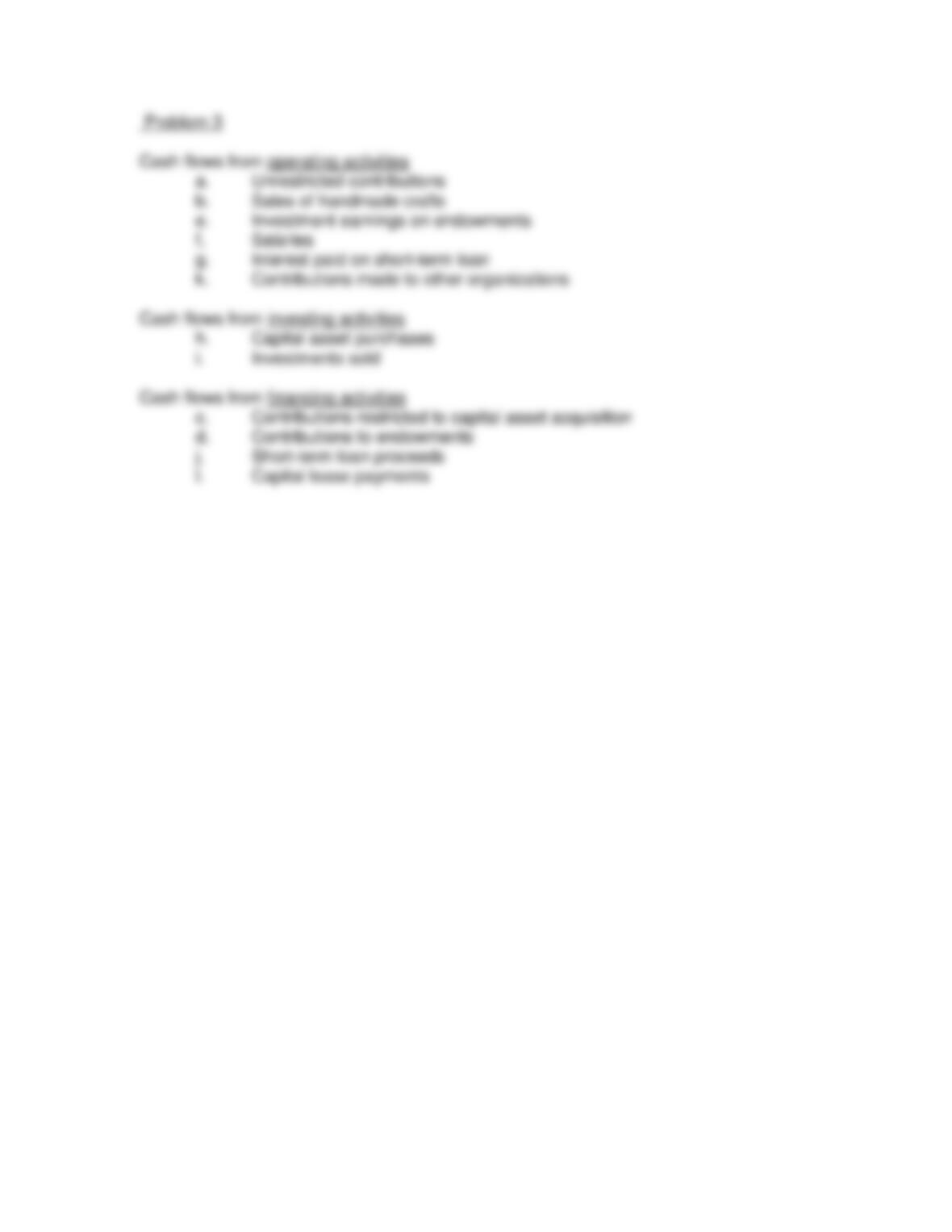
3. Save the Children Foundation had the following types of cash receipts and
disbursements during its current fiscal year. Indicate in which categories each of
these flows would be reported in the foundation’s statement of cash flows.
a. Unrestricted contributions
b. Sales of handmade crafts
c. Contributions restricted to capital asset acquisition
d. Contributions to endowments
e. Investment earnings on endowments, not required to be added to the
endowment
f. Salaries
g. Interest paid on short-term loan
h. Capital asset purchases
i. Investments sold
j. Short-term loan proceeds
k. Contributions made to other organizations
l. Capital lease payments.
ch12.doc Page 16
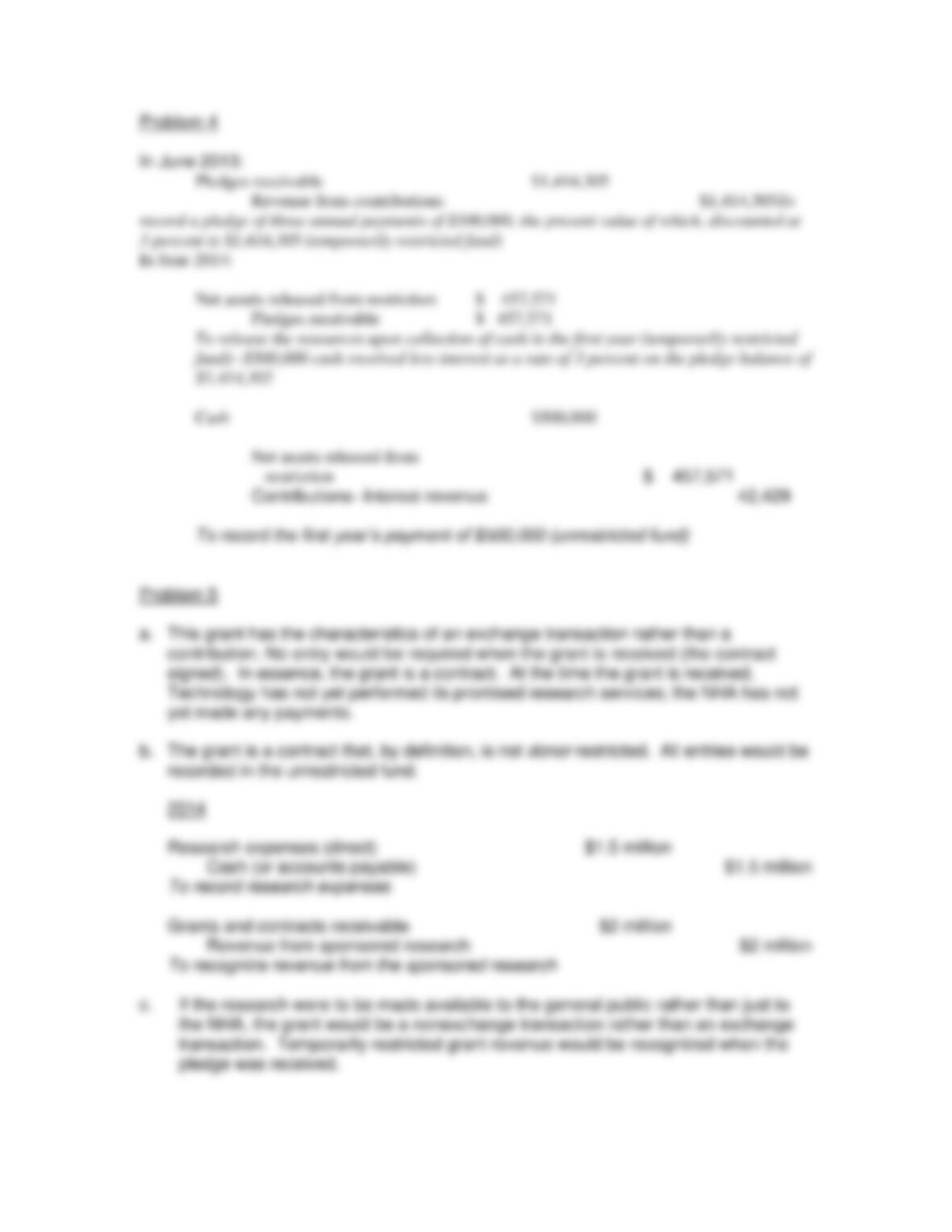
4. In June 2013, the wealthy parents of a college sophomore pledge to donate $1.5 million to
the college she attends, making payments of $0.5 million at the end of each of her remaining
years at the school until her expected graduation in 2016. The college applies a discount rate
of 3 percent. At that rate, the present value of $1 for three periods is $2.82861. What entry,
if any, would be required to recognize the pledge? What entry(ies), if any, would be required
to record the receipt of the first $0.5 million at the end of year 2013? Assume that the college
uses separate funds to track restricted resources and indicate in which fund each entry is
made.
5. In December 2013, Technology University received a $2 million grant from the
National Hockey Association to develop an effective neck brace to prevent injuries in its non-
goalie hockey players. The NHA grant was intended to cover $1.5 million of direct costs and
$0.5 million of overhead costs. The grant stipulated that the NHA would be the sole
beneficiary of the research. Technology carried out the research in 2014. As anticipated,
direct costs were $1.5 million.
REQUIRED:
a. What accounting entries, if any, should Technology make when notified of the
grant?
b. What accounting entries, if any, should Technology make in 2014? (Be sure to
indicate in which funds the entries would be recorded.)
c. Would your answer be different if the research were made available to the
general public and not just the NHA? Explain.
d. Would your answer be different if the NHA indicated it would not make any
payments on the research until Technology delivered the final research product?
ch12.doc Page 17
ESSAYS (CHAPTER 12)
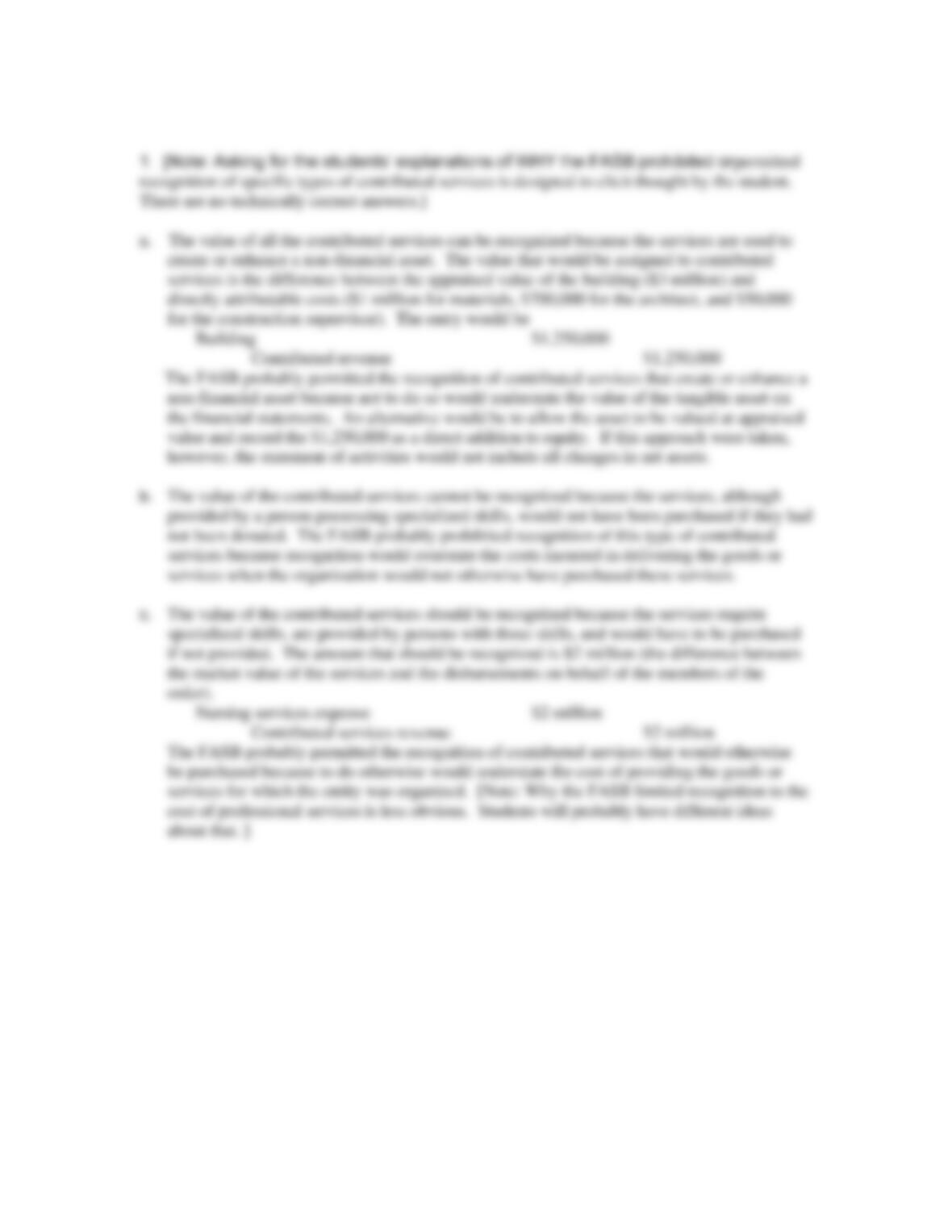
1. For each of the cases below, state whether the contributed services would be recognized and,
if so, how much would be recognized and how it would be recognized. Explain your answer
in terms of the existing standards. Also explain why, in your opinion, the standards permit or
prohibit recognition of this particular type of contribution.
a. A church votes to construct a new educational wing on its existing facility. The church
will hire an architect to design the new wing and a construction supervisor to oversee the
construction. Church members will provide most of the labor for the construction.
Labor donated by members who have construction experience or who are considered
professional craftsmen at the prevailing wage for their trade or craft is $500,000. Labor
donated by persons possessing non-building specialized skills (doctors, teachers, lawyers,
etc.) at their prevailing wage rates is $700,000. Labor donated by non-professionals
measured at the minimum wage is $300,000. The appraised value of the building when
completed is $3 million. The architect was paid $700,000, the construction supervisor
was paid $50,000 and the materials purchased for use in the building cost $1 million.
b. An investment advisor, a member of the board of No Fleas Please, a not-for-profit animal
care organization, provides pro bono investment advice to NFP. NFP does not have a
particularly large investment portfolio and, without the advice of the board member, NFP
probably would invest its idle cash in certificates of deposit at an insured commercial
bank to protect itself against loss of principal. If the investment advisor had provided
similar services to his customers he would have charged $2,000.
c. Members of a religious order provide professional nursing services for a healthcare
facility that is run by their order. The members are not compensated but their order
provides lodging, food, and other necessities, the cost of which is paid by the healthcare
entity and classified as nursing services expense. At the end of the year the balance in the
nursing services expense account is $3 million. The value of the nursing services
provided, measured at the prevailing wage for nurses, is $5 million.
2. A generous benefactor pledges $1 million to The R. J. Smith Foundation, a not-for-profit
entity that promotes the arts. The gift is to be used to provide scholarships for talented
musicians at a music camp operated by the Foundation. The gift was given in August 2013 to
support the Summer 2014 music program. The foundation director argues that the gift is a
conditional restricted gift and therefore cannot be recognized as revenue in 2013. The
accountant argues that the gift is an unconditional restricted gift and must be recognized in
the current year. What is the basis for the director’s argument? What is the basis for the
accountant’s argument? In your answer provide an explanation of the terms conditional,
unconditional, restricted and unrestricted.
3. Per FASB standards, not-for-profits must classify their net assets into three classes. What is
the basis for distinguishing the three classes? What is the rationale for this basis? How is
each class defined?
4. What is a charitable remainder trust? How should it be accounted for?

ch12.doc Page 18
ANSWERS TO TRUE/FALSE (CHAPTER 12)

ch12.doc Page 19
ANSWERS TO MULTIPLE CHOICE (CHAPTER 12)
ch12.doc Page 20
ANSWERS TO PROBLEMS (CHAPTER 12)
ch12.doc Page 21
ch12.doc Page 22
ch12.doc Page 23
ch12.doc Page 24
ch12.doc Page 25
ch12.doc Page 26
ch12.doc Page 27
ESSAY ANSWERS (CHAPTER 12)
ch12.doc Page 28

ch12.doc Page 29