
Use the following information to answer the question(s) below.
Consider the following information regarding corporate bonds:
Rating AAA AA A BBB BB B CCC
Average Default Rate 0.0% 0.1% 0.2% 0.5% 2.2% 5.5% 12.2%
Recession Default Rate 0.0% 1.0% 3.0% 3.0% 8.0% 16.0% 48.0%
Average Beta 0.05 0.05 0.05 0.10 0.17 0.26 0.31
8) Galt Industries has a market capitalization of $50 billion, $30 billion in BBB rated debt, and
$8 billion in cash. If Galt’s equity beta is 1.15, then Galt’s underlying asset beta is closest to:
A) 0.83
B) 0.92
C) 1.00
D) 1.15
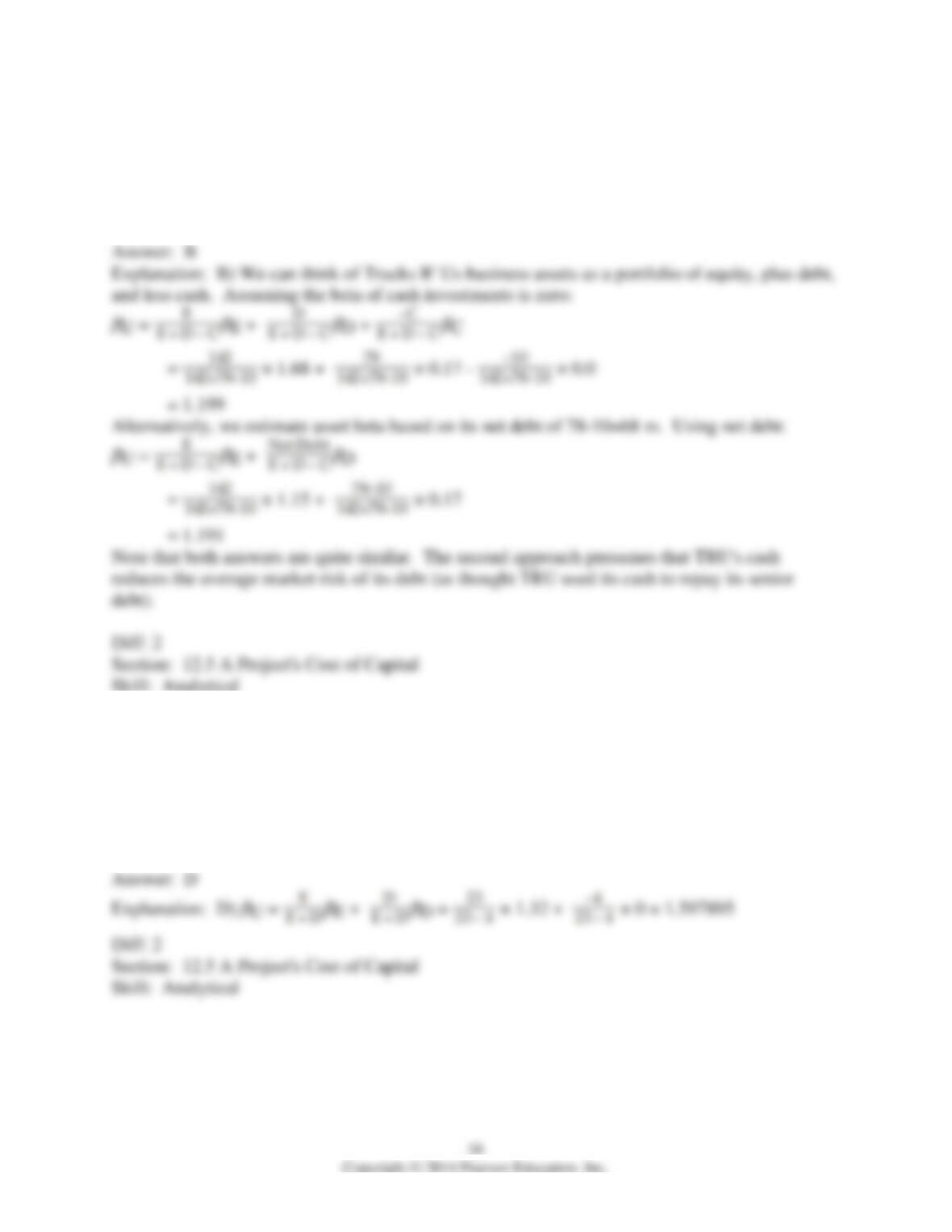
9) Trucks R’ Us has a market capitalization of $142 billion, $78 billion in BB rated debt, and $10
billion in cash. If Trucks R’ Us’ equity beta is 1.68, then their underlying asset beta is closest to:
A) 1.00
B) 1.20
C) 1.32
D) 1.48
10) Luther Industries has a market capitalization of $23 billion, no debt, and $4 billion in cash.
If Luther’s estimated equity beta is 1.32, then the beta of Luther’s underlying business enterprise
is closest to:
A) 1.09
B) 1.32
C) 1.48
D) 1.60
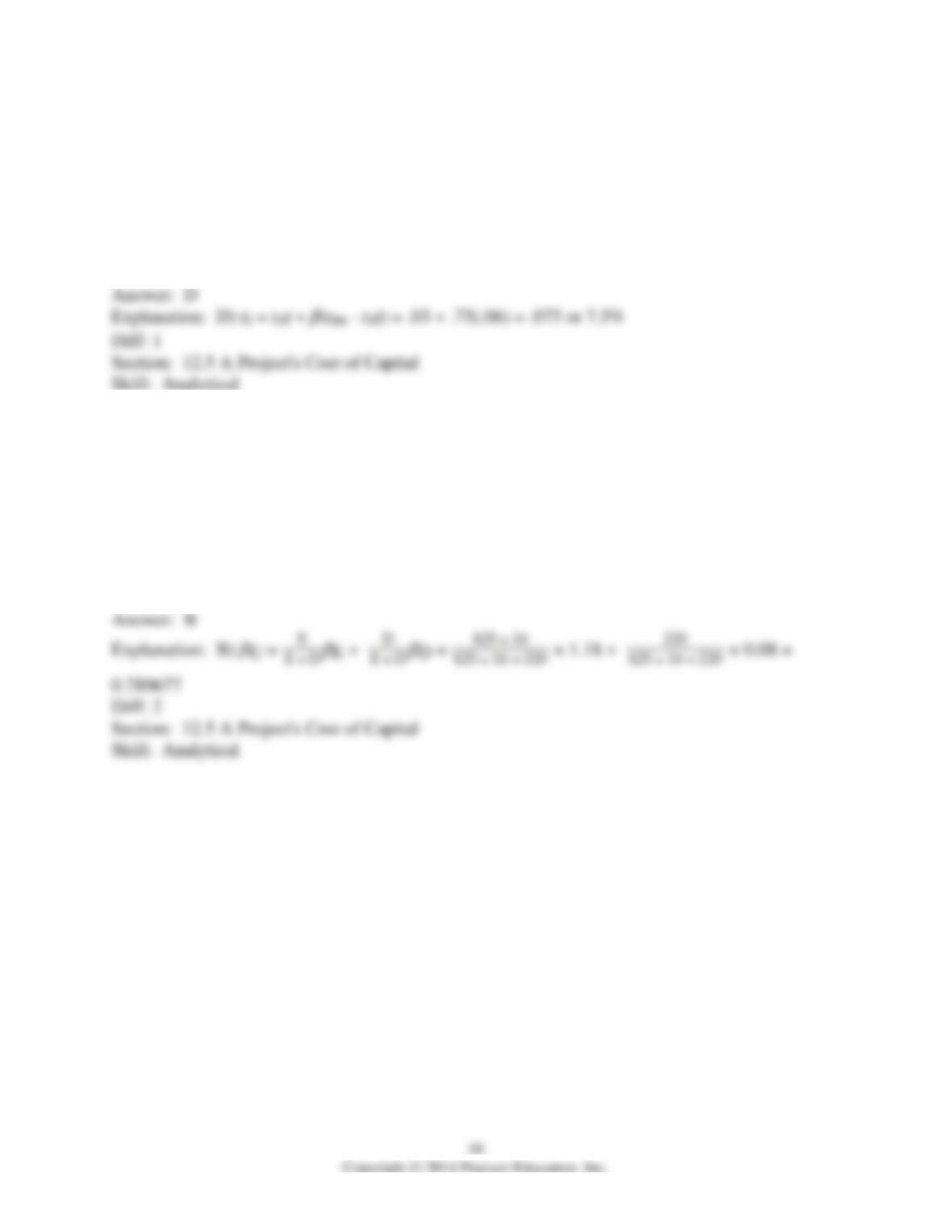
11) Your firm is planning to invest in a new power generation system. Galt Industries is an all
equity firm that specializes in this business. Suppose Galt’s equity beta is 0.75, the risk-free rate
is 3%, and the market risk premium is 6%. If your firm’s project is all equity financed, then your
estimate of your cost of capital is closest to:
A) 5.25%
B) 6.00%
C) 6.75%
D) 7.50%
12) Your firm is planning to invest in a new electrostatic power generation system. Electrostat
Inc is a firm that specializes in this business. Electrostat has a stock price of $25 per share with
16 million shares outstanding. Electrostat’s equity beta is 1.18. It also has $220 million in debt
outstanding with a debt beta of 0.08. Your estimate of the asset beta for electrostatic power
generators is closest to:
A) 0.76
B) 0.79
C) 0.93
D) 1.10

13) Your firm is planning to invest in a new electrostatic power generation system. Electrostat
Inc is a firm that specializes in this business. Electrostat has a stock price of $25 per share with
16 million shares outstanding. Electrostat’s equity beta is 1.18. It also has $220 million in debt
outstanding with a debt beta of 0.08. If the risk-free rate is 3%, and the market risk premium is
6%, then your estimate of your cost of capital for electrostatic power generators is closest to:
A) 7.50%
B) 7.75%
C) 9.50%
D) 10.10%
14) The firm’s unlevered (asset) beta is:
A) the weighted average of the equity beta and the debt beta.
B) the weighted average of the levered beta and the equity beta.
C) the debt beta minus the equity beta.
D) the unlevered beta minus the cost of capital.
15) The firm’s unlevered (asset) cost of capital is:
A) the weighted average of the equity cost of capital and the debt cost of capital.
B) the weighted average of the levered cost of capital and the equity cost of capital.
C) the debt cost of capital minus the equity cost of capital.
D) the unlevered beta minus the cost of capital.
16) If a firm’s excess cash holdings are greater than its debt, using net debt as the measure of
leverage will result in:
A) its unlevered beta and cost of capital equalling zero.
B) its unlevered beta and cost of capital being greater than its equity beta and cost of capital.
C) the risk of the firm’s equity being increased by its cash holdings in excess of its operating
needs.
D) the risk of the firm’s debt being increased by its cash holdings in excess of its operating needs.
17) Which of the following is true of asset betas?
A) Asset betas are expected to vary greatly within firms in the same industry.
B) Businesses that are less sensitive to market and economic conditions tend to have higher asset
betas than more cyclical industries.
C) Businesses that are less sensitive to market and economic conditions tend to have lower asset
betas than more cyclical industries.
D) A and B are correct.
12.6 Project Risk Characteristics and Financing
Use the following information to answer the question(s) below.
Division Asset
Beta Next Period’s Expected Free Cash
Flow ($mm) Expected
Growth
Rate
Oil Exploration 1.4 450 4.0%
Oil Refining 1.1 525 2.5%
Gas & Convenience Stores 0.8 600 3.0%
The risk-free rate of interest is 3% and the market risk premium is 5%.
1) The cost of capital for the oil exploration division is closest to:
A) 6.0%
B) 7.0%
C) 8.5%
D) 10.0%
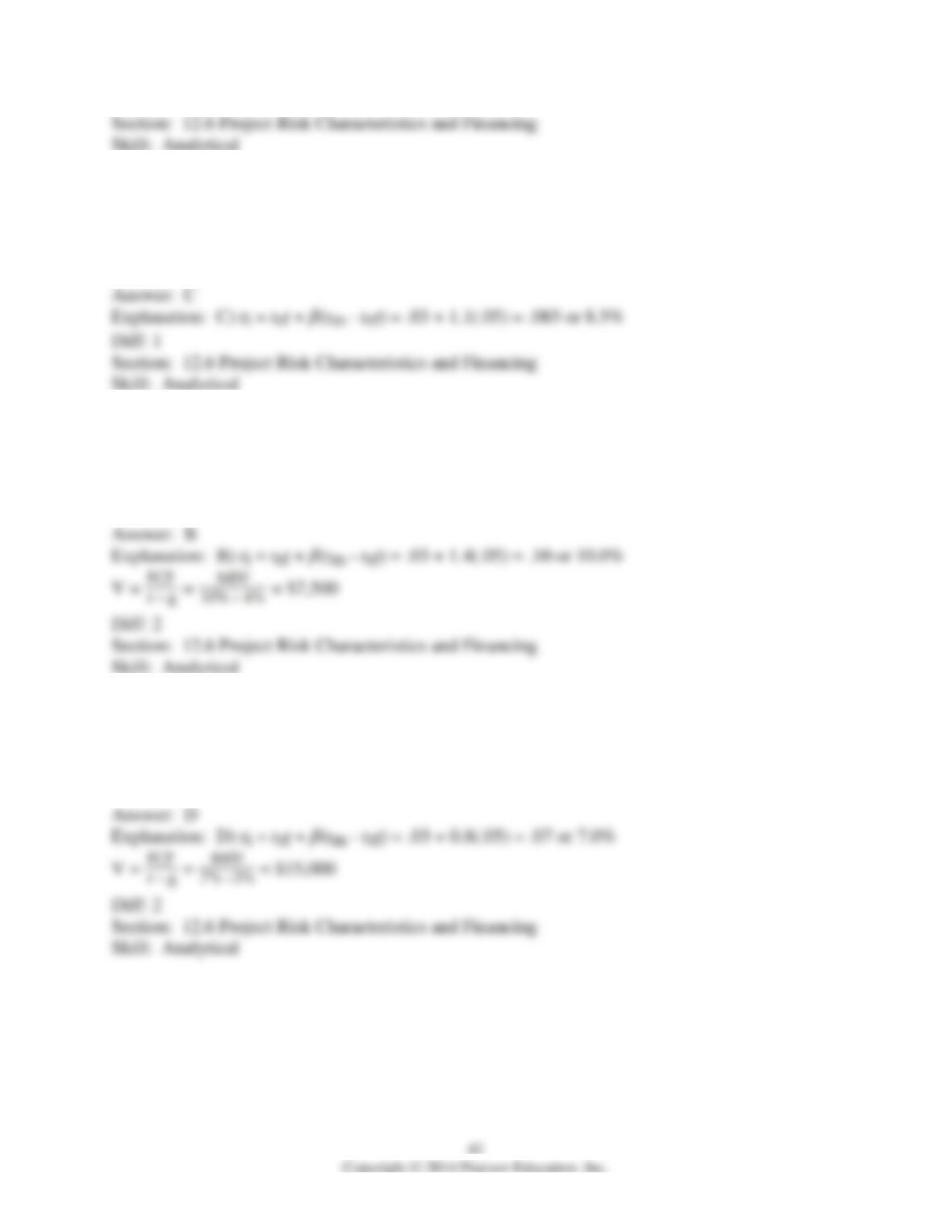
2) The cost of capital for the oil refining division is closest to:
A) 6.5%
B) 7.0%
C) 8.5%
D) 10.0%
3) The value of the oil exploration division is closest to:
A) $4,500
B) $7,500
C) $8,750
D) $10,000
4) The value of the gas and convenience store division is closest to:
A) $4,500
B) $6,000
C) $8,600
D) $15,000

5) The overall value of Wyatt Oil (in $ millions) is closest to:
A) $25,000
B) $18,846
C) $31,250
D) $15,000

6) The overall asset beta for Wyatt Oil is closest to:
A) 0.95
B) 1.05
C) 1.15
D) 1.25

7) The overall cost of capital for Wyatt Oil is closest to:
A) 8.1%
B) 8.5%
C) 8.8%
D) 9.3%
8) Firms should adjust for execution risk by:
A) assigning a higher cost of capital to new projects.
B) ignoring execution risk since it is diversifiable.
C) capturing this risk in the expected cash flows generated by the project.
D) noticing missteps in the firm’s execution of new projects.
9) One factor that can affect the market risk of a project is its degree of operating leverage,
which is:
A) the relative proportion of operating assets versus non-operating assets.
B) the relative proportion of operating assets versus equity.
C) the relative proportion of operating expenses versus non-operating expenses.
D) the relative proportion of fixed versus variable costs.
10) If a project has a higher proportion of fixed to variable costs, holding the risk of its revenues
constant:
A) its beta will be lower, hence its cost of capital will be lower.
B) its beta will be higher, hence its cost of capital will be higher.
C) its beta will be unaffected, since beta does not measure the sensitivity of the project’s cash
flows to market risk.
D) its financial leverage will be higher.
11) The difference between the weighted-average cost of capital (WACC) and the pre-tax
(unlevered) WACC is:
A) the weighted-average cost of capital is based on the after-tax cost of equity and the pre-tax
WACC is based on the after-tax cost of debt.
B) the weighted-average cost of capital multiplies the cost of equity and the cost of debt by (1-
tax rate) and the pre-tax WACC does not.
C) the weighted-average cost of capital multiplies the cost of debt by (1-tax rate) and the pre-tax
WACC does not.
D) the weighted-average cost of capital multiplies the component costs of equity and debt by
their weight in the capital structure, and the pre-tax WACC does not.
12) In a world with taxes, which of the following is the rate we should use to evaluate an all-
equity financed project with the same risk as the firm?
A) The weighted-average cost of capital
B) The pre-tax WACC
C) The cost of equity
D) The cost of debt
13) In a world with taxes, which of the following is the rate we should use to evaluate a project
with the same risk and the same financing as the firm itself?
A) The weighted-average cost of capital
B) The pre-tax WACC
C) The cost of equity
D) The cost of debt
Use the following information to answer the question(s) below.
Luther Industries has 25 million shares outstanding trading at $18 per share. In addition, Luther
has $150 million in outstanding debt. Suppose Luther’s equity cost of capital is 13%, its debt cost
of capital is 7%, and the corporate tax rate is 40%.
14) Luther’s unlevered cost of capital is closest to:
A) 7.0%
B) 9.8%
C) 10.8%
D) 11.5%
15) Luther’s after-tax debt cost of capital is closest to:
A) 4.2%
B) 5.4%
C) 7.0%
D) 9.8%
16) Luther’s weighted average cost of capital is closest to:
A) 9.8%
B) 10.8%
C) 11.5%
D) 13.0%
12.7 Final Thoughts on Using the CAPM
1) Which of the following is NOT considered a difficulty with regards to the CAPM?
A) Betas are not observed.
B) Expected returns are not observed.
C) The market proxy is not correct.
D) Investors risk preferences are not observed.
2) Which of the following is NOT considered to be an important choice when estimating beta?
A) The choice of the time horizon to use for estimation
B) The choice of method used to extrapolate beta
C) The choice between weekly and monthly returns
D) The choice of index used as the market portfolio
3) Which of the following statements is FALSE?
A) Many practitioners prefer to use average industry betas rather than individual stock betas.
B) When estimating beta by using past returns it is best to use the longest time horizon of returns
available.
C) The CAPM predicts that a security’s expected return depends on its beta with regard to the
market portfolio of all risky investments available to investors.
D) If we use too short a time horizon when estimating beta, our estimate of beta will be
unreliable.
4) Which of the following statements is FALSE?
A) We should be suspicious of beta estimates that are extreme relative to industry norms.
B) When using historical data, there is always the possibility of estimation error.
C) Evidence suggests that betas tend to revert toward zero over time.
D) For stocks, common practice is to use at least two years of weekly return data or five years of
monthly return data when estimating beta.
5) Which of the following statements is FALSE?
A) There may be reasons to exclude certain historical data as anomalous when estimating beta.
B) Many practitioners use adjusted betas, which are calculated by averaging the estimated beta
with 1.0.
C) The beta estimated we obtain from linear regression can be very sensitive to outliers, which
are returns of unusually small magnitude.
D) If we use very old data to when estimating beta, they data may be unrepresentative of the
current market risk of the security.
6) Which of the following statements is FALSE?
A) Many practitioners analyze other financial characteristics of a firm, when they forecast betas.
B) U.S. Treasuries are never subject to interest rate risk unless we select a maturity equal to our
investment horizon.
C) If a firm where to change industries, using its historical beta would be inferior to using the
beta of other firms in the new industry.
D) When using historical returns to forecast future betas, we must be mindful of changes in the
environment that might cause the future to differ from the past.
7) Which of the following statements is FALSE?
A) The CAPM states that we should use the risk-free interest rate corresponding to the
investment horizon of the firm’s investors.
B) To determine the risk premium for a stock using the security market line, we need an estimate
of the market risk premium.
C) When surveyed, the vast majority of large firms and financial analysts reported using the
yields of Treasury Bills to determine the risk-free rate.
D) The risk-free interest rate is generally determined using the yields of U.S. Treasury securities,
which are free from default risk.
8) Which of the following statements is FALSE?
A) The CAPM remains the predominant model use in practice to determine the equity cost of
capital.
B) Low beta stocks have tended to perform somewhat better than the CAPM predicts.
C) The empirically estimated security market line is somewhat steeper than that predicted by the
CAPM.
D) Some evidence suggests that the market risk premium has declined over time.
9) Which of the following statements is FALSE?
A) The imperfections in the CAPM may be critical in the context of capital budgeting and
corporate finance, where errors in estimating the cost of capital are likely to be far more
important than small discrepancies in the project cash flows.
B) To estimate the expected market risk premium we can look at the historical average excess
return of the market over the risk free interest rate.
C) The highest beta stocks have tended to under perform what the CAPM predicts.
D) Given an assessment of an index’s future cash flows, we can estimate the expected return of
the market by solving for the discount rate that is consistent with the current level of the index.
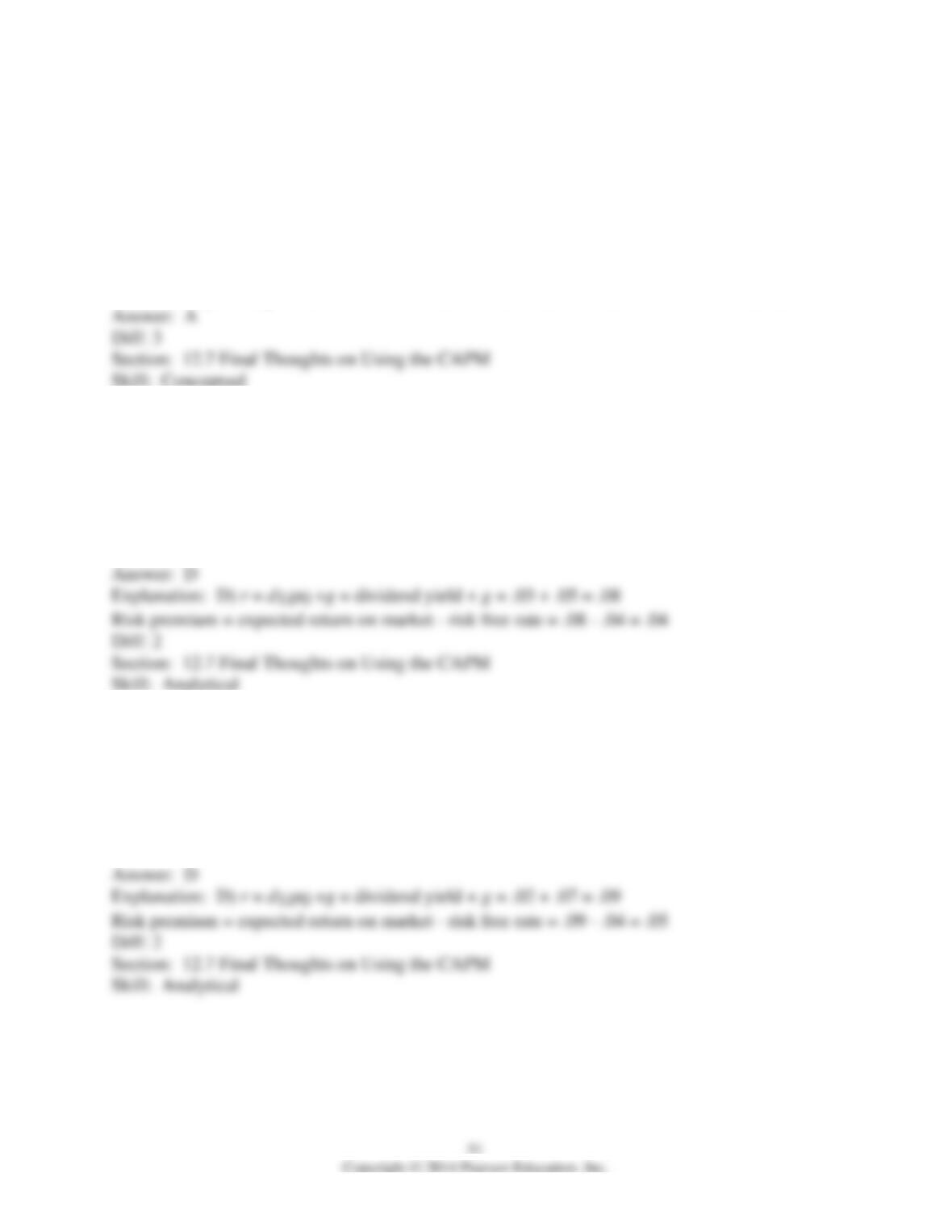
10) Assume that the S&P 500 currently has a dividend yield of 3% and that on average, the
dividends of S&P 500 firms have increased by about 5% per year. If the risk-free interest rate is
4%, then your estimate for the future market risk premium is:
A) 7%
B) 8%
C) 6%
D) 4%
11) Assume that the Wilshire 5000 currently has a dividend yield of 2% and that on average, the
dividends of Wilshire 5000 firms have increased by about 7% per year. If the risk-free interest
rate is 4%, then your estimate for the future market risk premium is:
A) 4%
B) 7%
C) 8%
D) 5%