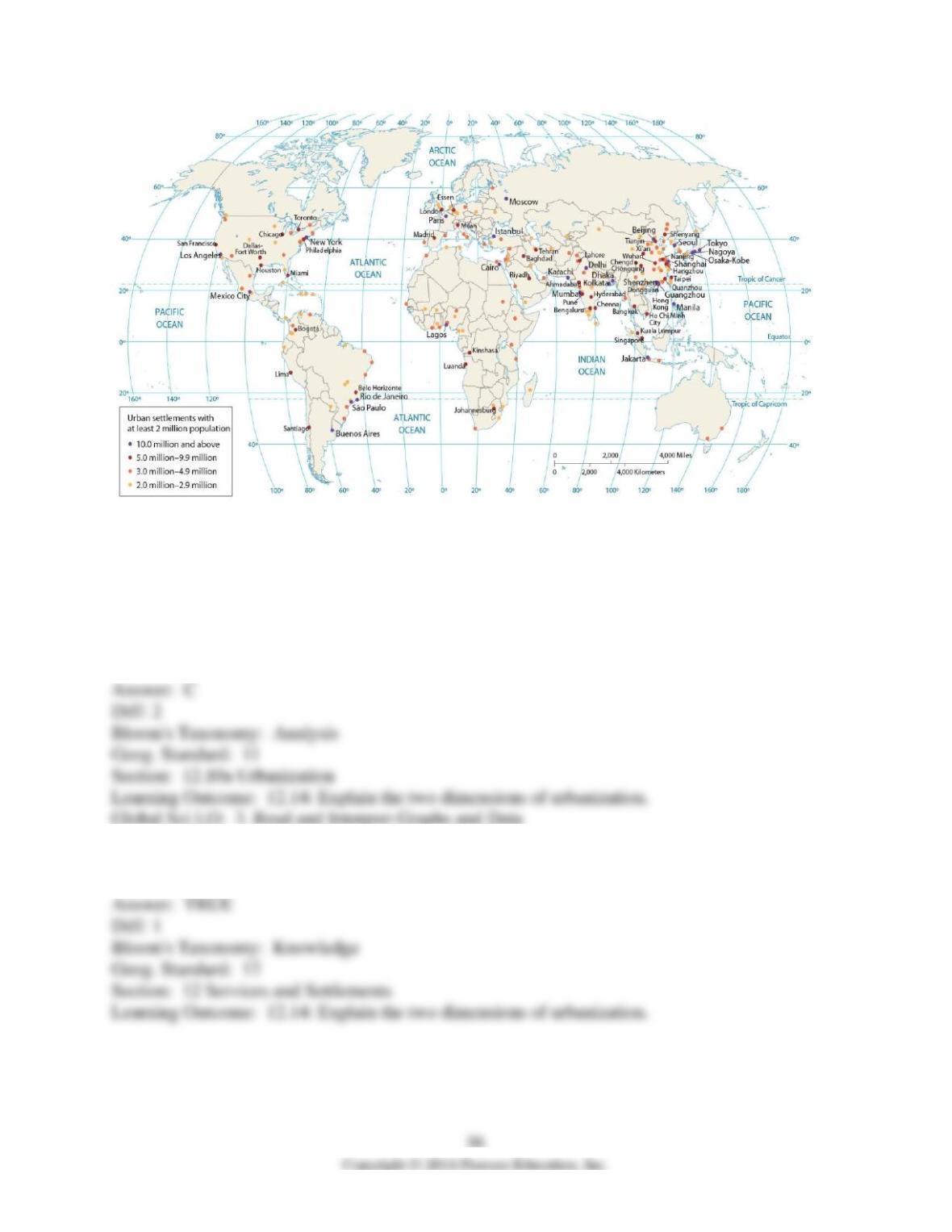
71) The map of major urban settlements indicates that the vast majority of cities with more than
two million residents
A) are located in North America and Europe.
B) that are in Asia are situated on or near the coasts.
C) that are in South America are on or near the coasts.
D) that are in South America, Asia, and North America are on or near the coasts.
E) are located in South Asia and Australia.
72) Settlements hold nearly all the Earth’s population but cover only about 1 percent of its
surface.

73) Linear settlement patterns were brought to North America by the French.
74) The colonial New England rural settlement pattern was clustered.
75) In recent decades growth in employment in the United States has come from the primary and
secondary sectors, while the tertiary sector has declined.
76) In recent decades the tertiary sector in Western Europe has declined.
77) People who live in rural settlements are more likely to engage in secondary sector economic
activities.
78) When determining the market threshold, there is no need to determine what is being sold.
79) The threshold of a service is the maximum distance that most of the customers are willing to
travel.
80) Copenhagen and London are primate cities even though they are located in more developed
countries.
81) Transportation and communication improvements have served to reduce the need for the
clustering of services in world cities.
82) According to the rank-size rule, if the largest city in a country contains 1,000,000
inhabitants, the fifth largest city should contain 200,000 inhabitants.
83) A community’s economic structure depends initially on its basic industries.
84) The frequency of periodic markets varies by culture.
85) Rapid urbanization continues today in the more developed countries.
86) As recently as 1800, only 3 percent of Earth’s population lived in urban settlements.
87) Among the oldest well-documented urban settlements is Ur in Mesopotamia.
88) Several cities in China are estimated to have exceeded 1 million inhabitants between 700 and
1800 A.D.
89) Although people had lived in the eastern Mediterranean for tens of thousands of years, urban
settlements were first established there about 2500 B.C.
90) People had established villages and other rural settlements in many parts of the world many
thousands of years before the beginning of recorded history around 5,000 years ago.
91) The population of the world is roughly split in half between urban and rural settlements.
92) Cities grew rapidly in Europe immediately after the collapse of the Roman Empire.
93) None of the world’s five most populous urban areas is located in Europe.
94) Most inhabitants of developing countries live in urban areas.
95) According to Louis Wirth, cities differ from rural areas in being larger, more dense, and
more socially homogeneous.
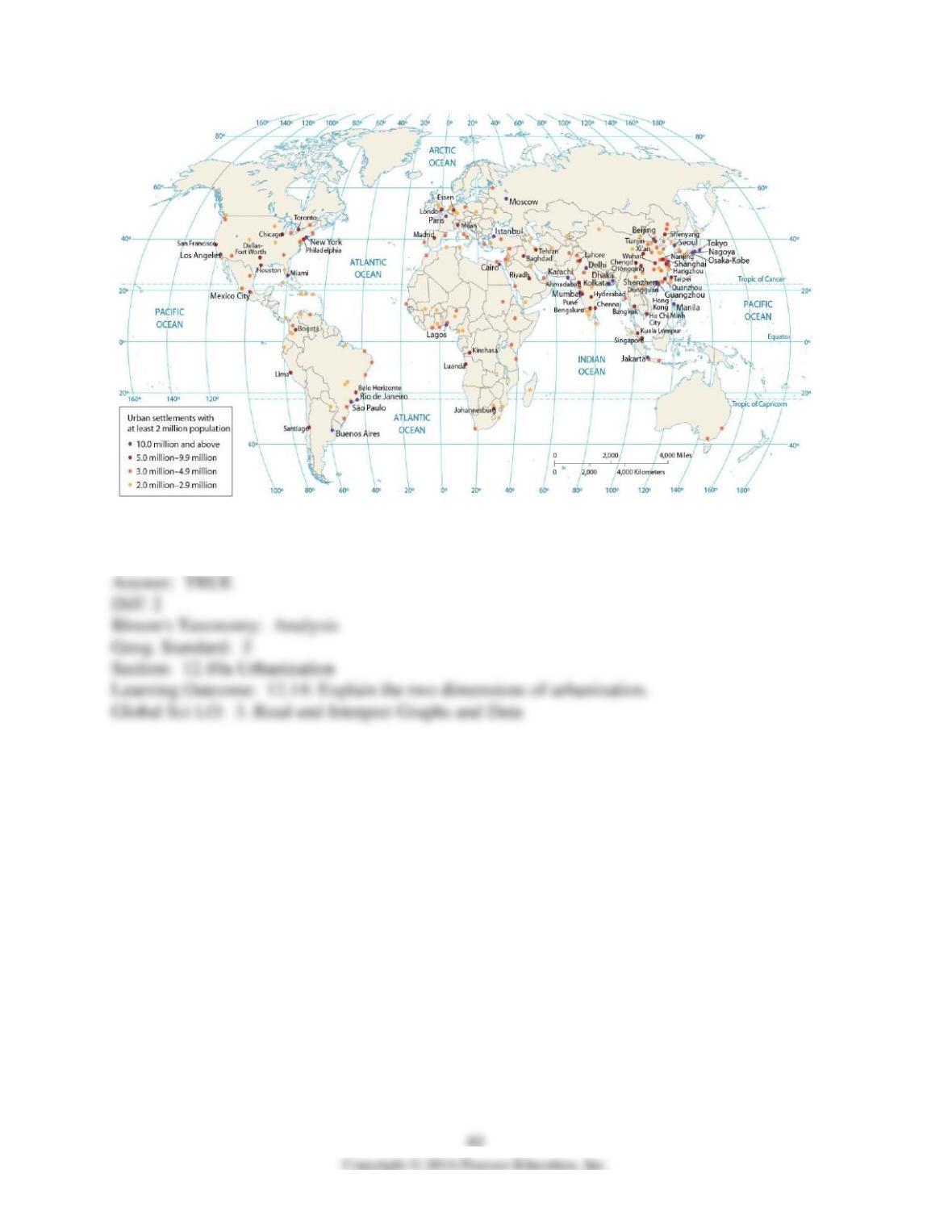
96) According to this map, most of the world’s cities that exceed two million residents are in
Asia.
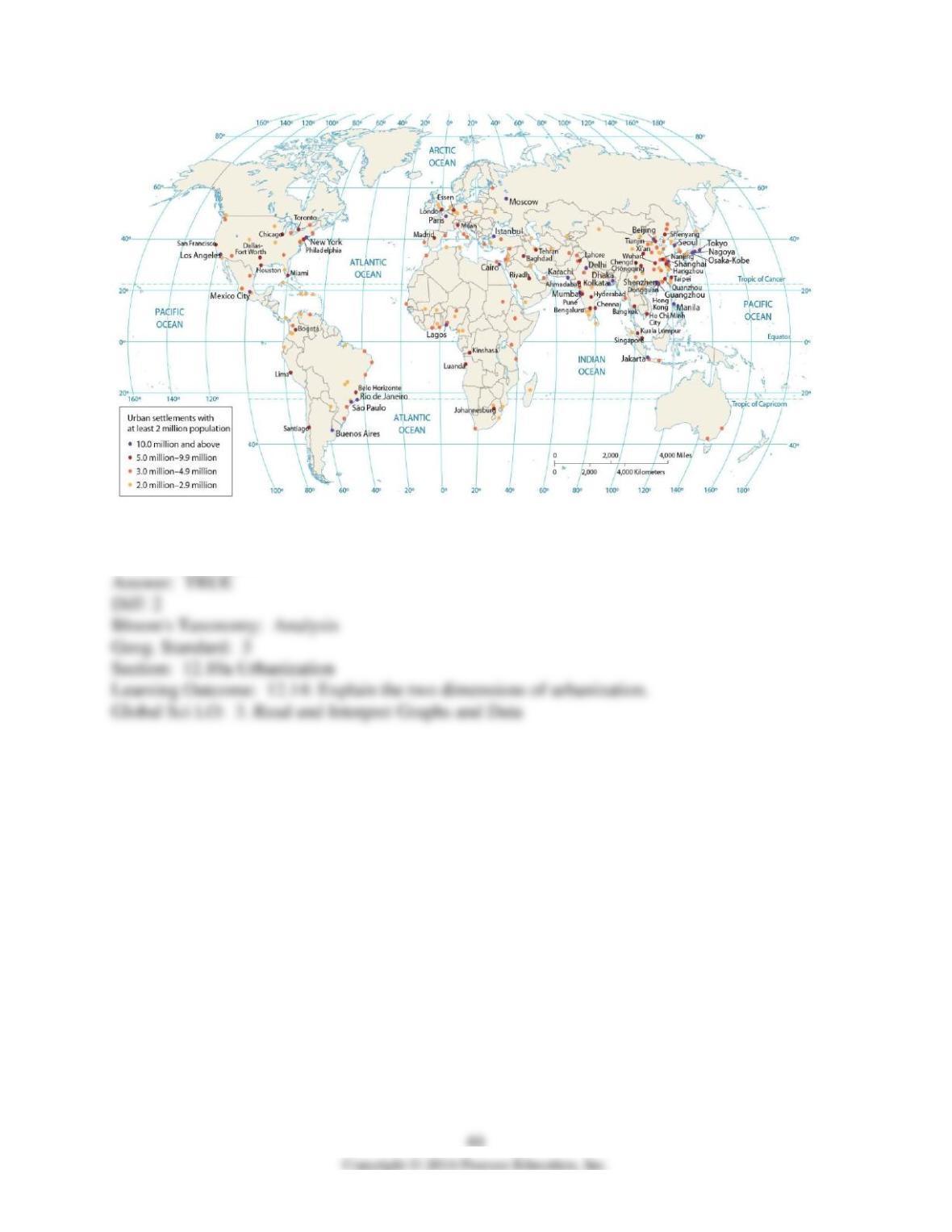
97) According to this map, at least a dozen cities in the United States have populations exceeding
two million people.
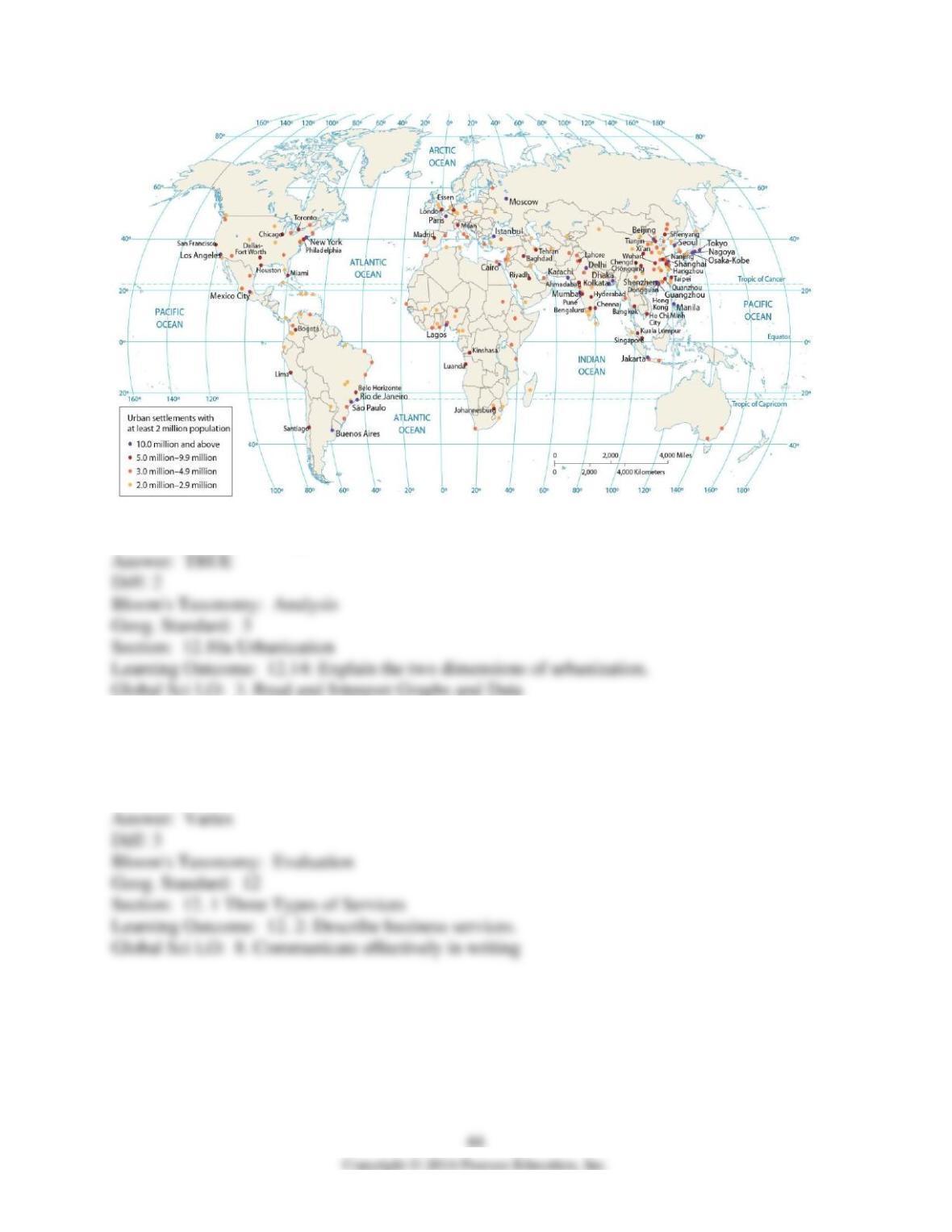
98) According to this map, Casablanca, Morocco, has at least two million residents.
99) Most geography textbooks describe business and consumer services as separate categories
for purposes of study and planning, but in what ways do the various kinds of business and
consumer services overlap? Discuss several examples where the lines between these categories
are blurred or confused.
100) Describe some of the different kinds of services evident on your university or college
campus. Do these comprise a major part of the economic base of your area? Why or why not?
101) Developing countries are experiencing rapid urbanization. What advantages might their
societies experience as a result of this rapid shift? What disadvantages are most pronounced? On
the whole, is this a positive or negative trend?
102) What strategies could you propose to either end the practice of offshore financial services
or dissuade companies and wealthy individuals from utilizing them? What advantages might the
United States garner by ending or limiting access to these offshore services?
103) Discuss the apparent economic base(s) of your local community and its significance to your
life at the present moment.
104) In many developing countries, large percentages of the people continue to live in rural
areas. Imagine ways in which per capita wealth be best increased in those rural areas. What
advantages and disadvantages might your plan entail?
105) The British enclosure movement is discussed in this chapter as a strategy toward economic
development. However, what disadvantages and problems can you imagine or envision
accompanying the enclosure movement? Who might have been disadvantaged by it, and why?
106) Suggest some methods that could be used to slow the process of rapid urbanization in
developing countries. Cite evidence from the textbook to back up your suggestions.
107) Imagine that for whatever reasons you wished to dramatically increase the rate of
urbanization in a developing country. How would you do this? Use one country as a specific case
as you discuss ways in which urbanization could be dramatically increased, and cite evidence
from the textbook to reinforce your ideas.
108) Discuss the possible reasons for the origin of settlements.
109) You are assembling a “time capsule” that you imagine anthropologists will open 500 years
from now to make sense of the values, experiences, and concerns of your generation (18 to 29
year olds). What five artifacts representing consumer services (and consumer culture) would you
add to the time capsule, and why?
110) In what ways have you participated economically in your community’s service economy,
both as a laborer and as a consumer, in recent years?
111) Outline the major principles of central place theory, and discuss the degree to which they
relate to your local community.
112) In a developing country, what are the economic advantages of having a primate city? What
are the disadvantages? In your opinion, is it generally better to have a primate city? Why or why
not?
113) Imagine that you live in a developing country with a large primate city. What strategies
might you propose to make the country’s population and economic power less concentrated?
Support your answer with the material from this chapter and your other knowledge of world
geography.
114) Outline the steps a retailer should take in selecting the optimal location for a store.
115) Take an inventory of the kinds of advertisements (in all media, print and electronic) that
you encounter over the course of two days. Which of these ads pertain more to consumer
services, and which pertain more to business services? How do these various kinds of ads
contribute to the consumer culture within which we are immersed? Consider questions of
socioeconomic class, gender, and ethnic identity as you formulate your responses to these
questions.
116) Discuss the impact of globalization on modern world cities.
117) Why does urbanization change the proportion of people employed in the various sectors of
the economy? Which sector is concentrated in world cities? Why?