Chapter 12—THE COST OF CAPITAL
MULTIPLE CHOICE
1. For a company that is not planning to change its target capital structure, the proportions of debt and
equity used in calculating the weighted cost of capital should be based on the current ____ weights of
the individual components.
a.
book value
b.
market value
c.
replacement value
d.
book and market value
2. The cost of capital is
a.
the rate of return required by investors in the firm’s securities
b.
the minimum rate of return required on new investments of average risk undertaken by the
firm
c.
approximately 10 percent for most firms
d.
a and b only
3. A firm can raise up to $700 million for investment from a mixture of debt, preferred stock and retained
equity. Above $700 million, the firm must issue new common stock. Assuming that debt costs and
preferred stock costs remain unchanged, the marginal cost of capital for amounts up to $700 million
will be ____ the marginal cost of capital for amounts over $700 million.
a.
less than
b.
equal to
c.
greater than
d.
cannot be determined from the information given
4. The CAPM assumes that the only risk of concern to the investor is ____, which is measured by ____.
a.
Unsystematic risk, beta
b.
Systematic risk, the return to the market portfolio
c.
Systematic risk, beta
d.
Unsystematic risk, the return to the market portfolio
5. For firms subject to the 34% marginal tax rate, the after-tax cost of ____ is roughly two-thirds the cost
of preferred stock.
a.
retained earnings
b.
new common stock
c.
long-term debt
d.
retained earnings and new common stock
6. The constant growth valuation model approach to calculating the cost of equity assumes that
a.
earnings and dividends grow at a constant rate, but stock price growth is indeterminate
b.
the growth rate is greater than or equal to ke
c.
dividends are constant
d.
earnings, dividends, and stock price will grow at a constant rate
7. The total return to stockholders, ke, is composed of the
a.
opportunity cost plus a risk premium
b.
dividend yield plus the price appreciation of the security
c.
opportunity cost plus an inflation premium
d.
none of the above
8. The historic beta of a firm is of little use as a forecast of the firm’s future systematic risk characteristics
when
a.
the firm is growing at a rate of 7-10 percent a year
b.
the firm is expanding an existing product line
c.
the firm is expanding into a new product line
d.
all of these answers are correct
9. The cost of external equity is greater than the cost of internal equity because
a.
it decreases the earnings per share
b.
it increases the market price of the stock
c.
of the flotation costs
d.
dividends are increased
10. Retained earnings are a cheaper source of funds than the sale of new equity because
a.
retention defers the payment of taxable dividends to shareholders
b.
there are no flotation costs
c.
new shares are usually priced below current market price
d.
all the above
11. Determine the (after-tax) percentage cost of a $50 million debt issue that the Mattingly Corporation is
planning to place privately with a large insurance company. Assume that the company has a 40%
marginal tax rate. This long-term debt issue will yield 12% to the insurance company.
a.
4.8%
b.
7.2%
c.
12.0%
d.
15%
12. Calculate the after-tax cost of preferred stock for Ohio Valley Power Company, which is planning to
sell $100 million of $3.25 cumulative preferred stock to the public at a price of $25 per share.
Flotation costs are $1.00 per share. Ohio Valley has a marginal income tax rate of 40%.
a.
13.0%
b.
7.8%
c.
8.12%
d.
13.54%
13. The Allegheny Valley Power Company common stock has a beta of 0.80. If the current risk-free rate is
6.5% and the expected return on the stock market as a whole is 16%, determine the cost of equity
capital for the firm (using the CAPM).
a.
14.1%
b.
7.6%
c.
6.5%
d.
2.4%
14. The following financial information is available on Rawls Manufacturing Company:
Current per share market price
$48.00
Current (t = 0) per share dividend
$3.50
Expected long-term growth rate
5.0%
0.1%).
a.
12.3%
b.
13.4%
c.
13.0%
d.
12.7%
15. The following financial information is available on Rawls Manufacturing Company:
Current per share market price
$48.00
Beta
1.1
Expected rate of return on market
12.0%
Risk-free rate
6.0%
Rawls can issue new common stock to net the company $44 per share. Determine the cost of internal
equity capital using the capital asset pricing model approach. (Compute answer to the nearest 0.1%).
a.
12.9%
b.
12.6%
c.
13.0%
d.
4.4%
16. The following financial information is available on Rawls Manufacturing Company:
Current per share market price
$48.00
Current per share dividend
$ 3.50
Current per share earnings
$ 6.00
Beta
1.1
Expected rate of return on market
12.0%
Risk-free rate
6.0%
Expected long-term growth rate
5.0%
Rawls can issue new common stock to net the company $44 per share. Determine the cost of external
equity capital using the dividend capitalization model approach. (Compute answer to the nearest
0.1%).
a.
12.7%
b.
14.4%
c.
12.6%
d.
13.4%
17. Determine the weighted cost of capital for the Mills Company that will finance its optimal capital
budget with $120 million of long-term debt (kd = 12.5%) and $180 million in retained earnings (ke =
16.0%). Mills’ present capital structure is considered optimal. The company’s marginal tax rate is 40%.
(Compute answer to nearest .1%).
a.
14.3%
b.
12.6%
c.
14.6%
d.
7.1%
18. What is the cost of equity for East Roon, if the firm is expected to always pay a constant dividend of
$2.22? The firm’s common stock is presently selling for $18.50.
a.
8.3%
b.
12.0%
c.
10.2%
d.
cannot be determined from the information given
19. According to Value Line, Bestway has a beta of 1.15. If 3-month Treasury bills currently yield 7.9
percent and the market risk premium is estimated to be 8.3 percent, what is Bestway’s cost of equity
capital?
a.
17.45%
b.
8.36%
c.
9.55%
d.
9.09%
20. Northeast Airlines (NA) has a current dividend of $1.80. Dividends are expected to grow at a rate of 7
percent a year into the foreseeable future. What is NA’s cost of external equity if its stock can be sold
to net $46 a share?
a.
10.9%
b.
11.2%
c.
7.2%
d.
3.9%
21. A firm with a 40 percent marginal tax rate has a capital structure of $60,000,000 in debt and
$140,000,000 in equity. What is the firm’s weighted cost of capital if the marginal pretax cost of debt
is 12 percent, the firm’s average pretax cost of debt outstanding is 8%, and the cost of equity is 14.5
percent?
a.
13.75%
b.
11.59%
c.
12.31%
d.
14.29%
22. Easy Rider Inc. sold a 15 year $1,000 face value bond with a 10 percent coupon rate. Interest is paid
annually. After flotation costs, Easy Rider received $928 per bond. Compute the after-tax cost of debt
for these bonds if the firm’s marginal tax rate is 40 percent.
a.
6.0%
b.
7.2%
c.
7.8%
d.
6.6%
23. Easy Slider recently sold a 15 year $1,000 face value bond at a discount for $700 that net the firm
$692 after flotation costs. The low coupon bond has a 6% coupon with interest paid semiannually. If
Easy Slider has a marginal tax rate of 40 percent, what is its after-tax cost of debt for these bonds?
a.
10.0%
b.
6.0%
c.
9.2%
d.
7.8%
24. Alpha Products maintains a capital structure of 40 percent debt and 60 percent common equity. To
finance its capital budget for next year, the firm will sell $50 million of 11 percent debentures at par
and finance the balance of its $125 million capital budget with retained earnings. Next year Alpha
expects net income to grow 7 percent to $140 million, and dividends also are expected to increase 7
percent to $1.40 per share and to continue growing at that rate for the foreseeable future. The current
market value of Alpha’s stock is $30. If the firm has a marginal tax rate of 40 percent, what is its
weighted cost of capital for the coming year?
a.
9.64%
b.
8.63%
c.
9.84%
d.
16.4%
25. Groves, Inc. pays an annual dividend of $1.22. This dividend is expected to continue growing at a rate
of about 5 percent each year. The firm is in a fairly risky business and has a beta of 1.45. The expected
market rate of return is 13.5 percent, and the risk-free rate is 9.3 percent. What is the cost of equity for
Groves?
a.
19.6%
b.
13.5%
c.
15.4%
d.
6.1%
26. Witin’s stock price is currently $34.25 and the current quarterly dividend is $0.25. Consensus estimates
for Witin indicate a growth rate in earnings of 10% into the foreseeable future. If Witin plans to sell 1
million shares to raise new capital for expansion, what is the cost of new equity if the issuance costs
are 8%?
a.
13.49%
b.
10.87%
c.
13.21%
d.
13.17%
27. Pluega Inc. issued a $100 million 8.27% coupon debenture bond due in the next 20 years. The bonds
each sold for $996. If the bonds pay interest semi-annually, what is Pluega’s after cash cost of debt?
Assume 40% tax rate.
a.
4.96%
b.
8.30%
c.
4.99%
d.
3.32%
28. Haulsee Inc. pays no dividend currently but is expected to start paying a small dividend next year. The
5-year old firm has a beta of 1.25 and current earnings of $0.90 per share. The current Treasury bill
rate is 6.10% and the market risk premium is 8.8%. Determine Haulsee’s cost of equity if the firm’s tax
rate is 40%.
a.
9.48%
b.
17.1%
c.
14.9%
d.
cannot determine from the information provided
29. Temple Company’s common stock dividends have grown over the past 5-year period from $0.60 per
share to $0.89 (today). Assume that Temple’s dividends are expected to grow at this rate for the
foreseeable future. Temple’s stock is currently selling for $12 per share. New common stock can be
sold to net the company $11 per share. Determine the costs of internal and external equity to Temple.
a.
18.1%; 18.9%
b.
15.9%; 16.6%
c.
16.2%; 16.9%
d.
cannot be computed
30. American Dental Laser is selling a 10 year $1,000 face value bond with a 8% coupon rate. Interest is
paid annually. The price to the public is $820 and the issue costs per bond are $10 each. Compute the
pretax cost of debt for these bonds.
a.
11.1%
b.
11.3%
c.
11.5%
d.
11.8%
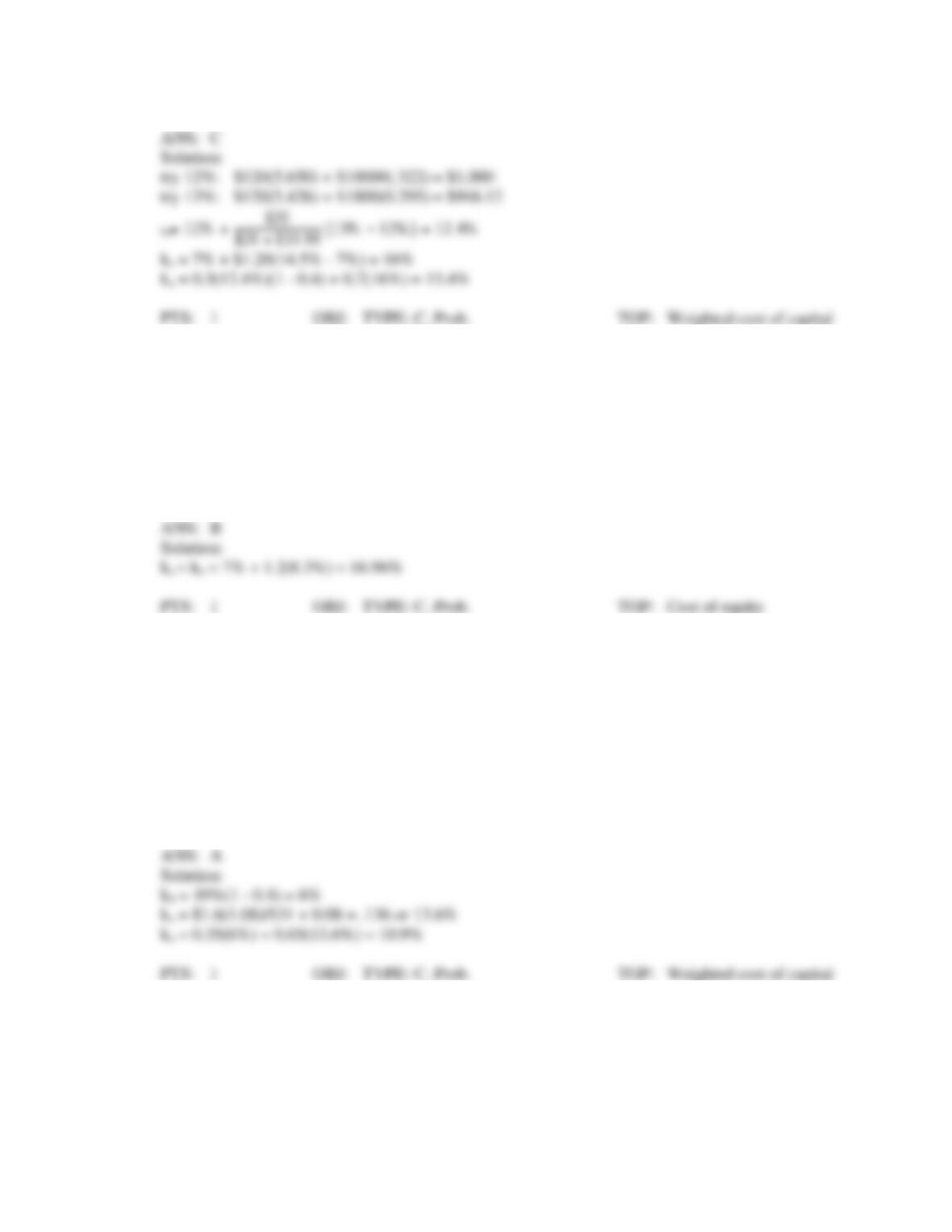
31. Wright Express(WE) has a capital structure of 30% debt and 70% equity. WE is considering a project
that requires an investment of $2.6 million. To finance this project, WE plans to issue 10-year bonds
with a coupon interest rate of 12%. Each of these bonds has a $1,000 face value and will be sold to net
WE $980. If the current risk-free rate is 7% and the expected market return is 14.5%, what is the
weighted cost of capital for WE? Assume WE has a beta of 1.20 and a marginal tax rate of 40%.
a.
14.9%
b.
12.4%
c.
13.4%
d.
16.0%
32. California Best (CB), a sport shoe store, expects an operating income of $2.3 million this year. CB has
no long-term debt. The firm is considering as expansion project. The current risk-free rate of return is
7% and the current market risk premium is 8.3%. If CB‘s beta is 20% greater than the overall market,
what is the firm’s cost of capital? Assume that CB has a marginal tax rate of 40%.
a.
8.3%
b.
16.96%
c.
9.96%
d.
15.3%
33. Columbia Gas Company’s(CG) current capital structure is 35% debt and 65% equity. This year CG has
earnings after tax of $5.31 million and is paying $1.6 million in dividends. To finance a transmission
pipe line, CG can borrow $2 million at a cost of 10%, the same rate that CG is currently paying on a
total of $15 million long-term debt. CG has 1,000,000 shares outstanding and its current market price
is $31. If CG’s long-term growth rate of dividends is expected to be 8%, what is the weighted cost of
capital for the firm? Assume a marginal tax rate of 40%.
a.
10.9%
b.
13.6%
c.
19.6%
d.
16.9%
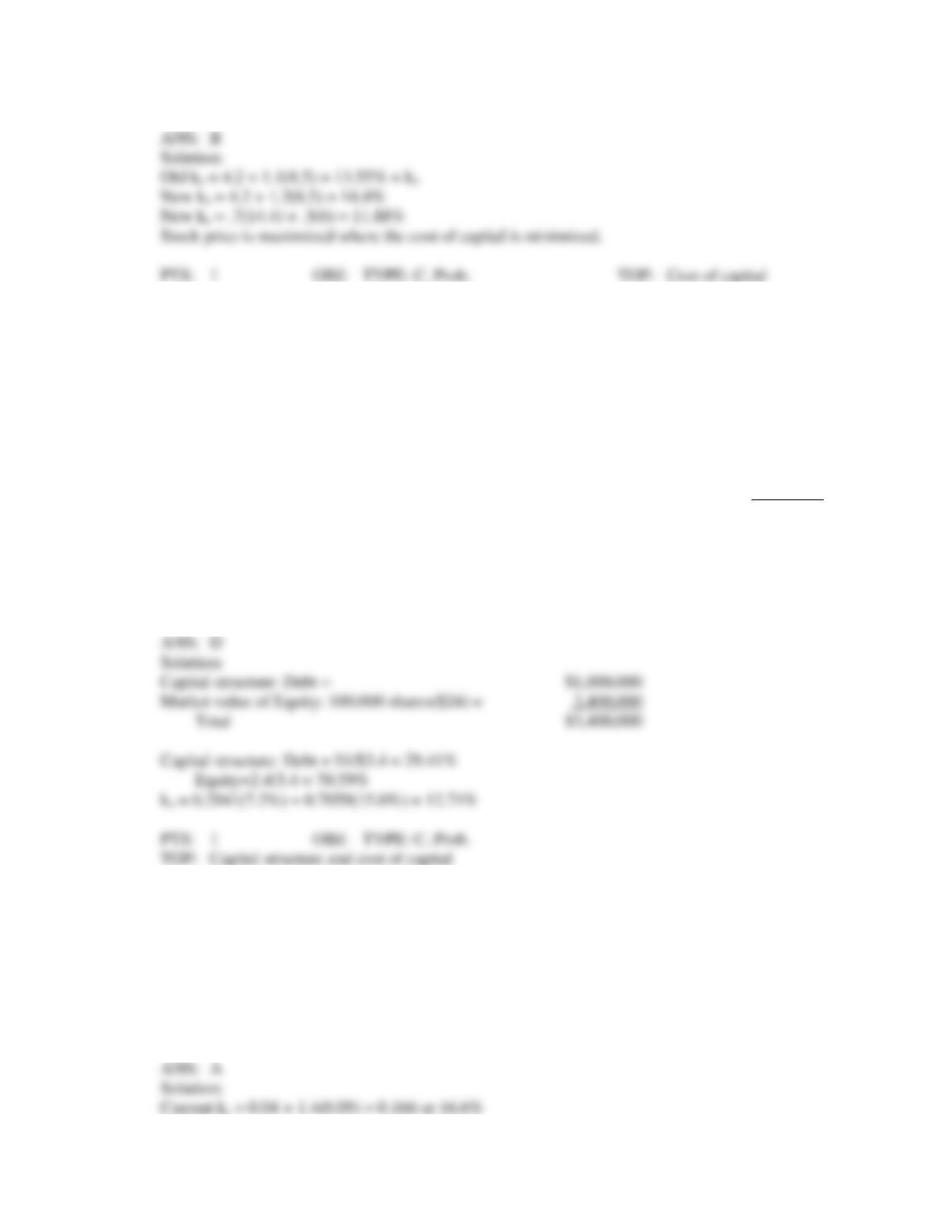
34. Heleveton Industries is 100% equity financed. Its current beta is 1.1. The expected market risk
premium is 8.5% and the risk-free rate is 4.2%. If Heleveton changes its capital structure to 25% debt,
it estimates its beta will increase to 1.2. If the after-tax cost of debt will be 6%, should Heleveton make
the capital structure change?
a.
Yes, cost of capital decreases by 2.52%
b.
Yes, cost of capital decreases 1.67%.
c.
No, stock price would decrease due to increased risk
d.
No, cost of capital increases by 0.85%.
35. Bay State Technology has determined that its cost of equity is 15% and its after-tax cost of debt is
7.2%. Bay State expects to earn $14 million after taxes next year and, as a new firm, does not pay any
dividends. The stock sells for $24. Bonds are currently selling at par value. Compute Bay State’s
weighted cost of capital. A partial balance sheet is shown below:
Current liabilities
$ 300,000
Long-term debt
1,000,000
Common stock at $1 par
100,000
Paid in capital
900,000
Retained earnings
3,000,000
Total liabilities and stockholders’ equity
$5,300,000
a.
13.4%
b.
13.1%
c.
11.6%
d.
12.7%
Solution:
Capital structure: Debt =
Market value of Equity: 100,000 shares($24) =
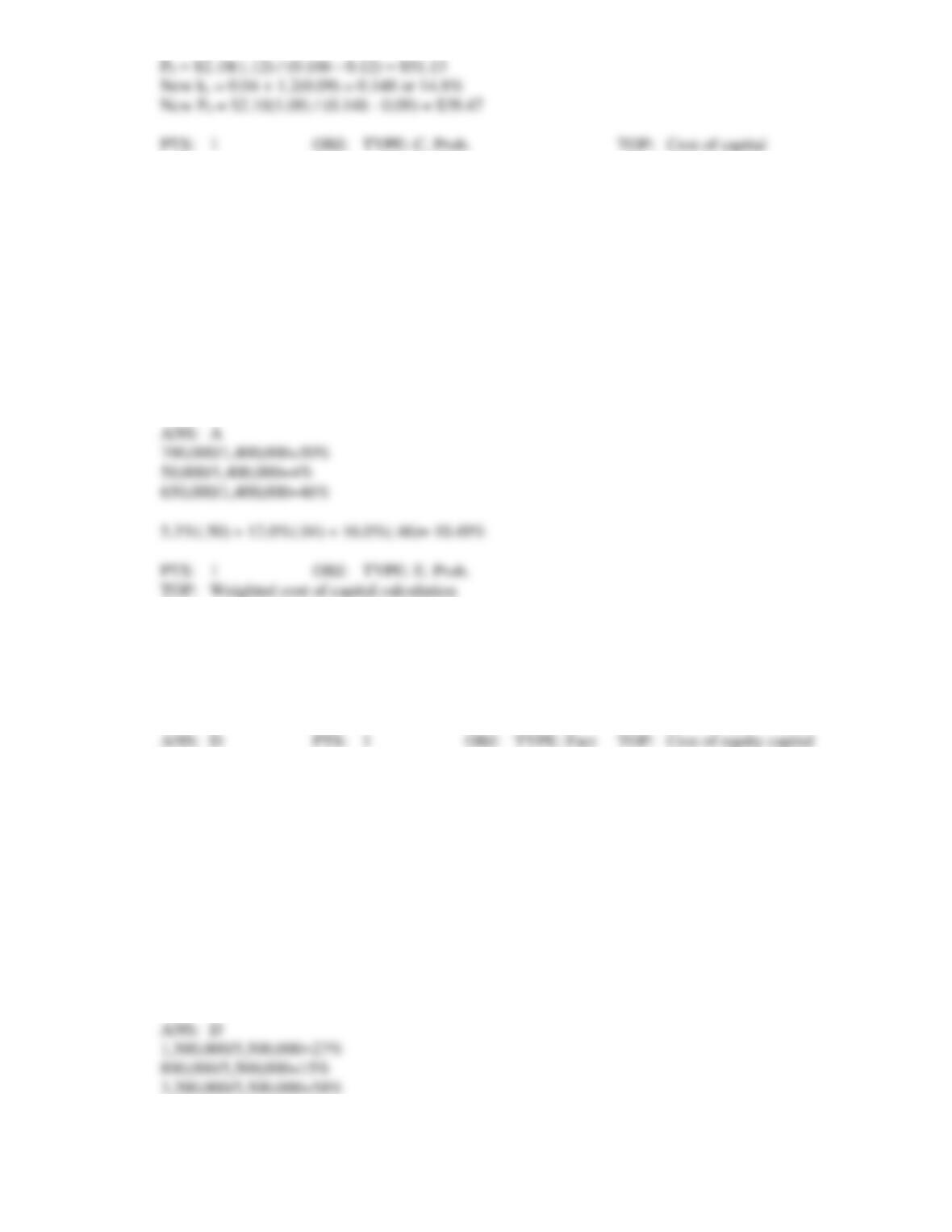
36. Mahlo is planing to diversify into the bakery industry. As a result, its beta should drop from 1.4 to 1.2
and the expected long-term growth rate of dividends will drop from 12% to 9%. The risk-free rate is
4%, the expected market risk premium is 9%, and the current dividend per share paid by Mahlo is
$2.10. Should Mahlo complete the diversification into the bakery industry?
a.
No, stock price drops about $11.70
b.
Yes, stock price increases about $9.40
c.
Yes, stock price increases about $1.80
d.
No, stock price drops about $9.40
37. Flipping Your Wig Toupee Company has determined the following information:
Source of Capital
Book Value
After-tax Cost
Long-term debt
$700,000
5.3%
Preferred stock
$ 50,000
12.0%
Common stock
$650,000
16.0%
What is the company’s weighted average cost of capital (rounded)?
a.
10.5%
b.
20.6%
c.
15.2%
d.
18.1%
38. One major expense associated with issuing new shares of common stock is:
a.
variable costs
b.
fixed costs
c.
operation costs
d.
flotation costs
39. What is the weighted average cost of capital (rounded) for Night Light Security Services given the
following information (the tax rate for Night Light is 30%):
Sources
Book Value
Before Tax Cost of Capital
Debt
$1,500,000
10%
Preferred stock
$ 800,000
12%
Common stock
$3,200,000
18%
a.
19%
b.
22%
c.
28%
d.
14%
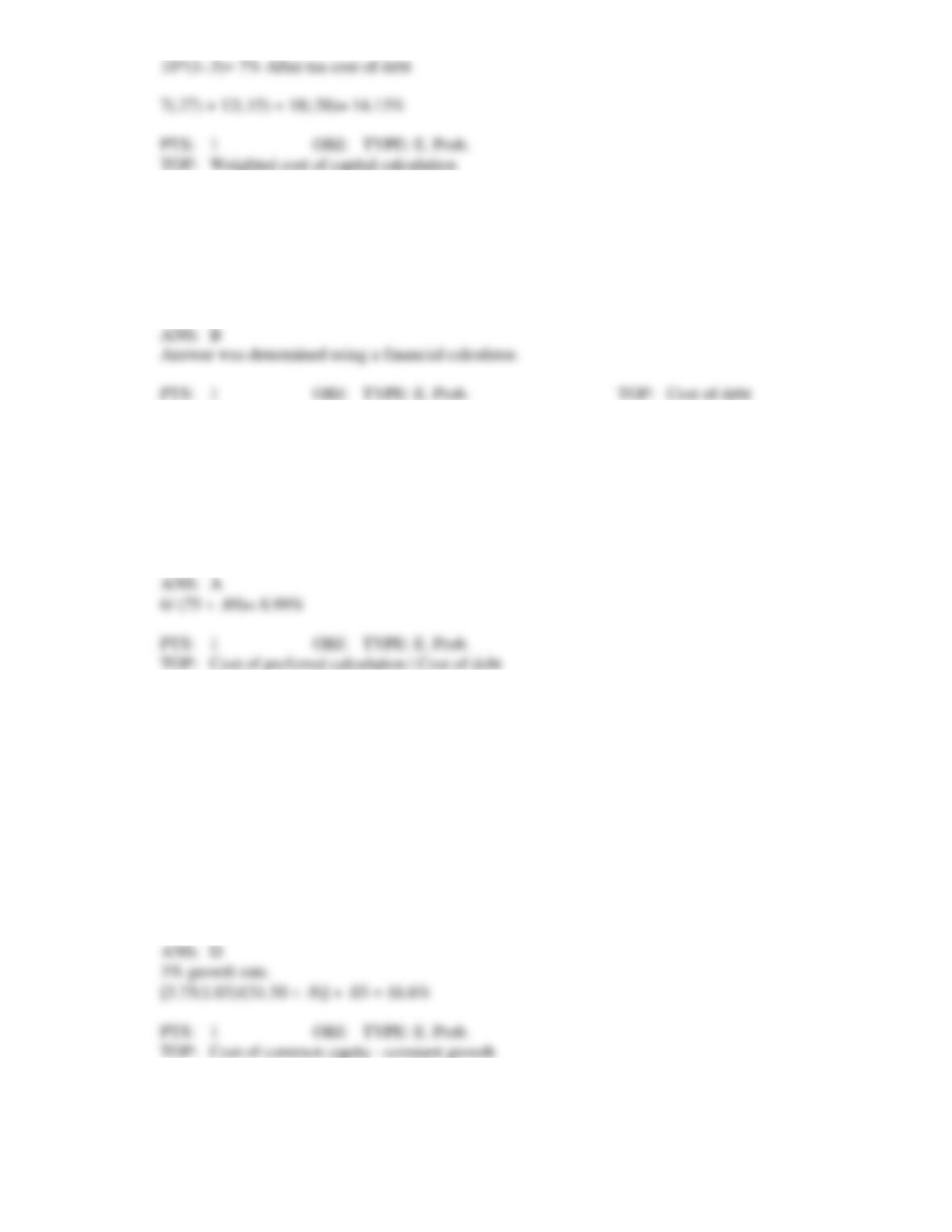
40. What is the cost of debt for a bond which has a $1,000 face value, costs $842 which is net of flotation
costs, has a coupon rate of 6.4% and will mature in 15 years? The firm’s tax rate is 35%.
a.
4.61%
b.
5.38%
c.
12.45%
d.
10.31%
41. Have No Clue Detective Agency is issuing preferred stock which pays a dividend of $6. It is
currently selling for $75 and flotation costs are 11% of its price. What is the cost of preferred stock
(rounded)?
a.
6%
b.
18%
c.
9%
d.
11%
42. What is the cost of equity for Rolling In Dough Bakeries if dividends are listed below and the price of
the stock is $31.50? Flotation costs are 10% of the price.
YEAR
DIVIDENDS
2005
$3.75
2004
$3.60
2003
$3.45
2002
$3.40
a.
12.8%
b.
22.7%
c.
15.2%
d.
16.6%
43. If last year’s dividend was $2.50, the anticipated constant growth rate is 4%, and the selling price of
the stock today is $28 per share with flotation costs for the new equity estimated to be 18%, what
would be the cost of equity?
a.
15.3%
b.
13.6%
c.
10.9%
d.
18.2%
44. The reason that the cost of internal equity is not zero is because of the:
a.
variable costs
b.
fixed costs
c.
opportunity costs
d.
weighted average cost of capital
45. Why is the cost of internal equity cheaper than the cost of external equity?
a.
Internal equity is easier to obtain.
b.
Internal equity does not incur flotation costs.
c.
Internal equity is deeply discounted.
d.
Internal equity is tax deductible.
46. Which of the following techniques may be used to determine the cost of equity?
I. The constant growth model
II. The capital asset pricing model
a.
I only
b.
II only
c.
Both I and II
d.
Neither I nor II
47. Which of the following items would be a method that common equity is raised?
I. It is raised internally by selling preferred stock.
II. It is raised externally by selling long-term bonds.
a.
I only
b.
II only
c.
Both I and II
d.
Neither I nor II
ESSAY
1. What are marginal costs and how does it compare to historical costs?
2. Explain the implications in choosing the appropriate capital structure.