
Chapter 12: Activity-Based Management
125. Which of the following is descriptive of financial-based responsibility accounting?
a. It assumes that activities are linked.
b. It assigns responsibility to organization units.
c. Its control emphasis is costs.
d. Its goal is continuous improvement.
126. Which of the following is NOT a necessary essential element of activity-based responsibility accounting?
a. Process management requires significant group activity.
b. Performance evaluation employs dynamic standards.
c. Performance evaluation uses only financial measures.
d. Performance evaluation is based on optimal standards.
127. The process which refers to the performance of a process in a new way to achieve major improvements is called:
a. Process improvement
b. Process creation
c. Process innovation
d. Process efficiency
128. Process improvement can be defined as
a. The performance of a process to achieve major improvements.
b. The adoption of new processes to meet strategic objectives.
c. The incremental or continual increases in the efficiency of a process.
d. The expression of performance measures in financial terms.
129. The process which refers to incremental or continual increases in the efficiency of an existing product is called:
a. Process elimination
b. Process innovation
c. Process creation
d. Process improvement
130. The process which refers to the adoption of new processes to meet strategic objectives is called:
a. Process creation
b. Process innovation
c. Process improvement
d. Process efficiency
Chapter 12: Activity-Based Management
131. Which of the following is NOT true about assigning rewards in activity-based responsibility accounting?
a. Rewards are assigned based on budgetary standards.
b. Rewards are assigned based on individual as well as team performance.
c. Rewards are assigned based on progress towards optimal standards.
d. Rewards include bonuses, profit sharing, and gainsharing.
132. The term(s )which refer(s) to a global incentive that encourages employees to contribute to the overall financial
well-being is(are) called
a. Bonuses
b. Demotion
c. Profit sharing
d. Gain sharing
133. The term(s) which refer(s) to an incentive that specifically relates to sharing the gains from improvements in
projects is(are) called
a. Bonuses
b. Gain sharing
c. Profit sharing
d. Stock options
134. The following is(are) awards made when performance is maintained or exceeds a specific measure:
a. Profit sharing
b. Stock options
c. Bonuses
d. Gain sharing
135. Describe how activity-based management and activity-based costing systems differ.
Chapter 12: Activity-Based Management
136. What is process value analysis?
137. What is Kaizen costing? How does activity analysis help reduce costs?
138. Given the following data:
Activity
Driver
SQ2016
AQ2016
SP2016
SQ2017
AQ2017
SP2017
Purchasing
Purchase Orders
2,000
3,000
$85
2,000
2,500
$85
Receiving
Receiving Orders
3,750
4,300
$60
3,750
4,000
$60
Moving
# of moves
0
300
$110
0
200
$110
Setups
# of setups
0
75
$210
0
50
$210
Required:
1. Determine the value-added and non-value added costs for each category for 2016
and 2017.
2. Prepare a trend report that compares 2016 and 2017.
Chapter 12: Activity-Based Management
139. Lionel, Inc., has developed ideal standards for four activities: labor, materials, inspection, and receiving.
Information is as follows:
Activity
Activity Driver
SQ
AQ
SP
Labor
Hours
500
550
$ 32
Materials
Pounds
2,000
2,500
48
Inspection
Inspection hours
0
375
22
Receiving
Orders
60
75
800
The actual prices paid per unit of each activity driver were equal to the standard prices.
Required:
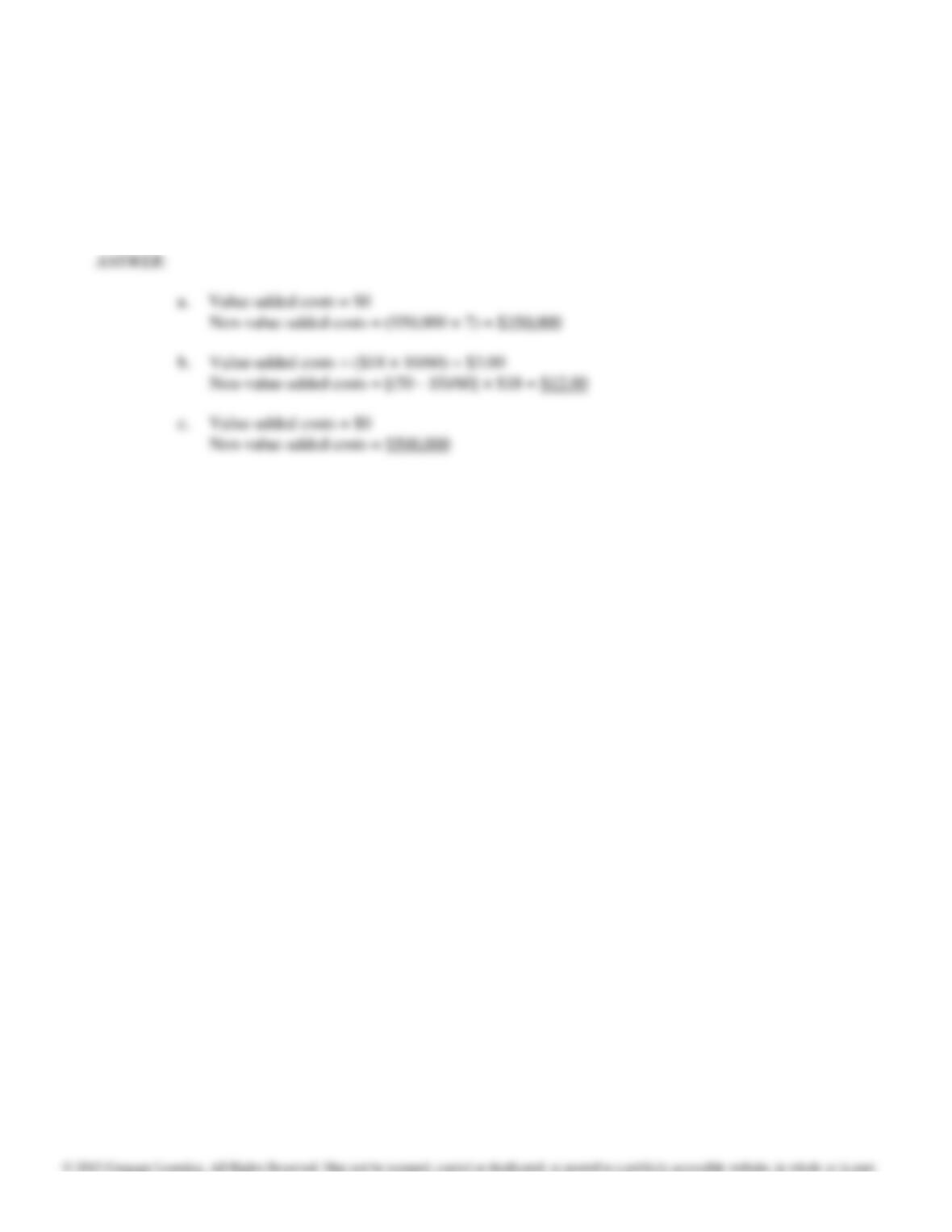
Complete the following cost report.
Activity
Value-Added
Non-value-Added
Actual
Labor
$_____________
$_____________
$____________
Materials
_____________
_____________
____________
Inspection
_____________
_____________
____________
Receiving
_____________
_____________
____________
Totals
$_____________
$_____________
$____________
Activity
Labor
$ 1,600
$ 17,600
Materials
24,000
120,000
Inspection
8,250
Receiving
12,000
Totals
$160,000
Chapter 12: Activity-Based Management
140. Goodyear,, Inc., has developed ideal standards for four activities: labor, materials, inspection, and receiving.
Information is as follows:
Activity
Activity Driver
SQ
AQ
SP
Labor
Hours
30,000
38,000
$11
Materials
Pounds
110,000
160,000
10
Inspection
Inspection hours
0
50,000
7
Receiving
Orders
600
700
450
The actual prices paid per unit of each activity driver were equal to the standard prices.
Required:
Complete the following cost report.
Activity
Value-Added
Non-value-Added
Actual
Labor
$_____________
$_____________
$____________
Materials
_____________
_____________
____________
Inspection
_____________
_____________
____________
Receiving
_____________
_____________
____________
Totals
$_____________
$_____________
$____________
(SQ SP)
Activity
Labor
$ 88,000
$ 418,000
Materials
1,600,000
Inspection
-0-
350,000
Receiving
Totals
Chapter 12: Activity-Based Management
141. The Opportunist Company recorded the following activities. Determine the amount of value-added and non-value-
added costs.
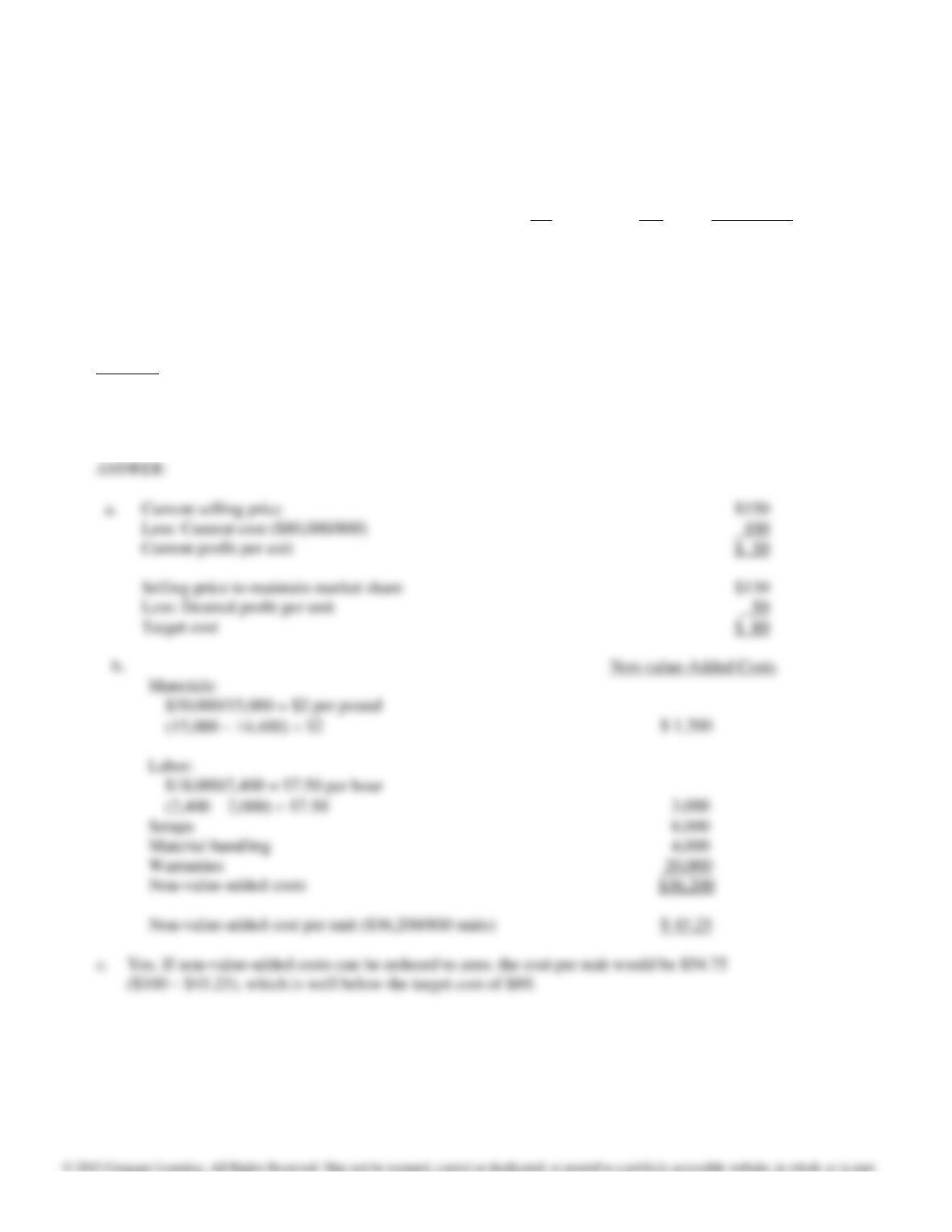
a. Opportunist keeps 7 days of materials inventory on hand to avoid shutdowns due to materials shortages.
Carrying costs are $50,000 per day.
b. A time-and-motion study revealed that it should take 10 minutes to produce a product that now takes 50
minutes to produce. Labor is $18 per hour.
c. Warranty work costs the firm $500,000 per year. Warranty costs for the industry average $100,000 per year.
Chapter 12: Activity-Based Management
142. Suburbia, Inc., sells one of its products for $150 each. Sales volume averages 800 units per year. Recently, its
main competitor reduced the price of its product to $130. Suburbia expects sales to drop dramatically unless it
matches the competitor’s price. In addition, the current profit per unit must be maintained. Information about the
product (for production of 800) is as follows:
SQ
AQ
Actual Cost
Materials (pounds)
14,400
15,000
$30,000
Labor (hours)
2,000
2,400
18,000
Setups (hours)
0
1,400
8,000
Material handling (moves)
0
600
4,000
Warranties (number repaired)
0
400
20,000
Required:
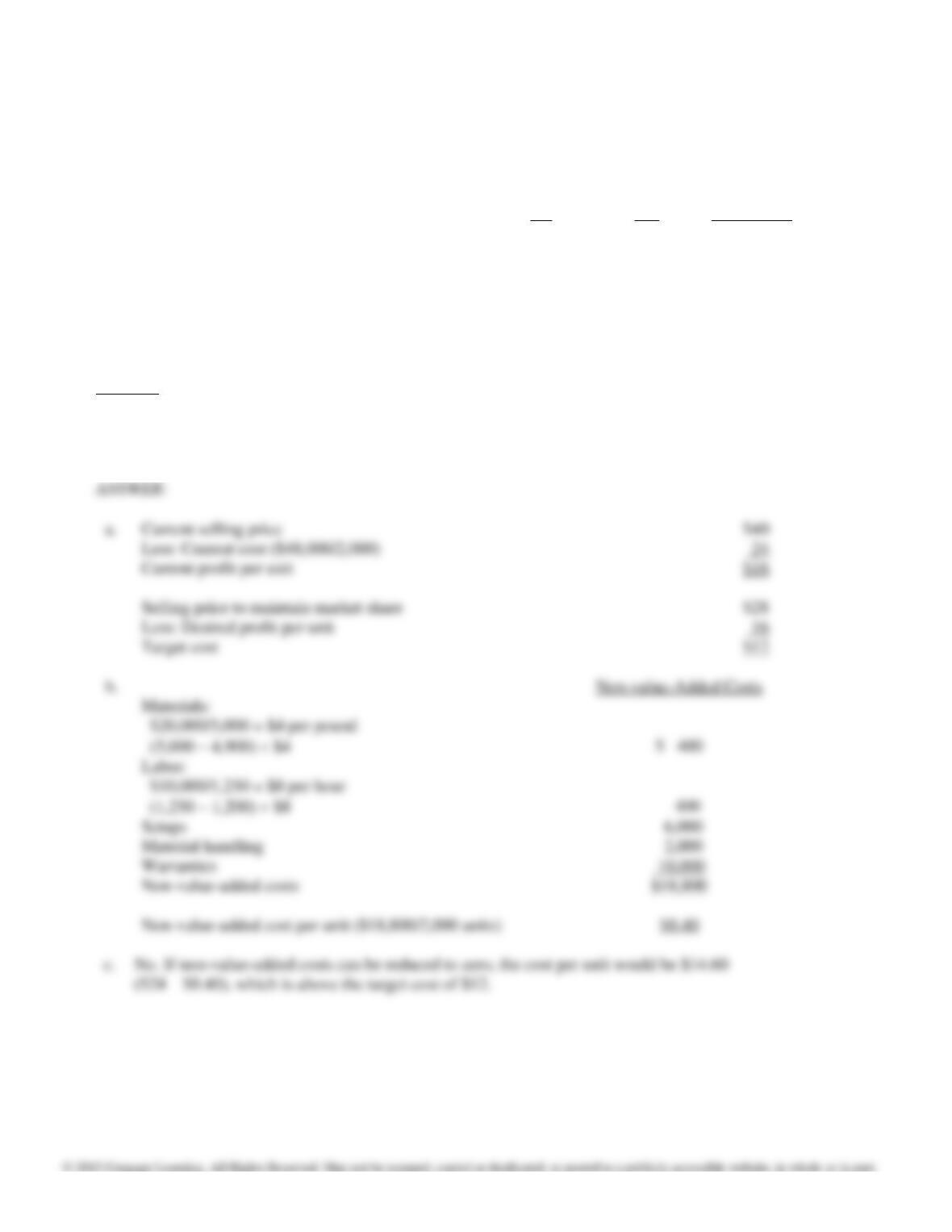
a. Calculate the target cost for maintaining current market share and profitability.
b. Calculate the non-value-added cost per unit.
c. If non-value-added costs can be reduced to zero, can the target cost be achieved?
Chapter 12: Activity-Based Management
143. Metropolitan, Inc., sells one of its products for $40 each. Sales volume averages 2,000 units per year. Recently, its
main competitor reduced the price of its product to $28. Metropolitan expects sales to drop dramatically unless it
matches the competitor’s price. In addition, the current profit per unit must be maintained. Information about the
product (for production of 2,000) is as follows:
SQ
AQ
Actual Cost
Materials (pounds)
4,900
5,000
$20,000
Labor (hours)
1,200
1,250
10,000
Setups (hours)
0
200
6,000
Material handling (moves)
0
350
2,000
Warranties (number repaired)
0
250
10,000
Required:
a. Calculate the target cost for maintaining current market share and profitability.
b. Calculate the non-value-added cost per unit.
c. If non-value-added costs can be reduced to zero, can the target cost be achieved?

Chapter 12: Activity-Based Management
144. Buoungiorno Manufacturing has developed the following standards for its activities:
ACTIVITY
ACTIVITY DRIVER
SQ
AQ
SP
Materials usage
Yards
48,000
50,000
$5
Purchasing
Purchase orders
1,000
1,200
$40
Inspection
Inspection hours
0
6,000
$10
Assume the materials usage and purchasing costs correspond to flexible resources that acquired as needed and that
inspections use resources that are acquired in blocks of 2,000 hours. The actual prices paid for inputs equal the
standard prices.
Required:
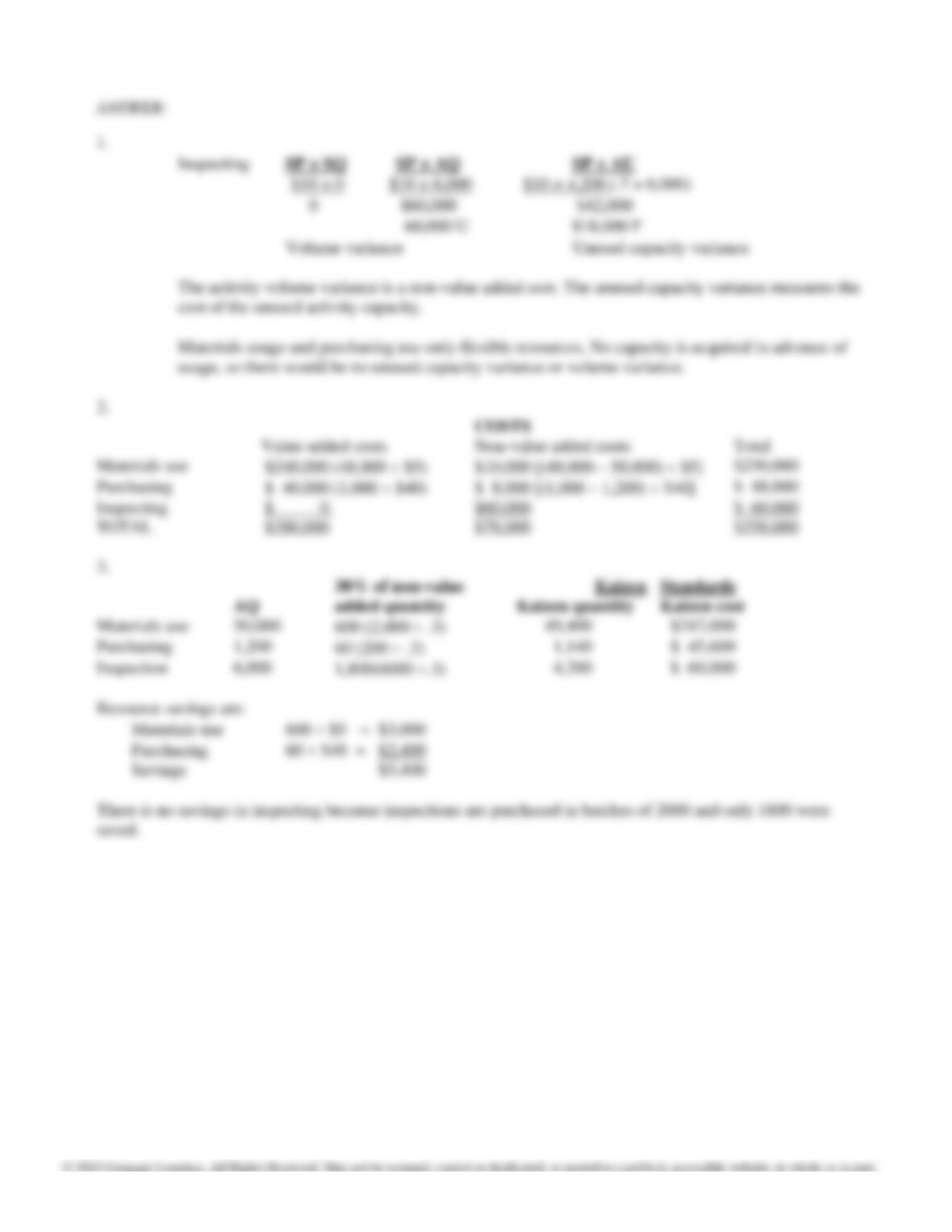
1. Assume that continuous improvement efforts reduce the demand for inspection by 30 percent during the
year, which drops the actual activity usage by 30 percent. Calculate the volume and unused capacity
variances for inspection activity, materials usage and purchasing. Explain the meaning of these variances.
2. Prepare a cost report that shows the value- and non-value-added costs.
3. Buoungiorno wants to reduce all non-value added costs by 30 percent. What Kaizen standards would be used to
evaluate the company’s progress? What would be the savings in resource spending?
Chapter 12: Activity-Based Management
Chapter 12: Activity-Based Management
145. Describe how the activity-based management model combines the process and costing views. What are the steps
involved in each? What are the objectives of the activity-based management system?
146. What is responsibility accounting? Compare and contrast financial-based responsibility accounting with
activity-based responsibility accounting.