Exam
Name___________________________________
SHORT ANSWER. Write the word or phrase that best completes each statement or answers the question.
Provide an appropriate response.
1)
What is the sum of the exponents of x and y in each term of the expansion of a binomial?
1)
2)
How many terms are in the expansion of (x + y)13?
2)
3)
Explain how to find the common difference for an arithmetic sequence if you are given a12
and a13.
3)
4)
Show that n
5=n(n – 1)(n – 2)(n – 3)(n – 4)
5!
4)
MULTIPLE CHOICE. Choose the one alternative that best completes the statement or answers the question.
Find the common difference, d, for the arithmetic sequence.
5)
8, 12, 16, 20, . . .
5)
A)
4
B)
8
C)
12
D)
20
Find the determinant.
6)
9 2
7 3
6)
A)
-3
B)
41
C)
13
D)
-13
Find the sample space for the experiment.
7)
There are 3 cards in a hat; one is a king, one is a queen, and one is an ace. A card is selected at
random and replaced and then a second card is selected.
7)
A)
{K Q , K A, Q K, Q A, A K, A Q}
B)
{K K, K Q , K A, Q Q, Q A, AQ, A A}
C)
{K K Q , K A K, Q Q Q, K Q , A A K}
D)
{K K, K Q , K A, Q K, Q Q, Q A, A K, A Q, A A}
Find x.
8)
3 x
2 -1 =9
8)
A)
-6
B)
6
C)
9
2
D)
3
1
Find an expression for the general term, an.
9)
1024, 256, 64, 16, . . .
9)
A)
an=1024(4) n – 1
B)
an=1024 1
3 n – 1
C)
an=1024 1
4 n – 1
D)
an=1024 1
5 n – 1
Solve the problem.
10)
A woman deposits $447 in the bank, and each month afterward deposits 4% more than the month
before. How much did she deposit for the year?
10)
A)
$715.66
B)
$12.48
C)
$6716.54
D)
$6028.40
Find the determinant.
11)
1
4 – 1
4
3
48
11)
A)
29
16
B)
35
16
C)
– 35
16
D)
0
Translate the problem to a system of equations, then solve using Cramer’s Rule.
12)
Jerry has 3 pieces of string. The total length is 82 inches. The sum of the two longer pieces is 70. The
middle piece is twice as long as the shortest piece. What are the lengths of the 3 pieces?
12)
A)
6, 12, and 64 inches
B)
12, 24, and 46 inches
C)
12, 46, and 56 inches
D)
No solution
Find the common ratio, r, for the given geometric sequence.
13)
81, 27, 9, 3, . . .
13)
A)
3
B)
1
2
C)
1
3
D)
1
4
Provide an appropriate response.
14)
Is -1, -2, -4, -8, . . . an arithmetic sequence?
14)
A)
Yes
B)
No
Find the event that corresponds with the outcome.
15)
Getting 2 tails if 3 coins are tossed.
15)
A)
TTH, HTT
B)
TTH, THT, HTT
C)
TTH, THT, HTT, TTT
D)
TT
Evaluate the binomial coefficient.
16)
8
4
16)
A)
35
B)
35
4
C)
280
D)
70
2

17)
31
1
17)
A)
32
B)
1
C)
30
D)
31
Find the probability.
18)
A box contains 3 white, 2 green, 2 red, and 1 blue marble. A marble is drawn at random and
replaced and then a second marble is drawn. Find the probability that both marbles are blue.
18)
A)
1
64
B)
1
16
C)
0
D)
1
4
Find the indicated probability.
19)
If you flip a coin three times, the possible outcomes are HHH, HHT, HTH, HTT, THH, THT, TTH,
TTT. What is the probability of getting more than one tail?
19)
A)
3
8
B)
1
8
C)
1
2
D)
5
8
Find x.
20)
4-4 3
0 5 9
0 0 x = –140
20)
A)
4
B)
7
C)
-7
D)
–4
Use the binomial theorem to expand the expression.
21)
(x – y)5
21)
A)
x5–y5
B)
–x5+5x4y –10x3y2+10x2y3– 5xy4+y5
C)
x5–5x4y +10x3y2–10x2y3+ 5xy4–y5
D)
x5+5x4y +10x3y2+10x2y3+ 5xy4+y5
Evaluate the expression.
22)
8P8
22)
A)
336
B)
40,320
C)
5040
D)
362,880
Solve the problem.
23)
Find the sum of the first 715 even natural numbers.
23)
A)
510,510
B)
512,656
C)
511,225
D)
511,940
24)
Find the sum of the first 717 natural numbers.
24)
A)
257,403
B)
514,089
C)
256,686
D)
514,806
Find the probability.
25)
In a poll, respondents were asked whether they had ever been in a car accident. 107 respondents
indicated that they had been in a car accident and 212 respondents said that they had not been in a
car accident. If one of these respondents is randomly selected, what is the probability of getting
someone who has been in a car accident? Round to the nearest thousandth, if necessary.
25)
A)
0.665
B)
0.505
C)
0.009
D)
0.335
3

Write the first four terms of the sequence and the indicated term.
26)
an=3n + 4, 20th term
26)
A)
7, 10, 13, 16, 61
B)
7, 10, 13, 16, 64
C)
4, 7, 10, 13, 61
D)
4, 10, 13, 16, 64
Evaluate the expression.
27)
11C11
27)
A)
39,916,800
B)
1
C)
0
D)
11
Provide an appropriate response.
28)
How do you find Dz when solving a system of equations using Cramer’s Rule?
28)
A)
Replace the x–column values with the constant–column values.
B)
Replace the y–column values with the constant–column values.
C)
Replace the x–column and y–column values with the constant–column values.
D)
Replace the z–column values with the constant–column values.
Write the first four terms of the sequence and the indicated term.
29)
an=(-1)n
n2+ 5, 10th term
29)
A)
1
6, – 1
9, 1
14, – 1
21 , 1
105
B)
– 1
6, 1
9, – 1
14 , 1
21, 1
105
C)
– 1
6, 1
9, – 1
14 , 1
21, – 1
105
D)
1
5, – 1
6, 1
9, – 1
14 , – 1
86
Find the indicated probability.
30)
A sample of 4 different calculators is randomly selected from a group containing 38 that are
defective and 23 that have no defects. What is the probability that all four of the calculators selected
are defective?
30)
A)
0.1342
B)
0.1414
C)
8.3360
D)
0.1506
Solve the problem.
31)
Find the first term of a geometric sequence with seventh term 1
128 and common ratio of 1
2.
31)
A)
1
4
B)
1
2
C)
1
D)
2
Use the formula for the nth term to find r.
32)
a = –243, r < 0, a5= –3
32)
A)
–1
4
B)
1
3
C)
-3
D)
–1
3
Solve using Cramer’s Rule.
33)
3x + 4y + z = -28
3x – 5y – z = 9
2x + y + 4z = 3
33)
A)
(-4, -5, 4)
B)
(4, -5, -4)
C)
(-4, 4, -5)
D)
No solution
4
Write the first five terms of the geometric sequence satisfying the given conditions.
34)
a =64, r =1
2
34)
A)
4, 8, 16, 32, 64
B)
64, 32, 16, 8, 4
C)
32, 16, 8, 4, 2
D)
2, 4, 8, 16, 32
Use the binomial theorem to expand the expression.
35)
(a – b)6
35)
A)
a6– 6a5b – 15a4b2– 20a3b3– 15a2b4– 6ab5– b6
B)
a6+ 6a5b + 15a4b2+ 20a3b3+ 15a2b4+ 6ab5+ b6
C)
a6– 6a5b + 15a4b2– 20a3b3+ 15a2b4– 6ab5+ b6
D)
–a6+ 6a5b – 15a4b2+ 20a3b3– 15a2b4+ 6ab5– b6
Solve the problem.
36)
In how many ways can you answer the questions on an exam that consists of 7 multiple choice
questions, each of which has 3 answer choices?
36)
A)
2187
B)
1957
C)
343
D)
3027
Solve using Cramer’s Rule.
37)
0.6x + 0.8y = -5.8
x – 0.6y = 0
37)
A)
(-3, -5)
B)
(0.3, 0.5)
C)
(-0.3, -0.5)
D)
(-5, -3)
38)
3x + 5z = 28
7x + 8y + 9z = 68
6x – 4y = –2
38)
A)
(1, -2, -5)
B)
(2, 5, 2)
C)
(1, 2, 5)
D)
(2, 0, 5)
Write the first five terms of the geometric sequence satisfying the given conditions.
39)
a =7, r =-5
39)
A)
-35, 175, -875, 4375, -21,875
B)
7, 35, 175, 875, 4375
C)
7, -35, 175, –875, 4375
D)
7, 2, -10, -8, -13
Write the repeating decimal as a fraction.
40)
0.95
40)
A)
95
9
B)
19
20
C)
95
99
D)
95
999
Find x.
41)
-2 5
1 x =-9
41)
A)
2
B)
-9
C)
7
D)
No solution
5
Solve using Cramer’s Rule.
42)
-4x – 7y = 7
2x + 3y = -3
42)
A)
(0, 0)
B)
(-1, 0)
C)
(0, -1)
D)
No solution
Find the sample space for the experiment.
43)
A couple plans to have four children. List the elements that make up the sample space. (Use “B” for
“boy” and “G” for “girl.”)
43)
A)
{BBBB, BBBG, BBGB, BBGG, BGBB, BGBG, BGGB, BGGG, GBBB, GBBG, GBGB, GBGG, GGBB,
GGBG, GGGB, GGGG}
B)
{BBBG, BBGB, BBGG, BGBB, BGBG, BGGB, BGGG, GBBB, GBBG, GBGB, GBGG, GGBB,
GGBG, GGGB}
C)
{BBBB, BBB, BB, B}
D)
{BBBB, BBBG, BBGG, BGGG, GGGG}
Answer the question.
44)
an=300(1.02)n : Find the 8th term of the sequence.
44)
A)
2448
B)
344.6057
C)
358.527771
D)
351.497814
Solve using Cramer’s Rule.
45)
8x – 8y + 6z = 70
–5x + 7y + 2z = 20
6x – 7y – 6z = -48
45)
A)
(9, 4, 9)
B)
(8, -6, -9)
C)
(6, 9, 6)
D)
(8, 6, 9)
Solve the problem.
46)
A town has a population of 3000 people and is increasing by 9% every year. What will the
population be at the end of 11 years?
46)
A)
8438 people
B)
7741 people
C)
7102 people
D)
5970 people
Find the determinant.
47)
6 8 3
7 7 5
6 6 3
47)
A)
18
B)
-462
C)
966
D)
–18
Find the sum of the infinite geometric series, if possible. If it is not possible, explain why. If necessary, round to three
decimal places.
48)
12 –4+4
3–. . .
48)
A)
18
B)
The sum does not exist because r 1.
C)
9
D)
6
6
Find the probability.
49)
A box contains 3 white, 2 green, 2 red, and 1 blue marble. A marble is drawn at random and
replaced and then a second marble is drawn. Find the probability that both marbles are red.
49)
A)
1
2
B)
1
16
C)
1
28
D)
1
4
Solve the problem.
50)
A person ordering a certain model of car can choose any of 9 colors, either manual or automatic
transmission, and any of 8 audio systems. How many ways are there to order this model of car?
50)
A)
154
B)
144
C)
140
D)
152
Use the formula for the nth term to find r.
51)
a =-3 , r > 0, a4=-81
51)
A)
3
B)
1
3
C)
81
D)
9
Solve using Cramer’s Rule.
52)
x + 4y = -27
-7x + 3y = -28
52)
A)
(0, –6)
B)
(-1, –6)
C)
(1, –7)
D)
No solution
Evaluate the expression.
53)
5C0
53)
A)
120
B)
0
C)
5
D)
1
Find the indicated probability.
54)
A bag contains 5 red marbles, 4 blue marbles, and 1 green marble. A marble is drawn at random
from the bag. What is the probability of choosing a marble that is not blue?
54)
A)
3
5
B)
5
3
C)
6
D)
2
5
Solve using Cramer’s Rule.
55)
1
3x – 1
2y + 5
6z = 0
3
2x + 1
4y + 2
3z = – 23
6
1
2x + 3
4y + 1
4z = – 4
55)
A)
(1, –4, 2)
B)
(-1, –4, -2)
C)
(-1, 4, -2)
D)
(1, –4, -2)
Translate the problem to a system of equations, then solve using Cramer’s Rule.
56)
During the 2001–2002 Little League season, the Tigers played 51 games. They won 19 more games
than they lost. How many games did they win that season?
56)
A)
37 games
B)
35 games
C)
32 games
D)
16 games
7

Solve the problem.
57)
In how many ways can you answer the questions on an exam that consists of 5 multiple choice
questions, each of which has 4 answer choices, followed by 5 true–false questions?
57)
A)
32,768
B)
157,598
C)
615,873
D)
20,318
Find the event that corresponds with the outcome.
58)
Rolling a total of 1 on a single roll of 2 dice.
58)
A)
(1, 1)
B)
no event
C)
(1, 0), (0, 1)
D)
(1, 0)
Write the first four terms of the geometric sequence.
59)
a = –64, r < 0, a5= –4
59)
A)
64, –32, 16, –8
B)
–64, 32, –16, 8
C)
32, –16, 8, –4
D)
–64, –32, –16, –8
Find the indicated probability.
60)
Two fair 6–sided dice are rolled. What is the probability that the sum of the two numbers on the
dice is greater than 10?
60)
A)
3
B)
1
18
C)
1
12
D)
5
18
Solve the problem.
61)
Find the sum of the first 455 odd natural numbers.
61)
A)
207,936
B)
207,480
C)
207,025
D)
206,116
Find the determinant.
62)
0.6 6
-1 –40
62)
A)
0
B)
18
C)
-30
D)
-18
Evaluate the expression.
63)
8P4
63)
A)
4
B)
70
C)
1680
D)
2
Expand by minors along the first column.
64)
x y 1
-4 1–5
2 0 1
64)
A)
x + 6y – 2
B)
x – 6y – 2
C)
x – 6y + 2
D)
–x – 6y – 2
Solve the problem.
65)
A woman deposits $213 in the bank, and each month afterward deposits 4% more than the month
before. How much did she deposit the 10th month?
65)
A)
$1.42
B)
$239.60
C)
$303.17
D)
$327.90
8

Solve using Cramer’s Rule.
66)
7x – 4y – z = 22
x – 2y – 7z = -8
5x + y + z = 29
66)
A)
(5, -3, -1)
B)
(3, 1, 3)
C)
(6, 1, 1)
D)
(5, 3, 1)
Solve the problem.
67)
If a person puts one penny in a piggy bank on the first day, two pennies in on the second day, three
pennies in on the third day, and so forth, how much money will be in the bank after 60 days?
67)
A)
$36.60
B)
$18.30
C)
$0.60
D)
$9.15
Find the indicated probability.
68)
If you flip a coin three times, the possible outcomes are HHH, HHT, HTH, HTT, THH, THT, TTH,
TTT. Find the probability of getting the same thing on all three coins.
68)
A)
1
2
B)
1
4
C)
1
8
D)
3
8
Find the determinant.
69)
1 2 1
5 3 1
5 1 5
69)
A)
-36
B)
36
C)
-56
D)
96
Use the formula for the nth term to find r.
70)
a =32, r > 0, a5=2
70)
A)
2
B)
1
4
C)
1
2
D)
–1
2
Find the indicated term.
71)
27, –9, 3, –1, . . . ; 9th term
71)
A)
–1
729
B)
1
729
C)
1
243
D)
–1
243
Solve using Cramer’s Rule.
72)
2.1x + 1.5y = 27.3
2.0x – 1.7y = 4.1
72)
A)
(-8, -7)
B)
(8, 7)
C)
(7, 8)
D)
(-7, 8)
Find the event that corresponds with the outcome.
73)
Getting all coins come up the same if 3 coins are tossed.
73)
A)
HHH, TTT, HHT, TTH
B)
TTT
C)
HHH, TTT
D)
HHH, TTT, TT, HH
9
Translate the problem to a system of equations, then solve using Cramer’s Rule.
74)
The sum of a student’s three scores is 218. If the first is 22 points more than the second, and the sum
of the first two is 14 more than twice the third, what was the first score?
74)
A)
64
B)
46
C)
86
D)
68
Find the indicated probability.
75)
If you flip a coin three times, the possible outcomes are HHH, HHT, HTH, HTT, THH, THT, TTH,
TTT. What is the probability of getting fewer than two heads?
75)
A)
1
2
B)
1
8
C)
5
8
D)
3
8
Find the event that corresponds with the outcome.
76)
Getting a head on the first toss if 3 coins are tossed.
76)
A)
H
B)
HHH, HHT, HTT
C)
HHH, HHT, HTH, HTT
D)
HHH, HHT, HTH, HTT, HHT
Find the indicated probability.
77)
Two 6–sided dice are rolled. What is the probability that the two numbers obtained differ by more
than 2?
77)
A)
1
4
B)
1
3
C)
11
36
D)
13
36
Solve the problem.
78)
A collection of dimes is arranged in a triangular array, with 16 coins in the base row, 15 in the next,
14 in the next, and so forth. Find the value of the collection.
78)
A)
$13.60
B)
$1.36
C)
$6.80
D)
$27.20
79)
There are 10 different books on a table. In how many ways can 7 books be chosen?
79)
A)
120
B)
86,400
C)
546
D)
604,800
Find the determinant.
80)
4 0 0
6-8 0
-8 9 7
80)
A)
224
B)
–224
C)
–278
D)
170
Write the first five terms of the geometric sequence satisfying the given conditions.
81)
a = –9, r =-7
81)
A)
9, -63, 441, -3087, 21,609
B)
–9, -63, –441, -3087, –21,609
C)
9, 2, -14, -12, -19
D)
–9, 63, –441, 3087, –21,609
Solve using Cramer’s Rule.
82)
3x + 2y = 42
2x – 3y = -11
82)
A)
(-9, 8)
B)
(8, 9)
C)
(-8, -9)
D)
(9, 8)
10
Use the formula for the nth term to find r.
83)
a =1, a4=-27
83)
A)
81
B)
-4
C)
3
D)
-3
Find the indicated term.
84)
a = – 3, r =4 ; 7th term
84)
A)
49,152
B)
-4096
C)
-12,288
D)
196,608
Find the sum of the infinite geometric series, if possible. If it is not possible, explain why. If necessary, round to three
decimal places.
85)
2 –5+25
2–. . .
85)
A)
2.5
B)
0
C)
5
D)
The sum does not exist because r 1.
Find the indicated term.
86)
a =160, r =1
2 ; 10th term
86)
A)
160
B)
5
32
C)
5
64
D)
5
16
Find the indicated probability.
87)
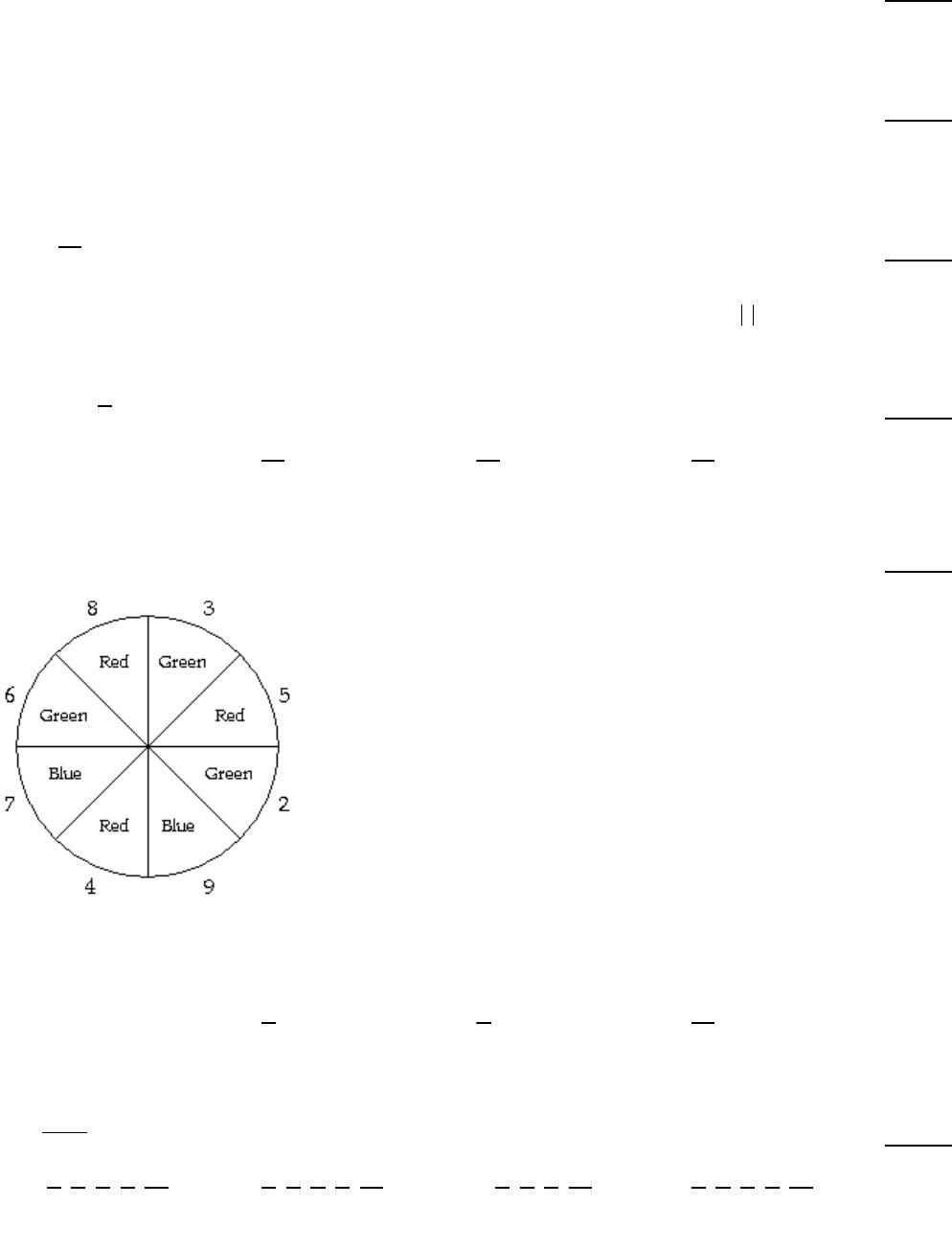
A dart is thrown randomly and sticks on the circular dart board shown.
Assuming the dart does not land on a border between colored areas, find the probability that the
dart lands on an area marked with a number greater than 2 and less than or equal to 9. Assume that
all sectors are of equal size.
87)
A)
1
B)
7
8
C)
3
4
D)
7
10
Write the first four terms of the sequence and the indicated term.
88)
an=n
n + 2 , 19th term
88)
A)
1
3, 1
2, 3
5, 2
3, 19
21
B)
1
3, 1
2, 3
5, 2
3, 19
6
C)
0, 1
3, 1
2, 3
5, 9
10
D)
1
3, 1
4, 1
5, 1
6, 1
21
11
Find the determinant.
89)
0.1 -0.1
-0.4 -0.5
89)
A)
-0.21
B)
0.09
C)
-0.09
D)
-0.01
Translate the problem to a system of equations, then solve using Cramer’s Rule.
90)
The perimeter of a rectangle is 24 meters. If the width is doubled and the length is tripled, the
perimeter is 60 meters. Determine the original width and length.
90)
A)
width =10 m, length =20 m
B)
width =8 m, length =12 m
C)
width =6 m, length =6 m
D)
width =12 m, length =12 m
Solve the problem.
91)
Find the common difference of an arithmetic sequence if the first term is 3 and the 8th term is 31.
91)
A)
-4
B)
28
C)
4
D)
-28
Provide an appropriate response.
92)
Find the minor of 2 in 1 3 -2
2 -2 1
-4 -1 6. Do not evaluate.
92)
A)
1 3
-4 -1
B)
3-2
-2 1
C)
-2 1
-1 6
D)
3-2
-1 6
Evaluate the expression.
93)
6P4
93)
A)
2
B)
360
C)
30
D)
24
Find an expression for the general term, an.
94)
64, –16, 4, –1, . . .
94)
A)
an=64 – 1
5 n – 1
B)
an=64 1
4 n – 1
C)
an=64(-4) n – 1
D)
an=64 – 1
4 n – 1
Find the sum of the infinite geometric series, if possible. If it is not possible, explain why. If necessary, round to three
decimal places.
95)
6+3+3
2+. . .
95)
A)
4
B)
12
C)
The sum does not exist because r 1.
D)
2
Write the series and find the sum.
96)
5
i = 1 2i2
96)
A)
2+4+6+8+10 =30
B)
4+16 +36 +64 +100=220
C)
4+8+12 +16 +20 =60
D)
2+8+18 +32 +50 =110
12
Translate the problem to a system of equations, then solve using Cramer’s Rule.
97)
Twice the water flow in the hot–water pipe is the same as three times the flow in the cold–water
pipe. The combined flow is 1200 liters per hour. What is the flow in each pipe?
97)
A)
400liters/hr hot, 600liters/hr cold
B)
720liters/hr hot, 480liters/hr cold
C)
600liters/hr hot, 400liters/hr cold
D)
480liters/hr hot, 720liters/hr cold
Use the binomial theorem to expand the expression.
98)
(-4m + 4n)4
98)
A)
256m4– 16,384m3n + 9216m2n2– 1024mn3+ 256n4
B)
256m4– 1024m3n – 1536m2n2– 1024mn3– 256n4
C)
256m4– 1024m3n + 1536m2n2– 1024mn3+ 256n4
D)
256m4– 16,384m3n – 9216m2n2– 1024mn3– 256n4
Find the event that corresponds with the outcome.
99)
Rolling a total of 6 on a single roll of 2 dice.
99)
A)
(1, 5), (2, 4), (3, 3)
B)
(6, 1), (6, 2), (6, 3), (6, 4), (6, 5), (6, 6)
C)
(1, 5), (2, 4), (3, 3), (4, 2), (5, 1)
D)
(6, 6)
Find the given Sn for the arithmetic series.
100)
7+12 +17 +22 +. . . . Find S28.
100)
A)
4312
B)
2086
C)
4172
D)
7952
Find the determinant.
101)
1 2 3
2 5 5
4 3 3
101)
A)
160
B)
–14
C)
-94
D)
14
Find the indicated term.
102)
4, -12, 36, -108 , . . . ; 5th term
102)
A)
81
B)
-108
C)
324
D)
2916
103)
3, 12, 48, 192 , . . . ; 10th term
103)
A)
262,144
B)
3,145,728
C)
12,582,912
D)
786,432
If a triangle has vertices of (x1, y1),(x2, y2), and (x3, y3) then the area of the triangle is given by A =1
2 det
x1y1 1
x2y21
x3y31 .
Find the area of the triangle with vertices at the given points.
104)
(2, 5) (5, 7) (8, 4)
104)
A)
2.5
B)
15
C)
7.5
D)
5
Write the indicated term of the binomial expansion.
105)
(x + 3y)14, 5th term
105)
A)
27,027x10y5
B)
81,081x10y4
C)
81,081x4y10
D)
27,027x4y10
13
Solve the problem.
106)
How many ways can a president, vice–president, and secretary be chosen from a club with 12
members?
106)
A)
220
B)
1320
C)
6
D)
36
Write the first four terms of the geometric sequence.
107)
a =3, a4=-81
107)
A)
-3 , -9 , -27, -81
B)
3, -9 , 27, -81
C)
3, -9 , -27, -81
D)
-9 , 27, -81 , 243
Evaluate the expression.
108)
12C9
108)
A)
4
9
B)
79,833,600
C)
220
D)
1320
Find the indicated probability.
109)
A bag contains 3 red marbles, 2 blue marbles, and 5 green marbles. A marble is drawn at random
from the bag. What is the probability of drawing a blue marble?
109)
A)
3
10
B)
1
2
C)
1
5
D)
2
5
Find the determinant.
110)
0-5
-2 0
110)
A)
10
B)
0
C)
-7
D)
-10
Evaluate the binomial coefficient.
111)
7
0
111)
A)
6
B)
720
C)
7
D)
1
Find the sample space for the experiment.
112)
A day of the week is selected at random.
112)
A)
{7}
B)
{Weekday, Weekend}
C)
{Monday, Tuesday, Wednesday, Thursday, Friday, Saturday, Sunday}
D)
{Monday, Tuesday, Wednesday, Thursday, Friday}
Find the common difference, d, for the arithmetic sequence.
113)
20, 16, 12, 8, . . .
113)
A)
-12
B)
4
C)
-4
D)
-8
14
Find the indicated term and an expression for the nth term of the given arithmetic sequence.
114)
a19 of 15, 17, 19, 21, . . .
114)
A)
an=2n + 13, a19 =51
B)
an=2n + 17, a19 =55
C)
an=2n + 15, a19 =53
D)
an=2n – 2, a19 =36
Write the first four terms of the arithmetic sequence with the given characteristics.
115)
d =6, a8=29
115)
A)
29, 35, 41, 47
B)
-7, -1, 5, 11
C)
0, -13, -7, -1
D)
-13, -7, -1, 5
Find the event that corresponds with the outcome.
116)
Rolling a 4 on the red die when a red die and a blue die are rolled.
116)
A)
(4, 4)
B)
(4, 1), (4, 2), (4, 3), (4, 4), (4, 5), (4, 6), (1, 4), (2, 4), (3, 4), (5, 4), (6, 4)
C)
(1, 3), (2, 2), (3, 1)
D)
(4, 1), (4, 2), (4, 3), (4, 4), (4, 5), (4, 6)
Solve the problem.
117)
Suppose there are 5 roads connecting town A to town B and 3 roads connecting town B to town C.
In how many ways can a person travel from A to C via B?
117)
A)
8
B)
15
C)
25
D)
9
Find the number of elements in the sample space of the experiment.
118)
Selecting a marble from a bag containing 6 marbles and selecting a chip from a bag containing 7
chips.
118)
A)
36
B)
42
C)
13
D)
49
Answer the question.
119)
an=400(1.04)n : Find the first five terms of the sequence.
119)
A)
400, 1.0816, 1.124864, 1.16985856, 1.2166529
B)
416, 432.64, 449.9456, 467.943424, 486.661161
C)
416, 832, 1248, 1664, 2080
D)
400, 416, 432.64, 449.9456, 467.943424
Find the indicated term.
120)
256, 64, 16, 4, . . . ; 7th term
120)
A)
16
B)
1
16
C)
1
64
D)
64
Solve the problem.
121)
A town has a population of 10,000 people and is increasing by 10% every year. What will the
population be at the end of 4 years?
121)
A)
14,000 people
B)
13,310 people
C)
14,641 people
D)
4641 people
Find the sum of the first n terms of the geometric series for the given value of n. If necessary, round to three decimal
places.
122)
16 –8+4–2+. . . , n =11
122)
A)
10.672
B)
-1.334
C)
31.984
D)
1.334
15
Solve using Cramer’s Rule.
123)
3x + 3y = –3
3x + y = -7
123)
A)
(3, -2)
B)
(-3, 2)
C)
(-2, -3)
D)
(2, -3)
Solve the problem.
124)
Suppose Janet could save $4 at the end of January, $8 at the end of February, $16 at the end of
March, and so on. What amount would she have saved by the end of one year? Round to the
nearest cent.
124)
A)
$4095.00
B)
$8190.00
C)
$252.00
D)
$16,380.00
Use the formula for the nth term to find r.
125)
a =-4 , r > 0, a5=-64
125)
A)
8
B)
16
C)
2
D)
1
2
Solve using Cramer’s Rule.
126)
0.3x – 0.5y + 0.8z = -3.3
1.6x + 0.2y + 0.6z = 1.2
0.4x + 0.7y + 0.1z = 3
126)
A)
(–1, 4, 2)
B)
(–1, 4,-2)
C)
(1, 4, -2)
D)
(1, -4, -2)
Find the determinant.
127)
4-10
0–3
127)
A)
-2
B)
-40
C)
12
D)
-12
Write the repeating decimal as a fraction.
128)
0.3
128)
A)
3
10
B)
3
999
C)
1
3
D)
1
33
Solve the problem.
129)
Find the common difference of an arithmetic sequence if the first term is 2 and the 44th term is -213.
129)
A)
5
B)
215
C)
-5
D)
-215
Write the indicated term of the binomial expansion.
130)
(3x + 2y)10, 5th term
130)
A)
816,480x4y6
B)
1,224,720x6y5
C)
2,449,440x6y4
D)
1,224,720x4y6
Solve the problem.
131)
Find the first term of an arithmetic sequence if a49 =133 and d =3.
131)
A)
-8
B)
-11
C)
-14
D)
3
16

Find the sum of the infinite geometric series, if possible. If it is not possible, explain why. If necessary, round to three
decimal places.
132)
3+6+12 +. . .
132)
A)
12
B)
2
C)
21
D)
The sum does not exist because r 1.
Find the indicated probability.
133)
If you flip a coin three times, the possible outcomes are HHH, HHT, HTH, HTT, THH, THT, TTH,
TTT. Find the probability of getting exactly two tails.
133)
A)
5
8
B)
1
4
C)
3
8
D)
1
2
Find the common ratio, r, for the given geometric sequence.
134)
625, –125, 25, –5, . . .
134)
A)
–1
5
B)
1
5
C)
-5
D)
–1
6
Solve the problem.
135)
A woman deposits $191 in the bank, and each month afterward deposits 7% more than the month
before. Find an expression for the amount she deposits on the nth month.
135)
A)
191(1.07) n
B)
191(1.07) n+1
C)
191(1.07) n-1
D)
191(1.7)n-1
Find the sample space for the experiment.
136)
There are 3 balls in a hat; one with the number 3 on it, one with the number 6 on it, and one with
the number 8 on it. You pick a ball from the hat at random and then you flip a coin.
136)
A)
{3 H, 3 T, 6 H, 6 T, 8 H, 8 T}
B)
{3 H T, 6 H T, 8 H T}
C)
{3 H, 6 H, 8 H}
D)
{3 6 8 H, 3 6 8 T}
Write the first four terms of the arithmetic sequence with the given characteristics.
137)
a1=3, a31 =213
137)
A)
3, 10, 17, 24
B)
10, 17, 24, 31
C)
213, 220, 227, 234
D)
0, 3, 10, 17
Evaluate the expression.
138)
6!
138)
A)
1440
B)
120
C)
720
D)
360
Solve the problem.
139)
There are 9 essay questions on a test. Students must select 3 of them to answer. In how many ways
can the 3 questions be chosen?
139)
A)
84
B)
504
C)
91
D)
82
Find the probability.
140)
Two marbles are drawn without replacement from a box containing 3 white, 2 green, 2 red, and 1
blue marble. Find the probability that both marbles are white.
140)
A)
3
8
B)
3
32
C)
9
64
D)
3
28
17

Evaluate the expression.
141)
10P4
141)
A)
6
B)
5040
C)
34
D)
210
Find the sum of the first n terms of the geometric series for the given value of n. If necessary, round to three decimal
places.
142)
16 +8+4+2+. . . , n =8
142)
A)
3.984
B)
10.625
C)
1.328
D)
31.875
Find the determinant.
143)
0.9 1.3 –3.7
–5.3 2.4 –1.4
6.7 –0.4 4.9
143)
A)
84.307
B)
31.465
C)
-35.693
D)
83.299
Find the number of elements in the sample space of the experiment.
144)
Choosing a committee of 4 from a club with 10 members.
144)
A)
5040
B)
40
C)
210
D)
10,000
Provide an appropriate response.
145)
Can you find the sum of the first n terms of the geometric series 2+4+8+. . . ? Why or Why not?
145)
A)
Yes. The common ratio, r, is equal to 1.
B)
No. The common ratio, r, is greater than 1.
C)
No. The first n terms do not form a geometric series.
D)
Yes. The first n terms form a finite geometric series.
If a triangle has vertices of (x1, y1),(x2, y2), and (x3, y3) then the area of the triangle is given by A =1
2 det
x1y1 1
x2y21
x3y31 .
Find the area of the triangle with vertices at the given points.
146)
(1, -3) (1, 1) (4, 3)
146)
A)
12
B)
2.5
C)
6
D)
5
Find the given Sn for the arithmetic series.
147)
If a1=12 and d =5, find S26.
147)
A)
1937
B)
3874
C)
4004
D)
7124
Find x.
148)
7-2 3
0 x 8
0 0 -8
= –448
148)
A)
8
B)
–7
C)
–8
D)
7
18
Solve using Cramer’s Rule.
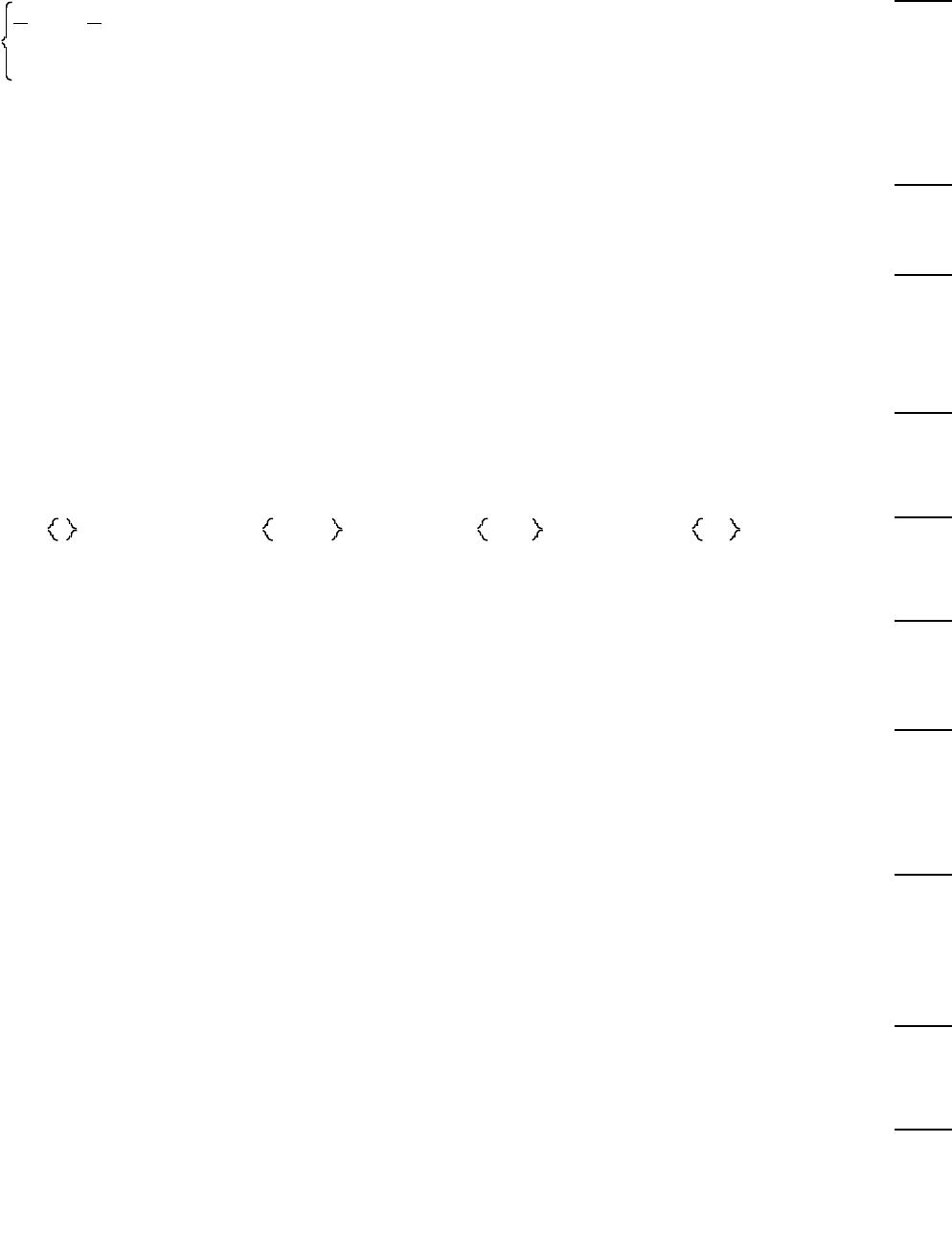
149)
3
5x + y = 1
5
3x + y = -7
149)
A)
(2, -3)
B)
(3,-2)
C)
(-3, 2)
D)
(-2,-3)
Write the first four terms of the geometric sequence.
150)
a =160, r > 0, a5=10
150)
A)
160, –80, 40, –20
B)
160, 80, 40, 10
C)
160, 80, 40, 20
D)
80, 40, 20, 10
151)
a =-4 , r > 0, a4=–108
151)
A)
–12, –36, –108, –324
B)
4, –12, 36, –108
C)
–4, 12, –36, 108
D)
–4, –12, –36, –108
Solve the problem.
152)
In how many ways can 5 letters from the word PAYMENT be chosen and arranged?
152)
A)
1260
B)
35
C)
2520
D)
42
Find the event that corresponds with the outcome.
153)
Getting a number greater than 4 on a single roll of a die.
153)
A)
5
B)
5, 6, …..
C)
4, 5, 6
D)
5, 6
Write the first four terms of the arithmetic sequence with the given characteristics.
154)
a1=8, d =4
154)
A)
8, 11, 14, 17
B)
0, 8, 12, 16
C)
8, 12, 16, 20
D)
12, 16, 20, 24
Write the first four terms of the geometric sequence.
155)
a =-4 , r > 0, a5=-64
155)
A)
–8, –16, –32, –64
B)
–4, –8, –16, –32
C)
–4, 8, –16, 32
D)
4, –8, 16, –32
Use the binomial theorem to expand the expression.
156)
(x + y)4
156)
A)
x4+ 4x2y2+y4
B)
x4+ 4x3+ 6x2+ 4x + 1
C)
x4+ 4x3y + 4x2y2+ 4xy3+y4
D)
x4+ 4x3y + 6x2y2+ 4xy3+y4
Evaluate the expression.
157)
7P1
157)
A)
1
B)
0
C)
5040
D)
7
Solve the problem.
158)
Sonya takes a job that pays $3500 the first year and a raise of $500 per year. What will her salary be
for the 15th year?
158)
A)
$10,500
B)
$7000
C)
$11,000
D)
None of the above
19
159)
In how many ways can you answer the questions on an exam that consists of 11 true–false
questions?
159)
A)
2128
B)
1984
C)
2048
D)
2168
Solve using Cramer’s Rule.
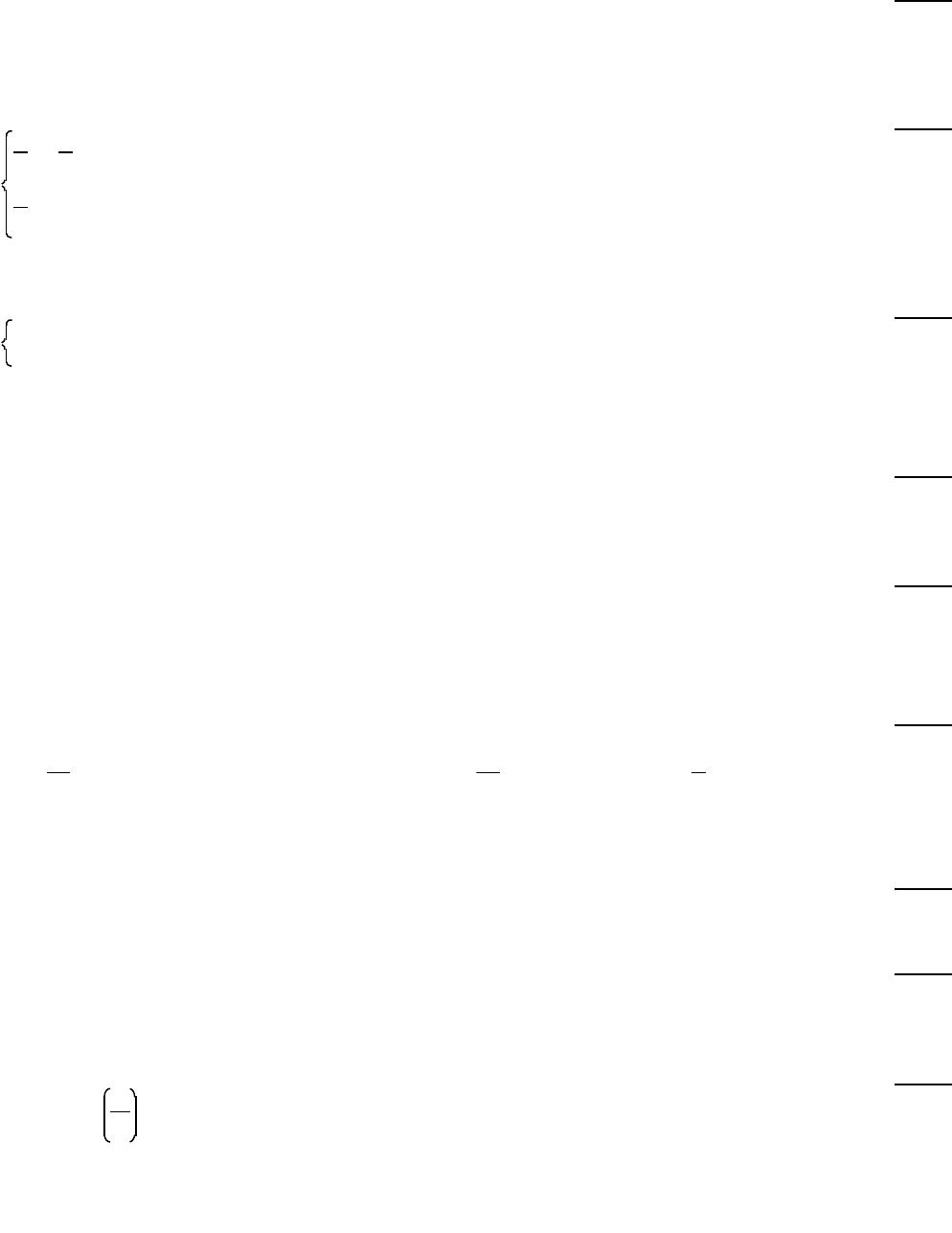
160)
7
3x + 5
4y = 4
5
6x – 2y = 21
160)
A)
(–6, 8)
B)
(6, 8)
C)
(6, –8)
D)
(–6, –8)
161)
3x – 2y = 0
2x + 4y = 16
161)
A)
(-3, 2)
B)
(2, 3)
C)
(-2, -3)
D)
(3, 2)
Write the first four terms of the sequence and the indicated term.
162)
an=n2– 2, 11th term
162)
A)
-2, –1, 2, 7, 98
B)
–1, 2, 7, 14, 98
C)
–1, 2, 7, 14, 119
D)
–1, 0, 1, 2, 9
Write the first four terms of the geometric sequence.
163)
a =2, a5=512
163)
A)
512, 128, 32, 8
B)
8, 32, 128, 512
C)
128, 32, 8, 2
D)
2, 8, 32, 128
Find the probability.
164)
A box contains 3 white, 2 green, 2 red, and 1 blue marble. A marble is drawn at random and then a
second marble is drawn without replacing the first. Find the probability that both marbles are blue.
164)
A)
1
16
B)
0
C)
1
64
D)
1
4
Find the indicated term.
165)
a =4, r =3; 9th term
165)
A)
6561
B)
78,732
C)
236,196
D)
26,244
166)
a =4, r =-3 ; 5th term
166)
A)
324
B)
2916
C)
-972
D)
81
Find an expression for the general term, an.
167)
2, 8, 32, 128, . . .
167)
A)
an=21
4n – 1
B)
an=2 (4 )n
C)
an=128(4 )n – 1
D)
an=2 (4 )n – 1
20

Find the given Sn for the arithmetic series.
168)
211+180 +149+118 +. . . . Find S16.
168)
A)
-592
B)
-344
C)
-688
D)
-2032
Solve the problem.
169)
There are 13 books on a reading list for English I. Students must select 4 books to read from this list.
In how many ways can the 4 books be selected?
169)
A)
17,160
B)
705
C)
735
D)
715
Find the indicated probability.
170)
If you flip a coin three times, the possible outcomes are HHH, HHT, HTH, HTT, THH, THT, TTH,
TTT. What is the probability of getting at least one head?
170)
A)
3
4
B)
1
4
C)
1
2
D)
7
8
Find an expression for the general term, an.
171)
4, -12, 36, –108, . . .
171)
A)
an=4 (-3 )n
B)
an=4 (-3 )n – 1
C)
an=4 (-16 )n – 1
D)
an=4 (3 )n – 1
Translate the problem to a system of equations, then solve using Cramer’s Rule.
172)
Two different gasohol mixtures are available. One contains 5% alcohol and the other 12% alcohol.
How much of each should be mixed to obtain 500 gallons of gasohol containing 10% alcohol?
172)
A)
208 gal 5%, 292 gal 12%
B)
357 gal 5%, 357 gal 12%
C)
25 gal 5%, 60 gal 12%
D)
143 gal 5%, 357 gal 12%
Find the given Sn for the arithmetic series.
173)
If a1=12 and d =-5, find S29.
173)
A)
-3364
B)
-3509
C)
-1682
D)
-7424
Evaluate the expression.
174)
10!
8!(10 – 8)!
174)
A)
1
B)
45
C)
0!
D)
10
Expand by minors along the first column.
175)
x y 1
-2 56
–1-1 -3
175)
A)
9x – 12y + 7
B)
–9x + 12y + 7
C)
–9x – 12y + 7
D)
–9x – 12y – 7
Provide an appropriate response.
176)
Is -4, -8, -12, -16, . . . an arithmetic sequence?
176)
A)
Yes
B)
No
21

Find the indicated probability.
177)
One card is selected from a standard deck of cards. Find the probability that the card selected is the
7 of hearts.
177)
A)
1
52
B)
1
13
C)
1
4
D)
1
7
Find the number of elements in the sample space of the experiment.
178)
Selecting a 5–digit number.
178)
A)
89,999
B)
3125
C)
100,000
D)
90,000
Solve the problem.
179)
A club has 31 members. In how many ways can they select a person to be President and a different
person to be Treasurer?
179)
A)
918 ways
B)
465 ways
C)
930 ways
D)
938 ways
Write the first four terms of the arithmetic sequence with the given characteristics.
180)
d =-7, a11 =-53
180)
A)
-53, -60, -67, -74
B)
0, 17, 10, 3
C)
10, 3, –4, -11
D)
17, 10, 3, –4
Find the indicated probability.
181)
Two fair 6–sided dice are rolled. What is the probability the sum of the two numbers on the dice is
3?
181)
A)
17
18
B)
1
18
C)
1
2
D)
2
Write the series and find the sum.
182)
6
i = 3 (2i – 3)
182)
A)
3+ 5 + 7 + 9 =24
B)
3+ 5 + 7 =15
C)
-1 + 1 + 3 + 5 + 7 + 9 =24
D)
9+ 11 + 13 + 15 =48
Write the first five terms of the geometric sequence satisfying the given conditions.
183)
a =128, r = – 1
2
183)
A)
–64, 32, –16, 8, –4
B)
128, 64, 32, 16, 8
C)
–128, 64, –32, 16, –8
D)
128, –64, 32, –16, 8
If a triangle has vertices of (x1, y1),(x2, y2), and (x3, y3) then the area of the triangle is given by A =1
2 det
x1y1 1
x2y21
x3y31 .
Find the area of the triangle with vertices at the given points.
184)
(-4, -4) (1, 4) (4, 2)
184)
A)
26
B)
34
C)
17
D)
52
22

Solve the problem.
185)
An auditorium has 25 rows, with 10 seats in the first row, 12 in the second row, 14 in the third row,
and so forth. How many seats are in the auditorium?
185)
A)
900
B)
850
C)
550
D)
500
Evaluate the expression.
186)
7!
9!
186)
A)
2!
B)
1
2!
C)
72
D)
1
72
Solve the problem.
187)
A game involves choosing 7 numbers from the numbers 1 through 13. In how many ways can this
be done?
187)
A)
8,648,640
B)
1724
C)
1696
D)
1716
Find the sum of the infinite geometric series, if possible. If it is not possible, explain why. If necessary, round to three
decimal places.
188)
6+ 3 + 3
2+. . .
188)
A)
13
B)
12
C)
11.5
D)
The sum does not exist because r 1.
Solve the problem.
189)
A woman deposits $237 in the bank, and each month afterward deposits 7% more than the month
before. Write the first four terms of the geometric sequence that gives the amount of her deposit
each month.
189)
A)
$237; $1659; $11,613.00; $81,291.00
B)
$1.07; $1.14; $1.23; $1.31
C)
$237; $253.59; $271.34; $290.34
D)
$253.59; $271.34; $290.34; $310.66
Find the event that corresponds with the outcome.
190)
Rolling at least one 5 on a single roll of 2 dice.
190)
A)
(1, 4), (2, 3), (3, 2), (4, 1)
B)
(5, 1), (5, 2), (5, 3), (5, 4), (5, 5), (5, 6)
C)
(5, 1), (5, 2), (5, 3), (5, 4), (5, 5), (5, 6), (1, 5), (2, 5), (3, 5), (4, 5), (6, 5)
D)
(5, 1), (5, 2), (5, 3), (5, 4), (5, 6), (1, 5), (2, 5), (3, 5), (4, 5), (6, 5)
Find the indicated probability.
191)
If you flip a coin three times, the possible outcomes are HHH, HHT, HTH, HTT, THH, THT, TTH,
TTT. What is the probability that the first two tosses come up the same?
191)
A)
1
2
B)
1
8
C)
1
4
D)
3
8
Find the determinant.
192)
555
-4 1-3
4–35
192)
A)
-10
B)
60
C)
180
D)
–60
23

Write the series and find the sum.
193)
3
i = 1 (3i2– 3)
193)
A)
-3 + 0 + 9 =6
B)
-6 + 3 + 18 =15
C)
0+ 9 + 24 =33
D)
0+ 3 + 6 =9
Use the binomial theorem to expand the expression.
194)
(3x – 4y)3
194)
A)
9x3y – 12x2y2+ 16xy3
B)
27x3– 36x2y + 48xy2– 64y3
C)
27x3– 108x2y + 144xy2– 64y3
D)
9x3y – 24x2y2+ 16xy3
Find the indicated probability.
195)
An IRS auditor randomly selects 3 tax returns from 46 returns of which 7 contain errors. What is the
probability that she selects none of those containing errors?
195)
A)
0.0023
B)
0.602
C)
0.6094
D)
0.0035
Solve the problem.
196)
There are 10 people in a club. A committee of 4 persons is to be chosen to represent the club at a
conference. In how many ways can the committee be chosen?
196)
A)
636
B)
5040
C)
210
D)
1260
If a triangle has vertices of (x1, y1),(x2, y2), and (x3, y3) then the area of the triangle is given by A =1
2 det
x1y1 1
x2y21
x3y31 .
Find the area of the triangle with vertices at the given points.
197)
(-4, 3) (-1, -4) (5, 1)
197)
A)
20.5
B)
57
C)
41
D)
28.5
Evaluate the expression.
198)
2!4!
198)
A)
48
B)
72
C)
24
D)
8
Write the first four terms of the arithmetic sequence with the given characteristics.
199)
a1=23, d =6
199)
A)
23, 29, 35, 41
B)
6, 23, 29, 35
C)
23, 58, 87, 116
D)
23, 29, 35, 47
Find the indicated term.
200)
a =96, r = – 1
2 ; 8th term
200)
A)
3
8
B)
–3
4
C)
3
4
D)
–3
8
Write the series and find the sum.
201)
4
i = 1 (2i + 1)
201)
A)
3+ 5 +7+9=21
B)
4+ 6 + 8 + 10 =28
C)
3+ 5 +7+9=24
D)
1+ 3 + 5 +7=16
24

Write the first four terms of the arithmetic sequence with the given characteristics.
202)
a1=15, d =-4
202)
A)
11, 7, 3, -1
B)
15, 11, 7, 3
C)
19, 15, 11, 7
D)
15, 11, 6, 3
Evaluate the binomial coefficient.
203)
8
5
203)
A)
56
B)
280
C)
35
D)
7
Evaluate the expression.
204)
6!
4!
204)
A)
2!
B)
3
2
C)
6
D)
30
Provide an appropriate response.
205)
What name do we give a sequence with an unlimited number of terms?
205)
A)
Finite sequence
B)
Infinite series
C)
Infinite sequence
D)
Finite series
Find the sample space for the experiment.
206)
There are 3 cards in a hat; one is a King, one is a Queen, and one is an Ace. Two cards are to be
selected at random without replacement.
206)
A)
{K K Q, K K Q, Q A K, A Q A}
B)
{K Q, K A, Q K, Q A, A K, A Q}
C)
{K Q A, Q K A, A K Q}
D)
{K K, K Q , K A, Q K , Q Q , Q A, A K , A Q , A A}
Use the formula for the nth term to find r.
207)
a =2, a5=512
207)
A)
256
B)
4
C)
1
4
D)
8
Evaluate the expression.
208)
8C3
208)
A)
336
B)
6720
C)
20,160
D)
56
Solve the problem.
209)
How many ways can an IRS auditor select 3 of 13 tax returns for an audit?
209)
A)
2197
B)
286
C)
6
D)
1716
Find the common ratio, r, for the given geometric sequence.
210)
1, -3 , 9, -27, . . .
210)
A)
81
B)
3
C)
-4
D)
-3
25
Write the first four terms of the arithmetic sequence with the given characteristics.
211)
a1=-24, d =6
211)
A)
-6, -12, -18, -24
B)
-24, -12, -6, 0
C)
-18, -12, -6, 0
D)
-24, -18, -12, -6
Find the sum of the first n terms of the geometric series for the given value of n. If necessary, round to three decimal
places.
212)
4+12 +36 +108+. . . , n =9
212)
A)
1,398,100
B)
349,524
C)
87,380
D)
-349,524
Solve the problem.
213)
In the “Big Bucks” lottery game, a person is to pick 7 digits from 0 to 9 in correct order. If a number
can be repeated, how many ways are there to play a pick?
213)
A)
40,353,607
B)
282,475,249
C)
100,000,000
D)
10,000,000
Find the sum of the infinite geometric series, if possible. If it is not possible, explain why. If necessary, round to three
decimal places.
214)
1 +3
8+9
64 +. . .
214)
A)
0.727
B)
0.2
C)
1.6
D)
The sum does not exist because r 1.
Solve the problem.
215)
The population of a small town in 1988 was 12,000 people. Due to decline in industrial growth the
population has since been decreasing at a rate of 3% every year. What was the population of this
town in 1998?
215)
A)
9805 people
B)
7978 people
C)
7185 people
D)
8849 people
Find the determinant.
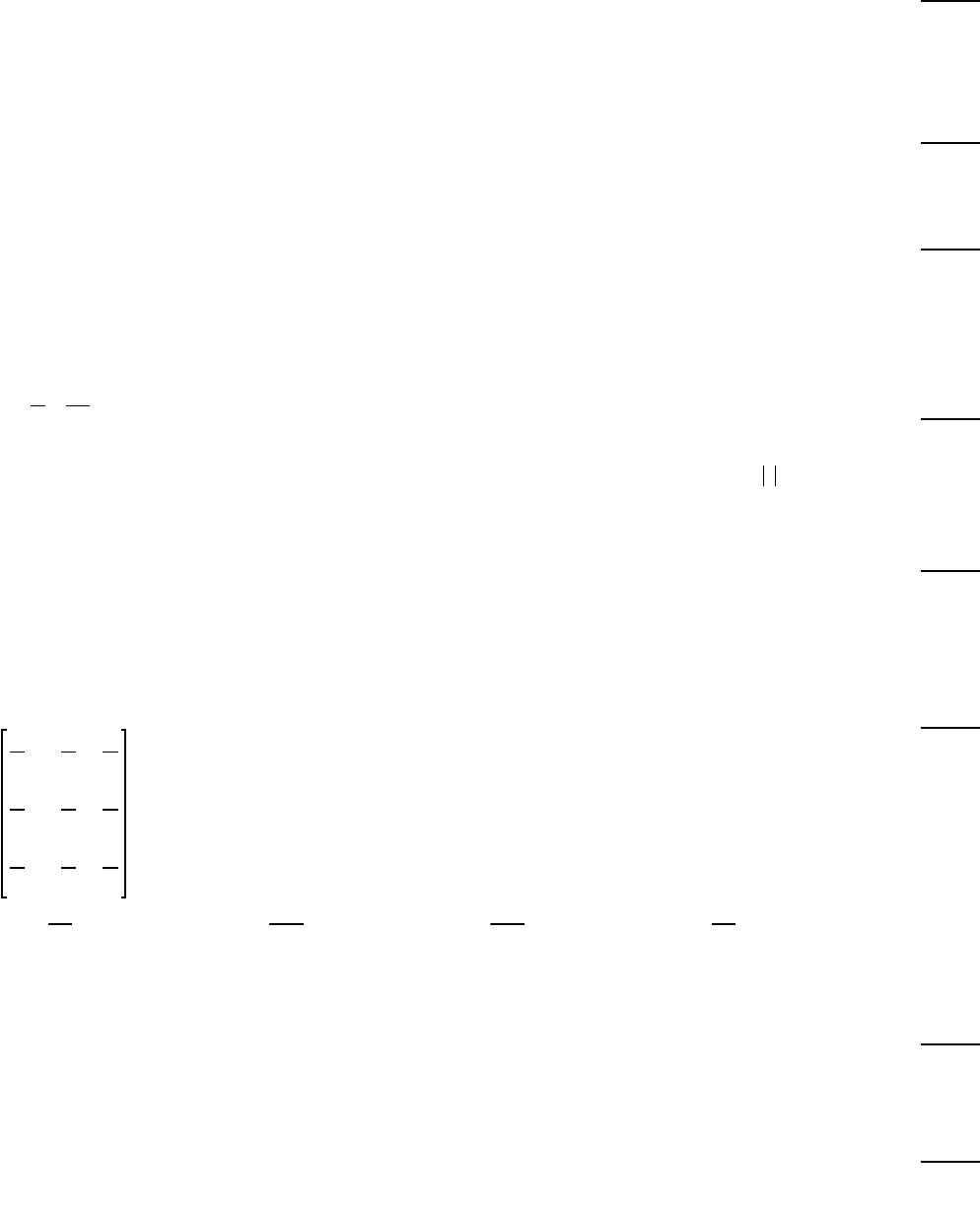
216)
1
21
43
2
2
3– 5
2
1
2
4
52
51
5
216)
A)
44
15
B)
187
60
C)
143
60
D)
19
24
Write the indicated term of the binomial expansion.
217)
(x + 3y)13, 10th term
217)
A)
14,073,345x4y9
B)
4,691,115x4y10
C)
14,073,345x9y4
D)
4,691,115x9y4
Find the indicated term.
218)
–3, -6 , -12, –24 , . . . ; 10th term
218)
A)
6144
B)
768
C)
-512
D)
-1536
26
Find the indicated probability.
219)
One card is selected from a standard deck. Find the probability that the card selected is greater than
4 and less than 9.
219)
A)
5
13
B)
7
26
C)
9
17
D)
4
13
Translate the problem to a system of equations, then solve using Cramer’s Rule.
220)
During the 2001–2002 Little League season, the Tigers played 49 games. They lost 21 more games
than they won. How many games did they win that season?
220)
A)
12 games
B)
13 games
C)
14 games
D)
15 games
Find the common ratio, r, for the given geometric sequence.
221)
4, 16, 64, 256, . . .
221)
A)
4
B)
256
C)
1
4
D)
16
Find the event that corresponds with the outcome.
222)
Rolling a total of 9 on a single roll of 2 dice.
222)
A)
(3, 6), (4, 5), (5, 4), (6, 3), (5, 5)
B)
(3, 6), (4, 5)
C)
(3, 6), (6, 3)
D)
(3, 6), (4, 5), (5, 4), (6, 3)
Provide an appropriate response.
223)
Is it possible to find the determinant for a 2×3 matrix?
223)
A)
No
B)
Yes
224)
Can you find the sum of the infinite geometric series 3+9+27 +. . . ? Why or Why not?
224)
A)
Yes. The common ratio, r, is less than 1.
B)
No. This is not a geometric series.
C)
No. The common ratio, r, is greater than 1.
D)
Yes. This is a geometric series.
Solve the problem.
225)
The population of a town was 35,500 at the beginning of 1980. If the population decreased 400
people per year, how many people lived in the town at the beginning of 1995?
225)
A)
6000
B)
29,900
C)
29,100
D)
29,500
226)
A musician plans to perform 5 selections for a concert. If he can choose from 7 different selections,
how many ways can he arrange his program?
226)
A)
2520
B)
21
C)
16,807
D)
35
Find the indicated probability.
227)
Among the contestants in a competition are 45 women and 26 men. If 5 winners are randomly
selected, what is the probability that they are all men?
227)
A)
0.00505
B)
0.06439
C)
0.05384
D)
0.10228
Write the indicated term of the binomial expansion.
228)
(3x – 3y)11, 6th term
228)
A)
27,280,638x6y6
B)
27,280,638x5y6
C)
–27,280,638x5y6
D)
–81,841,914x6y5
27
Translate the problem to a system of equations, then solve using Cramer’s Rule.
229)
During the 2001–2002 Little League season, the Tigers played 62 games. They won 18 more games
than they lost. How many games did they lose that season?
229)
A)
20 games
B)
22 games
C)
40 games
D)
25 games
Find the determinant.
230)
8-7 7
0 5 4
0 0 -6
230)
A)
–268
B)
240
C)
212
D)
–240
Find the indicated probability.
231)
A spinner has regions numbered 1 through 21. What is the probability that the spinner will stop on
an even number or a multiple of 3?
231)
A)
2
3
B)
17
C)
1
3
D)
10
9
Find the indicated term and an expression for the nth term of the given arithmetic sequence.
232)
a32 if a1=12 and d =-7
232)
A)
an=-7n + 19, a32 =–205
B)
an=-7n + 12, a32 =–212
C)
an=-7n + 7, a32 =–217
D)
an=-7n + 5, a32 =–219
Find the determinant.
233)
3 2
1–1
233)
A)
-1
B)
-5
C)
7
D)
5
Find the common difference, d, for the arithmetic sequence.
234)
–8, -12, -16 , -20, . . .
234)
A)
-12
B)
-4
C)
12
D)
-8
Provide an appropriate response.
235)
Write 0.43 as an infinite geometric series. What are a and r?
235)
A)
0.43 + 0.0043 + 0.000043 +. . . , where a = 0.43 and r = 0.01
B)
0.43 + 0.43 + 0.43 +. . . , where a = 0.43 and r = 1
C)
0.43 + 0.43 + 0.43 +. . . , where a = 0.43 and r = 0.01
D)
0.43 + 0.0043 + 0.000043 +. . . , where a = 0.43 and r = 0.1
Solve using Cramer’s Rule.
236)
y + 3z = 6
2x – 4z = 2
x + 6y =-2
236)
A)
– 47
8, – 21
16 , 39
16
B)
47
16, – 21
8, 39
8
C)
– 47
8, 21
16, – 39
16
D)
47
8, – 21
16 , 39
16
28
Find the indicated probability.
237)
A fair 12–sided die is rolled. What is the probability of rolling a number less than 11?
237)
A)
1
12
B)
5
6
C)
10
D)
11
12
Find the event that corresponds with the outcome.
238)
Getting a number less than 1 on a single roll of a die.
238)
A)
2, 3, 4, 5, 6
B)
1
C)
0
D)
no event
Evaluate the expression.
239)
9P0
239)
A)
9
B)
362,880
C)
1
D)
0
Evaluate the binomial coefficient.
240)
8
8
240)
A)
0
B)
1
C)
40,320
D)
2
Solve using Cramer’s Rule.
241)
x – y + 3z = 1
4x + z = 1
x + 2y + z = 5
241)
A)
(1, 2, 0)
B)
(1, 0, 2)
C)
(0, 2, 1)
D)
No solution
Evaluate the expression.
242)
7!
6!
242)
A)
7!
B)
7
C)
7
6
D)
1
Find the sample space for the experiment.
243)
There are 3 balls in a hat; one with the number 1 on it, one with the number 2 on it, and one with
the number 5 on it. You pick a ball from the hat at random and then you roll a die.
243)
A)
{1 1, 1 2, 1 3, 1 4, 1 5, 1 6, 2 1, 2 2, 2 3, 2 4, 2 5, 2 6, 5 1, 5 2, 5 3, 5 4, 5 5, 5 6, 3 1, 4 1, 6 1, 3 2, 4 2, 6
2, 3 5, 4 5, 6 5}
B)
{1 1, 1 2, 1 3, 1 4, 1 5, 1 6, 2 1, 2 2, 2 3, 2 4, 2 5, 2 6, 5 1, 5 2, 5 3, 5 4, 5 5, 5 6}
C)
{1 1, 1 2, 1 5, 2 1, 2 2, 2 5, 5 1, 5 2, 5 5}
D)
{1 2 5 1, 1 2 5 2, 1 2 5 3, 1 2 5 4, 1 2 5 5, 1 2 5 6}
Solve the problem.
244)
Find the first term of a geometric sequence with the sixth term 177,147 and common ratio of -3.
244)
A)
–3
B)
– 729
C)
-9
D)
1
29
Find the probability.
245)
A class consists of 83 women and 55 men. If a student is randomly selected, what is the probability
that the student is a woman?
245)
A)
55
138
B)
1
83
C)
83
138
D)
83
55
Find x.
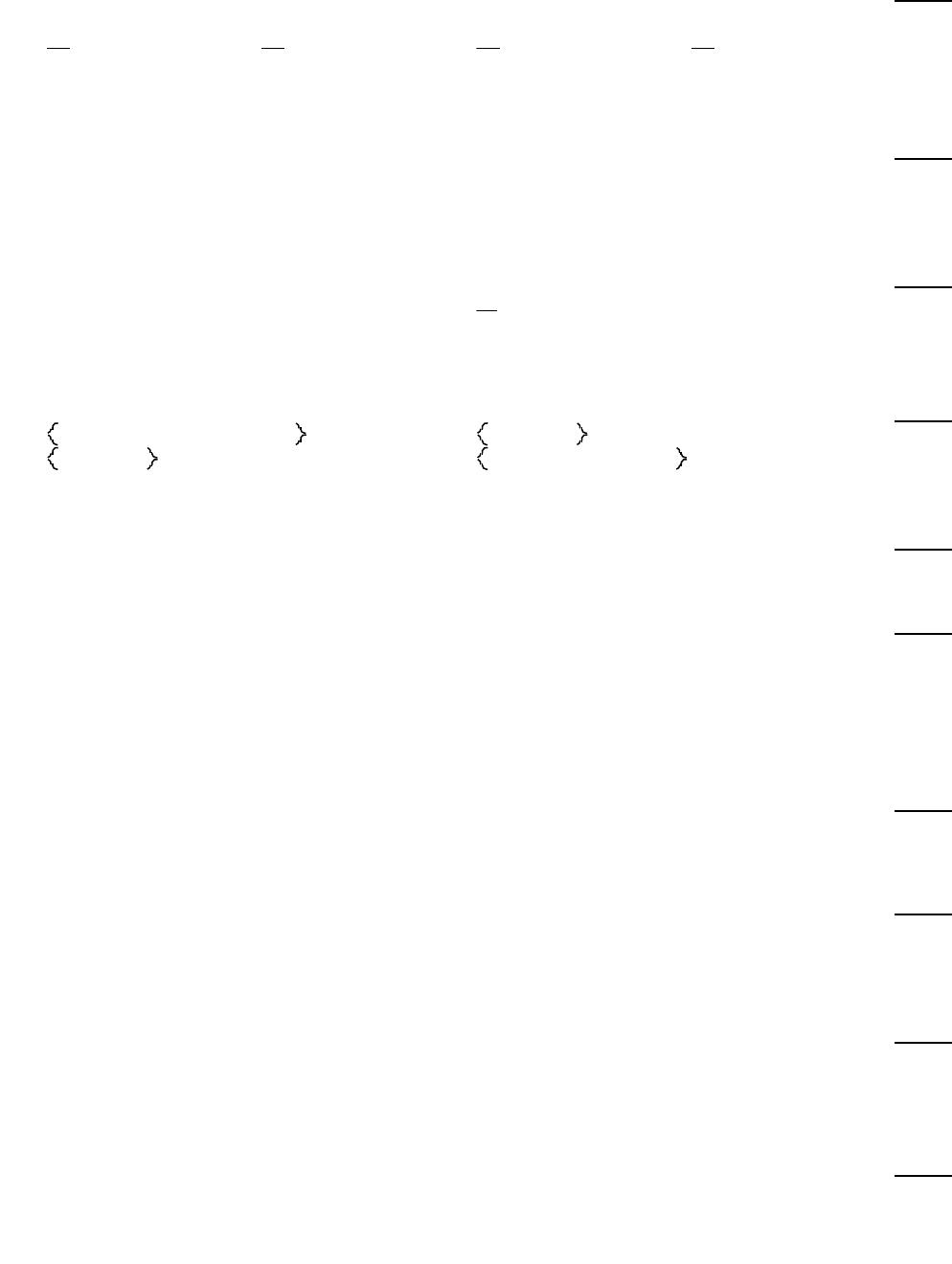
246)
x 3
2 1 =12
246)
A)
-2
B)
12
C)
4
D)
18
30
Answer Key
Testname: C12
Answer Key
Testname: C12
32
Answer Key
Testname: C12
33
Answer Key
Testname: C12
34
Answer Key
Testname: C12
35