
The Essential Cosmic Perspective, 8e (Bennett et al.)
Chapter 12 Surveying the Stars
12.1 Multiple Choice Questions
1) Since all stars begin their lives with the same basic composition, what characteristic is most
important in determining how they will differ?
A) their location in the galaxy
B) the time at which they formed
C) their initial luminosity
D) their initial mass
E) their initial color
2) A star’s luminosity depends primarily on its
A) radius and surface temperature.
B) distance from Earth.
C) radius.
D) mass and radius.
E) surface temperature.
3) A star’s luminosity is the
A) apparent brightness of the star in our sky.
B) surface temperature of the star.
C) lifetime of the star.
D) total amount of energy that the star will radiate over its entire lifetime.
E) total amount of energy that the star radiates each second.
4) Star A and B have the same luminosity, but star B is 10 times farther from Earth than star A.
How much brighter will star A appear?
A) 10 times
B) 100 times
C) 1,000 times
D) 10,000 times
E) 100,000 times
5) If the distance between us and a star is doubled, with everything else remaining the same, its
luminosity
A) is decreased by a factor of four, and its apparent brightness is decreased by a factor of four.
B) is decreased by a factor of two, and its apparent brightness is decreased by a factor of two.
C) remains the same, but its apparent brightness is decreased by a factor of two.
D) remains the same, but its apparent brightness is decreased by a factor of four.
E) is decreased by a factor of four, but its apparent brightness remains the same.

6) Which of the following correctly states the relationship between the apparent brightness,
luminosity, and distance of a star?
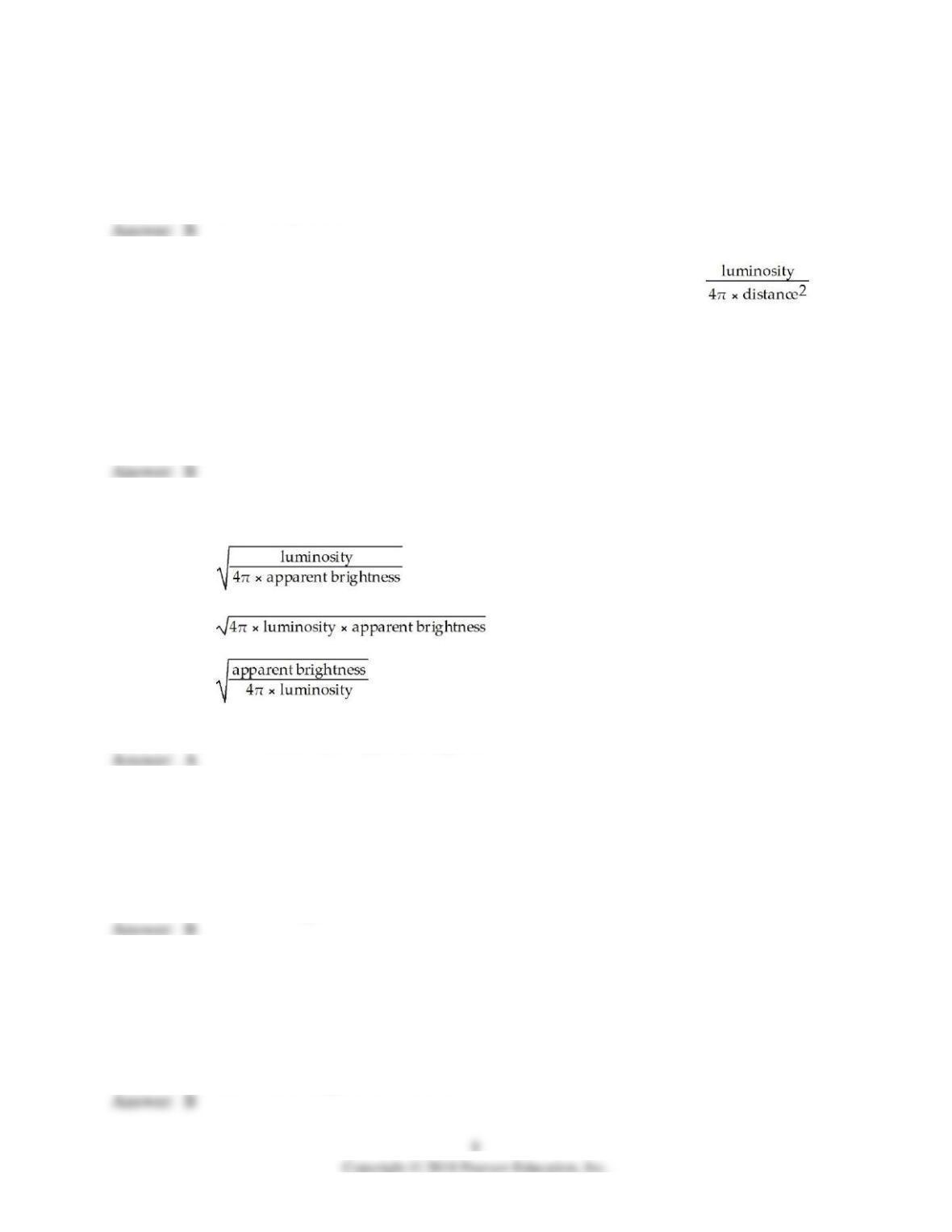
A) luminosity =
B) apparent brightness =
C) apparent brightness = luminosity × 4π × (distance)2
D) distance =
7) You measure the parallax angle for a star to be 0.1 arcseconds. The distance to this star is
A) 10 light-years.
B) 10 parsecs.
C) 0.1 light-year.
D) 0.1 parsec.
E) impossible to determine.
8) You measure the parallax angle for a star to be 0.5 arcseconds. The distance to this star is
A) 0.5 light-year.
B) 0.5 parsec.
C) 5 light-years.
D) 5 parsecs.
E) 2 parsecs.
9) You observe two stars which are just like the Sun but at different distances. Which star is the
most luminous?
A) They are both the same luminosity.
B) The one that appears the brightest in the sky.
C) The one that appears the faintest in the sky.
D) There is no way to tell from the information given.
10) Which of the following statements about apparent and absolute magnitudes is true?
A) The magnitude system that we use now is based on a system used by the ancient Greeks over
2,000 years ago that classified stars by how bright they appeared.
B) A star with an apparent magnitude of 1 appears brighter than a star with an apparent
magnitude of 2.
C) The absolute magnitude of a star is dependent upon its luminosity.
D) A star’s absolute magnitude is the apparent magnitude it would have if it were at a distance of
10 parsecs from Earth.
E) All of the above are true.

11) The faintest star visible to the naked eye has an apparent magnitude of about
A) 10.
B) 6.
C) 1.
D) 0.
E) -1.
12) The spectral sequence sorts stars according to
A) mass.
B) surface temperature.
C) luminosity.
D) core temperature.
E) radius.
13) The stellar spectral sequence was originally based on which of the following?
A) the composition of stars
B) the mass of stars
C) the strength of hydrogen lines in the spectra of stars
D) the core temperature of stars
E) the luminosity of stars
14) Which of the following statements about spectral types of stars is true?
A) The spectral type of a star can be used to determine its surface temperature.
B) The spectral type of a star can be used to determine its color.
C) A star with spectral type A is cooler than a star with spectral type B.
D) A star with spectral type F2 is hotter than a star with spectral type F3.
E) All of the above are true.
15) Which stellar spectral type has strong molecular absorption lines in its optical spectrum?
A) O
B) B
C) G
D) K
E) M

16) Which of the following stars are brightest at ultraviolet wavelengths?
A) O and B stars
B) A and F stars
C) G and K stars
D) M stars
E) None; all stars are brightest at optical wavelengths.
17) You see two main-sequence stars with the same spectral type. Star 1 is dimmer in apparent
brightness than Star 2 by a factor of 100. What can you conclude, assuming there is no
absorption of either star’s light by interstellar gas or dust?
A) Without first knowing the distances to these stars, you cannot draw any conclusions about
how their true luminosities compare to each other.
B) The luminosity of Star 1 is a factor of 100 less than the luminosity of Star 2.
C) Star 1 is 100 times more distant than Star 2.
D) Star 1 is 100 times nearer than Star 2.
E) Star 1 is 10 times more distant than Star 2.
18) Which of the following terms is given to a pair of stars that appear to change position in the
sky, indicating that they are orbiting one another?
A) visual binary
B) eclipsing binary
C) spectroscopic binary
D) double star
E) none of the above
19) Which of the following best describes the axes of a Hertzsprung–Russell (H-R) diagram?
A) surface temperature on the horizontal axis and luminosity on the vertical axis
B) mass on the horizontal axis and luminosity on the vertical axis
C) surface temperature on the horizontal axis and radius on the vertical axis
D) mass on the horizontal axis and stellar age on the vertical axis
E) interior temperature on the horizontal axis and mass on the vertical axis
20) On a Hertzsprung–Russell diagram, where would you find stars that are cool and have low
luminosities?
A) upper right
B) lower right
C) upper left
D) lower left

21) On a Hertzsprung–Russell diagram, where would you find stars that are cool and luminous?
A) upper right
B) lower right
C) upper left
D) lower left
22) On a Hertzsprung–Russell diagram, where would you find stars that have the largest radii?
A) upper right
B) lower right
C) upper left
D) lower left
23) On a Hertzsprung–Russell diagram, where on the main sequence would you find stars that
have the greatest mass?
A) upper right
B) lower right
C) upper left
D) lower left
24) On a Hertzsprung–Russell diagram, where would you find red giant stars?
A) upper right
B) lower right
C) upper left
D) lower left
25) On a Hertzsprung–Russell diagram, where would you find white dwarfs?
A) upper right
B) lower right
C) upper left
D) lower left
26) On the main sequence, stars obtain their energy
A) from chemical reactions.
B) from gravitational contraction.
C) by converting hydrogen to helium.
D) by converting helium to carbon, nitrogen, and oxygen.
E) from nuclear fission.

27) Which of the following is the most numerous type of main-sequence star?
A) an O star
B) an A star
C) an F star
D) a G star
E) an M star
28) Which of the following luminosity classes refers to stars on the main sequence?
A) I
B) II
C) III
D) IV
E) V
29) Which of the following stellar properties has the greatest range in values?
A) mass
B) radius
C) core temperature
D) surface temperature
E) luminosity
30) A star of spectral type B with a mass of 10 times the mass of the Sun will last approximately
how long on the main sequence?
A) 1,000 years
B) 10,000 years
C) 10 million years
D) 1 billion years
E) 10 billion years
31) A star of spectral type G will last approximately how long on the main sequence?
A) 1,000 years
B) 10,000 years
C) 10 million years
D) 1 billion years
E) 10 billion years

32) Which of the following comparisons between low-mass stars and high-mass main-sequence
stars is true?
A) Low-mass stars are cooler and less luminous than high-mass stars.
B) Low-mass stars are hotter and more luminous than high-mass stars.
C) Low-mass stars are cooler but more luminous than high-mass stars.
D) Low-mass stars are hotter but less luminous than high-mass stars.
E) Low-mass stars have the same temperature and luminosity as high-mass stars.
33) Which of the following statements about open clusters is true?
A) All stars in the cluster are approximately the same color.
B) All stars in the cluster are approximately the same age.
C) All stars in the cluster have approximately the same mass.
D) All stars in the cluster will evolve similarly.
E) There is an approximately equal number of all spectral type stars in the cluster.
34) Which of the following statements about globular clusters is true?
A) All stars in the cluster are approximately at the same stage in their evolution.
B) Most of the stars in the cluster are younger than 10 billion years.
C) Most stars in the cluster are yellow or reddish in color.
D) All stars in the cluster have approximately the same mass.
E) There is an approximately equal number of all spectral type stars in the cluster.
35) The age of stars in a cluster can be determined by
A) fitting the position of the main sequence to the Sun.
B) determining the main-sequence turnoff point.
C) finding pulsating variable stars in the cluster.
D) finding spectroscopic binaries in the cluster.
E) counting the number of stars in each spectral class.
36) You observe a star cluster with a main-sequence turn-off point at spectral type G2 (the same
spectral type as the Sun). What is the age of this star cluster?
A) 10,000 years
B) 4.6 billion years
C) 10 billion years
D) 100 billion years
E) You also need to know the luminosity class of the turn-off point to determine the age.
37) A main-sequence star’s luminosity can directly inform us of
A) the star’s distance from us.
B) the rate at which it converts hydrogen to helium.
C) the star’s radius.
D) the star’s surface temperature.
38) The apparent brightness of an object is calculated as: apparent brightness =
If one knew the luminosity and apparent brightness of a star that was too distant for a parallax
measurement, what would be the best approach to determining its distance?
A) Insert the values for luminosity and apparent brightness into the equation, then guess the
value for the distance that satisfies the equation.
B) Solve the equation for distance, then insert the values for luminosity and apparent brightness
into the new equation.
C) The distance cannot be determined.
39) If one knew the luminosity of a star and measured its apparent brightness, which expression
would one use to calculate the distance to the star?
A) distance =
B) distance =
C) distance =
D) distance = 4π × luminosity × apparent brightness
40) Star X has an apparent magnitude of 3, and star Y has an apparent magnitude of 8. How do
they compare in observed brightness?
A) Star X is 5 times brighter than star Y.
B) Star X is 100 times brighter than star Y.
C) Star Y is 5 times brighter than star X.
D) Star Y is 100 times brighter than star X.
41) Star X has an apparent magnitude of 3, and star Y has an apparent magnitude of 13. How do
they compare in observed brightness?
A) Star X is 10 times brighter than star Y.
B) Star X is 10,000 times brighter than star Y.
C) Star Y is 10 times brighter than star X.
D) Star Y is 10,000 times brighter than star X.
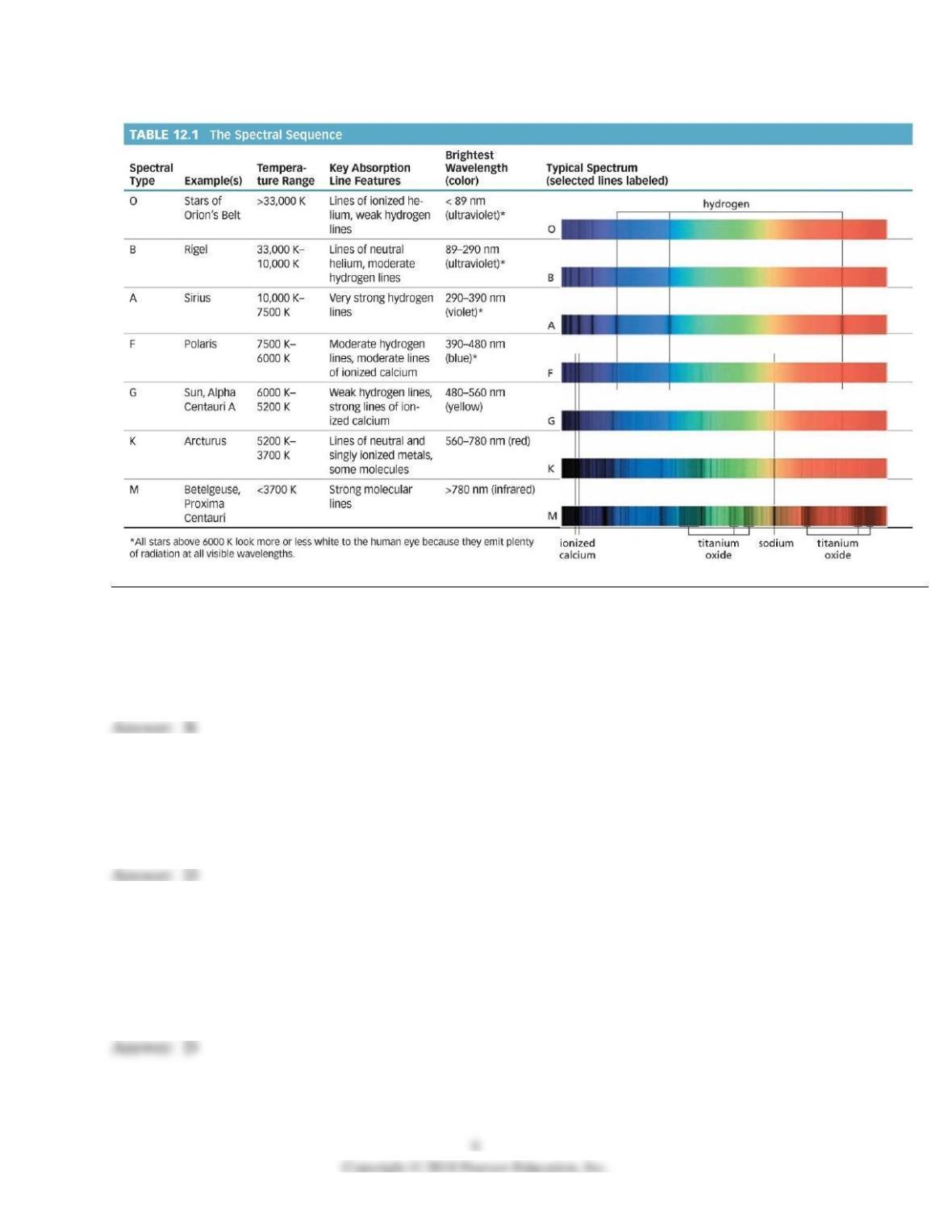
42) What is the spectral type of the star with the strongest hydrogen absorption lines?
A) B
B) A
C) F
D) G
43) What is the spectral type of the star with the strongest molecular absorption lines?
A) F
B) G
C) K
D) M
44) What is the approximate surface temperature of a star with moderate hydrogen absorption
lines and moderate ionized calcium absorption lines?
A) 3,500 K
B) 4,500 K
C) 5,500 K
D) 6,500 K
45) What is the approximate surface temperature of a star with weak hydrogen absorption lines
and strong absorption lines of ionized calcium?
A) 3,500 K
B) 4,500 K
C) 5,500 K
D) 6,500 K
46) What is the approximate surface temperature of an F star?
A) 5,000 K
B) 6,000 K
C) 7,000 K
D) 12,000 K

47) What is the approximate surface temperature of a B star?
A) 6,000 K
B) 40,000 K
C) 8,000 K
D) 20,000 K
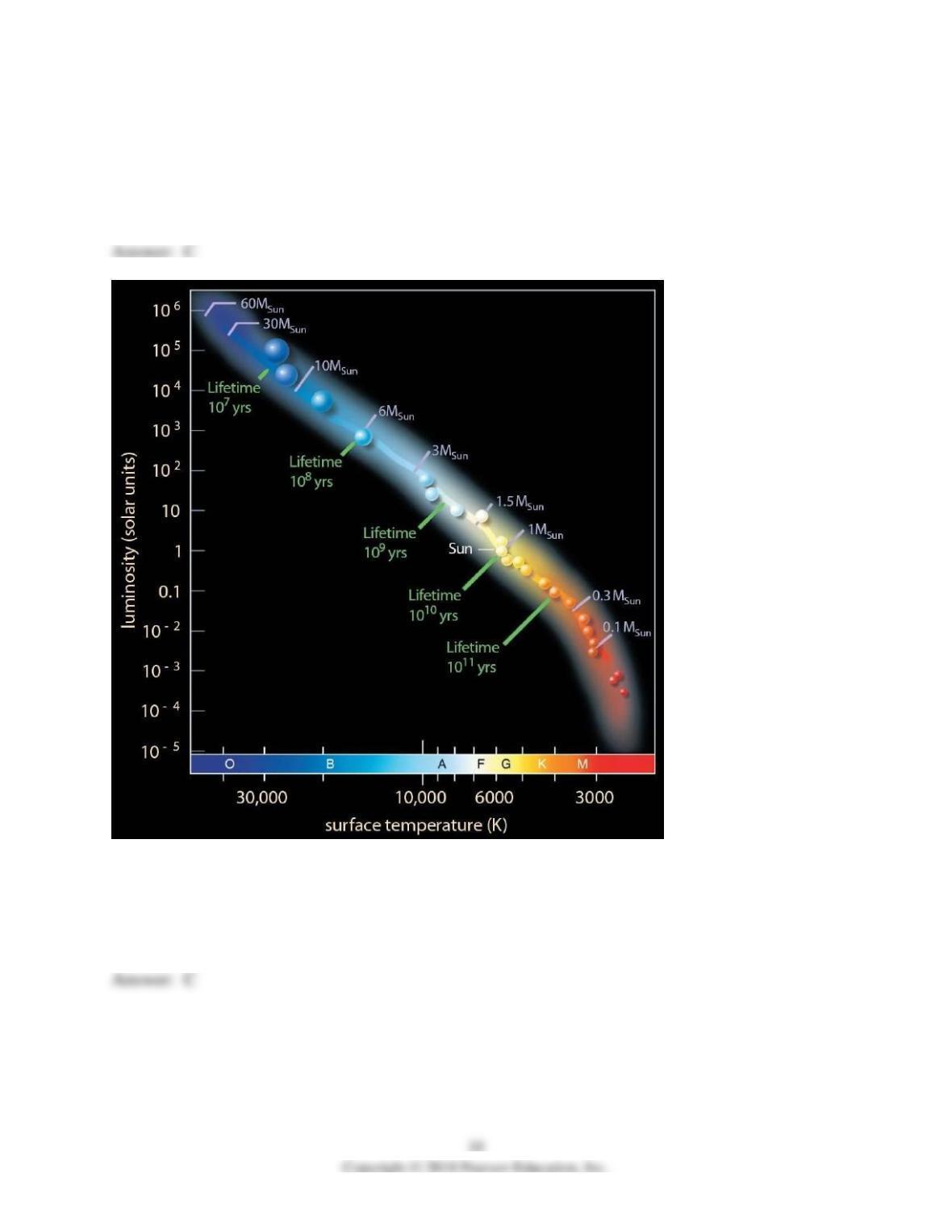
48) What is the spectral type of a main-sequence star with a luminosity 100 times greater than
the sun?
A) O
B) A
C) G
D) M
49) What is the approximate luminosity of a main-sequence M star?
A) 10−6 solar
B) 0.01 solar
C) 1 solar
D) 10 solar
50) A main-sequence star is observed with a surface temperature of 3,500 K and a luminosity of
10−2 solar. What is the approximate mass of this star?
A) 0.2 Msun
B) 0.5 Msun
C) 0.9 Msun
D) The mass cannot be determined.
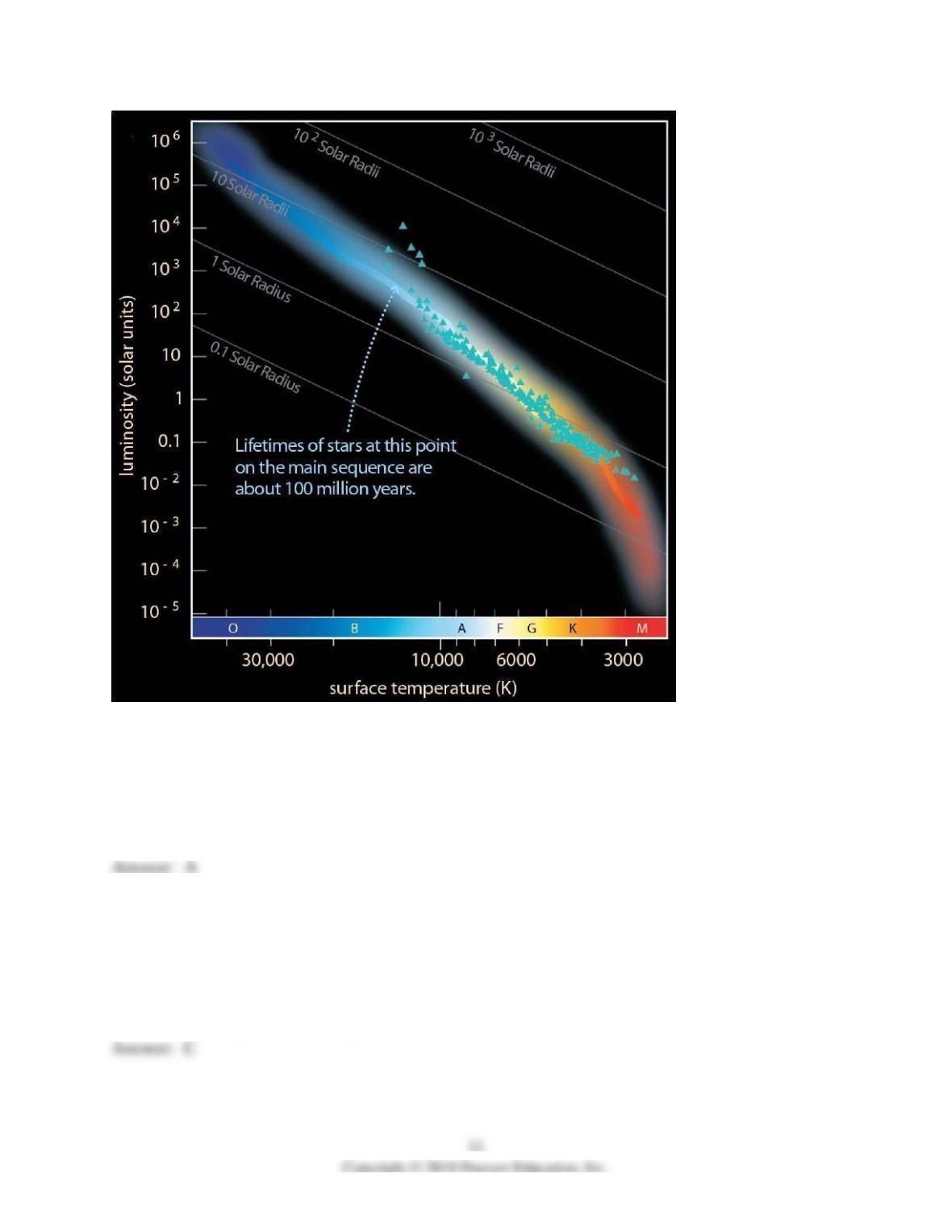
51) A star is observed with a surface temperature of 3,000 K and a luminosity of 10−3 solar.
What is the approximate radius of this star?
A) 0.1 solar radius
B) 0.5 solar radius
C) 1 solar radius
D) The radius cannot be determined.
52) A star is observed with a surface temperature of 3,000 K and a luminosity of 105 solar. What
is the approximate radius of this star?
A) 10 solar radii
B) 102 solar radii
C) 103 solar radii
D) The radius cannot be determined.
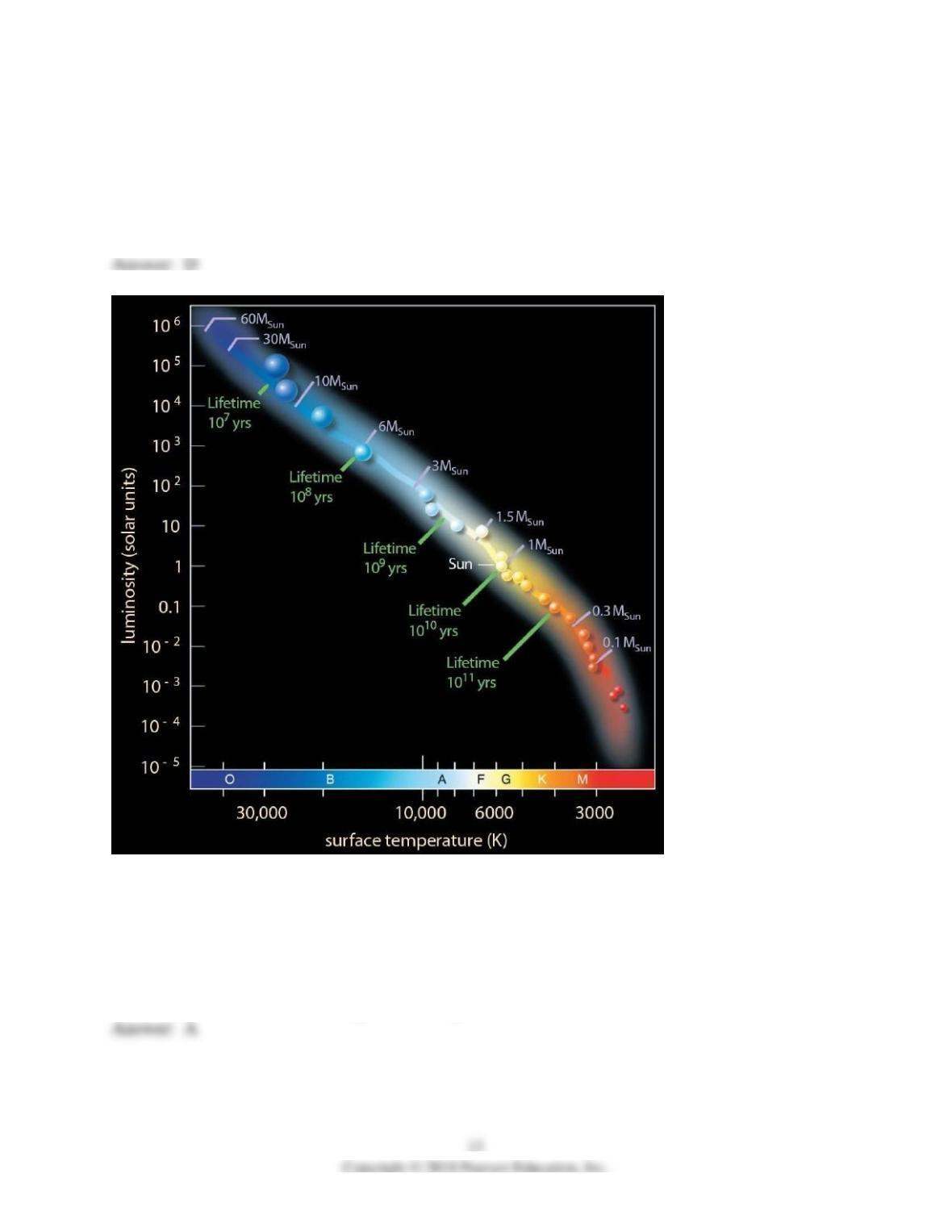
53) A star is observed with a surface temperature of 3,000 K and a luminosity of 105 solar. What
is the approximate mass of this star?
A) 0.3 Msun
B) 3 Msun
C) 30 Msun
D) The mass cannot be determined.
54) The brightest main-sequence star in a cluster has a temperature of 30,000 K and a luminosity
about 104 times greater than the sun. What is the approximate age of the cluster?
A) About 107 years
B) About 109 years
C) About 1011 years
D) This cannot be answered using the HR diagram.
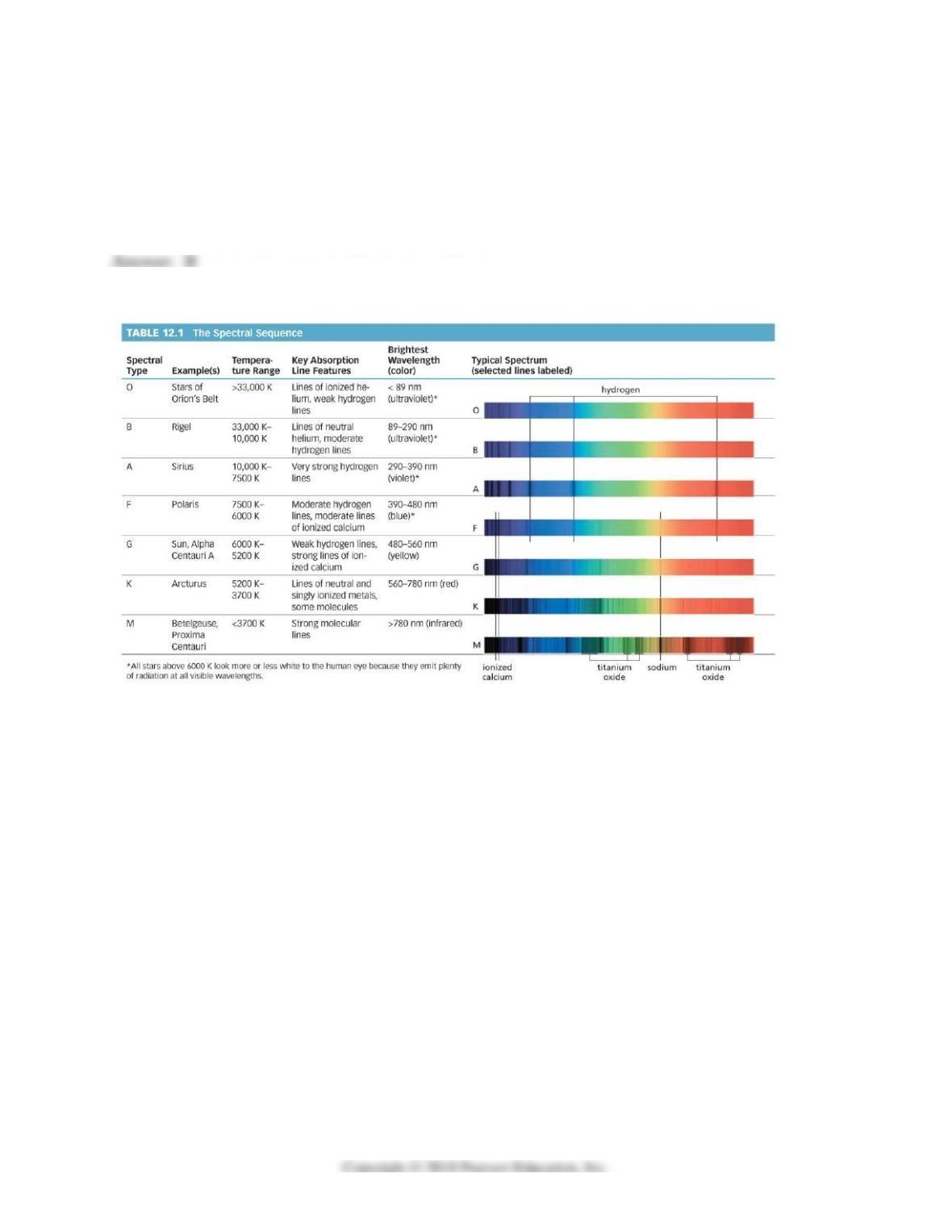
14
55) The brightest main-sequence star in a cluster has a temperature of 10,000 K and a luminosity
about 10 times greater than the sun. What is the approximate age of the cluster?
A) About 107 years
B) About 109 years
C) About 1011 years
D) This cannot be answered using the HR diagram.
56)
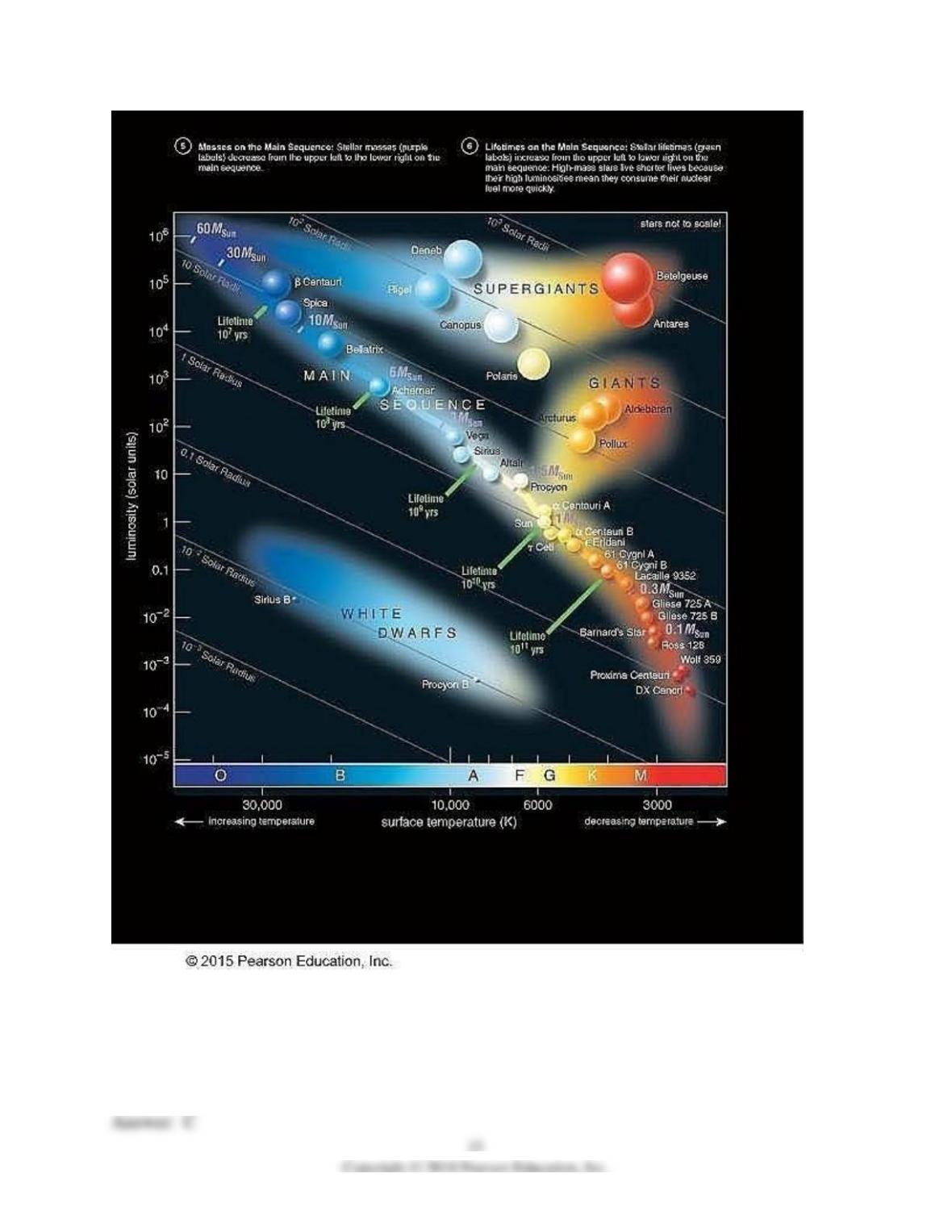
What is the approximate luminosity of a main-sequence star with weak hydrogen absorption
lines and strong absorption lines of ionized calcium?
A) About 10−2 solar
B) About 0.1 solar
C) About 1 solar
D) About 3 solar