
The Cultural Landscape, 11e (Rubenstein)
Chapter 12 Services and Settlements
1) Residents of rural settlements are more likely than residents of urban settlements to work in
A) agriculture.
B) manufacturing.
C) services.
D) education.
E) cities.
2) A place where farm buildings, homes, and churches are found close together is what kind of
settlement?
A) urban
B) linear rural
C) dispersed rural
D) clustered rural
E) primordial
3) In the United States about ________ of all jobs are in consumer services.
A) 50 percent
B) 10 percent
C) 5 percent
D) 75 percent
E) 25 percent

4) Consumer services include
A) educational, retail, wholesale, social, leisure, and hospitality jobs.
B) educational, retail, wholesale, professional, and financial service jobs.
C) educational, retail, wholesale, and financial service jobs.
D) health and social, professional, and financial service jobs.
E) wholesale, social, leisure, and information service jobs.
5) In the United States educational services account for about ________ of jobs.
A) 10 percent
B) 2 percent
C) 1 percent
D) 35 percent
E) 25 percent
6) Most people in the world live in what type of settlement?
A) clustered rural
B) dispersed rural
C) urban settlement
D) agricultural
E) primordial
7) Which of the following is not primarily a consumer service?
A) transportation services
B) retail and wholesale services
C) education services
D) health services
E) hospitality services
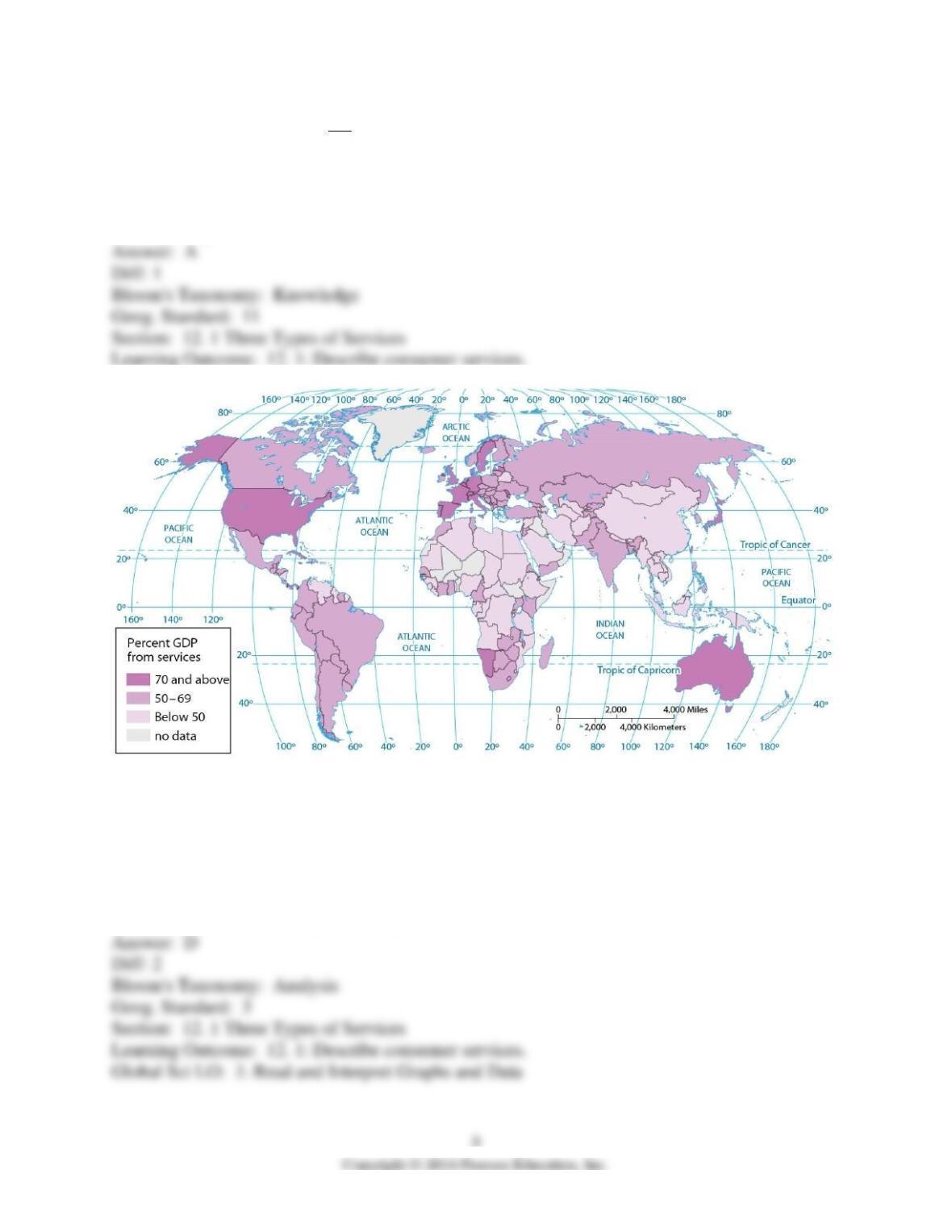
8) This map of the percentage of GDP from services indicates that services account for between
60 and 69 percent of GDP in
A) Russia, Australia, and Germany.
B) South Africa, Namibia, and Mexico.
C) Mexico, Canada, and Russia.
D) Brazil, Mexico, and Yemen.
E) Brazil, the United States, and Canada.
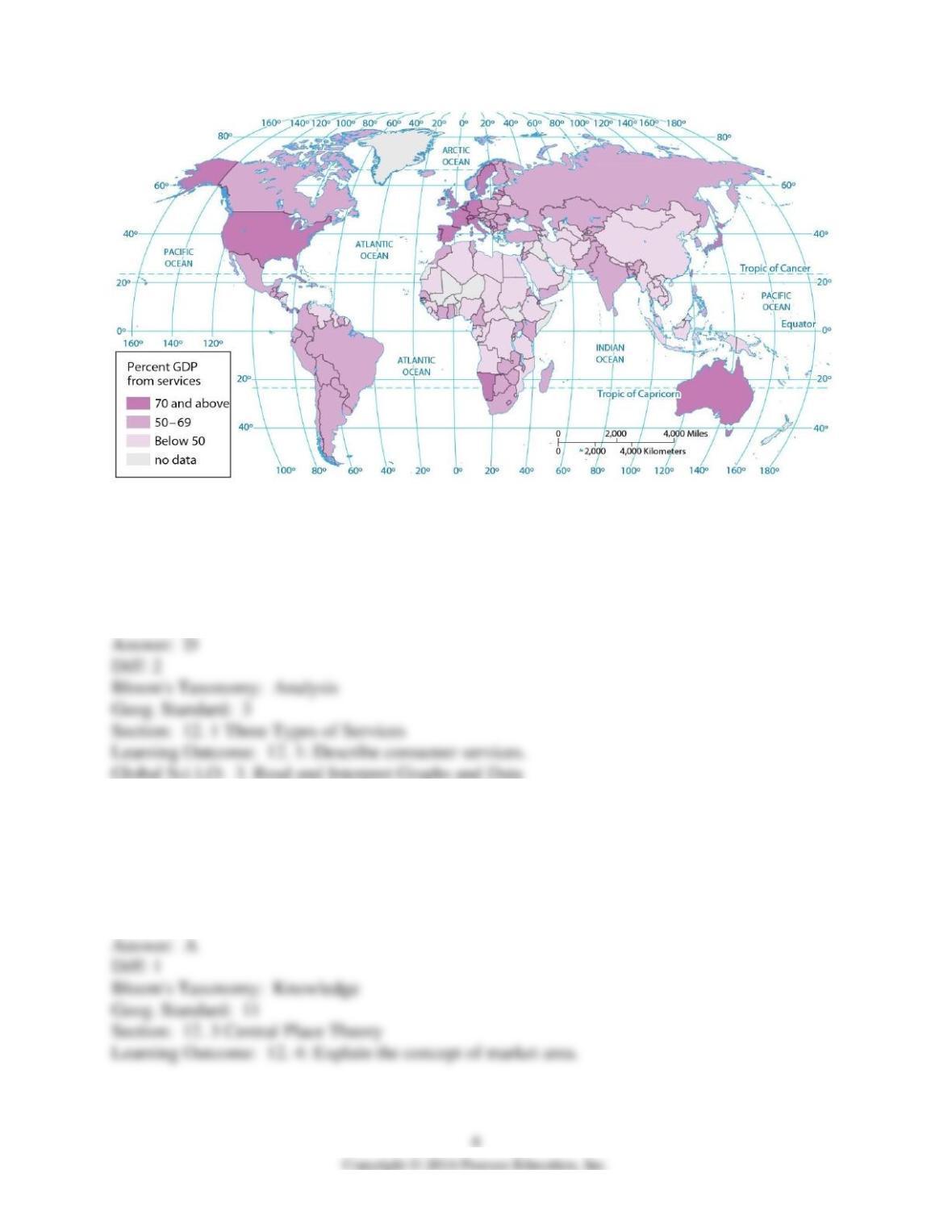
9) This map indicates that services account for less than 60 percent of GDP in
A) South Africa and India.
B) Colombia and Venezuela.
C) Australia and India.
D) China and India.
E) Brazil, Russia, and Namibia.
10) The area surrounding a service from which customers are attracted is the
A) hinterland.
B) range.
C) threshold.
D) median.
E) meridian

11) The maximum distance people are willing to travel for a service is
A) hinterland.
B) range.
C) threshold.
D) median.
E) meridian
12) A central place is a
A) hinterland.
B) market center.
C) range of a good.
D) rank-size distribution.
E) hexagonal settlement.
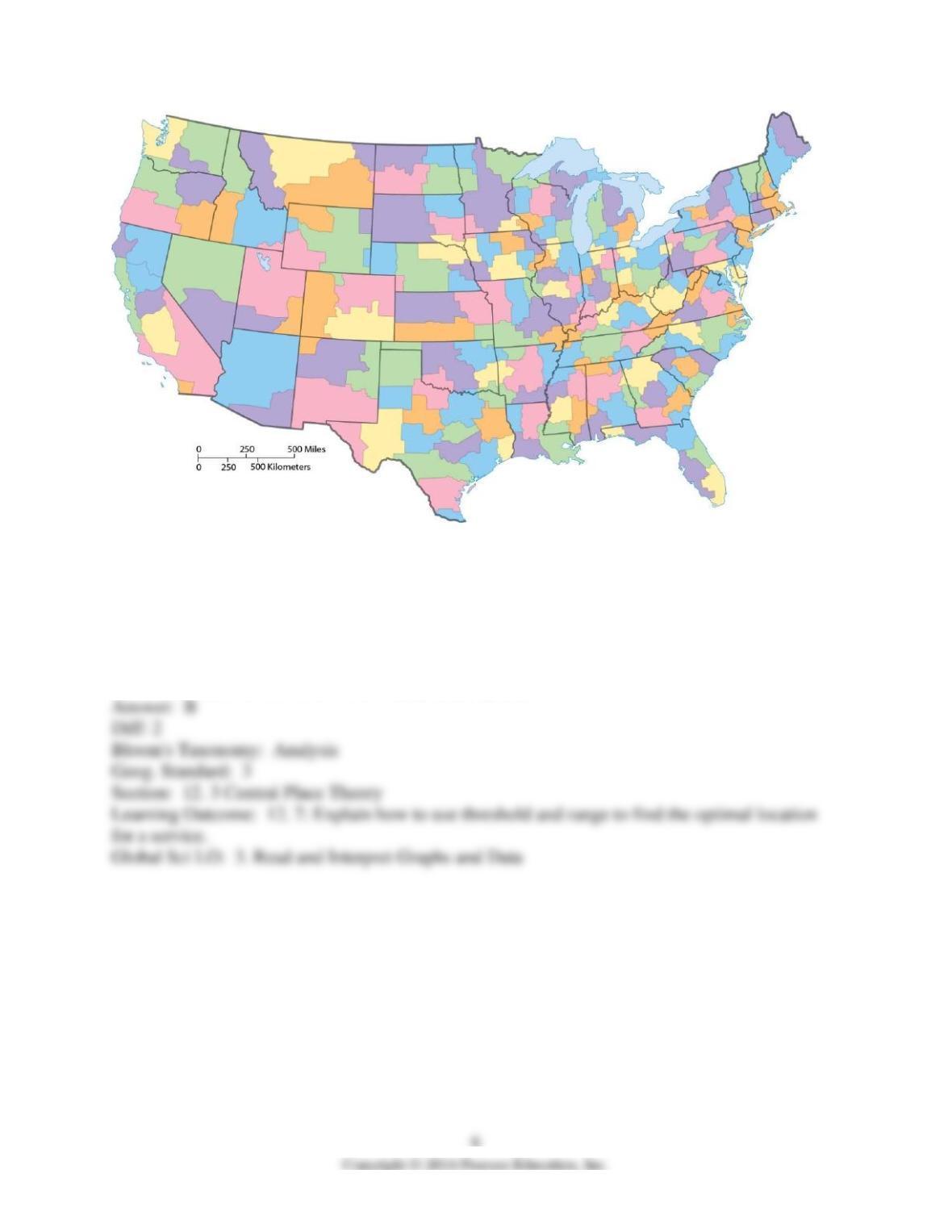
Daily Urban Systems
13) This map indicates that
A) urban systems are only available during the daytime in rural areas.
B) daily urban systems tend to cover much larger areas in western states.
C) daily urban systems tend to cover much smaller areas in western states.
D) daily urban systems in western states are about the same size as those in eastern states.
E) western states do not tend to have daily urban systems.
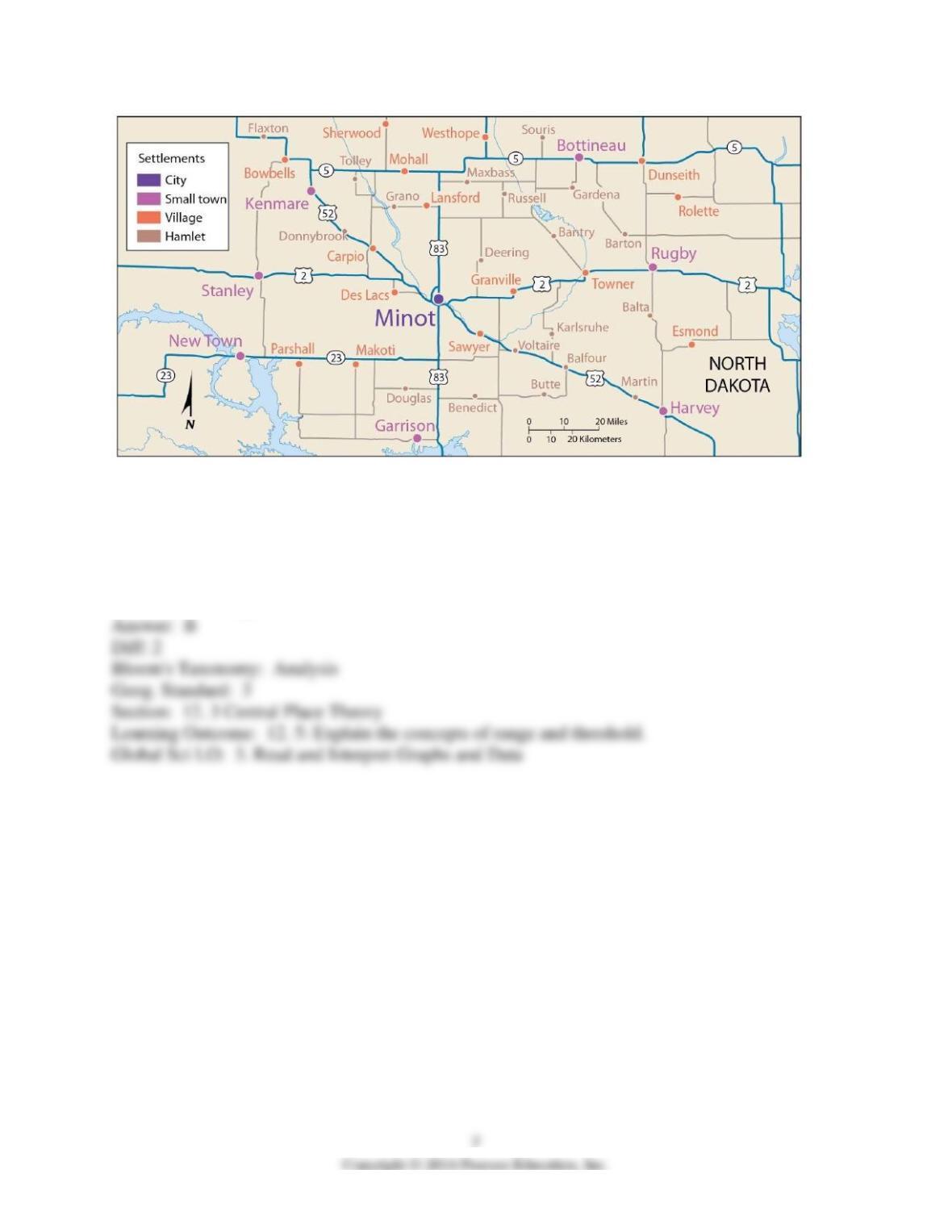
14) This map of central place theory in North Dakota indicates that the populations of
A) Rugby and Granville are smaller than Towner.
B) Granville and Towner are smaller than Rugby.
C) New Town and Stanley are larger than Minot.
D) Bottineau is smaller than Lansford.
E) Lansford is larger than Minot.
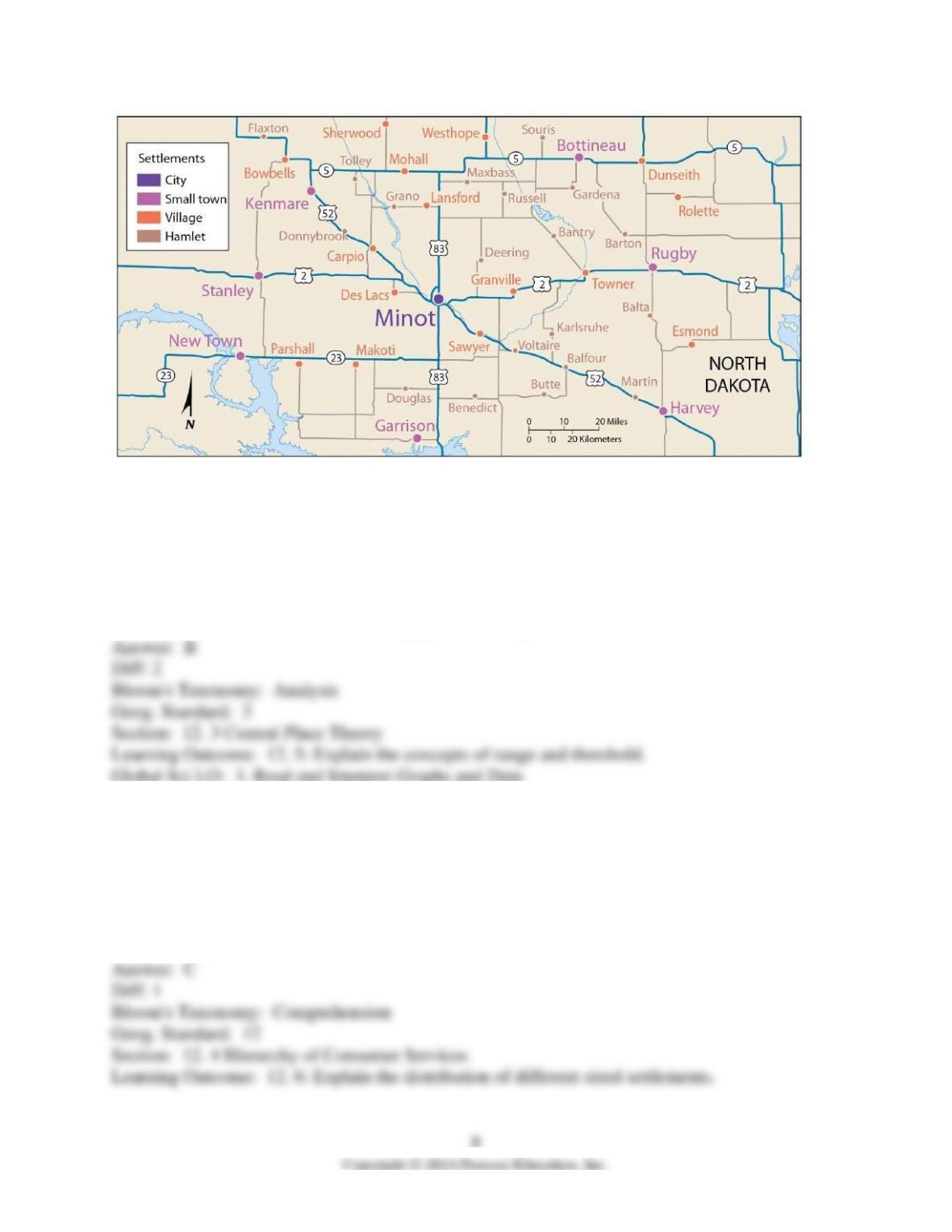
15) This map of central place theory in North Dakota indicates that
A) New Town is less than 10 miles from Parshall, and Parshall is less than 10 miles from
Makoti.
B) New Town is less than 20 miles from Parshall, and Parshall is less than 20 miles from Makoti.
C) New Town is less than 30 miles from Parshall, and Parshall is less than 30 miles from Makoti.
D) Minot is about 100 miles west of Rugby, and Stanley is about 100 miles west of Minot.
E) Minot is about 120 miles west of Rugby, and Stanley is about 120 miles west of Minot.
16) If a country’s largest city has 1,000,000 inhabitants and the second largest city has 200,000
inhabitants, the country follows what distribution?
A) central place
B) economic base
C) primate city
D) rank-size
E) equidistant

17) The hierarchical listing of settlements by size is known as the
A) primate city.
B) economic base.
C) gravity model.
D) rank-size rule.
E) nesting of settlements.
18) A primate city is
A) a city with political, economic, and cultural functions.
B) at least twice as large as the next smaller city.
C) the seat of a Roman Catholic diocese.
D) a rapidly growing city.
E) the center of gravity for a hinterland.
19) If a country follows the rank-size rule, if the largest city has 1,000,000 inhabitants, how
many people live in the fifth largest city?
A) 50,000
B) 100,000
C) 200,000
D) 500,000
E) 5,000,000

20) The minimum number of people needed to support a service is called the
A) hinterland.
B) range.
C) threshold.
D) median.
E) meridian.
21) The gravity model predicts that the optimal location of a service is
A) directly related to the number of people and services in the area and inversely related to the
lengths of highways and railways that access it.
B) directly related to the range in the area and inversely related to the hinterland.
C) directly related to the number of people in the area and inversely related to the distance
people must travel to access it.
D) directly related to the median of people in the area and inversely related to the meridian of
people who travel to access it.
E) directly related to the distance people must travel and inversely related to the number of
people in the area.
22) The potential use of a service at a location is related directly to population and inversely to
distance in the
A) gravity model.
B) population model.
C) distance decay.
D) gravitational model.
E) threshold model.

23) Periodic markets are likely to feature
A) vendors who move from town to town.
B) prices that change on a seasonal schedule.
C) large sales after the holiday season.
D) a daily offering of business services throughout the year.
E) consumer goods that change periodically in the central business district.
24) Central Place Theory predicts larger settlements are
A) more numerous and closer together.
B) more numerous and farther apart.
C) less numerous and farther apart.
D) less numerous and closer together.
E) more numerous.
25) In a linear community, we can deduce that the best location for a service is the
A) hinterland.
B) range.
C) threshold.
D) median.
E) meridian.
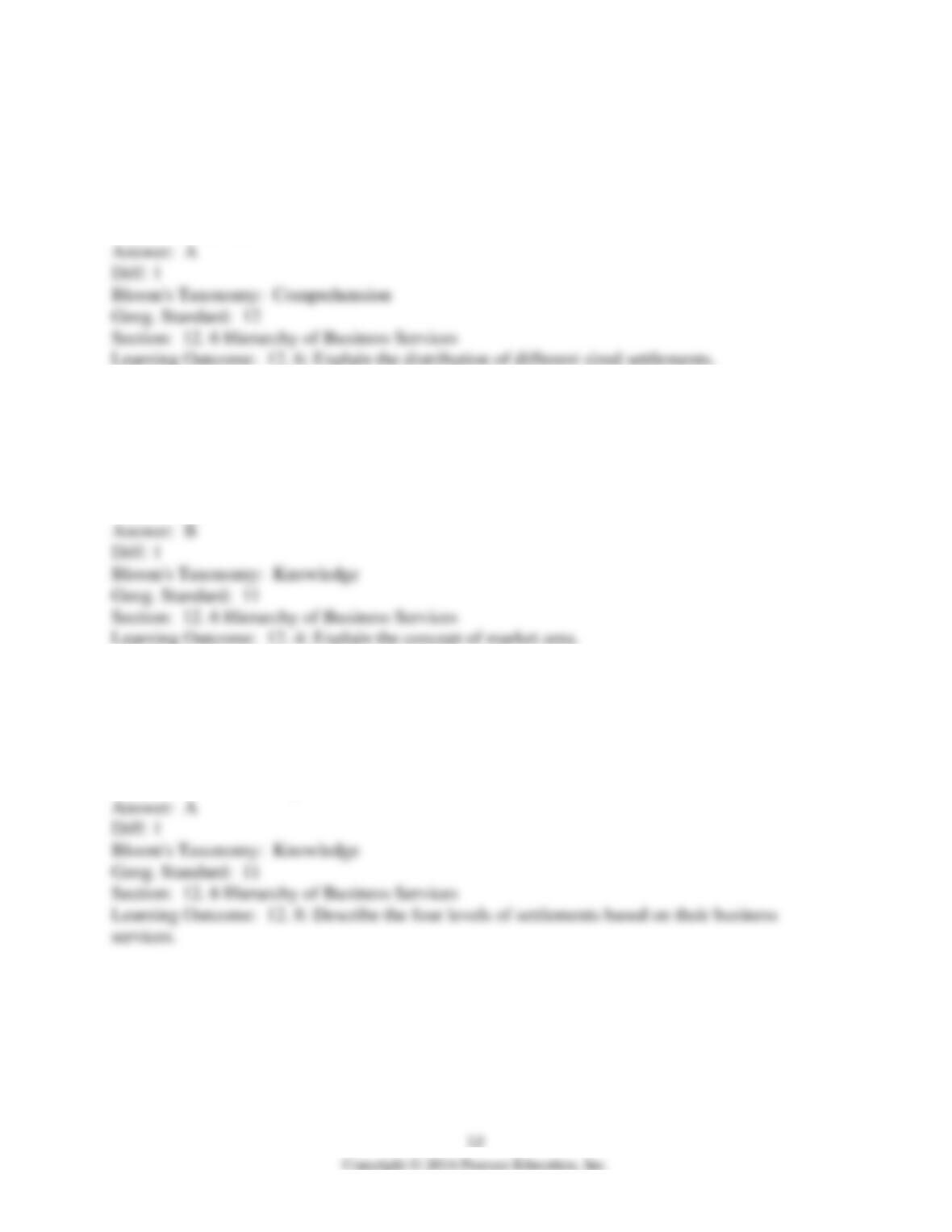
26) Global cities are identified and ranked by a combination of
A) economic, political, cultural, and infrastructure factors.
B) economic, service, industrial, and infrastructure factors.
C) central place theory and gravity models.
D) hinterland models.
E) political and infrastructure factors.
27) The geometric pattern which geographers use to represent market areas is
A) a circle.
B) a hexagon.
C) a square.
D) a pentagon.
E) an octagon.
28) A ________ is an example of a settlement that specializes in public services.
A) state capital
B) hospital
C) large casino complex
D) shopping mall
E) retirement community
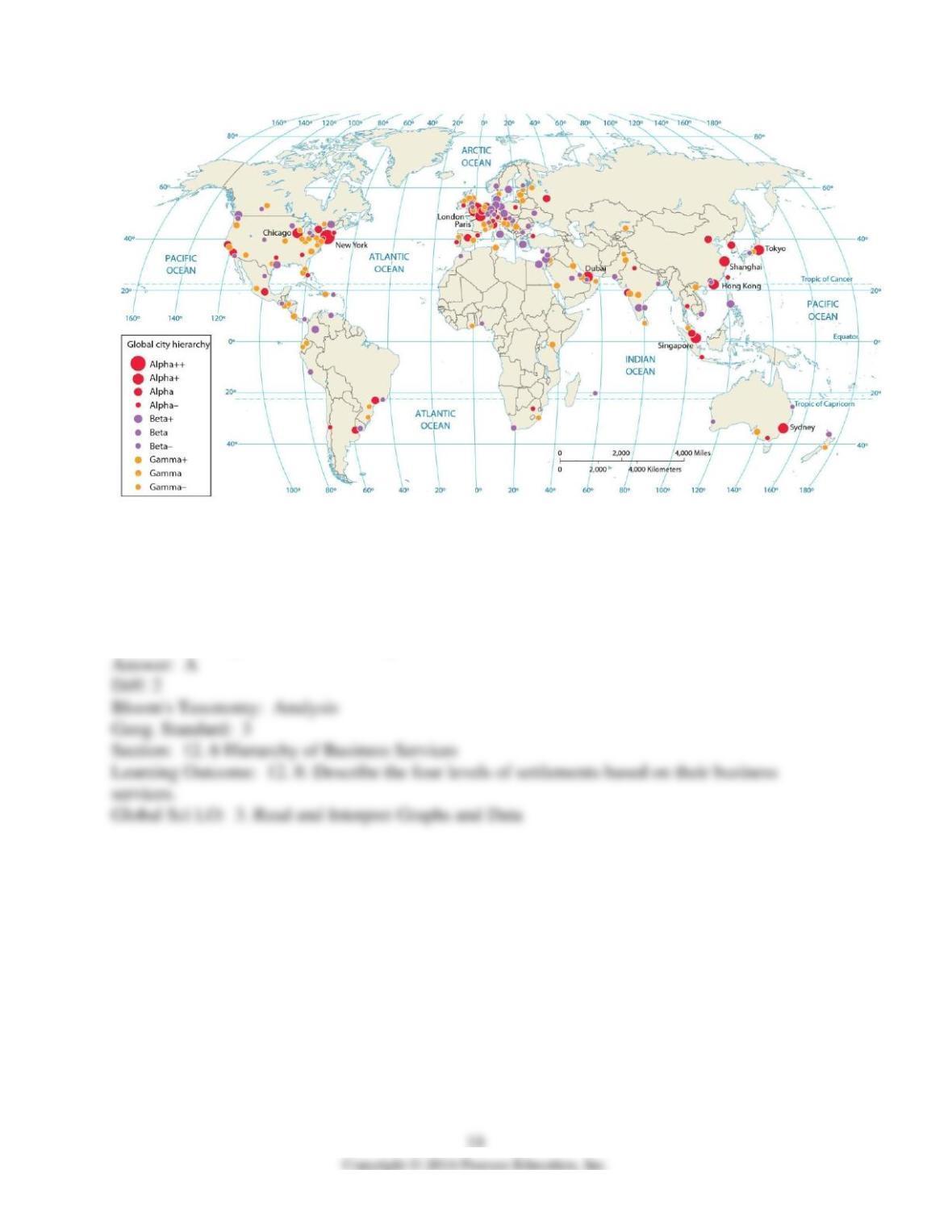
29) An analysis of this map of global cities indicates that
A) Chicago is an alpha-ranked world city.
B) New York City is a beta-ranked world city.
C) Sao Paulo is a beta-ranked world city.
D) Lima, Peru, is an alpha-ranked world city.
E) Cairo is an alpha-ranked world city.
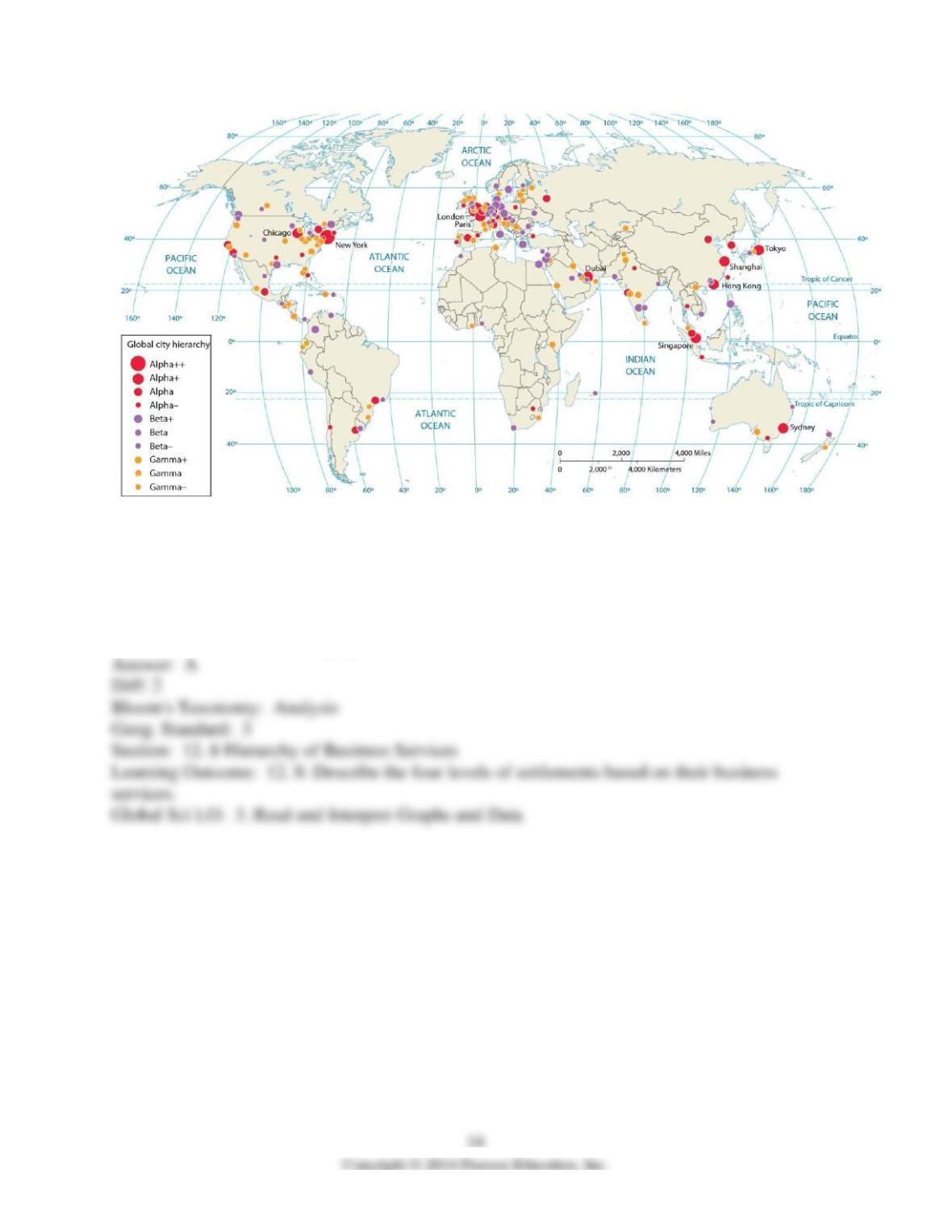
30) An analysis of this map of global cities indicates that
A) Chicago is ranked above Sao Paulo.
B) New York City is ranked below London.
C) Sao Paulo is ranked above Chicago.
D) Moscow is ranked above Sao Paulo.
E) Cairo is ranked above Beijing.
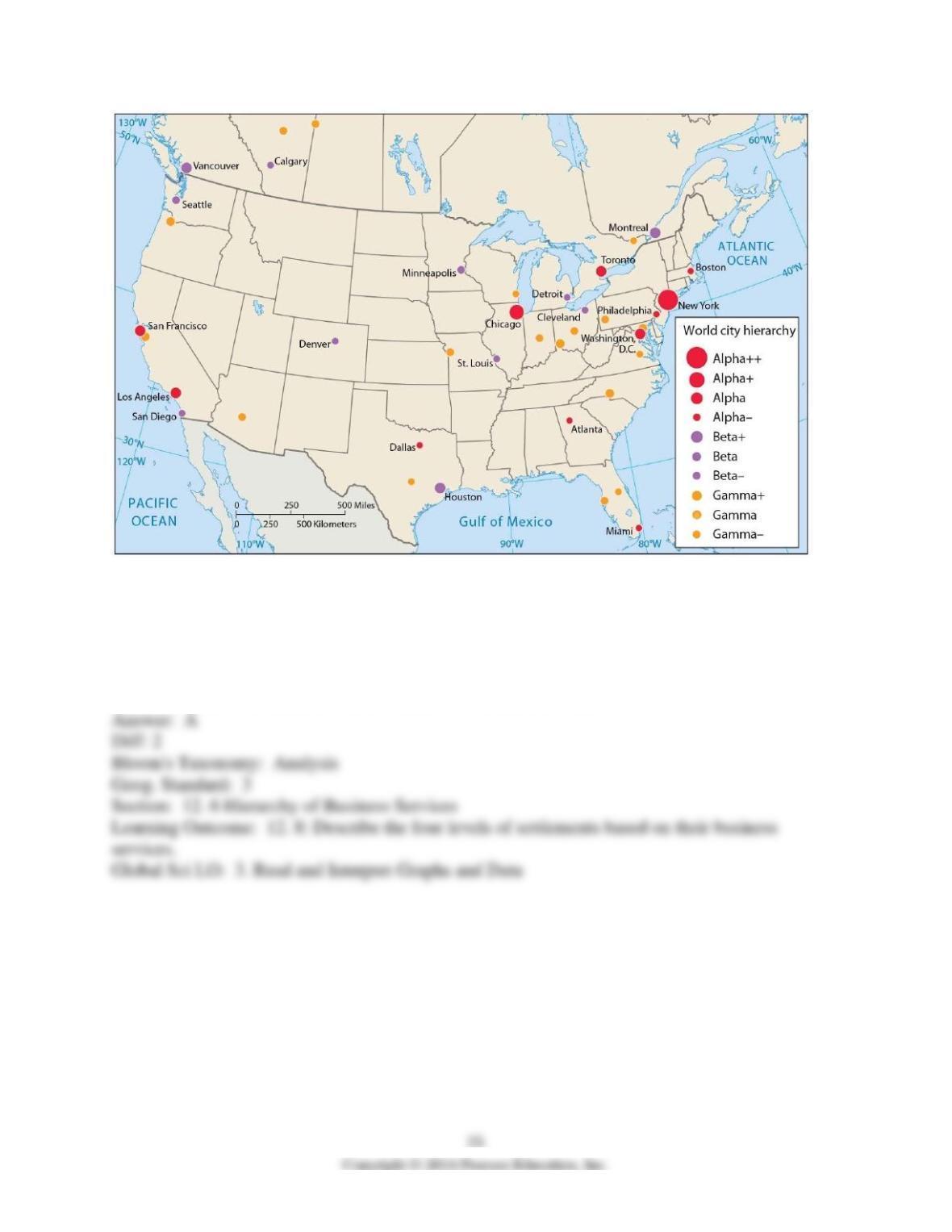
31) An analysis of this U.S. map indicates that
A) Indianapolis is Gamma-ranked and Denver is Beta-ranked.
B) Indianapolis is Beta-ranked and Denver is Alpha-ranked.
C) Indianapolis is Gamma-ranked and Denver is Alpha-ranked.
D) San Diego is Gamma-ranked and Denver is Alpha-ranked.
E) Indianapolis is Gamma-ranked and Detroit is Gamma-ranked.
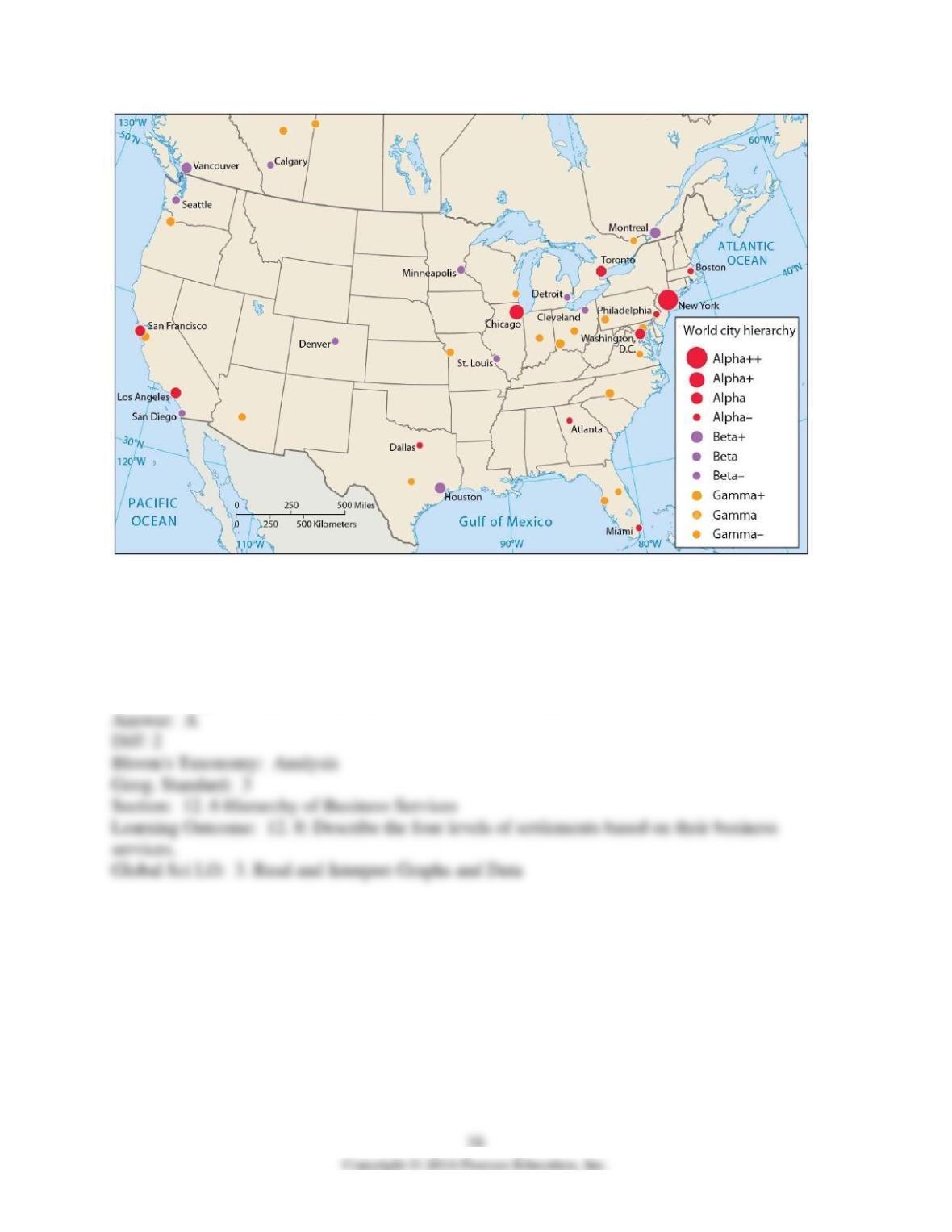
32) An analysis of this U.S. map indicates that
A) Phoenix is Gamma-ranked and San Diego is Beta-ranked.
B) Phoenix is ranked above Denver.
C) New York City is ranked below Chicago.
D) New York City is Beta- and Gamma-ranked.
E) San Diego is Gamma-ranked and Phoenix is Beta-ranked.
33) The attraction of the outsourced “call center” industry to locate in India can best be explained
by
A) low wages and the wide use of English.
B) low wages and geographic situational factors.
C) the wide use of English and the large number of working students.
D) Indian students’ ability to work at night and geographic situational factors.
E) low wages and desperate conditions.
34) The attraction of the outsourced “offshore banking” industry can best be explained by
A) bank secrecy laws and the avoidance of paying taxes in other countries.
B) low wages, bank secrecy laws, and the avoidance of paying taxes in other countries.
C) the wide use of English and the large number of working students in the Cayman Islands.
D) the avoidance of paying taxes in other countries and the hiding of prostitution and capital
crimes.
E) corporate greed and the hiding of unethical and illegal behaviors, including prostitution.
35) World cities are defined by
A) the number and type of business services found there.
B) their total population.
C) their location relative to other cities.
D) the number of museums, monuments, and universities they offer.
E) their total population in relation to major capital cities.
36) LDCs specialize in what two types of global business services?
A) management consulting and staff training
B) regional command and control centers
C) biotechnology and medical research
D) entertainment and recreation
E) offshore financial and back office
37) Two major benefits many LDCs offer in terms of global financial services are
A) tax breaks and privacy.
B) command and control centers and low wages.
C) dependent centers and tax breaks.
D) command and control centers and dependent centers.
E) privacy and low wages.
38) What factors determine where back office services will locate in LDCs?
A) political stability and cultural diversity
B) market threshold and service range
C) military training and proximity to command and control centers
D) low wage rates and workers who can speak English
E) tax advantages and bank secrecy laws
39) Back-office functions are also called
A) business-process offshore banking.
B) market threshold outsourcing.
C) command and control centering.
D) business-process outsourcing.
E) tax advantage outsourcing.
40) What technical development has allowed back-office functions to relocate to LDCs?
A) telecommunications
B) standard time zones
C) improved public health services in tropical countries
D) financial market reforms
E) effective trademark enforcement
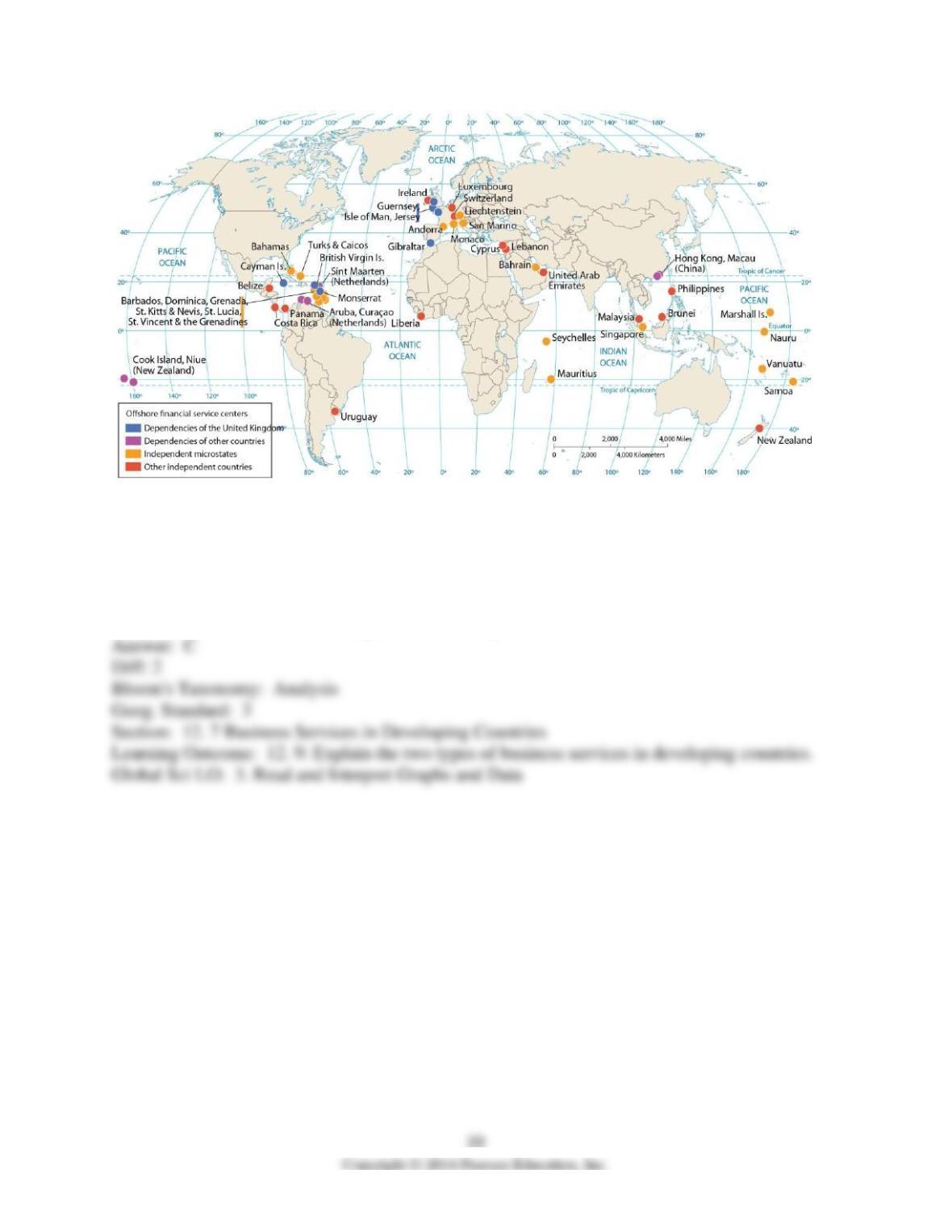
41) This map of offshore financial centers indicates that
A) most are concentrated in South America.
B) many are concentrated in the United States.
C) many are concentrated in the eastern Caribbean.
D) many are concentrated in East Asia.
E) there are more offshore banking centers in Europe than in the Caribbean.