1
Biology: A Guide to the Natural World, 5e (Krogh)
Chapter 12 Units of Heredity: Chromosomes and Inheritance
1) A woman who is a carrier for the hemophilia gene has a child with a man who does not have
hemophilia. Which prediction is correct?
A) All of the sons and none of the daughters will have hemophilia.
B) All of the daughters and none of the sons will have hemophilia.
C) Half of the sons and half of the daughters will have hemophilia.
D) Half of the sons and none of the daughters will have hemophilia.
E) Half of the daughters and none of the sons will have hemophilia.
2) A woman who does not carry the color-blindness allele has children with a man who is color
blind. What proportion of their children will be color blind?
A) all
B) 1/4
C) 1/2
D) 3/4
E) none
3) Regarding the human sex chromosomes, which statement is correct?
A) The Y chromosome carries a greater number of genes than does the X chromosome.
B) X and Y are different in size but carry nearly equal numbers of genes.
C) The X chromosome carries more genes than does the Y chromosome.
D) The X chromosome carries only gender-related genes.
E) The X chromosome carries the genes for the development of male phenotype.
4) What percent of males have some degree of color blindness?
A) 0.5 percent
B) 5 percent
C) 0.8 percent
D) 8 percent
E) 10 percent
5) A trait such as albinism is seen with equal frequency in males and females. Two people who
do not have the trait might have offspring who do have the trait, at a frequency of approximately
one in four. What can you conclude about the inheritance of this trait?
A) recessive, X-linked
B) recessive, autosomal
C) recessive, caused by polyploidy
D) dominant, X-linked
E) dominant, autosomal
6) What is a recessive disorder?
A) a genetic disorder with two functioning alleles
B) a genetic disorder that will express itself in the presence of one functioning allele
C) a genetic disorder that will express itself in the presence of two recessive alleles
D) a genetic disorder that involves change in chromosome number
E) a genetic disorder that involves change in chromosome structure
7) Why do X-linked conditions appear more frequently in males than in females?
A) A male with a nonfunctioning allele on the X chromosome does not have another allele of
that gene on the Y chromosome that could cover up the nonfunctioning one.
B) Males have no X chromosomes.
C) The Y chromosome carries many alleles that are recessive to alleles on the X chromosome.
D) Males are more likely to inherit an extra chromosome than females.
E) Females have no X chromosomes.
8) What do hemophilia, Duchenne muscular dystrophy, and red-green color blindness have in
common?
A) They are X-linked.
B) They are more common in females than in males.
C) They are caused by inheritance of an extra sex chromosome.
D) They are caused by inheritance of an extra autosome.
E) The gene that causes them is on the Y chromosome.
9) If a daughter expresses an X-linked recessive gene, she probably inherited the trait from:
A) her mother.
B) her father.
C) both parents.
D) neither parent.
E) her grandmother.
10) Red-green color blindness is an X-linked recessive trait in humans. A color-blind woman and
a man with normal vision have a son. What is the probability that the son is color blind?
A) 100 percent
B) 75 percent
C) 50 percent
D) 25 percent
E) 0 percent
11) Color blindness is caused by an X-linked recessive gene. A color-blind man and a woman
with normal vision whose father was color blind have a son. The probability that their son is
color blind is:
A) 0.25 (or 25 percent).
B) 0.50 (or 50 percent).
C) 0.75 (or 75 percent).
D) 1.00 (or 100 percent).
E) none of these.
12) Who is a “carrier” of X-linked disorders, such as hemophilia and color blindness?
A) a person who has the X-linked disorder
B) a heterozygous female who is normal but carries one nonfunctioning allele
C) a homozygous female who carries the normal alleles
D) a male who carries the nonfunctioning allele
E) a male who carries the functioning allele
13) An autosomal recessive disorder:
A) requires that only one parent be a carrier.
B) displays its symptoms only in heterozygotes.
C) is more frequent in males than females.
D) will appear only in children of parents who both carry the gene.
E) is dominant in females.
14) Genes not found on the sex chromosomes will be found on:
A) X chromosomes.
B) Y chromosomes.
C) autosomes.
D) centrosomes.
15) If a disease is caused by a dominant allele, it means that a person with the disease:
A) will always pass it on to all their children.
B) will pass it on to one-fourth of their children.
C) must be homozygous dominant for the allele.
D) must be heterozygous for the allele.
E) could be either homozygous or heterozygous for the allele.
16) A person who is heterozygous for the Huntington disease (HD) allele has offspring with
someone who does not have HD. What proportion of their children will have HD?
A) 1/16
B) 1/10
C) 1/8
D) 1/4
E) 1/2
17) A person with an inherited disorder has children with a person who does not have the
condition. Half the children have the disorder, both sons and daughters. How is this condition
inherited?
A) autosomal dominant
B) autosomal recessive
C) X-linked dominant
D) X-linked recessive
E) aneuploidy
18) What condition is caused by a dominant allele of a single gene?
A) Down syndrome
B) sickle-cell anemia
C) Huntington disease
D) color blindness
E) Turner syndrome
19) A person who has a recessive disorder but does not have the disorder him or herself is said to
be a/an:
A) aneuploid.
B) aberration.
C) carrier.
D) hybrid.
20) What is the connection between sickle-cell anemia and malaria?
A) Both are X-linked.
B) Both are autosomal recessive.
C) Both are dominant.
D) Heterozygotes for malaria have some resistance to sickle-cell anemia.
E) Heterozygotes for sickle-cell anemia have some resistance to malaria.
21) Which of the following is an autosomal recessive disorder?
A) hemophilia
B) Huntington disease
C) Down syndrome
D) sickle-cell anemia
E) Turner syndrome
22) Which of the following genetic disorders is caused by a dominant allele but does not produce
symptoms until the affected individual is well into adulthood?
A) Turner syndrome
B) Down syndrome
C) Huntington disease
D) sickle-cell anemia
E) hemophilia
23) In a pedigree chart, a darkened square demonstrates a:
A) diseased male.
B) diseased female.
C) normal male.
D) normal female.
24) A study of several pedigrees demonstrates that two parents are normal. If some of their
children express a trait, then the trait is controlled by a:
A) codominant gene.
B) simple dominant gene.
C) recessive gene.
D) sex-linked gene.
25) A pedigree is a representation of:
A) a genetic family tree.
B) a series of chromosomes arranged in order.
C) the inheritance pattern of recessive disorders.
D) the inheritance pattern of dominant disorders.
E) all the genetic disorders that can be inherited.
26) You are tracking the inheritance of a genetic disorder through a family’s pedigree, and you
notice that it shows up in every generation. The disorder is most likely:
A) recessive.
B) dominant.
C) X-linked recessive.
27) If more than one sperm fertilizes an egg, which of the following can result?
A) an autosomal dominant disorder
B) an autosomal recessive disorder
C) aneuploidy
D) polyploidy
28) The human genome has how many pairs of autosomal chromosomes?
A) 46 pairs
B) 44 pairs
C) 23 pairs
D) 22 pairs
E) 24 pairs
29) The state of having more than two sets of chromosomes is called:
A) autosomal.
B) dominant.
C) polyploidy.
D) aneuploidy.
E) nondisjunction.
30) What is one difference between polyploidy and aneuploidy?
A) Polyploidy is extra sets of chromosomes; aneuploidy occurs when there are either more or
fewer chromosomes than normally exist in its species full set.
B) Humans can be viable as polyploids but not as aneuploids.
C) Polyploidy is extra sex chromosomes; aneuploidy is extra autosomes.
D) Polyploidy is one extra chromosome; aneuploidy is one missing chromosome.
E) Polyploidy causes diseases and disorders in humans; aneuploidy does not.
31) What is nondisjunction?
A) failure of sperm and egg to fuse in fertilization
B) failure of cells to divide by cytokinesis in meiosis
C) failure of chromosomes to duplicate before mitosis or meiosis
D) failure of homologous chromosomes or sister chromatids to separate in meiosis
E) an extra duplication of the chromosomes before mitosis or meiosis
32) In humans, aneuploidy is fairly common yet goes largely unrecognized as a genetic problem.
This is because:
A) it produces autosomal recessive individuals who don’t always express the disorder.
B) its effects are usually hidden.
C) it actually produces healthy individuals.
D) it often results in miscarriage of embryos.
33) Down syndrome in humans is caused by:
A) an extra X chromosome.
B) an extra y chromosome.
C) three copies of chromosome 21.
D) three copies of chromosome 13.
E) a single copy of chromosome 21.
34) Aneuploid human embryos are least likely to survive except those involving:
A) chromosome 1, 2, 3, X, Y.
B) chromosome 1, 2, 3, 4, 5.
C) chromosome 13, 18, 21, X, Y.
D) chromosome 6, 7, 8, 9, 10.
E) chromosome 11, 12, 14, 15.
35) If a diploid cell from an organism has 46 chromosomes, how many chromosomes are likely
to be found in a gamete that is the result of nondisjunction?
A) 46 or 92
B) 23 or 22
C) 21 or 22
D) 22 or 24
E) 24 or 25
36) A woman is missing one of her X chromosomes. With which of the following conditions
would she be diagnosed?
A) Turner syndrome
B) polyploidy
C) a chromosomal deletion
D) Klinefelter syndrome
E) cancer
37) A person with the genotype XO is mainly female, phenotypically. A person with the
genotype XXY is mainly male. What can you conclude about the Y chromosome?
A) It has the same genes as X, just different alleles.
B) It has the same genes as X, in different orientation.
C) A Y chromosome confers maleness, regardless of the number of X chromosomes.
D) The only genes it carries are for female development.
E) A human cannot survive without a Y chromosome.
38) If a zygote has the genotype XYY, how many total chromosomes were in the sperm before it
fused with the egg?
A) 20
B) 21
C) 22
D) 23
E) 24
39) Nondisjunction of the X chromosomes may occur during formation of gametes and produce
two kinds of eggs. If normal sperm fertilizes these two kinds of eggs, which of the following
pairs of genotypes are possible?
A) XX and XY
B) XXY and XO
C) XYY and XO
D) XYY and YO
40) Which condition or disease is caused by aneuploidy?
A) sickle-cell anemia
B) hemophilia
C) malaria
D) color blindness
E) Down syndrome
41) A karyotype reveals that a woman is carrying a fetus that has 47 chromosomes. The test
reveals that the genotype of the fetus is XXY. Which of the following statements is correct?
A) The fetus has Down syndrome, and most likely a nondisjunction event occurred in the mother
during egg formation.
B) The fetus has Turner syndrome, and most likely a nondisjunction event occurred in the
mother during egg formation.
C) The fetus has Klinefelter syndrome.
D) The fetus has an autosomal disorder.
42) What single attribute determines that a human fetus is male?
A) the absence of a second X chromosome
B) the absence of a Y chromosome
C) the presence of a Y chromosome
D) the presence of two X chromosomes
43) Nondisjunction in somatic cells can result in aneuploid cells. This may give rise to:
A) Down syndrome.
B) Turner syndrome.
C) Klinefelter syndrome.
D) cancer.
E) cri-du-chat syndrome.
44) Which of the following combinations of chromosomes would be found in a person afflicted
with Turner syndrome?
A) XXY
B) XYY
C) XX
D) XY
E) XO
45) When a fragment breaks from a chromosome and rejoins it, in a flipped orientation, the result
is called a/an:
A) deletion.
B) polyploidy.
C) inversion.
D) aneuploidy.
E) translocation.
46) What is a possible cause of the chromosomal aberration called a “duplication”?
A) unequal crossing over
B) exchange between non-homologous chromosomes
C) a chromosome fragment that breaks off and does not rejoin any chromosome
D) breaking of a chromosome fragment, then rejoining in a flipped orientation
E) nondisjunction
47) A karyotype you are viewing shows an extra piece of chromosome 1 attached to
chromosome 22. What type of abnormality caused this?
A) inversion
B) deletion
C) translocation
D) nondisjunction
E) sex-linked
48) Which of the following is a transfer of genes between non-homologous chromosomes?
A) duplication
B) crossing over
C) inversion
D) deletion
E) translocation
49) Cri-du-chat syndrome babies are mentally challenged and have an abnormal larynx that
makes sounds like the cry of a cat. This disorder is due to a/an:
A) deletion in chromosome 5.
B) inversion in chromosome 2.
C) translocation between chromosome 9 and 22.
D) duplication in chromosome 7.
E) trisomy 21.
50) A chromosome that has been broken and has lost a section has had a/an:
A) aneuploidy.
B) inversion.
C) deletion.
D) duplication.
E) translocation.
51) Women do not express X-linked recessive characters.
52) A person must have two alleles for hemoglobin S in order to suffer from sickle-cell anemia.
53) A carrier for a genetic disorder will pass the allele to all of their offspring.
54) If one of your parents has Huntington disease and is heterozygous for the disorder, you have
a 50 percent chance of inheriting the disease.
55) Polyploidy is better tolerated in plants than in animals.
56) A single nondisjunction event results in some gametes with more chromosomes and some
gametes with fewer chromosomes.
Match the following.
A) aneuploidy
B) nondisjunction
C) duplication
D) translocation
E) deletion
57) This event may occur during meiosis I or meiosis II.
Topic: Section 12.5
Skill: Knowledge/Comprehension
58) Only 1 percent of human embryos with this condition survive.
Topic: Section 12.5
Skill: Knowledge/Comprehension
59) This produces cri-du-chat syndrome.
Topic: Section 12.6
Skill: Knowledge/Comprehension
60) Non-homologous chromosomes have exchanged parts.
Topic: Section 12.6
Skill: Knowledge/Comprehension
61) This has been involved in producing gene families and has been vital to evolution.
Topic: Section 12.6
Skill: Knowledge/Comprehension
62) Hemophilia, Duchenne muscular dystrophy, and color blindness are examples of ________
disorders.
63) A person with only one allele for a recessive condition who does not have the condition is
called a ________.
64) You have studied the presence of a trait in the members of three generations of a family.
With this information, you constructed a ________ to track how the trait was passed down
through the generations.
65) The condition in which an organism has more than two sets of chromosomes is called
________, while having either more or fewer than the normal number of a particular
chromosome is called ________.
66) ________ is the condition when an individual has three copies of chromosome 21.
67) Explain why a female can be heterozygous for an X-linked gene but a male cannot.
68) Hemophelia is an X-linked recessive disorder. A mother without the allele and a father with
the allele have a daughter. The daughter then marries a man with hemophilia. What is the
genotype of the daughter? What is the probability that the daughter’s children will develop the
disease?
69) Duchenne muscular dystrophy is a recessive disorder resulting in a wasting away of the
muscles. How would you design a study to determine if the disorder is X-linked or autosomal?
How would you be able to determine if it is X-linked or autosomal?
70) Phenylketonuria is the most commonly inherited genetic disorder that affects nervous system
development. It occurs in 1 out of every 10,000 births in the United States and Europe. How
would you design a study to determine if phenylketonuria is an autosomal dominant or
autosomal recessive disorder? How would you be able to determine if it is dominant or
recessive?
71) Explain what causes aneuploidy.
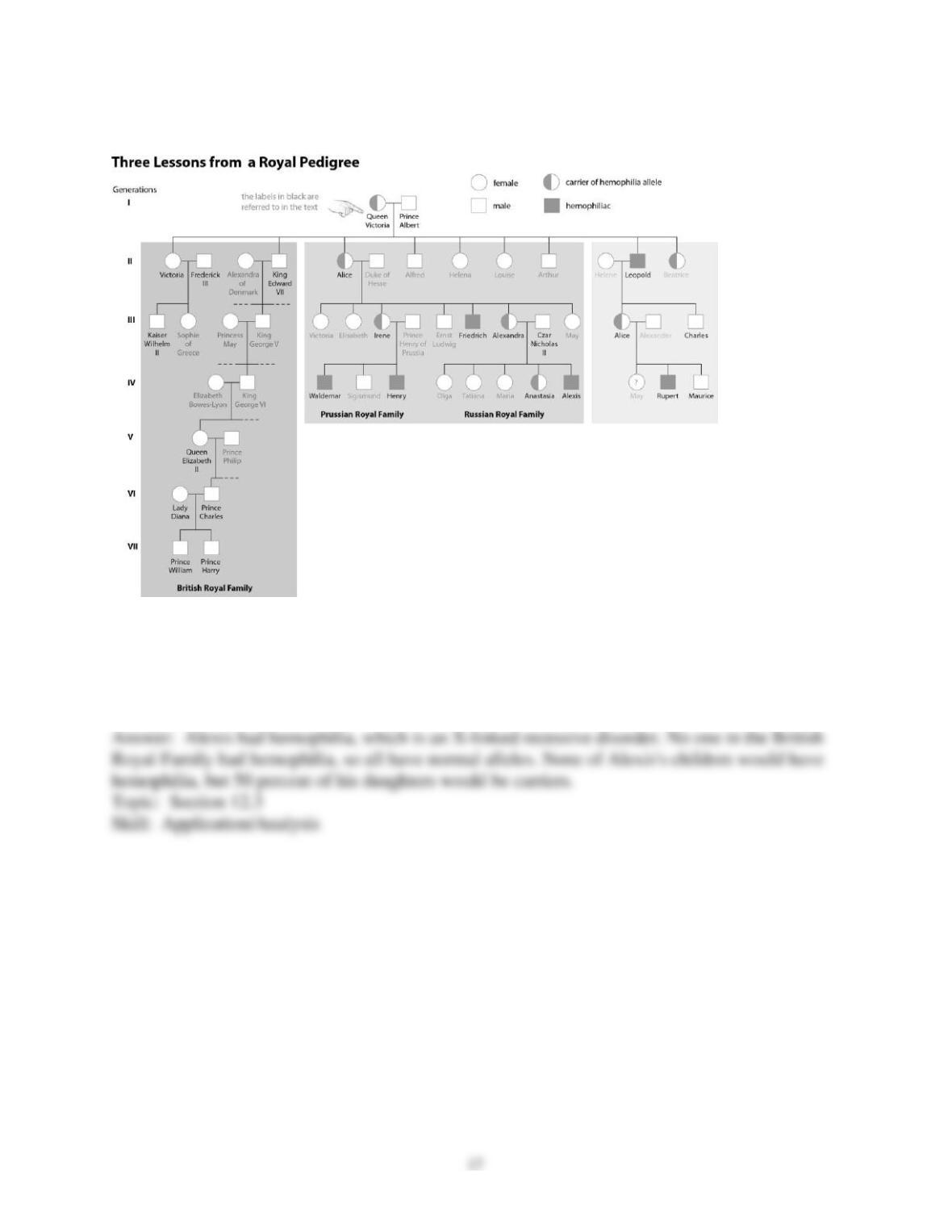
Refer to the figure below, and then answer the question that follows.
72) The last members of the Russian Royal Family were executed during the Russian
Revolution. Assume the revolution never took place and Alexis, son of Czar Nicholas II and
Alexandra, survived and married into the British Royal Family. What is the probability that his
children would have hemophilia? What is the probability his children would be carriers for
hemophilia?
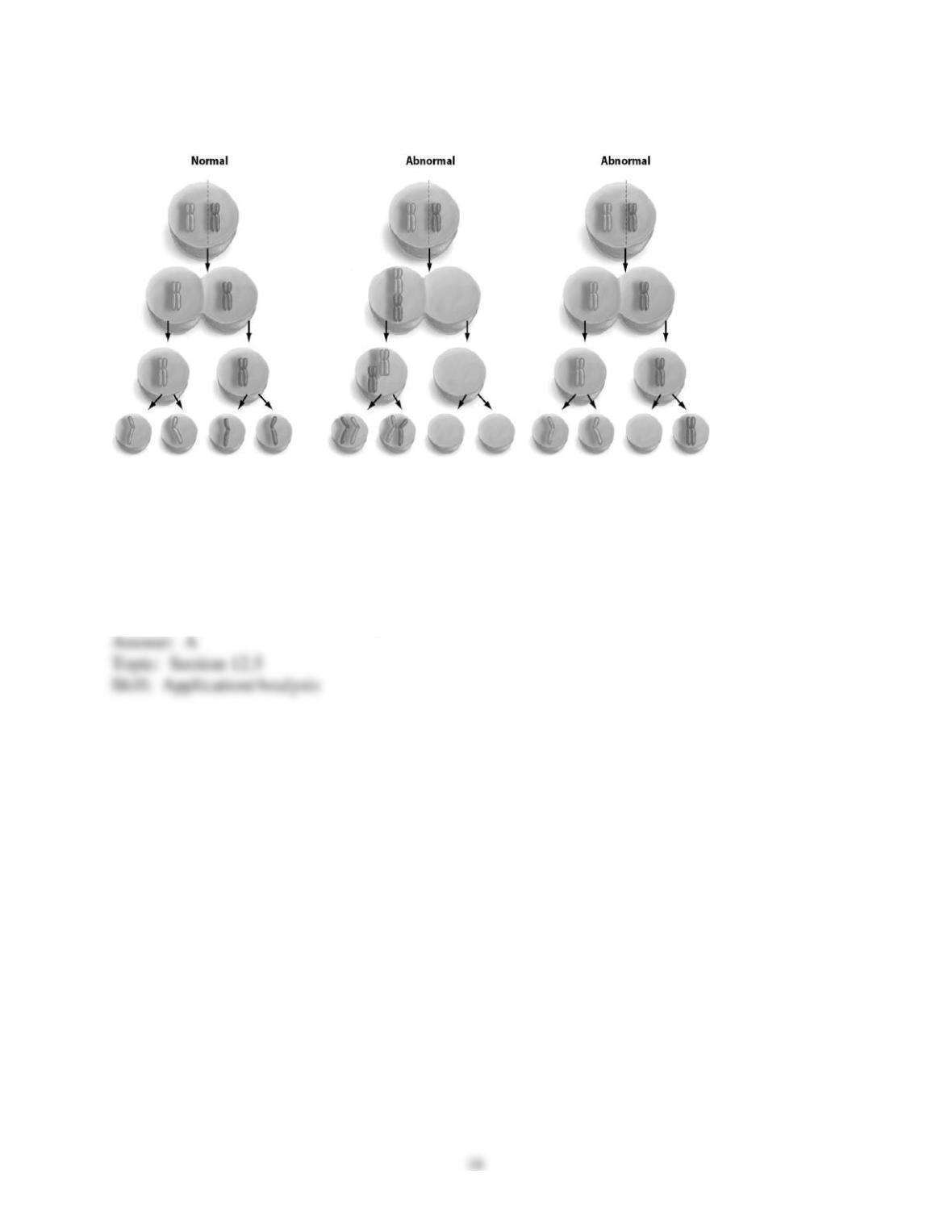
Refer to the figure below, and then answer the question that follows.
73) Nondisjunction in meiosis gives rise to gametes with abnormal chromosome numbers.
Which event is likely to produce a higher percentage of abnormal gametes?
A) failure of homologous chromosomes to separate at meiosis I
B) failure of homologous chromosomes to separate at meiosis II
C) failure of sister chromatids to separate at meiosis I
D) failure of sister chromatids to separate at meiosis II
E) failure of sister chromatids to separate at mitosis