Chapter 12 – Inventory and Supply Chain Models
1. Which of the following is not one of the factors which influence the decision about how much safety stock a company
should hold?
a.
Variance of demand during lead time
b.
Variance of the length of the lead time
c.
Variance of the cost of stockout
d.
Desired service level
c
1
2. Which of the following is a reason that motivates a company to carry as little inventory as possible?
a.
The fixed cost of ordering
b.
The desire not to run out of products that customers demand
c.
The lead time to process a supply order
d.
Interest costs
d
1
3. When customer demand is known, the resulting inventory model is called:
a.
normal
b.
uniform
c.
deterministic
d.
probabilistic
c
1
4. Which of the following is not one of the important issues in inventory models?
a.
Whether demand is generated internally or externally
b.
Whether the company orders the products it needs from a supplier or produces them internally
c.
Whether the inventory is stored onsite or offsite
d.
Whether inventory is reviewed continuously or periodically
c
1
5. The opportunity cost of having money tied up in inventory is a type of ____ cost:
a.
setup
b.
production
c.
carrying
d.
penalty
c
1
6. Which of the following is not one of the assumptions in an economic order quantity (EOQ) model?
a.
Orders can be placed at any time
b.
Demand is constant
c.
Lead time for delivery of the product from the supplier is constant
Chapter 12 – Inventory and Supply Chain Models
d.
Annual holding cost is constant
ANSWER:
d
POINTS:
1
7. The annual ordering cost in the economic order quantity (EOQ) model is:
a.
D/Q
b.
KD/Q
c.
icQ/2
d.
(s+ic)Q/2
ANSWER:
b
POINTS:
1
8. In an economic order quantity (EOQ) model with shortages allowed, the decision variables are:
a.
Q, the order quantity and b, the maximum amount backlogged
b.
Q, the order quantity and p, the unit penalty cost
c.
D, the demand and b, the maximum amount backlogged
d.
D, the demand and p, the unit penalty cost
ANSWER:
a
POINTS:
1
9. In specifying an (R,Q) ordering policy, the choice of R depends largely on:
a.
How shortage costs are measured
b.
Fixed ordering costs
c.
Nonfinancial holding costs
d.
Financial holding costs
ANSWER:
a
POINTS:
1
10. Which of the following is one of the two ways to “cost” shortages in inventory modeling?
a.
Lengthening the order cycle
b.
Constraining the lead time for orders
c.
Increasing the cost of the safety stock
d.
Constraining the service level
ANSWER:
d
POINTS:
1
11. The time it takes for an order to arrive at facility is called the stockout time.
a.
True
b.
False
ANSWER:
False
POINTS:
1
12. In the basic economic order quantity (EOQ) model, the annual ordering cost and the annual holding cost are always
equal.
a.
True
Chapter 12 – Inventory and Supply Chain Models
b.
False
True
1
13. The basic economic order quantity (EOQ) model can be formulated as a linear model in Solver.
a.
True
b.
False
False
1
14. The annual shortage cost in an economic order quantity (EOQ) model with shortages allowed is pb2/Q.
a.
True
b.
False
False
1
15. The only real cost benefit from synchronizing orders for several products is reduced setup costs.
a.
True
b.
False
True
1
16. Critical fractile analysis enables you to see how net profit is distributed for a given order quantity, but it isn’t well
suited to finding the optimal order quantity.
a.
True
b.
False
False
1
17. In a probabilistic inventory model, there is no guarantee that the planned safety stock will exist.
a.
True
b.
False
True
1
18. Any particular service level constraint in a probabilistic inventory model can be equivalently formulated with an
appropriate unit holding cost
a.
True
b.
False
False
1
19. An order cycle begins each time an order arrives and ends just before the next order arrives.
a.
True
b.
False
True
20. Uncertainty about lead time in a probabilistic inventory model adds to the uncertainty about the demand during lead
time.
a.
True
b.
False
True
1
Exhibit 12-1
An appliance store sells 500 units of a particular type of dishwasher each year. The demand for this product is essentially
constant throughout the year. The store orders its products from a regional supplier, and it typically takes two weeks for
the dishwashers to arrive after an order has been placed. Each time an order is placed, an ordering cost of $1000 is
incurred. Each dishwasher costs the hardware store $300 and retails for $550. The store’s annual cost of capital is
estimated to be 7% per year.
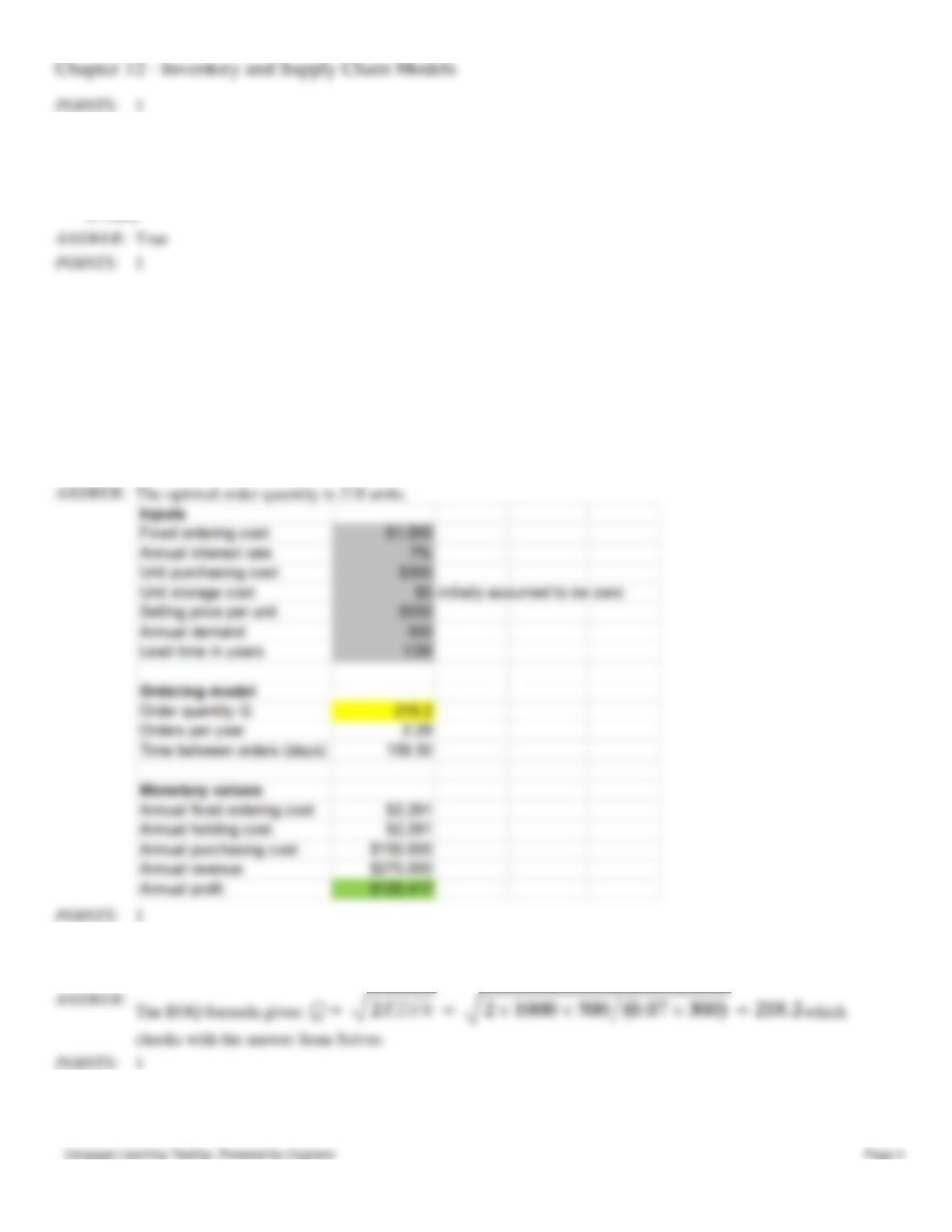
21. Refer to Exhibit 12–1. Assuming there are no storage costs, formulate a Solver model and find the optimal order
quantity.
1
22. Refer to Exhibit 12–1. Check your answer from Solver using the economic order quantity (EOQ) formula. Do you get
the same result? Show your work.
checks with the answer from Solver.
1
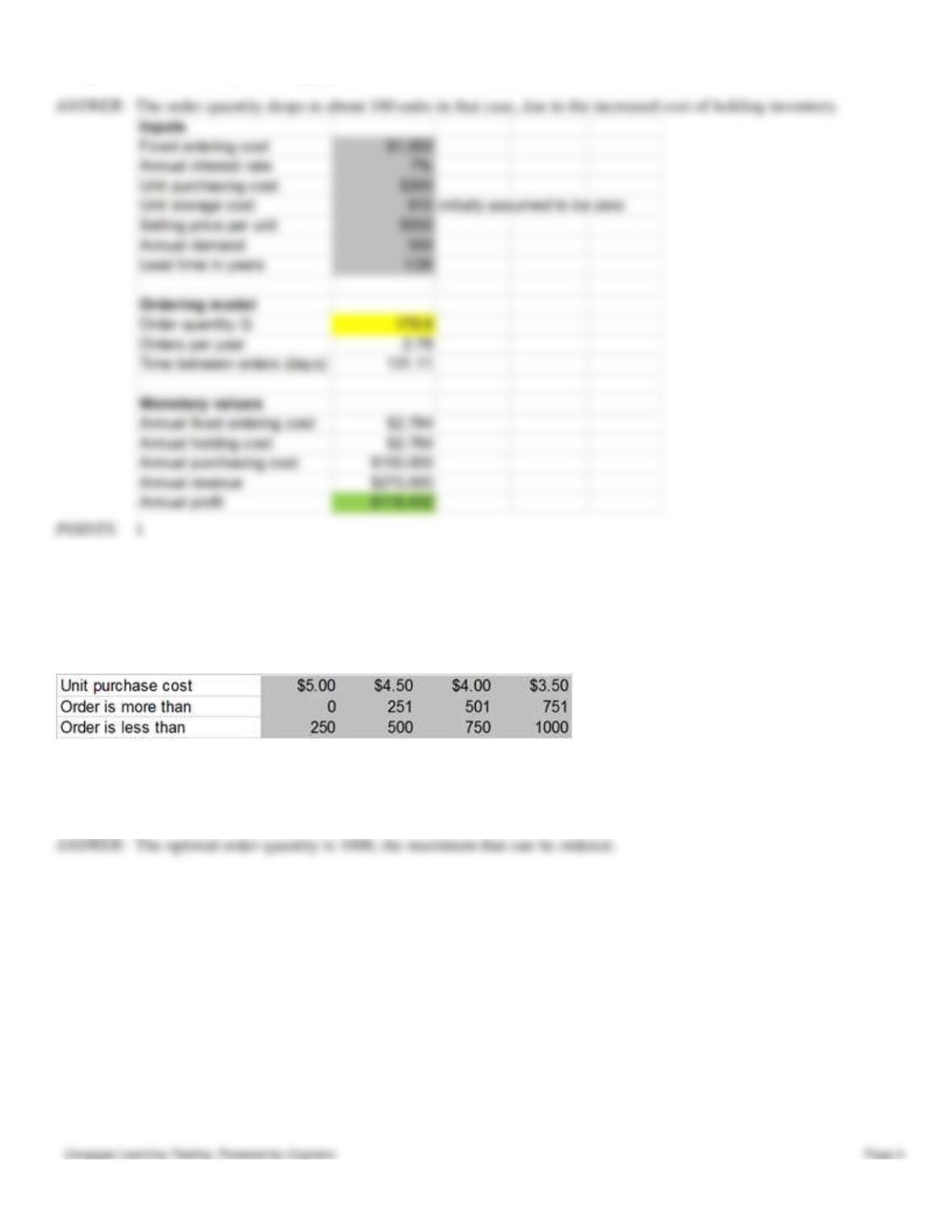
23. Refer to Exhibit 12–1. Suppose there is a storage cost of $10 per unit. Make the appropriate change to your Solver
model or EOQ formula, and find the optimal order quantity in that case.
1
Chapter 12 – Inventory and Supply Chain Models
Exhibit 12-2
A moving company purchases large cardboard shipping boxes from a supplier. The company uses approximately 10,000
of these boxes for packing customers’ belongings each year, and demand for the boxes is essentially constant throughout
the year. The box supplier offers the following pricing schedule, based on the quantity of boxes ordered:
The fixed cost of placing an order is $50, and the company’s cost of capital is 7% per year.
24. Refer to Exhibit 12–2. Assuming there are no storage costs, formulate a Solver model and find the optimal order
quantity.
The optimal order quantity is 1000, the maximum that can be ordered.
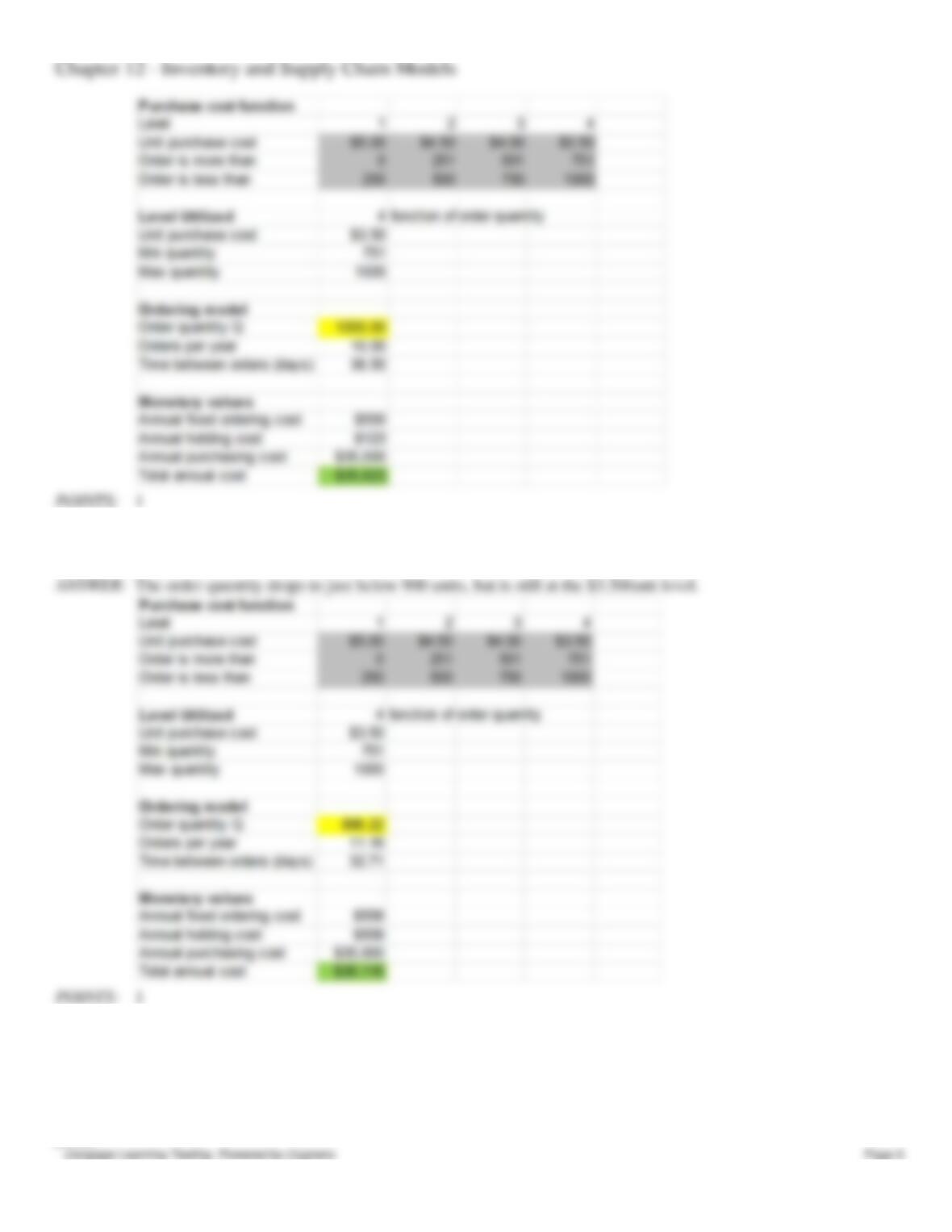
25. Refer to Exhibit 12–2. Suppose there is a storage cost of $1 per unit. Make the appropriate change to your Solver
model and find the optimal order quantity in that case. Does the unit purchasing price change?
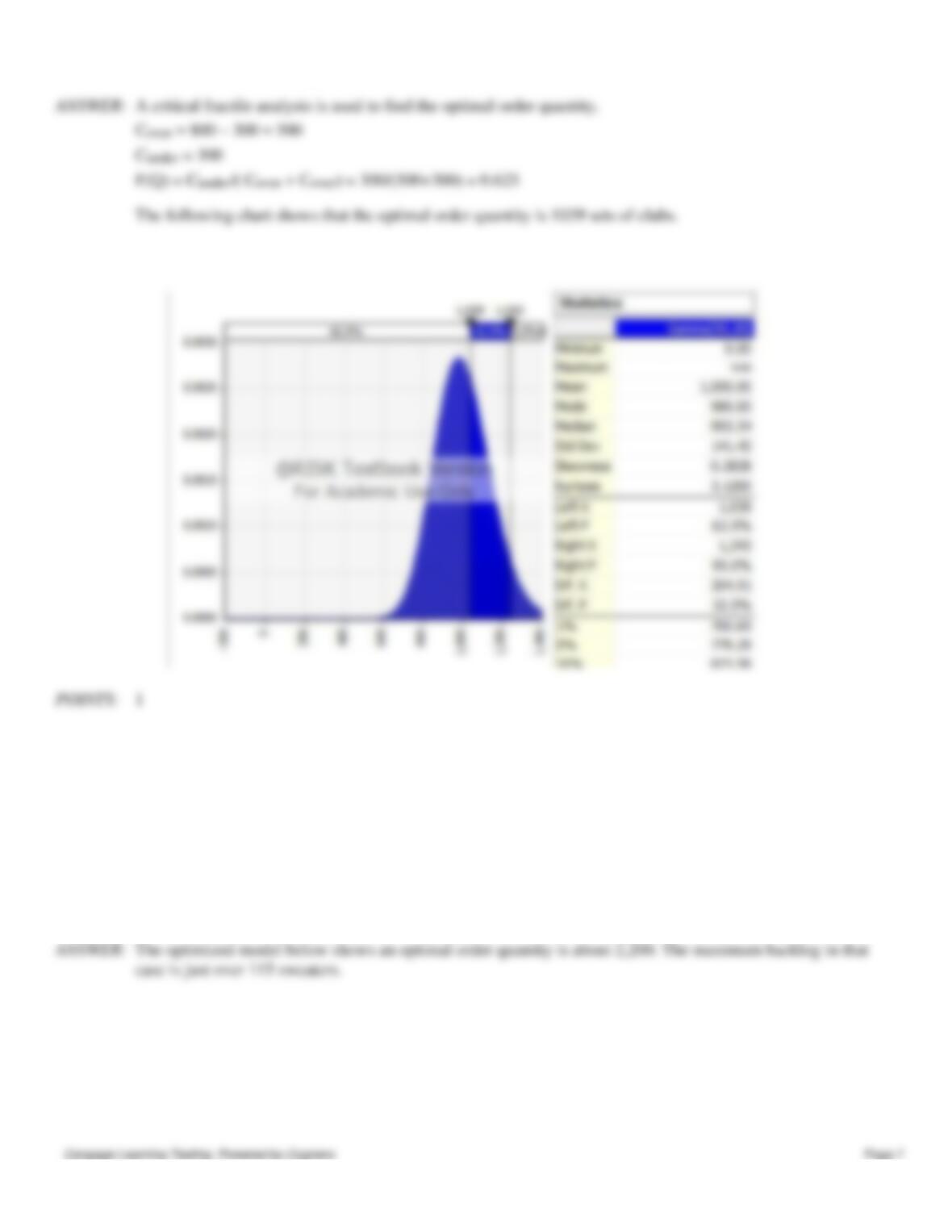
26.
Promoters of the Mulligan Golf tournament order sets of special edition clubs for $300 each that are sold during the
tournament for $800 per set. Once the tournament is over, unsold sets are donated to the local Boys and Girls Clubs to be
used by underprivileged youth. Based on past experience, they believe that demand for the sets will follow the Gamma
distribution with alpha equal to 50 and beta equal to 20. How many sets of clubs should they order to maximize expected
profit?
Chapter 12 – Inventory and Supply Chain Models
Exhibit 12-3
The North Slope clothing store chain sells approximately 26,000 units of its most popular cotton sweater each year. North
Slope buys these sweaters from a manufacturer located in Canada. The fixed cost of placing an order for this particular
product is $200. North Slope pays $10 for each cotton sweater. The company’s cost of capital is 11%, and the cost of
storing a sweater for one year is $1.10. While North Slope prefers not to backlog customer demand, management of the
company believes that it can afford to run out of sweaters on an occasional basis. The company estimates that the shortage
cost per sweater per year is about $20.
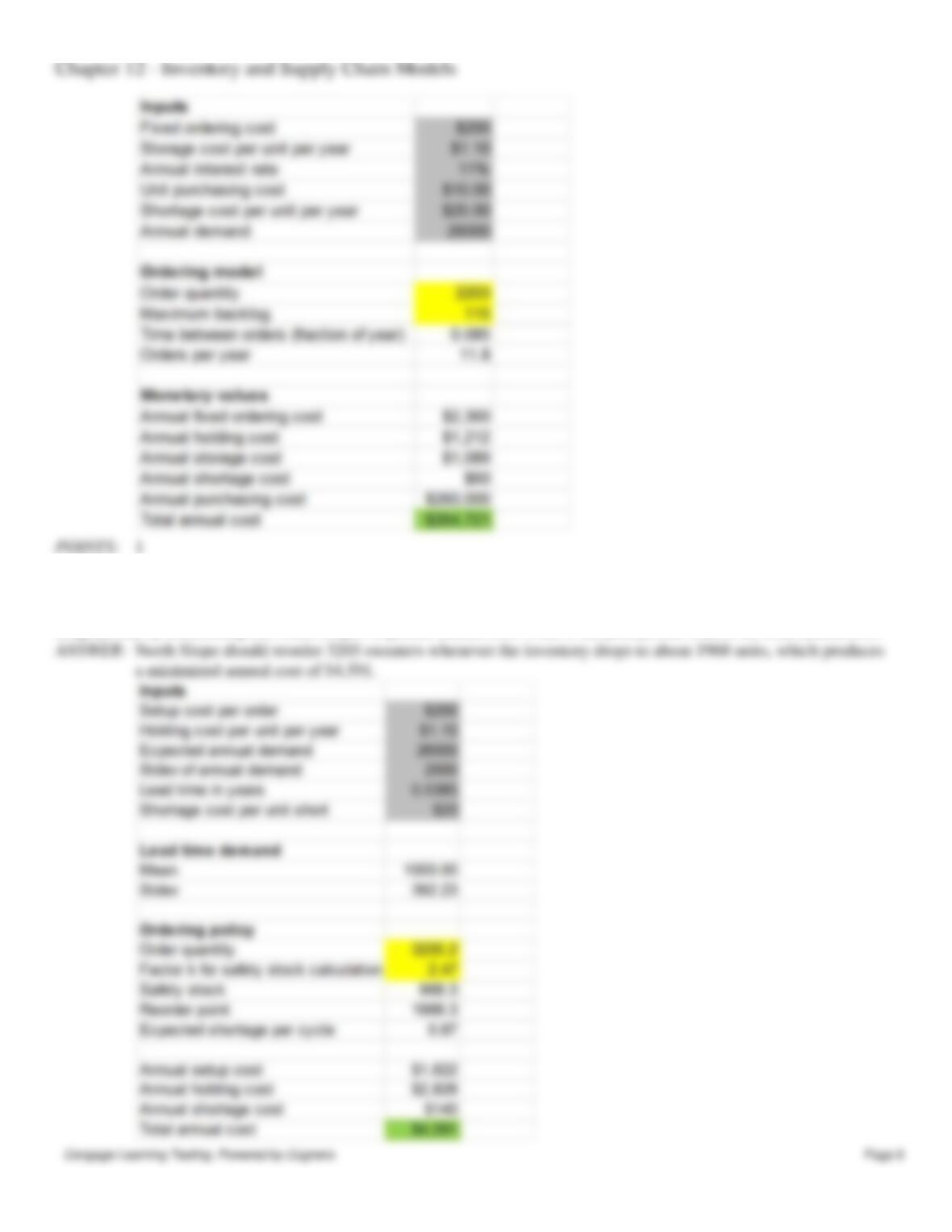
27. Refer to Exhibit 12–3. Formulate a Solver model and find the optimal order quantity for the cotton sweaters. What is
the optimal order? How much, if any, is the maximum backlog?
28. Refer to Exhibit 12–3. Suppose the annual demand for the sweaters is not known with certainty, but rather is estimated
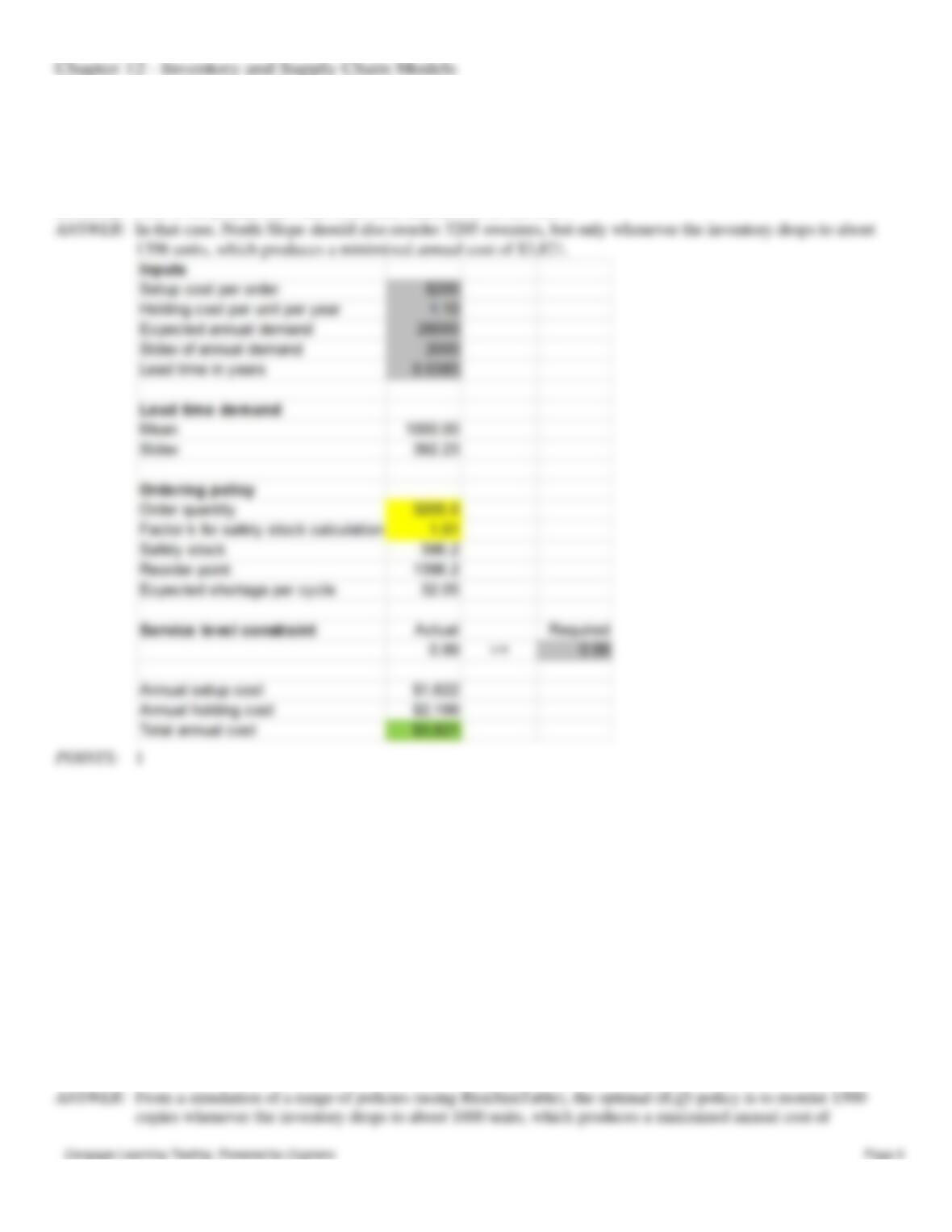
to be normally distributed with mean 26,000 and standard deviation 2,000. Formulate a Solver model to find the optimal
(R,Q) policy by minimizing the North Slope’s expected annual cost. What is the policy, and what is the total annual cost?
POINTS:
1
29. Refer to Exhibit 12–3. Suppose again that the annual demand for the sweaters is not known with certainty, but rather is
estimated to be normally distributed with mean 26,000 and standard deviation 2,000. However, this time, formulate a
Solver model to find the optimal (R,Q) policy to ensure that at least 99% of customer demands are met with existing
inventory. What is the policy, and what is the total annual cost in that case?
POINTS:
1
30. A bookstore chain often has to place orders for a wide variety of books. The setup cost for placing an order for copies
of a particular hardcover book is $100, regardless of the size of the order. The unit cost per copy is $40. The head of the
purchasing department of the bookstore estimates that the cost of holding a copy of this book in inventory for one week is
$6. The text’s inventory position at the beginning of any week is the number of copies in inventory plus any copies that
have already been ordered but have not yet arrived. The reorder policy specifies that if the inventory (x) at the beginning
of the week is less than or equal to R, exactly enough copies will be ordered to bring the inventory up to a set amount Q.
Thus, the bookstore will order Q − x copies. Otherwise, if the inventory is greater than R, no order will be placed that
week. If an order is placed, it will arrive after a lead time of 1, 2, or 3 weeks with probabilities 0.65, 0.25, and 0.10,
respectively. The weekly demand for this book is uncertain, but it can be described by a normal distribution with mean
600 and standard deviation 150. The bookstore’s policy is to satisfy all demand in the week it occurs. If weekly demand
cannot be satisfied completely from on-hand inventory, then an emergency order will be placed at the end of the week for
the shortage. This order will arrive virtually instantaneously (via express mail delivery), but at a much higher cost of $70.
It is currently the beginning of week 1, and the current inventory of this hardcover book, including any copies that might
have just arrived, is 1200. There are no other orders on the way. Simulate a range of (R,Q) ordering policies, from
400<R<1400 and 1000<Q<2500, and determine which one minimizes total cost over the next 52 weeks.