Chapter 12: Intangibles
100. The determination of impairment losses differs under IFRS versus GAAP in that
a.
only GAAP permits a value–in-use estimate
b.
only IFRS employs a disposal approach as a measure of fair value
c.
only GAAP compares the fair value to cost
d.
only IFRS permits a value-in-use estimate
d
1
Moderate
ACCT.WHAL.16.12.5 – LO: 12.5
United States – BUSPROG: Reflective Thinking – BUSPROG: Analytic
United States – OH – Default City – AICPA: FN-Decision Modeling
Bloom’s: Understanding
101. The first step in testing for impairment of goodwill is to
a.
measure the fair value of the reporting unit and the fair value of the identifiable assets of the reporting unit.
b.
compare the fair value of the reporting unit with its book value, including goodwill.
c.
compare the fair value of the reporting unit with its book value, excluding goodwill.
d.
assess qualitative factors that indicate whether the fair value of the reporting unit is greater or less than its
carrying value.
d
1
Moderate
ACCT.WHAL. – 16.20.1 – LO 20.1
United States – BUSPROG – Reflective Thinking; BUSPROG: Analytic
United States – OH – Default City – AICPA – FN-Decision Modeling
Bloom’s: Analyzing
102. Consider the following information from a company’s records for 2016:
Materials used in research and development projects
$4,500
Equipment acquired that will have alternative future uses in future
R&D projects for five years
1,500
Personnel costs of employees involved in R&D projects
5,500
Consulting fees paid to outsiders for R&D projects
2,800
Indirect costs reasonably allocable to R&D projects
250
Legal fees associated with registration of a patent resulting from a
2016 R&D project
2,500
Required:
a.
Compute the amount of R&D costs that should be classified as expenses in determining
2016 net income.
b.
For any listed item not included in your answer to requirement 1, provide the rationale for
not expensing it.
b.
103. The following costs were incurred by Mark Corporation during the current year:
∙
Legal fees paid to attorneys in connection with a patent application related to a new
invention developed by the company’s laboratory personnel: $40,000.
∙
Salaries of personnel involved in searching for applications of new research findings:
$150,000.
∙
Cost of machinery acquired on January 1, 2014: $355,000. The machinery will be used in a
current research and development project, as well as several other R&D projects over the
next eight years, after which the machine is expected to be sold for $15,000. Mark
Corporation uses straight-line depreciation.
∙
Costs of design, construction, and testing of preproduction prototypes of potential new
product lines for the company: $70,000.
∙
Cost of developing a valuable new product that was successfully patented: $100,000.
∙
Cost of marketing research to promote the new product: $60,000.
Required:
a.
Calculate the total research and development expense that should appear in Mark’s current
year income statement.
b.
For any of the above items you exclude from the current year expense amount, indicate the
proper accounting treatment.
Total research and development expense:
Salaries of laboratory personnel
Depreciation of machinery [($355,000 − $15,000)/8]
Cost of prototypes
Cost of development of new product
Total
1
Challenging
ACCT.WHAL.16.12.2 – LO: 12.2
United States – BUSPORG: Analytic
United States – OH – Default City – AICPA: FN-Measurement
Bloom’s: Analyzing
104. Consider the following information from a company’s records for the current year:
Feb. 11
Purchased materials exclusively for use in R&D projects.
Of these materials, 30% are left at the end of the year and
will be used in the same project next year (they have no
alternative use).
$ 85,000
Aug. 28
Construction costs for a new research facility that has
been placed in use on this date and is expected to be used
to house multiple R & D activities for 20 years. The
facility has no expected salvage value.
600,000
Aug. 29
Purchased an experimental machine from an inventor. The
machine is expected to be used for a particular R&D
activity for two years, after which it will have no residual
value.
16,000
Nov. 26
Salaries paid to employees involved in R&D.
35,000
Required:
Compute the amount of R&D expense for the current year. The company normally uses straight-line depreciation for
plant assets.
$85,000 + ($600,000/20 x 4/12) + $16,000 + $35,000 = $146,000
1
Challenging
ACCT.WHAL.16.12.2 – LO: 12.2
United States – BUSPORG: Analytic
United States – OH – Default City – AICPA: FN-Measurement
Bloom’s: Analyzing
105. Certain activities are listed below.
a.
Testing a new type of machine to evaluate its potential usefulness in production
b.
Engineering follow-through in an early phase of commercial production
c.
Total cost of an R&D building−No alternative use
d.
Salary of director of R&D
e.
Current period depreciation on a building housing R&D activities (alternative future use)
f.
General and administrative costs reasonably allocated to R&D projects
g.
Patent acquired solely for use in a specific R&D project
Required:
List by letter the activities that would be considered in determining R&D costs.
1
Challenging
ACCT.WHAL.16.12.2 – LO: 12.2
United States – BUSPROG: Reflective Thinking – BUSPROG: Analytic
United States – OH – Default City – AICPA: FN-Decision Modeling
Bloom’s: Evaluating
106. Costs associated with various intangibles of a company may either be expensed when incurred or capitalized and
amortized. Such costs might be recorded in any of the following ways:
a.
charged to the patent account and amortized
b.
charged to the franchise account and amortized
c.
charged to other appropriate asset accounts and amortized or depreciated
d.
charged to expense when incurred
Required:
Indicate how each of the following costs should be recorded by placing the appropriate letter (a-d) in the space
provided.
____
1.
Initial fee to acquire a franchise.
____
2.
Design, construction, and testing of preproduction prototypes and models.
____
3.
Legal costs incurred in connection with a successful patent application.
____
4.
Laboratory research aimed at discovery of new knowledge.
____
5.
Cost of purchased equipment that will be used in a series of R&D projects over a
ten-year period.
____
6.
Legal costs of the initial incorporation of a business.
____
7.
Cost of a long-term lease of land containing mineral deposits.
____
8.
Annual service fee paid to the franchiser’s headquarters for administrative services
rendered to the franchisee.
1.
b
5.
2.
d
6.
3.
a
7.
4.
d
8.
107. New Co. received a patent on a new type of machine. The legal costs and the patent application costs totaled
$180,000. R&D costs incurred to create the machine were $120,000. In the year in which the company received the
patent, $25,000 was spent in the successful defense of a patent infringement suit.
Required:
What amount of patent costs, if any, should be capitalized as an intangible asset?
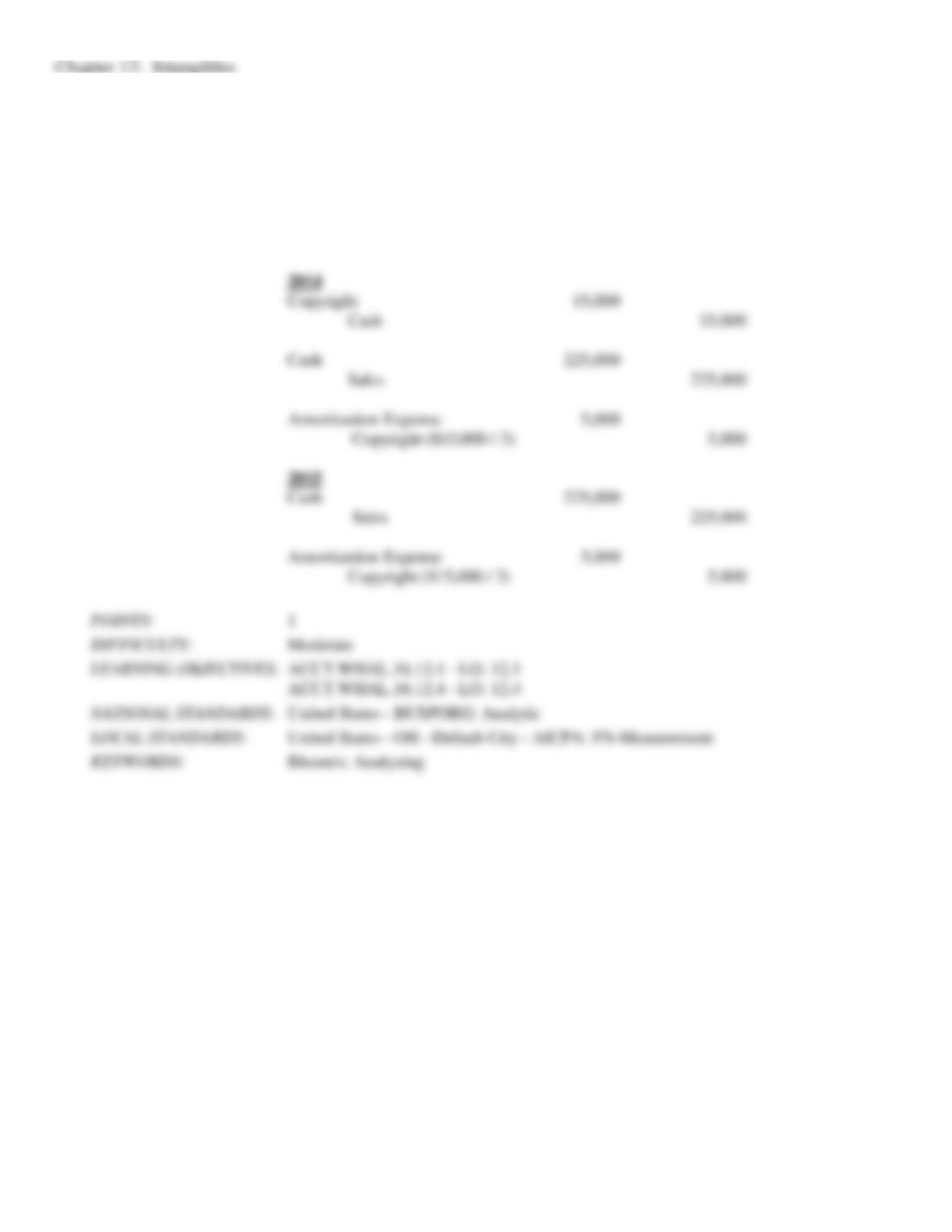
108. The Family company was expanding as a result they engaged in the following activities beginning in 2016.
a.
Paid $30,000 to the Major League Ballpark to have the Family name displayed
on the billboard for three years.
b.
Purchased a franchise for $20,000 to operate trolley services around the city for
tourists. The trolley service is expected to be decommissioned in 4 years due to
the maintenance costs, there is hope that it will remain in service.
c.
Purchased a patent for $45,000 the patent was originally filed in 2011.
d.
The owner of the patent was a well-known inventor and author who sold Family
the rights to his novel in exchange for 5,000 shares of stock. The stock has a $5
par value and is currently selling for $25 per share. The novel is expected to sell
1,000,000 copies in the next 2 years.
a.
Advertising Expense
Prepaid Advertising
b.
Amortization Expense
Franchise
($20,000/4 years)
c.
Amortization Expense
Patent
($45,000/ 15 year remaining life)
d.
Amortization Expense
Copyright
($125,000/ 2)
1
Challenging
ACCT.WHAL.16.12.4 – LO: 12.4
United States – BUSPORG: Analytic
United States – OH – Default City – AICPA: FN-Measurement
Bloom’s: Analyzing
Required:
Prepare the journal entries to record the amortization of the intangible assets for 2016. Amortize over their legal life
unless otherwise noted.
© 2016 Cengage Learning. All Rights Reserved. May not be scanned, copied or duplicated, or posted to a publicly accessible website, in whole or in part.
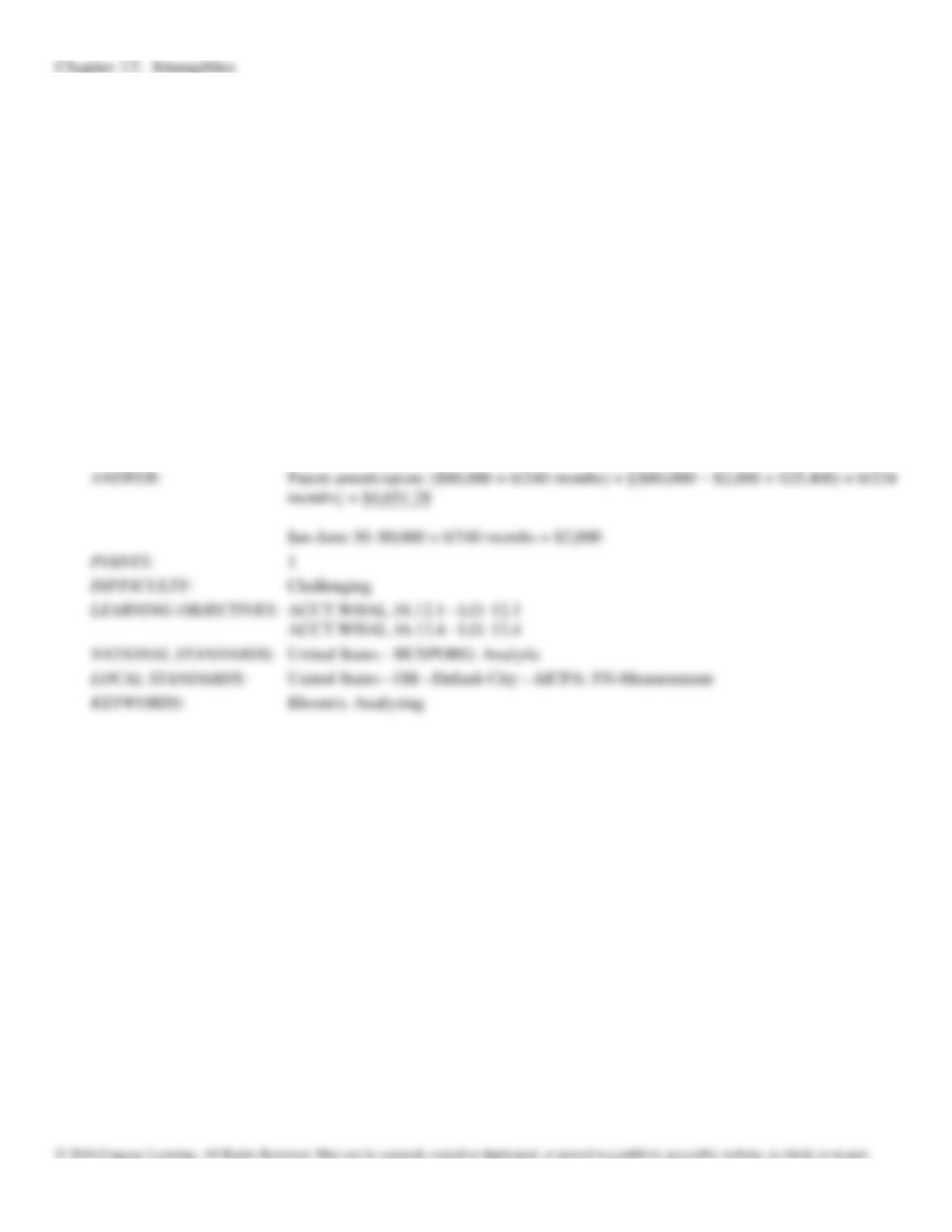
109. Ship Publishing signed a contract with an artist to publish his artwork into large format posters to resell. The contract
was signed on January 1, 2014, and a payment of $15,000 was made to obtain copyright privileges. Ship sold 15,000
posters each year starting in 2014 at a price of $15. The copyright is expected to be useful for 3 years.
Required:
Prepare the journal entries for 2014 and 2015.
ANSWER:
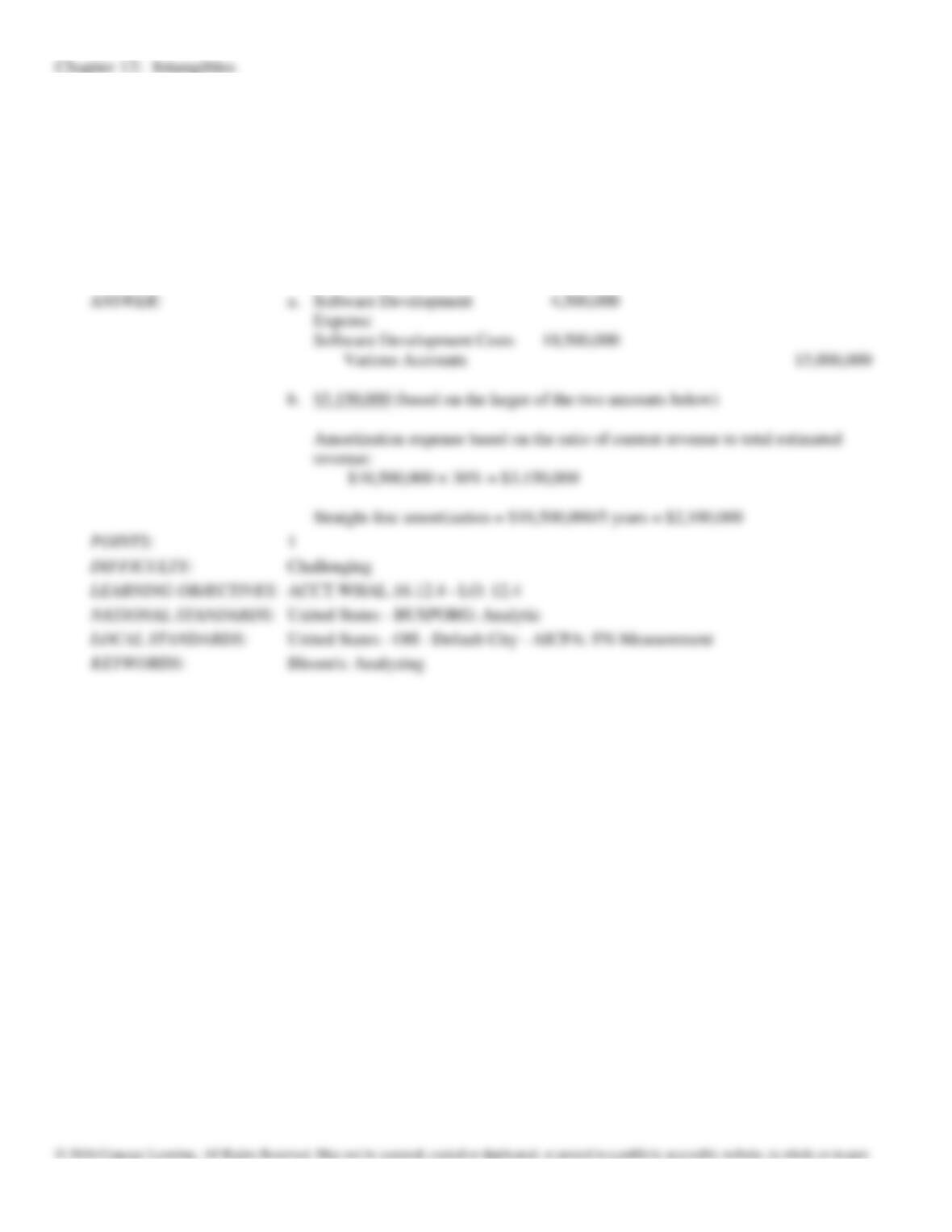
110. The Mario Company was organized at the end of 2015. The following items acquired on January 1, 2016, were listed
by the company as intangible assets at the end of 2016:
Legal fees for registration of a trademark with an anticipated indefinite life
$ 20,000
Patent purchased (newly issued)
80,000
Goodwill (resulting from the purchase of a supplier early in 2016)
240,000
At the beginning of 2016, Mario also purchased a research building at a cost of $275,000. The company estimates
that the building will be used in numerous projects over a 20-year period. During the year, Mario spent $75,000 on
research and development materials and salaries. In early January 2016, Mario purchased a patent for $75,000 that
was used exclusively for a single research project conducted during 2016. Mario uses straight-line amortization over
the maximum allowable periods. In addition, on July 1, 2016, Mario incurred legal fees of $25,400 to defend the new
patent that had been acquired for $80,000. Mario’s lawyers were successful in the defense of the patent.
Required:
Determine the amortization expense for intangibles for 2016. Mario calculates amortization expense to the nearest
month.
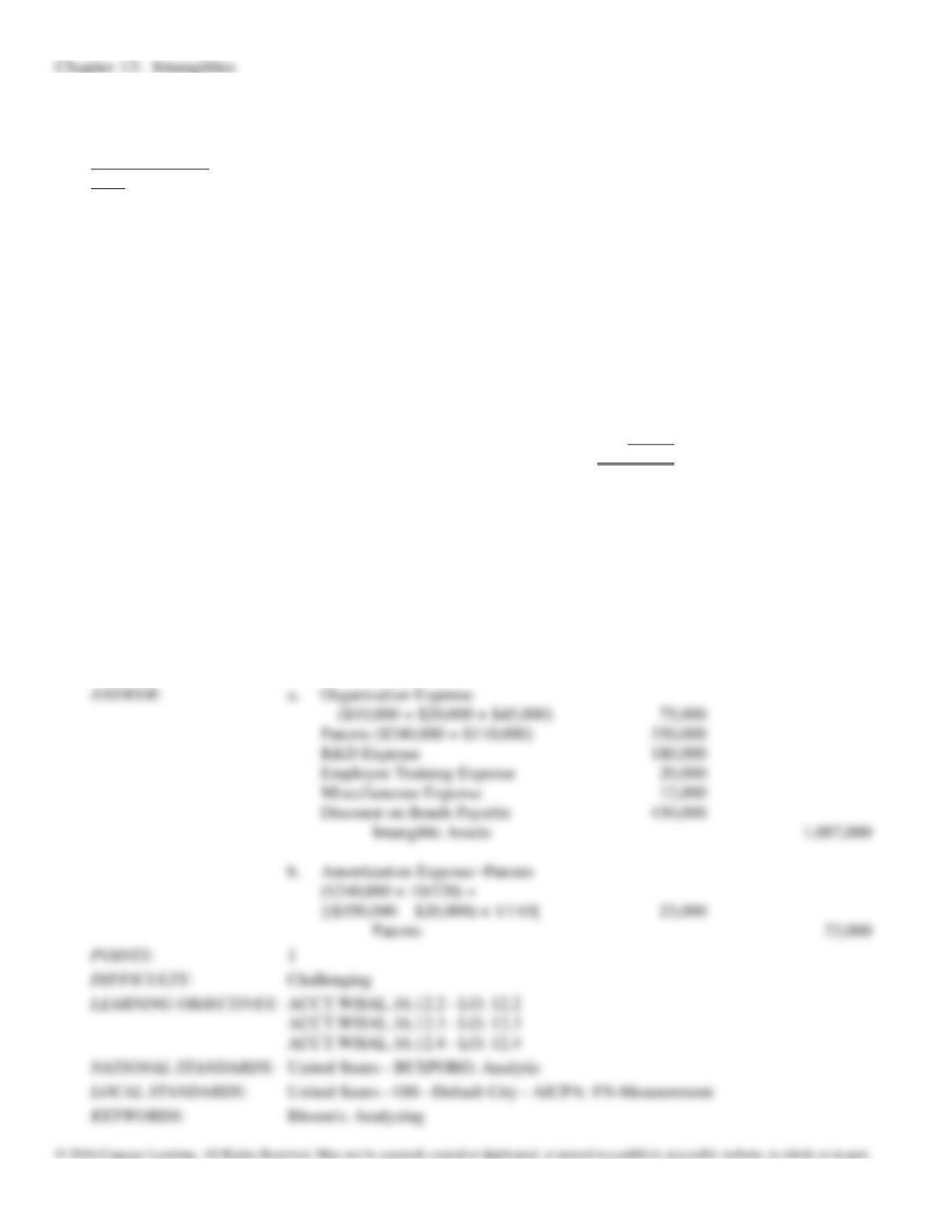
111. During 2016, Quartz, Inc. developed a new financial accounting software package for sale. The company spent
$15,000,000 on the system, 30% of which was incurred prior to technological feasibility being established. The
package was put on sale January 1, 2017, and the company estimates that over the five-year life of the package it will
generate $100 million in sales. During 2017, sales amounted to $30 million.
Required:
a.
Prepare the journal entry to record the development costs incurred in 2016.
b.
Compute the amortization expense of the capitalized software costs for 2017.
Software Development Costs
$10,500,000 × 30% = $3,150,000
Straight-line amortization = $10,500,000/5 years = $2,100,000
Challenging
ACCT.WHAL.16.12.4 – LO: 12.4
United States – OH – Default City – AICPA: FN-Measurement
112. Melissa Company, which was organized in January 2016, recorded the following transactions during 2014 in a single
account called Intangible Assets:
Intangible Assets
2016
January
2
State incorporation fees
$ 10,000
January
2
Legal fee to incorporate
20,000
January
3
Underwriter fees for handling stock issue
45,000
February
1
Patent acquired from Laura Company
240,000
June
1
Employee training costs−see note
20,000
December
1
Legal costs incurred to defend patent
acquired on Feb. 1
(Melissa Co. won the lawsuit)
110,000
December
1
Discount on bonds payable
450,000
January–
December
R&D costs incurred for new product
development
180,000
December
31
Catering costs for board of directors’ meeting
12,000
December
31
Ending balance
$1,087,000
Note: The president of Melissa has stated that she believes the employee training costs have resulted in goodwill.
Required:
a.
Prepare an entry as of December 31, 2016, to reclassify the items from the intangible assets
account to the appropriate accounts.
b.
Prepare the adjusting entry or entries required to amortize any intangible assets recorded or
remaining from requirement a. Patents are estimated to have a ten-year economic life. Any
other intangible assets recognized should be amortized over their legal life. Record
amortization to the nearest month, using the straight-line method.
Organization Expense
($10,000 + $20,000 + $45,000)
Patents ($240,000 + $110,000)
R&D Expense
Employee Training Expense
Miscellaneous Expense
Discount on Bonds Payable
Intangible Assets
b.
Amortization Expense−Patents
($240,000 × 10/120) +
[($350,000 − $20,000) × 1/110]
Patents
1
Challenging
Bloom’s: Analyzing
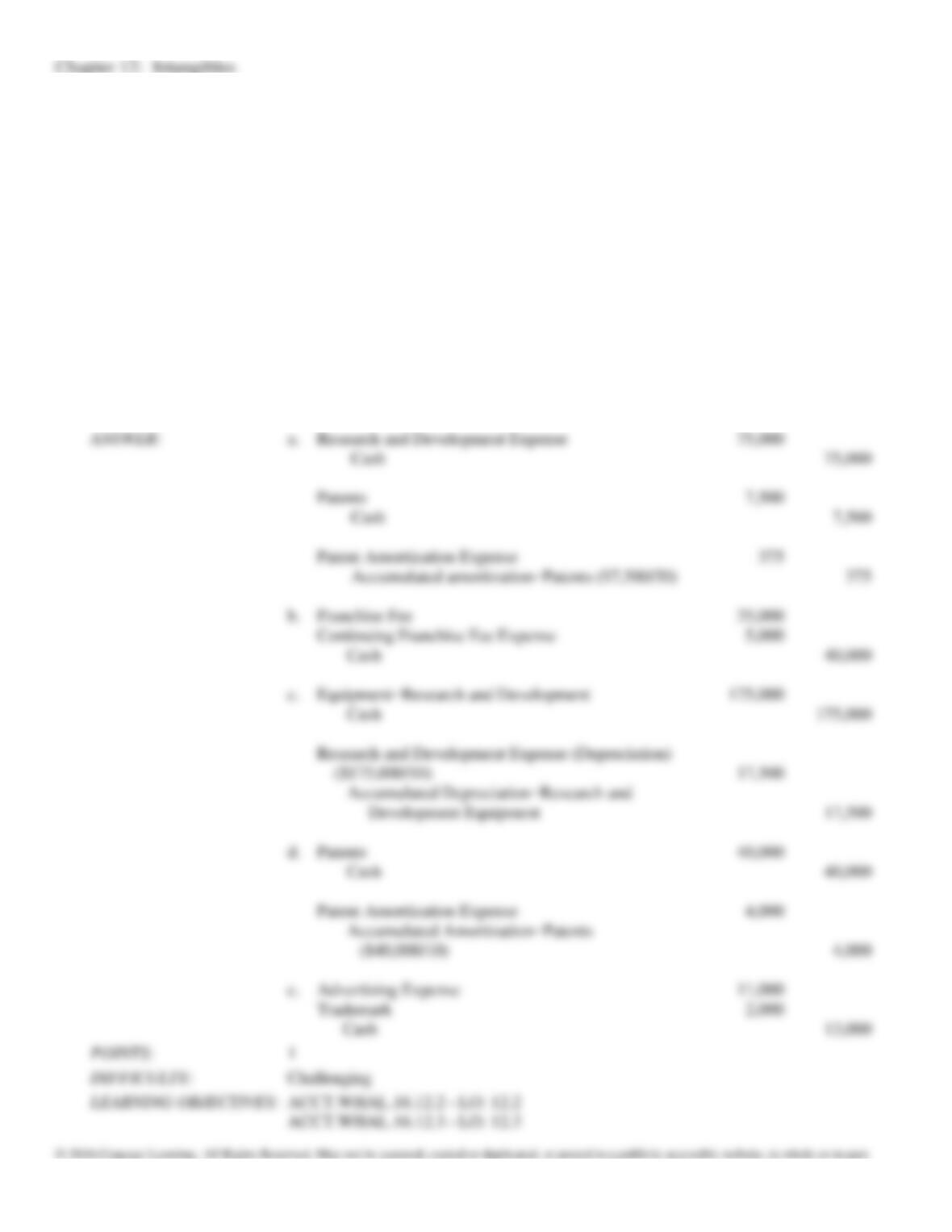
113. Early in the current year, Nathan Company entered into the following cash transactions:
a.
Registered a patent. Research and development costs for the patent were $75,000. Legal
fees incurred in registration were $7,500.
b.
Purchased a franchise with an unlimited life with payment of a $35,000 initial franchise fee
and a $5,000 operating fee.
c.
Purchased laboratory equipment costing $175,000. The equipment, with an estimated life
of ten years and no residual value, will be used in a variety of research projects.
d.
Purchased a patent from Asteroid Company at a cost of $40,000. The patent is believed to
have an estimated useful life of ten years.
e.
Registered a trademark that was developed by Nathan’s advertising department at a cost of
$11,000. Registration fees were $500, and the legal fees incurred were $1,500. The
trademark is expected to last indefinitely.
Required:
Prepare journal entries to record each transaction, including appropriate amortization for the year. Unless a better
alternative is indicated, amortize the intangibles over their legal lives.
Research and Development Expense
Cash
Patents
Cash
Patent Amortization Expense
Accumulated amortization−Patents ($7,500/20)
b.
Franchise Fee
Continuing Franchise Fee Expense
Cash
Cash
Research and Development Expense (Depreciation)
($175,000/10)
Accumulated Depreciation−Research and
Development Equipment
d.
Patents
Cash
Patent Amortization Expense
Accumulated Amortization−Patents
($40,000/10)
Advertising Expense
Trademark
Cash
1
ACCT.WHAL.16.12.2 – LO: 12.2
ACCT.WHAL.16.12.3 – LO: 12.3
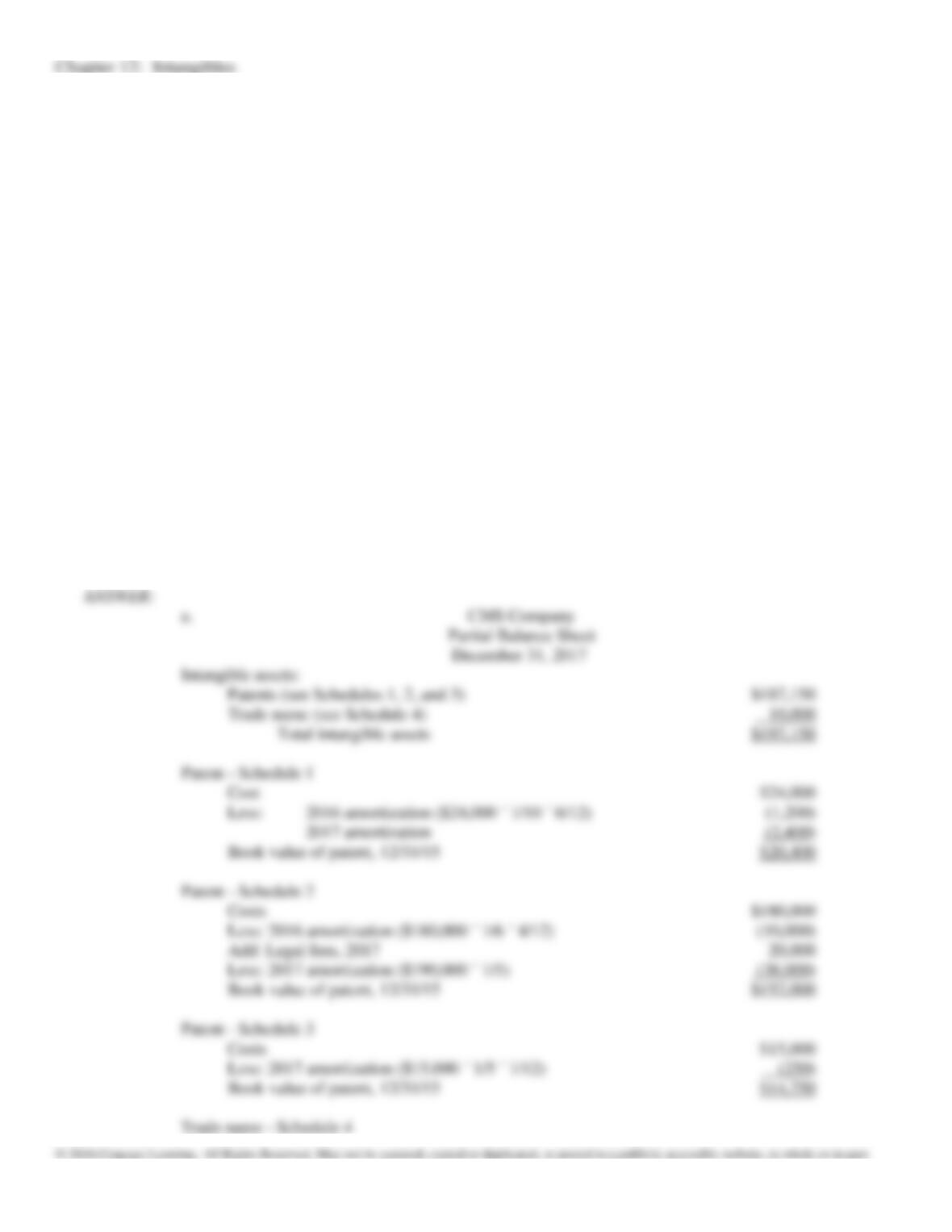
114. The CMS Co. began operations in January 2016. Listed below are selected transactions for 2016 and 2017:
∙
During 2016, $125,000 in R&D expenditures were made to develop a new product that was
patented on July 1, 2016. CMS believes the patent will provide benefits for ten years. Legal
fees incurred were $24,000.
∙
On September 1, 2016, CMS paid EZ Company $180,000 for its patent on a successful
product. The patent has six remaining years in its legal life.
∙
On October 1, 2016,CMS applied for and received a trade name from the government. The
legal costs associated with filing for the trade name were $10,000. In addition, during
November 2016, the company incurred $50,000 in advertising its name. Benefits are
expected indefinitely.
∙
In early January 2017, CMS paid $20,000 in legal fees to defend the patent acquired from
EZ. CMS’s attorneys were successful in the lawsuit.
∙
During 2017, R&D expenditures of $90,000 were incurred in the development of a
product. A patent was received on December 1, 2017. Legal fees paid in connection with
the patent were $15,000. The economic life of the product is expected to be five years.
Required:
a.
Prepare a partial balance sheet for CMS Company as of December 31, 2017, showing the
intangible assets. In support of your answer, prepare a separate schedule for each intangible
asset. The company amortizes its intangible assets using the straight-line method and
recognizes amortization to the nearest month.
b.
Prepare a schedule to calculate CMS’s expenses related to the above transactions for both
2016 and 2017.