52) The volatility of a portfolio that is equally invested in Wal–Mart and Duke Energy is closest to:
A) 5.0%
B) 0.6%
C) 7.6%
D) 22.4%
SHORT ANSWER. Write the word or phrase that best completes each statement or answers the question.
53) What diversification, if any, is achieved if two stocks in a portfolio are perfectly positively correlated?
MULTIPLE CHOICE. Choose the one alternative that best completes the statement or answers the question.
Use the table for the question(s) below.
Consider the following expected returns, volatilities, and correlations:
Stock
Expected
Return
Standard
Deviation
Correlation with
Duke Energy
Correlation with
Microsoft
Correlation with
Wal–Mart
Duke Energy
14%
6%
1.0
–1.0
0.0
Microsoft
44%
24%
–1.0
1.0
0.7
Wal–Mart
23%
14%
0.0
0.7
1.0
54) Which of the following combinations of two stocks would give you the biggest reduction in risk?
A) Duke Energy and Wal–Mart
B) Wal–Mart and Microsoft
C) Microsoft and Duke Energy
D) No combination will reduce risk.
SHORT ANSWER. Write the word or phrase that best completes each statement or answers the question.
55) What is the lowest risk possible by selecting two stocks that are perfectly negatively correlated?
TRUE/FALSE. Write ‘T’ if the statement is true and ‘F’ if the statement is false.
56) If you build a large enough portfolio, you can diversify away all the risks of a portfolio.
MULTIPLE CHOICE. Choose the one alternative that best completes the statement or answers the question.
57) A stock market comprises 5000 shares of stock A and 2000 shares of stock B. Assume the share prices for
stocks A and B are $20 and $35, respectively. What is the capitalization of the market portfolio?
A) $170,000
B) $150,000
C) $165,000
D) $185,000
58) A stock market comprises 5000 shares of stock A and 2000 shares of stock B. Assume the share prices for
stocks A and B are $20 and $35, respectively. What proportion of the market portfolio is comprised of stock A?
A) 58.8%
B) 41.2%
C) $100,000
D) $70,000
59) A stock market comprises 2000 shares of stock A and 2000 shares of stock B. The share prices for stocks A
and B are $20 and $10, respectively. What is the capitalization of the market portfolio?
A) $55,000
B) $60,000
C) $70,000
D) $65,000
60) A stock market comprises 2000 shares of stock A and 2000 shares of stock B. The share prices for stocks A
and B are $20 and $10, respectively. What proportion of the market portfolio is comprised of each stock?
A) Stock A is 66.7% and Stock B is 33.3%
B) Stock A is 33.3% and Stock B is 66.7%
C) Stock A is $40,000 and Stock B is $20,000
D) Stock A is 200% and Stock B is 100%
61) A stock market comprises 1000 shares of stock A and 3000 shares of stock B. The share prices for stocks A
and B are $25 and $30, respectively. What is the capitalization of the market portfolio?
A) $115,000
B) $100,000
C) $98,000
D) $125,000
62) You expect General Motors (GM) to have a beta of 1.3 over the next year and the beta of Exxon Mobil (XOM)
to be 0.9 over the next year. Also, you expect the volatility of General Motors to be 40% and that of Exxon
Mobil to be 30% over the next year. Which stock has more systematic risk? Which stock has more total risk?
A) XOM, GM
B) XOM, XOM
C) GM, XOM
D) GM, GM
63) You expect General Motors (GM) to have a beta of 1 over the next year and the beta of Exxon Mobil (XOM)
to be 1.2 over the next year. Also, you expect the volatility of General Motors to be 30% and that of Exxon
Mobil to be 40% over the next year. Which stock has more systematic risk? Which stock has more total risk?
A) GM, GM
B) GM, XOM
C) XOM, XOM
D) XOM, GM
64) You expect General Motors (GM) to have a beta of 1.5 over the next year and the beta of Exxon Mobil (XOM)
to be 1.9 over the next year. Also, you expect the volatility of General Motors to be 50% and that of Exxon
Mobil to be 35% over the next year. Which stock has more systematic risk? Which stock has more total risk?
A) XOM, GM
B) GM, XOM
C) GM, GM
D) XOM, XOM
65) The amount of a stock’s risk that is diversified away
A) is independent of the portfolio that you add it to.
B) depends on market risk premium.
C) depends on risk–free rate of interest.
D) depends on the portfolio that you add it to.
66) If you build a large enough portfolio, you can diversify away all ________ risk, but you will be left with
________ risk.
A) diversifiable, unsystematic
B) unsystematic, systematic
C) systematic, undiversifiable
D) diversifiable, diversifiable
67) The market portfolio is the portfolio of all risky investments held
A) in descending weights.
B) in ascending weights.
C) in proportion to their value.
D) based on previous year performance
68) The S&P 500 index traditionally is a ________ portfolio of the 500 largest U.S. stocks.
A) value weighted
B) equally weighted
C) chain weighted
D) price weighted
69) For each 1% change in the market portfolio’s excess return, the investment’s excess return is expected to
change by ________ percent due to risks that it has in common with the market.
A) beta
B) alpha
C) zero
D) cannot say for sure
70) The beta of the market portfolio is:
A) 0
B) –1
C) 2
D) 1
71) Companies that sell household products and food have very little relation to the state of the economy
because such basic needs do not go away. These stocks tend to have ________ betas.
A) high
B) low
C) negative
D) cannot say for sure
72) A linear regression to estimate the relation between General Motors’ stock returns and the market’s return
gives the best fitting line that represents the relation between the stock and the market. The slope of this
line is our estimate of
A) alpha.
B) beta.
C) risk–free rate.
D) volatility.
73) A linear regression was done to estimate the relation between Sprint’s stock returns and the market’s return.
The intercept of the line was found to be 0.23 and the slope was 1.47. Which of the following statements is
true regarding Sprint’s stock?
A) Sprint’s beta is 0.23
B) Sprint’s beta is 1.47
C) The risk–free rate is 1.47%
D) The standard deviation of Sprint’s excess returns is 23%
74) You observe that AT&T stock and the S&P 500 have the following weekly returns:
Week AT&T return S&P 500 return
1 0.005 0.001
2 0.010 0.005
3 –0.003 –0.005
4 –0.005 –0.001
If this pattern of stock returns is typical of AT&T stock, and you calculated a beta against the S&P 500, which
of the following is true?
A) AT&T’s beta is negative
B) AT&T’s beta is zero
C) AT&T’s beta is positive
D) Cannot be determined from information given.
75) Which of the following statements is FALSE?
A) We say a portfolio is an efficient portfolio whenever it is possible to find another portfolio that is better
in terms of both expected return and volatility.
B) We can rule out inefficient portfolios because they represent inferior investment choices.
C) The volatility of the portfolio will differ, depending on the correlation between the securities in the
portfolio.
D) Correlation has no effect on the expected return on a portfolio.
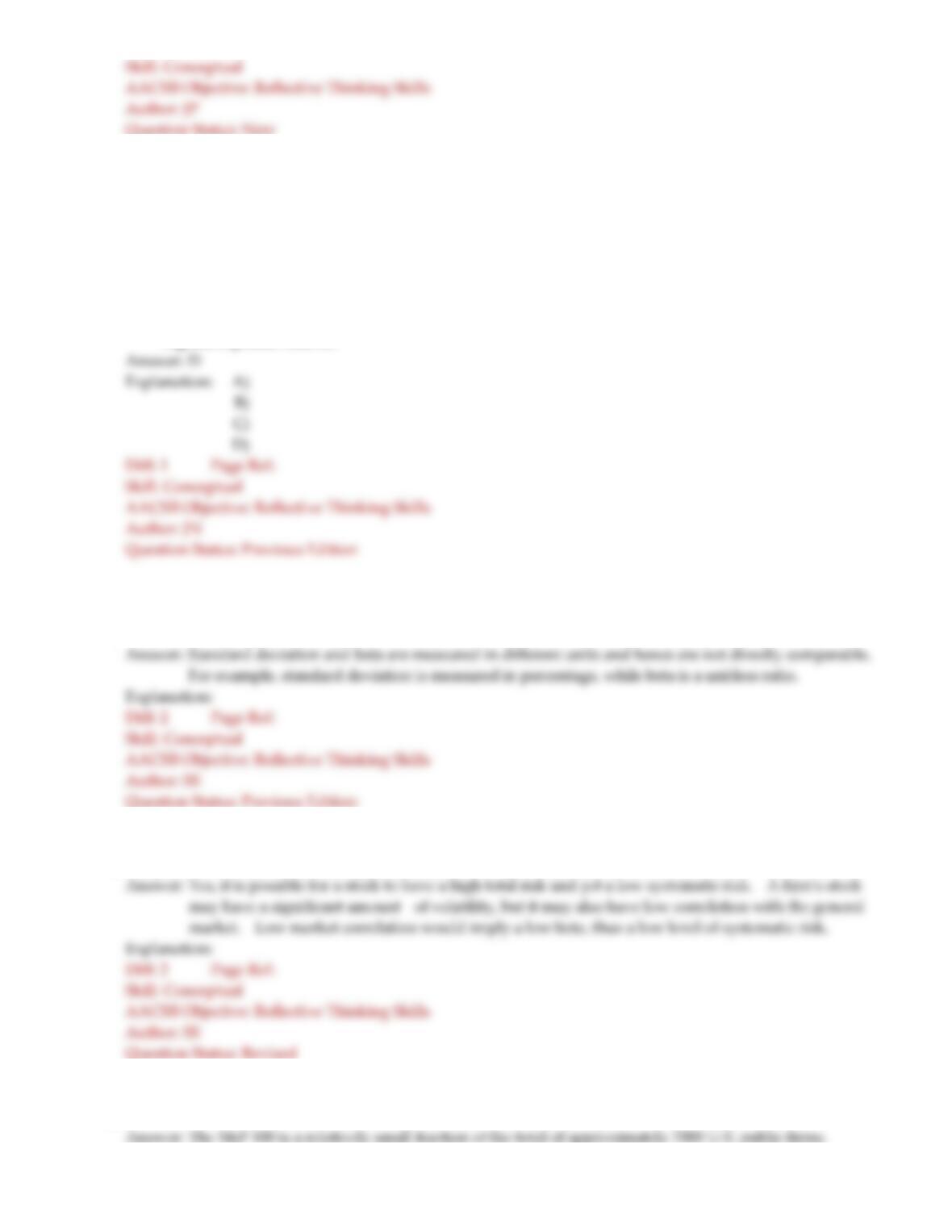
76) You observe the following scatterplot of Ford’s weekly returns against the S&P 500. Which of the following
statements is true about Ford’s beta against the S&P 500?
A) Ford’s beta appears to be positive.
B) Ford’s beta appears to be negative.
C) Ford’s beta appears to be zero– there is no apparent relation between its return and the S&P return.
D) Beta has nothing to do with the relationship seen in this scatterplot.
77) Which of the following statements is FALSE?
A) When stocks are perfectly positively correlated, the set of portfolios is identified graphically by a
straight line between them.
B) An investor seeking high returns and low volatility should only invest in an efficient portfolio.
C) When the correlation between securities is less than 1, the volatility of the portfolio is reduced due to
diversification.
D) Efficient portfolios can be easily ranked, because investors will choose from among them those with the
highest expected returns.
SHORT ANSWER. Write the word or phrase that best completes each statement or answers the question.
78) Since total risk is greater than systematic risk, should standard deviation be always greater than beta?
79) Is it possible for a stock to have high total risk but low systematic risk?
80) How does the S&P 500 index rank in terms of number and market capitalization of U.S. public firms?
TRUE/FALSE. Write ‘T’ if the statement is true and ‘F’ if the statement is false.
81) The market or equity risk premium can be estimated by computing the historical average excess return of the
market portfolio.
82) The security market line is a graph of the expected return of a stock as a function of systematic risk (beta).
83) The Capital Asset Pricing Model (CAPM) says that the excess return on a stock is equal to its beta times the
market risk premium.
MULTIPLE CHOICE. Choose the one alternative that best completes the statement or answers the question.
84) Your estimate of the market risk premium is 7%. The risk–free rate of return is 3.5% and General Motors has
a beta of 1.3. According to the Capital Asset Pricing Model (CAPM), what is its expected return?
A) 11.3%
B) 12.1%
C) 12.6%
D) 12.9%
85) Your estimate of the market risk premium is 5%. The risk–free rate of return is 4%, and General Motors has
a beta of 1.5. According to the Capital Asset Pricing Model (CAPM), what is its expected return?
A) 10.4%
B) 11.0%
C) 11.5%
D) 11.9%
86) Your estimate of the market risk premium is 6%. The risk–free rate of return is 5%, and General Motors has
a beta of 1.2. According to the Capital Asset Pricing Model (CAPM), what is its expected return?
A) 9.1%
B) 10.5%
C) 12.0%
D) 12.2%
87) A portfolio comprises Coke (beta of 1.2) and Wal–Mart (beta of 0.9). The amount invested in Coke is $20,000
and in Wal–Mart is $30,000. What is the beta of the portfolio?
A) 1.02
B) 1.15