Name:
Class:
Date:
Chapter 12: Labor Markets and Labor Unions
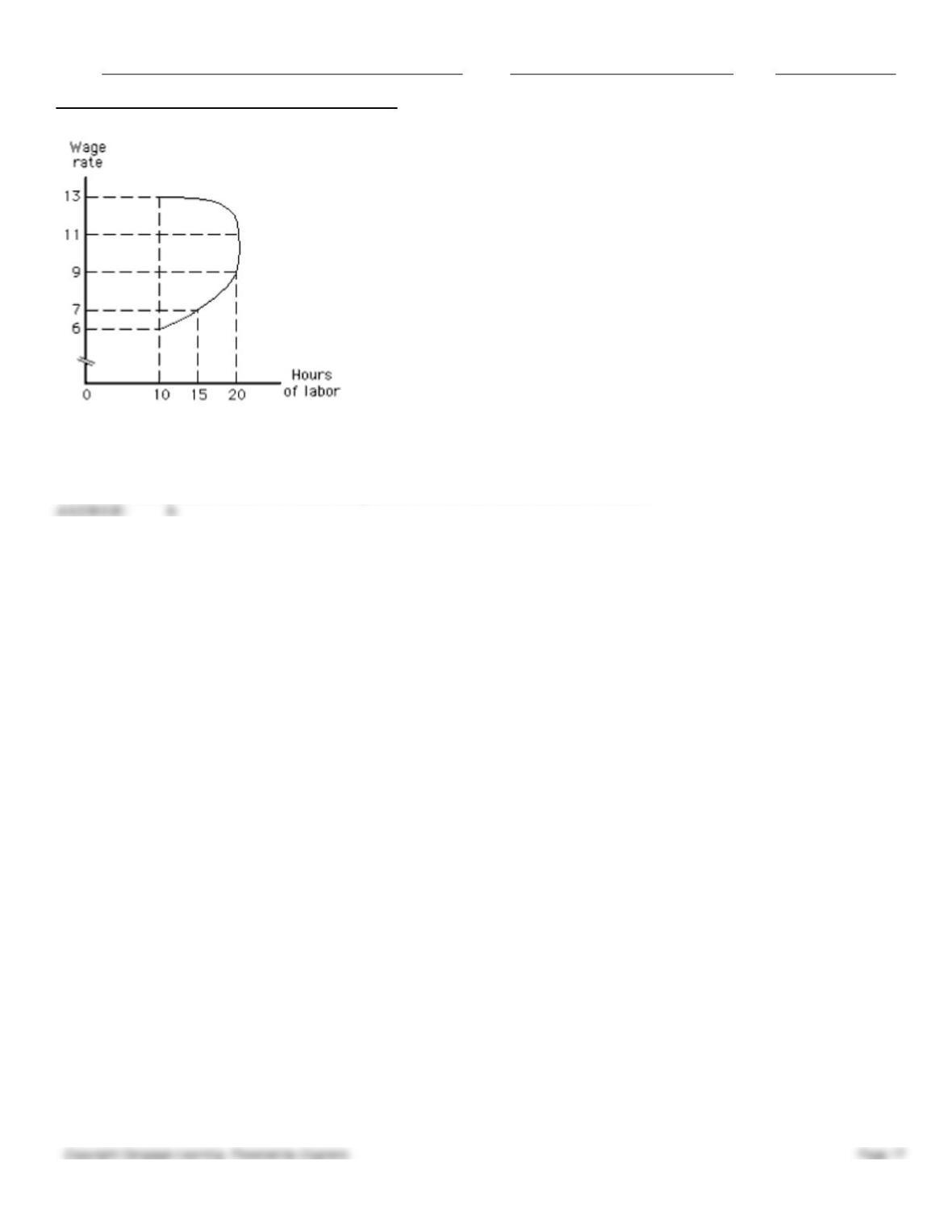
a. The substitution effect will cause the person to work more hours.
b. The income effect will cause the person to work less hours.
c. The substitution effect will cause the person to work fewer hours.
d. The income effect will cause the person to work the same number of hours.
e. The substitution effect will cause the person to work the same number of hours.
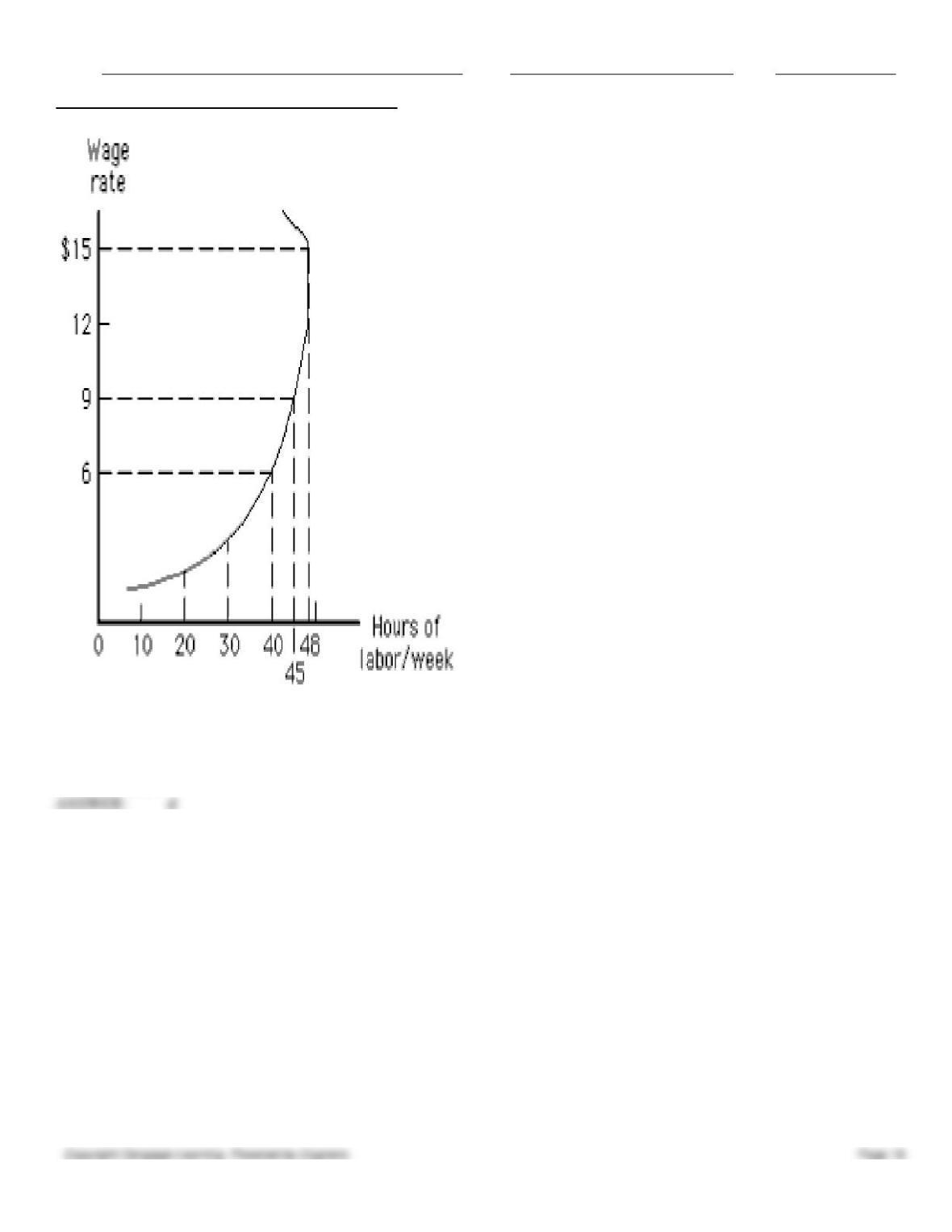
76. The figure given below shows a backward-bending labor supply curve for an individual. In the figure below, if the
wage rate is $9, how many hours per week will this person work?
Figure 12.4
Name:
Class:
Date:
Chapter 12: Labor Markets and Labor Unions
a. 30 hours
b. 36 hours
c. 40 hours
d. 45 hours
e. 48 hours
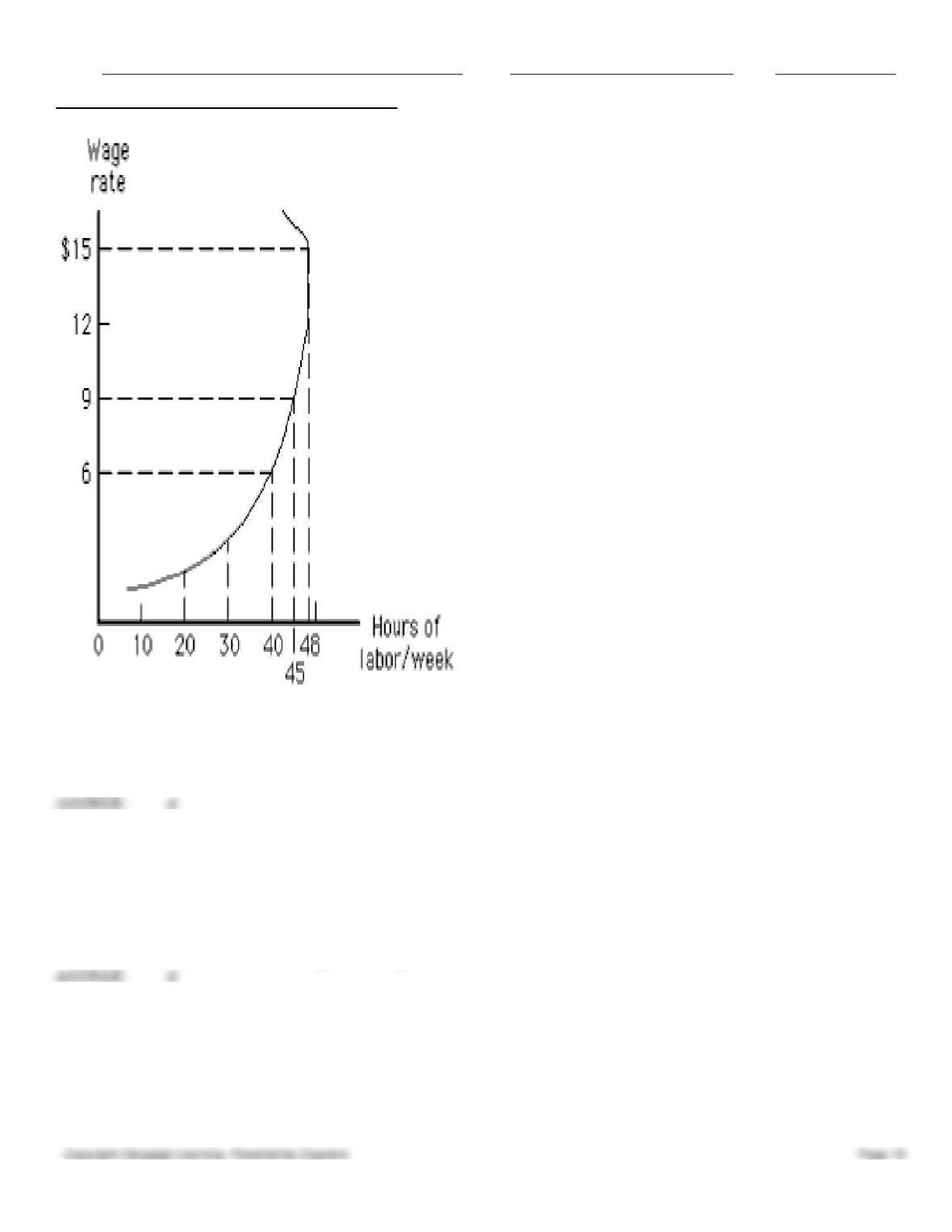
77. The figure given below shows a backward-bending labor supply curve for an individual. In the figure below, how
much will the employer have to pay per hour to get this worker to work 48 hours per week?
Figure 12.4
Name:
Class:
Date:
Chapter 12: Labor Markets and Labor Unions
a. $6
b. $7
c. $9
d. $12
e. $10
78. A large inheritance from a relative will tend to:
a. cause movement up and to the right along the individual’s labor supply curve.
b. cause movement up and to the left along the individual’s labor supply curve.
c. shift the individual’s labor supply curve outward.
d. shift the individual’s labor supply curve inward.
e. make the income effect of a wage increase positive.
79. A stock market crash that reduces the value of an individual’s trust fund will tend to:
a. increase his or her supply of labor if the substitution effect outweighs the income effect.
b. decrease his or her supply of labor if the substitution effect outweighs the income effect.
c. have no impact on his or her labor supply decision.
d. increase his or her supply of labor.
e. decrease his or her supply of labor.

Name:
Class:
Date:
Chapter 12: Labor Markets and Labor Unions
80. A person who wins a large sum of money in the state lottery is:
a. likely to increase the amount of market work offered at each wage rate.
b. not likely to change the amount of work offered at each wage rate.
c. likely to decrease the amount of work offered at each wage rate.
d. likely to substitute market work for leisure time due to the substitution effect.
e. likely to substitute market work for leisure time due to the income effect.
81. Other things equal, the supply of labor will be higher to a job that:
a. is less prestigious.
b. offers fewer nonmonetary rewards.
c. provides little on-the-job training.
d. is more difficult to perform.
e. provides a climate-controlled work environment.
82. The market labor supply curve is:
a. the sum of individual labor supply curves at each quantity of labor.
b. the sum of individual labor supply curves at each wage rate.
c. the average of all individual labor supply curves.
d. the sum of the upward-sloping portions of individual labor supply curves.
e. the sum of the downward-sloping portions of individual labor supply curves.
83. For wage rates between $7 and $15 per hour, Ali’s labor supply curve is backward bending, Ben’s labor supply curve
is upward sloping, and Charlie’s supply curve is vertical at 10 hours of labor supplied. If these three people are the only
ones supplying labor in this labor market, then the market labor supply curve will be the sum of the:
a. labor supply curves of Ali, Ben, and Charlie at each wage rate.
b. upward-sloping portions of Ben’s and Ali’s labor supply curves.
c. downward-sloping portions of individual labor supply curves.
d. average of all individual labor supply curves.
e. individual labor supply curves at each net utility for market work.
84. The market labor supply curve is usually _____ over the relevant range of market wage rates.
a. positively sloped
b. negatively sloped
c. backward bending
d. vertical
e. horizontal
85. The market labor supply curve is the:
a. vertical sum of the individual labor supply curves.
b. horizontal sum of the individual labor supply curves.

Name:
Class:
Date:
Chapter 12: Labor Markets and Labor Unions
c. vertical difference of the individual labor supply curves.
d. horizontal difference of the individual labor supply curves.
e. average of the individual labor supply curves.
86. The equilibrium wage:
a. is the same in all labor markets.
b. occurs where the supply of labor curve begins to bend backward.
c. cannot be calculated because there are so many labor markets.
d. is determined by the market demand for labor and the market supply of labor.
e. is irrelevant because of unions.
87. Which of the following explains an increase in demand for labor?
a. Additional training that increases the productivity of each unit of labor in a market
b. An increase in the amount of risk associated with a job
c. A decrease in the amount of risk associated with a job
d. An improvement in the working conditions associated with a job
e. A decline in the working conditions associated with a job
88. Which of the following could not contribute to differences in wage rates across labor markets?
a. Differences in training and education requirements
b. Discrimination in the job market
c. Differences in risks involved in the job
d. Problems of labor mobility among various uses
e. Distribution of a newspaper with classifieds
89. Who is likely to earn a higher income, dentists or dental hygienists, and why?
a. Dental hygienists, because their education is less expensive.
b. Dentists, because their education is less expensive.
c. Dental hygienists, because their education is more expensive.
d. Dentists, because their education is more expensive.
e. Neither, because they usually earn the same wage rate.
90. An increase in the cost of training to acquire a skill, which must be paid by the worker, will:
a. increase both the supply of and demand for labor in that market.
b. decrease both the supply of and demand for labor in that market.
c. increase the supply of labor and decrease the demand for labor in that market.
d. decrease the supply of labor and increase the demand for labor in that market.
e. decrease the supply of labor only in that market.
91. If two accountants have had the same education, amount of experience, and they work at the same type of job for the
same profit-maximizing firm, which charges its clients a uniform hourly fee, then:

Name:
Class:
Date:
Chapter 12: Labor Markets and Labor Unions
a. they should earn the same amount of money, even though one accountant is more productive than the other.
b. the one whose job is less risky should be paid more.
c. the one whose job is riskier should be paid less.
d. the one who has a higher marginal product should be paid more.
e. the one who has a higher marginal product should be paid less.
92. Other things equal, the supply of labor will be lower to a job that:
a. is prestigious.
b. offers valuable on-the-job training.
c. requires advanced skills or education.
d. provides a climate-controlled work environment.
e. allows for flexible work schedules.
93. Other things equal, the supply of labor will be higher to a job that:
a. is riskier than other jobs.
b. offers valuable on-the-job training.
c. doesn’t allow for flexible work schedules.
d. requires advanced skills or education.
e. is not prestigious and provides low wages.
94. Other things equal, the supply of labor will be higher to a job:
a. that requires a supervisor to closely monitor employee performance.
b. that provides few opportunities for training.
c. with working hours that start at midnight.
d. that requires advanced skills or education.
e. that offers more amenities.
95. Which of the following could explain why some professional basketball players earn a much higher income than their
teammates?
a. There is discrimination among professional basketball players within the same team.
b. Some professional basketball players are more talented than others.
c. Not too many people can play basketball professionally.
d. Many people want to become professional basketball players.
e. The threat of injury makes the job more exciting than other jobs.
96. Two workers are employed in the same job by the same firm. However, they are paid different wage rates. This could
be explained by differences in:
a. the income effect.
b. the price of the firm’s output.
c. their marginal products due to differences in ability.
d. working conditions at the workplace.
e. their marginal products due to differences in the risk faced.

Name:
Class:
Date:
Chapter 12: Labor Markets and Labor Unions
97. A medical doctor who specializes in a particular field, like surgery, generally earns more than a general practitioner
because:
a. of greater education and training requirements.
b. of differences in labor mobility.
c. a general practitioner is more likely to work in an urban area.
d. of racial discrimination.
e. a general practitioner treats a greater number of patients per day.
98. Truck drivers usually earn more than secretaries because:
a. drivers require more education and training.
b. truckers have more flexibility in their daily activities.
c. truckers face greater risks.
d. secretaries have higher productivity than truckers.
e. truckers are discriminated against.
99. In many cities, garbage collectors earn more than social workers. What could explain this wage differential?
a. Social work requires more education than garbage collecting does.
b. There is a greater demand for social workers.
c. There is a lesser supply of trash collectors.
d. Collecting garbage requires less skill.
e. Social work is a less prestigious profession.
100. Other things equal, the supply of labor will be greater to a job that:
a. requires advanced education and training.
b. requires working on weekends.
c. requires hard physical labor.
d. allows the employee greater discretion in the use of his or her time.
e. has a higher probability of injury or death.
101. It is sometimes claimed that deckhands on crab boats in the icy waters off Alaska are paid more than elementary
school teachers. If this is true, one reason might be:
a. the difference in working conditions.
b. that school teachers are usually women.
c. that the supply of teachers is small.
d. that the demand for teachers is small.
e. that the market does not value teachers.
102. Because of discrimination, which of the following has systematically earned less than others of equal ability?
a. Only African Americans
b. Only Hispanics
c. Only African Americans and Hispanics

Name:
Class:
Date:
Chapter 12: Labor Markets and Labor Unions
d. African Americans, Hispanics, and women
e. Only Hispanics and women
103. Most collective bargaining agreements in the United States are reached:
a. only after binding arbitration.
b. only after a strike lasting at least a year.
c. without a strike.
d. only after a strike lasting at least three weeks.
e. only after government intervention to avoid a strike.
104. A labor union is a group of:
a. employees who join together to improve their working conditions.
b. firms that join together to hire workers.
c. firms that work together to negotiate better prices in the market.
d. farmers who work together to receive better prices for their agricultural products.
e. workers and firm owners who join together to improve working conditions.
105. Unions whose membership is confined to workers with a particular skill are known as _____.
a. industrial unions
b. limited unions
c. regional unions
d. craft unions
e. inclusive unions
106. Which of the following groups is a craft union?
a. Auto workers
b. Steel workers
c. Writers
d. Government employees
e. Construction workers
107. Unions whose membership includes all workers in a particular product market, whether skilled or unskilled, are
known as _____.
a. craft unions
b. exclusive unions
c. national unions
d. regional unions
e. industrial unions
108. Industrial unions in the United States formed a national organization known as the _____.
a. National Union

Name:
Class:
Date:
Chapter 12: Labor Markets and Labor Unions
b. Knights of Labor
c. American Federation of Labor (AFL)
d. Congress of Industrial Organizations (CIO)
e. AFL-CIO
109. Unions and employers use collective bargaining to negotiate:
a. wages only.
b. wages and employee benefits only.
c. employee benefits only.
d. working conditions only.
e. wages, employee benefits, and working conditions.
110. Through collective bargaining, the:
a. representatives of an employer negotiate with the rank and file of the union membership.
b. union and nonunion members combine forces in negotiation.
c. craft and industrial unions combine forces in negotiation.
d. contracts are worked out between representatives of the union and employer representatives.
e. union workers must accept contracts negotiated by their representatives.
111. The process by which union and management representatives negotiate a mutually agreeable contract specifying
wages, benefits, and working conditions is called _____.
a. collective bargaining
b. mediation
c. arbitration
d. striking
e. litigation
112. Which of the following happens if the government intervenes in a labor dispute and requires settlement through
binding arbitration?
a. A neutral third party makes a decision that both parties must accept.
b. A neutral third party makes a decision that both parties may reject.
c. One party sues the other in court.
d. The two parties negotiate an agreement without assistance and both must accept it.
e. The two parties negotiate an agreement with assistance from their attorneys and both must accept it.
113. In a labor negotiation, a mediator:
a. represents the union rank and file members.
b. represents the management side.
c. is an impartial observer.
d. can call a strike.
e. can force both sides to agree to a contract.

Name:
Class:
Date:
Chapter 12: Labor Markets and Labor Unions
114. An impartial observer who listens to both sides in a labor–management dispute and makes suggestions as to how the
two sides could compromise is called a(n) _____.
a. mediator
b. arbitrator
c. litigator
d. scab
e. judge
115. The process by which union members and the firm’s management negotiate a contract is called _____.
a. settlement negotiation
b. collective bargaining
c. a union contract
d. collection arbitration
e. settlement bargaining
116. An impartial observer who attempts to settle disagreements by listening to both sides separately and making
suggestions is called a(n) _____.
a. collective bargaining agent
b. arbitrageur
c. mediator
d. binding negotiator
e. judge
117. Strikes are expensive for:
a. workers only because their income falls.
b. employers only because their revenue falls.
c. the public only because output falls.
d. both the public and employers because workers are compensated by the union for lost income.
e. workers, employers, and the public.
118. The threat of a strike:
a. can serve as an incentive for labor and management to reach an agreement.
b. destroys incentives for labor and management to reach an agreement.
c. is usually not taken seriously because employers know the workers will suffer during a strike.
d. is not taken seriously unless management expects to suffer.
e. is not taken seriously even if public safety is at risk.
119. The source of power for a labor union is its ability to:
a. increase the supply of labor.
b. decrease the demand for capital.
c. increase the quantity supplied of labor.
d. decrease the quantity supplied of labor.

Name:
Class:
Date:
Chapter 12: Labor Markets and Labor Unions
e. decrease the supply of labor.
120. Unions can increase their wage rates by:
a. increasing the supply of union labor.
b. decreasing the demand of union labor.
c. using the threat of a strike.
d. decreasing the proportion of union workers in the industry.
e. decreasing the demand for the product they produce.
121. Which of the following union tactics, if successful, would increase wages and create a surplus of labor?
a. Collective bargaining to fix the wage above the competitive level
b. Decreasing the marginal revenue product of union workers
c. Increasing the demand for union-made products
d. Restricting the supply of nonunion products that compete with union-made products
e. Increasing labor productivity by minimizing conflicts and resolving differences between labor and management
122. An industrial union can obtain a wage higher than the competitive level:
a. without any change in total employment.
b. at the cost of a reduction in total employment.
c. and achieve higher total employment as well.
d. and achieve the same or higher total employment.
e. and thus increase the quantity of labor demanded.
123. When industrial unions negotiate with an entire industry, wage gains come at the cost of _____.
a. longer working hours
b. worse working conditions
c. reduced total employment
d. worse products
e. labor mobility
124. If a union negotiates a wage floor above the market equilibrium, each firm hiring union members faces:
a. a perfectly inelastic supply curve for labor.
b. a perfectly elastic supply curve for labor.
c. a perfectly inelastic demand curve for labor.
d. a perfectly elastic demand curve for labor.
e. unit elastic demand curve for labor.
125. If a union negotiates a wage above the market equilibrium, each firm’s:
a. supply of labor is greater than its marginal resource cost.
b. supply of labor is less than its marginal resource cost.
c. supply of labor is equal to its marginal resource cost.

Name:
Class:
Date:
Chapter 12: Labor Markets and Labor Unions
d. demand for labor is less than its marginal resource cost.
e. demand for labor is greater than its marginal resource cost.
126. If a teachers’ union negotiates a wage for all college professors above the equilibrium wage rate, the market supply
curve of college professors becomes _____.
a. perfectly elastic everywhere
b. perfectly inelastic everywhere
c. horizontal, and then it slopes upward
d. vertical, and it slopes upward
e. upward sloping and then becomes horizontal
127. Union wages in the United States are almost:
a. equal to nonunion wages.
b. twice as high as nonunion wages.
c. half of nonunion wages.
d. 15 percent higher than nonunion wages.
e. 50 percent higher than nonunion wages.
128. If United Mine Workers successfully negotiates a wage that is higher than the competitive wage, then:
a. an excess demand for labor is created.
b. a surplus of labor is created.
c. the demand for labor increases.
d. the supply of labor decreases.
e. the quantity of labor demanded increases.
129. If a union collective bargaining results in a surplus of labor in some industries, the resulting:
a. increase in demand for labor in the nonunion sector drives nonunion wages up.
b. decrease in demand for labor in the nonunion sector drives nonunion wages down.
c. increase in supply of labor in the nonunion sector drives nonunion wages down.
d. increase in supply of labor in the nonunion sector drives nonunion wages up.
e. decrease in supply of labor in the nonunion sector drives nonunion wages up.
130. An industry with a strong union:
a. will increase wages in the nonunion sector of the industry.
b. will increase employment for union workers when wages increase.
c. can force employers to hire all union members regardless of the wage.
d. can increase the demand for union workers by increasing turnover and reducing productivity.
e. can bargain for wages that are greater than the market’s equilibrium wage.
131. Craft unions typically attempt to increase wages by _____.
a. setting a wage floor

Name:
Class:
Date:
Chapter 12: Labor Markets and Labor Unions
b. reducing labor supply
c. increasing labor demand
d. reducing initiation fees
e. expanding new union memberships
132. Restricting the supply of labor in order to increase wages:
a. is a tactic used by service sector unions.
b. is a tactic more likely to be used by the American Medical Association (AMA) than the United Auto Workers
(UAW).
c. is a tactic more likely to be used by the UAW than the AMA.
d. is a tactic used solely by professional groups such as lawyers.
e. has less effect on the wage than direct negotiation does.
133. In order to reduce labor supply, a craft union must be able to:
a. control the demand of firms.
b. force all employers in the industry to hire only union members.
c. set wages in the industry.
d. agree to wage concessions.
e. increase union membership.
134. If an electricians’ union is successful in its attempts to restrict entry into that craft, it will shift:
a. the supply curve of electricians to the right.
b. the supply curve of electricians to the left.
c. the demand curve of electricians to the right.
d. the demand curve of electricians to the left.
e. both the supply and the demand curves for electricians.
135. Craft unions attempt to increase wages in their profession by:
a. increasing labor demand.
b. decreasing labor demand.
c. decreasing labor supply.
d. increasing labor supply.
e. negotiating exclusive dealing contracts.
136. Which of the following would not shift demand curve for union labor to the right?
a. An increase in demand for union-made goods
b. An increase in labor productivity by lowering quit rates
c. An increase in supply of products that compete with union-made products
d. An increase in labor productivity through better labor–management relations
e. An appeal to consumers to buy only union-made products

137. An appeal to consumers to purchase union-made products represents an attempt to:
a. increase the supply of union labor.
b. increase the demand for union labor.
c. decrease the supply of union labor.
d. decrease the quantity of union labor demanded.
e. decrease the demand for union labor.
138. Unions sometimes try to ensure that employers hire more union labor than they might otherwise prefer by _____.
a. collective bargaining
b. featherbedding
c. work enlargement
d. restricting the supply of labor
e. increasing the demand for union-made products
139. Which of the following is an example of featherbedding?
a. A craft union restricting entry into its profession
b. A union-imposed wage floor
c. An increase in labor productivity that results from a decrease in quit rates
d. Attempts to reduce the sale of nonunion goods
e. A construction workers union requiring an unnecessarily large number of workers to be employed for a particular
job
140. If featherbedding reduces a firm’s competitiveness, it:
a. increases employment at the firm and in the industry.
b. decreases employment at the firm and in the industry.
c. increases employment at the firm but may decrease it in the industry.
d. decreases employment at the firm and increases it in the industry.
e. decreases employment at the firm and reduces the number of firms so that there is no net effect on industry
employment.
141. It is possible that unions increase worker productivity by:
a. minimizing conflicts, resolving differences, and reducing job turnover.
b. using seniority rules to keep the most experienced workers employed.
c. increasing job turnover so that the least experienced workers quit.
d. allowing workers more free time, which improves morale.
e. increasing the number of workers required to perform each task.
142. Featherbedding by unions is an attempt to:
a. increase the demand for union labor.
b. increase the demand for nonunion labor.
c. decrease the demand for union labor.
d. increase the supply of union labor.
e. increase the supply of nonunion labor.

Name:
Class:
Date:
Chapter 12: Labor Markets and Labor Unions
143. If a union is able to increase the demand for union-made goods, then:
a. wages will increase but employment of union labor will decrease.
b. wages will increase and employment of union labor will increase.
c. wages will decrease but employment of union labor will increase.
d. wages will decrease and employment of union labor will decrease.
e. the demand for nonunion labor will increase.
144. If a union is able to restrict the supply of a nonunion-made substitute product, then, in the union sector, _____.
a. wages will increase but employment will decrease
b. wages will increase and employment will increase
c. wages will decrease but employment will increase
d. wages will decrease and employment will decrease
e. the demand for nonunion labor will increase
145. The union participation rate in the United States is:
a. lowest among service workers in the private sector.
b. highest among service workers in the private sector.
c. lowest among service workers in the public sector.
d. highest in the heavy industries.
e. highest in high-technology industries.
146. Which of the following explains the recent decline in union membership in the United States?
a. Availability of smaller government safety nets
b. Slower technological changes
c. The change from a manufacturing to a service-based economy
d. Increasing market concentration
e. An increase in female participation in the job market
147. Unions are less likely to strike today than in the past because:
a. real wages have increased over the last 20 years.
b. employers are less willing to hire strikebreakers.
c. most workers in the U.S. are already union members.
d. more workers, both union and nonunion, are willing to cross picket lines.
e. many high-profile strikes have succeeded in winning job security.
148. Currently, union membership in the U.S. is:
a. declining as a percentage of the labor force.
b. remaining constant.
c. increasing as a percentage of the labor force.
d. increasing in the service sector.

Name:
Class:
Date:
Chapter 12: Labor Markets and Labor Unions
e. decreasing among government employees.
149. Union membership rates in the U.S. are:
a. highest among government employees.
b. highest among industrial sector employees.
c. highest among service sector employees.
d. increasing at a faster rate than the labor force.
e. highest among women.
150. One significant reason for the declining union membership in the U.S. is:
a. more workers are entering the teaching field.
b. increasing employment rates in the industrial sector.
c. the structural shift of the economy toward the service sector
d. increasing cultural diversity in the workforce.
e. a decrease in the number of public sector employees.