Cost Accounting: A Managerial Emphasis, 6e
Chapter 12 – Pricing Decisions, Product Profitability Decisions, and Cost Management
Chapter 12 Pricing Decisions, Product Profitability Decisions, and Cost
Management
12.1 Discuss the major influences on both short– and long-run pricing decisions.
1) The three major influences on pricing decisions are: costs, competitors, and customers.
2) Managers have little discretion in setting prices in market situations which are not competitive.
3) Short-run pricing decisions include adjusting product mix and output volume in a competitive market.
4) Pricing decisions that are long-run based should focus on more than short-run costs.
5) Knowledge of long-run product costs helps guide decisions about entering or remaining in the market
for a given product when in a highly competitive price-setting situation.
6) Upstream costs refer to post-production costs such as after-sales service.
Cost Accounting: A Managerial Emphasis, 6e
Chapter 12 – Pricing Decisions, Product Profitability Decisions, and Cost Management
7) In less competitive markets where products can be differentiated by their features the pricing decision
depends on the pricing strategies of competitors.
8) Relevant costs for pricing decisions include manufacturing costs, but not costs from other value-chain
functions.
9) The three major influences on pricing decisions are
A) competition, costs, and customers.
B) competition, demand, and production efficiency.
C) continuous improvement, customer satisfaction, and a dual internal/external focus.
D) variable costs, fixed costs, and mixed costs.
E) economic, qualitative, and costs.
10) Which of the following are examples of downstream costs?
A) R&D, distribution, marketing, design
B) production, distribution, marketing, design
C) R&D, design, production
D) production, R&D, distribution, marketing, design
E) after-sales service, distribution, marketing
11) Pricing for one-time-only special orders is, typically,
A) a pricing decision using the time horizon.
B) a short-run decision.
C) a long-run decision.
D) higher in variable costs than usual.
E) based on fixed costs alone.
Cost Accounting: A Managerial Emphasis, 6e
Chapter 12 – Pricing Decisions, Product Profitability Decisions, and Cost Management
12) For long-run pricing decisions, using stable prices has the advantage of
A) helping build buyer-seller relationships.
B) reducing the need to change cost structures frequently.
C) reducing competition.
D) minimizing the need to monitor competitors prices frequently.
E) increasing margins.
13) Target pricing is based on
A) engineered cost.
B) variable manufacturing and nonmanufacturing costs.
C) full product cost.
D) what customers are willing to pay.
E) full manufacturing cost.
14) The controller and sales manager are at odds over the pricing of a new product. What major
influences should be considered in pricing the new product? Discuss each briefly.
Cost Accounting: A Managerial Emphasis, 6e
Chapter 12 – Pricing Decisions, Product Profitability Decisions, and Cost Management
15) Explain the differences between short-run pricing decisions and long-run pricing decisions.
12.2 Evaluate existing information to decide on a competitive price for a special order.
1) Special orders increase income if the revenue from the order exceeds the incremental variable and fixed
costs incurred to fill the order.
2) In deciding whether to accept a special sales order, any fixed costs that would remain unchanged are
considered irrelevant data.
3) A price-bidding decision for a one-time-only special order includes an analysis of
A) only marketing costs.
B) all cost drivers.
C) all costs of each function in the value chain.
D) only fixed manufacturing costs.
E) indirect costs of each category in the value chain.
Cost Accounting: A Managerial Emphasis, 6e
Chapter 12 – Pricing Decisions, Product Profitability Decisions, and Cost Management
4) Decisions on the price to bid on a one-time-only special order should include
A) only cost data.
B) only the potential bids of competitors.
C) existing fixed manufacturing overhead.
D) cost data, and the use of variable costing income statements.
E) cost data and potential bids of competitors.
5) Your company produces 700,000 widgets per year but has the capacity to produce 950,000 units.
Company records show the following; full product costs = $85 per unit, which includes fixed
manufacturing overhead of $11, and variable overhead of $4 per unit, and direct variable costs of $22, all
based on the current 700,000 production run. If the company wanted to bid on a special one-time order,
based on the above information only, what would be its minimum bid?
A) $59
B) $81
C) $63
D) $74
E) $85
Cost Accounting: A Managerial Emphasis, 6e
Chapter 12 – Pricing Decisions, Product Profitability Decisions, and Cost Management
Use the information below to answer the following question(s).
Action Mopeds manufactures mopeds. The following information pertains to the company’s normal
operations per month:
Output units
15,000 mopeds
Machine-hours
4,000 hours
Direct manufacturing labour hours
5,000 hours
Direct manufacturing labour per hour
$24
Direct materials per unit
$200
Variable manufacturing overhead costs
$322,500
Fixed costs:
Fixed manufacturing overhead costs
$1,200,000
Marketing and distribution costs
$1,125,000
Research and development costs
$900,000
6) What is the unit cost for establishing a minimum bid on a one-time-only special order of 1,000 mopeds
from an overseas city if all cost relationships remain the same except for a one-time setup charge of
$40,000?
A) $269.50
B) $309.50
C) $444.50
D) $260.50
E) $209.50
Cost Accounting: A Managerial Emphasis, 6e
Chapter 12 – Pricing Decisions, Product Profitability Decisions, and Cost Management
7) What is the unit cost when establishing a long-run price for mopeds?
A) $309.50
B) $325.48
C) $444.50
D) $460.50
E) $470.00
Answer the following question(s) using the information below.
Rogers’ Heaters is approached by Ms. Yukki, a new customer, to fulfill a large one-time-only special order
for a product similar to one offered to regular customers. Rogers’ Heaters has excess capacity. The
following per unit data apply for sales to regular customers:
Direct materials
$200
Direct manufacturing labour
60
Variable manufacturing support
30
Fixed manufacturing support
100
Total manufacturing costs
390
Markup (30%)
117
Estimated selling price
$507
8) For Rogers’ Heaters, what is the minimum acceptable price of this one-time-only special order?
A) $290
B) $390
C) $260
D) $507
E) $377
Cost Accounting: A Managerial Emphasis, 6e
Chapter 12 – Pricing Decisions, Product Profitability Decisions, and Cost Management
9) If Ms. Yukki wanted a long-term commitment for supplying this product, what price would most
likely be quoted to her?
A) $290
B) $390
C) $260
D) $377
E) $507
Answer the following question(s) using the information below.
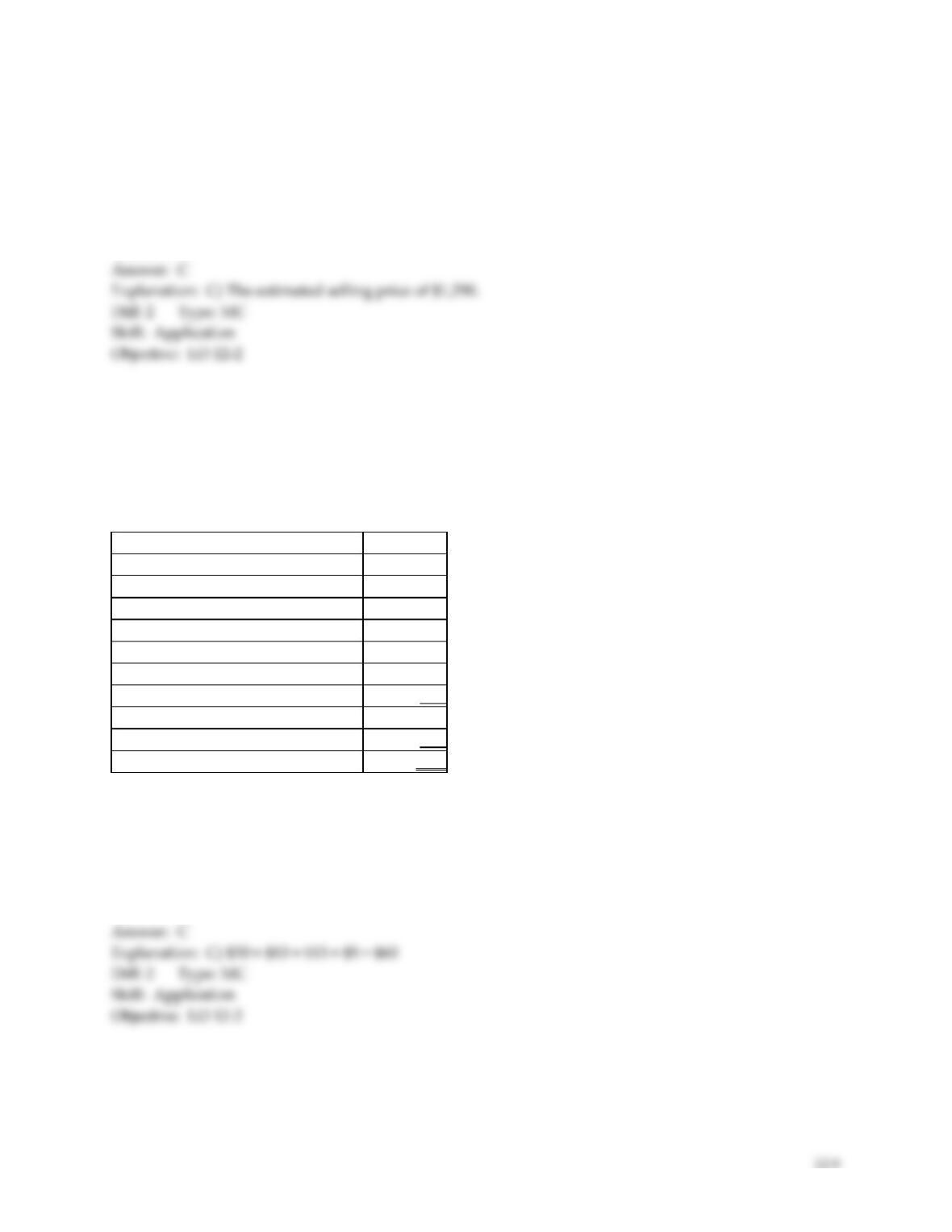
Gerry’s Generator Supply is approached by Mr. Gladstone, a new customer, to fulfill a large one-time-
only special order for a product similar to one offered to regular customers. Gerry’s Generator Supply has
excess capacity. The following per unit data apply for sales to regular customers:
Direct materials
$850
Direct manufacturing labour
50
Variable manufacturing support
100
Fixed manufacturing support
75
Total manufacturing costs
1,075
Markup (20%)
215
Estimated selling price
$1,290
10) For Gerry’s Generators, what is the minimum acceptable price of this one-time-only special order?
A) $900
B) $1,000
C) $1,075
D) $1,290
E) $1,200
Cost Accounting: A Managerial Emphasis, 6e
Chapter 12 – Pricing Decisions, Product Profitability Decisions, and Cost Management
11) If Mr. Gladstone wanted a long-term commitment for supplying this product, what price would most
likely be quoted to him?
A) $1,000
B) $1,200
C) $1,290
D) $1,400
E) $1,075
Answer the following question(s) using the information below.
Welch Manufacturing is approached by a European customer to fulfill a one-time-only special order for a
product similar to one offered to domestic customers. Welch Manufacturing has a policy of adding a 10%
markup to full costs and currently has excess capacity. The following per unit data apply for sales to
regular customers:
Variable costs:
Direct materials
$30
Direct labour
10
Manufacturing overhead
15
Marketing costs
5
Fixed costs:
Manufacturing overhead
100
Marketing costs
20
Total costs
180
Markup (10%)
18
Estimated selling price
$198
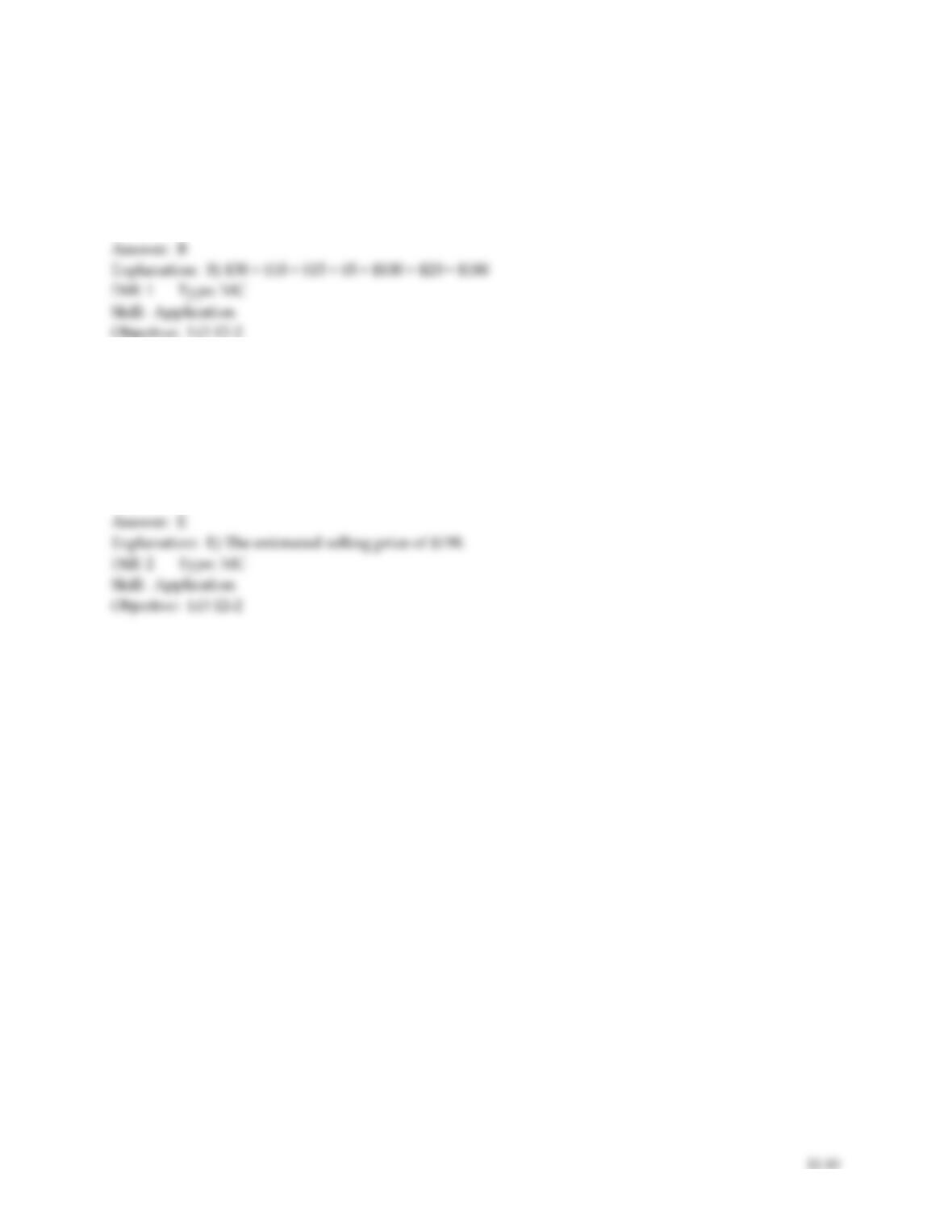
12) For Welch Manufacturing, what is the minimum acceptable price of this one-time-only special order?
A) $40
B) $55
C) $60
D) $66
E) $86
Cost Accounting: A Managerial Emphasis, 6e
Chapter 12 – Pricing Decisions, Product Profitability Decisions, and Cost Management
13) What is the full cost of the product per unit?
A) $60
B) $180
C) $198
D) $66
E) $155
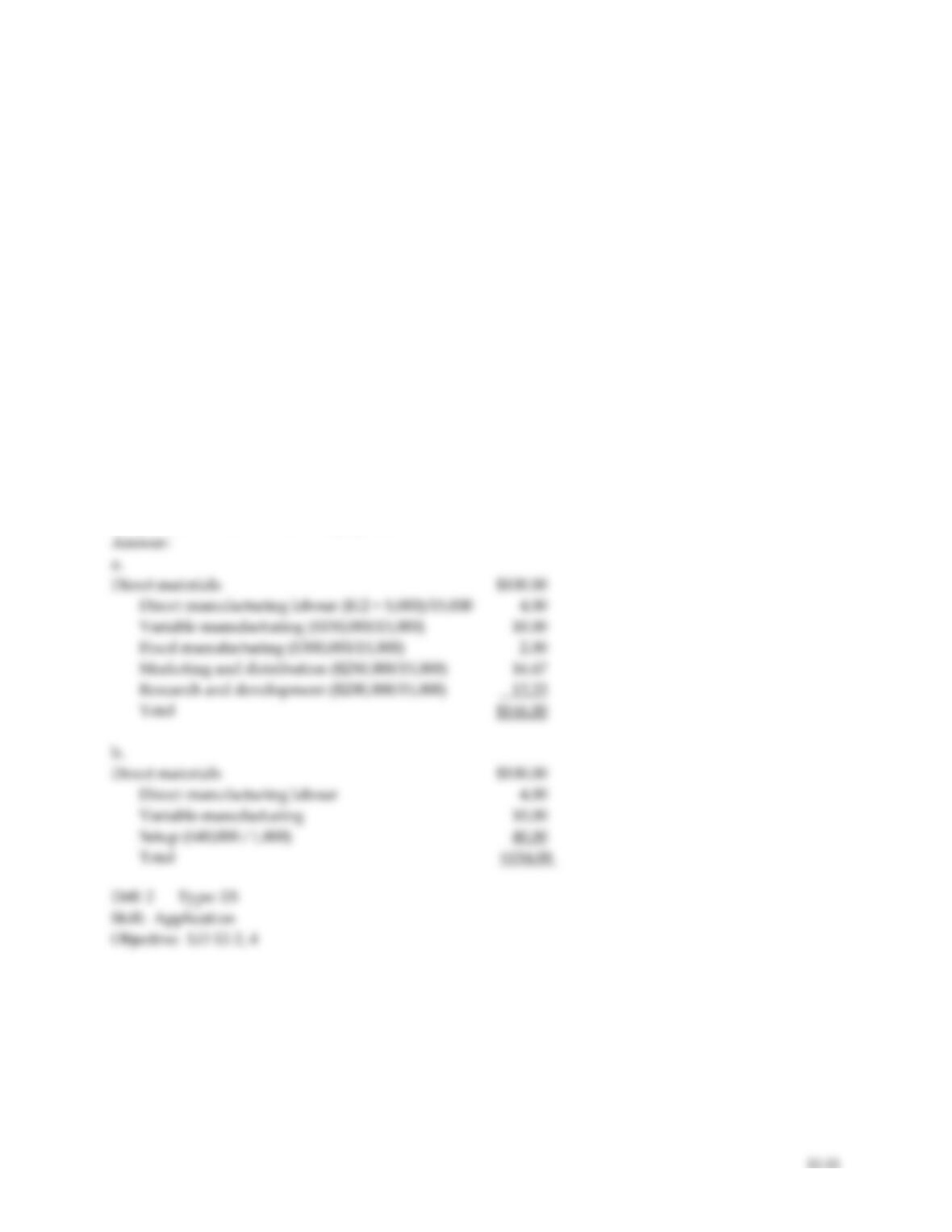
14) If the European customer wanted a long-term commitment for supplying this product, what price
would most likely be quoted?
A) $66
B) $180
C) $155
D) $217
E) $198
Cost Accounting: A Managerial Emphasis, 6e
Chapter 12 – Pricing Decisions, Product Profitability Decisions, and Cost Management
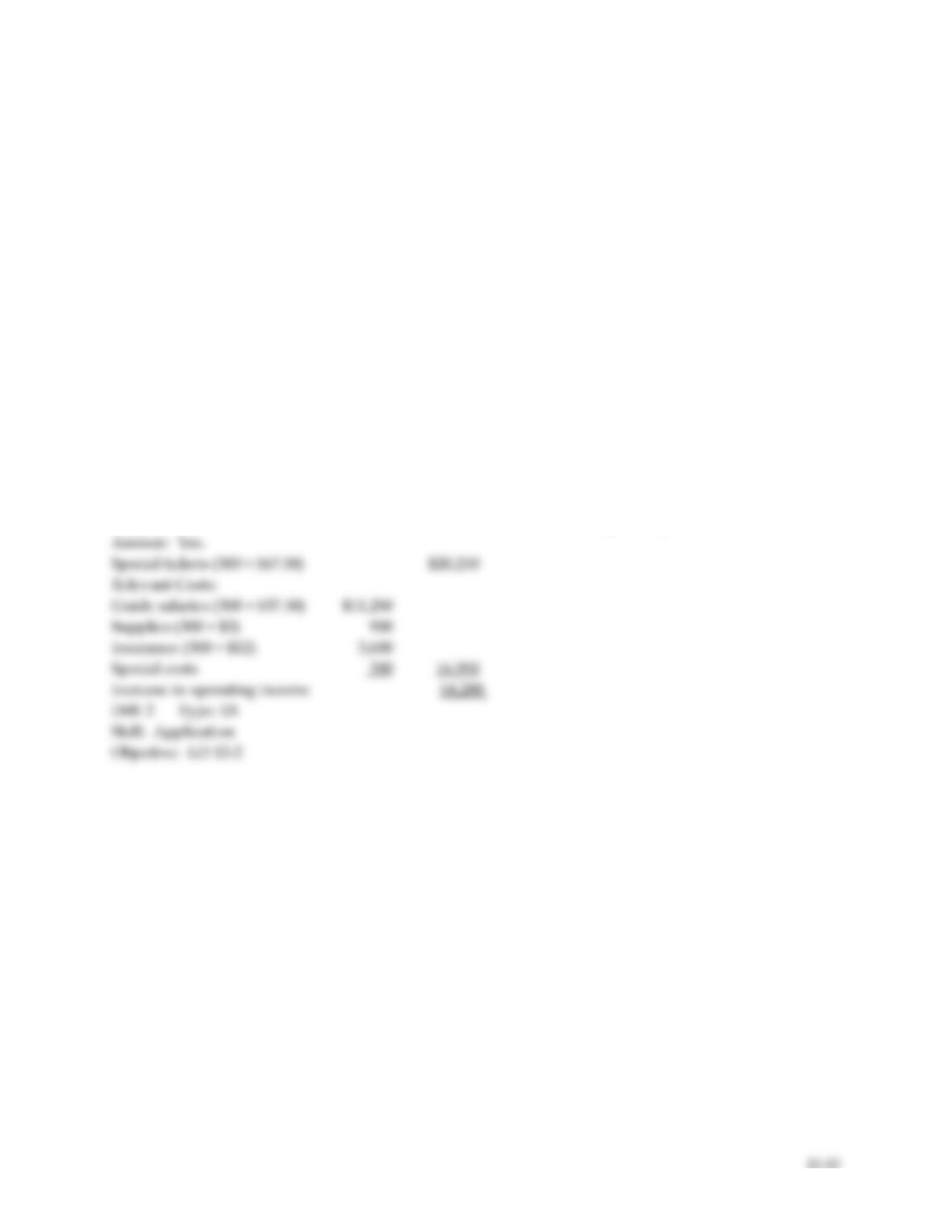
15) Schlickau Company manufactures basketball backboards. The following information pertains to the
company’s normal operations per month:
Output units 15,000 boards
Machine-hours 4,000 hours
Direct manufacturing labour-hours 5,000 hours
Direct manufacturing labour per hour $12
Direct materials per unit $100
Variable manufacturing overhead costs $150,000
Fixed manufacturing overhead costs $300,000
Product and process design costs $200,000
Marketing and distribution costs $250,000
Required:
a. For long-run pricing, what is the full-cost base per unit?
b. Schlickau Company is approached by an overseas city to fulfill a one-time-only special order for 1,000
units. All cost relationships remain the same except for an additional one-time setup charge of $40,000.
No additional design, marketing, or distribution costs will be incurred. What is the minimum acceptable
bid per unit on this one-time-only special order?
Cost Accounting: A Managerial Emphasis, 6e
Chapter 12 – Pricing Decisions, Product Profitability Decisions, and Cost Management
16) Muskoka Travel offers guided tours through the lake system. Muskoka Travel provides a guide,
necessary equipment, and food for a fee of $75 per person per day. Currently the company is providing
an average of 600 guide-days per month. Based on available equipment and guides the maximum
capacity is 950 guide-days (customers taken on the equivalent of an all day tour) per month.
Variable costs per guide-day for the year were as follows:
Food $7.50 Guide’s salary $37.50
Supplies 3.00 Insurance 12.00
Fixed costs per month during the year were as follows:
Equipment rental $7,500 Marketing $3,000
Administration 6,000 Customer service 1,500
Required:
A group of foreign tourists has offered Muskoka Travel a proposal of 300 guide-days in July if they will
cut the fee to $67.50 per guide-day. They have their own food and do not want to use the Muskoka Travel
menus. Muskoka Travel will incur $300 in additional costs for busing the tourists back and forth to the
camp site. If fixed costs would not increase, should Muskoka Travel accept the special offer?
Cost Accounting: A Managerial Emphasis, 6e
Chapter 12 – Pricing Decisions, Product Profitability Decisions, and Cost Management
17) Brady Lumber Company, a producer of oak lumber for furniture companies has an offer to supply a
special load of lumber for an exporter. It will take three months to fill the order of 1,000,000 board metres.
During the three months half of its production capacity will be utilized for the special order. The total
fixed costs for the three months will be $6,000,000. Variable costs per 1,000 board metres will be $2,500.
The marketing manager believes that half of the capacity taken up by the special order can be utilized
with regular business which will generate income of $240,000.
Required:
Determine the minimum price that needs to be charged for the special order.
18) Backwoods Incorporated manufactures rustic furniture. The cost accounting system estimates
manufacturing costs to be $80 per table, consisting of 70% variable costs and 30% fixed costs. The
company has surplus capacity available. It is Backwoods’ policy to add a 50% markup to full costs.
Required:
a. Backwoods Incorporated is invited to bid on an order to supply 100 rustic tables. What is the lowest
price Backwoods should bid on this one-time-only special order?
b. A large hotel chain is currently expanding and has decided to decorate all new hotels using the rustic
style. Backwoods Incorporated is invited to submit a bid to the hotel chain. What is the lowest price per
unit Backwoods should bid on this long-term order?
Cost Accounting: A Managerial Emphasis, 6e
Chapter 12 – Pricing Decisions, Product Profitability Decisions, and Cost Management
19) At a management meeting, you just finished presenting your cost analysis report, showing unit costs
last year for 60,000 widgets produced were $435.00. The sales manager then complained that she was
going to lose a special overseas sale because the customer had indicated they could only pay $425.00. She
knew from sources that no competitor would be bidding below $440, and she complained that if the
company had better cost control, there would be more profit for everyone. The production manager also
would like to take the extra job, since even with the extra production, the plant would be under-capacity.
Required:
What type of information would you need in order to be able to determine if the extra order could be
profitably produced if the selling price was held to $425 per unit?
12.3 Apply two of three pricing methods: target pricing to set target costs and cost-plus
pricing.
1) Including unit fixed costs for pricing is often used because of its simplicity.
2) Target pricing includes: (1) developing a needed product, (2) choosing a target price, (3) deriving a
target cost per unit, and (4) performing value engineering.
3) When prices are set in a competitive marketplace, product costs are the most important influence on
pricing decisions.
Cost Accounting: A Managerial Emphasis, 6e
Chapter 12 – Pricing Decisions, Product Profitability Decisions, and Cost Management
4) Companies that produce high quality products do not have to pay attention to the actions of their
competitors.
5) Relevant costs for pricing decisions include manufacturing costs, but not costs from other value-chain
functions.
6) Profit margins are often set to earn a reasonable return on investment for short-term pricing decisions,
but not long-term pricing decisions.
Cost Accounting: A Managerial Emphasis, 6e
Chapter 12 – Pricing Decisions, Product Profitability Decisions, and Cost Management
Use the information below to answer the following question(s).
Pershing Company budgeted the following costs for the production of its one and only product, blades,
for the next fiscal year:
Direct materials
$187,500
Direct labour
130,000
Factory overhead:
Variable
140,000
Fixed
107,500
Selling and administrative:
Variable
60,000
Fixed
80,000
Total costs
$705,000
Pershing has a target profit of $150,000.
7) What is the target profit percentage as a percentage of total manufacturing costs?
A) 61%
B) 21%
C) 47%
D) 27%
E) 35%
8) If total invested capital is $1,000,000, what is the company’s target rate of return on investment?
A) 15 %
B) 20 %
C) 25 %
D) 30 %
E) 35 %
Cost Accounting: A Managerial Emphasis, 6e
Chapter 12 – Pricing Decisions, Product Profitability Decisions, and Cost Management
9) The target profit percentage for setting prices as a percentage of total variable costs would be
A) 47%.
B) 33%.
C) 29%.
D) 38%.
E) 61%.
10) The target profit percentage for setting prices as a percentage of total costs would be
A) 61%.
B) 21%.
C) 47%.
D) 27%.
E) 35%.
11) Which of the following best describes the cost-plus pricing approach?
A) Cost base + Markup component = Prospective selling price
B) Prospective selling price + Cost base = Markup component
C) Cost base + Gross margin = Prospective selling price
D) Variable cost + Fixed cost + Contribution margin = Prospective selling price
E) Cost base plus markup ÷ 100% = selling profit percentage
12) The current selling price for the Pluto, a mid-sized car, is $19,000. For next year it is anticipated that
Pluto will have a $12,000 cost base. What is its prospective selling price, using cost-plus pricing, if the
company desires a markup component of 15 percent?
A) $10,200
B) $13,800
C) $19,000
D) $30,000
E) $31,000
Cost Accounting: A Managerial Emphasis, 6e
Chapter 12 – Pricing Decisions, Product Profitability Decisions, and Cost Management
13) Seneca Company has invested $1,000,000 in a plant to make gas pumps for service stations. The
average long-run income desired from the plant is $150,000 annually. The annual cost base for each pump
is $1,000. What should be the prospective selling price for each pump if the company uses a target return
on investment as the markup base?
A) $1,150
B) $2,500
C) $16,000
D) $17,000
E) $17,500
14) A product’s markup percentage would need to cover fixed manufacturing costs if
A) the company has only fixed manufacturing costs.
B) the company wants to break-even during the fiscal period.
C) the company wants to make a profit.
D) the cost base does not include fixed manufacturing costs.
E) the cost base includes fixed manufacturing costs as well as variable costs.
15) Johnson Petroleum Company is considering pricing its 5,000 litre petroleum tanks using either
variable manufacturing or full product costs as the base. The variable cost base provides a prospective
price of $2,800 and the full cost base provides a prospective price of $2,850. The difference between the
two prices is
A) the amount of profit to be included.
B) due to the fact that the variable cost base must estimate all fixed costs, other variable costs, and desired
profit while the full cost base must estimate only desired profit.
C) known as price discrimination.
D) caused by the inability of most companies to estimate fixed cost per unit with any degree of reliability.
E) known as peak pricing.
Cost Accounting: A Managerial Emphasis, 6e
Chapter 12 – Pricing Decisions, Product Profitability Decisions, and Cost Management
16) When target costing and target pricing are used together,
A) the target cost is established first, then the target price.
B) the target cost per unit is the estimated long-run price per unit that enables a product or service to
achieve the target profit per unit.
C) the target price is set to undercut the competition.
D) target costs are higher than current costs because of inflation over time.
E) target price is the estimated price for a product or service that a potential customer will be willing to
pay.
17) The target pricing approach is easier when
A) products highly differentiated and the consumer life cycle is shorter.
B) products highly differentiated and the consumer life cycle is longer.
C) products are not well differentiated and the consumer life cycle is shorter.
D) products are not well differentiated and the consumer life cycle is longer.
E) little is known about market factors.
Use the information below to answer the following question(s).
Acorn Products currently sells small boats for $360. It has costs currently assigned to it of $280. A
competitor is bringing a new small boat to market that will sell for $300. Management believes it must
lower the price to $300 to compete in the market for small boats. Marketing believes that the new price
will cause sales to increase by 10 percent, even with a new competitor in the market. Acorn’s sales are
currently 100,000 per year.
18) What is the target cost if target profit is 25 percent of the competitor’s selling price?
A) $75
B) $90
C) $225
D) $270
E) $280
Cost Accounting: A Managerial Emphasis, 6e
Chapter 12 – Pricing Decisions, Product Profitability Decisions, and Cost Management
19) Under cost-plus pricing, what is the required selling price to achieve a 15% markup?
A) $285
B) $6300
C) $310
D) $315
E) $322
20) What is Acorn’s target selling price if costs cannot be reduced and target profit is changed cost plus 20
percent?
A) $280.00
B) $336.00
C) $350.00
D) $353.33
E) $360.00
21) What is Acorn’s target cost if the company wants to maintain its same income level, and marketing is
correct?
A) $280.00
B) $270.00
C) $252.00
D) $236.27
E) $227.27