
58) Urban change in core regions has been influenced the most by
A) higher levels of education.
B) Postmodern architectural styles.
C) the economic transformation to a postindustrial economy.
D) increased racial tensions.
E) higher levels of spending on urban renewal by national governments.
59) The inability of central city areas to generate sufficient tax revenue is due to all of the
following except
A) decentralization of cities.
B) loss of residential taxpayers.
C) increased demands for social services.
D) increased demands for infrastructure repairs.
E) inadequate collection mechanisms.
60) The cycle of poverty
A) is of little consequence in core countries.
B) results in the middle class dropping down into poverty.
C) transmits poverty from one generation to the next.
D) occurs primarily in rural areas of peripheral countries.
E) is found only in the periphery.

61) ________ is a characteristic of the cycle of poverty.
A) School absenteeism
B) Improper nutrition
C) Psychological stress from crowding
D) Unemployment
E) All of these are found in the cycle of poverty.
62) Redlining
A) targets the underclass.
B) is legal.
C) gives government-subsidized loans to low-income families.
D) helps break the cycle of poverty.
E) promotes geographic literacy.
63) Customers of stores like H&M, Old Navy, and Banana Republic can buy garments made by
workers in ________, where the minimum wage for garment workers is the lowest in the world.
A) Dhaka, Bangladesh
B) Doha, Qatar
C) Cali, Colombia
D) Mumbai, India

64) Slum removal and demolition
A) is most commonly tried in core countries.
B) usually results in the quick construction of another slum in another part of the city.
C) was banned by the South Korean government in the early 1980s.
D) could affect up to 1 billion people world-wide if it were applied to all slums.
65) According to the World Bank, ________ has 16 of the 20 most air-polluted cities on earth.
A) China
B) Brazil
C) Mexico
D) United Kingdom
E) the United States
66) The typical African-American neighborhood in an American city can best be termed a(n)
A) ghetto.
B) enclave.
C) congregation.
D) colony.

67) Which of the following is NOT a problem currently being faced by the North American
City?
A) municipal socialism
B) fiscal squeeze
C) infrastructural decay
D) mortgage foreclosures
E) poverty
68) Which of is a problem faced uniquely by Detroit among North American cities?
A) municipal socialism
B) fiscal squeeze
C) infrastructural decay
D) vacant land
E) poverty
69) More than anything else, the ________ and its box-like steel-frame structures of concrete
and glass facades have imposed a measure of uniformity on cities of the world.
A) International Style
B) Beaux Arts Style.
C) Modern Movement
D) SmartCode
E) New Urbanism

70) Smart growth—that attempts to manage urban growth and minimize urban sprawl—is most
likely to target growth at or around
A) existing public mass transit stations.
B) the CBD.
C) industrial areas.
D) low population density areas.
E) neighborhoods ready for gentrification.
71) The megalopolis that extends from Washington, D.C. to Boston is best exemplified by which
of the following explanations of urban structure?
A) polycentric metropolis
B) New Urbanism
C) isotropic landscape
D) open geography
E) zone in transition
72) The urban renewal schemes of Frenchman Baron Georges Haussmann were designed to
enhance
A) efficiency and order.
B) history and culture.
C) revolutionary ideas and politics.
D) traditional neighborhoods and activities.

73) Edge cities, “edgeless cities,” micropolitan centers, criss-crossing freeways, and interspersed
residences with office employment and high-end retailing in polycentric networks characterize
A) megapolitan regions.
B) virtual cities.
C) Modernist urban planning.
D) the reaction to gentrification.
74) Gentrification is most likely to be found in
A) Central Business Districts.
B) central city zones of transition.
C) edge cities.
D) micropolitan centers.
E) Gentrification regularly occurs in both edge cities and central city zones of transition.
75) The beneficiaries of the community revitalization that accompanies gentrification include all
of the following except
A) poorer households.
B) affluent households.
C) realtors and landlords.
D) city governments.
E) young urban professionals.

76) The economic activities not a part of the official record and that take place outside official
systems of regulation or remuneration make up the ________ sector of the economy and tend to
be an important part of urban economic life around the world.
A) informal
B) underground
C) black market
D) market
12.2 True or False
1) Generally, as the accessibility of a location increases, its utility decreases.
2) In an idealized city, the center is the point of maximum utility where bid-rents are highest.
3) As one travels outward from the center in a concentric zone model of the city, accessibility,
utility and bid-rents decrease.

4) The territorial and residential clustering of Arabs in Dearborn, MI (metropolitan Detroit) is an
example of congregation.
5) Ghettos are spatial forms of segregation.
6) Segregation is involuntary congregation.
7) Gentrification, even as a form of colonization, is widely encouraged by city governments.
8) Gentrification has helped long-term residents of centrally-located working class
neighborhoods save and renew their neighborhoods.

9) In contrast to cities of the world’s periphery, U.S. cities have been able to maintain spending
and repairs on infrastructures, making them the world’s best-functioning cities.
10) Globalization and economic restructuring have helped break the cycle of poverty and reduce
homelessness in U.S. cities.
11) In contrast to Baron Georges Haussmann, Le Corbusier treated buildings and cities as
machines and emphasized technology and function.
12) Islamic cities can be found throughout the Islamic world, not just on the Arabian Peninsula.
13) Because of their high population densities and compact structure, it is difficult to maintain
any sense of household privacy in Islamic cities.

14) Informal sector employment, housing and transportation is, increasingly, acknowledged to be
a rational response to poverty.
15) Shanty and squatter neighborhoods can be viewed as “slums of hope” for the opportunities,
support and community they provide new immigrants.
16) Edge cities are a peculiarly North American phenomena.
17) One positive side to urban sprawl is that suburban and exurban development has become less
generic, and is resulting in more creative, unique and individual landscapes.
18) Isotropic surfaces are only found in rural areas.

19) The dualism of the informal and formal sectors of the economy can be found in world cities.
20) Edge cities are typically situated near major highway intersections.
21) Segregation can occur through congregation, discrimination, or both.
22) Gentrification and its characteristic improvements to the built environment are especially
beneficial to the poorer households in the community.
23) The shape of most European cities is almost entirely due to building and planning activity in
the twentieth century.

24) Compared to their American counterparts, European neighborhoods are more stable in terms
of how long people tend to live there.
25) The shape and nature of an urban landscape reflect the values and intentions of the people
associated with it.
26) When geographers speak of the Islamic city, they refer to the few cities left in the world that
still reflect the important principles of historical Islamic urban development.
27) The residential areas of traditional Islamic cities were designed to minimize the likelihood
that a woman would be seen by strangers.
28) Residents of the suburbs pay lower bid-rents than people of the CBD.

29) The infrastructure in most large American cities is currently in good shape, but will need
major repairs or replacement in about 25 to 50 years.
30) In contrast to cities in the world’s periphery, minorities in North American cities have not
been forced to congregate.
31) In peripheral cities, the informal sector often makes a significant contribution to the formal
sector.
32) The informal sector provides hope and opportunity for the underemployed.
33) Street vending, parking cars, selling souvenirs, writing letters for others, selling drugs are
typical formal sector jobs in the world’s periphery.

34) An isotropic surface has the same topography everywhere.
35) Most European cities are densely populated.
36) Most European cities have downtowns that are losing their economic vitality.
37) Islamic cities have no underlying urban forms that unify them.
38) You would expect to find narrow, twisting streets in a medina.
39) Neighborhood decay has been increasing in American cities for the past several decades.

40) Substandard educational facilities are usually an important factor in the cycle of
neighborhood poverty.
41) Most members of the underclass quickly rise in economic status.
42) Social life in traditional Italian cities centers on their piazzas.
43) India has the world’s highest auto accident rate.
44) The Swiss architect and urban planner Le Corbusier was keen on technology, functional
design and open spaces.

45) Haussmann and Le Corbusier shared a desire for efficient and concentrated use of urban
space.
46) Doha was built and is advertised as the first Modernist Islamic City.
47) Residential areas of Islamic cities are designed to promote the efficient flow of traffic.
48) Residential areas are no longer important nor relevant in metroburbia.
49) The informal sector in the periphery subsidizes products for consumers in the core.
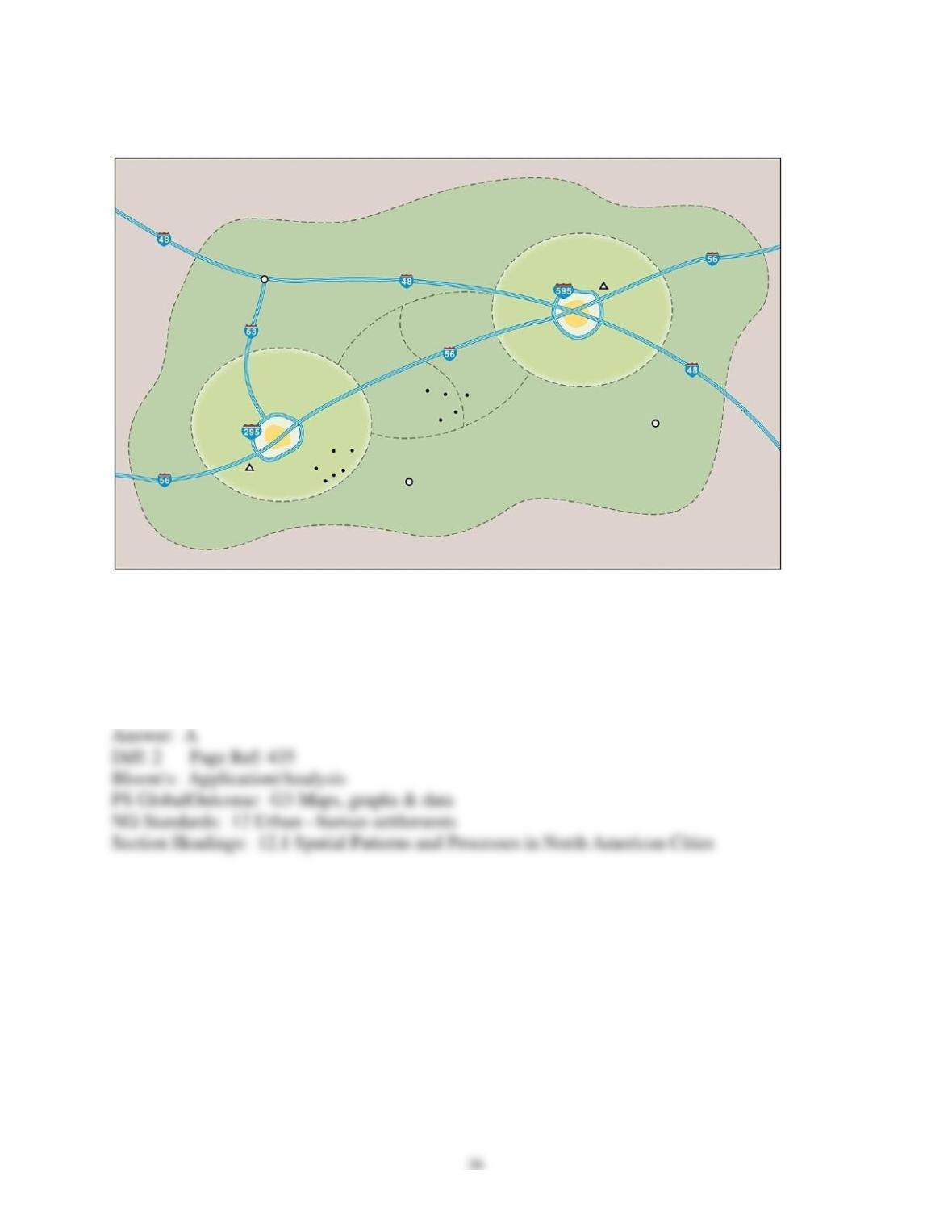
12.3 Questions with Images
1) The above diagram graphically characterizes
A) the new metropolis.
B) the ecological model of urban land use.
C) the classic concentric zone pattern of the North American city.
D) egg city and sunny side up urbanism.
E) a zone in transition.
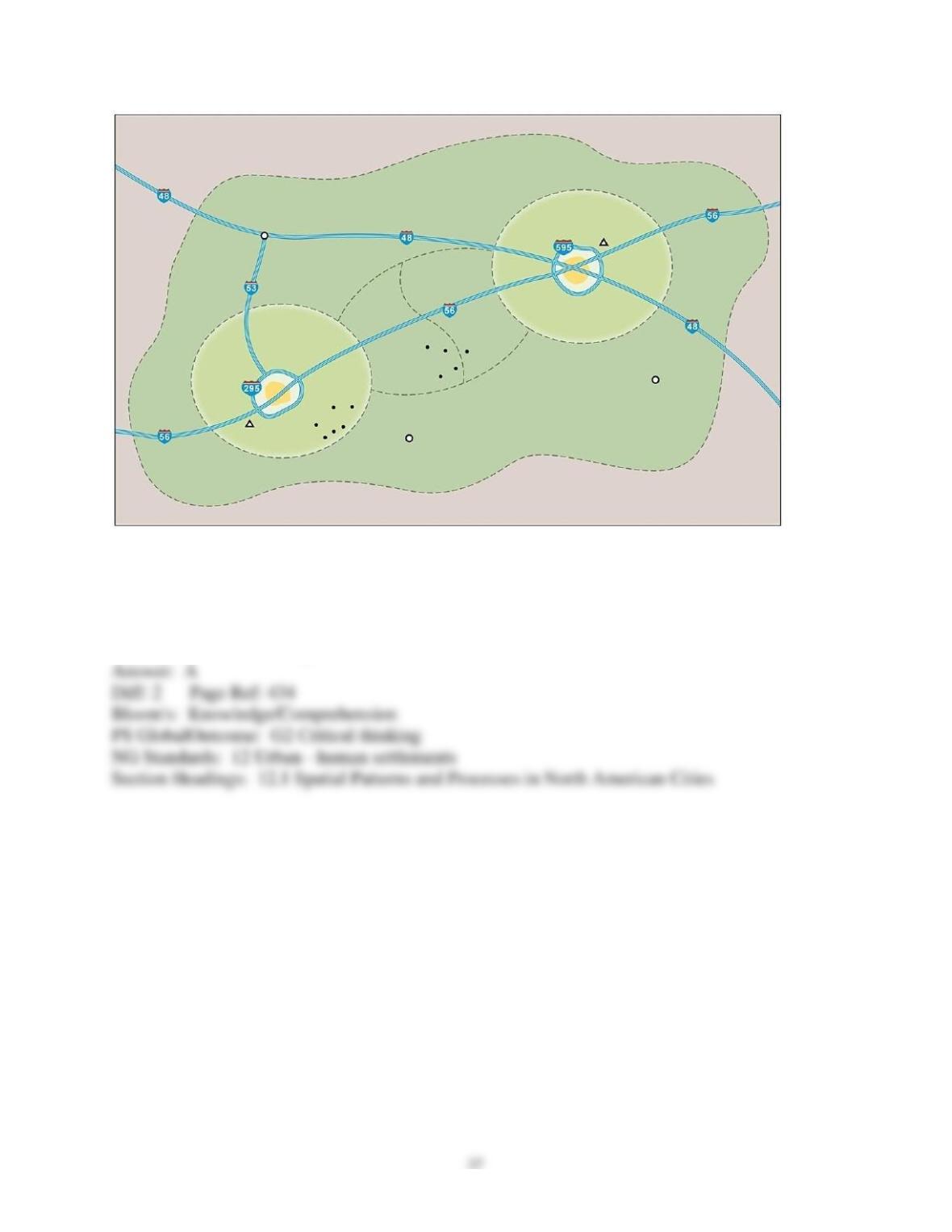
2) The above diagram most accurately represents the ________ model of urban structure.
A) multiple-nuclei
B) corridor and sector
C) concentric ring
D) polycentric new metropolis