
CHAPTER 12: ACTIVITY-BASED MANAGEMENT
1. Activitybased management focuses management’s attention on activities resulting in improving customer value
and profits.
a. True
b. False
2. Activity-based costing does not provide good information for activity-based management.
a. True
b. False
3. Activity-based costing is very concerned with waste issues.
a. True
b. False
4. The activity-based management model has two dimensions: a cost dimension and a process dimension.
a. True
b. False
5. Process value analysis maximizes systemwide performance by emphasizing activity management.
a. True
b. False
6. Process value consists of three elements: .driver analysis, activity analysis, and performance measurement.
a. True
b. False
7. Driver analysis identifies performance levels.
a. True
b. False
8. Performance measurement is concerned with how well activities are performed.
a. True
b. False

Chapter 12: Activity-Based Management
9. Financial measures of performance focus on the dollar effect of activity performance changes.
a. True
b. False
10. Reducing non-value added costs decreases activity deficiency.
a. True
b. False
11. Cost reduction is a measure of activity improvement.
a. True
b. False
12. Kaizen costing is concerned with reducing the costs by identifying small, continuous improvement for existing
products and processes.
a. True
b. False
13. Implementing an activity-based management requires careful planning and execution.
a. True
b. False
14. Identifying, defining, and classifying activities require more attention for ABC than ABM.
a. True
b. False
15. One of the major reasons for the failure of ABM is lack of upper management support.
a. True
b. False
16. The common steps in implementing activity-based management are systems planning and activity identification,
definition, and classification.
a. True
b. False

Chapter 12: Activity-Based Management
17. A financial-based responsibility accounting system focuses on the assignment of responsibility to organizational
units and measures performance in financial terms.
a. True
b. False
18. Activity-based responsibility accounting assigns responsibility to processes and uses only nonfinancial measures
of performance.
a. True
b. False
19. Financial-based responsibility accounting focuses on functional organizational units.
a. True
b. False
20. Process improvement refers to incremental and erratic increases in the efficiency of an existing process.
a. True
b. False
21. The process of improving performance and constantly eliminating waste is
known as __________ .
22. The process that focuses on accountability for activities rather than costs and emphasizes systemwide performance
is called __________ .
23. The resources consumed by the activity in producing its output are called .
24. Activities that contribute to customer value and are necessary to remain in business
are called activities.
25. A well accepted approach for reducing costs by eliminating waste is called costing.
26. Activity flexible budgeting differs from traditional approaches by using more than drivers to
predict costs.
Chapter 12: Activity-Based Management
27. The successful implementation of activity-based management relies on support from
higher __________ .
28. The system that provides the justification for implementing activity-based management and addresses the issues
related with its implementation is called .
29. The responsibility accounting system that focuses on organizational units such as departments and plants is called
responsibility.
30. The responsibility accounting system that uses both operational and financial measures is
called responsibility.
31. The major source of information for the activity management system is
a. driver analysis.
b. an activity-based costing system.
c. a performance measurement system.
d. product information.
32. Activity-based management attempts to
a. identify and eliminate all unnecessary activities.
b. increase the efficiency of necessary activities.
c. add new activities that increase value.
d. all of these.
33. Processes are
a. tasks that must be completed to do work.
b. outcomes of activities.
c. activities linked to perform a specific objective.
d. the linked set of value-creating activities from disposal of materials to disposal of the finished product by end
consumers.
34. Which of the following is NOT part of the process dimension of the activity-based management model?
a. resources
b. driver analysis
c. activities
d. performance measures

Chapter 12: Activity-Based Management
35. Which of the following is NOT part of the two-dimensional activity-based management model?
a. personnel selection
b. driver analysis
c. resources
d. performance measures
36. What are the two dimensions of an activity-based management model?
a. the cost dimension and the project dimension
b. the cost dimension and the process dimension
c. the quality dimension and the process dimension
d. the quality dimension and the activity dimension
37. Which of the following is NOT part of the cost dimension of the activity-based management model?
a. resources
b. driver analysis
c. activities
d. cost objects
38. Which of the following is part of the cost and process dimensions of the activity-based management model?
a. resources
b. driver analysis
c. activities
d. cost objects
39. What is the purpose of driver analysis?
a. identify activities in a process
b. identify number of processes
c. identify root causes of activity costs
d. identify complexity of processes
40. The results or products of an activity are called:
a. Activity inputs
b. Driver analysis
c. Activity outputs
d. Value-added activities

Chapter 12: Activity-Based Management
41. The resource(s) consumed by the activity in producing its output is(are) called:
a. Value-added activities
b. Activity outputs
c. Driver analysis
d. Activity inputs
42. The process of identifying, describing, and evaluating the activities an organization performs is called:
a. Activity inputs
b. Driver analysis
c. Activity analysis
d. Value-added activities
43. The effort expended to identify those factors that are the root causes of activity costs is(are) called:
a. Driver analysis
b. Activity outputs
c. Activity inputs
d. Value-added activities
44. An activity output measure is
a. the number of outputs from a process.
b. the cost of the activity measured.
c. the effort expended to identify root causes.
d. the number of times an activity is performed.
45. Which of the following process dimensions of the activity-based management model deals with “why”?
a. resources
b. driver analysis
c. activities
d. performance measures
46. Which of the following process dimensions of the activity-based management model deals with “what”?
a. resources
b. driver analysis
c. activities
d. performance measures

Chapter 12: Activity-Based Management
47. Which of the following is NOT an expected outcome of activity analysis?
a. What activities are performed?
b. How many people perform the activities?
c. The time and resources required to perform the activities.
d. All of these are expected outcomes.
48. An example of activity reduction would be
a. improving cycle time so the need for expediting is eliminated.
b. redesigning products to lead to a reduced cost set of activities.
c. designing a new product that uses components already used by another product.
d. reducing demand for customer complaint handling by improving product quality.
49. The activities necessary to remain in business are called:
a. Value-added activities
b. Activity inputs
c. Activity outputs
d. Activity drivers
50. Non-value-added activities
a. are unnecessary inputs.
b. are valued outputs to internal users.
c. are valued outputs to external users.
d. help meet the organization’s needs, not the product needs.
51. Which of the following is an example of a value-added activity?
a. supervision of production workers
b. inspection of products
c. scheduling of production
d. All of these are value-added activities.
52. Which of the following is NOT a necessary condition for classification as a value-added activity?
a. The activity produces no change of state.
b. The change of state was not achievable by preceding activities.
c. Activity enables other activities to be performed.
d. All of these are necessary conditions.

Chapter 12: Activity-Based Management
53. Which of the following is a reason for managerial activity to be considered a value-added activity?
a. It is an enabling resource for operational activities that bring about a change of state.
b. Managing activities brings order by changing the state from uncoordinated activities to coordinated activities.
c. Both are reasons for classifying managerial activities as value-added activity.
d. Neither is a reason for classifying managerial activities as value-added activity.
54. Which of the following is an example of a non-value-added manufacturing activity?
a. assembly
b. scheduling
c. finishing
d. All of these are value-added activities.
55. Which of the following is a value-added activity?
a. moving
b. inspection
c. processing
d. waiting
56. Which of the following process dimensions of the activity-based management model deals with “how well”?
a. resources
b. driver analysis
c. activities
d. performance measures
57. The effort to reduce costs of existing products and processes is named:
a. Activity reduction
b. Activity elimination
c. Activity selection
d. Kaizen costing
58. The process which involves choosing among various sets of activities that are caused by competing strategies.
a. Activity sharing
b. Activity selection
c. Activity elimination
d. Activity reduction

Chapter 12: Activity-Based Management
59. The process that focuses on non-value-added activities is called:
a. Activity sharing
b. Activity reduction
c. Activity selection
d. Activity elimination
60. The process that decreases the time and resources required by different activities is called:
a. Activity sharing
b. Activity elimination
c. Activity reduction
d. Activity selection
61. The process which increases the efficiency of necessary activities by using economies of scale is called:
a. Activity elimination
b. Activity sharing
c. Activity selection
d. Activity reduction
62. Which of the following focuses on the relationship of activity outputs to activity inputs?
a. activity reduction
b. quality
c. time
d. efficiency
63. Which of the following is a financial measure of activity efficiency?
a. activity flexible budgeting
b. trends in activity costs
c. benchmarking
d. all of these
64. For non-value-added activities that are unnecessary, the standard quantity is
a. one.
b. zero.
c. actual quantity minus standard price.
d. actual quantity plus standard price.
Chapter 12: Activity-Based Management
65. Value-added costs are standard costs based on
a. currently attainable standards.
b. ideal usage standards.
c. cycle time.
d. the value added.
66. Value-added costs equal standard quantity times
a. non-value-added costs.
b. currently attainable standards.
c. standard price.
d. actual price.
67. A time-and-motion study revealed that it should take 3 hours to produce a product that currently takes 7 hours
to produce. Labor is $9 per hour.
The non-value-added costs are
a. $56.
b. $24.
c. $36.
d. $-0-.
68. Mendelsohn company keeps 20 days of materials inventory on hand to avoid shutdowns due to materials
shortages. Carrying costs average $4,000 per day. Bach, Inc., a competitor, keeps 10 days of inventory on hand,
and the competitor’s carrying costs average $2,000 per day.
The value-added costs are
a. $-0-.
b. $40,000.
c. $20,000.
d. $80,000.
Chapter 12: Activity-Based Management
69. Mendelsohn company keeps 20 days of materials inventory on hand to avoid shutdowns due to materials
shortages. Carrying costs average $4,000 per day. Bach, Inc., a competitor, keeps 10 days of inventory on hand,
and the competitor’s carrying costs average $2,000 per day.
The non-value-added costs for the company are
a. $-0-.
b. $40,000.
c. $20,000.
d. $80,000.
70. A company has 19 days of finished goods inventory on hand to avoid stockouts. The carrying costs of the
inventory average $6,000 per day.
The value-added costs would be
a. $100,000.
b. $-0-.
c. $5,000.
d. $10,000.
71. A company has 19 days of finished goods inventory on hand to avoid stockouts. The carrying costs of the
inventory average $6,000 per day.
The non-value-added costs are
a. $250.
b. $10,000.
c. $5,000.
d. $114,000.
72. A firm’s warranty costs are $125,000 per year. A competitor’s warranty costs are $25,000 per year.
The value-added costs are
a. $125,000.
b. $100,000.
c. $25,000.
d. $-0-.
Chapter 12: Activity-Based Management
RATIONALE: SUPPORTING CALCULATIONS:
Warranty costs are considered non-value-added costs.
73. A firm’s warranty costs are $125,000 per year. A competitor’s warranty costs are $25,000 per year.
The non-value-added costs are
a. $125,000.
b. $100,000.
c. $25,000.
d. $0.
74. A time-and-motion study revealed that it should take 2 hours to produce a product that currently takes 6 hours to
produce. Labor is $8 per hour.
The value-added costs are
a. $48.
b. $32.
c. $16.
d. $-0-.
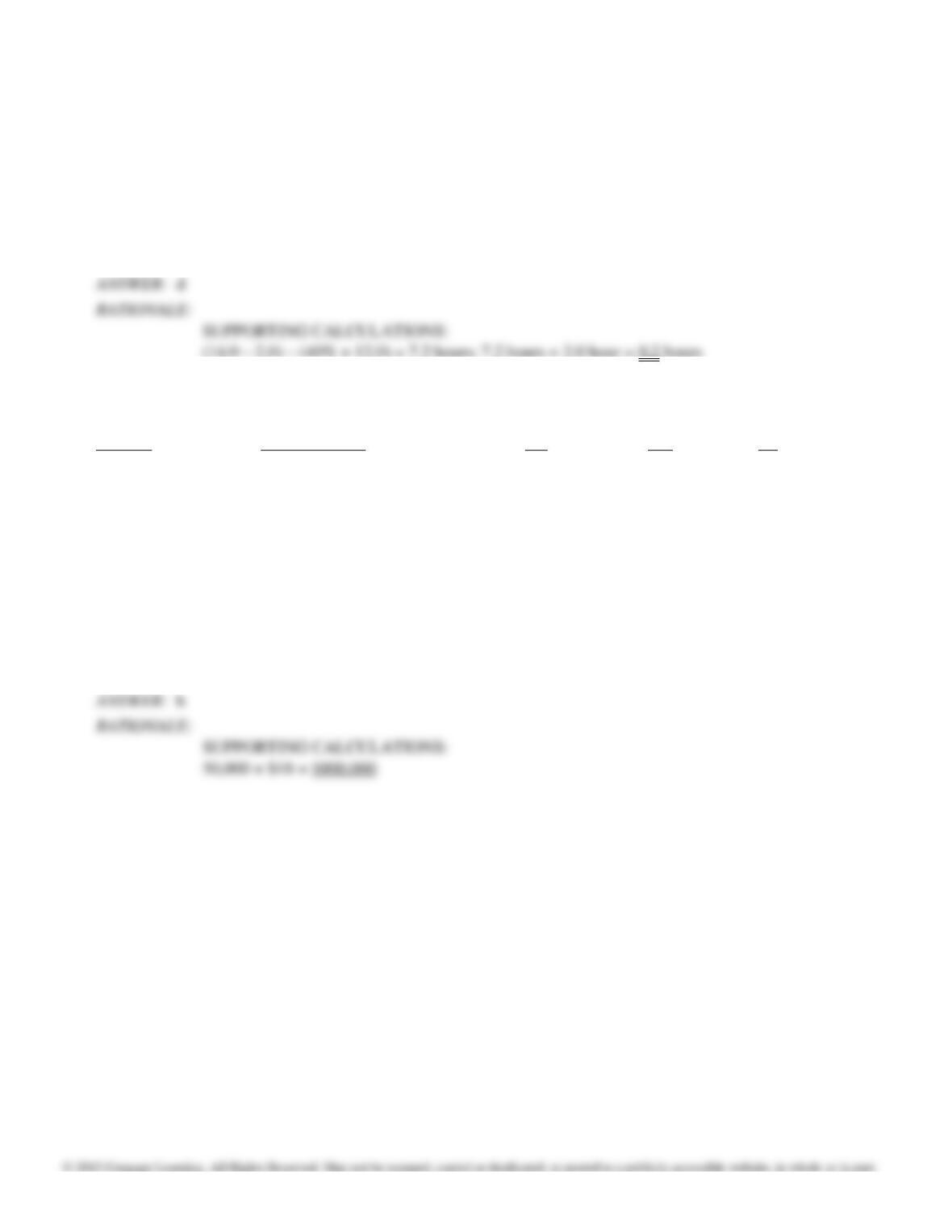
75. Each unit of product requires 16 pounds of material. Due to scrap and rework, each unit has been averaging 18
pounds of material. The material costs $6 per pound.
If the company wants to reduce non-value-added costs by 25 percent next year, the currently attainable standard
for material would be
a. 16.00 pounds.
b. 17.50 pounds.
c. 16.80 pounds.
d. 18.00 pounds.
Chapter 12: Activity-Based Management
76. Setup time for a product is 14 hours. A firm that uses JIT and produces the same product has reduced setup time
by 2 hours. Setup labor is $35 per hour. If the company wants to reduce non-value-added costs by 40 percent next
year, the currently attainable standard for setup time would be
a. 6.8 hours.
b. 9.2 hours.
c. 8.6 hours.
d. 9.6 hours.
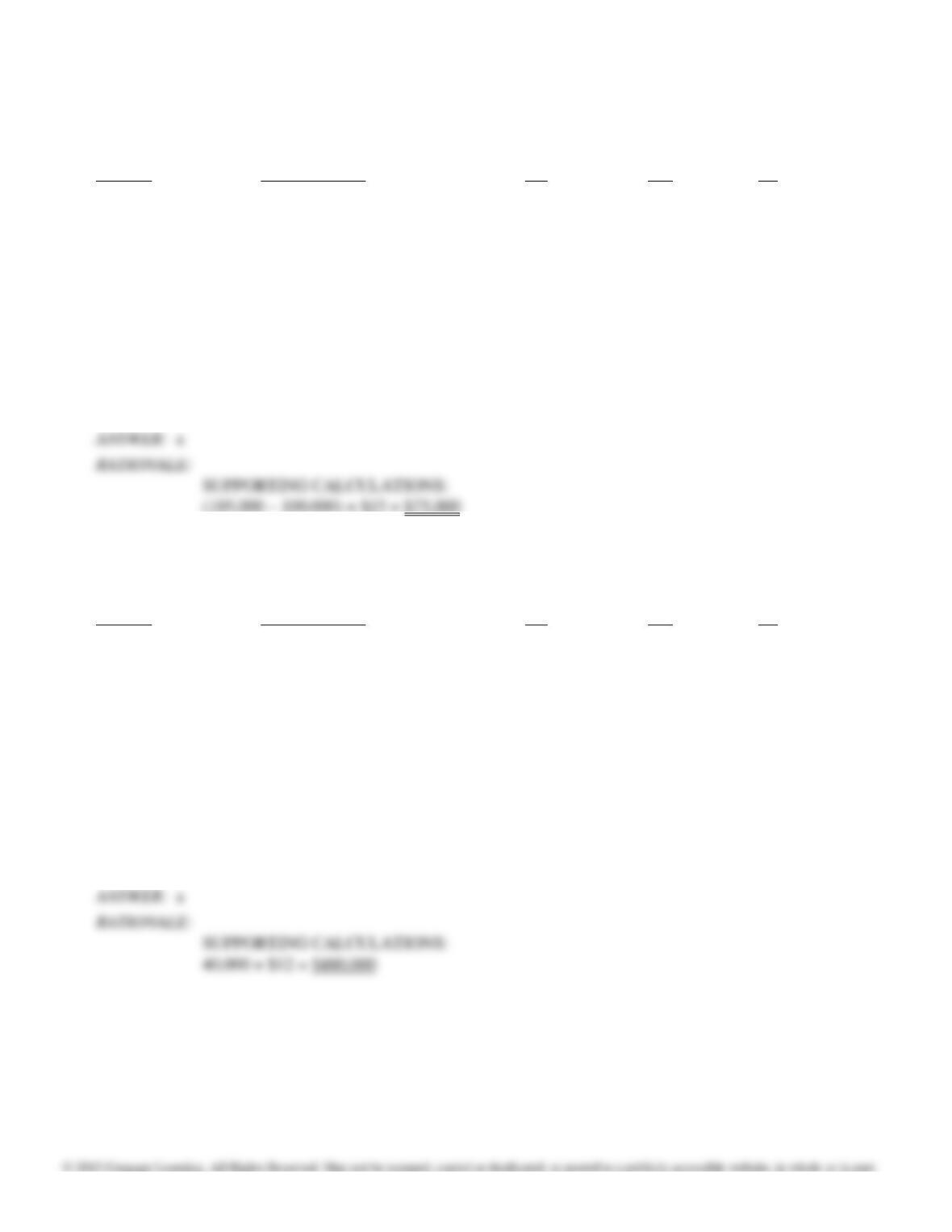
77. Bandolero Corporation has developed ideal standards for four activities: labor, materials, inspection, and
receiving. Information is as follows:
Activity
Activity Driver
SQ
AQ
SP
Inspection
Inspection hours
-0-
40,000
$12
Labor
Hours
50,000
56,000
18
Materials
Pounds
100,000
105,000
15
Receiving
Orders
150
190
450
The actual prices paid per unit of each activity driver were equal to the standard prices. The value-added costs for
labor are
a. $792,000.
b. $900,000.
c. $84,000.
d. $75,000.
Chapter 12: Activity-Based Management
78. Bandolero Corporation has developed ideal standards for four activities: labor, materials, inspection, and
receiving. Information is as follows:
Activity
Activity Driver
SQ
AQ
SP
Inspection
Inspection hours
-0-
40,000
$12
Labor
Hours
50,000
56,000
18
Materials
Pounds
100,000
105,000
15
Receiving
Orders
150
190
450
The actual prices paid per unit of each activity driver were equal to the standard prices. The non-value-added costs
for materials are
a. $75,000.
b. $157,500.
c. $150,000.
d. $1,575,000.
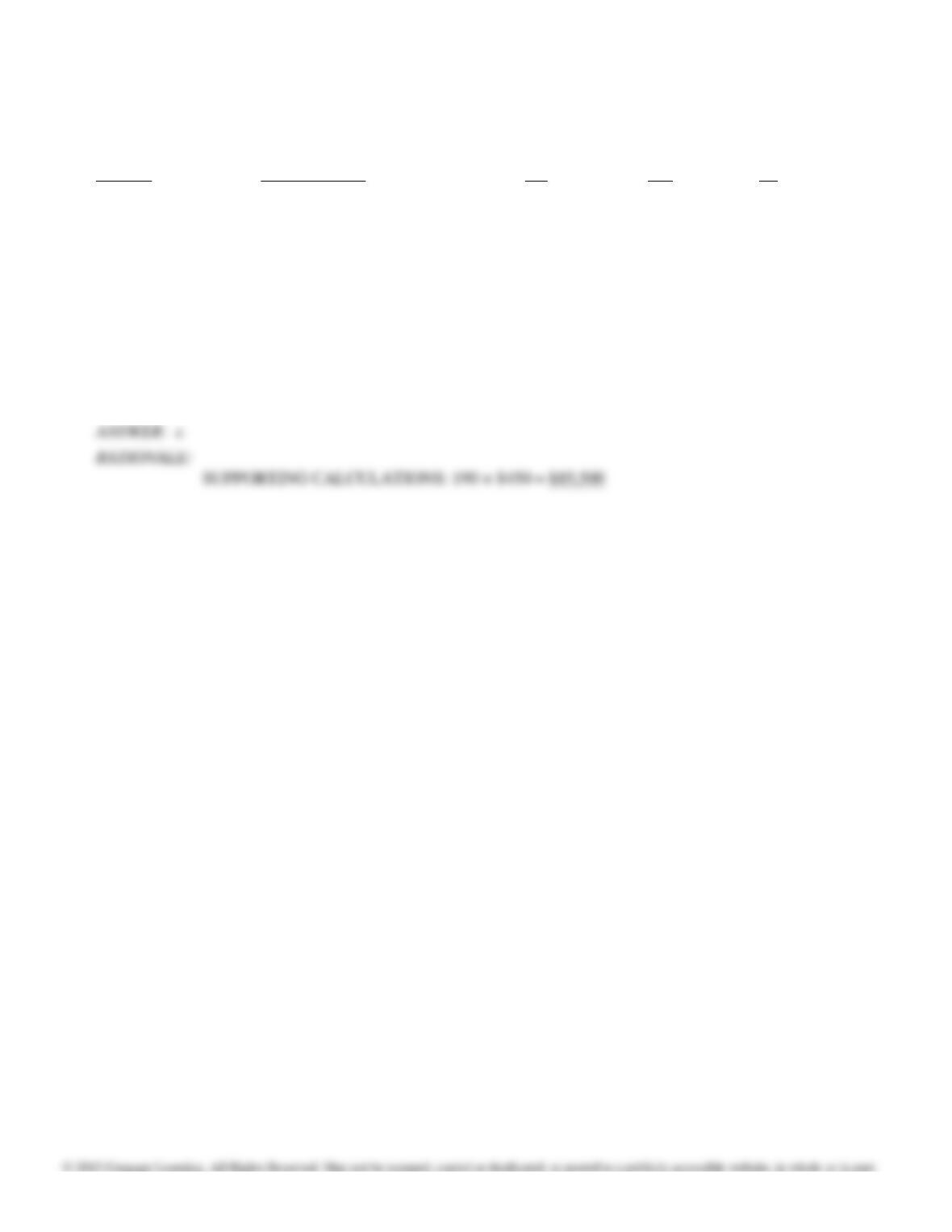
79. Bandolero Corporation has developed ideal standards for four activities: labor, materials, inspection, and
receiving. Information is as follows:
Activity
Activity Driver
SQ
AQ
SP
Inspection
Inspection hours
-0-
40,000
$12
Labor
Hours
50,000
56,000
18
Materials
Pounds
100,000
105,000
15
Receiving
Orders
150
190
450
The actual prices paid per unit of each activity driver were equal to the standard prices. The non-value-added costs
for inspection are
a. $480,000.
b. $60,000.
c. $420,000.
d. $40,000.
Chapter 12: Activity-Based Management
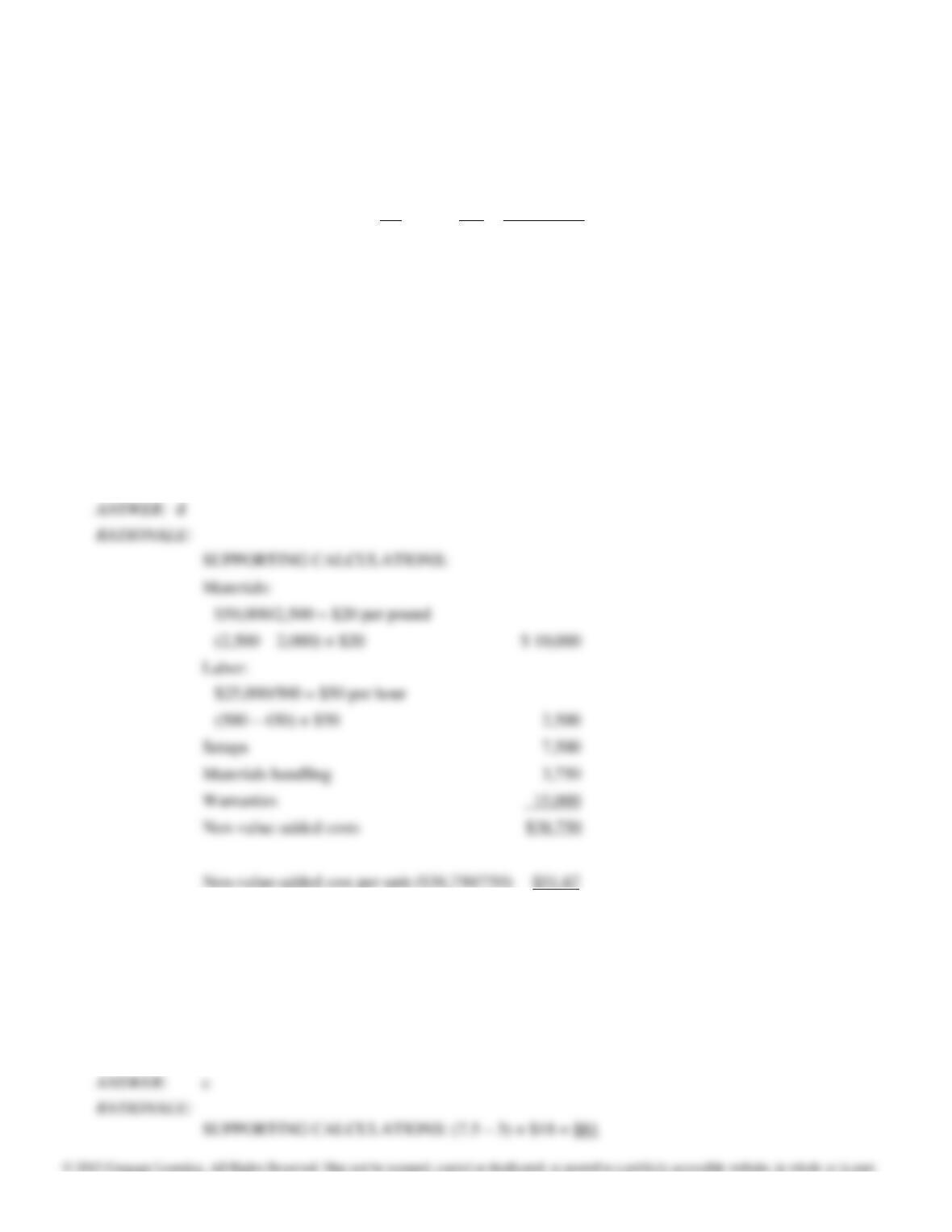
80. Bandolero Corporation has developed ideal standards for four activities: labor, materials, inspection, and
receiving. Information is as follows:
Activity
Activity Driver
SQ
AQ
SP
Inspection
Inspection hours
-0-
40,000
$ 12
Labor
Hours
50,000
56,000
18
Materials
Pounds
100,000
105,000
15
Receiving
Orders
150
190
450
The actual prices paid per unit of each activity driver were equal to the standard prices. The actual costs for
receiving are
a. $49,500.
b. $67,500.
c. $85,500.
d. $18,000.
Chapter 12: Activity-Based Management
81. Cheshire Cat Company sells one of its products for $100 each. Sales volume averages 750 units per year.
Recently, its main competitor reduced the price of its product to $80. Cheshire Cat Company expects sales to drop
dramatically unless it matches the competitor’s price. In addition, the current profit per unit must be maintained.
Information about the product (for production of 750) is as follows:
SQ
AQ
Actual Cost
Materials (pounds)
2,000
2,500
$50,000
Labor (hours)
450
500
25,000
Setups (hours)
0
600
7,500
Material handling (moves)
0
300
3,750
Warranties (number repaired)
0
200
15,000
The non-value-added cost per unit is
a. $49.67.
b. $48.33.
c. $48.67.
d. $51.67.
82. A time-and-motion study revealed that it should take 3 hours to produce a product that currently takes 7.5 hours to
produce. Labor is $18 per hour. The non-value-added costs are
a. $27.
b. $54.
c. $81.
d. $0.
Chapter 12: Activity-Based Management
83. Your company keeps 15 days of materials inventory on hand to avoid shutdowns due to materials shortages.
Carrying costs average $5,000 per day. A competitor keeps 12 days of inventory on hand, and the competitor’s
carrying costs average $3,000 per day. The value-added costs are
a. $-0-.
b. $5,000.
c. $30,000.
d. $75,000.
84. Your company keeps 15 days of materials inventory on hand to avoid shutdowns due to materials shortages.
Carrying costs average $5,000 per day. A competitor keeps 12 days of inventory on hand, and the competitor’s
carrying costs average $3,000 per day. The non-value-added costs would be
a. $-0-.
b. $75,000.
c. $30,000.
d. $80,000.
85. Setup time for a product is 12 hours. A firm that uses JIT and produces the same product has reduced setup time to
1 hour. Setup labor is $6 per hour. The value-added costs are
a. $72.
b. $66.
c. $12.
d. $6.
86. Setup time for a product is 12 hours. A firm that uses JIT and produces the same product has reduced setup time to
1 hour. Setup labor is $6 per hour. The non-value-added costs are
a. $72.
b. $66.
c. $12.
d. $6.
Chapter 12: Activity-Based Management
87. A company has 5 days of finished goods inventory on hand to avoid stockouts. The carrying costs of the
inventory average $5,000 per day. The value-added costs are
a. $-0-.
b. $1,000.
c. $5,000.
d.
$25,000.
88. Each unit of product requires 16 pounds of material. Due to scrap and rework, each unit has been averaging
18 pounds of material. The material costs $4 per pound. The value-added costs are
a. $4.
b. $8.
c. $64.
d. $72.
89. Each unit of product requires 16 pounds of material. Due to scrap and rework, each unit has been averaging 18
pounds of material. The material costs $4 per pound. The non-value-added costs are
a. $8.
b. $4.
c. $64.
d. $72.
90. A company has 5 days of finished goods inventory on hand to avoid stockouts. The carrying costs of the inventory
average $2,500 per day. The non-value-added costs are
a. $-0-.
b. 500.
c. $2,500.
d. $12,500.
Chapter 12: Activity-Based Management
91. A firm’s warranty costs are $375,000 per year. A competitor’s warranty costs are $175,000 per year. The value-
added costs are
a. $225,000.
b. $75,000.
c. $150,000.
d. $-0-.
92. A firm’s warranty costs are $375,000 per year. A competitor’s warranty costs are $175,000 per year. The non–
value-added costs are
a. $-0-.
b. $375,000.
c. $200,000.
d. $75,000.
93. A time-and-motion study revealed that it should take 3 hours to produce a product that currently takes 7.5 hours to
produce. Labor is $18 per hour. The value-added costs are
a. $27.
b. $135.
c. $81.
d. $54.
94. The purpose of trend reporting on non-value-added costs is to
a. trace resources to cost objectives.
b. assess value content.
c. define root causes.
d. see if cost reductions occurred as expected.
95. Controlling the cost reduction process using Kaizen costing is accomplished
a. through repetition of subcycle processes.
b. by punishment of those not reaching the Kaizen standard.
c. through one-time adjustments.
d. through reviews every four to five years.
Chapter 12: Activity-Based Management
96. The continuous improvement subcycle of Kaizen costing is defined by what sequence?
a. check-do-plan-act
b. do-check-plan-act
c. plan-do-check-act
d. None of these is the correct sequence.
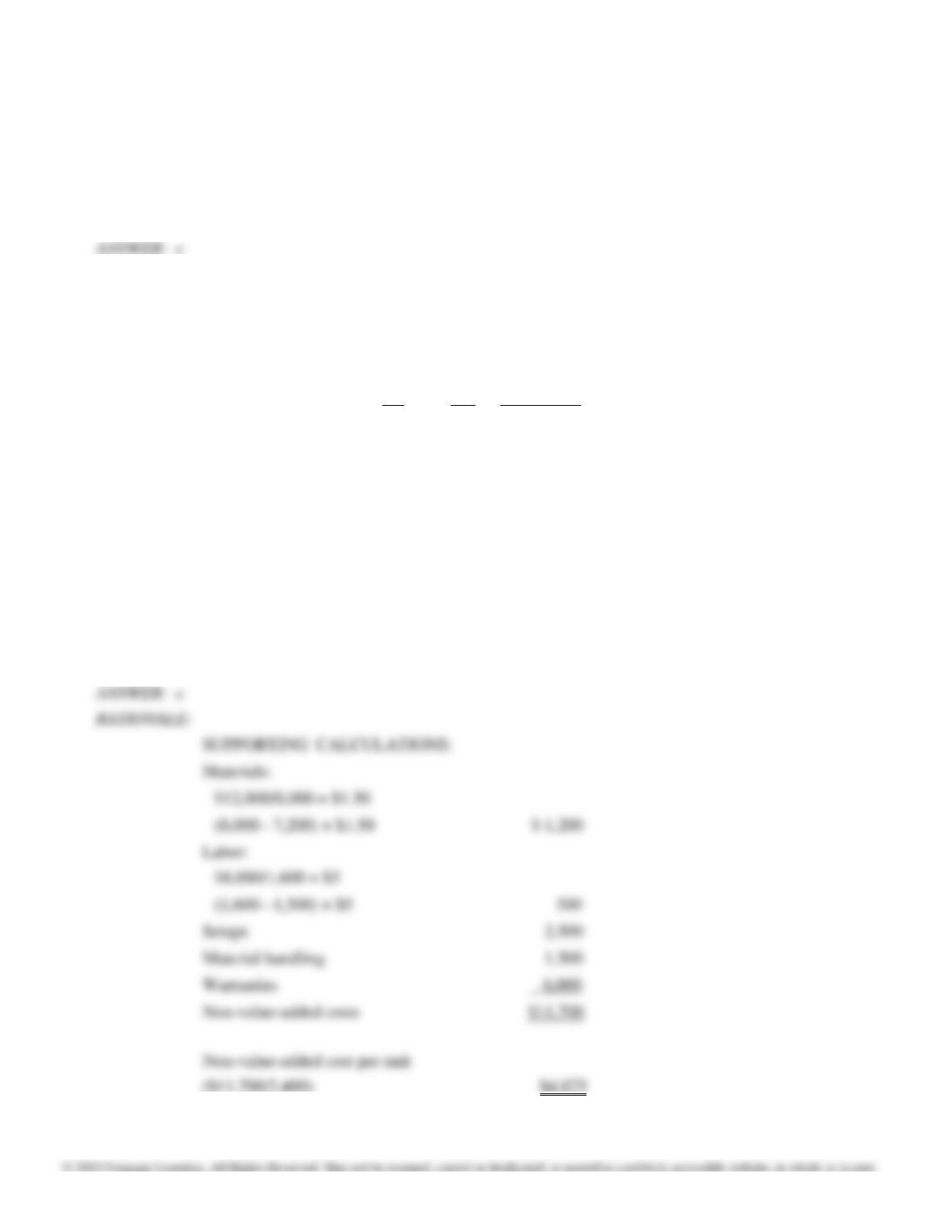
97. Mattress Company sells one of its products for $35 each. Sales volume averages 2,400 units per year. Recently, its
main competitor reduced the price of its product to $30. Mattress Company expects sales to drop dramatically
unless it matches the competitor’s price. In addition, the current profit per unit must be maintained. Information
about the product (for production of 2,400) is as follows:
SQ
AQ
Actual Cost
Materials (pounds)
7,200
8,000
$12,000
Labor (hours)
1,500
1,600
8,000
Setups (hours)
0
1,600
2,500
Material handling (moves)
0
500
1,500
Warranties (number repaired)
0
300
6,000
The non-value-added cost per unit is
a. $4.525.
b. $4.190.
c. $4.875.
d. $3.475.