35) In the EOQ model, for a given level of demand, annual holding cost is larger as the order quantity is
________.
36) A(n) ________ model gives satisfactory answers even with substantial variations in its parameters.
37) In the production order quantity model, the fraction of inventory that is used immediately and not
stored is represented by the ratio of ________.
38) ________ is extra stock that is carried to serve as a buffer.
39) In a quantity discount problem, if the savings in annual product cost is smaller than the increase in
the sum of annual setup cost and annual holding cost, the discount should be ________.
40) Compare the assumptions of the production order quantity model to those of the basic EOQ model.
41) In some inventory models, the optimal behavior occurs where ordering costs and carrying costs are
equal to one another. Provide an example of a model where this rule does not hold; explain how the
model’s results are optimal anyway.
42) What are the assumptions of the EOQ model?
43) Consider two inventory problems with identical demand, holding cost, and setup cost. In one, goods
arrive instantly, but in the other goods arrive at a measurable rate. Which of these problems will have the
larger optimal order quantity? Why?
44) How sensitive is the EOQ to variations in demand or costs?
45) What is a reorder point?
46) Lead time for one of Montegut Manufacturing’s fastest moving products is 4 days. Demand during
this period averages 100 units per day. What would be an appropriate re-order point?
47) Montegut Manufacturing produces a product for which the annual demand is 10,000 units.
Production averages 100 units per day, while demand is 40 units per day. Holding costs are $2.00 per unit
per year, and setup cost is $200.00. (a) If the firm wishes to produce this product in economic batches,
what size batch should be used? (b) What is the maximum inventory level? (c) How many order cycles
are there per year? (d) What are the total annual holding and setup costs?
48) The annual demand, ordering cost, and the annual inventory carrying cost rate for a certain item are
D = 600 units, S = $20/order and I = 30% of item price. Price is established by the following quantity
discount schedule. What should the order quantity be in order to minimize the total annual cost?
Quantity
1 to 49
50 to 249
250 and up
Price
$5.00 per unit
$4.50 per unit
$4.10 per unit
Range 1
Range 2
Range 3
Minimum quantity
1
Unit Price, P
$5.00
$4.50
$4.10
Q* (Square root formula)
126.49
133.33
139.69
Order Quantity
Discarded
133.33
Holding cost
$90.00
Setup cost
$90.00
$48.00
Unit costs
$2,700.00
$2,460.00
$2,880.00
$2,661.75
49) Central University uses $123,000 of a particular toner cartridge for laser printers in the student
computer labs each year. The purchasing director of the university estimates the ordering cost at $45 and
thinks that the university can hold this type of inventory at an annual storage cost of 22% of the purchase
price. How many months’ supply should the purchasing director order at one time to minimize the total
annual cost of purchasing and carrying?
50) The soft goods department of a large department store sells 175 units per month of a certain large
bath towel. The unit cost of a towel to the store is $2.50 and the cost of placing an order has been
estimated to be $12.00. The store uses an inventory carrying charge of I = 27% per year. Determine (a) the
optimal order quantity, (b) the order frequency, and (c) the annual holding and setup cost. If, through
automation of the purchasing process, the ordering cost can be cut to $4.00, what will be (d) the new
economic order quantity, (e) the order frequency, and (f) annual holding and setup costs? Explain these
results.
51) A firm that makes electronic circuits has been ordering a certain raw material 250 ounces at a time.
The firm estimates that carrying cost is I = 30% per year, and that ordering cost is about $20 per order. The
current price of the ingredient is $200 per ounce. The assumptions of the basic EOQ model are thought to
apply. For what value of annual demand is their action optimal?
52) A printing company estimates that it will require 1,000 reams of a certain type of paper in a given
period. The cost of carrying one unit in inventory for that period is 50 cents. The company buys the paper
from a wholesaler in the same town, sending its own truck to pick up the orders at a fixed cost of $20.00
per trip. Treating this cost as the order cost, (a) what is the optimum number of reams to buy at one time?
(b) How many times should lots of this size be bought during this period? (c) What is the minimum cost
(holding and setup) of maintaining inventory on this item for the period? (d) Of this total cost, how much
is carrying cost and how much is ordering cost?
53) The Rushton Trash Company stocks, among many other products, a certain container, each of which
occupies four square feet of warehouse space. The warehouse space currently available for storing this
product is limited to 600 square feet. Demand for the product is 15,000 units per year. Holding costs are
$4 per container per year. Ordering costs are $5 per order.
(a) What is the cost-minimizing order quantity decision for Rushton?
(b) What is the total inventory-related cost of this decision?
(c) What is the total inventory-related cost of managing the inventory of this product, when the limited
amount of warehouse space is taken into account?
(d) What would the firm be willing to pay for additional warehouse space?
54) Given the following data: D=65,000 units per year, S = $120 per setup, P = $5 per unit, and I = 25% per
year, (a) calculate the EOQ, and (b) calculate annual costs of holding and setup following EOQ behavior.
55) A toy manufacturer makes its own wind-up motors, which are then put into its toys. While the toy
manufacturing process is continuous, the motors are intermittent flow. Data on the manufacture of the
motors appears below.
Annual demand (D) = 50,000 units Daily subassembly production rate = 1,000
Setup cost (S) = $85 per batch Daily subassembly usage rate = 200
Carrying cost = $.20 per unit per year
(a) To minimize cost, how large should each batch of subassemblies be?
(b) Approximately how many days are required to produce a batch?
(c) How long is a complete cycle?
(d) What is the average inventory for this problem?
(e) What is the total annual inventory cost (holding plus setup) of the optimal behavior in this problem?
56) Louisiana Specialty Foods can produce its famous meat pies at a rate of 1650 cases of 48 pies each per
day. The firm distributes the pies to regional stores and restaurants at a steady rate of 250 cases per day.
The cost of setup, cleanup, idle time in transition from other products to pies, etc., is $320. Annual
holding costs are $11.50 per case. Assume 250 days per year.
(a) Determine the optimum production run (batch size).
(b) Determine the number of production runs per year.
(c) Determine maximum inventory.
(d) Determine total inventory-related (setup and carrying) costs per year (rounded to the nearest dollar).
57) Holstein Computing manufactures an inexpensive audio card (Audio Max) for assembly into several
models of its microcomputers. The annual demand for this part is 100,000 units. The annual inventory
carrying cost is $5 per unit and the cost of preparing an order and making production setup for the order
is $750. The company operates 250 days per year. The machine used to manufacture this part has a
production rate of 2000 units per day.
(a) Calculate the optimum lot size.
(b) How many lots are produced in a year?
(c) What is the average inventory for Audio Max?
(d) What is the annual holding and setup cost for Audio Max?
58) Clement Bait and Tackle has been buying a chemical water conditioner for its bait (to help keep its
baitfish alive) in an optimal fashion using EOQ analysis. The supplier has now offered Clement a
discount of $0.50 off all units if the firm will make its purchases monthly or $1.00 off if the firm will make
its purchases quarterly. Current data for the problem are: D = 720 units per year; S = $6.00, I = 20% per
year; P = $25.
(a) What is the EOQ at the current behavior?
(b) What is the annual total cost, including product cost, of continuing their current behavior?
(c) What are the annual total costs, if they accept either of the proposed discounts?
(d) At the cheapest of the total costs, are carrying costs equal to ordering costs? Explain.
59) The annual demand for an item is 10,000 units. The cost to process an order is $75 and the annual
inventory holding cost is 20% of item cost. (a) What is the optimal order quantity, given the following
price breaks for purchasing the item? (b) What price should the firm pay per unit? (c) What is the total
annual cost at the optimal behavior?
Quantity
Price
1-9
$2.95 per unit
10 – 999
$2.50 per unit
1,000 – 4,999
$2.30 per unit
5,000 or more
$1.85 per unit
Range 3
Range 4
Q* (Square root formula)
Order Quantity
Holding cost
Setup cost
Unit costs
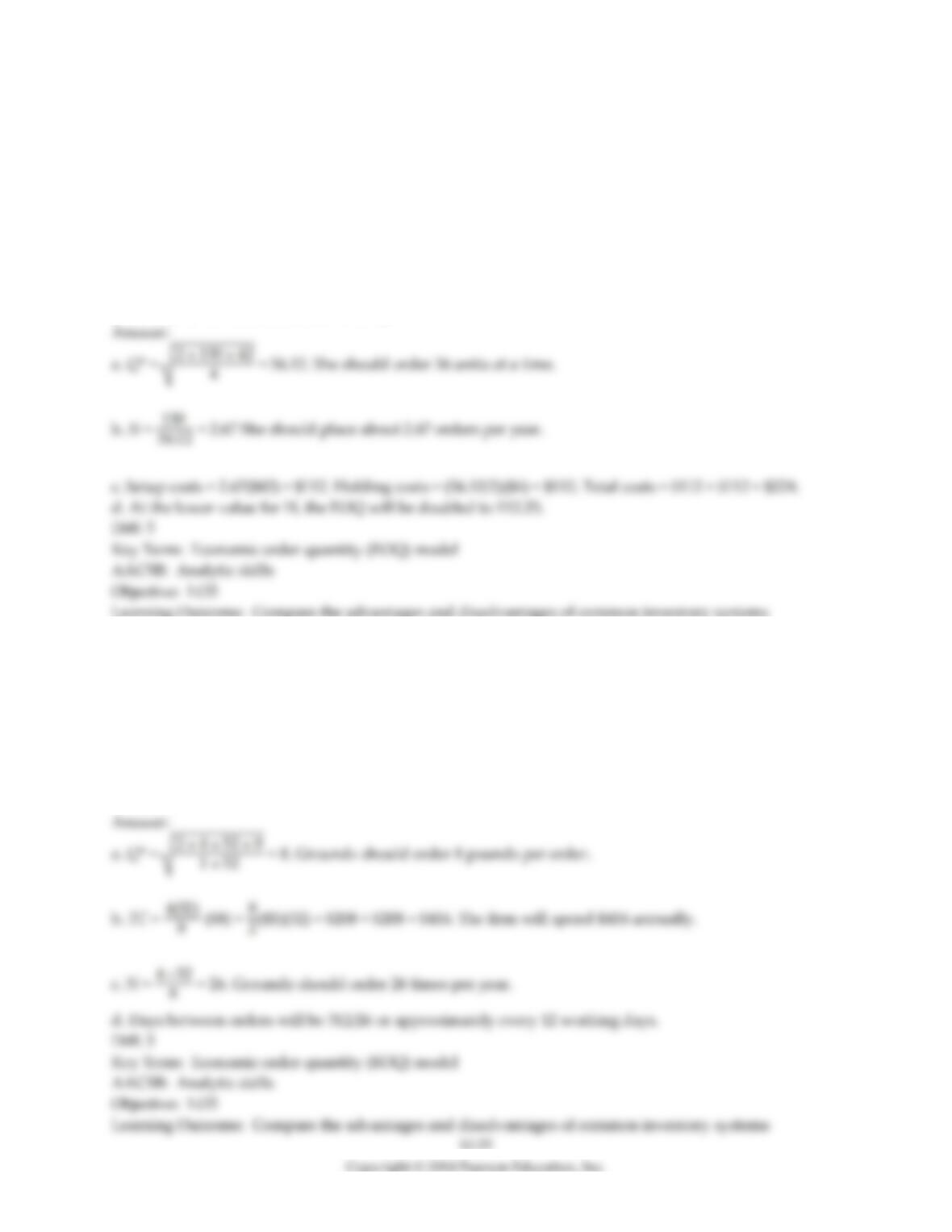
60) A local artisan uses supplies purchased from an overseas supplier. The owner believes the
assumptions of the EOQ model are met reasonably well. Minimization of inventory costs is her objective.
Relevant data, from the files of the craft firm, are annual demand (D) =150 units, ordering cost (S) = $42
per order, and holding cost (H) = $4 per unit per year
a. How many should she order at one time?
b. How many times per year will she replenish her inventory of this material?
c. What will be the total annual inventory (holding and setup) costs associated with this material
(rounded to the nearest dollar)?
d. If she discovered that the carrying cost had been overstated, and was in reality only $1 per unit per
year, what is the corrected value of EOQ?
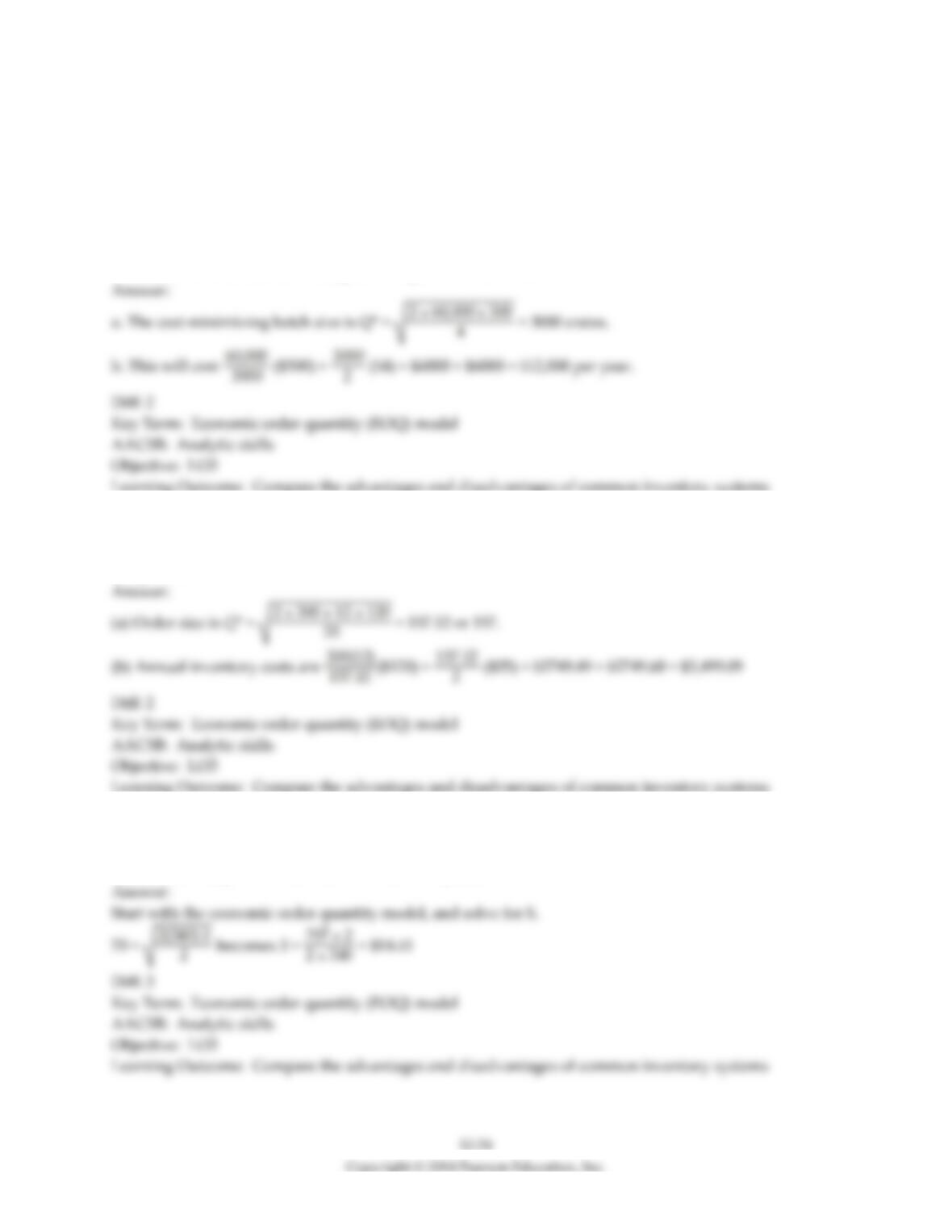
61) Groundz Coffee Shop uses 4 pounds of a specialty tea weekly; each pound costs $16. Carrying costs
are $1 per pound per week because space is very scarce. It costs the firm $8 to prepare an order. Assume
the basic EOQ model with no shortages applies. Assume 52 weeks per year, closed on Mondays.
a. How many pounds should Groundz order at a time?
b. What is total annual cost (excluding item cost) of managing this item on a cost-minimizing basis?
c. In pursuing lowest annual total cost, how many orders should Groundz place annually?
d. How many days will there be between orders (assume 312 operating days) if Groundz practices EOQ
behavior?
62) Pointe au Chien Containers, Inc., manufactures in batches, and the manufactured items are placed in
stock. Specifically, the firm is questioning how best to manage a specific wooden crate for shipping live
seafood, which is sold primarily by the mail/phone order marketing division of the firm. The firm has
estimated that carrying cost is $4 per unit per year. In addition, annual demand = 60,000 units, and setup
cost is $300. The firm currently plans to satisfy all customer demand from stock on hand. Demand is
known and constant. The production rate is nearly instantaneous.
a. What is the cost minimizing size of the manufacturing batch?
b. What is the total annual holding and setup cost of this solution?
63) Holding costs are $35 per unit per year, the ordering cost is $120 per order, and sales are relatively
constant at 300 per month. (a) What is the optimal order quantity? (b) What are the annual holding and
setup costs?
64) An organization has had a policy of ordering 70 units at a time. Their annual demand is 340 units, and
the item has an annual carrying cost of $2. The assumptions of the EOQ are thought to apply. For what
value of ordering cost would this order size be optimal?
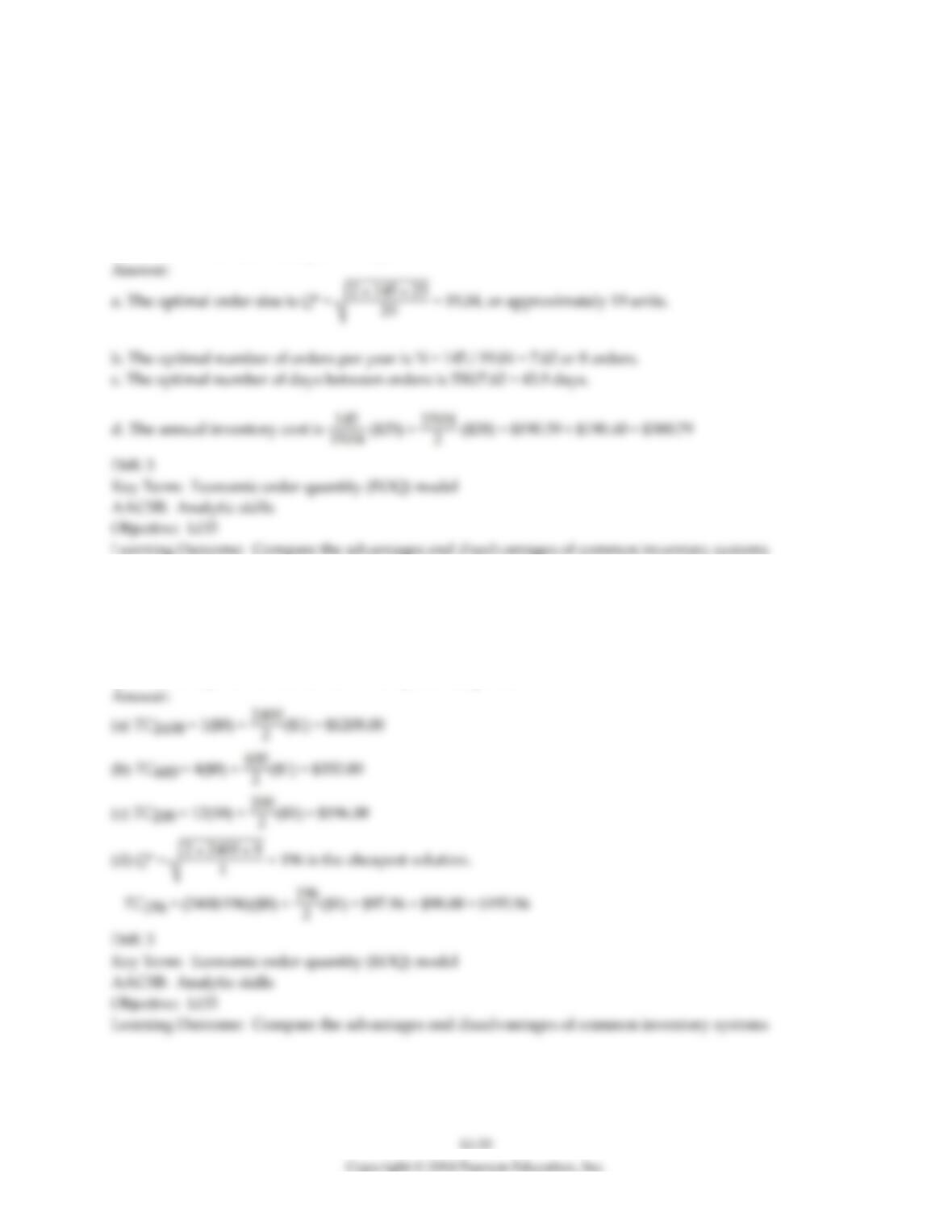
65) Joe’s Camera shop has a favorite model that has annual sales of 145. The cost to place an order to
replenish inventory is $25 per order, and annual inventory holding cost per unit is $20. Assume the store
is open 350 days per year.
a. What is the optimal order size?
b. What is the optimal number of orders per year?
c. What is the optimal number of days between orders?
d. What is the annual holding and setup cost?
66) The inventory management costs for a certain product are S=$8 to order, and H=$1 to hold for a year.
Annual demand is 2400 units. Consider the following ordering plans: (a) order all 2400 at one time, (b)
order 600 once each quarter, and (c) order 200 once each month. Calculate the annual holding and setup
costs associated with each plan. (d) Is there another plan, cheaper than any of these? Calculate this order
quantity along with its total annual holding and setup costs.
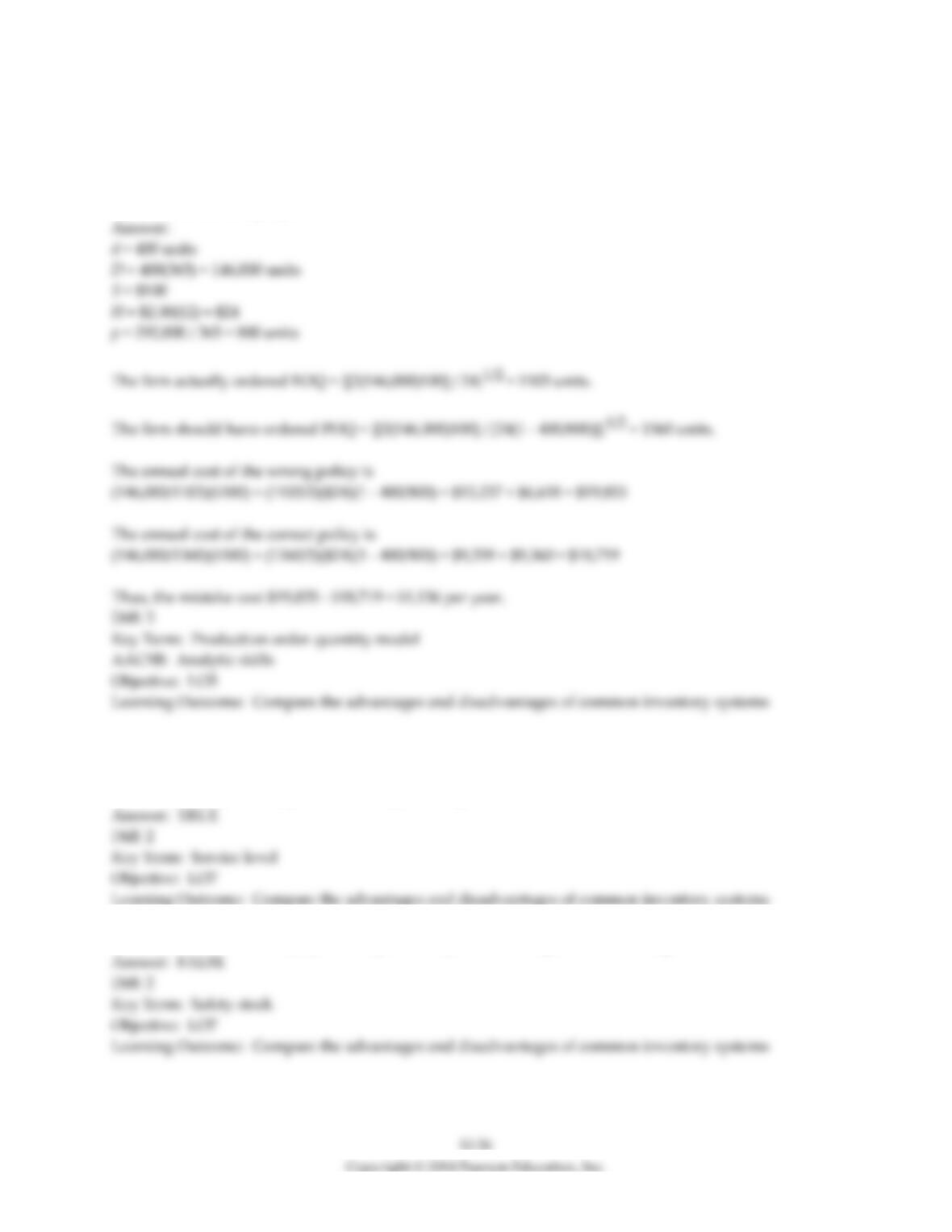
67) Consider a product with a daily demand of 400 units, a setup cost per production run of $100, a
monthly holding cost per unit of $2.00, and an annual production rate of 292,000 units. The firm operates
and experiences demand 365 days per year. Suppose that management mistakenly used the basic EOQ
model to calculate the batch size instead of using the POQ model. How much money per year has that
mistake cost the company?
Section 5 Probabilistic Models and Safety Stock
1) Service level is the complement of the probability of a stockout.
2) Safety stock in inventory systems depends only on the average demand during the lead time.