Chapter 12—Capital Structure: Theory and Taxes
MULTIPLE CHOICE
1. PureMeds is a highly profitable pharmaceutical company that places great importance on funding
research and development projects. According to finance research, the expected capital structure for
PureMeds:
a.
would show a high market-value leverage level
b.
would show a high book-value leverage level
c.
would contain a high long-term debt level
d.
would contain a high total debt level
e.
would show a low financial leverage level
2. If the bankruptcy laws of a country change such that debtors are afforded increased protection, then
over the long-term, market-value of financial leverage:
a.
should tend to increase
b.
should tend to decrease
c.
will remain unchanged
d.
will only be affected in countries with heavy reliance on capital markets versus banks for
corporate financing
e.
will only be affected in developing countries
3. Given an increase in personal tax rates on both dividends and interest income, companies should:
a.
decrease retained earnings and increase leverage levels over time
b.
increase retained earnings and decrease leverage levels over time
c.
decrease retained earnings and decrease debt financing over time
d.
increase dividend payments to investors and increase leverage levels over time
e.
cannot say without knowing the values of the tax rates
4. Devard, CFO of Buymore, Inc., must create a financing plan for a proposed acquisition offer.
Buymore’s existing shareholders would likely consider the purchase to be “good news” if:
a.
Buymore issued new shares to finance the acquisition
b.
current Buymore shares were accepted as payment for the acquisition
c.
Buymore employed a debt-financed cash tender for the acquisition
d.
Buymore offered to exchange debt holdings for equity holdings in the new corporation
e.
the entire remaining balance of cash reserves were used for the acquisition
5. In a frictionless capital market, if the market value of a levered firm’s outstanding securities differs
from the market value of an otherwise identical all-equity firm’s outstanding securities, M & M
demonstrate that:
a.
investors are willing to pay a premium price for shares of levered firms
b.
investors will require “too high” an expected return on levered equity
c.
investors are maximizing personal profits

d.
the market value of levered equity is given by capitalizing operating income at a rate equal
to the firm’s WACC
e.
an arbitrage opportunity exists
6. Two firms, Top-Dog and Under-Dog, generate $s in net operating income each year. Top-Dog has a
capital structure consisting of 100% equity, whereas Under-Dog uses 50% debt and 50% equity.
Under-Dog must pay $d in interest on its debt each year. If the tax on corporate profits is r%, what is
the value of the tax shield for Under-Dog each period, employing the M&M “modified” model?
a.
$w1
b.
$w2
c.
$ans
d.
$w3
e.
cannot be computed with the information provided
7. Consider the following hypothetical situation: In a given year, the corporate tax rate is r1% and
personal tax rates on interest income and income from stock are r2% and r3%, respectively (assume
the same tax rate applies to dividends and capital gains). If BestCo uses 100% equity to finance its
operations, no dividends are paid and all profits are plowed back as retained earnings. Alternatively,
BestCo can finance its operations with some proportion of debt. Suppose BestCo earns a net operating
profit of $d. Which of the following statements is true?
a.
Shareholders are worse off if the company finances part of its operations with debt.
b.
The introduction of a r1% tax on corporate profits causes an immediate increase in the
market value of BestCo if it is all-equity financed.
c.
The tax code offers an incentive to increase firm value by increasing equity issues.
d.
The tax code offers firms an incentive to use leverage.
e.
The tax code offers individuals an opportunity to capitalize on dividend income.
8. Firms in the __________ industry(ies) use a great deal of debt.
a.
computer software
b.
computer software and pharmaceutical
c.
aerospace
d.
aerospace and retailing
e.
utility and auto manufacturing
9. __________ firms use almost no debt in their capital structure.
a.
Aerospace
b.
High-tech
c.
Aerospace and pharmaceutical
d.
Aerospace and retailing
e.
Utility
10. If a firm has $d million in debt, $eq million in equity, a tax rate of r1%, and pays r2% interest on debt,
what is the firm’s PV of the interest tax shields?
a.
$w2
b.
$w3
c.
$w1 million
d.
$pv million
e.
$w4
11. What do you need to know to calculate the gains from using leverage for individual companies?
a.
tax rate on corporate profits
b.
market value of a firm’s outstanding debt
c.
personal tax rate on income from debt
d.
personal tax rate on income from stock
e.
all of the above
12. In attempting to develop a model, M & M showed that capital structure could not affect the firm value
in a world with __________.
a.
perfect markets
b.
target leverage zones
c.
homemade leverage
d.
arbitrage
e.
none of the above
13. When M & M assume that capital markets are frictionless it means __________.
a.
no taxes
b.
no transaction costs
c.
investors can borrow and lend at the same rate that corporations can
d.
all of the above
e.
none of the above
14. M & M Proposition II says that the WACC is not influenced by changing the mix of debt and equity
because changes in leverage cause an offsetting change in the __________.
a.
WACC

b.
required return on equity
c.
target leverage zones
d.
secured debt hypothesis
e.
none of the above
15. The logic of the Modigliani and Miller’s proposition 1 crucially depends on investors having
__________.
a.
risk neutral preferences.
b.
mean-variance preferences.
c.
Neither of these preference types are essential.
16. Using M&M propositions with corporate taxes and the following information, what is the value of the
levered firm? NOI = $noi; Corporate Taxes = r1%; the firm borrows $b at a rate of r2%.
a.
$ans
c.
$w2
b.
$w1
d.
$w3
17. The relationship of corporate income taxes, personal income taxes on equity investments, and personal
income taxes on interest income should have a predictable change in debt ratios; which of the
following predicts increasing debt ratios?
a.
Higher corporate income taxes, higher personal taxes on equity investments, lower
personal taxes on interest income
b.
Lower corporate income taxes, higher personal taxes on equity investments, lower
personal taxes on interest income
c.
Higher corporate income taxes, lower personal taxes on equity investments, lower
personal taxes on interest income
d.
Higher corporate income taxes, higher personal taxes on equity investments, higher
personal taxes on interest income
18. Financial leverage
a.
Increases expect EPS and Increases EPS volatility
b.
Increases expect EPS and Decreases EPS volatility
c.
Decreases expect EPS and Increases EPS volatility
d.
Decreases expect EPS and Decreases EPS volatility
19. According to M&M’s Proposition II the expected return on a levered firm’s equity
a.
Falls to the debt-to-equity ratio
b.
The levered firm’s equity expect return does not change with the debt–to-equity level
Rises with the debt-to-equity ratio
c.
Rises with the debt-to-equity ratio
d.
Proposition II does not address the leveraged firm’s expected return on equity
20. Using M&M propositions with corporate taxes and the following information, what is the value of the
levered firm? NOI = $noi; Corporate Taxes = r1%; the firm borrows $b at a rate of r2%.
a.
$ans
b.
$w1
c.
$w2
d.
$w3
MATCHING
Match the following relationships:
a.
M&M theory
b.
managerial opportunism theory
c.
trade-off theory
1. capital structure is the result of market timing
2. firms balance costs and benefits of debt
3. firm value does not depend on capital structure
Match the following statements:
a.
increases the tax gain from leverage
b.
decreases the tax gain from leverage
c.
Proposition I
d.
Proposition II
e.
Pecking order model
f.
Homemade leverage
4. a reduction in the corporate tax rate
5. higher debt increases the cost of equity
6. a reduction in personal taxes on interest income
7. explains why firms want financial slack
8. says capital structure cannot affect firm value
9. investors can unwind firms’ capital structures
SHORT ANSWER
1. In the late 1990s Ford Motor company held a large cash balance that was often called a war chest. In
terms of the pecking order hypothesis, discuss why Ford might have been willing to maintain large
cash balances over this period of time. At the end of this period, Ford decided that it no longer had a
need for these excess funds for investment opportunities and it made a large payout to existing
shareholders. How does this corporate behavior fit with the pecking order hypothesis?
2. Consider two firms in the same industry that operate in frictionless markets. Both firms, DebtHungry
and Ner-aBorrower, have identical net operating income of $oi per year. The riskiness of each
company’s assets suggests a fair weighted average cost of capital of r1 percent.
a.
What is the value of each company?
b.
If DebtHungry has borrowed $b at a required rate of return of r2 percent, what is the fair
required rate of return on the firm’s equity?
c.
Given that the expected rate of return on an investment at the corporate level in
Ner-aBorrower is r1 percent, explain how you create an investment identical to an equity
investment in Ner-aBorrower with only an investment in DebtHungry’s equity and riskless
debt (that earns r2 percent).
d.
Suppose the actual market value of Ner-aBorrower is $s million. Explain how you can exploit
this mispricing via arbitrage.
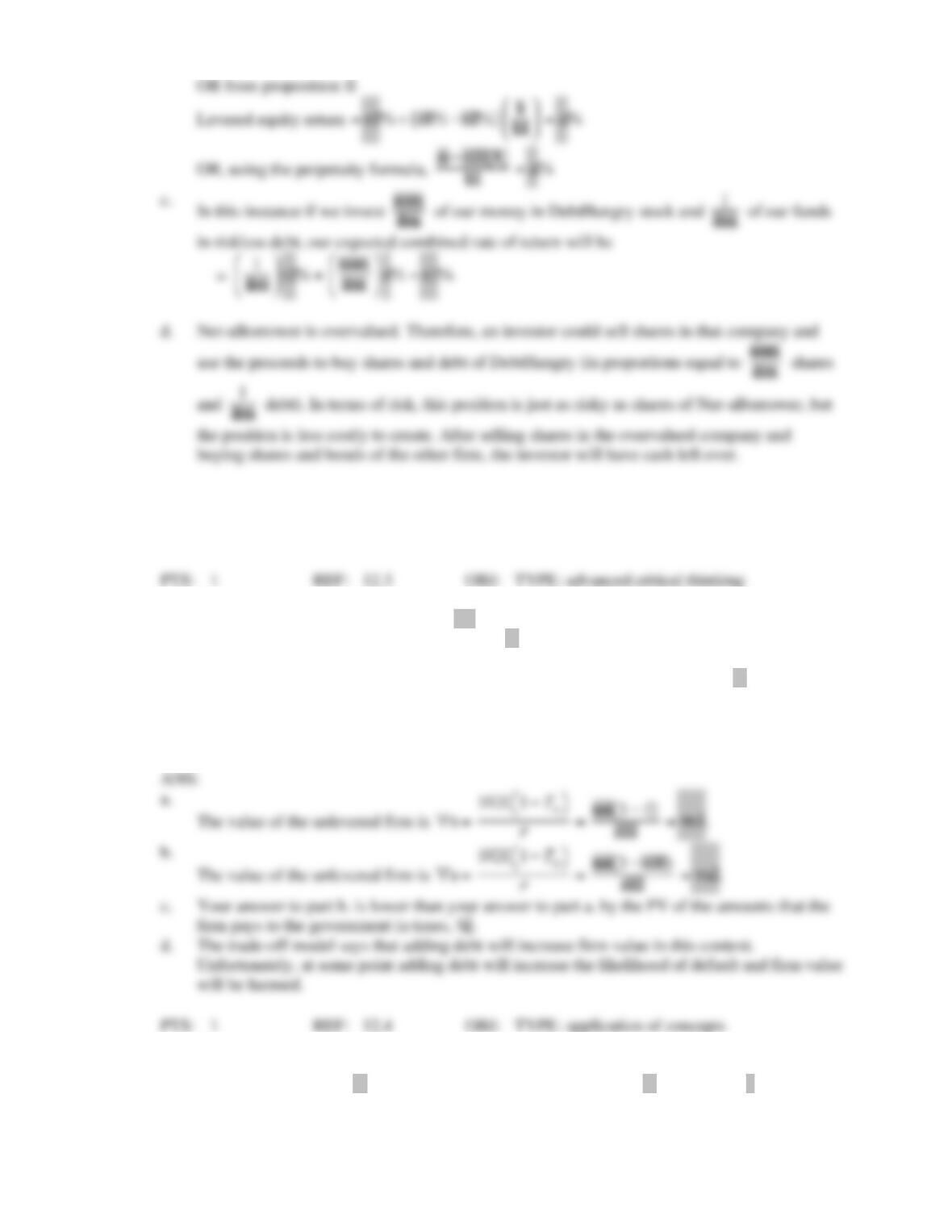
b.
The rate of return on levered equity must be such that the total combined rate of return is still
therefore X% = x%
3. Couglin Inc. has net operating income of $noi per year. Couglin uses no debt in its capital structure
and the required rate of return to equity holders is r1 percent.
a.
Calculate the value of the unlevered firm if the firm has a marginal tax rate of 0%.
b.
Calculate the value of the unlevered firm if the firm has a marginal tax rate of r2%.
c.
Interpret the difference in your findings to parts a. and b.
d.
If your answer to part a. is less than your answer to part b, can we increase firm value by
taking on debt? If so, will these benefits always continue as we add more and more debt?
Your answer to part b. is lower than your answer to part a. by the PV of the amounts that the
firm pays to the government in taxes, $c.
Unfortunately, at some point adding debt will increase the likelihood of default and firm value
will be harmed.
4. Kylie Surfboards Ltd. runs a successful enterprise on the Northeastern coast of Australia. Kylie
Surfboards has a tax rate of r1 percent and a before tax cost of debt of r2 percent on $d of debt.
a.
What is Kylie Surfboard’s PV of interest tax shields?
OR from proposition II
in riskless debt, our expected combined rate of return will be

b.
Would your answer change if you expected the company to be unwound in ten years when
Kylie retires?
5. Your firm, FloThru, has a net operating profit of $op, or $act after corporate taxes. FloThru’s tax rate is
r1 percent and the personal tax rates on interest and income from stock are r2 percent and r3 percent,
respectively.
a.
If FloThru paid the entire $act in after-tax income as a dividend, what is the after-tax cash
flow to the shareholders?
b.
If operations were financed entirely with debt (so that all of the net operating income escaped
corporate taxes), how much cash flow would bondholders receive after paying the required
personal tax?
c.
Considering only taxation issues, should the firm finance its operations mostly through debt
or mostly through equity given the information above?
d.
Suppose that in part a. above the $act in after corporate tax income was retained by the firm.
How would that affect your answer to part c.?
After paying personal tax at a r3% rate, shareholders would receive k3 $act = $a.
b.
Bondholders would receive $op(1 – r20) = $b after personal taxes.
From a taxation viewpoint, the firm can distribute $c more to investors when debt is used.
gains and lets their investment accumulate the effective annual tax rate is reduced. This may
substantively affect the answer to part c. as equity is may now be more attractive.
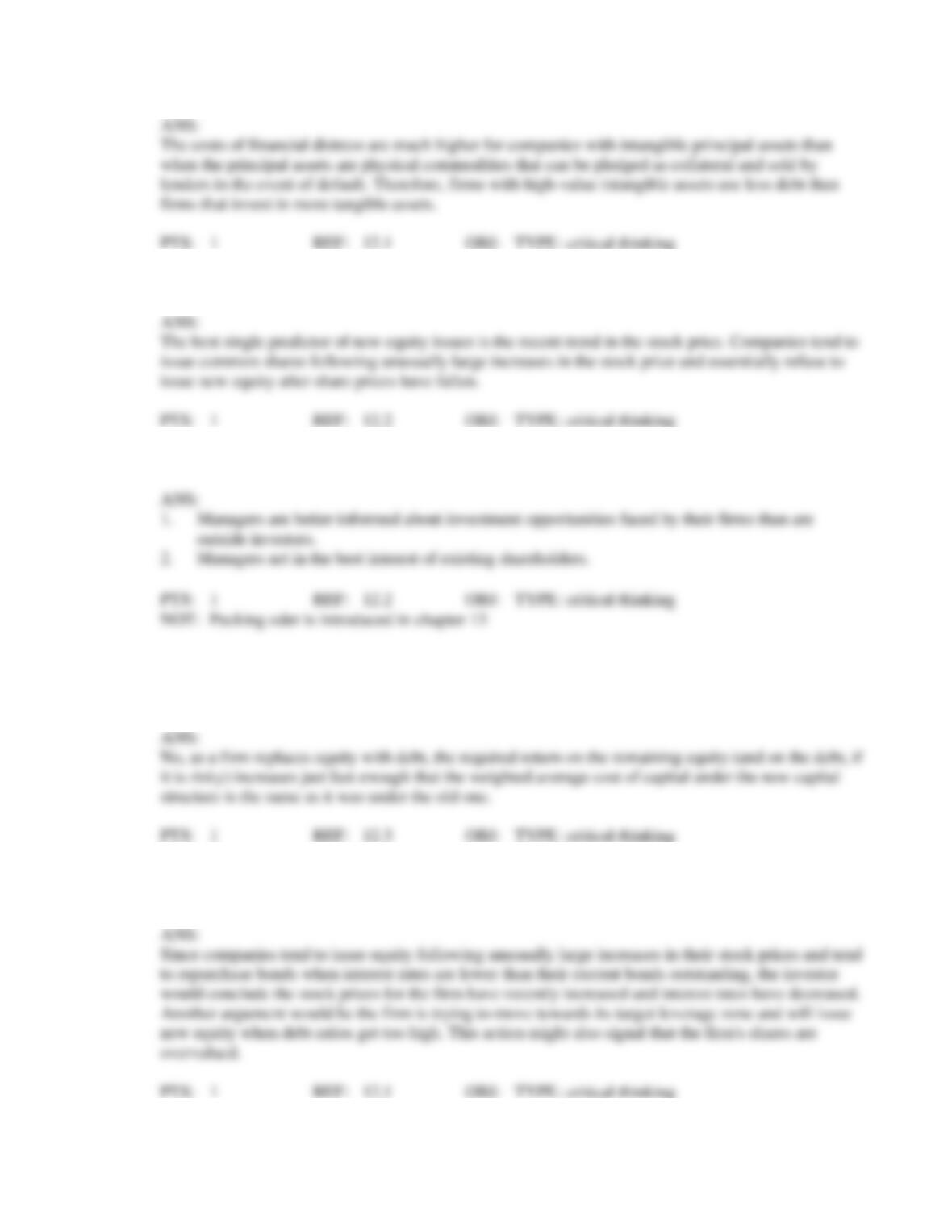
6. The equation , shows the gains from leverage. Discuss how the
traditional M&M findings can be obtained as special cases by using different tax rate assumptions.

7. Consider a firm with $d in total debt, a corporate tax rate of r1 percent, and a personal tax rate on
interest income of r2 percent. According to the gains from leverage equation
, at what personal tax rate on income from stock should the firm be
indifferent to using more or less borrowing? If the firm’s total borrowings were twice as large, how
does you answer change?
8. Within industries, what is the relationship between profitability and leverage? How does this line up
with the trade-off model?
9. Why do firms with high-value intangible assets use less debt than firms that invest in more tangible
assets?
10. What is the best single predictor of new equity issues?
11. What are the assumptions of the pecking order hypothesis?
12. In the M & M world without corporate and personal taxes, will replacing a security that has a high
required rate of return (equity) with one that requires a lower return (debt) lower the average cost of
capital?
13. What do you conclude as an investor if a firm sells stock and uses the proceeds to repurchase some of
its outstanding bonds?
14. What is the relationship between the value of a firm and its capital structure in the M & M world
without taxes?
15. What is the relationship between the value of the firm and its capital structure in the M & M world
with corporate taxes?
16. What is the relationship between the value of the firm and its capital structure in the M & M world
with corporate and personal taxes?
17. What is the asymmetric information assumption?
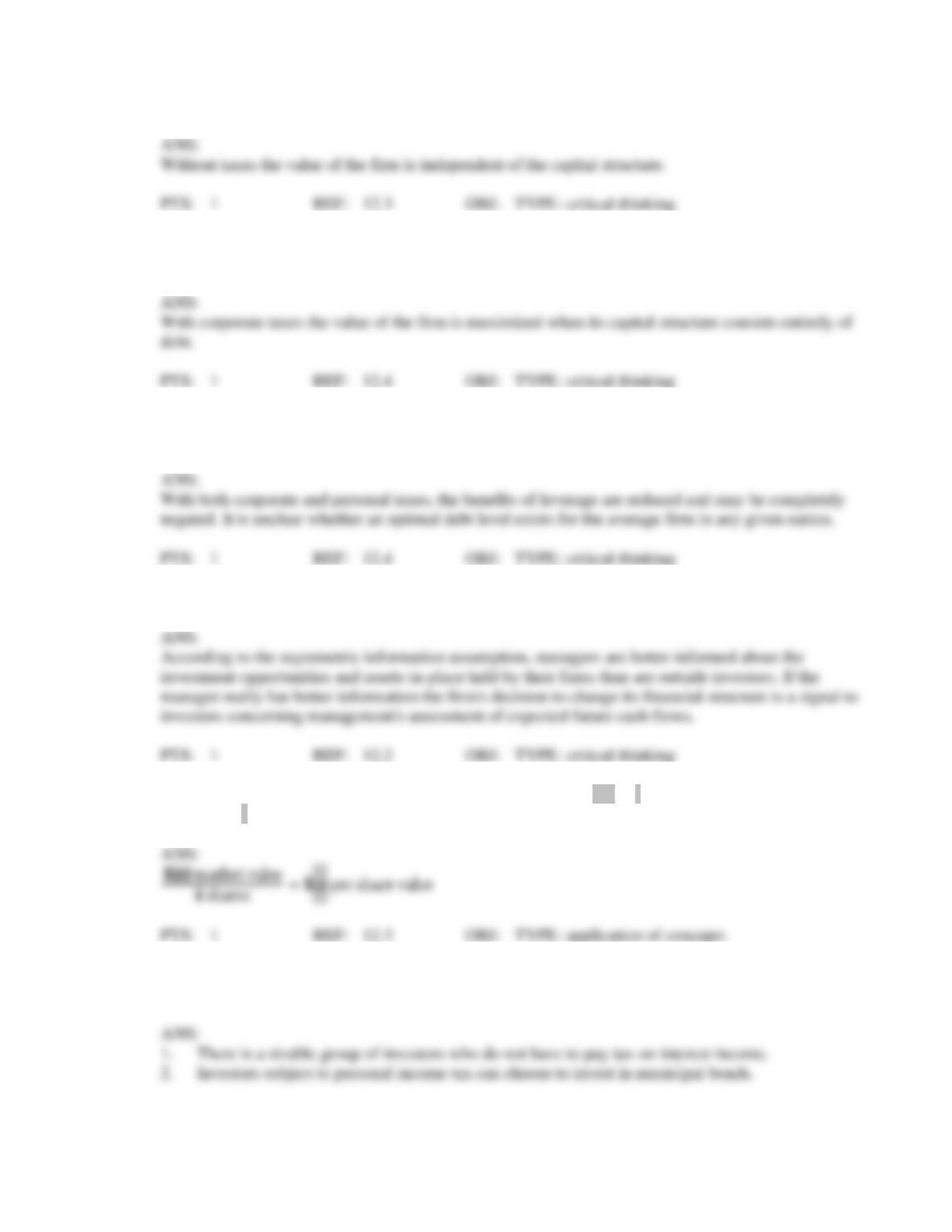
18. If the D corporation has a market valuation of equity equal to $mv, a r% required rate of return on
equity, and s shares of stock, what is the market value of a share of common stock?
19. Upon introduction of corporate and personal income taxes, why are interest rates not bid up
immediately to compensate investors for taxes due?
20. Do companies with large amounts of depreciation, investment tax credits, R & D expenditures, and
other nondebt tax shields employ less debt financing?
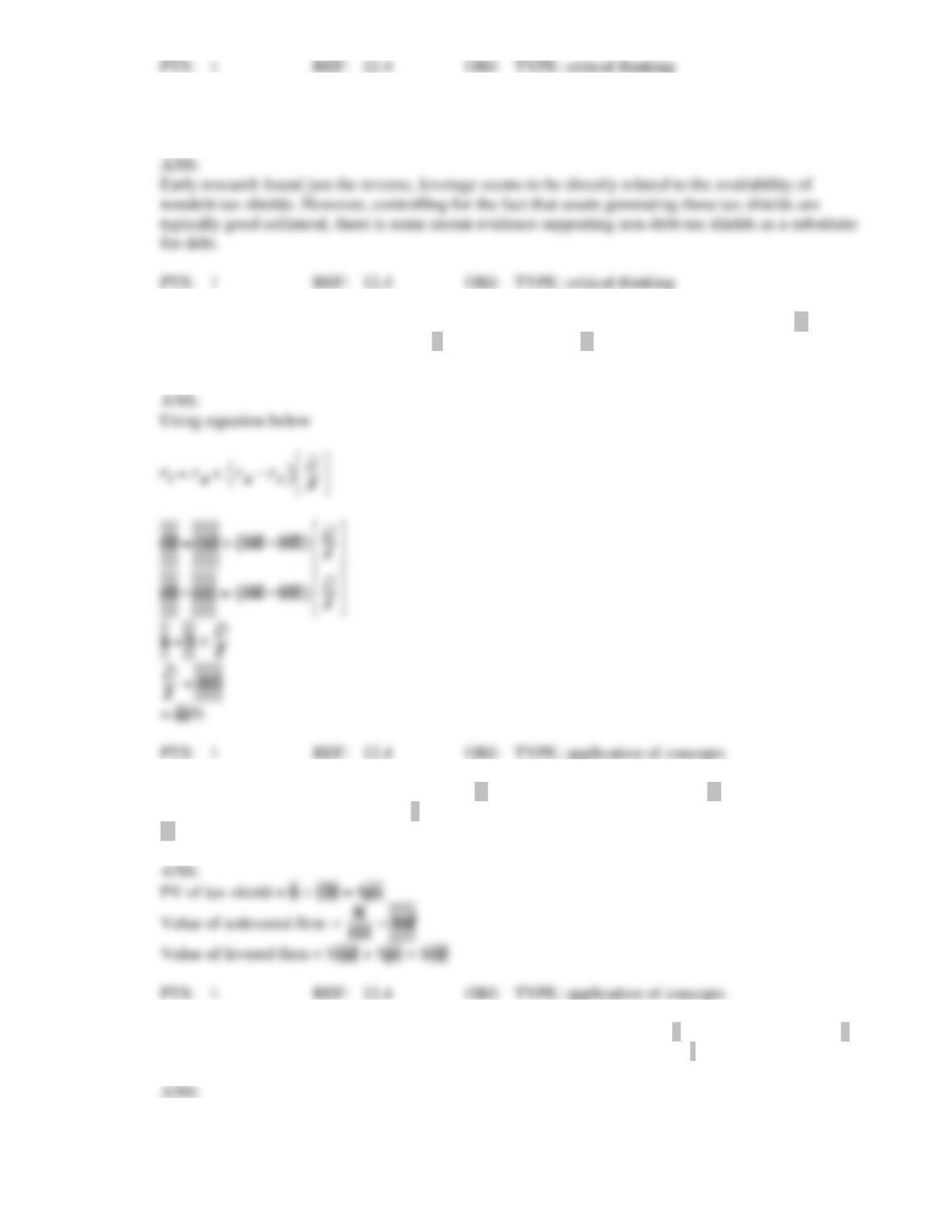
21. If a firm operates in a perfect capital market, has a required return on its outstanding debt of rd%, a
required return on its common stock of rl%, and a WACC of ra%, what is the firm’s debt-to-equity
ratio?
22. An unlevered corporation has net income of $ni and a required rate of return of r1%. What would the
value of this firm be if it borrowed $b to buy back some of its stock? Assume a corporate tax rate of
r2%.
23. If a company with no debt decides to change its capital structure and add $d in debt to repurchase $d in
common stock, how much would the value of the company change if it has a r% corporate tax rate?

24. Assume that capital markets are perfect. If a firm finances its operations with $cs in common stock
with a required return of r1% and $b in bonds with a required return of r2%, what would happen to the
required rate of return on the common stock if the firm issues $ab in additional bonds at r2% to retire
$ab worth of equity?
25. The personal tax rate on debt is r1% and the personal tax on equity is r2%. The corporate tax rate is
r3%. There is a firm, initially with no debt and market value $mv billion. This firm decides to issue
$rfd million of perpetual risk-free debt paying the riskfree interest rate of r4%. The proceeds from the
sale of debt are used to buy back shares at a price appropriately reflecting the gains from leverage.
What is the new value of the remaining equity in the firm?

26. There are two firms, Beautiful Widgets (BW) and Glamorous Thingamajigs (GT). Each has expected
Net Operating Income (NOI) of $noi million each year forever, and the NOI to BW will always be
exactly the same as that to GT, whether it ends up above or below the expected amount. After any
interest payments, all income is paid out to equity holders. BW is all equity (stock). GT has some
equity, along with $gt million (market value and face value) in perpetual debt. GT’s debt pays riskfree
r% interest each year, while BW has expected return on its equity of . There are no
taxes, and the rest of the Modigliani-Miller assumptions hold.
a.
What is the value of BW equity?
b.
What is the value of GT equity?
c.
What is the expected cash flow to GT equity holders each year?
d.
What is the expected return on GT stock
27. There are two firms, Hello and olleH. Each has expected Net Operating Income (NOI) of $noi million
each year forever, and the cash flow to Hello will always be exactly the same as that to olleH, whether
it ends up above or below the expected amount. Hello is all equity (stock). olleH has some equity,
along with $d million in debt (market value and face value). olleH’s debt pays r1% interest at the end
of each year, and olleH has expected return on its equity of r2%. There are no taxes, and the rest of the
Modigliani-Miller assumptions hold.
a.
What is the expected cash flow to olleH equity holders each year?
b.
What is the value of olleH equity?
c.
What is the value of Hello equity?
d.
What is the expected return on Hello stock?
e.
Your friend, whom you admire greatly, has $f of olleH stock. You would like to put
your spare cash of $f toward an investment with exactly the same risk and expected
return. However, you don’t wish to be a copycat, so you will buy some Hello stock
financed partly with your cash and partly with borrowing. How much borrowing do you
do and how much Hello stock do you buy?
ESSAY
1. Clearly state proposition I of Modigliani and Miller. Intuitively, how can one rationalize the apparent
patterns in financial leverage choices and this proposition?
2. Identify and explain the three key empirical patterns of the pecking order hypothesis.
3. How is arbitrage used to prove that the use of leverage has no impact on the firm’s
total market value?
4. Explain Miller’s claim that capital structure shouldn’t matter, even in the presence of corporate and
personal taxes.