
CHAPTER 12—INTERNATIONAL TAXATION Key
1. The jurisdictional principle limits U.S. taxation on income to that earned only within the nation’s borders.
2. The source of employee compensation is determined by the country of residence of the employer paying the
compensation.
3. The source of dividend income is determined by the country of residence of the corporation paying the
dividend.
4. Foreign taxes paid by individuals may be used as a current-year itemized deduction, or a tax credit.
5. A U.S. parent corporation that understates the transfer price of goods sold to a profitable foreign branch
increases its foreign tax credit limitation.
6. Generally, a U.S. citizen who has foreign-earned income should elect the earned income exclusion when the
U.S. effective tax rate exceeds the foreign effective tax rate.
7. U.S. citizens employed by the U.S. National Weather Service in the foreign country of Timbuktu qualify as
bona fide residents if they reside in Timbuktu the entire year.

8. Foreign taxes accrued on dividends cannot be claimed as a business deduction or a tax credit by a U.S.
corporation.
9. A U.S. corporation may not claim, as a deduction or a credit, foreign taxes paid by a foreign corporation
unless the U.S. corporation directly owns more than 50 percent of the foreign corporation.
10. Net losses of a foreign subsidiary that is wholly owned by a U.S. corporation are deductible by the U.S.
corporation as of the end of the foreign corporation’s taxable year.
11. A manufacturing corporation can be located in a tax-haven country in order to avoid foreign taxes without
being considered a Controlled Foreign Corporation.
12. Although Congressional intent in creating the Controlled Foreign Corporation (CFC) legislation was to
penalize inactive corporations located in tax-haven countries, active corporations that are not organized
primarily to avoid U.S. taxation are subject to the CFC provisions.
13. To ensure avoidance of U.S. taxation on transfers between subsidiaries of a U.S.-based multinational parent,
holding companies are established in tax-haven countries.
14. It is a uniform, worldwide precept that dealings between units of the same multinational organization must
be based on market values.
15. A U.S. corporation operating in a foreign country may be assessed income taxes on the same income by
both the United States and by the country in which it operates.
16. Exchange gains and losses of a U.S. corporation are taxed as ordinary income or losses, regardless of the
type of transaction involved.
17. U.S. corporations with foreign branches must use the net worth method to determine their exchange gains
and losses.
18. Resident and nonresident aliens are taxed in the same manner on U.S. corporate dividend income, bond
interest, and interest earned on a U.S. bank savings account.
19. Which of the following options can be legally employed by individuals to decrease the double tax burden
from foreign source income?
20. An Irish partnership has $400,000 of net income in the current year. None of the income is from U.S.
sources. F, a U.S. citizen living in Dublin, has a distributive share of $40,000 (e.g., a 10% owner). If F performs
services for the partnership valued at $13,000 and capital is not a material income-producing factor, how much
foreign unearned income does F have?
21. A U.S. resident, visiting West Germany, sells his personal Mercedes Benz to a German citizen. What kind
of income does such a transaction produce for the U.S. resident?

22. X is a U.S. citizen who lives and works in Illinois for K, Inc., a U.S. corporation. Her wages this year are
$19,250. She also received $4,000 in dividends from a Japanese corporation with no U.S. source income. The
Japanese corporation withheld $440, disbursing the rest to X. X is a single non-itemizer with no other income
and no dependents. Her 2012 U.S. Federal income tax is
23. T, a U.S. citizen who has been a resident of France for three years, has the following income in 2012 from
French sources:
Salary
Interest Income
Gross amount
$70,000
$30,000
French income tax (30%)
(21,000)
(9,000)
Net cash received (70%)
The interest income was from a French bank on her savings account. In addition, T’s employer provided her with housing costing $20,000, which was
not subject to French tax. T also has U.S.-source earned income of $48,000. T’s minimum includible gross income subject to U.S. federal income
taxes is
24. T, a U.S. citizen who has been a resident of France for three years, has the following income in 2012 from
French sources:
Salary
Interest Income
Gross amount
$70,000
$30,000
French income tax (30%)
(21,000)
(9,000)
Net cash received (70%)
The interest income was from a French bank on her savings account. In addition, T’s employer provided her with housing costing $20,000, which was
not subject to French tax. T also has U.S.-source earned income of $48,000. T’s foreign tax eligible for the foreign tax credit (before any foreign tax
credit limitations are applied) is
25. P, a single taxpayer, meets the bona fide residence test while employed in New Zealand. During 2012, she
has (1) wages of $52,000, (2) interest income from a local bank of $1,400, (3) interest income from a U.S. bank
of $1,200, (4) dividend income from New Zealand corporate stock of $200, and (5) employer-provided housing
valued at $9,600. Assume all amounts are in U.S. dollars. P has excludable foreign source income of
26. P Corporation is the U.S.-based parent of F Company, a French-based branch. If P Corporation has U.S.
taxable income of $100,000 and F Company has a $20,000 loss, what is P Corporation’s worldwide taxable
income?
27. L, a U.S. citizen, is transferred to Singapore for a three-year assignment. L establishes residency in
Singapore on his day of arrival, April 3, 2012. Due to family illness, L returns to the United States and stays the
entire month of December 2012 and the first 14 days in May 2013; he is transferred back to the United States
June 4, 2013. During this 14-month period, L was in Tokyo on business two days each month (except
December). L recaps his days as follows:
2012
2013
Total
In the United States
31
14
45
In Tokyo
16
10
26
In Singapore
225
131
356
L meets
28. Several tax provisions are liberalized for U.S. citizens working abroad. Which one of the following benefits
is correct?

29. N, Inc., owns 25 percent of a German corporation whose taxable income is $200,000 and that pays German
income taxes at a rate of 20 percent. The German corporation pays a cash dividend of 75 percent of the after-tax
income and Germany has a withholding tax of 10 percent. N, Inc., has grossed-up foreign source income of
30. T, Inc., has $60,000 U.S. source income, $40,000 grossed-up foreign source income, and $16,000 foreign
taxes deemed paid by T. T’s foreign tax credit is
31. A U.S. corporation established a 100 percent owned business in Germany. The U.S. corporation has U.S.
source income in the current year of $300,000. The German business reports the following information for the
current year:
German-source net income
$200,000
German income tax
(80,000)
Net income after taxes
Cash remitted to U.S. owner
$ 30,000
German withholding tax
(3,000)
Cash received by U.S. owner
Assume the business is a branch. The U.S. corporation’s worldwide taxable income {before foreign tax deductions or credits) is

32. A U.S. corporation established a 100 percent owned business in Germany. The U.S. corporation has U.S.
source income in the current year of $300,000. The German business reports the following information for the
current year:
German-source net income
$200,000
German income tax
(80,000)
Net income after taxes
Cash remitted to U.S. owner
$ 30,000
German withholding tax
(3,000)
Cash received by U.S. owner
Assume the business is a branch. The foreign taxes deemed paid by the U.S. corporation {before any limitations are applied) is
33. A U.S. corporation established a 100 percent owned business in Germany. The U.S. corporation has U.S.
source income in the current year of $300,000. The German business reports the following information for the
current year:
German-source net income
$200,000
German income tax
(80,000)
Net income after taxes
Cash remitted to U.S. owner
$ 30,000
German withholding tax
(3,000)
Cash received by U.S. owner
Assume the business is a foreign corporation. The U.S. corporation‘s worldwide taxable income {before foreign tax deductions or credits) is
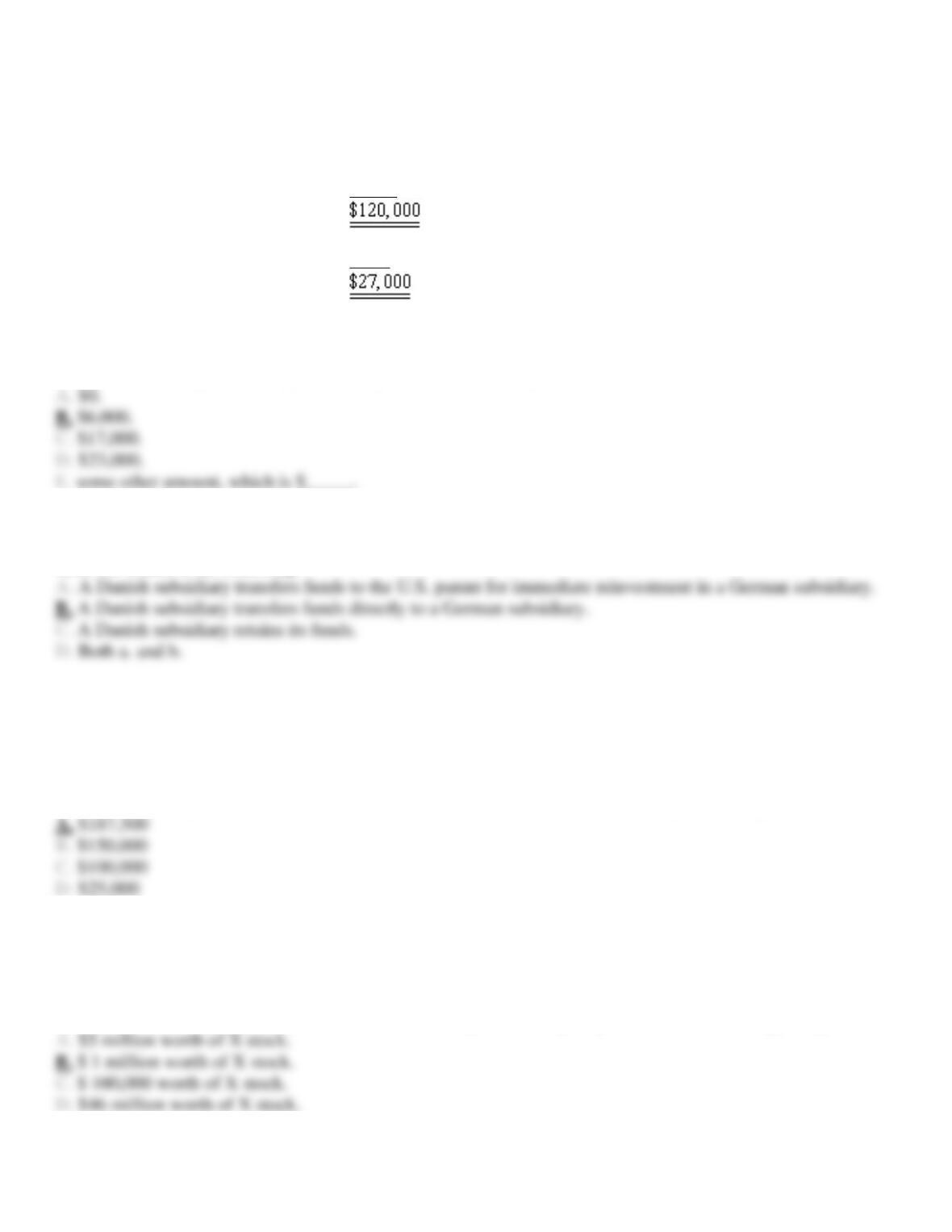
34. A U.S. corporation established a 100 percent owned business in Germany. The U.S. corporation has U.S.
source income in the current year of $300,000. The German business reports the following information for the
current year:
German-source net income
$200,000
German income tax
(80,000)
Net income after taxes
Cash remitted to U.S. owner
$ 30,000
German withholding tax
(3,000)
Cash received by U.S. owner
Assume the business is a foreign corporation. For simplicity, assume the U.S. Federal income tax for the U. S. corporation on its worldwide income
is $119,000. The U.S. corporation’s foreign tax credit carryover for the current year (rounded to the nearest $100) is
35. The “deemed dividend” rule for the taxation of U.S.-based multinational corporations will result in U.S.
taxes for which of the following?
36. A U.S.-based multinational parent corporation owns 75 percent of a Mexican corporation. The Mexican
corporation owns 100 percent of a Panamanian company. Panama is a tax-haven country. The Panamanian
company is a controlled foreign corporation (CFC) and all of its $250,000 income is Subpart F income. If none
of the companies paid dividends, how much dividend income must the U.S.-based parent recognize?
37. Corporation X has one class of outstanding stock valued at $100 million. Six U.S. stockholders own equal
portions of X stock and control 54 percent of the stock. How much additional stock would have to be acquired
by any one of the U.S. stockholders in order for the corporation to qualify as a Controlled Foreign Corporation?
38. Which of the following statements is false concerning § 482 and its aim of reallocating income and
deductions among affiliated companies?
39. In which situation must U.S. taxpayers use the U.S. dollar for recording international transactions?
40. K Corporation’s branch operation in Sweden had net profits for 2012 of 300,000 Kronas. It received 30,000
Kronas from the branch at the end of each quarter. Assume that the exchange rates of Swedish Kronas per U. S.
dollar were
1/1/2012 = 7.40
9/30/2012 = 7.60
3/31/2012 = 7.40
12/31/2012 = 7.60
6/30/2012 = 7.50
2012 weighted = 7.50
Under the profit and loss method, K Corporation reports branch profits of (the answer is rounded to the nearest dollar.)
41. J, an unmarried resident and citizen of Z, receives the following income from U.S. sources: (1) $1,850
dividend income from U.S. corporations, (2) $400 corporate bond interest income, (3) $550 interest income on a
loan to a U.S. citizen, and (4) $2,795 interest income from a savings and loan association. Z does not have a tax
treaty with the United States. J will receive cash from the U.S. sources of
42. A blocked currency is one with exchange restrictions. Taxpayers with income in blocked currencies may
elect to defer their U.S. taxes until any of the following occur except
43. The parent company may seek relief from double taxation resulting from a § 482 adjustment by turning to
the competent authority designed by treaty. Which of the following might dissuade a company from seeking the
competent authority’s aid?
44. R is a graduate student from Honduras, studying at an American university. He makes $7,500 as a graduate
assistant plus $10,000 from a fellowship granted by his government. Which amount of the $17,500 R receives
will be taxed at the regular U.S. graduated tax rate?
45. U.S. citizens earning income in countries with effective tax rates exceeding the U.S. rates will probably
benefit most by
46. Corporation Y is a Controlled Foreign Corporation. What may its U.S. parent corporation do to avoid the
CFC control test?

47. S, a nonresident alien in the United States from June 1 through September 30, sold her Long Island estate
for $850,000. She purchased the estate for $500,000 two years ago. On what amount will she owe capital gains
tax?