
Exam
Name___________________________________
MULTIPLE CHOICE. Choose the one alternative that best completes the statement or answers the question.
1)
Which of the following is the most numerous type of main–sequence star?
1)
A)
an M star
B)
an O star
C)
an F star
D)
an A star
E)
a G star
2)
On an H–R diagram, stellar radii ________.
2)
A)
are greatest in the lower left and least in the upper right
B)
increase diagonally from the lower left to the upper right
C)
decrease from left to right
D)
are impossible to determine
3)
The most distant stars we can currently measure stellar parallax for are approximately
3)
A)
10,000 parsecs away.
B)
1,000 parsecs away.
C)
5 parsecs away.
D)
in the Andromeda Galaxy.
E)
halfway across the Milky Way Galaxy.
4)
From hottest to coolest, the order of the spectral types of stars is ________.
4)
A)
OBAFGKM
B)
OBAGFKM
C)
OMKGFBA
D)
ABFGKMO
E)
ABCDEFG

5)
The axes on a Hertzsprung–Russell (H–R) diagram represent ________.
5)
A)
luminosity and apparent brightness
B)
mass and radius
C)
mass and luminosity
D)
luminosity and surface temperature
6)
Astronomers can measure a star’s mass in only certain cases. Which one of the following cases
might allow astronomers to measure a star’s mass?
6)
A)
The star is of spectral type G.
B)
The star is of spectral type A.
C)
We know the star’s luminosity and distance.
D)
The star is a member of a binary star system.
7)
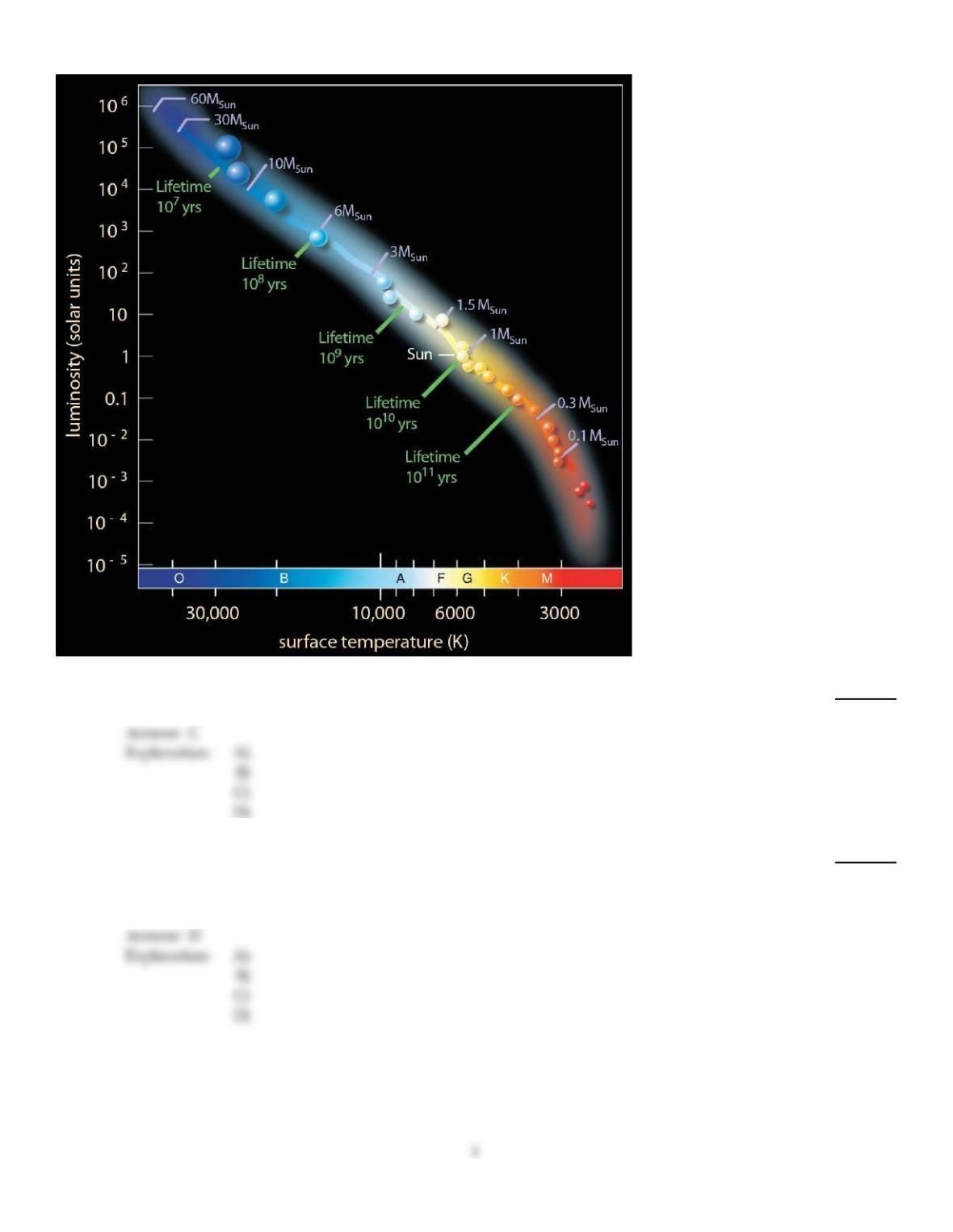
What is the approximate surface temperature of a B star?
7)
A)
8,000 K
B)
6,000 K
C)
20,000 K
D)
40,000 K
8)
You observe a star and you want to plot it on an H–R diagram. You will need to measure all of the
following, except the star’s ________.
8)
A)
distance
B)
spectral type
C)
apparent brightness
D)
mass
9)
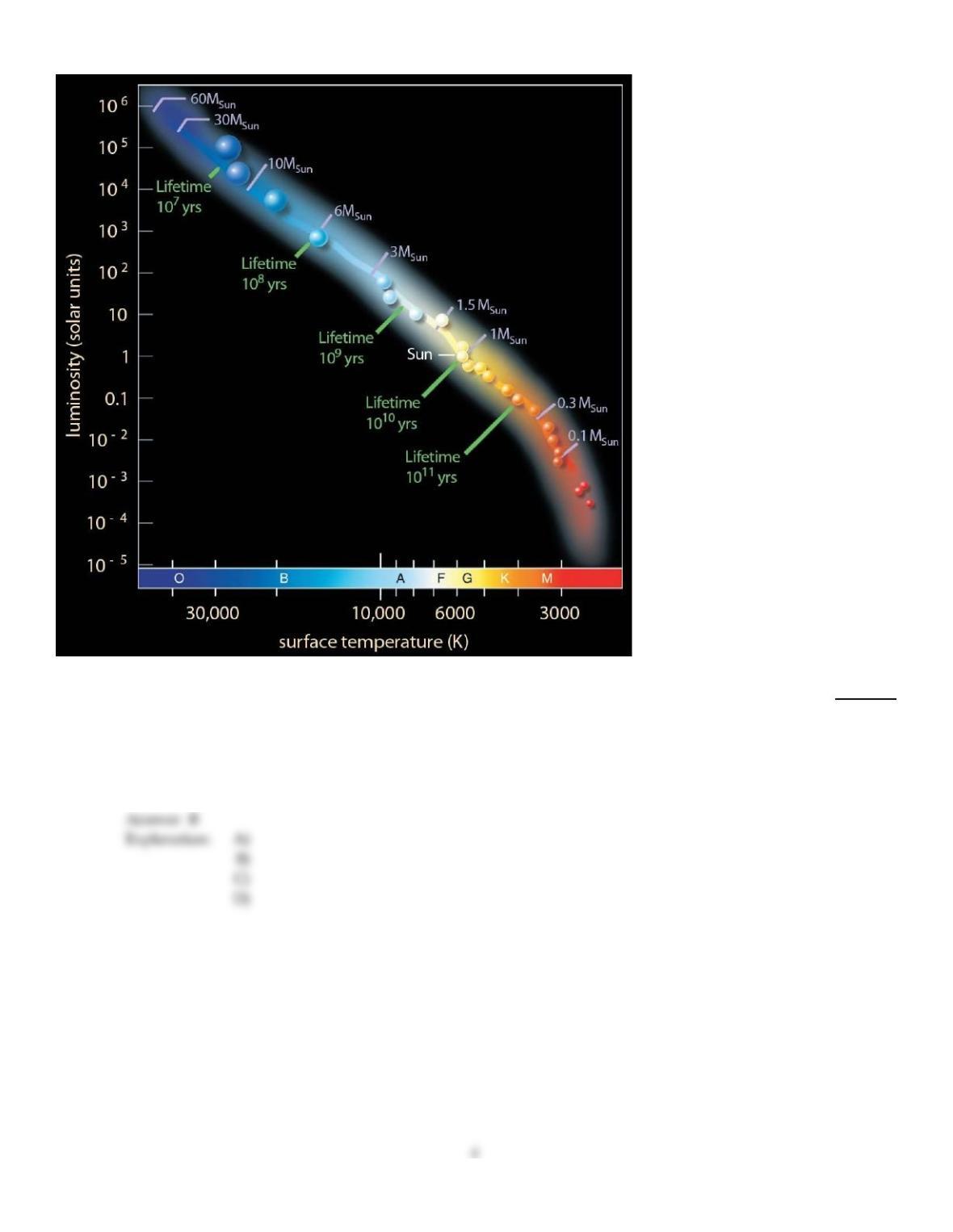
How does the rate of hydrogen consumption of a main–sequence B star compare to the hydrogen
consumption of the sun?
9)
A)
A B star consumes hydrogen at a rate about 6 to 10 times faster than the sun.
B)
A B star consumes hydrogen at a rate about 103 to 104 times faster than the sun.
C)
A B star consumes hydrogen at a rate about 107 to 108 times faster than the sun.
D)
This cannot be answered using the HR diagram.

10)
Which of the following stellar properties has the greatest range in values?
10)
A)
surface temperature
B)
core temperature
C)
luminosity
D)
radius
E)
mass
11)
All stars are born with the same basic composition, yet stars can look quite different from one
another. Which two factors primarily determine the characteristics of a star?
11)
A)
its apparent brightness and its luminosity
B)
its age and its location in the galaxy
C)
its mass and its stage of life
D)
its apparent brightness and its distance
E)
its mass and its surface temperature
Explanation:
12)
The spectral sequence sorts stars according to
12)
A)
core temperature.
B)
mass.
C)
luminosity.
D)
surface temperature.
E)
radius.
Explanation:
Explanation:

13)
Which of the following correctly states the relationship between the apparent brightness,
luminosity, and distance of a star?
13)
A)
apparent brightness =luminosity
4 × (distance)2
B)
luminosity =apparent brightness
4 × (distance)2
C)
apparent brightness = luminosity × 4 × (distance)2
D)
distance =luminosity
4 × (apparent brightness)2
14)
What is a white dwarf?
14)
A)
a type of star that produces energy by gravitational contraction
B)
the remains of a star that ran out of fuel for nuclear fusion
C)
a star that follows a period–luminosity relation
D)
a main–sequence star of spectral type F, which tends to look white in color
Explanation:
15)
Which of the following statements about globular clusters is true?
15)
A)
There is an approximately equal number of all types of stars in the cluster.
B)
All stars in the cluster have approximately the same mass.
C)
Most of the stars in the cluster are younger than 10 billion years.
D)
All stars in the cluster are approximately at the same stage in their evolution.
E)
Most stars in the cluster are yellow or reddish in color.
Explanation:
16)
What can we infer, at least roughly, from a star’s luminosity class?
16)
A)
its surface temperature
B)
its mass
C)
its size (radius)
D)
its age in years
Explanation:
Explanation:
17)
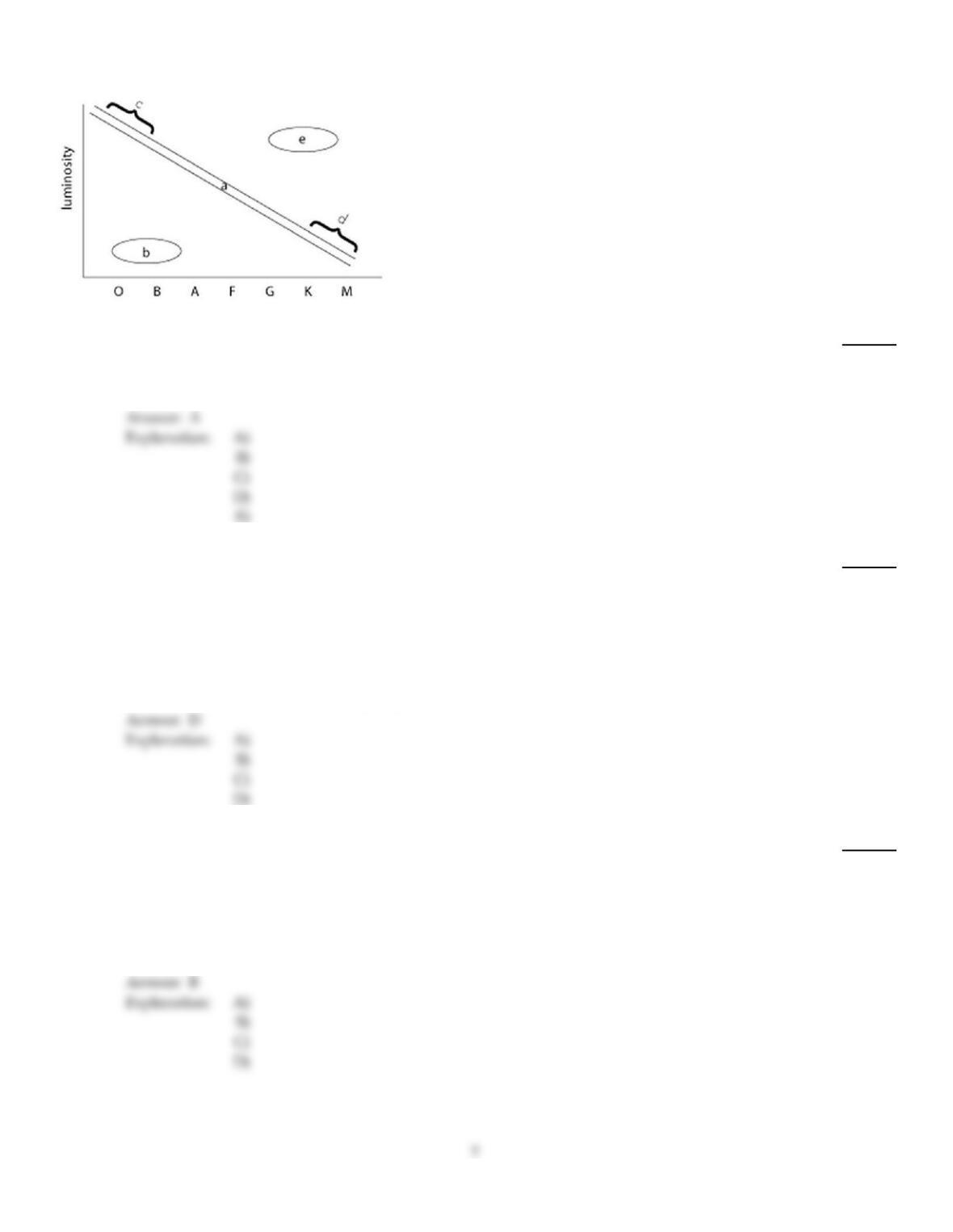
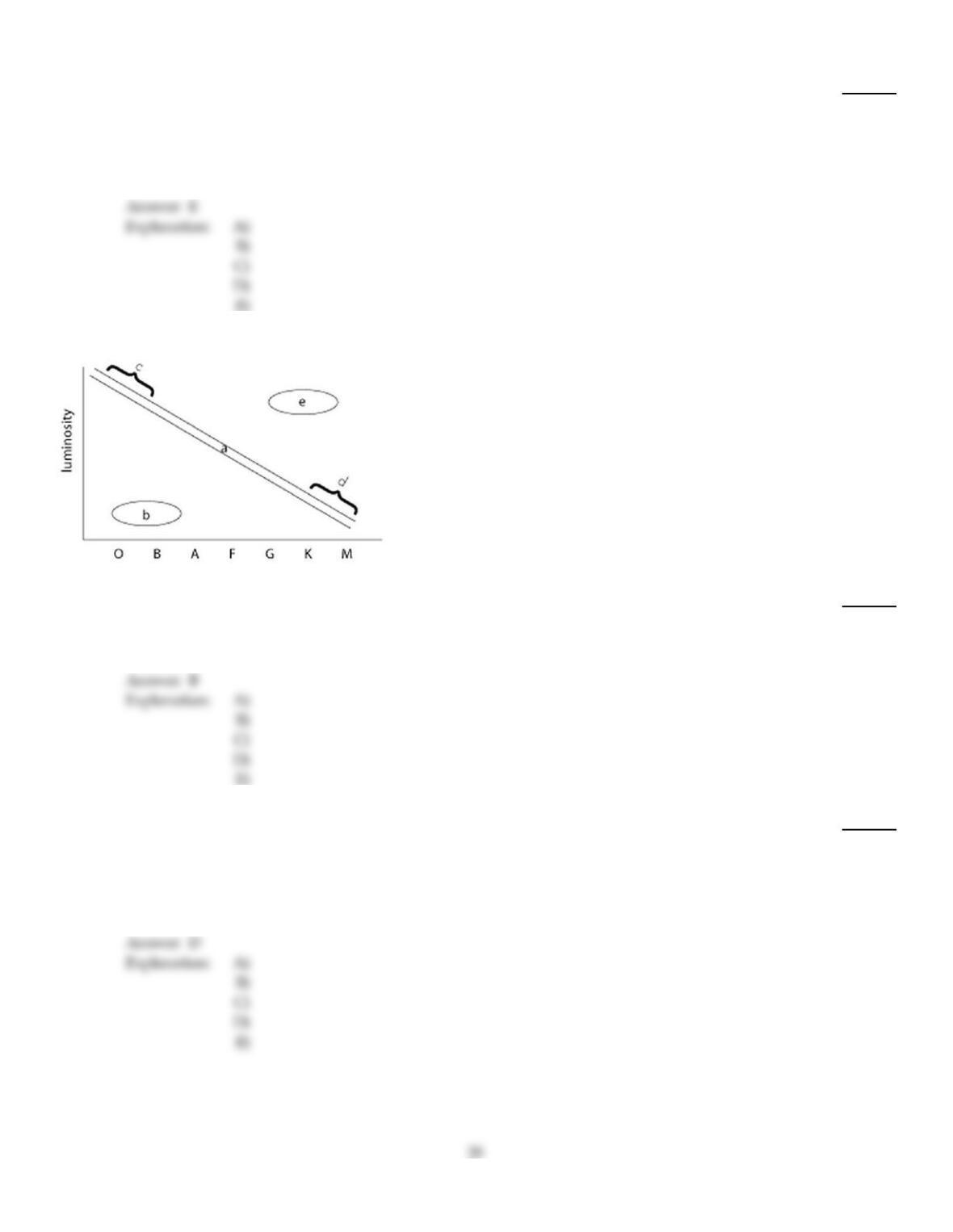
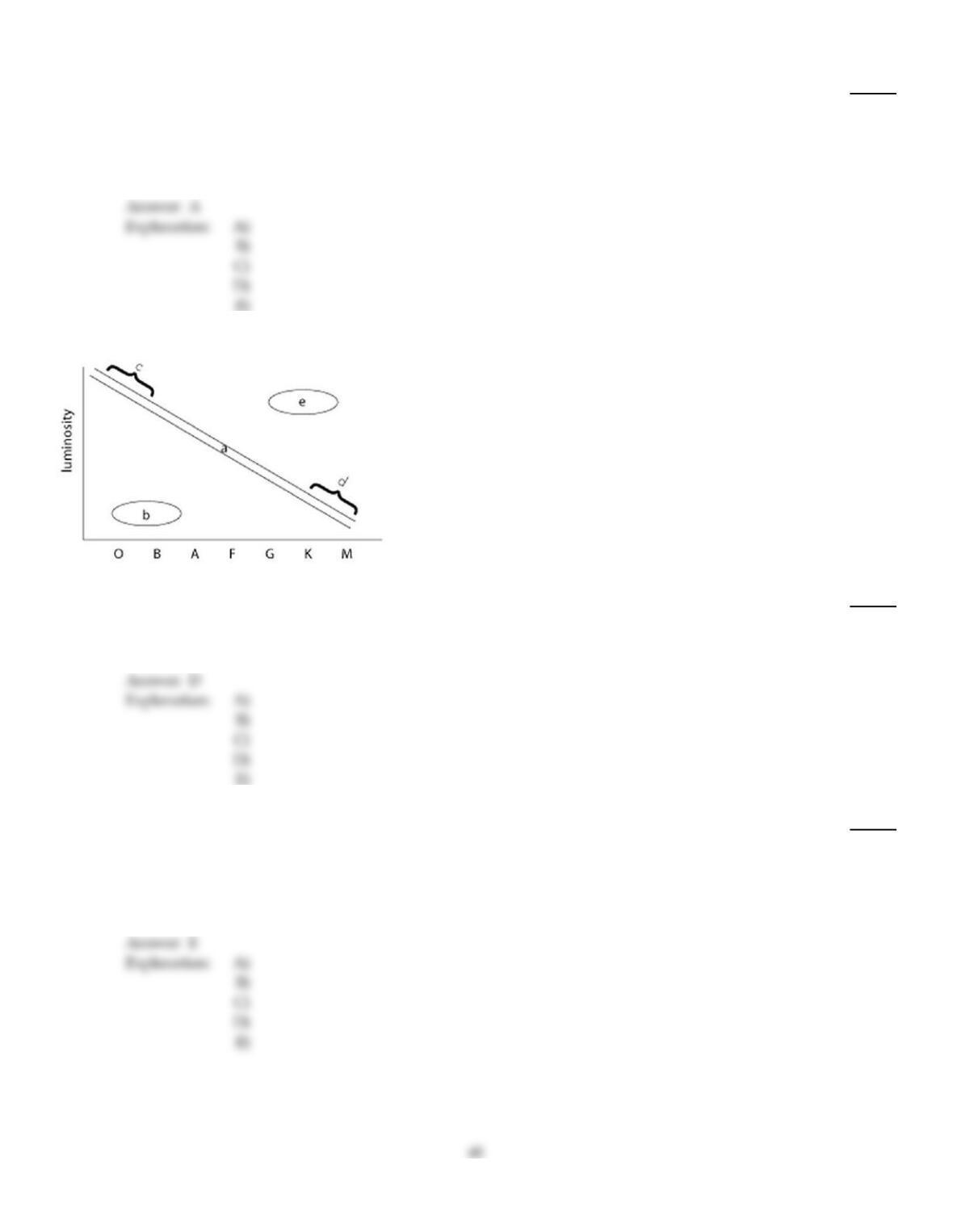
The sketch above shows groups of stars on the H–R diagram, labeled (a) through (e); note that (a)
represents the entire main sequence while (c) and (d) represent only small parts of the main
sequence. Which group represents stars fusing hydrogen in their cores?
17)
A)
a
B)
b
C)
c
D)
d
E)
e
18)
Careful measurements reveal that a star maintains a steady apparent brightness at most times,
except that at precise intervals of 73 hours the star becomes dimmer for about 2 hours. The change
in brightness alternates between a small change and a large change. The most likely explanation is
that ________.
18)
A)
the star is a Cepheid variable
B)
the star is a white dwarf
C)
the star is periodically ejecting gas into space, every 73 hours
D)
the star is a member of an eclipsing binary star system
19)
Assuming that we can measure the apparent brightness of a star, what does the inverse square law
for light allow us to do?
19)
A)
determine the distance to the star from its apparent brightness
B)
calculate the star’s luminosity if we know its distance, or calculate its distance if we know its
luminosity
C)
calculate the star’s surface temperature if we know either its luminosity or its distance
D)
determine both the star’s distance and luminosity from its apparent brightness
20)
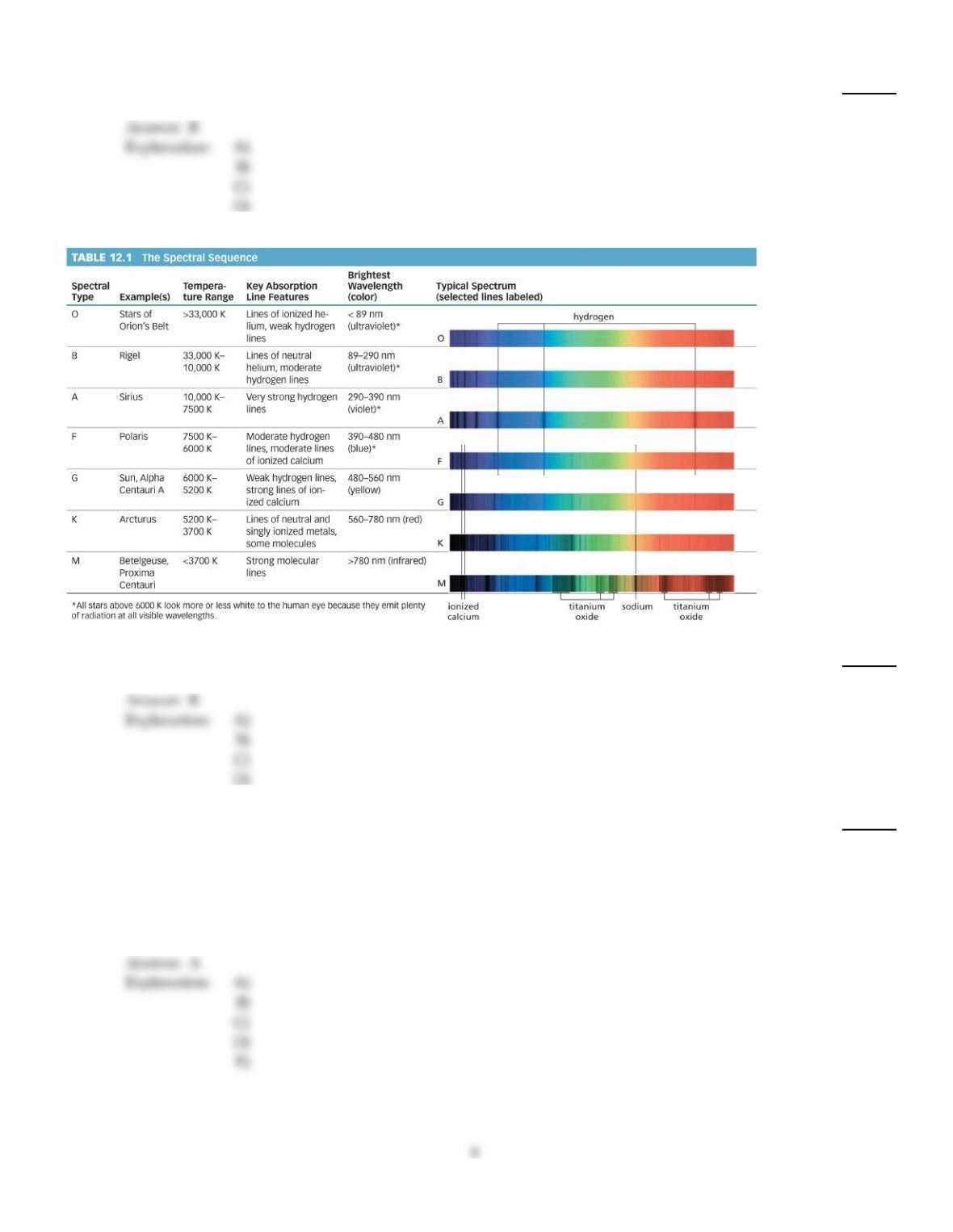
On a Hertzsprung–Russell diagram, where would you find stars that are cool and dim?
20)
A)
upper right
B)
lower right
C)
upper left
D)
lower left
21)
What is the spectral type of a star with very strong hydrogen absorption lines?
21)
A)
G
B)
A
C)
B
D)
F
22)
You observe a star cluster with a main–sequence turn–off point at spectral type G2 (the same
spectral type as the Sun). What is the age of this star cluster?
22)
A)
10 billion years
B)
4.6 billion years
C)
100 billion years
D)
10,000 years
E)
You also need to know the luminosity class of the turn–off point to determine the age.

23)
The stellar spectral sequence, in order of decreasing temperature, is
23)
A)
ABFGKMO.
B)
OBAGFKM.
C)
OBAFGKM.
D)
BAGFKMO.
E)
OFBAGKM.
24)
Ten parsecs is about ________.
24)
A)
10,000 seconds
B)
32.6 light–years
C)
10 parallax seconds of angle
D)
150 million kilometers
25)
You see two main–sequence stars with the same spectral type. Star 1 is dimmer in apparent
brightness than Star 2 by a factor of 100. What can you conclude, assuming there is no absorption of
either star’s light by interstellar gas or dust?
25)
A)
Without first knowing the distances to these stars, you cannot draw any conclusions about
how their true luminosities compare to each other.
B)
The luminosity of Star 1 is a factor of 100 less than the luminosity of Star 2.
C)
Star 1 is 10 times more distant than Star 2.
D)
Star 1 is 100 times more distant than Star 2.
E)
Star 1 is 100 times nearer than Star 2.
26)
On a Hertzsprung–Russell diagram, where would you find white dwarfs?
26)
A)
upper right
B)
lower right
C)
upper left
D)
lower left

27)
To calculate the masses of stars in a binary system, we must measure their ________.
27)
A)
orbital period and average orbital distance
B)
luminosities and distance from Earth
C)
spectral types and distance from Earth
D)
absolute magnitudes and luminosities
28)
Which of the following statements about open clusters is true?
28)
A)
All stars in the cluster have approximately the same mass.
B)
There is an approximately equal number of all types of stars in the cluster.
C)
All stars in the cluster are approximately the same color.
D)
All stars in the cluster will evolve similarly.
E)
All stars in the cluster are approximately the same age.
E
Explanation:
29)
Which star is the hottest star?
29)
A)
A
B)
G
C)
M
D)
O
E)
Can’t tell from information provided.
D
Explanation:
A
Explanation:
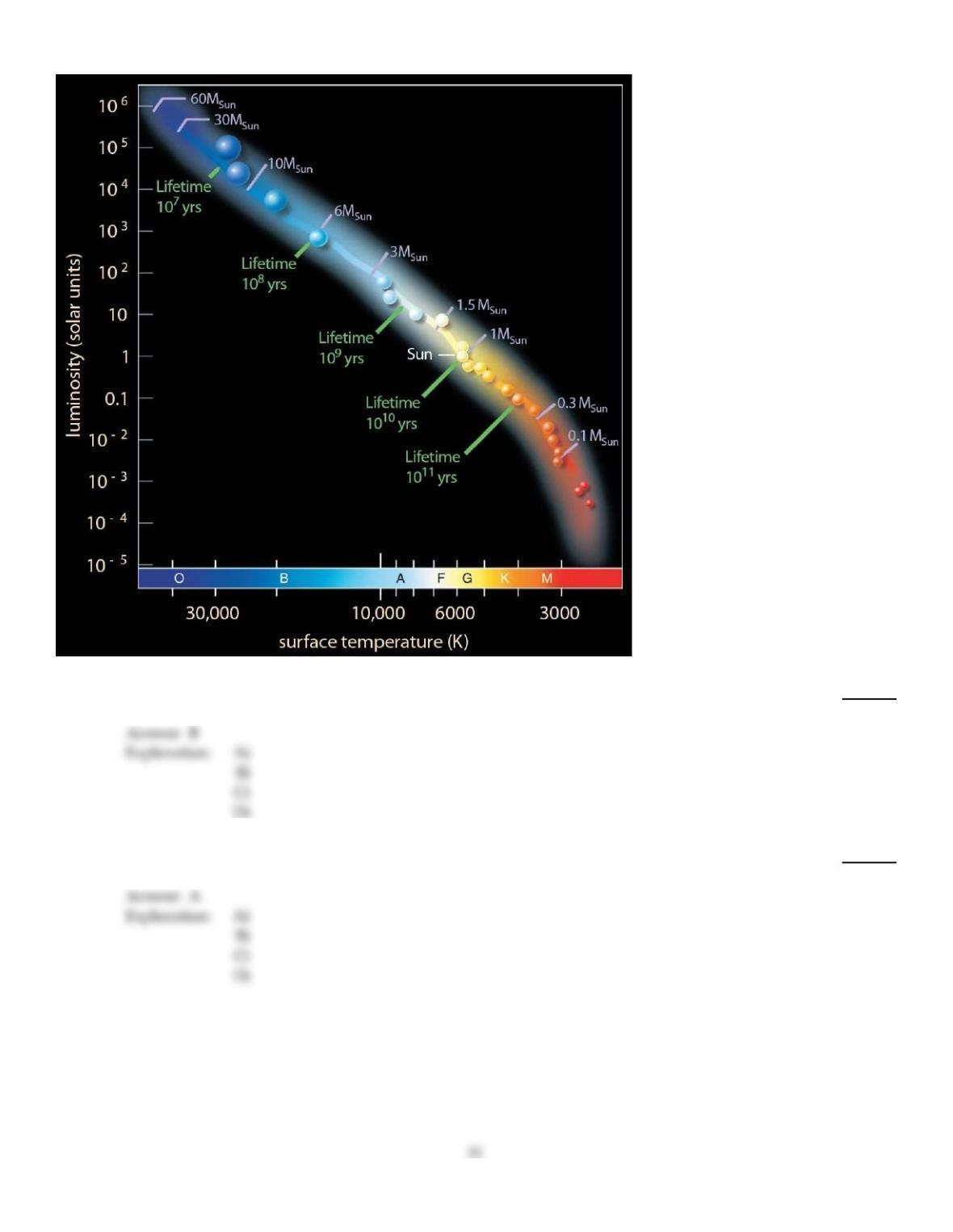
30)
What is the spectral type of a main sequence star with a luminosity 100 times greater than the sun?
30)
A)
M
B)
A
C)
G
D)
O
31)
On a Hertzsprung–Russell diagram, where would you find red giant stars?
31)
A)
upper right
B)
lower right
C)
upper left
D)
lower left

32)
Sirius is a star with spectral type A and Rigel is a star with spectral type B. What can we conclude?
32)
A)
Sirius has a higher surface temperature than Rigel.
B)
Rigel has a higher surface temperature than Sirius.
C)
Rigel has a higher core temperature than Sirius.
D)
Sirius has a higher core temperature than Rigel.
33)
On an H–R diagram, stellar masses ________.
33)
A)
decrease from upper left to lower right
B)
are greatest in the lower left and least in the upper right
C)
can be determined for main sequence stars but not for other types of stars
D)
are impossible to determine
34)
Which of the following stars has a spectrum that peaks at the highest frequency?
34)
A)
a yellow star
B)
a blue star
C)
a red star
35)
Which of the following statements about apparent and absolute magnitudes is true?
35)
A)
A star’s absolute magnitude is the apparent magnitude it would have if it were at a distance
of 10 parsecs from Earth.
B)
A star with an apparent magnitude of 1 appears brighter than a star with an apparent
magnitude of 2.
C)
The magnitude system that we use now is based on a system used by the ancient Greeks over
2,000 years ago that classified stars by how bright they appeared.
D)
The absolute magnitude of a star is another measure of its luminosity.
E)
All of the above are true.

36)
An O–star has a hotter surface temperature than the Sun. Therefore, compared to the Sun,
36)
A)
its emission peaks in the blue part of the spectrum.
B)
its emission peaks in the infrared part of the spectrum.
C)
it emits at about the same wavelengths as the Sun (similar peak) but it is much brighter.
D)
it emits at about the same wavelengths as the Sun (similar peak) but it is much fainter.
37)
If the Sun–Earth separation were 10 AU instead of 1 AU, what would the ux of sunlight (energy
per second per square meter) be at the Earth, compared to what it is today?
37)
A)
100 times more
B)
100 times less
C)
10 times less
D)
about 3.16 (or the square root of 10) times less
E)
10 times more
38)
A main–sequence star’s luminosity can directly inform us of
38)
A)
the star’s radius.
B)
the star’s mass.
C)
the star’s distance from us.
D)
the rate at which it converts hydrogen to helium.
39)
What are the standard units for apparent brightness?
39)
A)
Newtons
B)
Watts per square meter
C)
Joules
D)
Watts per second
E)
Watts

40)
On a Hertzsprung–Russell diagram, where would you find stars that are cool and luminous?
40)
A)
upper right
B)
lower right
C)
upper left
D)
lower left
41)
Which of the following terms is given to a pair of stars that we can determine are orbiting each
other only by measuring their periodic Doppler shifts?
41)
A)
visual binary
B)
double star
C)
eclipsing binary
D)
spectroscopic binary
D
42)
How did astronomers discover the relationship between spectral type and mass for main sequence
stars?
42)
A)
by using computer models of hydrogen fusion and stellar structure
B)
by measuring the masses and spectral types of main–sequence stars in binary systems
C)
by measuring stellar radii with very powerful telescopes
D)
by comparing stars with the same spectral type but different luminosities
B
43)
Which main–sequence star will have the shortest lifetime?
43)
A)
M
B)
G
C)
O
D)
A
E)
Can’t tell from information provided.
C
44)
The faintest star visible to the naked eye has an apparent magnitude of about
44)
A)
6.
B)
10.
C)
0.
D)
–1.
E)
1.
A
A

45)
The youngest star cluster is the one where the brightest main–sequence stars are
45)
A)
G stars.
B)
O stars.
C)
B stars.
D)
A stars.
E)
M stars.
46)
The choices below each describe the appearance of an H–R diagram for a different star cluster.
Which cluster is the youngest?
46)
A)
The diagram shows main–sequence stars of all the spectral types except O and B, along with a
few giants and supergiants.
B)
The diagram shows main–sequence stars of every spectral type except O, along with a few
giants and supergiants.
C)
The diagram shows main–sequence stars of spectral types G, K, and M, along with numerous
giants and white dwarfs.
D)
The diagram shows no main–sequence stars at all, but it has numerous supergiants and white
dwarfs.
47)
A stars exhibit strong hydrogen absorption lines because the surface temperature of 10,000 K is
high enough to place most hydrogen in an excited, but not yet ionized, state. The transitions from
this excited state then correspond to visible light wavelengths. Which of the following statements is
a plausible explanation for why G stars exhibit weak hydrogen absorption lines?
47)
A)
At these high temperatures, nearly all the hydrogen is ionized, and unable to interact with
light.
B)
G stars are too cool to excite hydrogen atoms to the first energy level from which they can
then absorb visible wavelengths of light.
C)
G stars contain very little hydrogen.
48)
Which of the following stars has a spectrum that peaks at the shortest wavelength?
48)
A)
a blue star
B)
a yellow star
C)
a red star

49)
The choices below each describe the appearance of an H–R diagram for a different star cluster.
Which cluster is most likely to be located in the halo of our galaxy?
49)
A)
The diagram shows main–sequence stars of all the spectral types except O and B, along with a
few giants and supergiants.
B)
The diagram shows no main–sequence stars at all, but it has numerous supergiants and white
dwarfs.
C)
The diagram shows main–sequence stars of every spectral type except O, along with a few
giants and supergiants.
D)
The diagram shows main–sequence stars of spectral types G, K, and M, along with numerous
giants and white dwarfs.
50)
The approximate main–sequence lifetime of a star of spectral type O is ________.
50)
A)
10,000 years
B)
10 billion years
C)
3 million years
D)
300 million years
51)
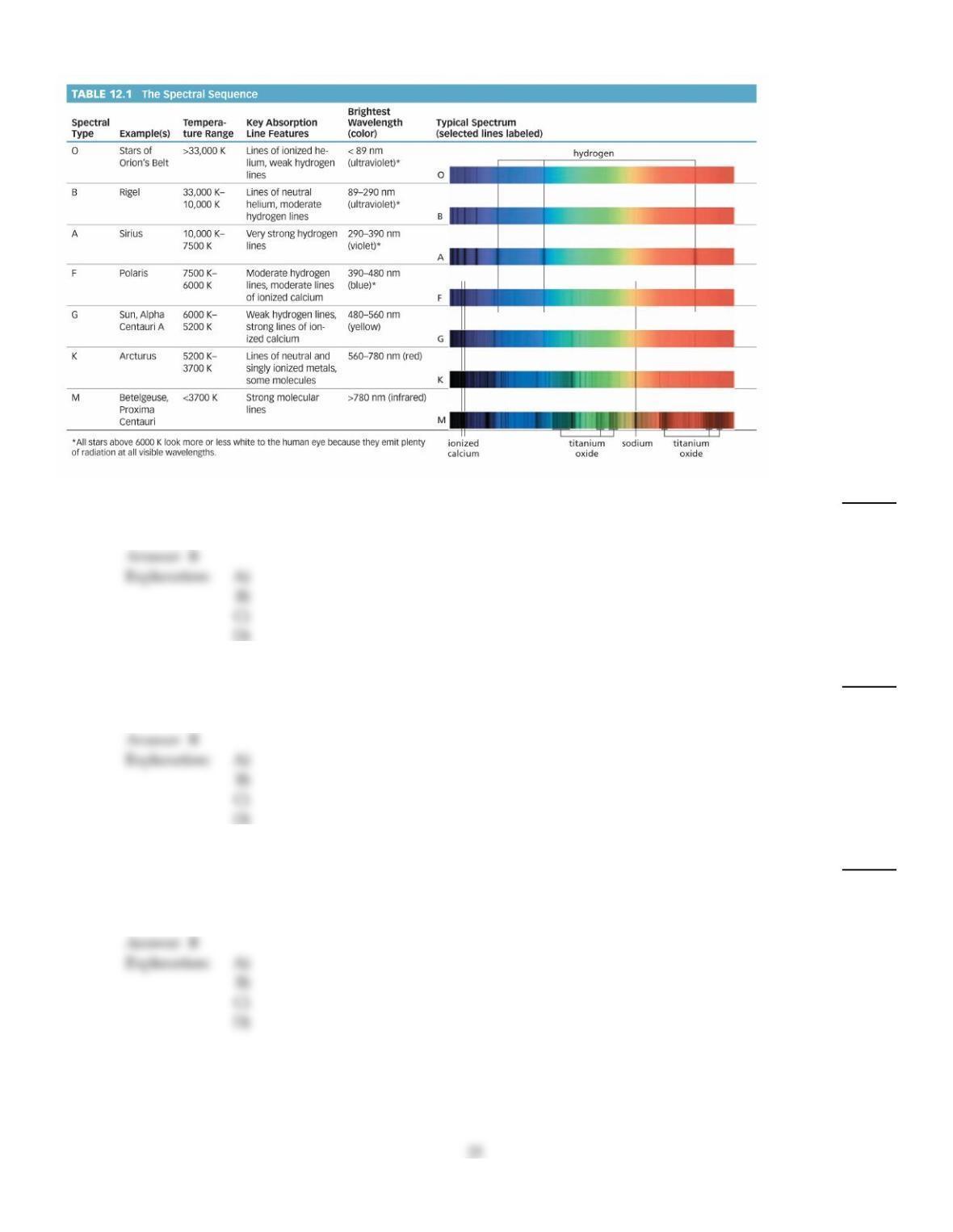
Which stellar spectral type has strong molecular absorption lines in its optical spectrum?
51)
A)
G
B)
O
C)
B
D)
K
E)
M
52)
Which of the following comparisons between low–mass stars and high–mass main–sequence stars
is true?
52)
A)
Low–mass stars are cooler and less luminous than high–mass stars.
B)
Low–mass stars are hotter and more luminous than high–mass stars.
C)
Low–mass stars have the same temperature and luminosity as high–mass stars.
D)
Low–mass stars are hotter but less luminous than high–mass stars.
E)
Low–mass stars are cooler but more luminous than high–mass stars.
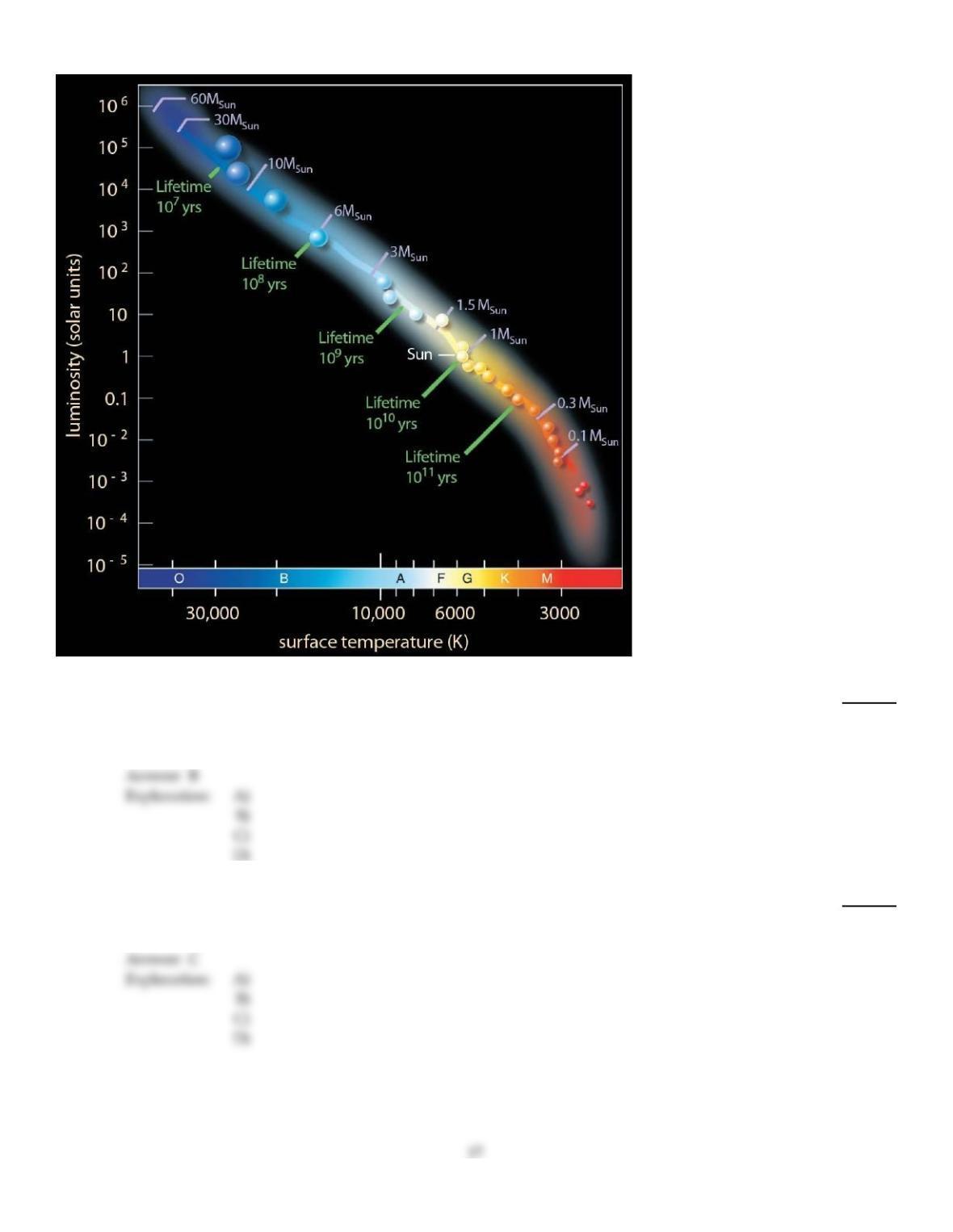
53)
A star is observed with a surface temperature of 3,000 K and a luminosity of 102 solar. What is the
approximate mass of this star?
53)
A)
0.9 Msun
B)
0.2 Msun
C)
0.5 Msun
D)
The mass cannot be determined.
54)
On a Hertzsprung–Russell diagram, where on the main sequence would you find stars that have
the greatest mass?
54)
A)
upper right
B)
lower right
C)
upper left
D)
lower left
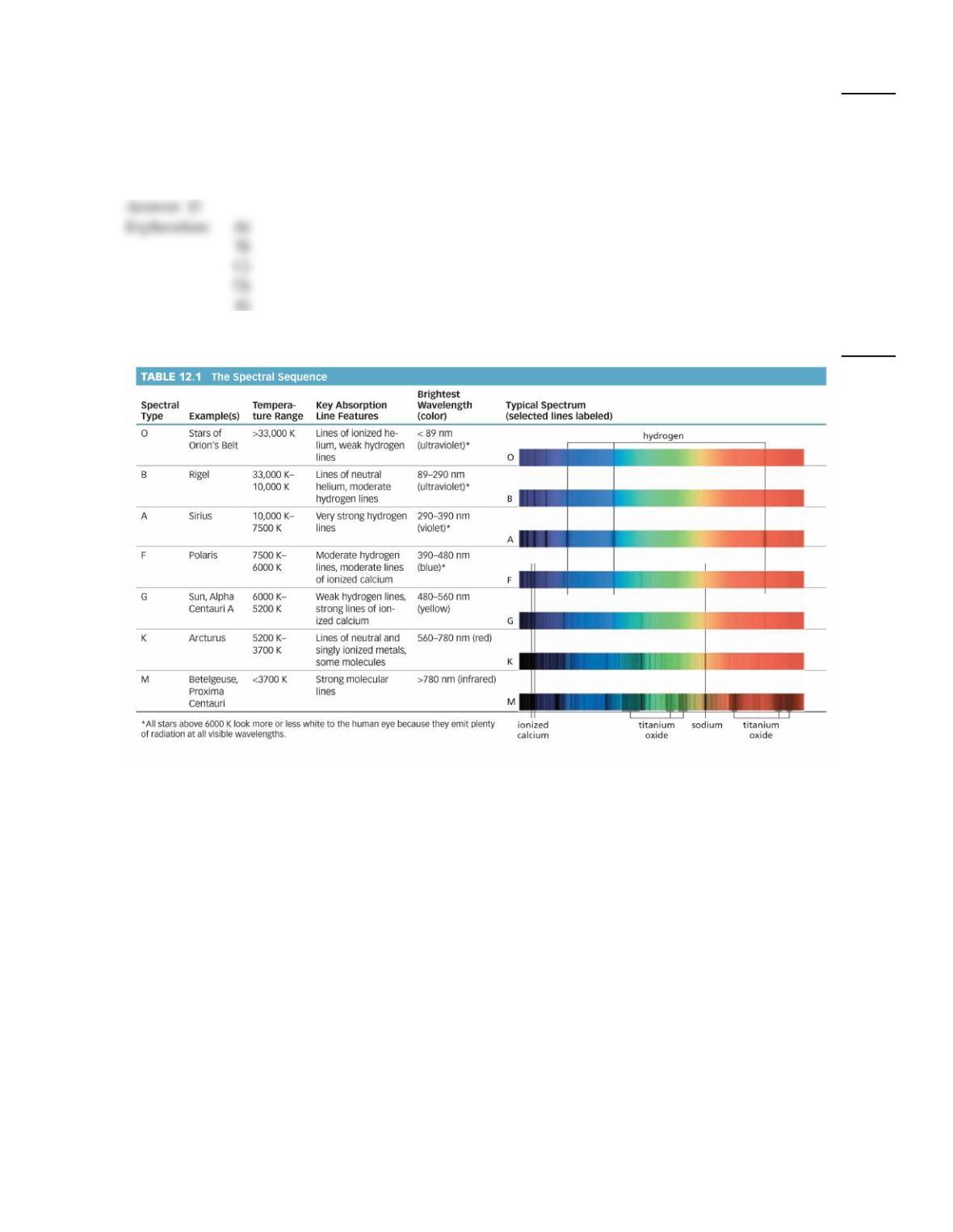
55)
What are the standard units for luminosity?
55)
A)
Watts per second
B)
Joules
C)
kilograms
D)
Watts
E)
Newtons
56)
56)
18
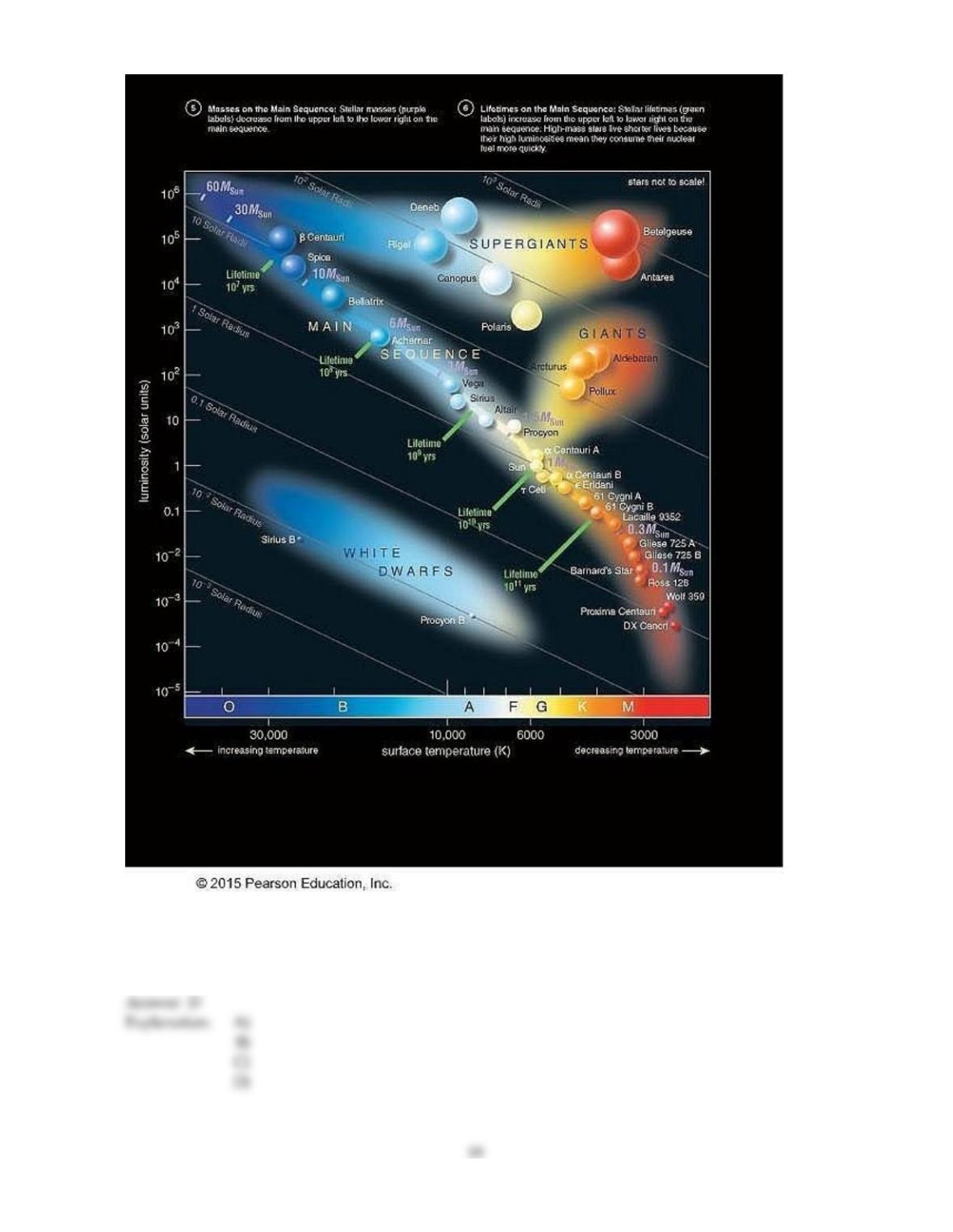
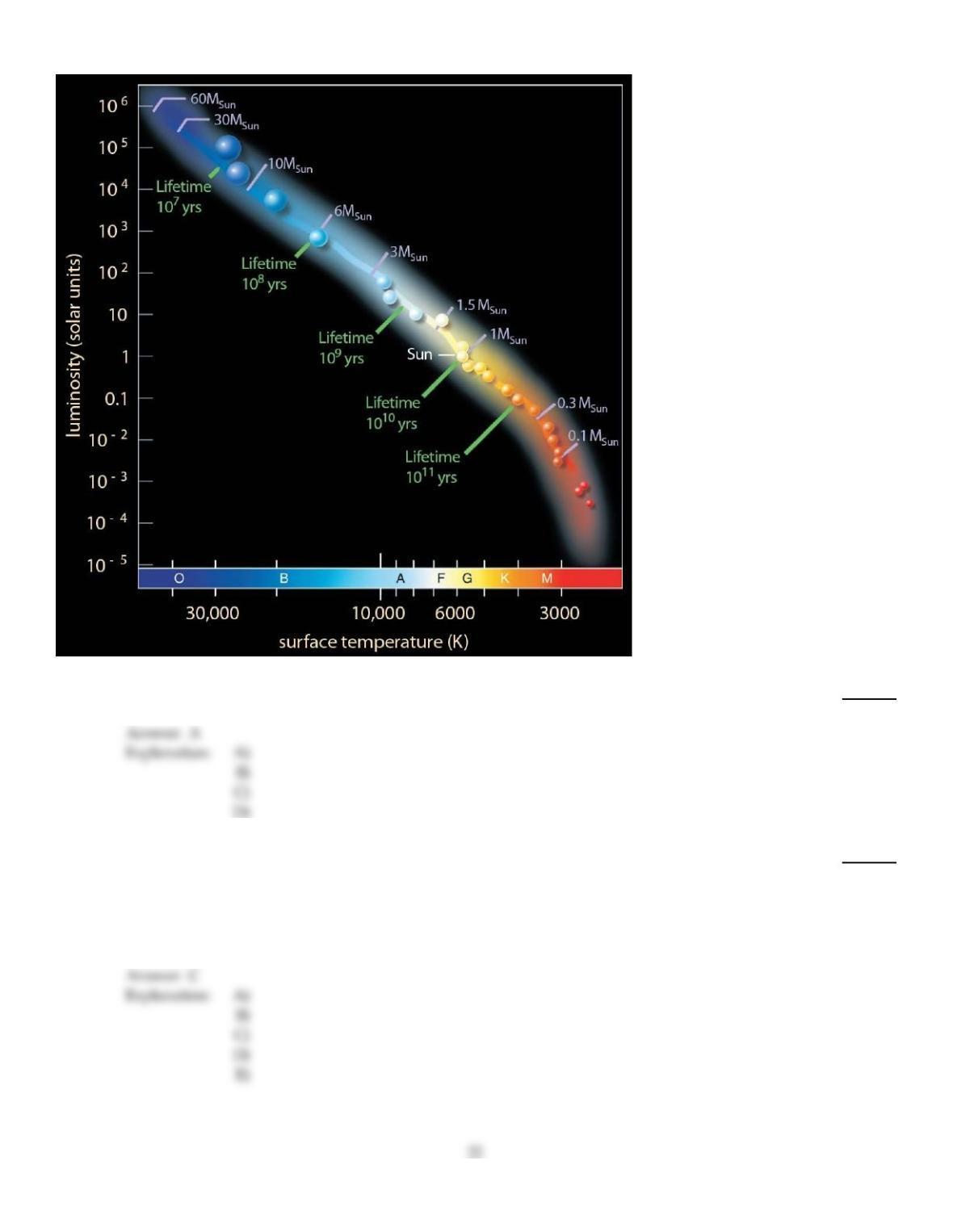
What is the approximate luminosity of a main–sequence star with weak hydrogen absorption lines
and strong absorption lines of ionized calcium?
A)
About 0.1 solar
B)
About 102 solar
C)
About 3 solar
D)
About 1 solar
57)
Which of the following statements about spectral types of stars is true?
57)
A)
The spectral type of a star can be used to determine its surface temperature.
B)
A star with spectral type F2 is hotter than a star with spectral type F3.
C)
A star with spectral type A is cooler than a star with spectral type B.
D)
The spectral type of a star can be used to determine its color.
E)
All of the above are true.
58)
The sketch above shows groups of stars on the H–R diagram, labeled (a) through (e); note that (a)
represents the entire main sequence while (c) and (d) represent only small parts of the main
sequence. Which group represents stars that have no ongoing nuclear fusion?
58)
A)
a
B)
b
C)
c
D)
d
E)
e
B
59)
A star’s luminosity is the
59)
A)
surface temperature of the star.
B)
apparent brightness of the star in our sky.
C)
total amount of energy that the star will radiate over its entire lifetime.
D)
total amount of energy that the star radiates each second.
E)
lifetime of the star.
D
E

60)
The apparent brightness of an object is calculated as: apparent brightness =luminosity
4 × distance2
If one knew the luminosity and apparent brightness of a star that was too distant for a parallax
measurement, what would be the best approach to determining its distance?
60)
A)
Solve the equation for distance, then insert the values for luminosity and apparent brightness
into the new equation.
B)
Insert the values for luminosity and apparent brightness into the equation, then guess the
value for the distance that satisfy the equation.
C)
The distance cannot be determined.
61)
If a star has a mass of 10 solar masses and a luminosity of 10,000 solar luminosities, how long is its
lifetime? (The Sun’s lifetime is 10 billion years.)
61)
A)
100 trillion years
B)
10 million years
C)
1 million years
D)
100 billion years
B
62)
A scientist claims that all red main–sequence stars are 1 billion years old. Which of the following, if
true, would prove that this claim is false?
62)
A)
The discovery of a red main–sequence star in a star cluster where the main sequence turnoff is
about that of the Sun
B)
The minimum lifespan of a red main–sequence star is estimated to be 10 billion years.
C)
Stellar evolution theory predicts that the main–sequence lifetime of red stars can be as long as
100 billion years.
D)
The discovery of a red main–sequence star in a star cluster where all the other stars are red
giants or red supergiants
A
A
63)
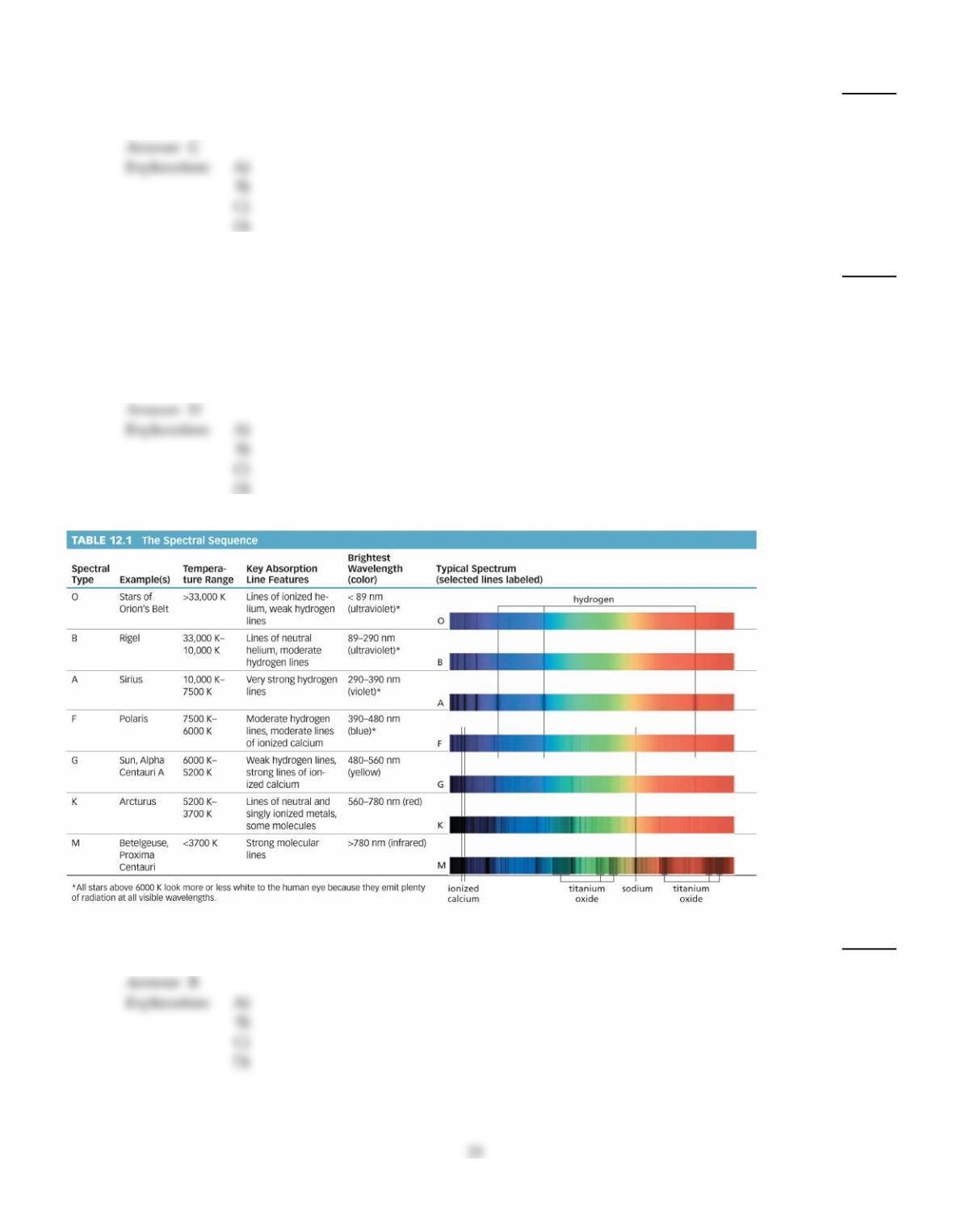
What is the approximate surface temperature of an F star?
63)
A)
7,000 K
B)
12,000 K
C)
5,000 K
D)
6,000 K
64)
You measure the parallax angle for a star to be 0.5 arcseconds. The distance to this star is
64)
A)
0.5 parsec.
B)
5 light–years.
C)
2 parsecs.
D)
0.5 light–year.
E)
5 parsecs.
65)
Each choice below lists a spectral type and luminosity class for a star. Which one is a red supergiant?
65)
A)
spectral type O9, luminosity class I
B)
spectral type G2, luminosity class V
C)
spectral type M2, luminosity class I
D)
spectral type M1, luminosity class V
66)
What do we mean by the main–sequence turnoff point of a star cluster, and what does it tell us?
66)
A)
It is the point in a star cluster beyond which main sequence stars are not found, and it tells us
the cluster’s distance.
B)
It is the mass of the most massive star in the star cluster, and it tells us the cluster’s size.
C)
It is the luminosity class of the largest star in a star cluster, and it tells us the cluster’s age.
D)
It is the spectral type of the hottest main–sequence star in a star cluster, and it tells us the
cluster’s age.
67)
What is the spectral type of a star with strong molecular absorption lines?
67)
A)
F
B)
M
C)
K
D)
G

68)
Star A has an apparent magnitude of 3, and Star B has an apparent magnitude of 5. Which star is
brighter in our sky?
68)
A)
Star A
B)
Star B
C)
The two stars have the same brightness in our sky, but Star A is closer to us than Star B.
D)
There is not enough information to answer the question.
69)
Since all stars begin their lives with the same basic composition, what characteristic most
determines how they will differ?
69)
A)
mass they are formed with
B)
time they are formed
C)
luminosity they are formed with
D)
location where they are formed
E)
color they are formed with
70)
Star X has an apparent magnitude of 3, and star Y has an apparent magnitude of 13. How do they
compare in observed brightness?
70)
A)
Star Y is 10,000 times brighter than star X.
B)
Star X is 10 times brighter than star Y.
C)
Star Y is 10 times brighter than star X.
D)
Star X is 10,000 times brighter than star Y.
71)
What is the approximate surface temperature of a star with weak hydrogen absorption lines and
strong absorption lines of ionized calcium?
71)
A)
6,500 K
B)
5,500 K
C)
4,500 K
D)
3,500 K
72)
What is the approximate surface temperature of a star with moderate hydrogen absorption lines
and moderate ionized calcium absorption lines?
72)
A)
5,500 K
B)
6,500 K
C)
3,500 K
D)
4,500 K
73)
Star X has an apparent magnitude of 3, and star Y has an apparent magnitude of 8. How do they
compare in observed brightness?
73)
A)
Star Y is 5 times brighter than star X.
B)
Star X is 100 times brighter than star Y.
C)
Star Y is 100 times brighter than star X.
D)
Star X is 5 times brighter than star Y.

74)
A star with a parallax angle of 1/20 arcsecond is ________.
74)
A)
20 light–years away
B)
1/20 parsec away
C)
20 parsecs away
D)
10 parsecs away
75)
The age of stars in a cluster can be determined by
75)
A)
finding spectroscopic binaries in the cluster.
B)
fitting the position of the main sequence to the Sun.
C)
counting the number of stars in each spectral class.
D)
determining the main sequence turnoff point.
E)
finding pulsating variable stars in the cluster.
76)
Which of the following luminosity classes refers to stars on the main sequence?
76)
A)
I
B)
II
C)
III
D)
IV
E)
V
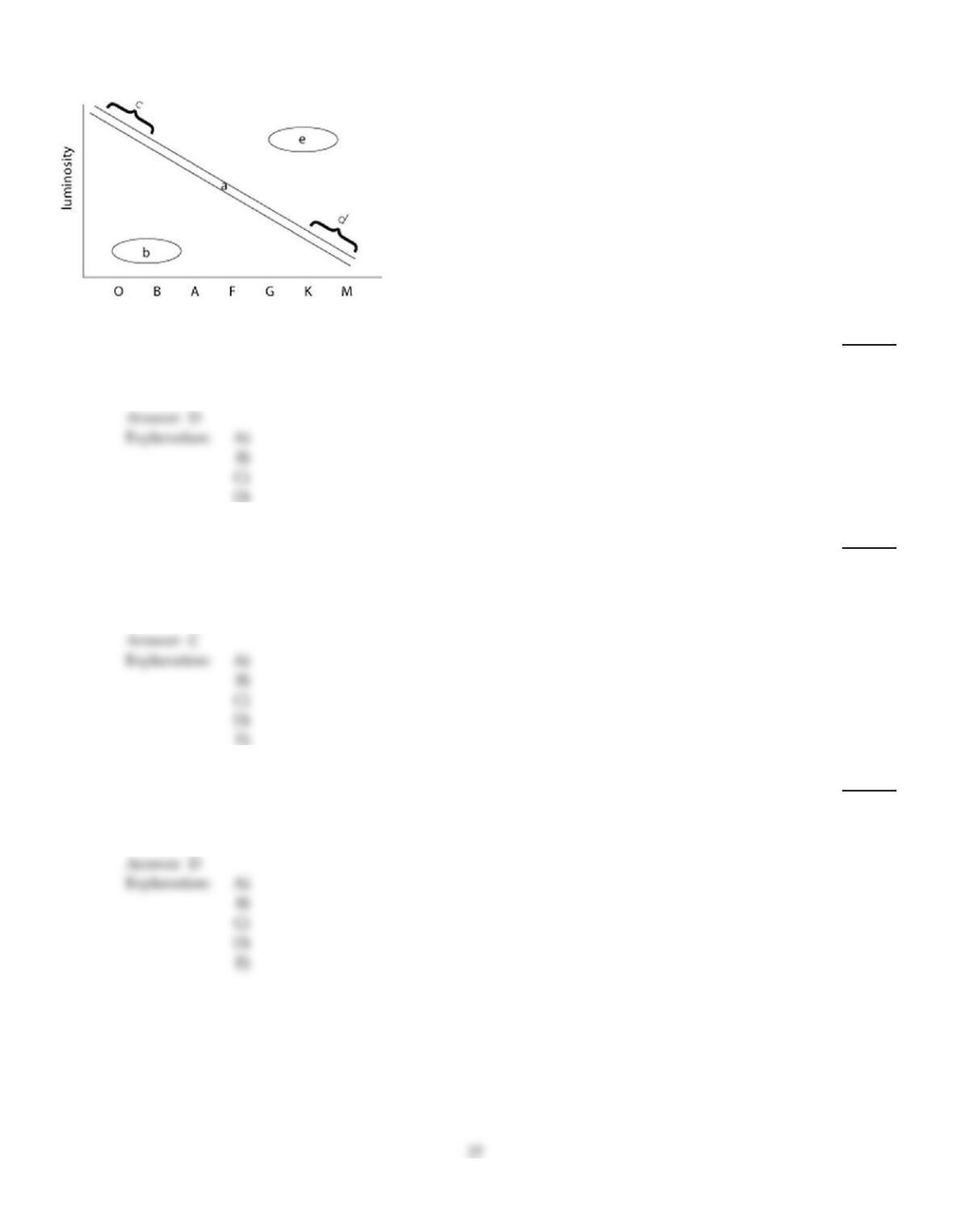
77)
The sketch above shows groups of stars on the H–R diagram, labeled (a) through (e); note that (a)
represents the entire main sequence while (c) and (d) represent only small parts of the main
sequence. Which group represents the most common type of stars?
77)
A)
e
B)
b
C)
c
D)
d
78)
The sketch above shows groups of stars on the H–R diagram, labeled (a) through (e); note that (a)
represents the entire main sequence while (c) and (d) represent only small parts of the main
sequence. Which group represents stars that are extremely bright and emit most of their radiation as
ultraviolet light?
78)
A)
a
B)
b
C)
c
D)
d
E)
e
79)
The sketch above shows groups of stars on the H–R diagram, labeled (a) through (e); note that (a)
represents the entire main sequence while (c) and (d) represent only small parts of the main
sequence. Which group represents stars that are cool and dim?
79)
A)
a
B)
b
C)
c
D)
d
E)
e

80)
On a Hertzsprung–Russell diagram, where would you find stars that have the largest radii?
80)
A)
upper right
B)
lower right
C)
upper left
D)
lower left
81)
According to the inverse square law of light, how will the apparent brightness of an object change if
its distance to us triples?
81)
A)
Its apparent brightness will increase by a factor of 9.
B)
Its apparent brightness will increase by a factor of 3.
C)
Its apparent brightness will decrease by a factor of 3.
D)
Its apparent brightness will decrease by a factor of 9.
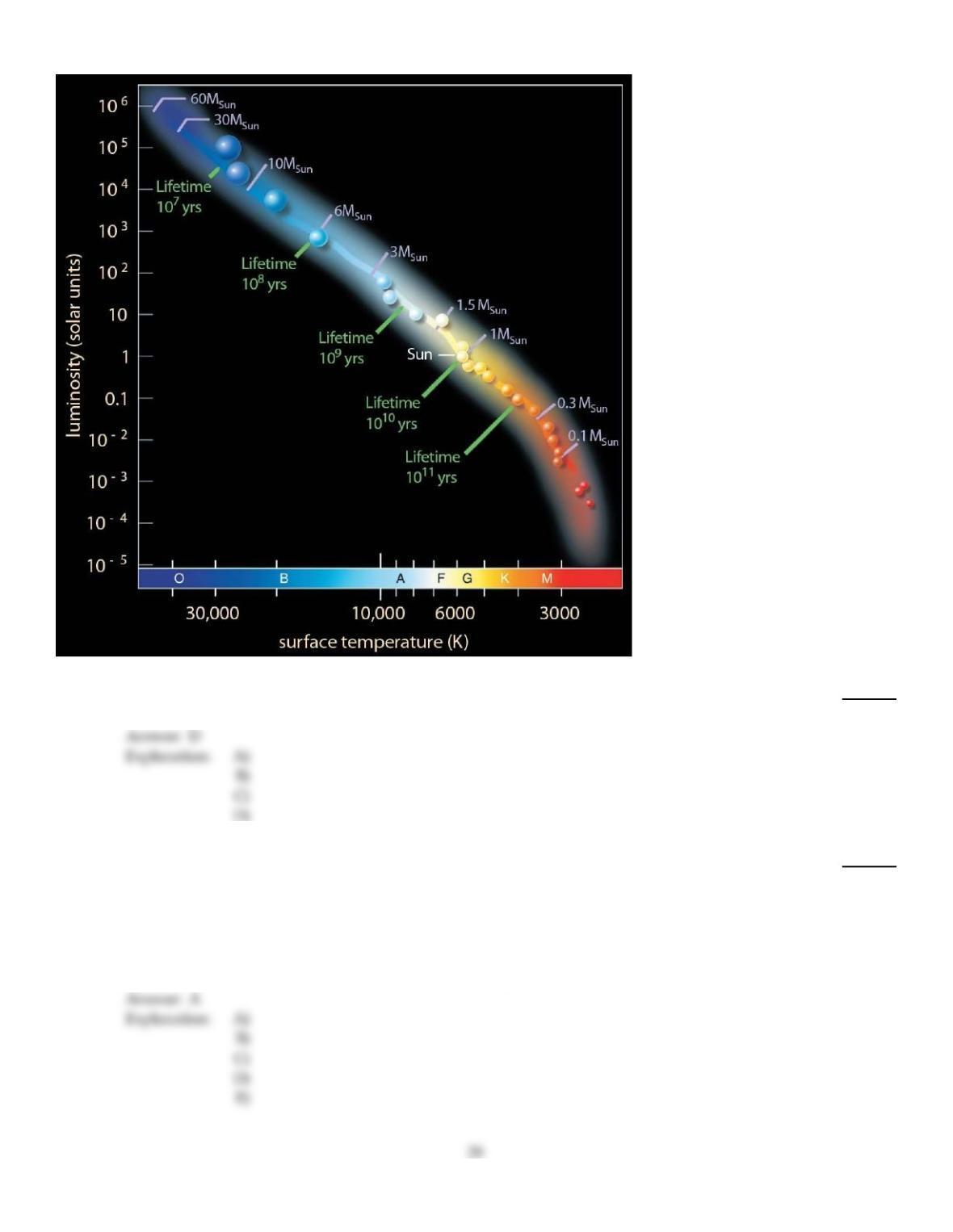
82)
What is the approximate luminosity of a main–sequence M star?
82)
A)
1 solar
B)
10 solar
C)
106 solar
D)
0.01 solar
83)
If the distance between us and a star is doubled, with everything else remaining the same, its
luminosity
83)
A)
remains the same, but its apparent brightness is decreased by a factor of four.
B)
remains the same, but its apparent brightness is decreased by a factor of two.
C)
is decreased by a factor of four, but its apparent brightness remains the same.
D)
is decreased by a factor of four, and its apparent brightness is decreased by a factor of four.
E)
is decreased by a factor of two, and its apparent brightness is decreased by a factor of two.

84)
What is the common trait of all main–sequence stars?
84)
A)
They all have approximately the same mass.
B)
They are in the final stage of their lives.
C)
They are all spectral type G.
D)
They generate energy through hydrogen fusion in their core.
85)
Suppose our Sun were suddenly replaced by a supergiant star. Which of the following would be
true?
85)
A)
The supergiant’s surface temperature would be much hotter than the surface temperature of
our Sun.
B)
The supergiant would appear as large as the full Moon in our sky.
C)
Earth would be inside the supergiant.
D)
Earth would fly off into interstellar space.
C
D
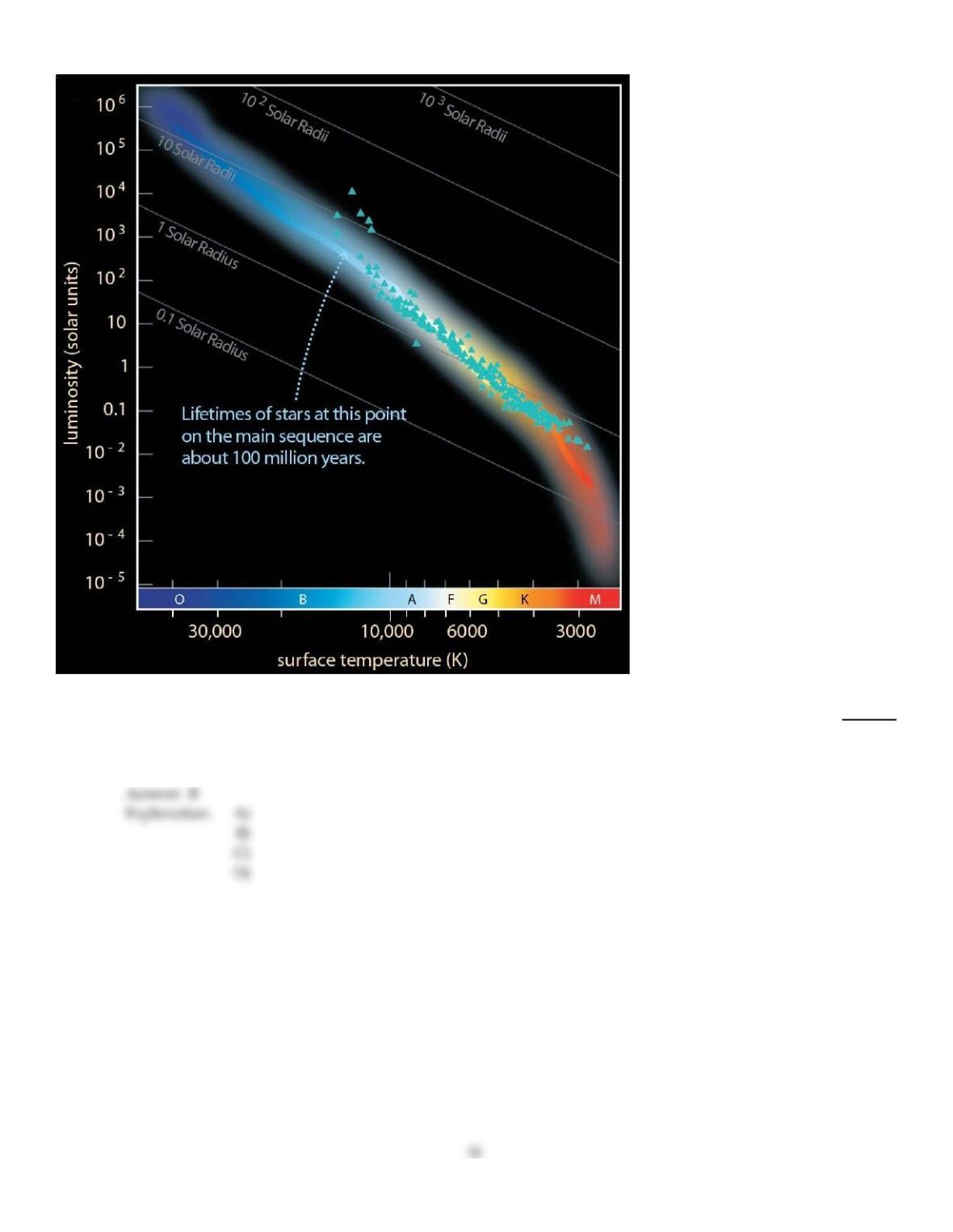
86)
A star is observed with a surface temperature of 3,000 K and a luminosity of 102 solar. What is the
approximate radius of this star?
86)
A)
1 solar radius
B)
0.3 solar radius
C)
0.1 solar radius
D)
The radius cannot be determined.

87)
A star of spectral type B with a mass of 10 times the mass of the Sun lives approximately how long
on the main sequence?
87)
A)
10 million years
B)
1 billion years
C)
10 billion years
D)
1,000 years
E)
10,000 years
88)
Why do O stars exhibit weak hydrogen absorption lines?
88)
A)
At these high temperatures, nearly all the hydrogen is ionized, and is therefore unable to
interact with light.
B)
O stars contain very little hydrogen.
C)
O stars are too cool to excite hydrogen atoms to the first energy level from which they can
then absorb visible wavelengths of light.
89)
Which of the following terms is given to a pair of stars that appear to change position in the sky,
indicating that they are orbiting one another?
89)
A)
visual binary
B)
eclipsing binary
C)
double star
D)
spectroscopic binary
E)
none of the above
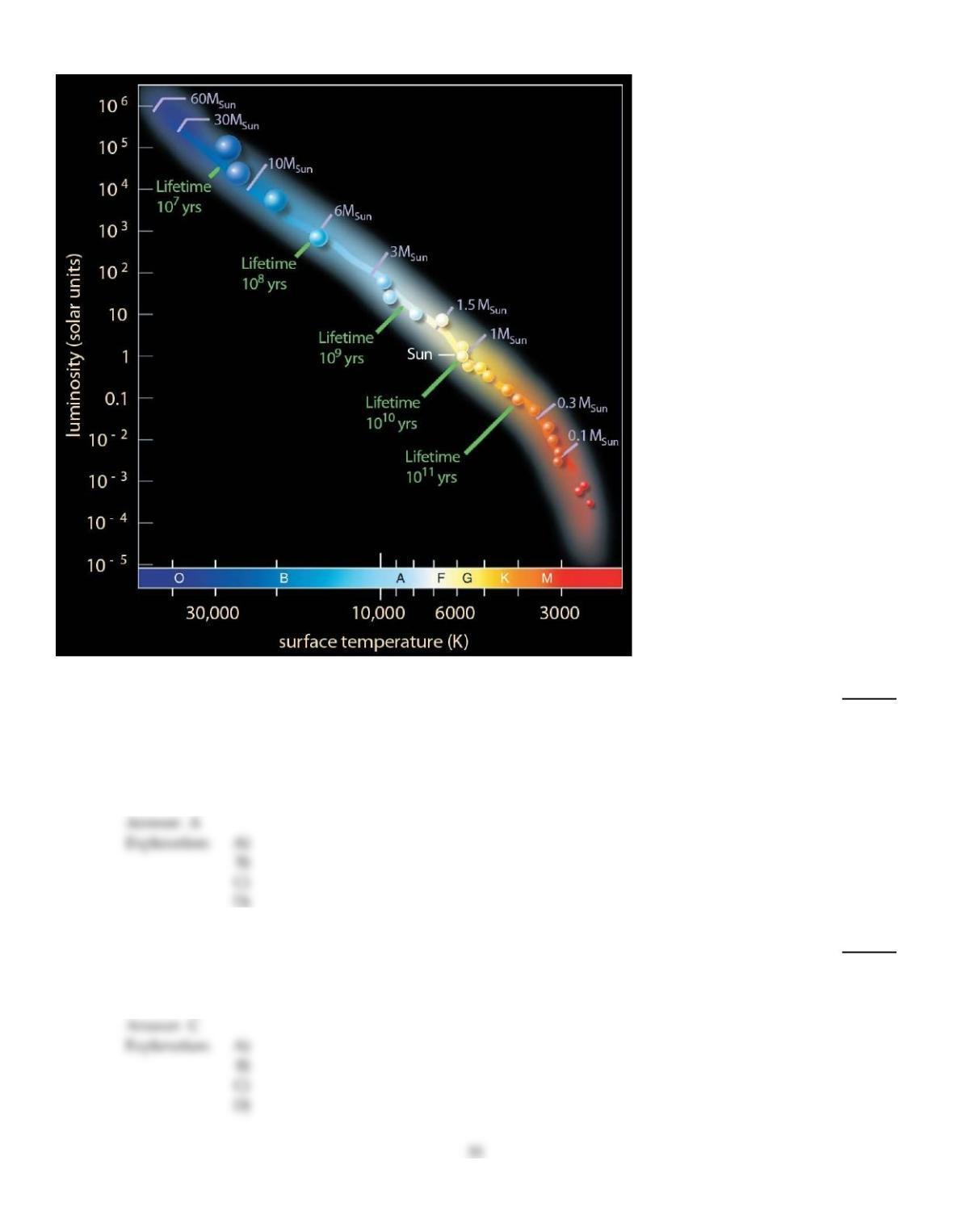
90)
The brightest main–sequence star in a cluster has a temperature of 10,000 K and a luminosity about
100 times greater than the sun. What is the approximate age of the cluster?
90)
A)
About 109 years
B)
About 107 years
C)
About 1011 years
D)
This cannot be answered using the HR diagram.
91)
The total amount of power (in watts, for example) that a star radiates into space is called its
________.
91)
A)
flux
B)
apparent brightness
C)
luminosity
D)
absolute magnitude
92)
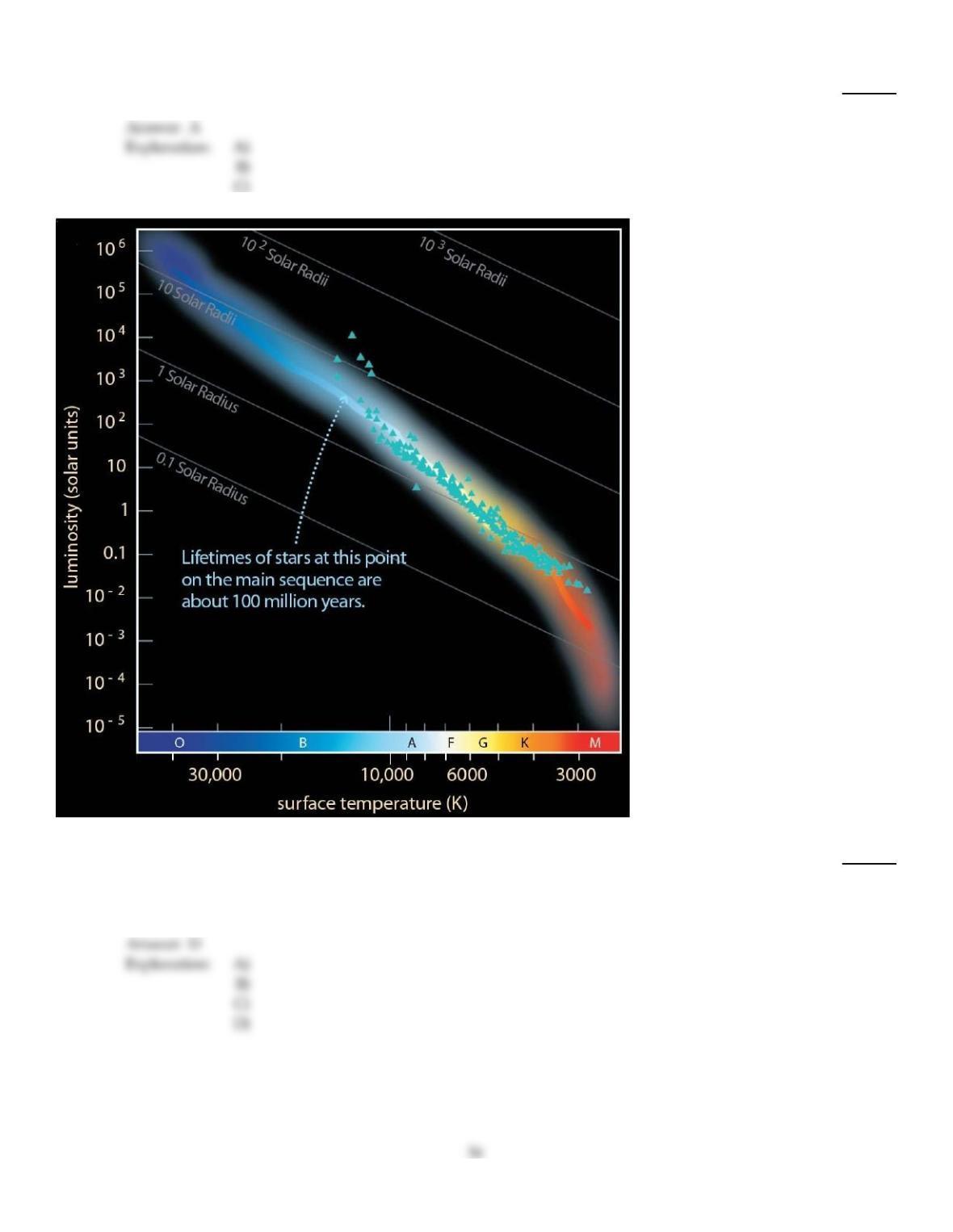
What is the approximate age of a star cluster where the brightest main sequence stars are G stars?
92)
A)
10 billion years
B)
100 billion years
C)
10 million years
93)
A star is observed with a surface temperature of 3,000 K and a luminosity of 105 solar. What is the
approximate radius of this star?
93)
A)
0.3 Msun
B)
30 Msun
C)
3 Msun
D)
The radius cannot be determined.

94)
You measure the parallax angle for a star to be 0.1 arcseconds. The distance to this star is
94)
A)
0.1 parsec.
B)
10 light–years.
C)
0.1 light–year.
D)
10 parsecs.
E)
impossible to determine.
95)
Star A is identical to Star B, except that Star A is twice as far from us as Star B. Therefore, ________.
95)
A)
both stars have the same luminosity, but the apparent brightness of Star B is four times that of
Star A
B)
both stars have the same apparent brightness, but the luminosity of Star B is four times that of
Star A
C)
both stars have the same luminosity, but the apparent brightness of Star B is twice that of Star
A
D)
both stars have the same luminosity, but the apparent brightness of Star A is four times that of
Star B
96)
If Star A is closer to us than Star B, then Star A’s parallax angle is ________.
96)
A)
fewer parsecs than that of Star B
B)
smaller than that of Star B
C)
hotter than that of Star B
D)
larger than that of Star B
97)
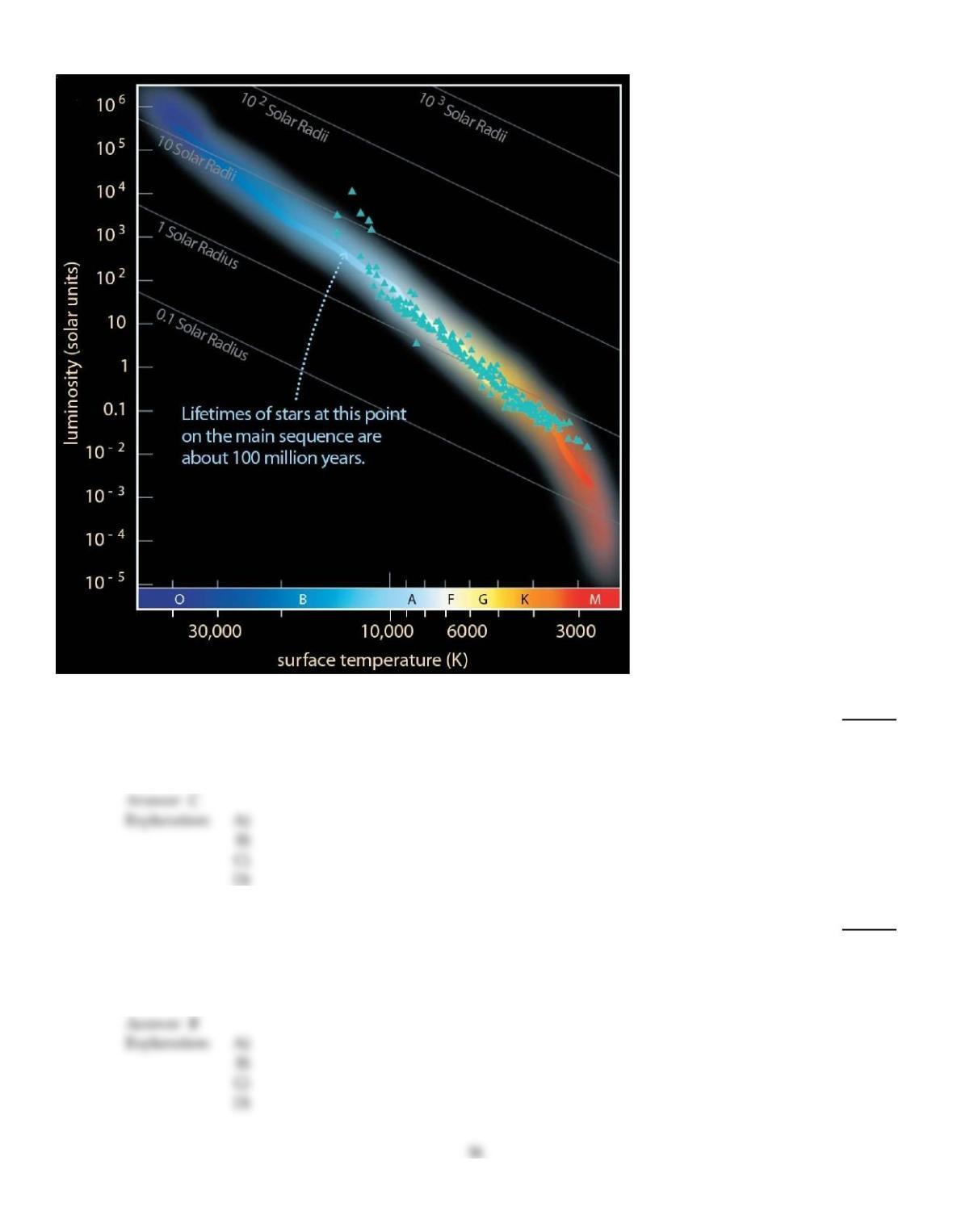
A star is observed with a surface temperature of 3,000 K and a lumi nosity of 105 solar. What is the
approximate radius of this star?
97)
A)
102 solar radii
B)
10 solar radii
C)
103 solar radii
D)
The radius cannot be determined.
98)
Which of the following statements about spectral types of stars is not generally true?
98)
A)
The spectral type of a star can be determined by identifying lines in its spectrum.
B)
The spectral type of a star can be used to determine its distance.
C)
The spectral type of a star can be used to determine its surface temperature.
D)
The spectral type of a star can be used to determine its color.
B
C

99)
Which main–sequence star has the lowest mass?
99)
A)
M
B)
A
C)
G
D)
O
E)
Can’t tell from information provided.
100)
Two separate pairs of binary stars are observed. The separation of the pairs is identical, but the
orbital period of Pair X is 4 times the orbital period of Pair Y. How does the total mass of the stars
in Pair X compare to the total mass of the stars in Pair Y?
100)
A)
Pair Y has a total mass 2 times greater than Pair X.
B)
Pair X has a total mass 16 times greater than Pair Y.
C)
Pair X has a total mass 2 times greater than Pair Y.
D)
Pair Y has a total mass 16 times greater than Pair X.
D
101)
What is the approximate chemical composition (by mass) with which all stars are born?
101)
A)
Half hydrogen and half helium
B)
95% hydrogen, 4% helium, no more than 1% heavier elements
C)
Three quarters hydrogen, one quarter helium, no more than 2% heavier elements
D)
98% hydrogen, 2% helium
C
102)
Which of the following stars are brightest at ultraviolet wavelengths?
102)
A)
M stars
B)
G and K stars
C)
O and B stars
D)
A and F stars
E)
None; all stars are brightest at optical wavelengths.
C
A
103)
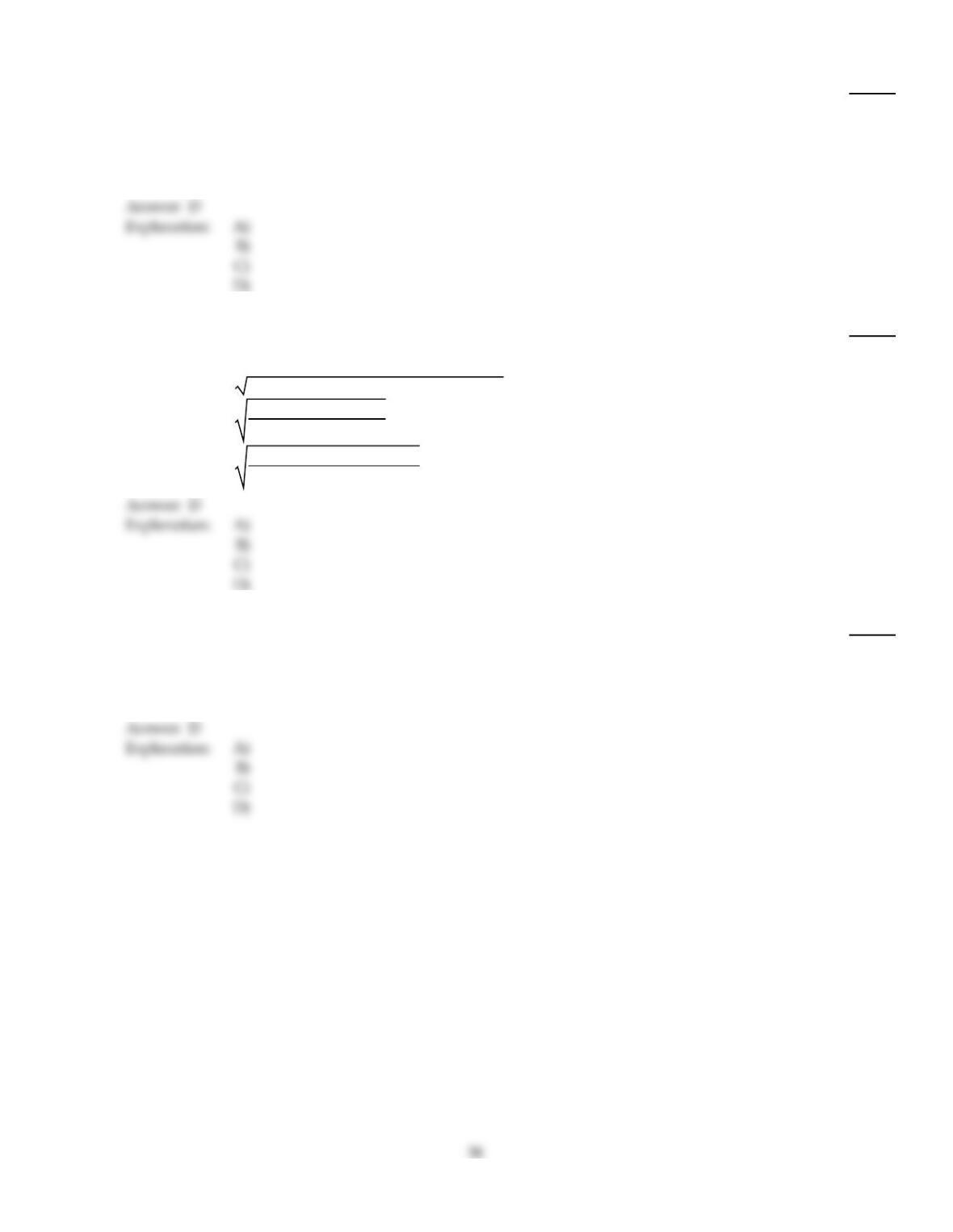
The star Vega has an absolute magnitude of about 4 and an apparent magnitude of about 0. Based
on the definitions of absolute and apparent magnitude, we can conclude that ________.
103)
A)
Vega’s luminosity is less than that of our Sun
B)
Vega has a parallax angle of 1/10 arcsecond
C)
Vega’s surface temperature is cooler than the Sun
D)
Vega is nearer than 10 parsecs from Earth
104)
If one knew the luminosity of a star and measured its apparent brightness, which expression would
one use to calculate the distance to the star?
104)
A)
distance = 4 × luminosity × apparent brightness
B)
distance =4 × luminosity × apparent brightness
C)
distance =apparent brightness
4 × luminosity
D)
distance =luminosity
4 × apparent brightness
105)
How is the lifetime of a star related to its mass?
105)
A)
More massive stars live much longer lives than less massive stars.
B)
More massive stars live slightly shorter lives than less massive stars.
C)
More massive stars live slightly longer lives than less massive stars.
D)
More massive stars live much shorter lives than less massive stars.
106)
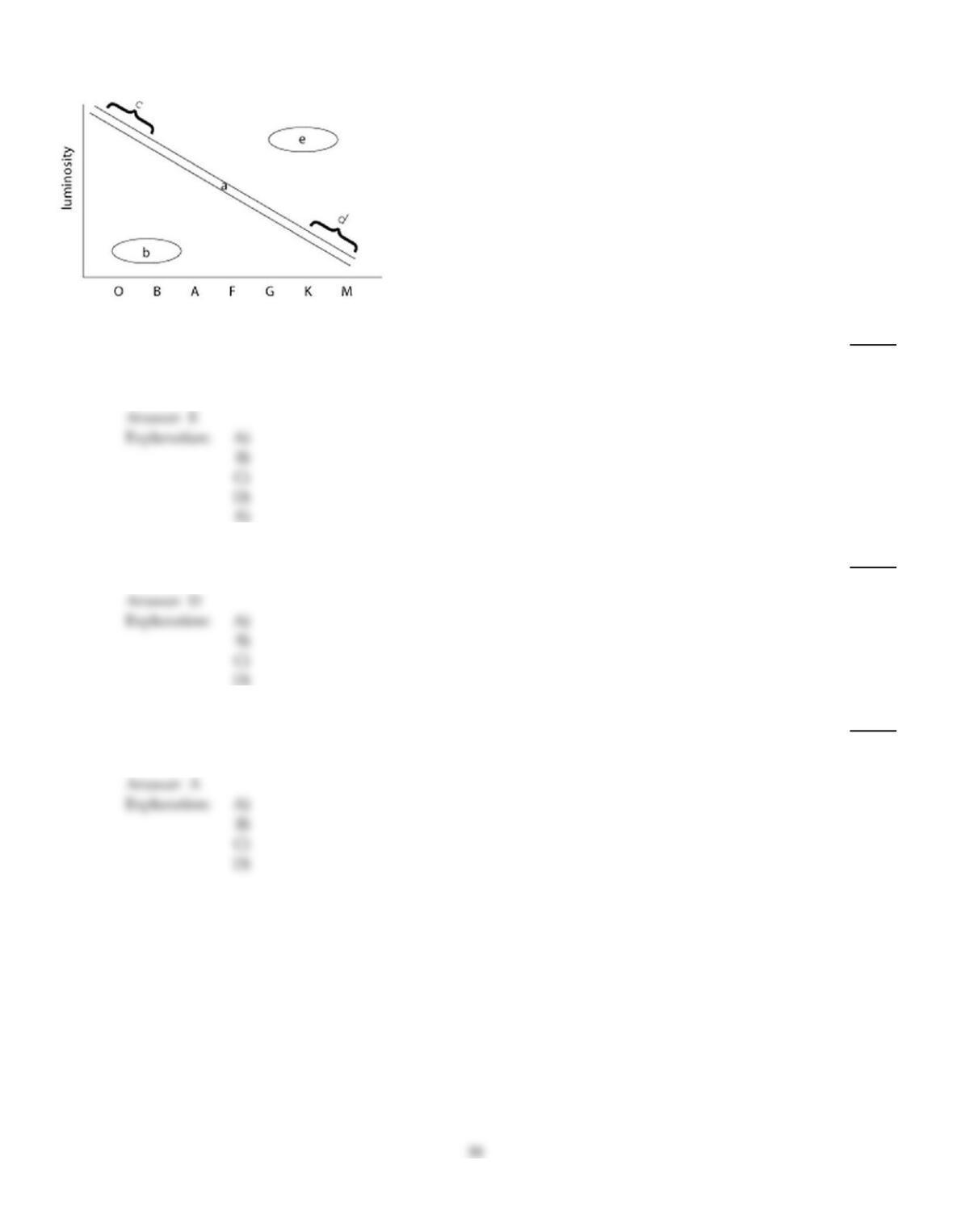
The sketch above shows groups of stars on the H–R diagram, labeled (a) through (e); note that (a)
represents the entire main sequence while (c) and (d) represent only small parts of the main
sequence. Which group represents stars of the largest radii?
106)
A)
a
B)
b
C)
c
D)
d
E)
e
107)
Our Sun is a star of spectral type ________.
107)
A)
F
B)
S
C)
M
D)
G
108)
Based on the definition of apparent brightness, which units are appropriate for its measurement?
108)
A)
Watts per square meter
B)
Watts
C)
Newtons
D)
Joules
109)
Which of the following best describes the axes of a Hertzsprung–Russell (H–R) diagram?
109)
A)
surface temperature on the horizontal axis and luminosity on the vertical axis
B)
mass on the horizontal axis and luminosity on the vertical axis
C)
mass on the horizontal axis and stellar age on the vertical axis
D)
interior temperature on the horizontal axis and mass on the vertical axis
E)
surface temperature on the horizontal axis and radius on the vertical axis
110)
The sketch above shows groups of stars on the H–R diagram, labeled (a) through (e); note that (a)
represents the entire main sequence while (c) and (d) represent only small parts of the main
sequence. Which group represents stars with the longest main–sequence lifetimes?
110)
A)
a
B)
b
C)
c
D)
d
E)
e
111)
On the main sequence, stars obtain their energy
111)
A)
by converting helium to carbon, nitrogen, and oxygen.
B)
from chemical reactions.
C)
from nuclear fission.
D)
from gravitational contraction.
E)
by converting hydrogen to helium.
112)
A star of spectral type G lives approximately how long on the main sequence?
112)
A)
10,000 years
B)
1 billion years
C)
10 billion years
D)
1,000 years
E)
10 million years
113)
Which of the following statements comparing open and globular star clusters is not true?
113)
A)
Open and globular clusters each typically contain a few hundred stars.
B)
For both open and globular clusters, we can assume that all the stars in a particular cluster are
about the same age.
C)
Stars in open clusters are relatively young while stars in globular clusters are very old.
D)
Open clusters are found only in the disk of the galaxy while globular clusters may be found
both in the disk and the halo of the galaxy.
SHORT ANSWER. Write the word or phrase that best completes each statement or answers the question.
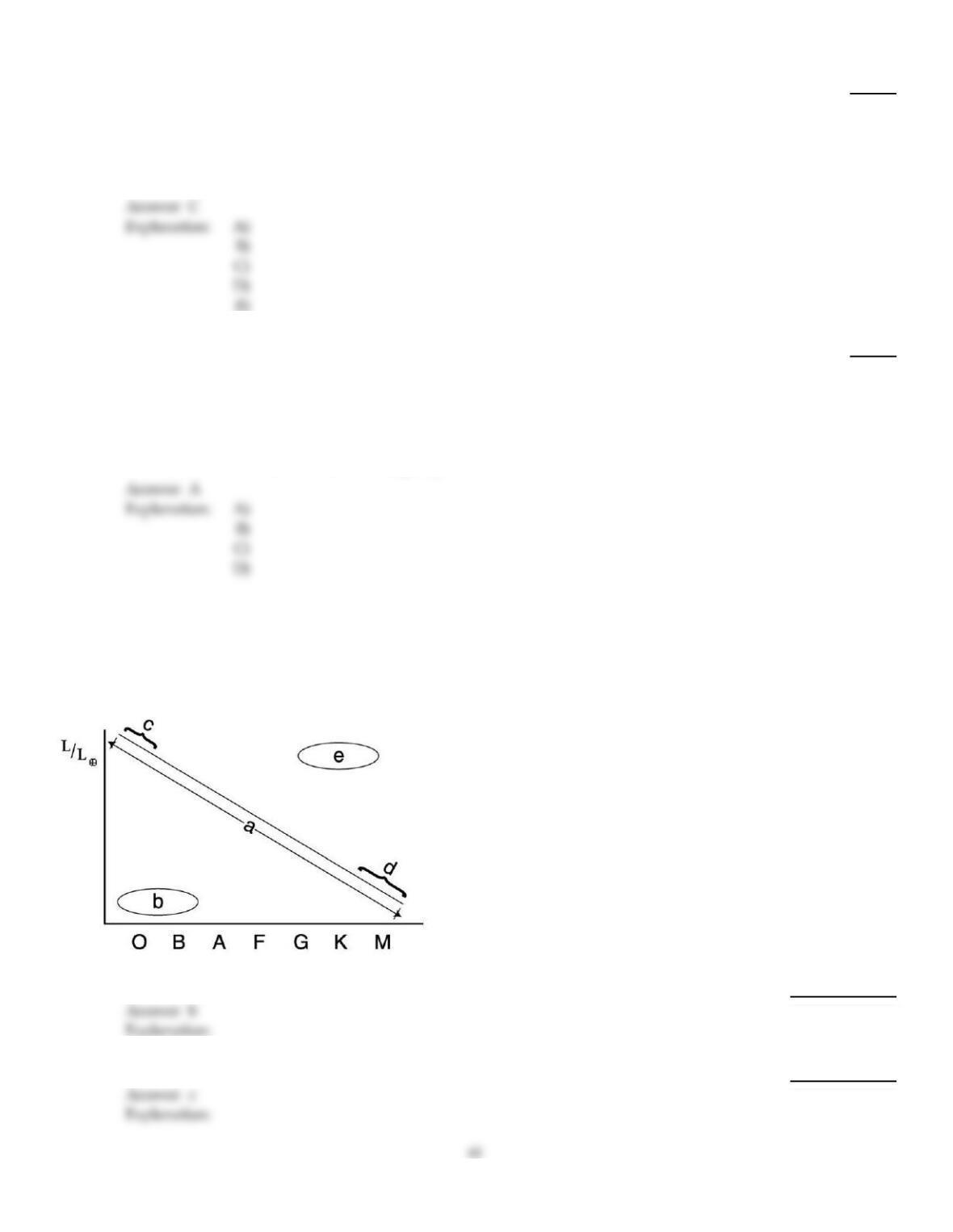
The following questions refer to the sketch of the H–R diagram below. Choose the best answer in each case. Note that choice (a) refers to
the entire main sequence, while (c) and (d) refer to only small parts of the main sequence. If choice (c) or (d) offers a better answer to a
particular question than (a), use the best choice. You may use the same choice more than once.
114)
Which group represents stars of the smallest radii?
114)
115)
Which group represents hydrogen–burning stars with the shortest lifetimes?
115)
116)
The Earth is about 150 million km from the Sun, and the apparent brightness of the Sun in
our sky is about 1,300 watts per square meter. Determine the apparent brightness we
would measure for the Sun if we were located half the earth’s distance from the Sun.
116)
117)
Explain why stars displaying spectral lines of molecules must be relatively cool.
117)
118)
Explain why stars more massive than the Sun live shorter main sequence lives than stars
less massive than the Sun, despite having more fuel available for nuclear reactions.
118)
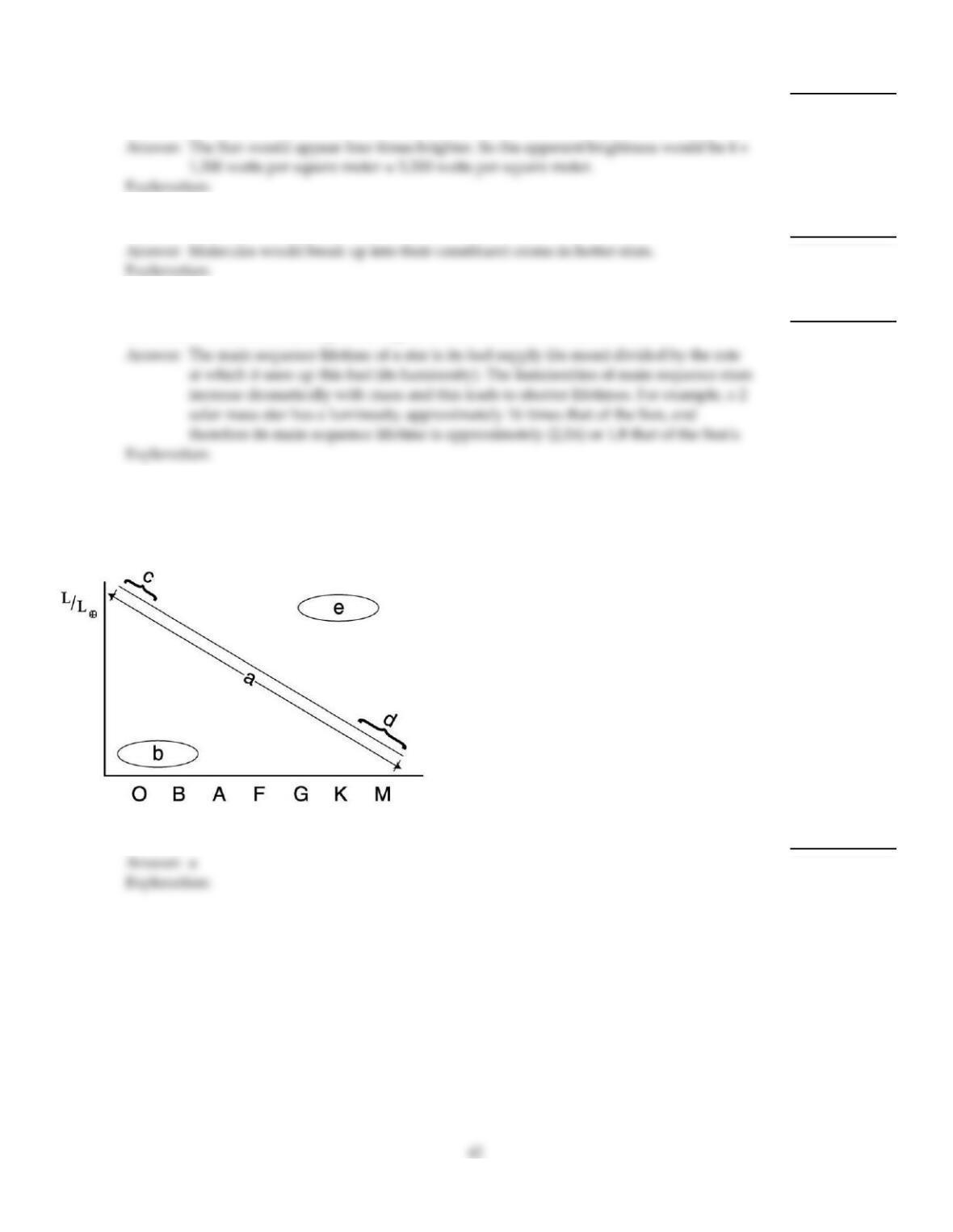
The following questions refer to the sketch of the H–R diagram below. Choose the best answer in each case. Note that choice (a) refers to
the entire main sequence, while (c) and (d) refer to only small parts of the main sequence. If choice (c) or (d) offers a better answer to a
particular question than (a), use the best choice. You may use the same choice more than once.
119)
Which group includes the Sun?
119)
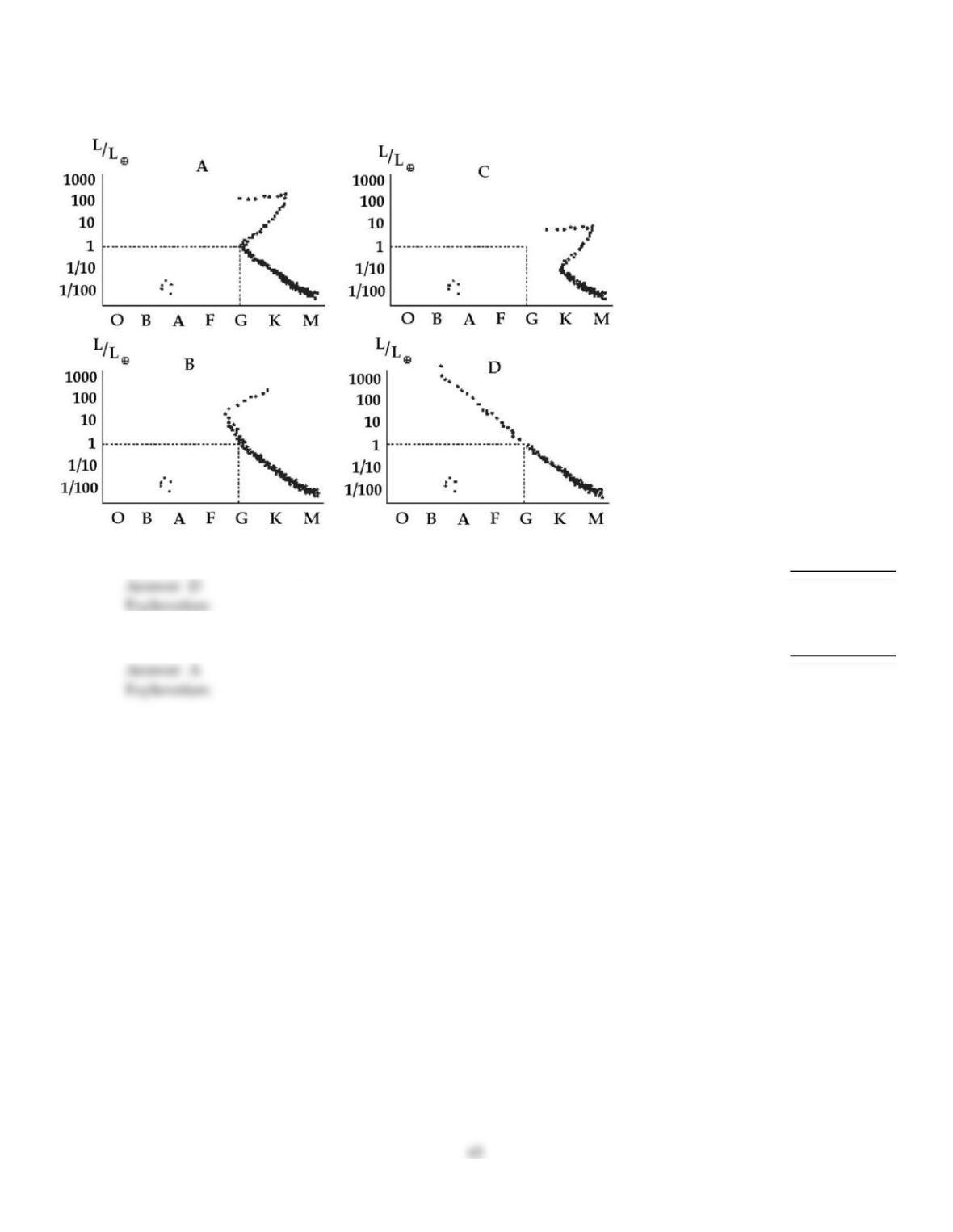
The following questions refer to the representations below of H–R diagrams for different clusters of stars. In each diagram, the dotted
lines locate the position of the Sun.
120)
Which cluster is the youngest?
120)
121)
Which cluster is 10 billion years old?
121)
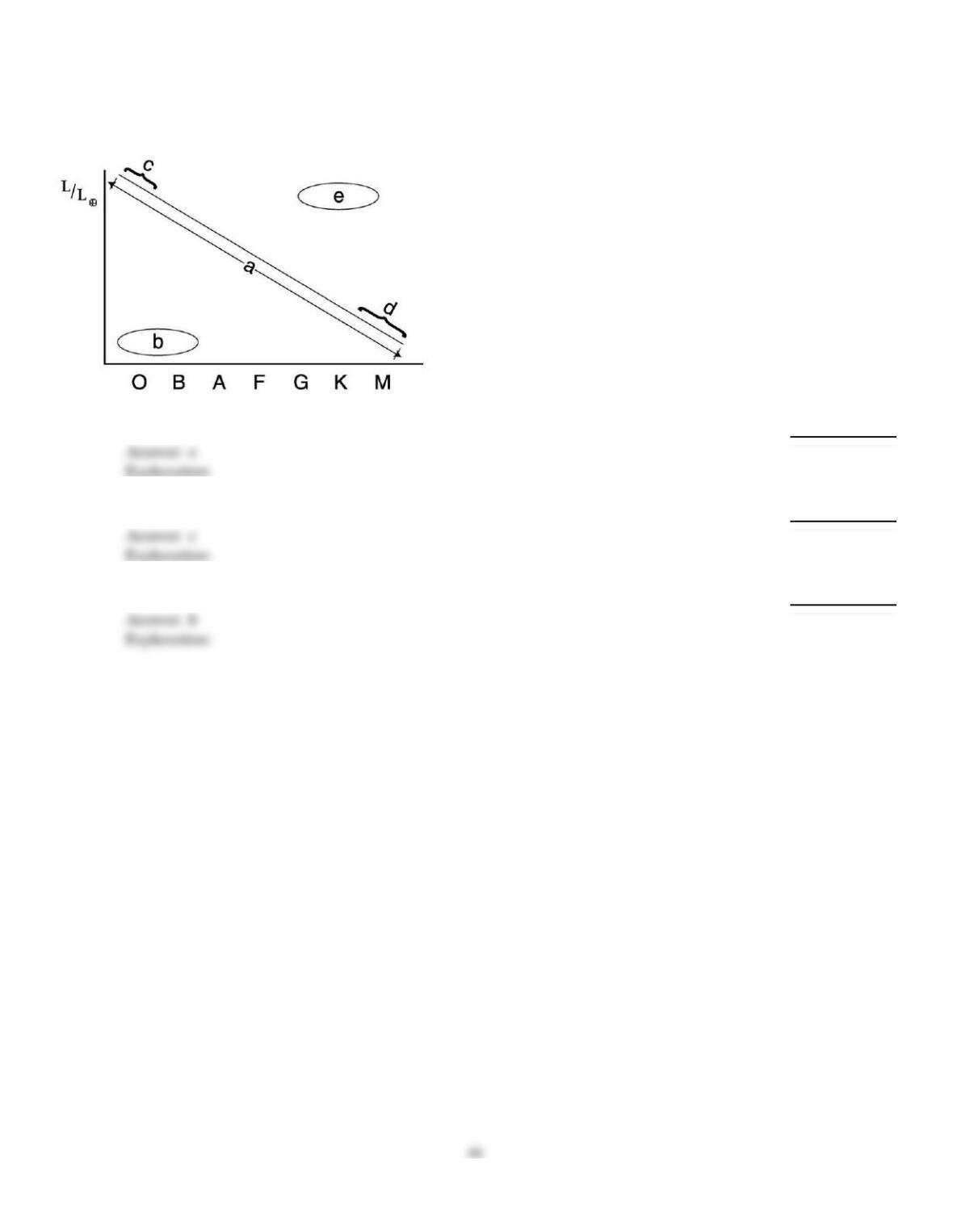
The following questions refer to the sketch of the H–R diagram below. Choose the best answer in each case. Note that choice (a) refers to
the entire main sequence, while (c) and (d) refer to only small parts of the main sequence. If choice (c) or (d) offers a better answer to a
particular question than (a), use the best choice. You may use the same choice more than once.
122)
Which group includes stars that are burning helium in their cores?
122)
123)
Which group represents stars that are hot and very bright?
123)
124)
Which group represents stars that are hot but dim?
124)
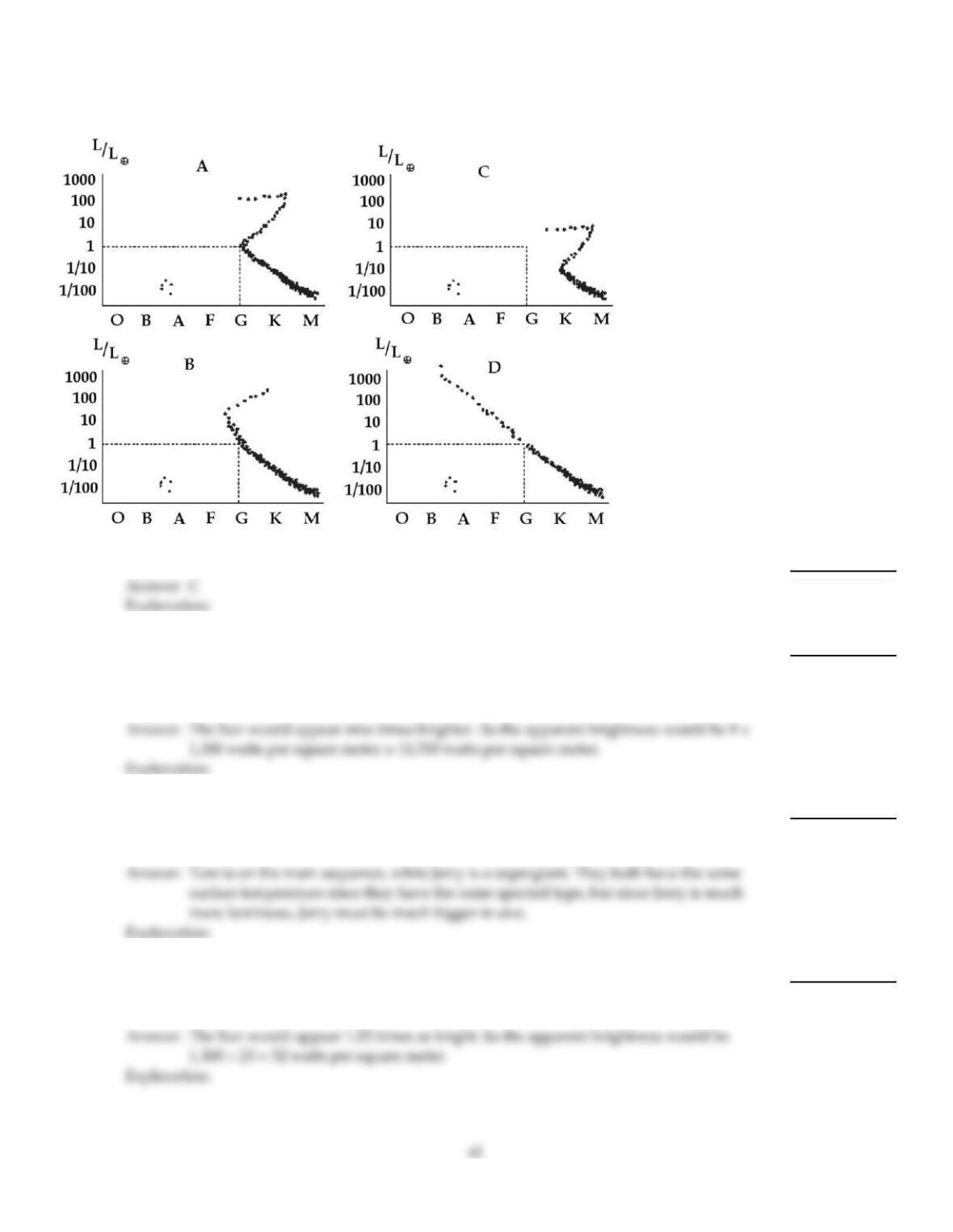
The following questions refer to the representations below of H–R diagrams for different clusters of stars. In each diagram, the dotted
lines locate the position of the Sun.
125)
Which cluster is the oldest?
125)
126)
The Earth is about 150 million km from the Sun, and the apparent brightness of the Sun in
our sky is about 1,300 watts per square meter. Determine the apparent brightness we
would measure for the Sun if we were located one–third of the earth’s distance from the
Sun.
126)
127)
Two stars, Tom and Jerry, have the same spectral type. Tom is luminosity class V and Jerry
is luminosity class I. Which star is bigger? Which star is more luminous? Which star has a
hotter surface temperature? Explain your answers.
127)
128)
The Earth is about 150 million km from the Sun, and the apparent brightness of the Sun in
our sky is about 1,300 watts per square meter. Determine the apparent brightness we
would measure for the Sun if we were located five times the earth’s distance from the Sun.
128)
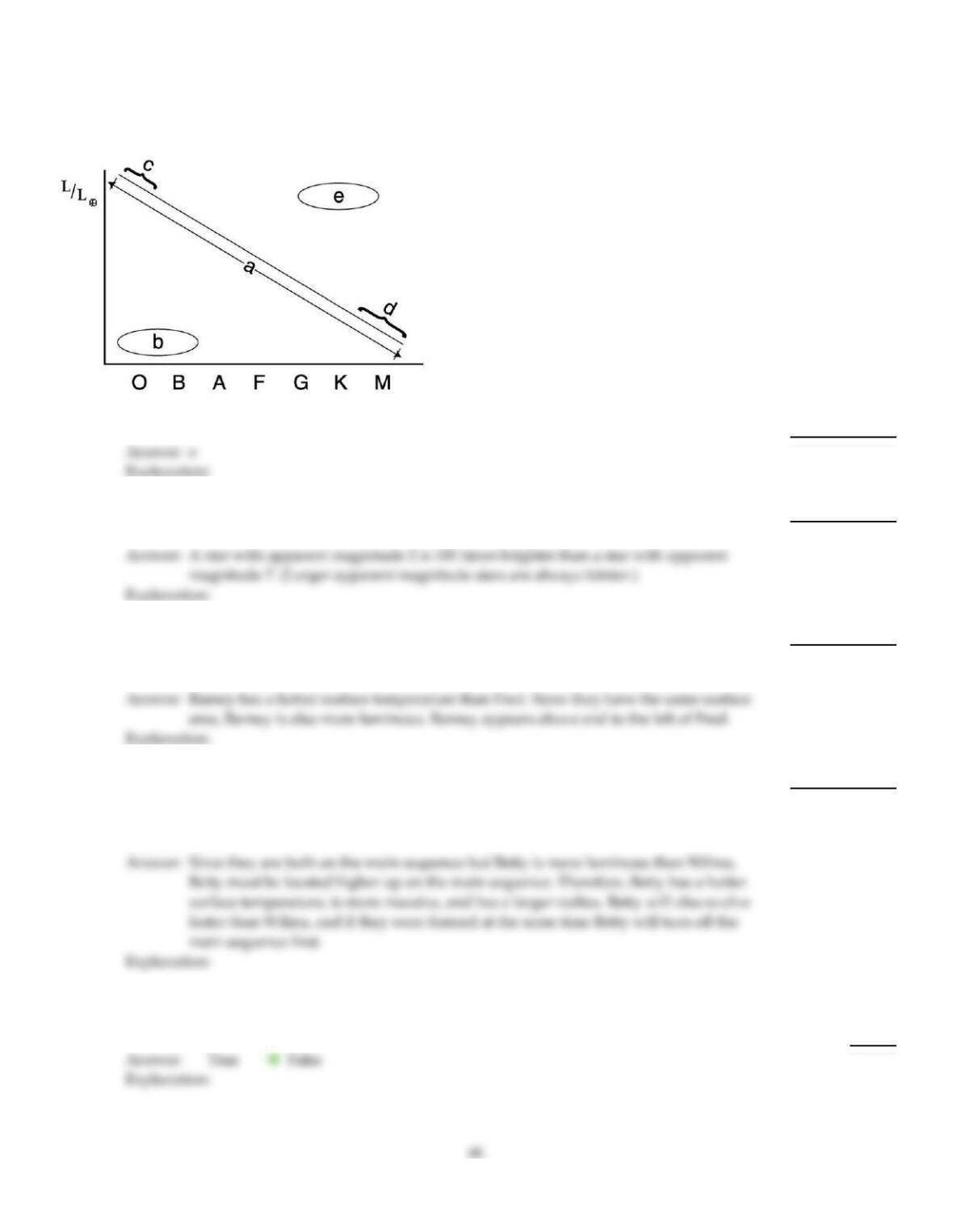
The following questions refer to the sketch of the H–R diagram below. Choose the best answer in each case. Note that choice (a) refers to
the entire main sequence, while (c) and (d) refer to only small parts of the main sequence. If choice (c) or (d) offers a better answer to a
particular question than (a), use the best choice. You may use the same choice more than once.
129)
Which group includes stars that are burning elements besides hydrogen in their cores?
129)
130)
Which is brighter in our sky, a star with apparent magnitude 2 or a star with apparent
magnitude 7? How many times brighter does it appear?
130)
131)
Two stars, Fred and Barney, are of the same size. Fred has spectral type F, while Barney
has spectral type B. Which one is more luminous? What are their relative locations on the
HR diagram?
131)
132)
Two stars, Betty and Wilma, are both on the main sequence. Betty is more luminous than
Wilma. Which one has a hotter surface temperature? Which one is more massive? Which
one is bigger? If they both formed at the same time, which one will evolve off the main
sequence first?
132)
TRUE/FALSE. Write ‘T’ if the statement is true and ‘F’ if the statement is false.
133)
The apparent brightness of a star depends only on its luminosity.
133)

134)
White dwarfs are all about the same size.
134)
135)
If the distance between us and a star is doubled, its apparent brightness will decrease by a factor of
four.
135)
136)
Two stars have the same luminosity. Star X is spectral type F, while Star Y is spectral type K. Star X
must be larger in radius than Star Y.
136)
137)
The more distant a star, the smaller its parallax.
137)
138)
We can measure the parallax of most stars in our galaxy.
138)
139)
Most stars on the main sequence fuse hydrogen into helium in their cores, but some do not.
139)
140)
Main sequence stars have radii ranging from about 0.03 solar radius to 30 solar radius.
140)
141)
Two stars both lie on the main sequence. Star X is spectral type A, while Star Y is spectral type G.
Star X must be more massive than Star Y.
141)
142)
We can measure the radii of stars in eclipsing binary systems.
142)
143)
Some stars are cool enough to have molecules in their atmosphere.
143)
144)
Main sequence stars are all about the same radius as the Sun.
144)

145)
Two stars have the same spectral type. Star X is in luminosity class III, while Star Y is in luminosity
class V. Star X must be larger in radius than Star Y.
145)
146)
Some 10 solar mass main–sequence stars have much shorter lifetimes than other 10 solar mass
main–sequence stars.
146)
147)
All stars spend approximately the same amount of time on the main sequence.
147)
148)
All main–sequence G stars have approximately the same mass.
148)
149)
It is impossible for a star to have a negative apparent magnitude, such as –1.
149)
150)
A 10 solar mass star is about ten times more luminous than a 1 solar mass star.
150)
151)
The faintest visible stars to the naked eye have an apparent magnitude of about 6
151)
152)
The size of the Earth’s orbit is doubled. This will allow the parallaxes of more distant stars to be
measured.
152)
153)
Blue stars are always more luminous than red stars.
153)
154)
A star with an apparent magnitude of 10 appears fainter than a star with an apparent magnitude of
9.
154)
155)
Spectral type, surface temperature, and color all describe the same basic characteristic of a star.
155)

ESSAY. Write your answer in the space provided or on a separate sheet of paper.
156)
Inferring stellar lifetimes: Scientists must often draw on a variety of concepts to develop new understanding.
Take, for example, the inferred lifetimes of stars. What two properties must be precisely measured in order to
estimate the lifetime? Outline the set of observations that must be made in order to determine those properties.
Then discuss the fundamental physics that must be understood to relate these to the rate at which hydrogen is
converted to helium in the stellar core, and to determine the amount of hydrogen available in the core.
157)
Observing Stellar Evolution: Stars evolve on timescales of millions to billions of years, making it impossible for
astronomers to follow the life–cycle of any individual star. Explain how astronomers overcome this limitation.
Be sure to discuss the important role that observations of star clusters play in revealing the evolution of stars.
158)
Our Sun, An Average Star: Often in science it is helpful to talk about a representative example of the objects or
phenomena being studied. However, you must always keep in mind that the average case is not always
representative. For example, our Sun is often described as an “average” star in the Milky Way. In what sense is
this statement true? In what sense is this statement seriously misleading? Do you think it is useful to
characterize the stars in the Milky Way by simply citing our “average” Sun?
159)
Confusing Terminology in Science: Scientists’ love of jargon and acronyms often confounds the public and makes
it impossible for them to read scientific literature. Use the example of spectral types introduced in this chapter
(i.e., the Sun is a “G2” star) as a case study in jargon. What is the historical origin of the spectral types? Why are
the letters in a confusing, non–alphabetical order? Why do you think astronomers persist in using spectral
types? Do you think astronomers should drop this notation, and, if so, what should replace it?

Answer Key
Testname: C12
Answer Key
Testname: C12
Answer Key
Testname: C12

Answer Key
Testname: C12