Garrett/Grisham 5e Test Bank 1
Chapter 12—Recombinant DNA: Cloning and Creation of Chimeric Genes
MULTIPLE CHOICE
1. All are characteristic of plasmids EXCEPT:
a.
naturally occurring, circular extrachromosomal DNA.
b.
able to perpetuate themselves without a host organism.
c.
artificial plasmids can be constructed by restriction endonuclease digestion, insertion, and
ligation.
d.
harbor genes for novel metabolic activities.
e.
an origin of replication must be included in the plasmid to facilitate propagation.
2. All are features of a plasmid useful for cloning EXCEPT:
a.
expressed sequence tag.
b.
a cloning site.
c.
a replicator (origin of replication).
d.
a selectable marker.
e.
all are features.
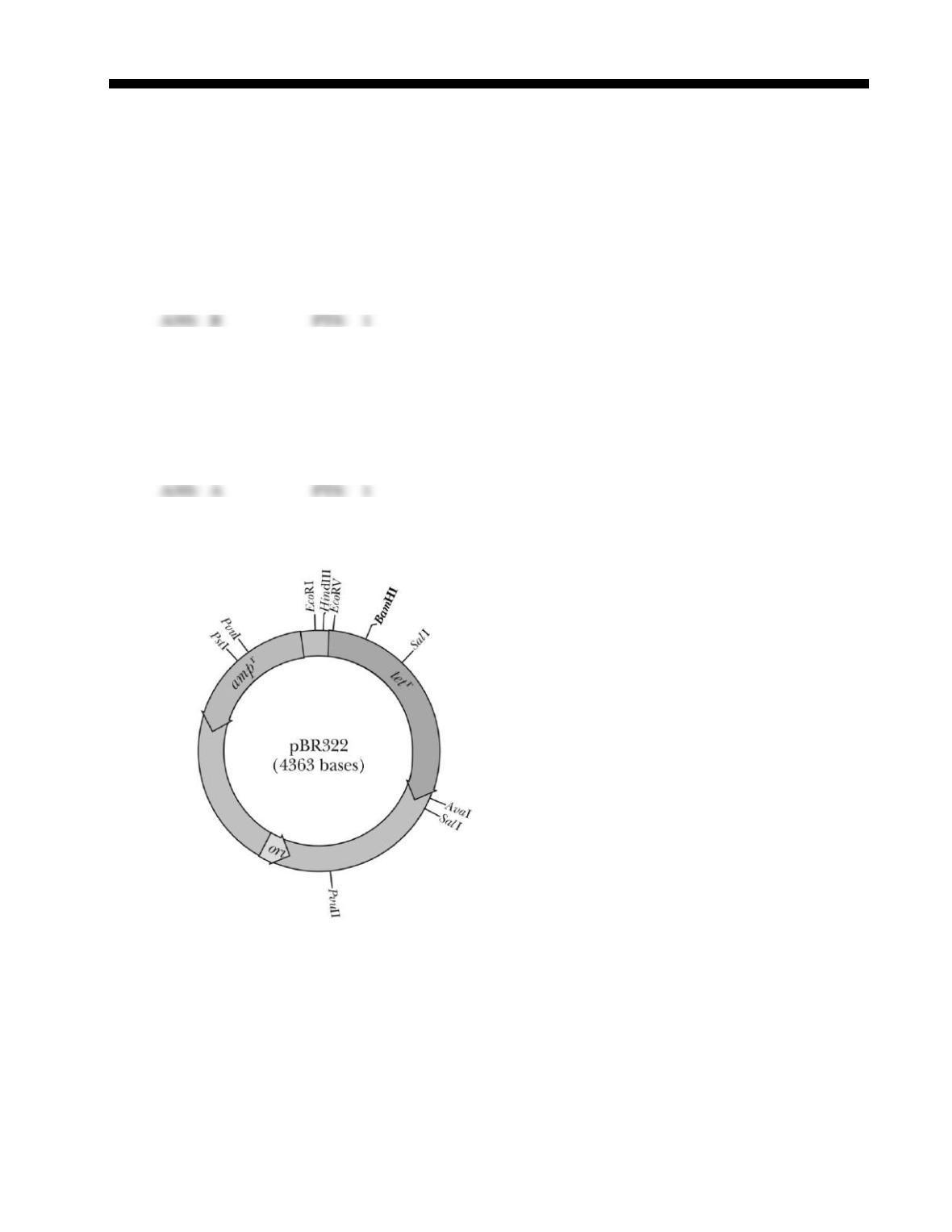
3. If the pBR322 were treated with PstI in order to insert a gene into the plasmid, which of the following
would be correct regarding cells that were transformed with the resulting vector?
a.
cells that contained the desired vector would be resistant to ampicillin but sensitive to
tetracycline
b.
cells that contained the desired vector would be resistant to tetracycline but sensitive to
ampicillin
c.
cells that contained the desired vector would be resistant to both ampicillin and
tetracycline
d.
cells that contained the desired vector would be sensitive to both ampicillin and
tetracycline
e.
none of the above

4. To position a gene in an expression vector downstream from a promoter (i.e., perform directional
cloning), it is best to:
a.
use the largest plasmid available.
b.
treat the gene with DNase I.
c.
restrict both the gene and the plasmid with one restriction endonuclease and then screen all
colonies for those that express the gene.
d.
restrict each end of the DNA fragment (gene) with a different restriction endonuclease and
do likewise for the plasmid.
e.
use a vector with two sites for the same restriction endonuclease.
5. A method used to insert or transform cells with a plasmid is to:
a.
add the DNA to bacterial cells that have been lightly treated with lysozyme to produce
“holes” in the cell wall.
b.
add the DNA to a heated suspension of cells at 42C.
c.
treat the bacteria with Ca2+, add the DNA, and briefly heat to 42C.
d.
incubate the DNA with the cells overnight at 4C.
e.
mixing plasmids with an extract of broken cells.
6. If DNA fragments of about 4 kb are to be cloned, which vector would be most useful?
a.
plasmid
b.
cosmid
c.
YACs (yeast artificial chromosomes)
d.
bacteriophage lambda
e.
E. coli chromosome
7. All are steps in the sequence for construction of a chimeric plasmid EXCEPT:
a.
annealing the ends of the vector and foreign DNA.
b.
cutting the source of the foreign DNA with a restriction endonuclease.
c.
reannealing the ends of the vector back together.
d.
cutting the vector plasmid with the same restriction endonuclease.
e.
none of the above.
8. One of the problems with plasmids like pUR278 is that there is no true marker for determining
whether or not the plasmid contains the inserted gene since the cloning site does not lie within any
specific gene. Which of the following would be an extremely useful tool for rapid selection of those
bacteria that have taken up a plasmid with the desired DNA insert?
a.
look for the production of the lacZ gene by adding X-gal to the growth medium
b.
include the gene for a fluorescent protein such as GFP in the inserted DNA
c.
after ligating the DNA insert and plasmid, separate the mixture of DNA molecules by
agarose gel electrophoresis to isolate the DNA molecule that corresponds to the size of the
plasmid+insert
d.
look for ampicillin resistance in the transformed cells
e.
none of the above would be effective

9. The advantages of using the pET plasmid system include ____.
a.
genes to be expressed are under the control of a T7 promoter
b.
the T7 polymerase is slower than a typical E coli polymerase
c.
the expressed protein never accounts for more than 5% of the total cell protein
d.
the T7 polymerase is under the control of the lac operon and is thus only active when
induced by an agent such as IPTG
e.
both a and d are correct
10. Shuttle vectors have the property that they:
a.
contain promoters for the expression of the gene.
b.
have origins of replication for two different cell types, usually bacteria and yeast.
c.
are capable of incorporating very large DNA fragments.
d.
contain more than one antibiotic resistant gene.
e.
none of the above
11. All are characteristic of YACs (yeast artificial chromosomes) EXCEPT:
a.
YACs can successfully propagate DNA molecules of 2 megabase pairs in length.
b.
YACs have been transferred into animals.
c.
YACs must include a centromere.
d.
YACs must include telomers.
e.
All are true.
12. A genomic DNA library is:
a.
a collection of short fragments from nuclear DNA digestion.
b.
arrays of synthetic oligonucleotides used to select for a specific DNA.
c.
a set of cloned fragments that collectively represent the genes of a particular organism.
d.
a short segment of DNA whose sequence is complementary to a portion of the DNA of
interest.
e.
a circular DNA molecule of 1 kb to 200 kb found in bacteria and yeast cells.
13. The correct sequence for colony hybridization experiments is:
A.
A replica of the bacterial colonies is obtained on an absorbent disc.
B.
Autoradiography of the disc reveals probe complementary DNA.
C.
Host bacteria with plasmid are plated and allowed to grow overnight.
D.
The disc is treated with alkali.
E.
The disc is reacted with labeled probe.
a.
A, C, E, B, D
b.
C, A, E, D, B
c.
C, E, A, B, D
d.
C, A, E, B, D
e.
C, A, D, E, B

14. In the Southern hybridization procedure, the gel after electrophoresis is treated with NaOH and then
neutralized before blotting. What is the primary function of the alkaline treatment?
a.
It neutralizes any acid soluble impurities in the gel.
b.
It cleaves the DNA into smaller fragments to permit greater efficiency of transfer.
c.
It inactivates any restriction endonucleases that may be in the gel.
d.
It neutralizes any acidic phosphate groups that might prevent hybridization.
e.
It denatures the duplex DNA to single-stranded DNA (ssDNA).
15. All are true for cDNA libraries EXCEPT:
a.
reverse transcriptase synthesizes a DNA strand complement of the mRNA templates.
b.
mRNA templates are isolated using oligo (dA)-cellulose chromatography.
c.
linkers are added and the cDNA is cloned into suitable vectors.
d.
the cDNA are copies from mRNA templates.
e.
all are true.
16. The correct sequence of procedures in the Southern blotting (hybridization) technique is:
A.
hybridization with radioactive probe.
B.
agarose gel electrophoresis and visualize bands.
C.
transfer (blot) to nitrocellulose filter.
D.
digest DNA with restriction nucleases.
E.
expose filter to X-ray film, develop and observe.
a.
B, A, C, E, D
b.
D, C, B, A, E
c.
C, D, B, E, A
d.
D, B, C, A, E
e.
A, B, C, D, E
17. Looking at all of the genes that are activated during a major metabolic shift or during embryogenesis
and development of organisms is called:
a.
fractional expression.
b.
genetic fractionation.
c.
functional genomics.
d.
mutagenesis.
e.
none of the above.
18. The study of all of the proteins expressed by a certain cell or tissue under specific conditions is called:
a.
genetics.
b.
proteomics.
c.
embryogenesis.
d.
mutagenesis.
e.
all of the above.

Garrett/Grisham 5e Test Bank 5
19. To express a eukaryotic protein in E. coli, the eukaryotic cDNA must be cloned in a(n) ____ that
contains ____ and ____.
a.
expression vector; promoter; ribosomal-binding site
b.
hybridization complex; promoter; transition start site
c.
mRNA; ribosomal-binding site; promoter
d.
mRNA; introns; exons
e.
none of the above
20. Hybrid proteins or fusion proteins are produced by:
a.
incubation of two proteins with a protease.
b.
expression of genes coding for multiple proteins.
c.
translation of mRNAs without removing exons.
d.
translation of recombinant sequences from expression vectors carrying cDNA inserts
cloned directly into the coding sequence of a vector-born protein-coding gene.
e.
all of the above.
21. Reporter genes such as those for green fluorescent protein (GFP) are found on many commercial
plasmids. These genes are useful to determine:
a.
if the plasmid is in the host.
b.
if a gene is present in a library.
c.
if a foreign protein is being expressed on a vector.
d.
the relative strength of a promoter sequence.
e.
all of the above.
22. Each cycle of amplification in PCR involves all of the steps EXCEPT:
a.
the addition of fresh dNTPs to the reaction mixture.
b.
annealing of oligodeoxyribonucleotide primers to DNA.
c.
thermal denaturation of the target duplex DNA.
d.
reaction with DNA polymerase at approximately 70C.
e.
none of the above.
23. RT–PCR differs from basic PCR in that:
a.
reverse temperatures are used for annealing and transcription.
b.
transcription is reversed from 5′ to 3′ ends.
c.
reverse transcriptase is used to synthesize a cDNA strand complementary to an RNA
strand.
d.
reverse transcripase is used to synthesize an RNA strand from the DNA strand.
e.
none of the above.
24. In vitro ____ makes it possible to alter the nucleotide sequence of a cloned gene systematically.
a.
protein synthesis
b.
mRNA synthesis
c.
hybridization
d.
mutagenesis
e.
all are true

25. Which of the following is the appropriate source of the DNA polymerase included in the PCR reaction
mixture?
a.
E. coli
b.
bacteriophage T4
c.
Thermus aquaticus
d.
Drosophila melanogaster
e.
Human
26. What would be the 9-residue primer used to amplify:
5′-ATCGACGTTACGCTACATAGCATAAGGCTT-3′
a.
5′-TAGCTGCAA-3′
b.
5′-AAGCCTTAT-3′
c.
5′-UAGCUGCAA-3′
d.
5′-AAGCCUUAU-3′
e.
5′-TGCGATGTA-3′
27. PCR-based mutagenesis is used to create:
a.
mutant strains of an eukaryotic organism.
b.
generally modified plasmid vectors.
c.
mutant bacterial strains.
d.
mutant DNA libraries.
e.
specifically altered proteins.
28. How does RNA interference function?
a.
siRNA binds to genes and prevents transcription
b.
a single strand of the siRNA binds to the gene transcript, preventing translation
c.
the double stranded siRNA binds to mRNA to prevent ribosomal association
d.
siRNA binds to RNA polymerase preventing mRNA production
e.
none of the above
29. The most promising vector for human gene therapy is ____.
a.
yeast
b.
E coli
c.
human papilloma virus
d.
adenovirus
e.
bacteriophage

30. All are strategies for human gene therapy EXCEPT:
a.
use of expression cassettes.
b.
incorporation into expression vectors.
c.
transfer into patient cells.
d.
introduction of transformed stem cells.
e.
all are true.
31. The original development of PCR did not use the Taq polymerase. What is the reason that the Taq
polymerase is currently used?
a.
the DNA melting step at 95°C would cause denaturation of most DNA polymerases from
other organisms
b.
the Taq polymerase is one of the most rapid DNA polymerase enzymes known and is
therefore extremely useful for PCR
c.
the original method of PCR required that DNA polymerase be added prior to each round
of elongation, something that is not conducive to automation
d.
the Taq polymerase is the only DNA polymerase that will allow production of 2n amounts
of DNA (where n=number of cycles)
e.
both A and C are corect
32. In a DNA microarray, how many different oligonucleotides can be produced if each oligonucleotide is
20 nucleotides long?
a.
420
b.
204
c.
80
d.
20
e.
none of the above
33. Which of the following describes the major utility of a eukaryotic cDNA library if one is trying to
express a protein present in a eukaryotic cell?
a.
the library represents all genes that were actively expressed at a specific time
b.
the genes lack introns and thus can be expressed by bacterial expression systems
c.
cDNA libraries are readily available
d.
all of the above are correct
e.
both A and B are correct