
Chapter 12 – Accounting for Private Not-For-Profit Organizations (including Accounting for
Not-for-Profit Colleges and Universities and Health Care Organizations)
MULTIPLE CHOICE
1. Which of the following is NOT a required characteristic of a private
not-for-profit organization per the definition given by the AICPA?
a.
no owners or shareholders
b.
an operating purpose other than making a profit
c.
an organization dedicated to service of the public good
d.
Significant contributions from providers who do not expect
reciprocal goods or services in return
2. Alice makes a cash gift which has no strings attached to a political
party. It is recorded as:
a.
An Endowment.
b.
Revenue-Unrestricted contribution.
c.
Revenue-Temporarily Restricted Contribution.
d.
An increase in the fund balance of the General Fund.
3. Atlee makes a cash gift to a not-for–profit local ballet company which
is designated by the donor to buy costumes for a new ballet staging. It
should be accounted for with the following journal entry:
a.
Cash XXX
Revenue–Unrestricted Contribution XXX
b.
Cash XXX
Revenue–Temporarily Restricted Contribution XXX
c.
Cash XXX
Revenue–Endowment Fund XXX
d.
Cash XXX
Revenue–Permanently Restricted XXX
4. A major corporation makes a donation of $10,000,000 to the local art
museum foundation for the construction of a new art museum provided the
community can match the $10,000,000 with other donations. This is an
example of a(n):
a.
Unconditional Pledge
b.
Unrestricted Contribution
c.
Conditional Pledge
d.
Endowment

5. Government grants that require performance by the not-for-profit
organization will be accounted for as:
a.
Revenue-Unrestricted
b.
Refundable deposits until earned, then Revenue-Unrestricted
c.
Revenue-Temporarily Unrestricted
d.
Endowments
6. In a not-for-profit organization, depreciation on capital assets is
recognized on all but which of the following?
a.
contributed assets.
b.
building.
c.
equipment.
d.
works of art intended for a display collection.
7. The local chapter of a CPA association, a not-for-profit organization,
separate their expenses between program functions and support
functions. Which of the following denote a proper classification of
expenses?
Program Expense Support Expense
a.
Continuing Education Programs Conference Expenses
on Sales/Use Tax Requirements on Selecting Accounting
Software
b.
Continuing Education Programs Executive Director Salary
on Sales/Use Tax Requirements
c.
Fund Raising Expenses Continuing Education
Programs Conference Expenses
on Sales/Use Tax
d.
Fund Raising Expenses Executive Director Salary
8. On the financial statements of a not–for-profit prepared under FASB
117, the term “fund balance” has been replaced with the term:
a.
surplus/deficit
b.
Net Income/Loss
c.
Net Assets
d.
Net Equity
9. Which of the following is NOT a required external financial statement
for a not-for-profit organization?
a.
Statement of Financial Position
b.
Statement of Functional Expenses
c.
Statement of Activities
d.
Management Discussion and Analysis

10. Public support for a voluntary health and welfare organization
includes:
a.
news articles about the organization.
b.
banners and promotional materials.
c.
legacies and bequests.
d.
celebrity endorsements.
11. Which of the following organizations would be classified as a voluntary
health and welfare organization?
a.
the local ballet company
b.
the Sierra Foundation, an environmental organization
c.
a private elementary school
d.
a synagogue
12. Currently, which of the following has jurisdiction over accounting and
financial reporting standards for voluntary health and welfare
organizations?
a.
The Governmental Accounting Standards Board
b.
The Financial Accounting Standards Board
c.
American Institute of Certified Public Accountants
d.
The Not-for–Profit Accounting Board
13. A donation was received by a voluntary health and welfare organization
specifically to care for indigent patients. Which of the following
should be used to record the gift?
a.
Unrestricted Net Assets
b.
Public Support–Unrestricted Contribution
c.
Public Support–Temporarily Restricted Contributions
d.
Revenues–Unrestricted
14. Depreciation Expense is recorded in which of the following funds for a
voluntary health and welfare organization electing to use fund
accounting?
a.
Current Unrestricted Fund
b.
Plant Fund
c.
Depreciation is recorded in both the Current Unrestricted and
Plant funds.
d.
Depreciation is not normally recorded by health and welfare
organizations.

15. A donation was received by a voluntary health and welfare organization
of materials to be used in providing services. How would these donated
materials be recorded?
a.
As inventory
b.
As restricted contributions
c.
As assets held for resale
d.
As contributed services
16. A voluntary welfare organization is permitted to use building
facilities rent free. This should be recorded as:
a.
a footnote in the financial statements disclosing the rent-free
arrangement.
b.
a contribution.
c.
rent expense at the fair market value.
d.
both b and c are correct.
17. Which of the following items are considered special event support for a
voluntary health and welfare organization?
a.
bingo games and bake sales
b.
a donated painting
c.
donated stock in a publicly traded company
d.
bequest of a building
18. A contribution made in 1999 to a voluntary health and welfare
organization, which is restricted to usage to celebrate the millennium
in the year 2000, is recorded as a credit to:
a.
Contributions.
b.
Revenue–unrestricted.
c.
Revenue–temporarily restricted.
d.
Revenue–permanently restricted.
19. What is the proper method of carrying investments by a voluntary health
and welfare organization?
a.
cost
b.
lower of cost or market
c.
either cost or market if applied consistently
d.
market value measured at year end

20. Which of the following financial statements is not required when
reporting for a voluntary health and welfare organization?
a.
Statement of Financial Position
b.
Statement of Support, Revenue, Expenses and Changes in Fund
Balances
c.
Statement of Functional Expenses
d.
Statement of Cash Flows
21. Assume that investments in an Endowment Fund are being carried at
market value. The annual net appreciation of investments should:
a.
not be recognized until realized.
b.
be recorded as investment revenue.
c.
be recorded as deferred revenue.
d.
be credited directly to the Endowment Fund Balance.
22. The American Heart Association is having its annual Heart Ball. The
ball is an on-going event and a major annual event for the association.
Any direct costs of the ball are considered:
a.
Cost of Special Events
b.
Operating Expenses
c.
Fund Raising Expenses
d.
None of the above
23. Which of the following would appear in the Custodian (Agency) Funds of
a voluntary health and welfare organization?
Revenues Liabilities
a.
Yes Yes
b.
No Yes
c.
Yes No
d.
No No
24. Gains and losses, in other than the first year, from pooled investments
are distributed to participating funds based on:
a.
cost of contributed assets at the time of original pooling.
b.
market value of contributed assets at the time of original
pooling.
c.
market value at the time of any additions or withdrawals.
d.
market value at the previous valuation date.

25. Which of the following expenses would be considered a program service
expense for the local cancer society?
a.
salary of a home care nurse
b.
salary of the local director
c.
rent for the local office
d.
printing costs for a fund-raising brochure
26. A CPA donates her services to prepare the annual financial report for a
voluntary health and welfare organization. The services should be
recorded as:
a.
revenues-unrestricted.
b.
accounting expenses.
c.
a footnote disclosure in the financial report.
d.
both a and b are correct.
27. Voluntary health and welfare organizations prepare a Statement of
Activities which displays program and supporting services costs.
Program expenses for a cancer society would include:
a.
fund-raising costs
b.
chief executive officer salary
c.
program costs of cancer research
d.
Brochures for prospective members
28. Donated services are recognized as a contribution if:
a.
they create or enhance nonfinancial assets.
b.
they require specialized skills and the individuals performing the
donated service possess those skills.
c.
the organization would otherwise purchase the service.
d.
All of the above are correct.
29. What is the basis of accounting used in accounting for not-for-profit
universities?
a.
fund accounting
b.
accrual basis
c.
modified accrual basis
d.
cash basis

30. With the adoption of GASB statement #35 in 1999, public colleges and
universities are required to report their activities in a manner more
like a(n):
a.
general fund
b.
special revenue fund
c.
enterprise fund
d.
fiduciary fund
31. Currently, which organization has jurisdiction over accounting and
reporting standards for private colleges and universities?
a.
National Association of College and University Business Officers
b.
the Governmental Accounting Standards Board
c.
the Financial Accounting Standards Board
d.
the U.S. Department of Education
32. Under new governmental standards, which of the following financial
statements is required for the annual financial reports of public
colleges and universities?
a.
statement of revenues, expenses, and changes in net assets
b.
statement of activities
c.
single audit report
d.
statement of changes in fund balances
33. Which of the following is NOT an example of one of the major categories
of funds for a college or university?
a.
current funds
b.
proprietary funds
c.
plant funds
d.
trust and agency funds

34. Which of the following is NOT an example of Educational and General
Revenue in a college or university?
a.
student athletic fees
b.
room and board fees received by the dormitory
c.
governmental grants
d.
endowment income
35. Which of the following receipts should be recorded in the restricted–
current fund of a public university?
a.
endowment income to provide for faculty travel
b.
a cash donation to provide loans to students
c.
a cash donation to provide scholarships
d.
a state-funded research grant
36. Which of the following is not an example of general and educational
expenses recorded by a college or university?
a.
purchase of sweatshirts for sale in the college bookstore
b.
expenses paid for instructors in the continuing education, non–
degree program
c.
consultant fees paid for a report on increasing the enrollment
d.
salary of the football coach
37. As expenses are made in compliance with donor restrictions on
previously made contributions, what type of journal entry must be made
to record the transaction from the aspect of the current, unrestricted
fund?
a.
Reclassification Out-Temporarily Restricted
Satisfaction of donor restriction XXX
Reclassification In-Temporarily
Restricted –Satisfaction
of donor restriction XXX
b.
Cash XXX
Revenue-Temporarily Restricted Contributions XXX
c.
Cash XXX
Revenue-Unrestricted XXX
d.
Interfund Transfer out-Temp Restricted XXX
Interfund Transfer In-Unrestricted XXX

38. Al Alumni donates $5,000,000 to Great University for a new Women’s
Studies program. Al wants the principal to remain intact but the
investment earnings can be expended to support the Women’s Studies
Program. This donation would be accounted for in the
a.
Quasi-Endowment Fund.
b.
Endowment Fund.
c.
Term Endowment Fund.
d.
Agency Fund.
39. The loan fund would account for loans
a.
to hospital patients.
b.
to purchase assets.
c.
to University students.
d.
due to another fund.
40. Government grants, like Pell Grants, which are essentially pass-through
financial aid to students are accounted for as
a.
temporary restricted funds
b.
unrestricted funds
c.
loan funds
d.
agency transactions
41. A pledge is unconditional if it
a.
depends only on the passage of time.
b.
depends on the demand by the university to be paid.
c.
can be spent on any purpose.
d.
a and b are correct.
42. A contribution is a(n)
a.
conditional transfer of cash.
b.
unconditional transfer of cash.
c.
donation of services which would not be purchased otherwise.
d.
donation of unskilled services which you might purchase.

Chapter 12
43. Contribution of a work of art to a museum for public exhibit would be
a.
recognized as a contribution at fair market value.
b.
recognized as operating revenue based upon admission fees.
c.
recognized as an asset subject to depreciation.
d.
not be recognized as a contribution.
44. A federal grant was received for research. Which is the correct credit?
a.
Deferred Revenue–U.S. Government grants
b.
Revenues–U.S. Government grants
c.
U.S. Government grants refundable
d.
Revenues, Temporarily restricted
45. A collection of first editions is donated to the university for its
library. Which is the correct credit?
a.
Net investment in Plant
b.
No entry is required
c.
Revenues, temporarily unrestricted contributions
d.
Fund Balance, restricted
46. Which of the following is not correct?
a.
The difference in private vs. public colleges or universities
focuses on expenses rather than expenditures.
b.
All expenses are changes in unrestricted net assets.
c.
Expenses denote outlays of resources.
d.
Expenses denote “using up” of resources.
47. A contribution is given without donor restrictions. Under which fund
group would this be recorded?
a.
Current unrestricted funds
b.
Current restricted funds
c.
Loan fund
d.
Endowment fund

Chapter 12
48. Which university fund is most similar to the governmental general fund?
a.
Agency
b.
Annuity and Life income
c.
Current-unrestricted
d.
Loan
49. Health care revenue recognition is determined by:
a.
The gross amount being charged for patient services
b.
The contracted amount to be paid, calculated by third party payers
c.
Gross charges for patient services, less an allowance for bad debt
d.
Cost allocation model designed by the physician or hospital
50. Alice makes a cash gift which has no strings attached to a not-for–
profit hospital. It is recorded as:
a.
Patient Service Revenue.
b.
Other Operating Revenue–Unrestricted Contribution.
c.
Nonoperating Revenue–Unrestricted Contribution.
d.
an increase in the fund balance of the General Fund.
51. Atlee makes a cash gift to a not-for–profit hospital which is
restricted by the donor to buy toys for the pediatric ward. It should
be recorded in the:
a.
General Fund.
b.
Specific-Purpose Fund.
c.
Endowment Fund.
d.
Enterprise Fund.
52. A public or governmental healthcare organization would provide which of
the following combinations of financial statements to their users?
a.
Statement of Activities; Statement of Financial Position;
Statement of Cash Flows
b.
Statement of Net Assets; Statement of Revenue, Expenses, and
Change in Net Assets; Statement of Cash Flows
c.
Statement of Activities; Statement of Financial Position;
Statement of Cash Flows
d.
Statement of Net Assets; Statement of Functional Expenses;
Statement of Cash Flows

Chapter 12
53. Other Operating Revenue includes:
a.
revenues from outpatient surgery.
b.
revenues from educational programs.
c.
revenue from nursing services for post-operative care.
d.
revenue from radiology services.
54. Malpractice claims recorded as IBNR claims represent
a.
an estimated amount of current lawsuits pending in court
b.
claims asserted and filed, but not settled on the balance sheet
date
c.
estimated claims for incidents occurring before the balance sheet
date with no claim filed as of yet
d.
estimated amount of malpractice loss not covered by physician’s
malpractice insurance
PROBLEM
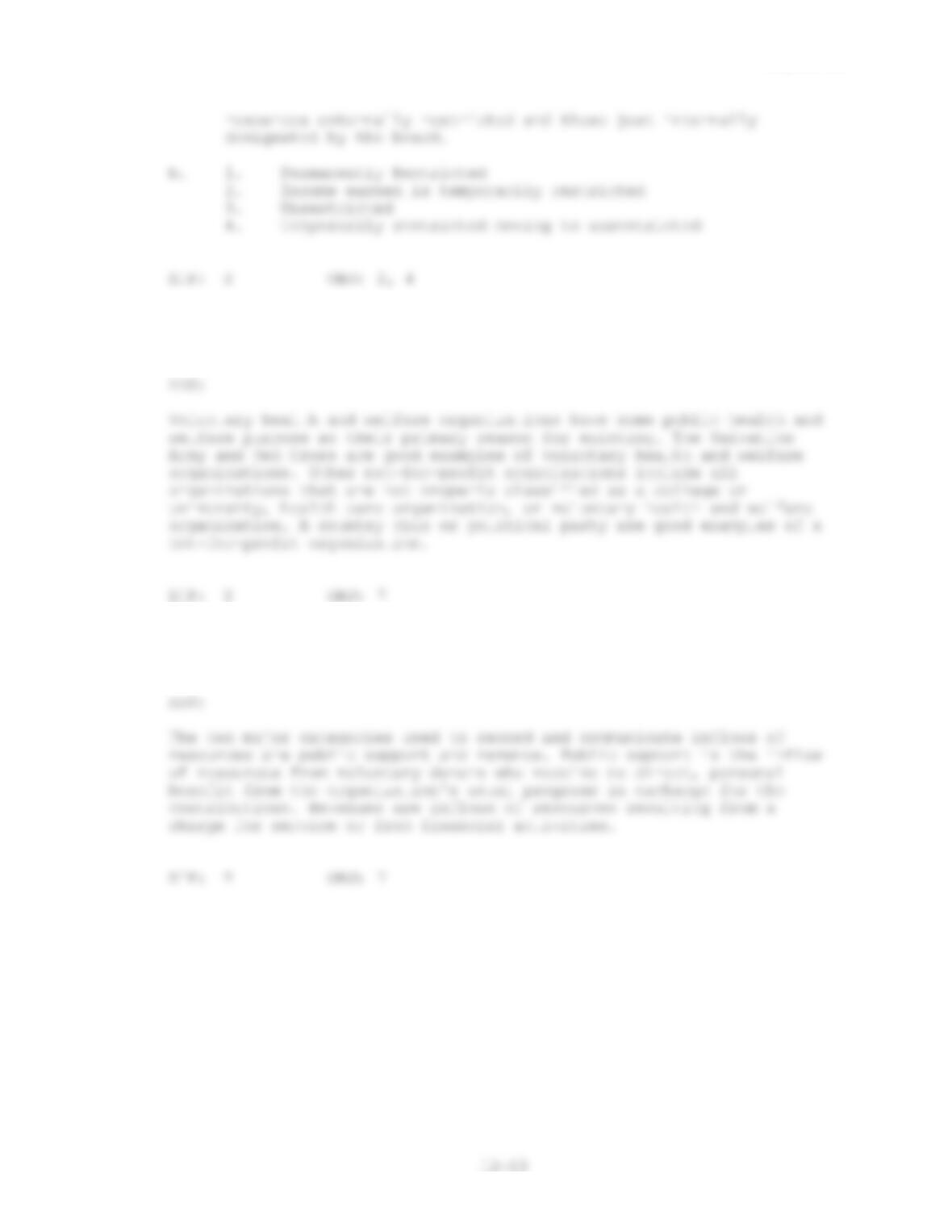
1. a. Describe the basic accounting for private not-for-profit groups
promoted by FASB Statement No. 117 including a brief
description of the three net asset classes.
b. Indicate in which of the net asset classes the following
transactions belong:
1. Donor makes gift to not-for profit which must be invested
and maintained in perpetuity
2. Income Earned on donation noted in item #1 is restricted to
certain program expenditures
3. Gains/Losses, both realized and unrealized, on donation
noted in item #1. Not stipulated in donor agreement or by
the law
4. Expenses paid out for programs stipulated in donor
agreement relating to donation made in item #1.
Chapter 12
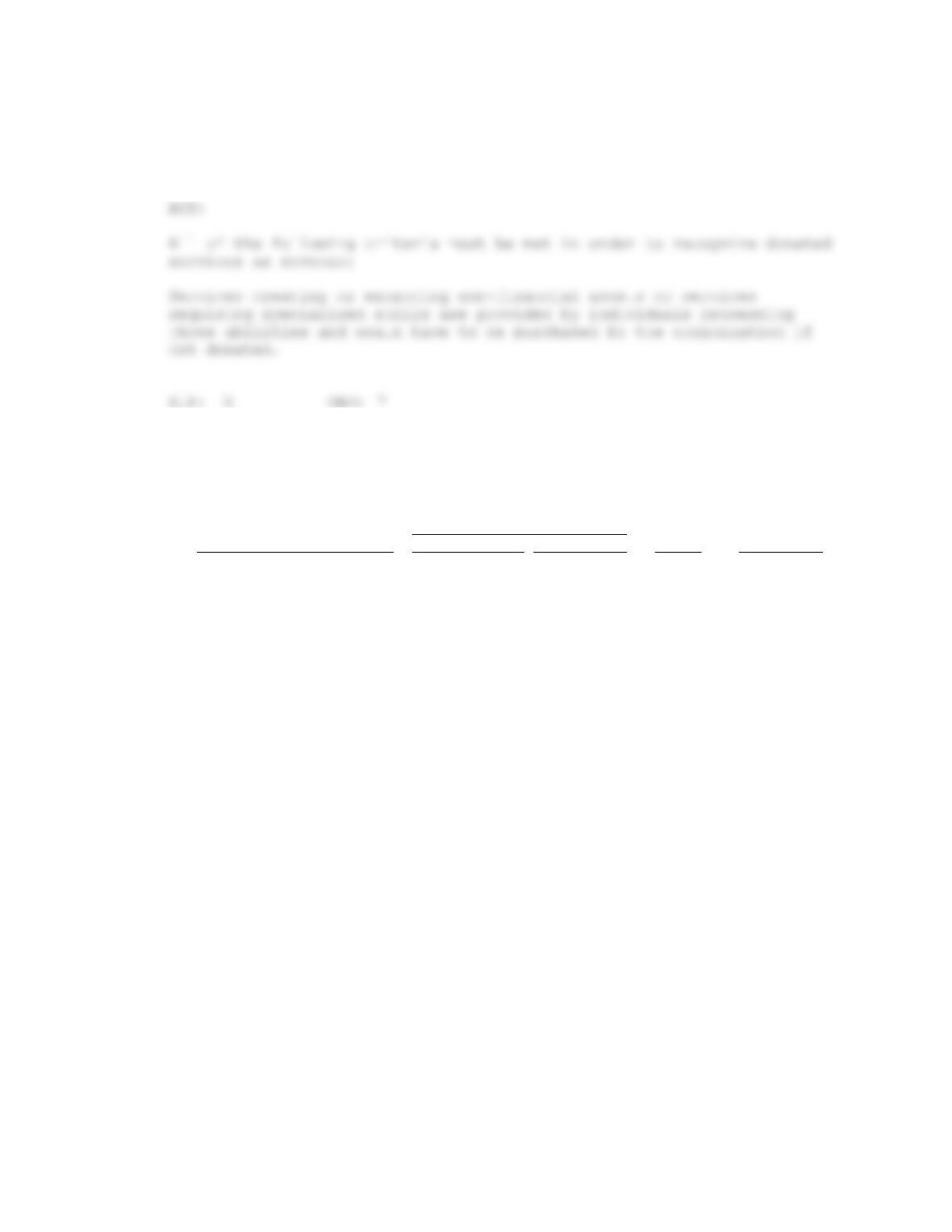
2. How do you differentiate between a voluntary health and welfare
organization and another not-for-profit organization?
3. What are the two major categories of resources obtained by voluntary
health and welfare organizations, and how do they differ?
Chapter 12
12–14
4. Describe the circumstances that must be true in order for donated,
personal services to be recorded as revenue (contributions) in a
voluntary health and welfare organization.
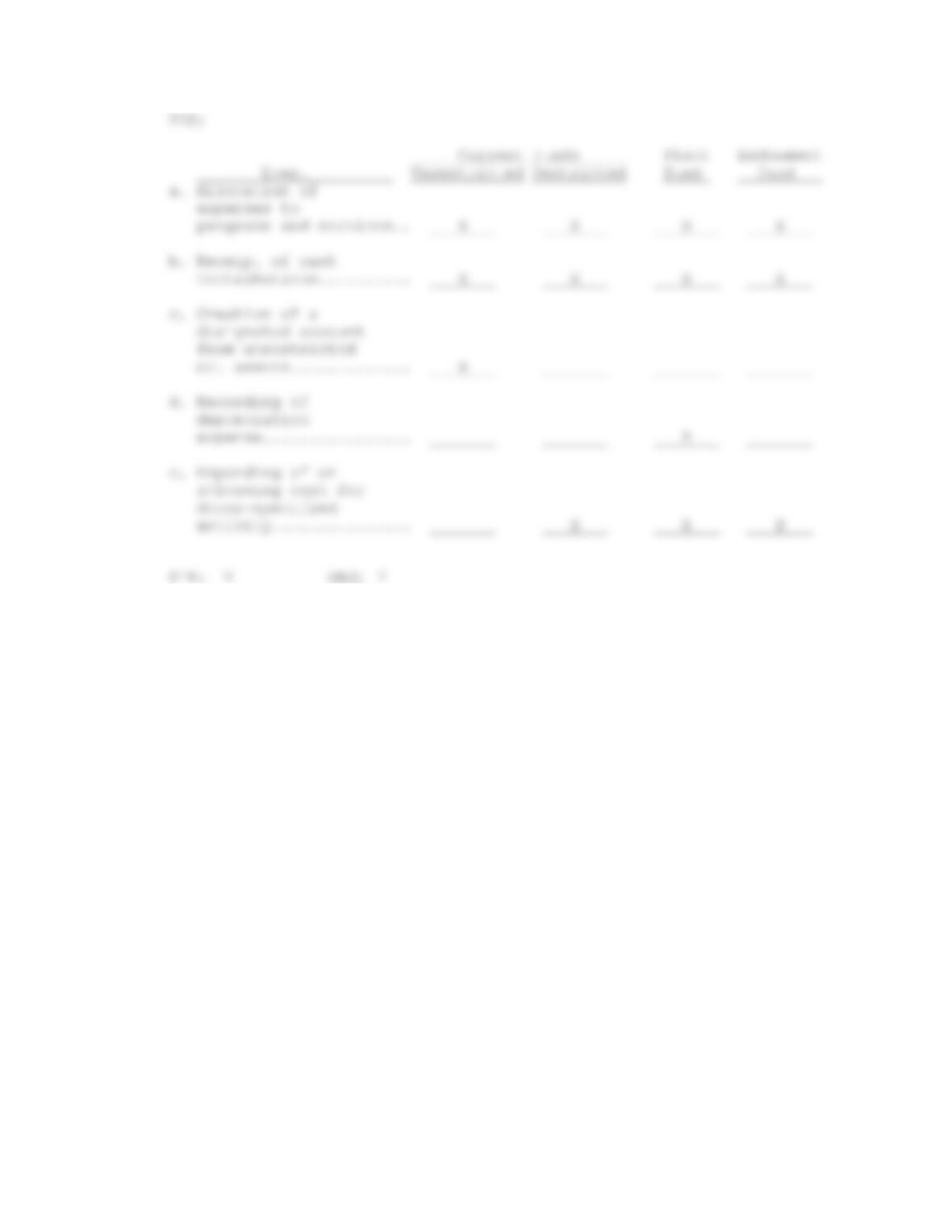
5. By placing a check mark in the appropriate column, indicate all of the
funds of a voluntary health and welfare organization in which the
following events might correctly be recorded. (Hint: An event may
require entries in more than one fund.)
Current Funds Plant Endowment
Event Unrestricted Restricted Fund Fund
a. Allocation of
expenses to
programs and services _______ _______ _______ _______
b. Receipt of cash
contributions…….. _______ _______ _______ _______
c. Creation of a
designated account
from unrestricted
net assets……….. _______ _______ _______ _______
d. Recording of
depreciation
expense………….. _______ _______ _______ _______
e. Expending of or
releasing cash for
donor-specified
activity…………. _______ _______ _______ _______
Chapter 12
12–15
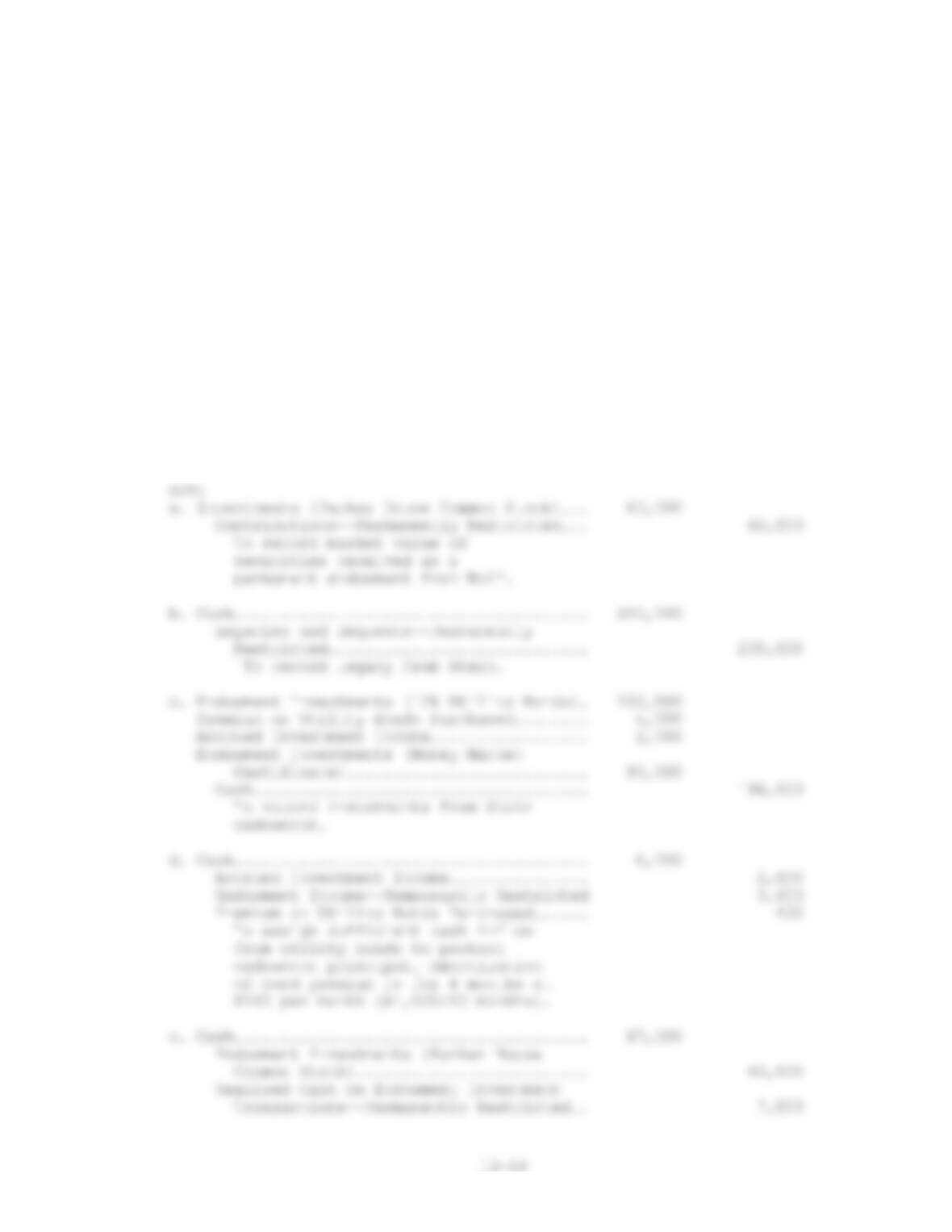
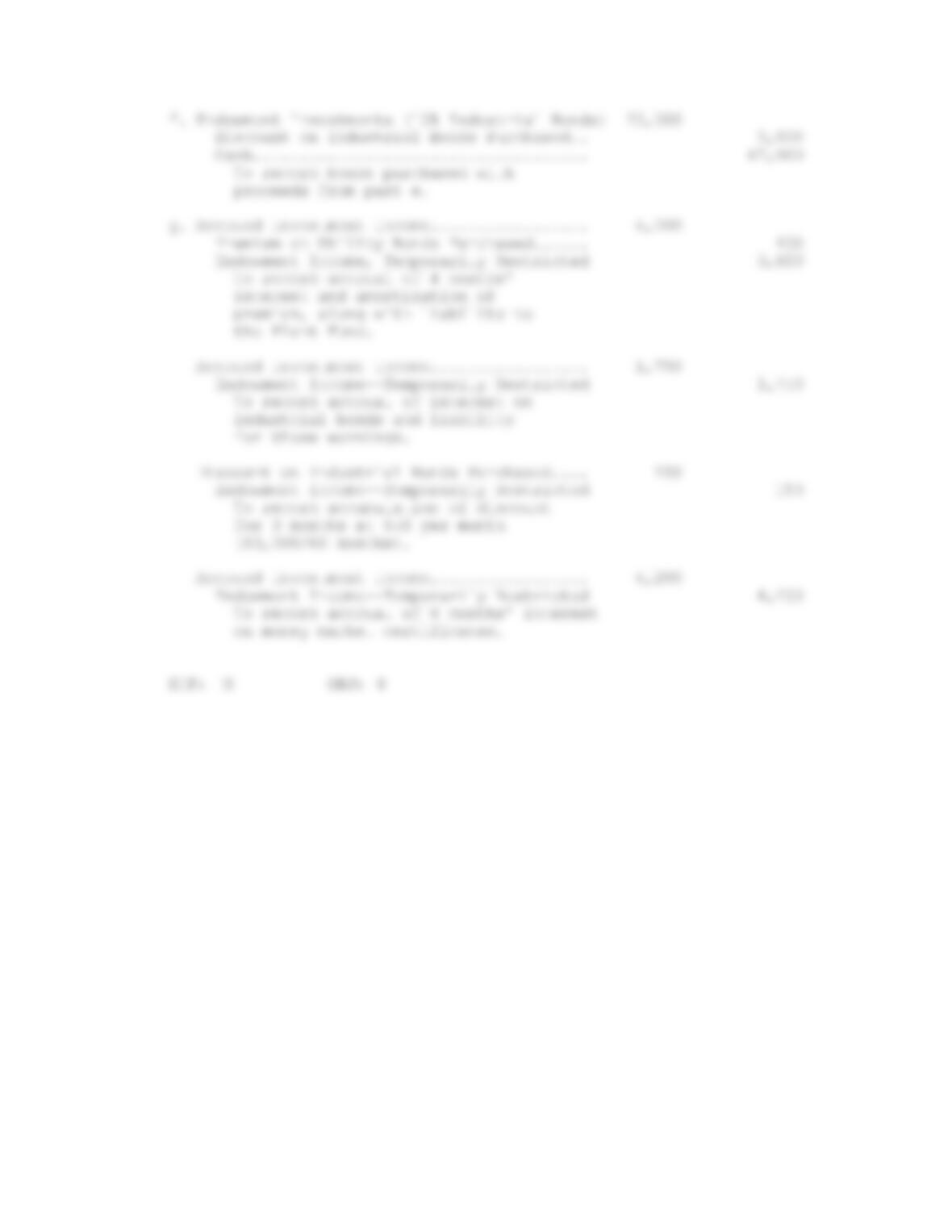
6. The following events are for the Public Health Agency, a voluntary
health and welfare organization that conducts two programs: public
health research and public health education:
a.
The agency received its first contribution, consisting of
1,000 shares of Parker House common stock valued at $60,000.
The stock was donated by Ron Wolf, a local financier, who
specified that earnings from the permanent endowment would not
be subject to any restrictions.
b.
Dianne Stein, a widow who was a volunteer for the Public
Health Agency, died. Her will established a cash endowment of
$200,000 and stipulated that gains on the sale of any
investments purchased with these funds should increase the
permanent endowment. However, earnings should be used for the
purchase of equipment. The cash was accepted under the terms
in the will.
c.
Investments were made from the Stein endowment fund. Utility
bonds with a face value of $100,000 and a contract rate of 12%
were purchased at 104, plus $2,000 of accrued interest for 2
months on May 1, 20X7. The bonds mature in 40 months. On the
same date, $90,000 was invested in money market certificates
yielding 7%.
d.
The following revenue was received on September 1, 20X7:
Dividends on the Parker House common stock……. $3,000
Semiannual interest on the utility bonds……… $6,000
Chapter 12
e.
The Parker House common stock is sold at a net price of $67
per share on October 1, 20X7.
f.
The $67,000 proceeds from the sale of Parker House common
stock were invested in 10% industrial bonds with a face value
of $70,000 and a market value of $67,000 on an interest
payment date. The bonds mature in 60 months. This transaction
had the approval of Wolf, who recommended that only the cash
flow be available for operations. The board agreed that this
was preferable.
g.
At year end, accrued interest for four months on the utility
bonds was $4,000; accrued interest for three months on the
industrial bonds was $1,750. The interest on money market
certificates was accrued.
Required:
Prepare journal entries for the year ended December 31, 20X7:
Chapter 12
12–17
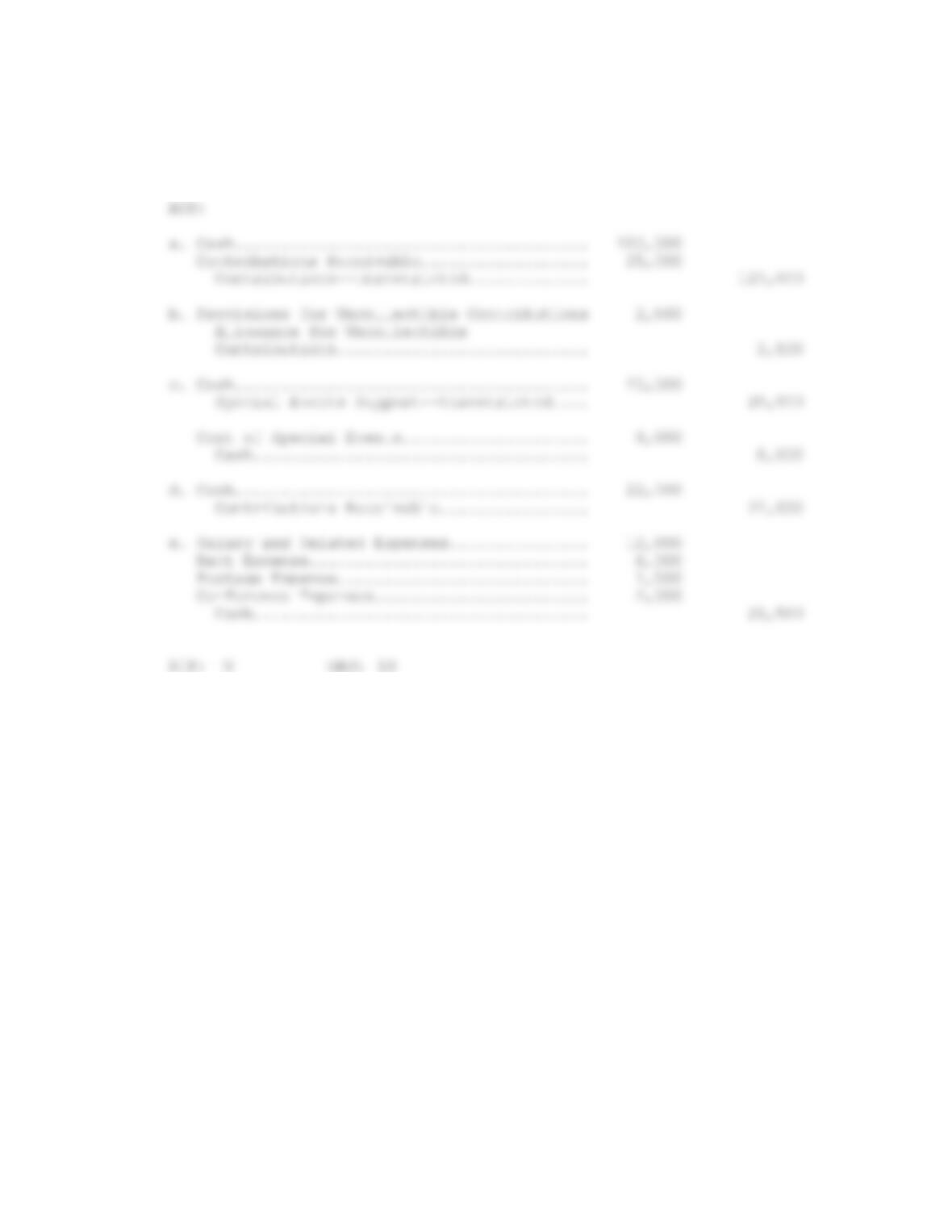
7. Rapitown Arts Council provides financial support to a number of
independent fine-art projects in the city. Data concerning several
events follow:
a.
During 20X5, a fund-raising drive yielded $100,000 in cash and
$25,000 in pledges.
b.
Based on past experience, 10% of the pledges are estimated to
be uncollectible.
c.
A July 4 art fair yielded $20,000 in gross revenue. The
proceeds of the fair are considered unrestricted. The cost of
the program was $8,000, paid in cash.
d.
$22,000 of the pledges mentioned in part (a) are collected
during the year.
e.
The following expenses were paid:
Director’s salary…………………………… $12,000
Rent expense……………………………….. 6,000
Postage……………………………………. 1,500
Conference expenses…………………………. 2,000
Chapter 12
12–18
Required:
Make the necessary entries to record the transactions.
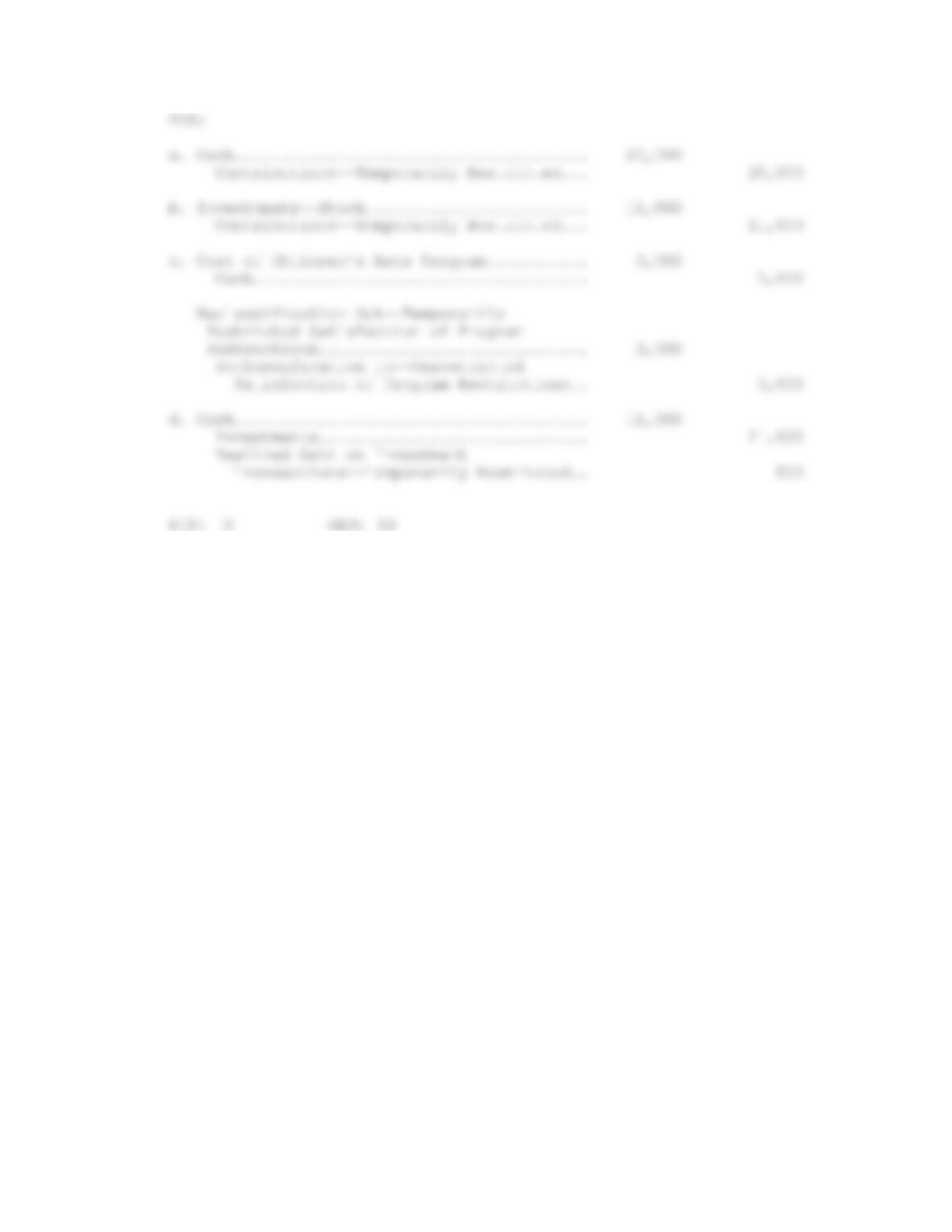
8. The following events affected the Rapitown Arts Council:
a.
Contributions of $20,000, restricted for use in the children’s
art program, are received.
b.
Stocks with a book value of $10,000 and a fair market value of
$11,000 were donated. The proceeds from the sale of the stocks
are to be used by the local drama group.
c.
A famous author lectured to high school students in the
children’s art program. The cost was $3,000 and was paid by
the contributions from part (a).
d.
The stock donated in part (b) is sold for $11,500.
Required:
Make the necessary journal entries.
Chapter 12
12–19
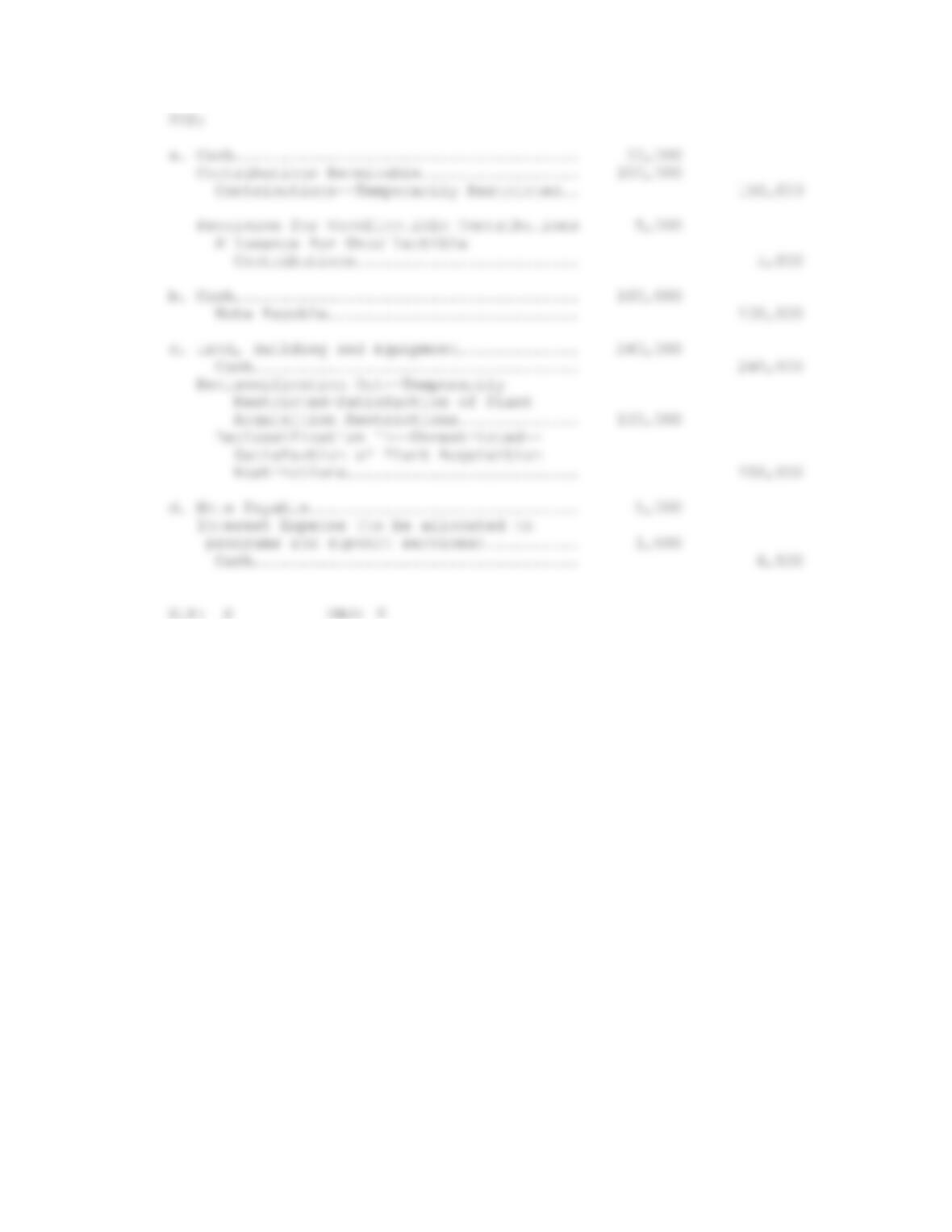
9. The following events are for South City Shelter, a voluntary health and
welfare organization that provides emergency shelter and health care
for the homeless, as well as educational programs:
a.
A fund-raising program for a portable medical clinic yielded
cash contributions of $50,000 and pledges of $100,000. In the
past, 5% of pledges have been shown to be uncollectible.
b.
A note for $100,000 was signed to finance the remaining cost
of the clinic.
c.
The mobile clinic and support materials were purchased for
$240,000.
d.
A note payment of $5,000 and $1,500 in interest was paid for
the note in part (c).
Required:
Record the necessary journal entries.
Chapter 12
12–20
10. South City Shelter is a voluntary health and welfare organization that
provides emergency shelter and health care for the homeless, as well as
educational programs. South City Shelter incurred the following
transactions:
a.
A computer with a book value of $500 (original cost, $2,800)
was sold for $650.
b.
Kitchen equipment with a book value of $1,100 (original cost,
$3,500) was damaged in a fire and taken to the dump.
c.
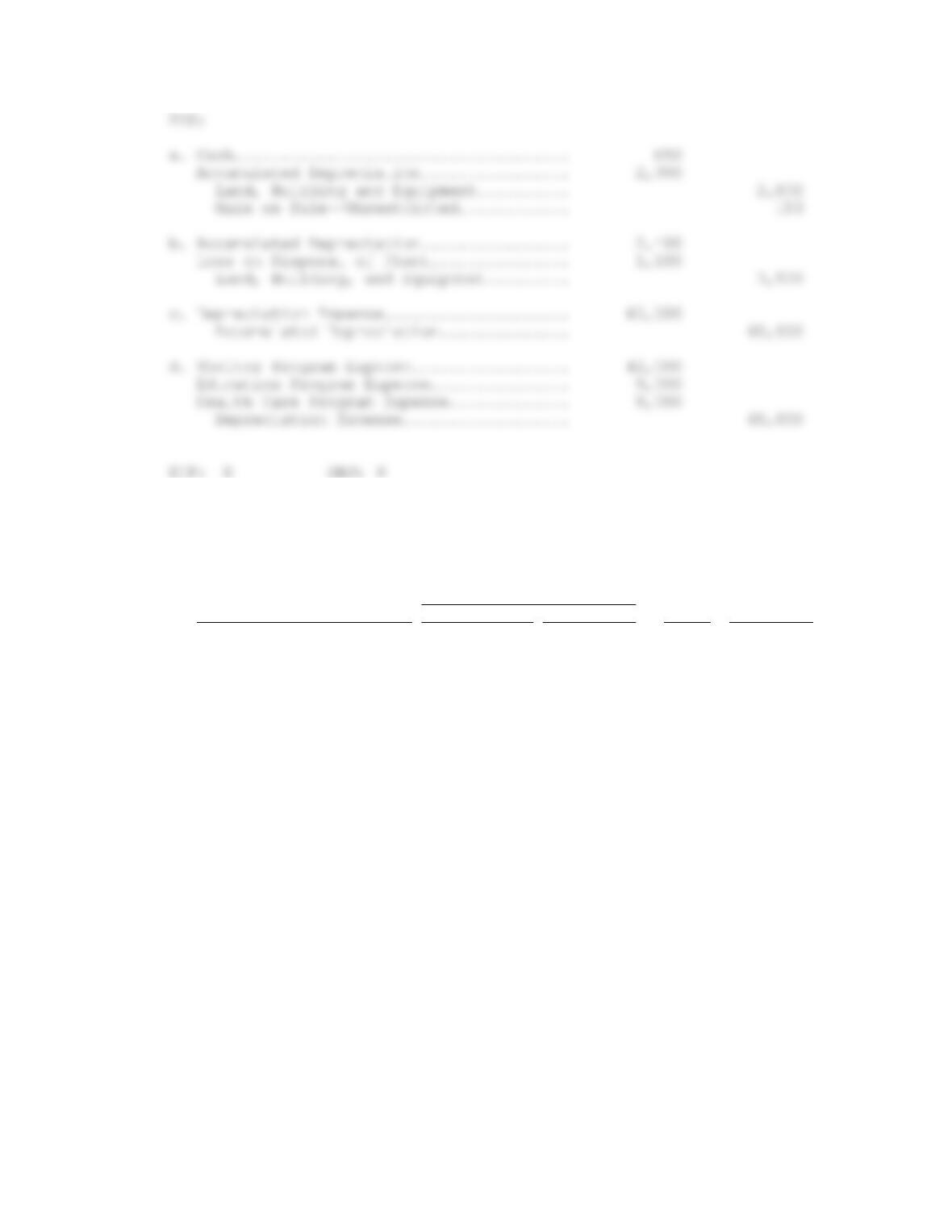
Total depreciation for the year was $60,000.
d.
To close the depreciation expense, it was determined that 70%
should be allocated to the Shelter Program, 15% to the
Education Program, and 15% to the Health Care Program.
Required:
Make the necessary journal entries to reflect the events.
Chapter 12
12–21
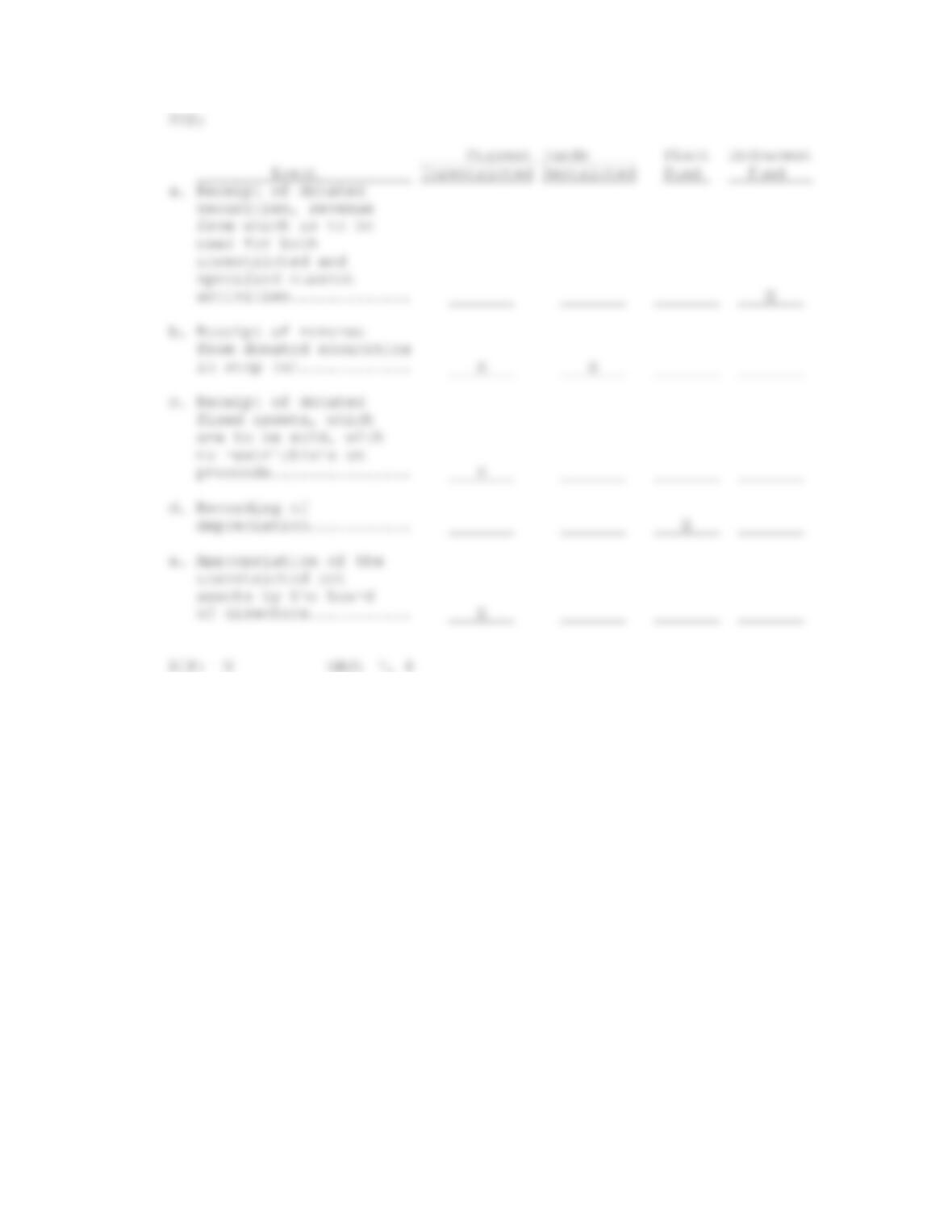
11. By placing a check mark in the appropriate column, indicate in which
fund of a voluntary health and welfare organization the following
events normally would be recorded. (Note: An event may require entries
in more than one fund.)
Current Funds Plant Endowment
Event Unrestricted Restricted Fund Fund
a. Receipt of donated
securities, revenue
from which is to be
used for both
unrestricted and
specified current
activities…………. _______ _______ _______ _______
b. Receipt of revenue
from donated securities
in step (a)………… _______ _______ _______ _______
c. Receipt of donated
fixed assets, which
are to be sold, with
no restrictions on
proceeds…………… _______ _______ _______ _______
d. Recording of
depreciation……….. _______ _______ _______ _______
e. Appropriation of the
unrestricted net
assets by the board
of directors……….. _______ _______ _______ _______
Chapter 12
12–22
12. The Good Health Agency is a voluntary health and welfare organization
that conducts two programs: public health research and public health
education.
a.
Public support for general activities consisted of the
following:
Cash………………………………………. $ 60,000
Gross pledges………………………………. 295,000
Estimated uncollectible pledges………………. 15,000
b.
During the year, several rummage sales were held to raise
funds for general operations. Gross cash proceeds were
$17,000, with $4,000 of direct costs paid in cash.
c.
Terry Well, a former nurse, died. Her will provided $50,000 to
be used as the board of directors saw fit.
d.
Cash collected from pledges totaled $230,000. Pledges written
off as uncollectible amounted to $12,000.
e.
Income from investments for the year totaled $11,800, of which
$800 represents dividends declared but not yet received.

Chapter 12
Income is unrestricted.
f.
A health club was formed by the agency. Its members could use
various facilities of the agency. Cash received from
membership dues was $1,700.
g.
The following expenses were vouchered:
Salaries and related expenses………………… $171,900
Professional fees and expenses……………….. 75,600
Administrative expenses……………………… 35,000
Rent expense……………………………….. 19,700
Conference and meeting expenses………………. 16,900
Printing and distribution expenses……………. 19,200
Transportation expenses……………………… 17,700
Provision for Uncollectible Contributions 15,000
Total……………………………………. $371,000
========
h.
A total of $316,000 in vouchers was paid.
i.
A statement of functional expenses was prepared and showed the
following allocations:
Programs:
Public health research………………………. $118,300
Public health education……………………… 140,800
Supporting Services:
Management and general………………………. 59,500
Fund-raising……………………………….. 52,400
Total……………………………………….. $371,000
========
Required:
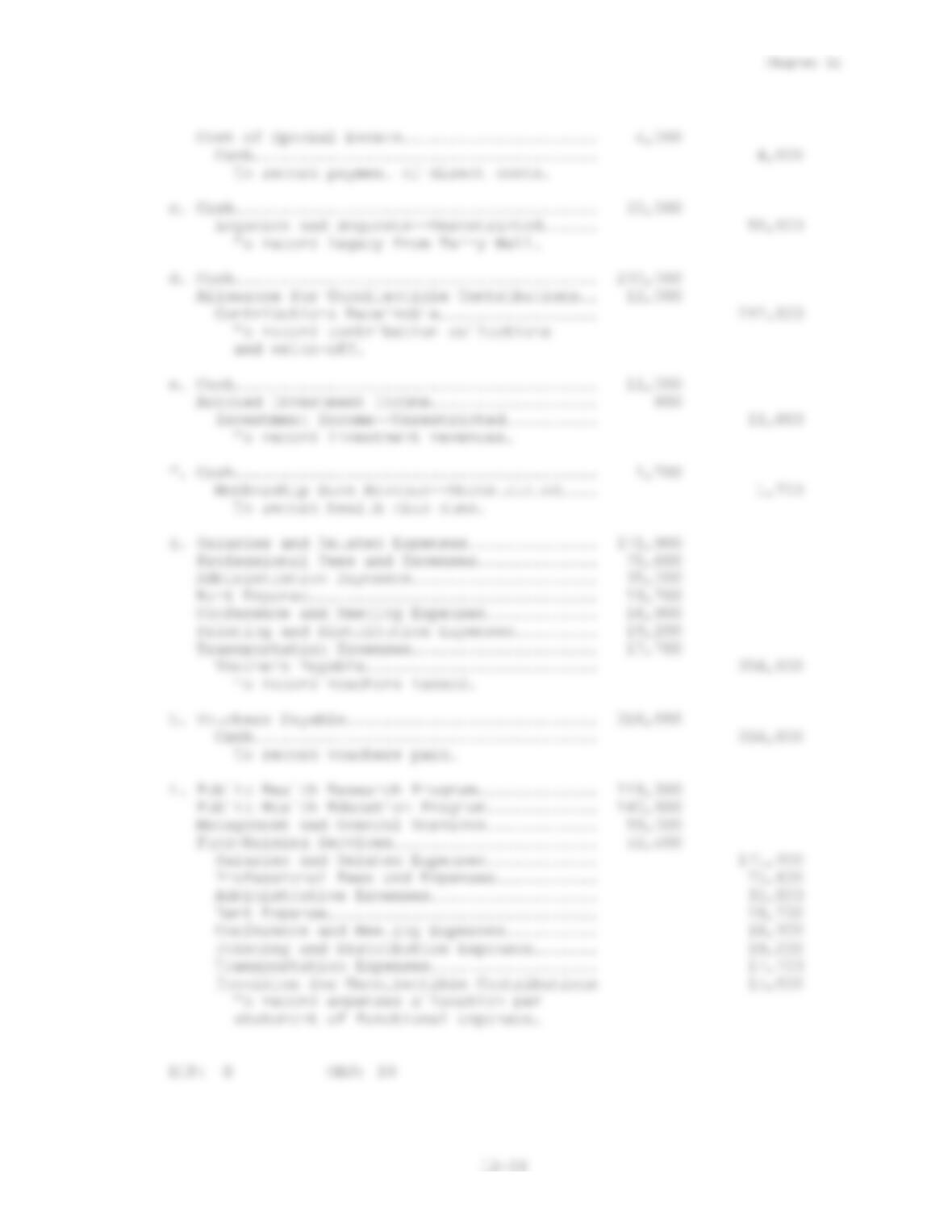
Prepare journal entries for these events. Charge the respective
services for their share of expenses.

Chapter 12
13. The Elder Citizens Agency is a voluntary health and welfare
organization. The following events occur:
a.
This year’s fund drive resulted in unrestricted pledges
totaling $130,000. Pledges of $25,000 were received for a
special hot meal program.
b.
Cash collected from pledges: unrestricted, $100,000;
restricted, $18,000.
c.
A philanthropist, who is an attorney, contributed a painting
valued at $4,000, which is to be auctioned off at a
Thanksgiving supper organized to raise funds for a legal
assistance program for the elderly. The event was an
unexpected success. The painting was sold for $7,800.
Additional gross cash revenues were $4,900. Direct costs paid
were $1,700.
d.
The agency received $11,000 from the local division of United
Way for general support.
e.
Salaries amounted to $70,000, payroll taxes were $6,000, and
other employee benefits amounted to $10,000. Of these items,
$5,000 is unpaid.
f.
Arrangements have been made to have a local catering firm
bring in a hot lunch. Senior citizens are charged $0.75 per
meal. To date, payments to the catering service are $2,300.
Cash collections from the meal program service totaled $900.
g.
It is estimated that 10% of the remaining unrestricted pledges
and 5% of the remaining restricted pledges will prove
uncollectible.
h.
At the end of the previous year, $10,000 of the balance of the
Unrestricted Net Assets had been designated for a special
program for handicapped elderly persons. The program was to be
conducted during the current year if sufficient support could
be generated. The idea was abandoned this year for lack of
interest. The governing board authorizes the reclassification
of the amount as undesignated.
i.
The Elder Citizens Agency had budgeted $500 per month to rent
space to conduct its general activities. A generous citizen
permits the agency to occupy equivalent space at a nominal fee
of $100 per year. The annual fee is paid, and the appropriate
expense for the year is recorded.
Required:
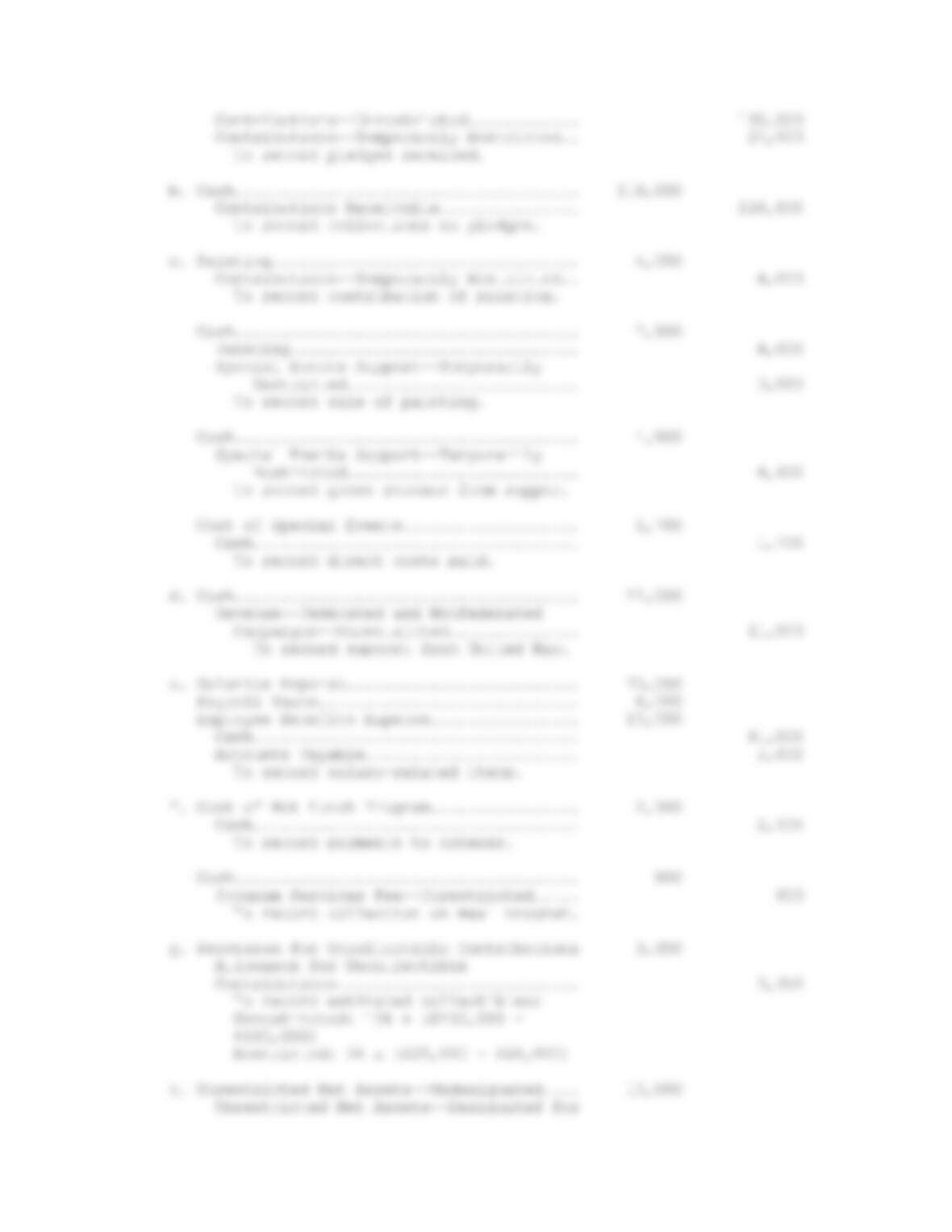
Prepare journal entries to record the events.
Chapter 12
12–26
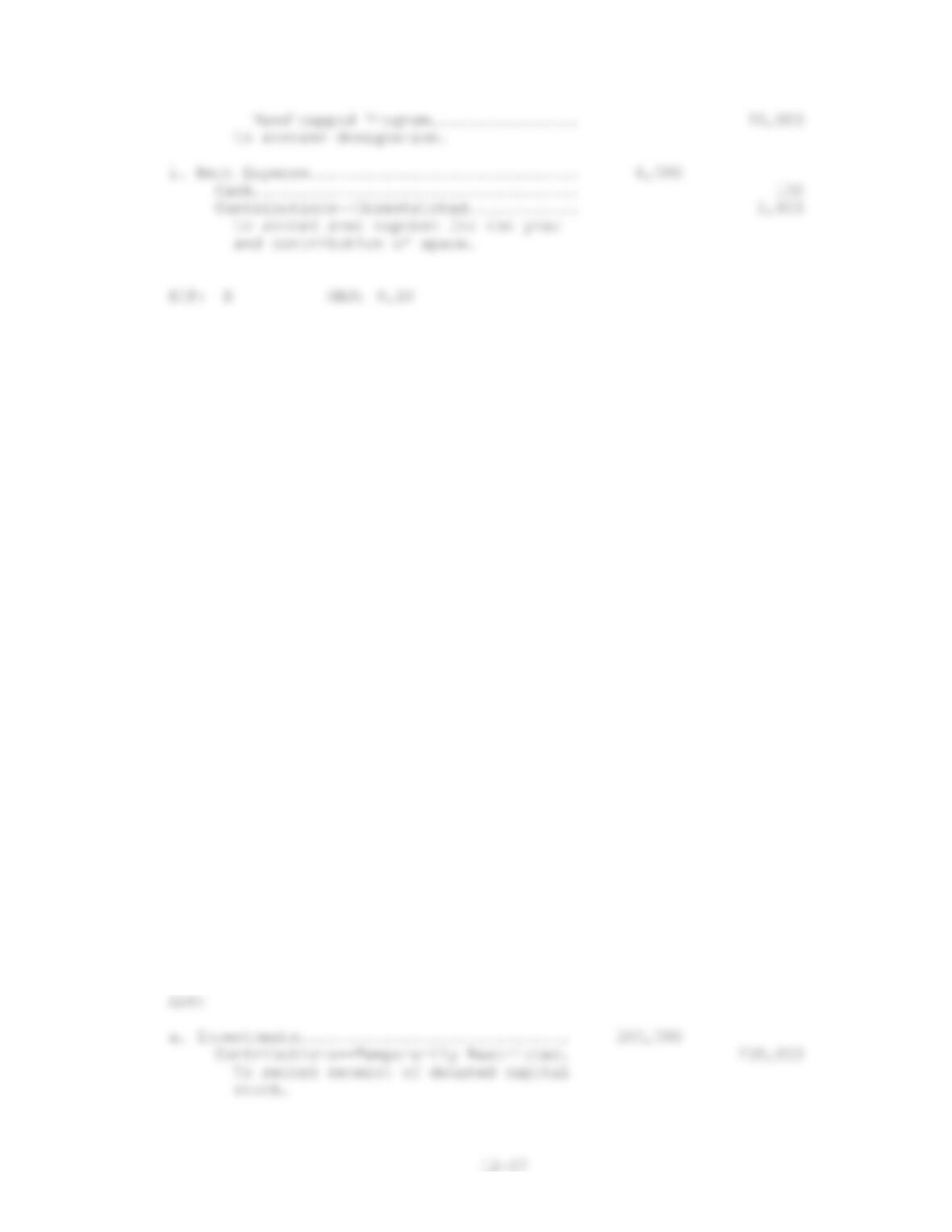
Chapter 12
14. The following events are for the Public Health Agency, a voluntary
health and welfare organization that conducts two programs: public
health research and public health education:
a.
The agency received a donation of capital stock with a market
value of $200,000, with the stipulation that the income and
principal may be used only for additions to plant.
b.
An adjoining building and land were purchased at a cost of
$600,000. A 10% cash down payment was made. A mortgage note
for the remainder was signed.
c.
Unused sterilizers with a cost of $15,000 and a book value of
$5,000 were sold for $3,000 cash.
d.
New sterilizers costing $28,000 were purchased.
e.
A payment of $90,000 was made to cover semiannual mortgage
interest of $20,000 and reduction of principal of $70,000.
f.
Annual depreciation of $180,000 was recorded.
g.
The directors approved the following percentages for
allocating all expenses (but not losses) of the Plant Fund:
Public health research program……………….. 30%
Public health education program………………. 40%
Management and general services………………. 10%
Fund-raising services……………………….. 20%
Total……………………………………. 100%
====
Required:
Prepare the journal entries for the events.
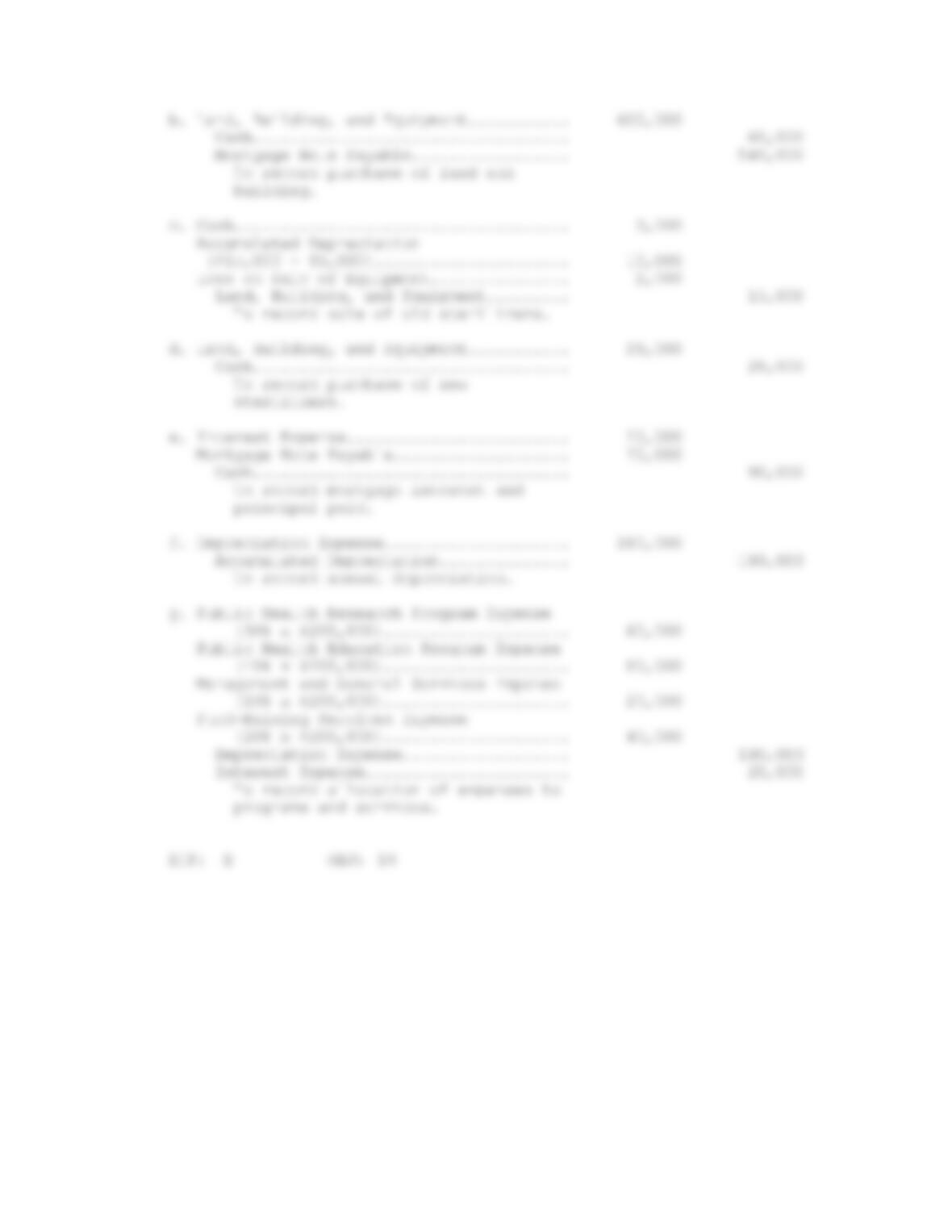
Chapter 12
12–28
15. The Community Drug Clinic is a voluntary health and welfare
organization that conducts two programs: drug abuse research and drug
abuse education. An inexperienced accountant recorded the following
entries:
a. Pledges Receivable………………….. 200,000
Income…………………………… 200,000
To record signed pledges received. Of
the total, 20% must be used for a
special local college program. It is
estimated that 5% of the unrestricted
pledges will prove uncollectible.

Chapter 12
12–29
b. Cash………………………………. 100,000
Income…………………………… 100,000
Received money from a successful
business person, formerly a drug
addict. Amount must be used to
acquire a building for the clinic’s
program.
c. Building, etc………………………. 100,000
Cash…………………………….. 100,000
To record down payment on land,
building, and equipment with funds
received in step (b). A mortgage note
was signed for an additional $150,000.
d. Cash………………………………. 15,000
Income…………………………… 15,000
To record amount received for general
operations from the will of the
former mayor, who died.
e. Cash………………………………. 120,000
Pledges Write-Off Expense……………. 5,000
Pledges Receivable………………… 125,000
To record collection of all pledges
for special college program (step a)
and partial collection and some
write-offs for remaining pledges.
f. Equipment………………………….. 14,000
Cash…………………………….. 14,000
To record purchase of equipment from
unrestricted funds.
g. Operating Expenses………………….. 100,000
Cash…………………………….. 100,000
To record payment of expenses, 80% of
which are related to unrestricted
activity and the remainder to
restricted.
h. Depreciation Expense………………… 4,000
Accumulated Depreciation…………… 4,000
To record annual depreciation
provision.
i.
No other entries were made. An analysis of expenses and their
allocation to programs and services was approved as follows:
Percentage of Expenses Applicable to:
Programs on Drug Abuse_Services
Fund–
Expenses Financed by: Research Education Management raising Total
Unrestricted Funds… 40 30 20 10 100
Donor Restricted
Funds–Programs….. 40 50 10 0 100
Donor Restricted–
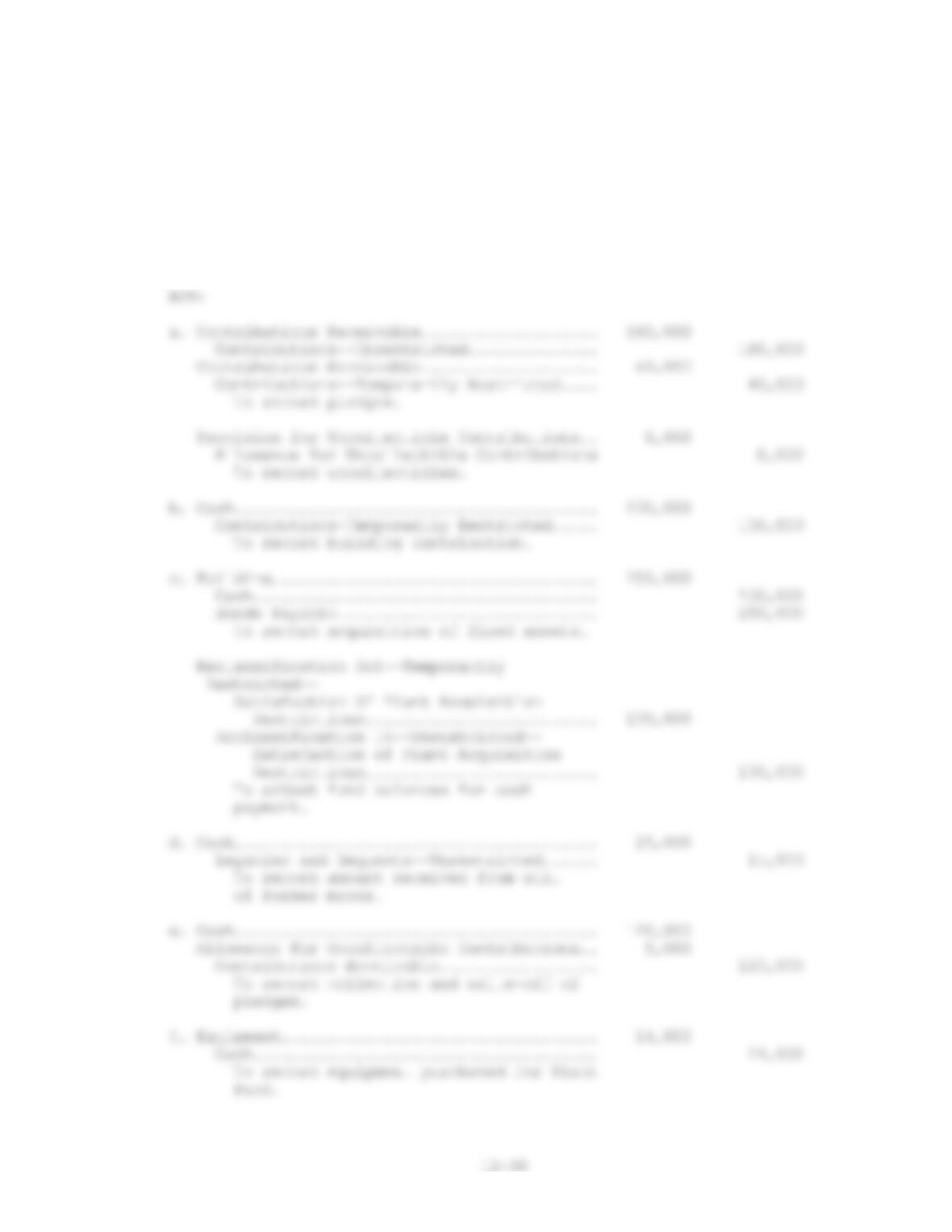
Chapter 12
Plant Acquisitions.. 50 20 20 10 100
Required:
Omitting explanations, prepare the correct entries, including the entry
to assign expenses to programs and services. Assume that the incorrect
entries of the previous accountant are reversed prior to your entries.
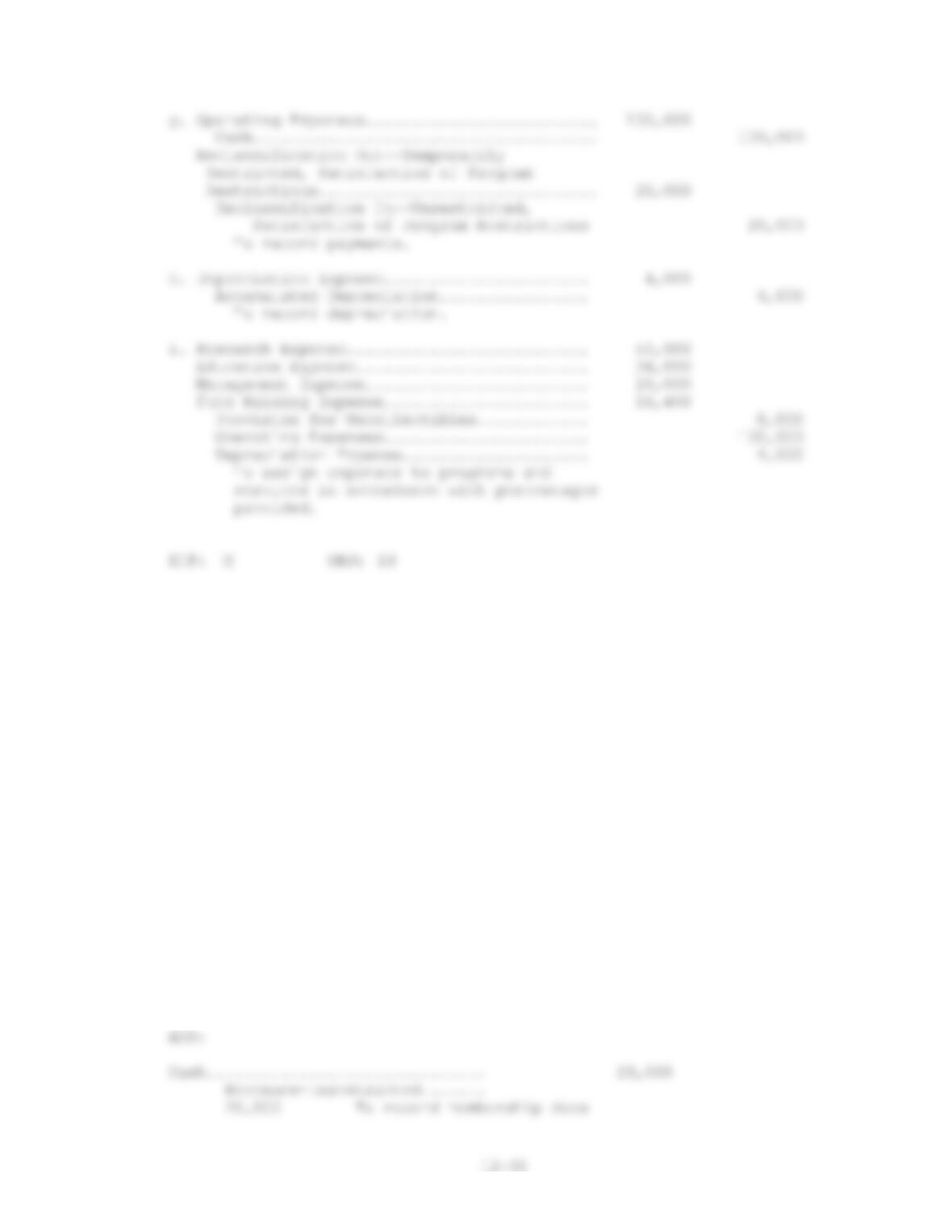
Chapter 12
16. In the year 2005, a group of merchants in the community of Gunning
organized a merchant group, The Gunning Group, in an effort to work
together to increase business to Gunning area merchants. Each member
pays dues of $200 per year for operations and fund raising. All dues
were collected in 2005. Other group activities for 2005 were as
follows:
Net Receipts-July 4 food/beverage booth $35,000
Unrestricted Donation $50,000
Investment of Donation made into Marketable Securities $40,000
Interest earned on Investment $ 3,200
Program Expenses such as advertising Paid $18,500
Receipt of Contribution restricted to Speaker Fees $ 5,000
for the year 2001/2002
Expense made in compliance with donor restriction–
Speaker Fee paid for annual meeting of merchants $ 1,500
Received a Government Grant to encourage
minority business development in Gunning $15,000
Expenses incurred in conjunction with provision
of the grant $ 8,000
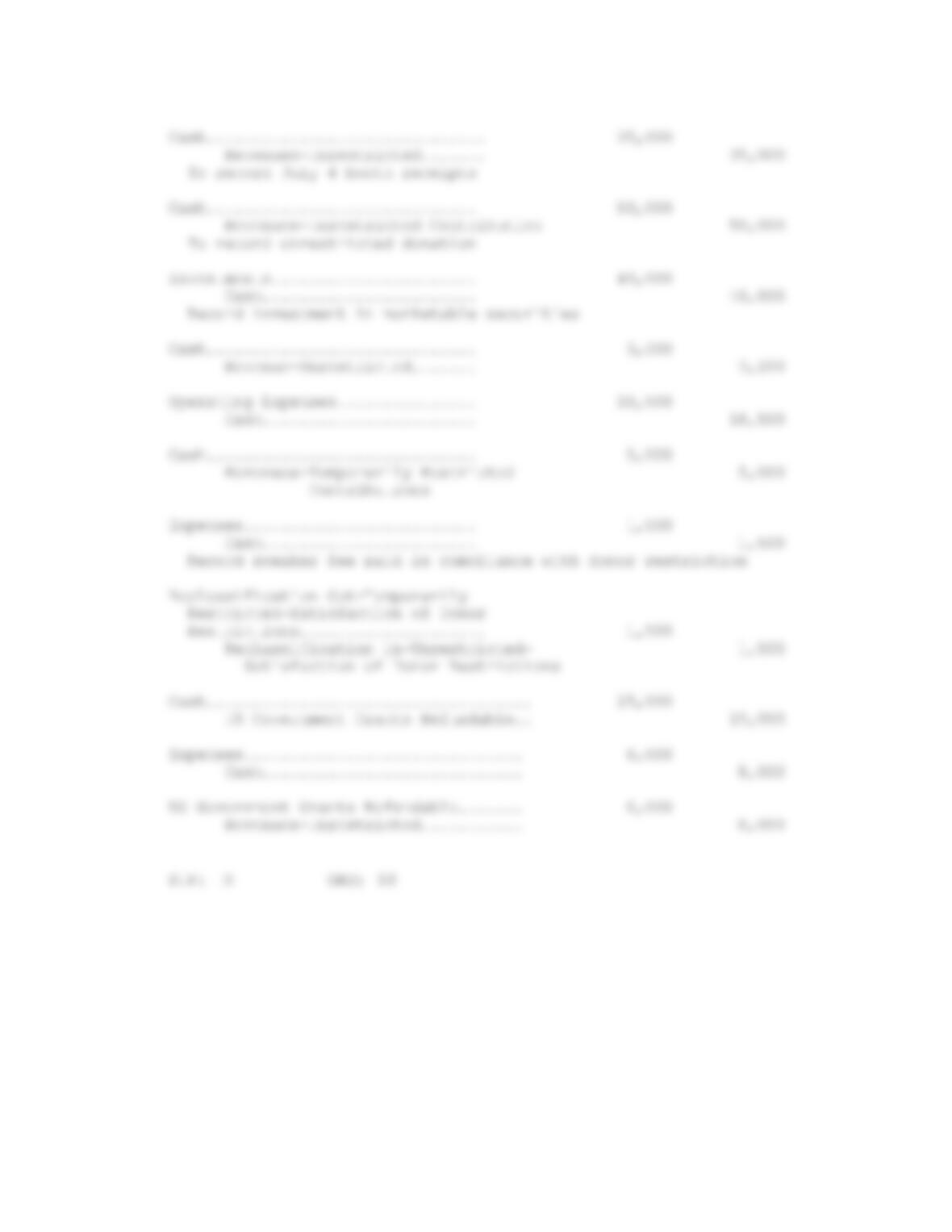
Make the necessary entries to account for the above listed
transactions.
Chapter 12
12–32
Chapter 12
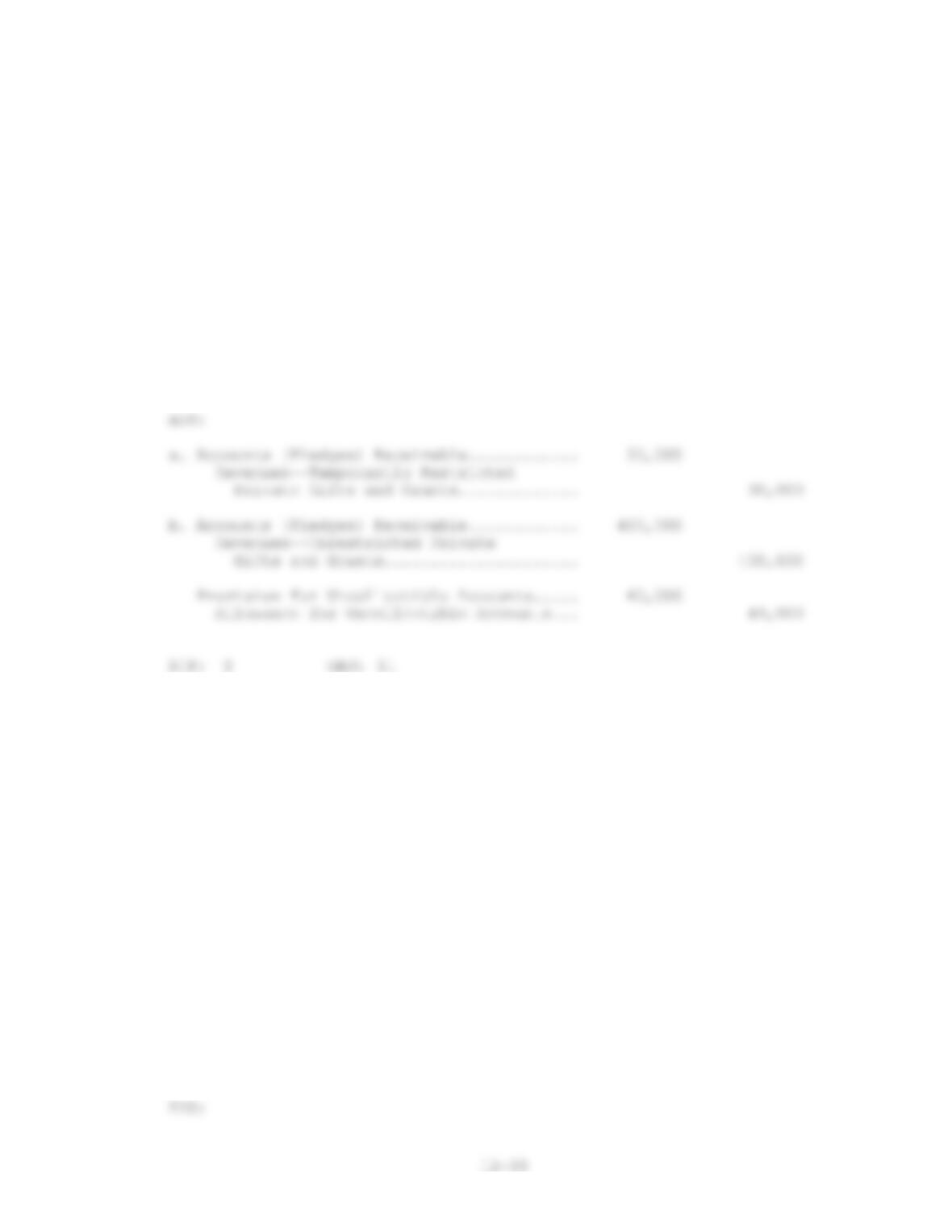
17. Carlton (private) University received the following pledges during
20X5:
a.
Jane Baker pledges $30,000 to be used for student
scholarships.
b.
As a result of a pledge drive, $400,000 is pledged to be paid
by the end of the accounting year. Ten percent of pledges in
the past have been shown to be uncollectible. These pledges
are unrestricted.
Required:
Make the journal entries necessary to record the pledges.
18. The registrar at Eastern West Virginia (public) University has
summarized the current semester’s student fees and tuition as follows:
Original gross amount assessed students…………. $3,600,000
Refunds of original amounts assessed paid
to students who dropped classes………………. 200,000
Tuition remissions to disadvantaged
students…………………………………… 150,000
Scholarships granted to students, paid
from Unrestricted Current Funds………………. 250,000
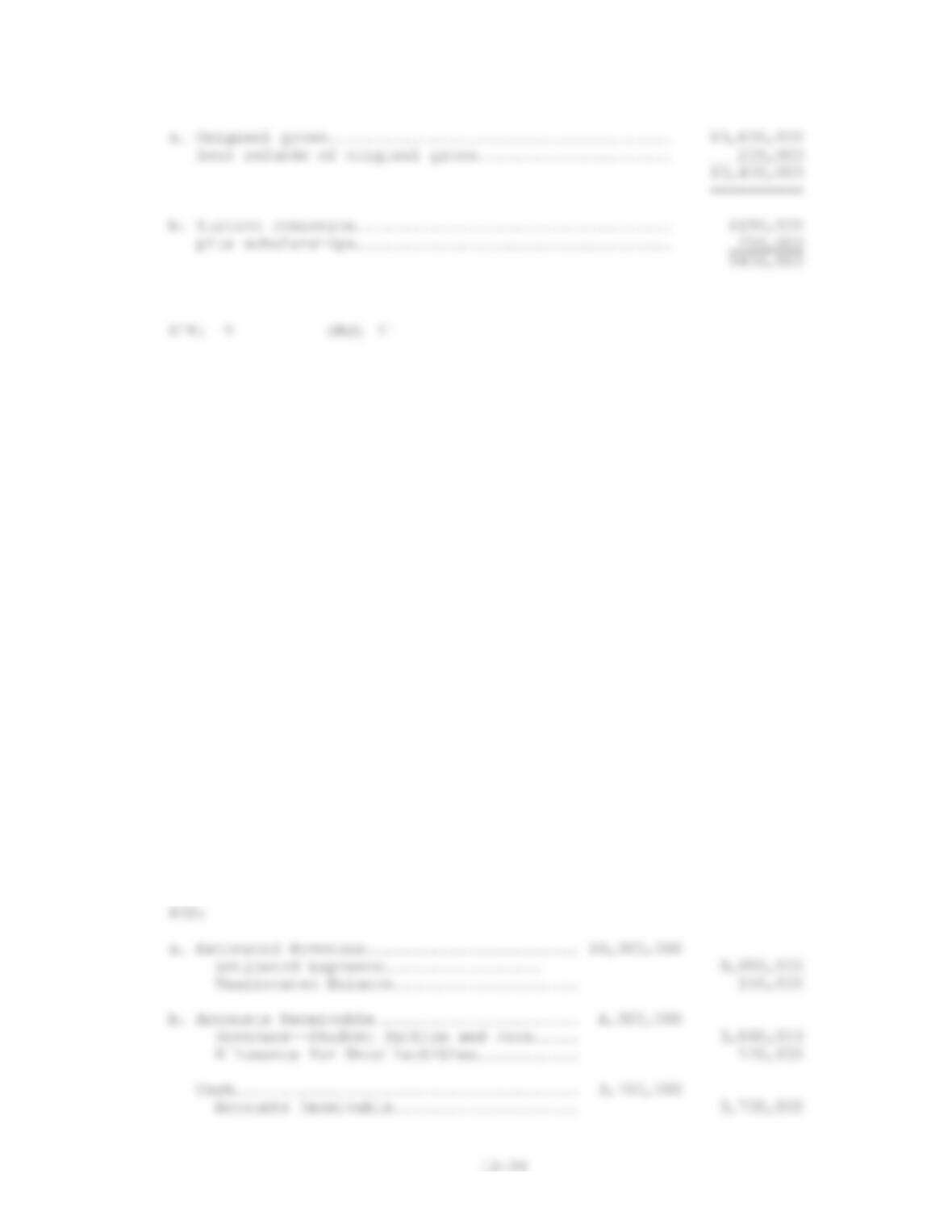
Required:
Determine the following for the Statement of Activities for the Current
Funds:
a.
The revenues from student tuition and fees
b.
The expense for student aid
Chapter 12
19. The following selected transactions affected the Unrestricted Current
Funds of Tiger State University (public) during the current fiscal
year:
a.
The Board of Control approved a budget estimating $10,000,000
in revenues and expenses of $9,850,000.
b.
Student tuition assessed during the year was $4,000,000, of
which $3,700,000 had been collected, with 3% considered
uncollectible.
c.
Student aid included $500,000 in cash scholarships and $75,000
in tuition remission.
d.
Salary and wages during the year included $5,500,000 for
instruction, $500,000 for academic support, and $700,000 for
institutional support.
e.
Transfers to the Plant Funds included $450,000 in transfers
for a mortgage payment and $155,000 in discretionary
transfers.
f.
A grant received of $10,000 in cash was restricted to use for
laser technology research.
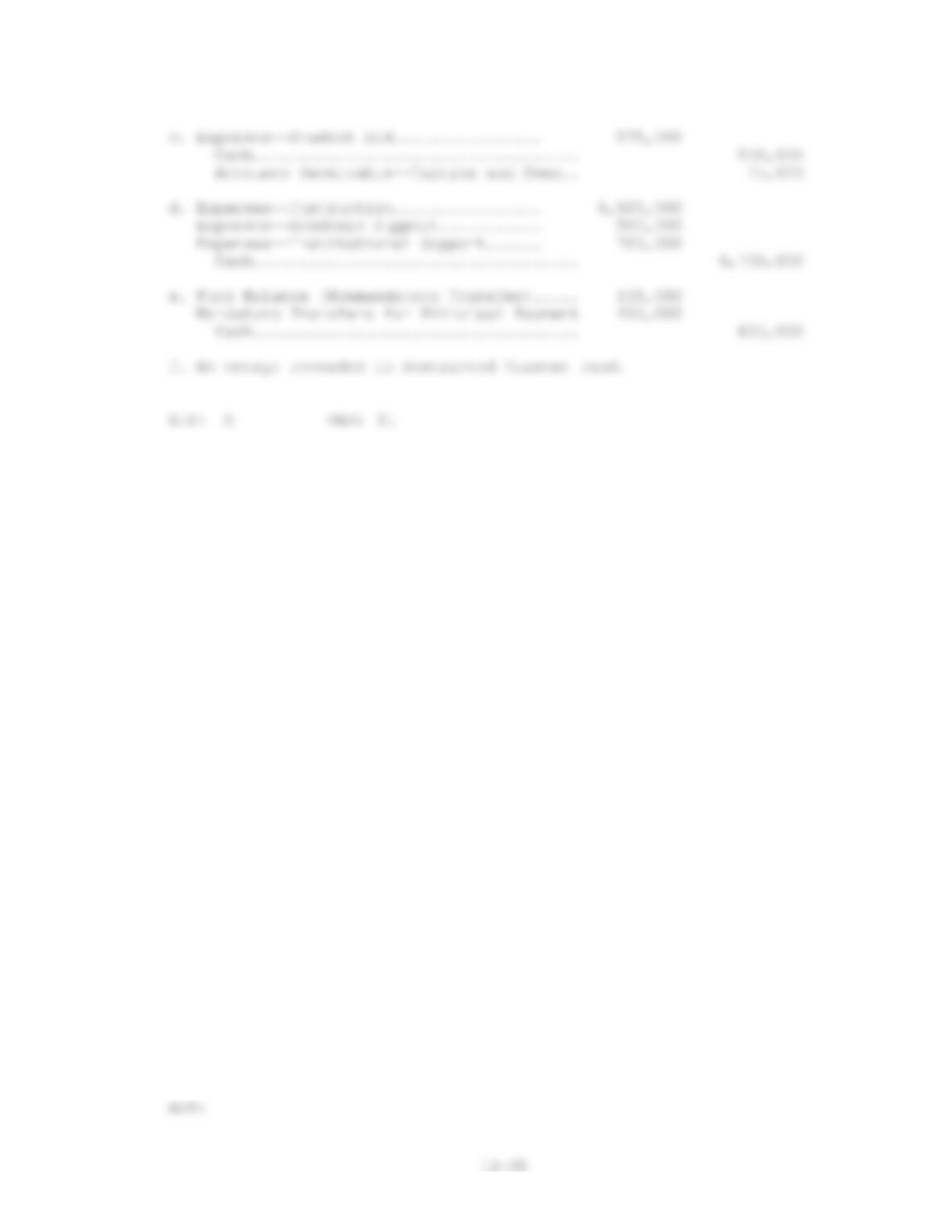
Required:
Make the journal entries necessary to record the selected transactions.
Chapter 12
20. The following selected transactions affected the Franklin State
(public) University during the current fiscal year:
a.
Student tuition and feels billed for the year for $8,000,000,
which was used for educational and general purposes. Prior
experience shows $100,000 will be uncollectible.
b.
$7,200,000 of the billings in ‘a’ were collected.
c.
Unrestricted income from endowment funds amounted to $185,000.
d.
Auxiliary enterprise included $175,000 form student residence
halls; $200,000 from cafeterias; and $750,000 from the college
store sales. All amounts have been collected.
e.
$300,000 of Term Endowments funds are now available for
unrestricted use.
f.
Operating Expenses are as follows: Instruction $300,000;
Research $150,000; Academic Support $50,000; Student Services
$25,000; Institutional Support $120,000
g.
University’s student aid committee granted student tuition and
fee reductions of $200,000.
h.
Auxiliary expenses amounted to $750,000
i.
The trustees have specified certain current fund revenues must
be transferred to meet the debt service provisions relating to
the university’s institutional properties. These mandatory
transfers amount to $550,000.
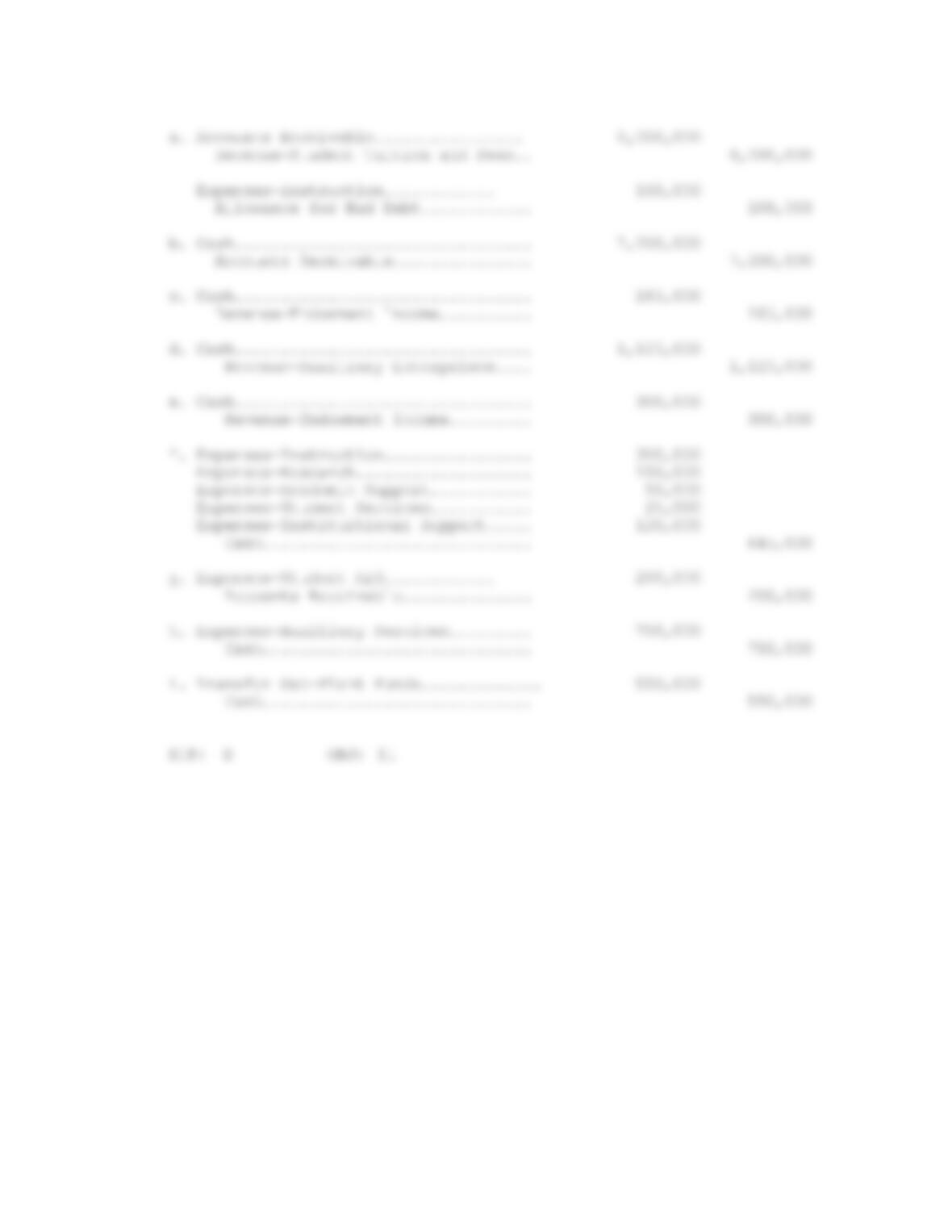
Required:
Make the journal entries necessary to record the selected transactions.
Chapter 12
12–36
21. The following events involve a loan fund of East York public
University:
a.
To establish the Hanson Student Loan Fund, two brothers
donated $40,000 cash and securities that cost $80,000. Market
value of the securities at time of donation was $160,000.
b.
The securities were later sold for $189,000. The original
agreement stipulated that any gain on the sale or income
received from the securities be added to the loan fund.
c.
An appreciative board of trustees transferred $30,000 cash
from the Unrestricted Current Fund to the loan fund.
d.
Loans of $140,000 were made to students at 6% annual interest.
e.
The board of trustees agreed that loans to students in the
amounts of $9,000 were uncollectible. At year end, the board
took action to write off the uncollectible loans outstanding
Chapter 12
12–37
of $9,000.
f.
Collections on Hanson loans amounted to $13,000 plus $450 in
interest.
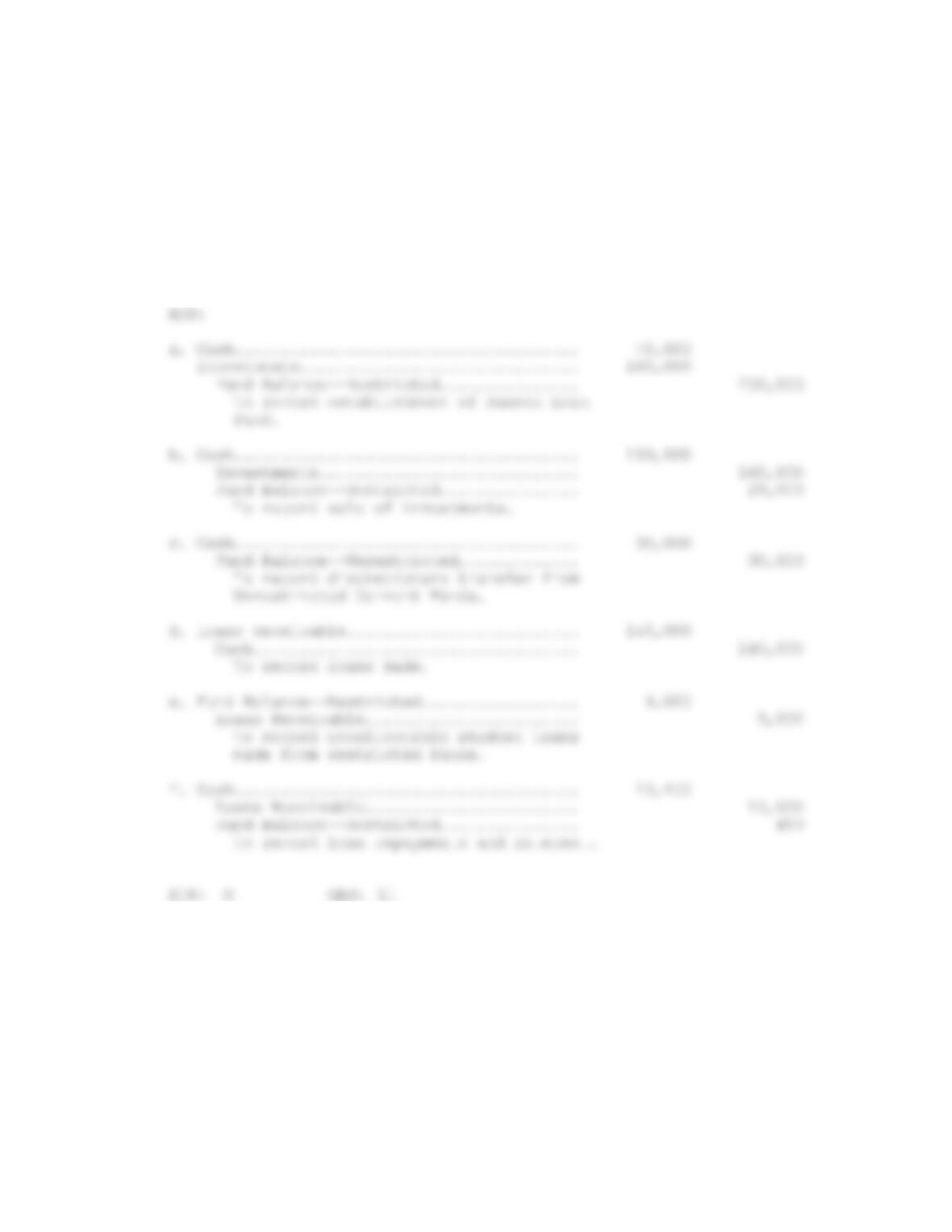
Required:
Prepare journal entries to record the above events.
22. The following selected transactions affecting the Annuity and Life
Income Funds of Tremper State University (public) occurred during the
current fiscal year.
a.
Upon his death, John Sooner, a local businessman, donates a
portfolio of stock with a cost basis of $100,000 and a market
value of $125,000. John’s wife is to receive an annuity of
$8,000 per year for life. Her life expectancy is ten years. An
estimated rate of return of 8% yields a present value of
$53,681 for the annuity.
Chapter 12
12–38
b.
Dividends of $7,500 are received from Life Income Fund
investments.
c.
Annuity fund investments with a book value of $6,000 are sold
for $6,500.
d.
The beneficiary of the life income investments described in
part (b) are paid.
e.
The first annuity payment to John Sooner’s wife is made from
part (a).
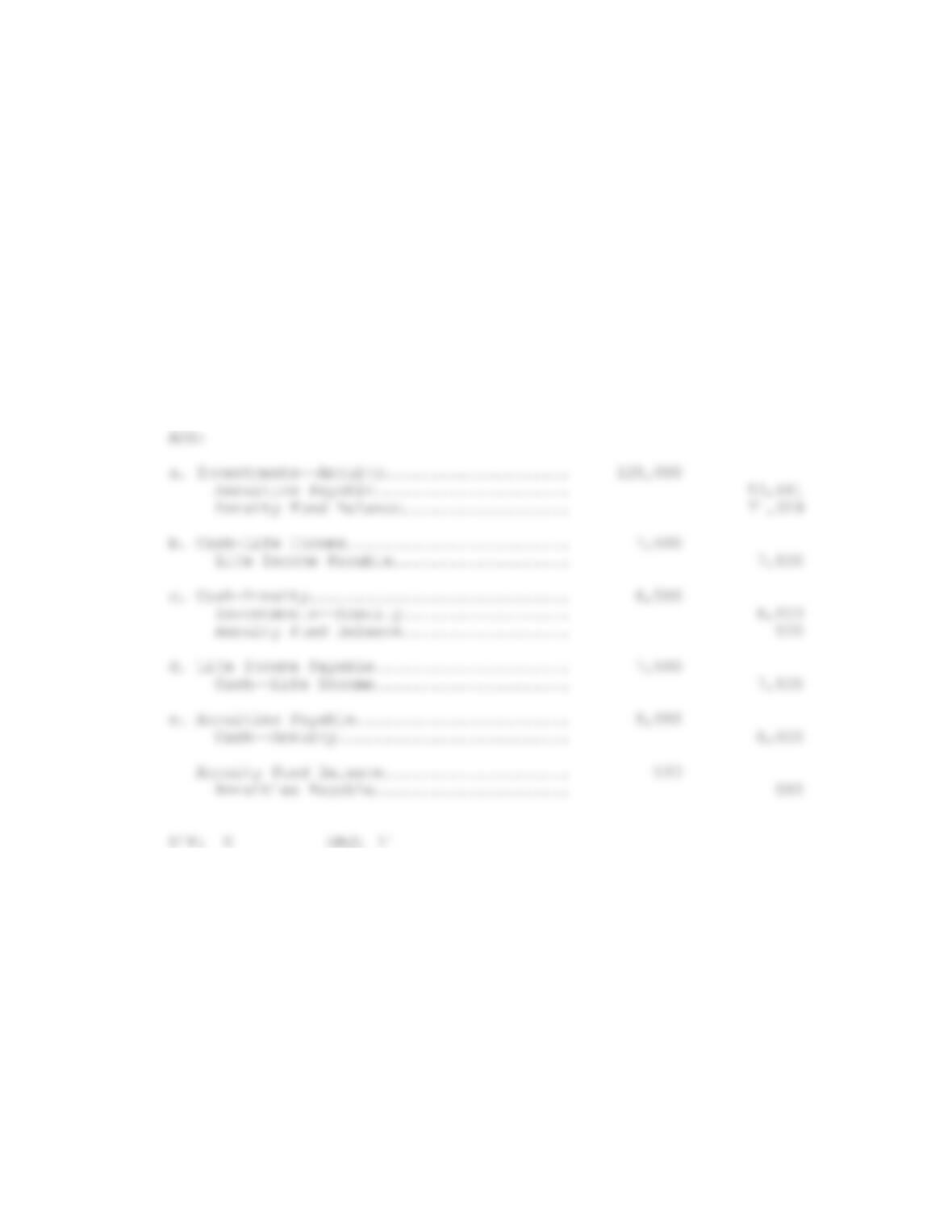
Required:
Make the journal entries necessary to record the transactions.
23. Records of the items that follow are maintained in a public
university’s Plant Fund. Fill in the name or names of the appropriate
plant subgroup funds in which the items are recorded.
Plant Subgroup
Item Funds
(1) Plant assets which were acquired with
Unrestricted Current Funds…………. 1. ___________________
(2) Accumulation of resources to keep
plant in operating condition……….. 2. ___________________
(3) Accumulation of resources for
acquiring properties………………. 3. ___________________

Chapter 12
12–39
(4) Accumulation of resources to
pay interest and principal of
Plant Fund debt…………………… 4. ___________________
(5) Recording of long-term liabilities
related to plant assets……………. 5. ___________________
(6) Receipt of proceeds from bond
issue floated to cover cost
of construction project……………. 6. ___________________
(7) Recording of construction in progress
on project mentioned in item 6……… 7. ___________________
(8) Two subgroups affected by completion of
construction project mentioned in
item 7…………………………… 8. ___________________
(9) Recording of receipt of donated land… 9. ___________________
(10) Two subgroups affected by payment of
mortgage that is a lien on plant
assets…………………………… 10. ___________________
24. Southern Coast (private) University received the following pledges
during 20X4:
a.
Joy Dance pledges $60,000 to be paid over a three-year period
beginning at the end of this year. Southern Coast discounts
this contribution at 10%. The present value is $49,737.
b.
As a result of a pledge drive, $500,000 is pledged to be paid
by the end of the accounting year. Ten percent of pledges in
the past have been shown to be uncollectible.
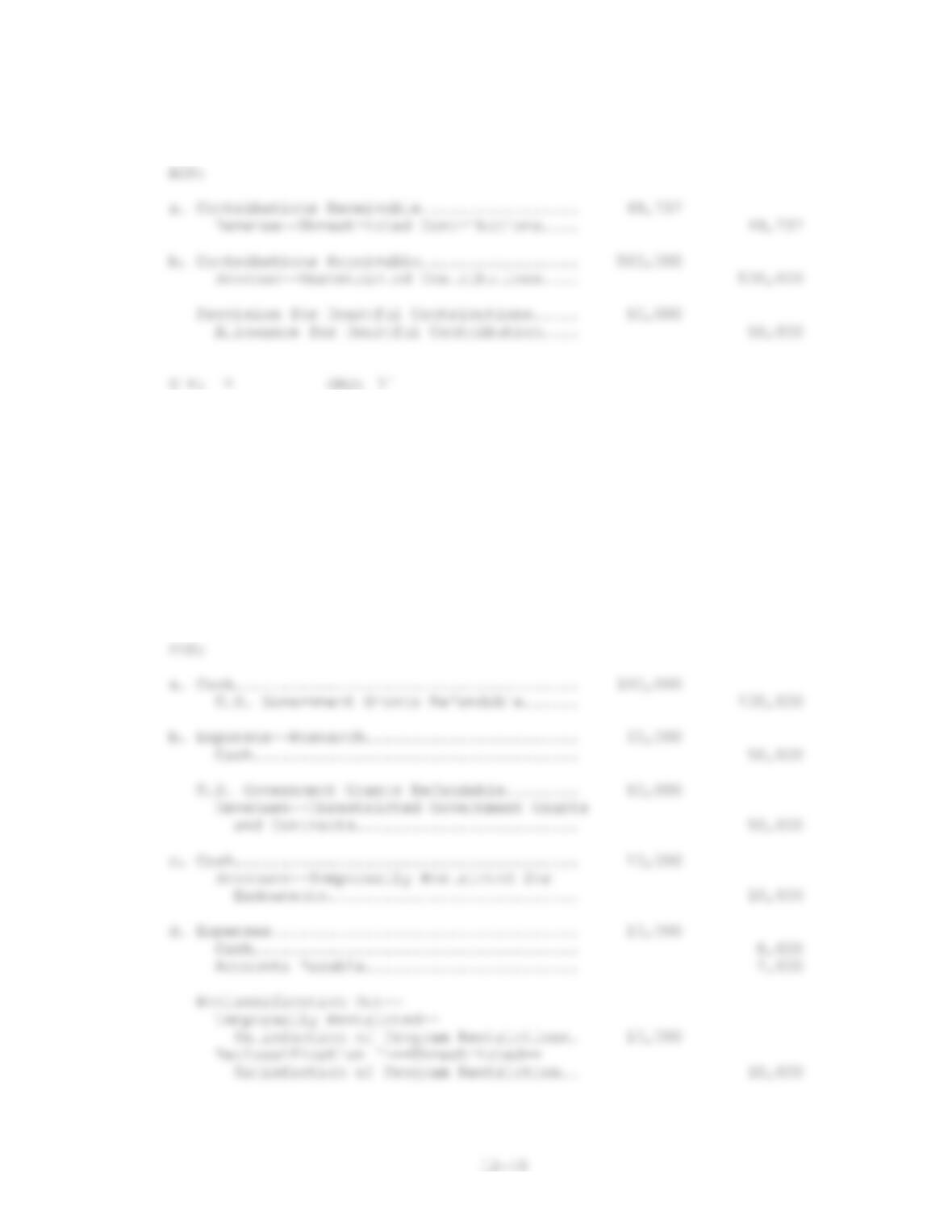
Required:
Chapter 12
Make the necessary journal entries to record the pledges.
25. Prepare the journal entries to record the following events for Cost
(private) University:
a.
A federal grant of $100,000 was received for research.
b.
Expenses for the research project totaled $50,000 to date.
c.
Endowment income of $10,000 is restricted to student aid
activities.
d.
All but $2,000 of expenses are paid for student aid.
Chapter 12
26. Consider the following transactions for the University of Northland
(private):
a.
On January 1st a gift of $100,000 was received from an
alumnus. She requested one half be used for student loans and
the other as a pure endowment contribution.
b.
Loans totaling $25,000 are made to students. Collections from
other loans made to students total $30,000 plus $3,000
interest.
c.
During the year, investments of $20,000 were sold for $30,000.
Any gain is restricted for improvements in classroom
instruction.
d.
During the year, interest charges of $5,000 were earned and
collected on late student fee payments.
e.
A student loan of $500 is deemed uncollectible.
f.
During the year, operating expenses of $150,000 were recorded.
At the end of the year, $25,000 remains unpaid.
Required:
Prepare journal entries necessary to record the transactions.
Chapter 12
27. The following events occurred as part of operations in Hard Knocks
(private) University:
a.
To construct a new computer center, the University floated at
par a $10,000,000 10% serial bond issued on January 1, paying
interest December 31 and June 30.
b.
$100,000 for computer equipment was donated by a wealthy
alumnus.
c.
Payments for construction to date total $5,000,000.
d.
Interest payments are made on June 30th.
e.
Construction of the center is completed at an additional cost
of $7,000,000 and it is paid in full.
f.
The first serial bond of $2,000,000 plus interest is paid.
g.
A building valued at $100,000 is received as a gift on the
condition the university assumes the $50,000 mortgage and uses
the building for classroom purposes only. The University
elects to “release” the restriction over the useful life of
the building.
h.
Depreciation on the building totaled $10,000.
Required:
Prepare journal entries for the above events.
Chapter 12
12–43
28. Consider the following events affecting Private University:
a.
A $2,000,000, 10% serial bond issue, paying interest
semiannually, was sold at face value on an interest payment
date. Proceeds of the bond issue are to be used to add a wing
to the library.
b.
A lot valued at $30,000 was donated by a former librarian to
permit building of the proposed library wing. No permanent
restrictions were stipulated by the donor.
c.
The State Building Board approved the plans submitted by the
architect, who was paid $20,000. A contract for $1,900,000 was
signed for construction of the library wing.
d.
The bond interest was paid.
e.
At year end, approximately two-thirds of the construction was
completed. A payment of $1,200,000 was made to the contractor.
f.
Tuckpointing and other repairs to university buildings
amounting to $35,000 were paid from resources previously
provided specifically for that purpose by a retired faculty
member.
Chapter 12
g.
The library wing was completed. The remaining contract price
is paid, and the building cost and bond payable are
transferred to the proper fund.
h.
Payments of the second six months’ interest on bonds
($100,000) and the first bond serial ($200,000) were made.
i.
A donation made last year by a public accounting firm was
expanded to acquire a specified collection of books on
accounting, dating back to the 16th and 17th centuries, at a
cost of $85,000.
Required:
Prepare journal entries to record the events.
Chapter 12
12–45
29. Consider the following events for Chase Private University:
a.
Unrestricted contributions are pledged in the amount of
$500,000.
b.
Purchase of material and supplies totaling $100,000 of which
$25,000 is not yet paid.
c.
Endowment income of $8,000 is restricted to student aid
activities.
d.
A federal grant for $200,000 was awarded for research.
e.
Materials and supplies used were as follows: Student services
$10,000, Auxiliary enterprise $25,000
f.
Federal government monies of $50,000 restricted for student
loans are received.
g.
Expenses for the research project in d. totaled $100,000 to
date.
h.
Term endowments expire, making $10,000 cash available.
i.
Cash of $10,000 from Life Income Fund Investments is received.
j.
Stock with a market value of $45,000 is received from an art
patron to finance art gallery improvements.
Chapter 12
k.
Federal grants for student awards through the Pell Grant
program are received in the amount of $175,000.
l.
Bills went out for dormitory fees of which $250,000 is paid
and $50,000 is still not received.
m.
Payment of $100,000 is made on the mortgage.
n.
Depreciation on all assets total $125,000. Of this
depreciation charge, $25,000 represents depreciation on assets
classified as donor restricted. Chase Private University
elects to release donor restrictions when assets are placed in
service.
o.
Art gallery improvements of $25,000 were made with donor–
restricted contributions.
Required:
Assuming that fund accounting is used, record the events. Identify the
appropriate fund for each transaction.
Chapter 12
12–47
30. The following events are for Tubac Center, a not-for-profit hospital.
The hospital records expense data based on the nature of the expense,
such as wages, salaries, and benefits.
a.
Patient services amounting to $300,000 were billed. A 5%
allowance for uncollectibles is to be recorded.
b.
Of $70,000 gross billings in part (a), third-party payers
remitted $62,000 in full settlement. The remaining $8,000 is a
contractual adjustment.
c.
The board of trustees authorized $90,000 to increase the
malpractice fund held by a trustee.
d.
Supplies costing $77,000 were requisitioned from inventory
maintained on a perpetual basis. These supplies were used by
Chapter 12
professional services.
e.
Nurses’ salaries of $110,000 were incurred. Of this amount,
$8,000 of accrued benefits were unpaid. Ignore payroll
deductions.
f.
$200,000 of the temporarily restricted net assets are
reclassified to cover specified, current operations.
Required:
Prepare the necessary journal entries.

Chapter 12
31. A not-for-profit hospital uses three revenue-controlling accounts:
Patient Service Revenue, Other Operating Revenue, and Nonoperating
Revenue.
Required:
Indicate which of the three revenue accounts would be credited to
record the following transactions, or None if none of the accounts is
appropriate.
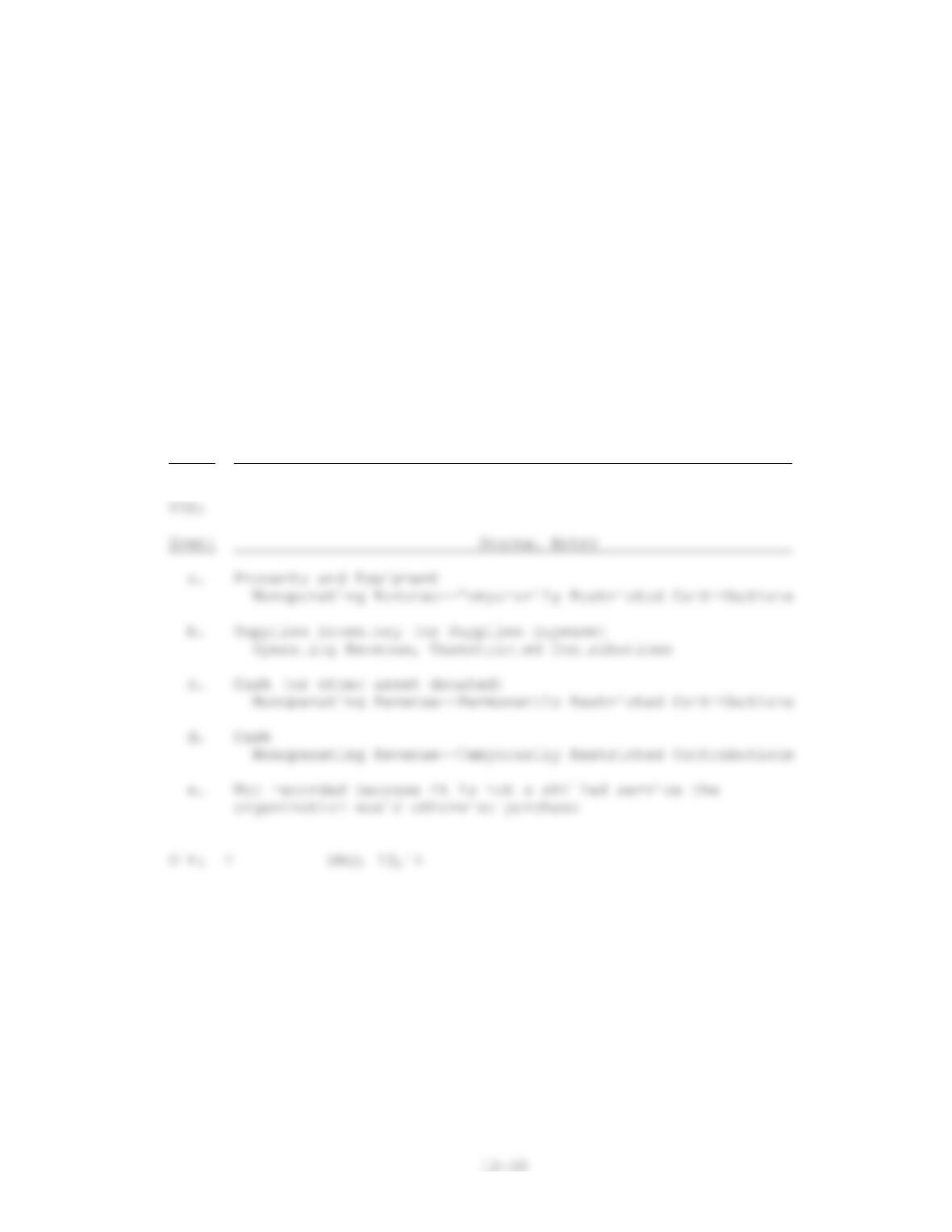
a. Snack bar sales…………………….. _______________________
b. Dividends from unrestricted investments.. _______________________
c. Operating room fees…………………. _______________________
d. Pharmacy sales to patients…………… _______________________
e. Fees for educational program
offered to nurses…………………… _______________________
f. Proceeds from bond sale……………… _______________________
g. Gains on sale of unrestricted
investments………………………… _______________________
h. Contributions for a term endowment……. _______________________
i. Cash transfers from matured term
endowments for use in operations……… _______________________
j. Cafeteria sales to visitors………….. _______________________
Chapter 12
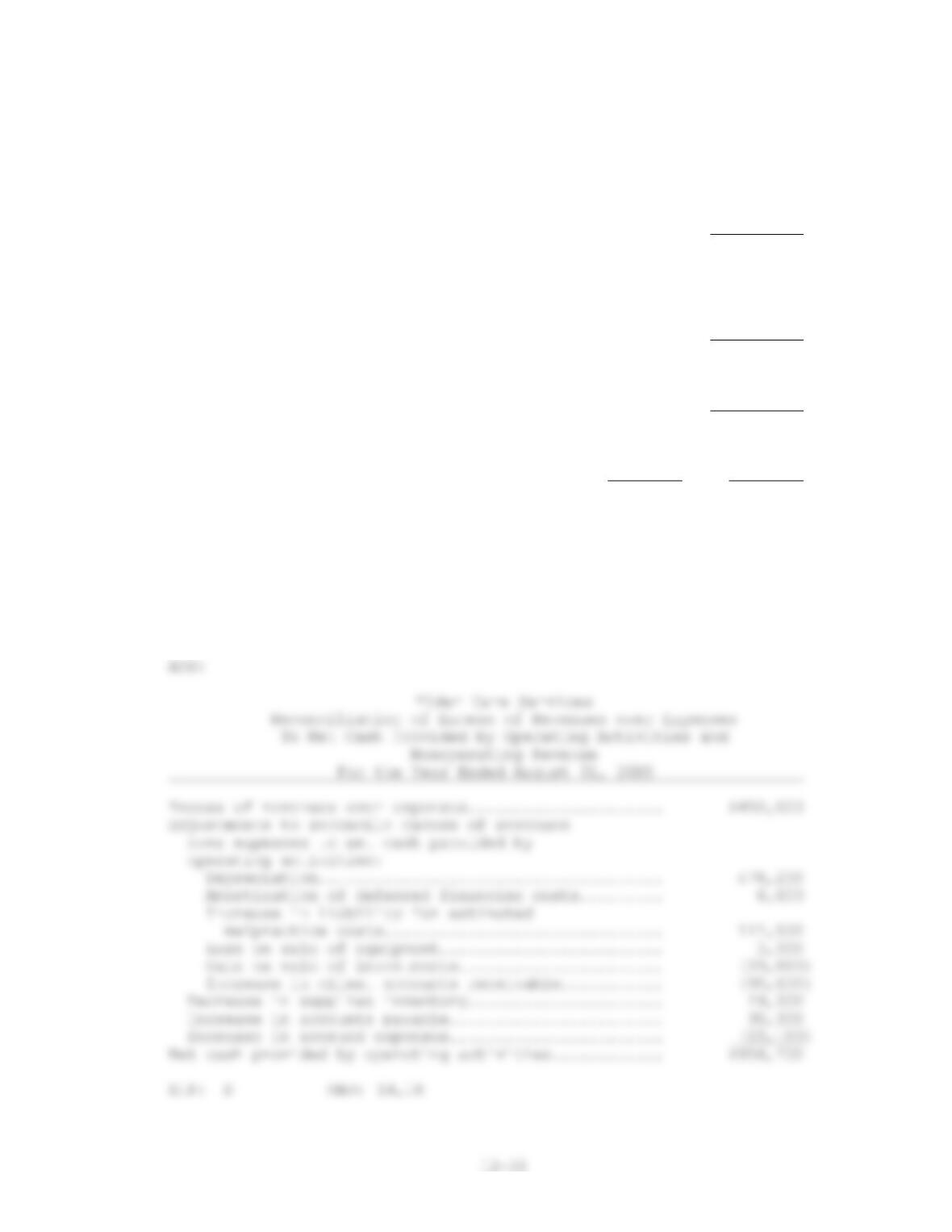
32. Consider the following unrestricted donations to a not-for-profit
health care facility:
a.
Donation of property and equipment.
b.
Donation of substantial amount of medical supplies.
c.
Donation of resources to endow a fund.
d.
Donation of cash to be used to conduct cancer research.
e.
Volunteer provision of services by local high school students
involving visiting and reading to patients.
Required:
Using the following format, indicate what entries would be recorded:
Event Journal Entry
Chapter 12
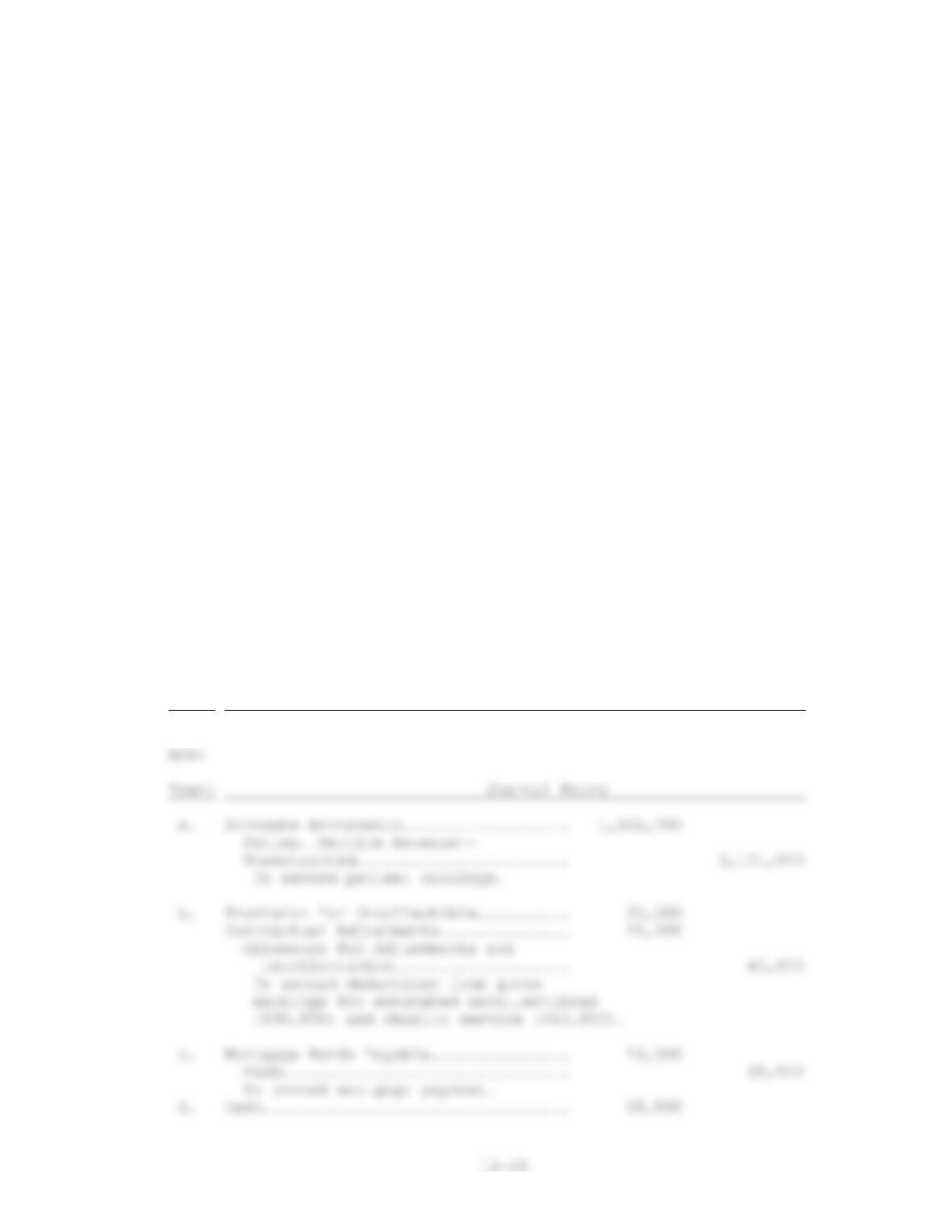
33. Elder Care Services is a not-for-profit provider of health care
services.
a.
The condensed income statement for the year ended August 31,
20X5 shows the following:
Net patient service revenue………………….. $9,164,600
Other operating revenue……………………… 568,000
Total operating revenues…………………… $9,732,600
Operating expenses (includes $478,200 in
depreciation; $6,600 of amortization of
deferred financing costs; and an increase in
liability for estimated malpractice costs of
$112,500)………………………………. 9,671,500
Income from operations…………………….. $ 61,100
Nonoperating revenue (net) (includes
loss on sale of equipment of $5,300; gain
on sale of investments of $39,800)………… 388,900
Excess of revenues over expenses……………. $ 450,000
==========
b.
Comparative balance sheets for August 31 show the following:
20X5 20X4
Client accounts receivable………… $432,200 $341,600
Supplies inventory……………….. 153,500 172,800
Accounts payable…………………. 318,760 288,460
Accrued expenses…………………. 60,100 75,200
Required:
Prepare a schedule showing net cash provided by operating activities
and nonoperating activities and nonoperating revenue that is presented
under the indirect method of preparing a statement of cash flows.

Chapter 12
12–52
34. The post-closing trial balance for Blakely Hospital as of January 1,
20X5, is as follows:
Debit Credit
Cash…………………………….. 79,800
Accounts Receivable……………….. 37,000
Allowance for Adjustments and
Uncollectibles……………………. 7,000
Inventory of Supplies……………… 14,000
Long-Term Investments……………… 146,200
Property, Plant, and Equipment……… 2,830,000
Accumulated Depreciation…………… 564,000
Endowment Investments……………… 260,000
Vouchers Payable………………….. 16,000
Accrued Expenses………………….. 6,000
Mortgage Bonds Payable…………….. 150,000
Unrestricted Net Assets……………. 1,158,000
Temporarily Restricted Net Assets…… 1,250,000
Permanently Restricted Net Assets…… 216,000
3,367,000 3,367,000
========= =========
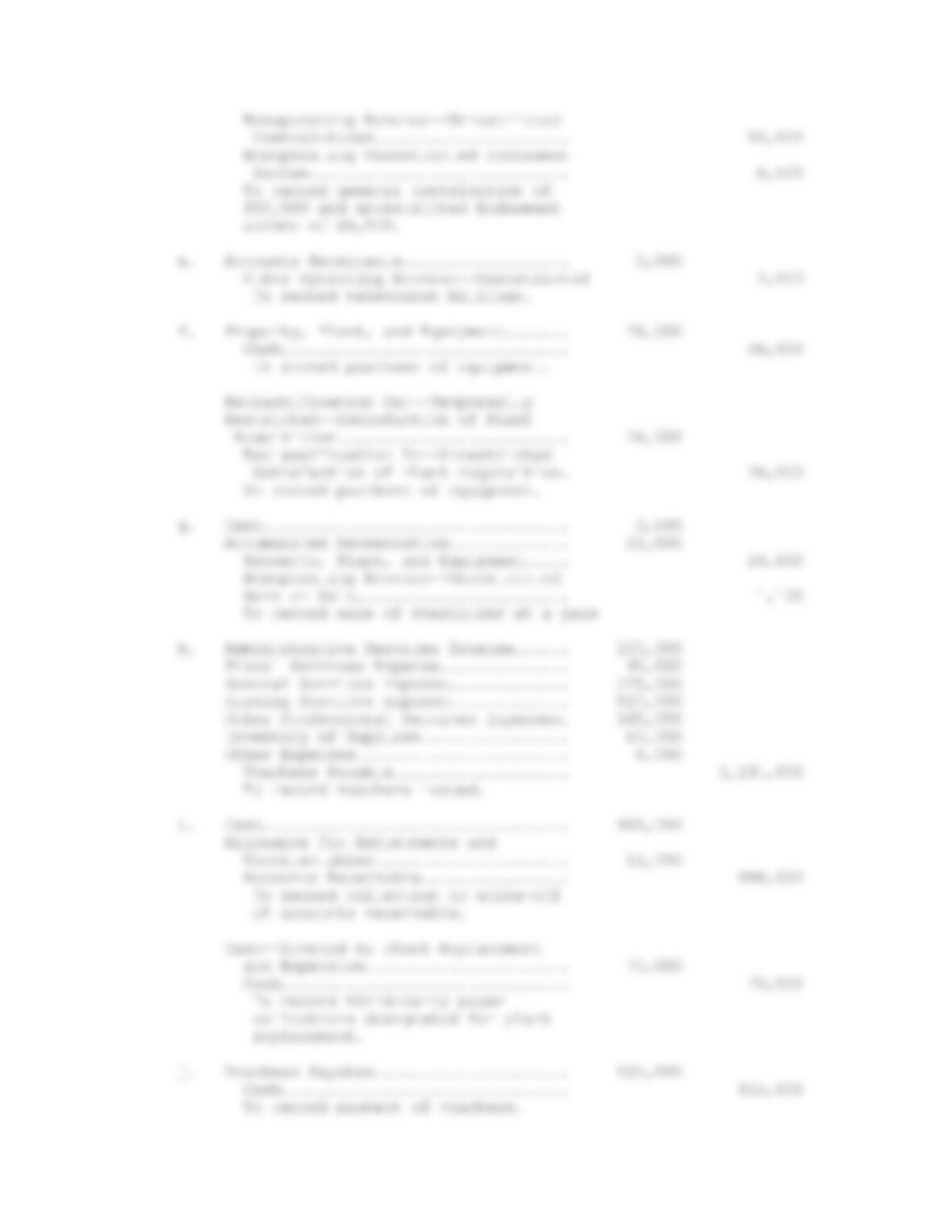
The following events occurred during 20X5:
a.
Gross charges for hospital service, all charged to accounts
receivable, were as follows:
Room and board charges………………………. $780,000
Charges for other professional services……….. 321,000
b.
Deductions from gross revenues were as follows:
Provision for uncollectible receivables……….. $30,000
Charity service…………………………….. 15,000
c.
The hospital paid $18,000 to retire mortgage bonds payable
with an equivalent book value.
d.
During the year, Blakely Hospital received general
contributions of $50,000 and income of $6,500 from endowment
investments. Income received on endowment investments is
unrestricted.
e.
Patients were billed $3,000 for television rental.
f.
$26,000 of donor specified contributions were used to acquire
new equipment. The hospital policy is to release donor
restrictions when asset is placed in service.
g.
A sterilizer that originally cost $24,000 and had a book value
of $2,400 was sold for $3,500.
h.
Vouchers totaling $1,191,000 were issued for the following
items:
Administrative services expense………………… $120,000
Fiscal services expense……………………….. 95,000
General services expense………………………. 225,000
Nursing services expense………………………. 520,000
Other professional services expense…………….. 165,000
Supplies (use a perpetual inventory system)……… 60,000
Expenses accrued on December 31, 20X4…………… 6,000
Chapter 12
i.
Collections on accounts receivable totaled $985,000. Accounts
written off as uncollectible amounted to $11,000. Collections
from third-party payers included $70,000 that is restricted to
plant replacement.
j.
Cash payments on vouchers payable during the year were
$825,000.
k.
Supplies of $37,000 were issued to nursing services.
l.
During the year, $12,000 of cash income on temporarily
restricted investments was received. On December 31, 20X5,
there was $800 of accrued interest income on these
investments. Earnings are restricted to plant and expansion.
m.
Depreciation of buildings and equipment for the year was
$117,000.
n.
On December 31, 20X5, an accrual of $6,100 was made for
interest on mortgage bonds payable. Interest is considered an
Administrative Services Expense.
o.
A grateful patient contributed $100,000 in cash. Earnings must
accumulate during the patient’s lifetime. Upon death, the
principal and accumulated earnings are to be used for plant
expansion.
Required:
Using the following format, prepare journal entries for the events.
Expense data are recorded based on types of services provided.
Event Journal Entry
Chapter 12
12–54
Chapter 12
12–55
35. The following is an adjusted preclosing trial balance of the General
Funds of Barnes Nursing Home (non-profit).
Barnes Nursing Home
Adjusted Current Funds Trial Balance
December 31, 20X5
Unrestricted Restricted
Cash…………………… 300,000 107,000
Pledges Receivable………. 12,000 206,000
Accrued Interest Receivable. 1,000
Inventory of Supplies……. 120,000
Vouchers Payable………… 50,000 10,000
Accrued Expenses………… 25,000
Refundable Deposits……… 2,000
Allowance for Uncollectible
Pledges……………….. 3,000
Net Assets, January 1, 20X5
Designated–Unrestricted.. 12,000
Undesignated–Unrestricted 26,000
Temporarily Restricted…. 3,000
Permanently Restricted…. 250,000
Contributions…………… 200,000 50,000
Resident Service Revenue…. 415,000
Other Operating Revenue….. 20,000 5,000
Outreach Expenses……….. 20,000
Nursing Services Expenses… 100,000
Chapter 12
Dietary Service Expense….. 100,000
General Service Expense….. 45,000
Financial Service Expense… 60,000
Reclassification In–
Satisfaction of Program
Restriction……………. 5,000
Reclassification Out–
Satisfaction of Program
Restrictions…………… 5,000
758,000 758,000 318,000 318,000
======= ======= ======= =======
Required:
Prepare a statement of activities and a statement of financial position
as of December 31, 20X5.
Chapter 12
12–57
36. The following data apply to Riverside Hospital, a not-for–profit
organization.
a.
Summarized cash receipts showed cash received from the
following:
Patients and third-party payers………………. $903,420
Other operational activities…………………. 57,120
Donor restricted gifts for programs…………… 11,220
Unrestricted interest from investments………… 25,100
b.
Summarized cash payments showed cash paid to the following:
Suppliers and employees……………………… $892,140
The bank to cover interest charges……………. 14,500
For the purchase of equipment………………… 45,450
c.
Donation of $100,000 cash received with donor restriction that
it be permanently restricted. Income may be used for
replacement of equipment.
d.
Bonds payable that would have matured in two years were
retired on an interest date at a face value of $18,000.
e.
The cash balance on January 1, 20X1, was $168,020. On December
31, 20X1, the cash balance was $145,300.
Required:
Using the direct method, prepare a statement of cash flows for the year
ended December 31, 20X1.
Chapter 12
ESSAY
1. Are not-for-profit universities required to use fund accounting?
Chapter 12
2. How has the adoption of GASB Statement No. 35 changed the reporting
standards for colleges and universities.
3. In accounting for not-for-profit public universities, Endowment and
Similar Funds are commonly used.
Required:
a. List and briefly define the three types of endowments often found in
the university environment.
b. Describe the accounting procedures for income earned on endowment
funds.
c. Explain the use of investment pools.
Chapter 12
4. Explain how certain transactions that traditionally were reported as
restricted by private universities will now be categorized as
unrestricted exchange transaction. Describe how they will be accounted
for per FASB 116.
5. In accounting for health care services, several methods are utilized.
Required:
a. List and briefly define the three types of classifications of health
care facilities
b. Describe the effects of third party payer arrangements on revenue
recognition procedures for health care organizations.
c. Describe the classification of expenses in a health care
environment.
Chapter 12
12–61