Cost Accounting: A Managerial Emphasis, 6e
Chapter 12 – Pricing Decisions, Product Profitability Decisions, and Cost Management
Answer the following question(s) using the information below.
After conducting a market research study, Schultz Manufacturing decided to produce a new interior door
to complement its exterior door line. It is estimated that the new interior door can be sold at a target price
of $60. The annual target sales volume for interior doors is 20,000. Schultz has target operating income of
20% of sales.
22) What are target sales revenues?
A) $960,000
B) $2,000,000
C) $1,800,000
D) $1,000,000
E) $1,200,000
23) What is the target operating income?
A) $240,000
B) $360,000
C) $200,000
D) $192,000
E) $400,000
24) What is the target cost?
A) $800,000
B) $960,000
C) $1,440,000
D) $1,600,000
E) $768,000
Cost Accounting: A Managerial Emphasis, 6e
Chapter 12 – Pricing Decisions, Product Profitability Decisions, and Cost Management
25) What is the target cost for each interior door?
A) $48
B) $72
C) $80
D) $38
E) $40
Answer the following question(s) using the information below.
After conducting a market research study, Potter Products decided to produce an electric coffee pot to
complement its line of kitchen products. It is estimated that the new coffee pot can be sold at a target
price of $46. The annual target sales volume for the coffee pot is 300,000. Potter has target operating
income of 18% of sales.
26) What are the target sales revenues?
A) $1,380,000
B) $13,800,000
C) $11,316,000
D) $12,000,000
E) $16,284,000
27) What is the target operating income?
A) $2,931,120
B) $2,160,000
C) $2,036,880
D) $2,484,000
E) $248,400
Cost Accounting: A Managerial Emphasis, 6e
Chapter 12 – Pricing Decisions, Product Profitability Decisions, and Cost Management
28) What is the total target cost?
A) $9,840,000
B) $11,316,000
C) $13,352,000
D) $9,279,120
E) $1,131,600
29) What is the target cost for each coffee pot?
A) $32.80
B) $44.51
C) $30.93
D) $3.77
E) $37.72
Answer the following question(s) using the information below.
Sheltar’s TV currently sells small televisions for $180. It has costs of $140. A competitor is bringing a new
small television to market that will sell for $150. Management believes it must lower the price to $150 to
compete in the market for small televisions. Marketing believes that the new price will cause sales to
increase by 10%, even with a new competitor in the market. Sheltar’s sales are currently 100,000
televisions per year.
30) What is the target cost if target operating income is 25% of sales?
A) $105.00
B) $145.00
C) $140.00
D) $135.00
E) $112.50
Cost Accounting: A Managerial Emphasis, 6e
Chapter 12 – Pricing Decisions, Product Profitability Decisions, and Cost Management
31) What is the change in operating income if marketing is correct and only the sales price is changed?
A) $125,000
B) $950,000
C) $(3,450,000)
D) $(2,900,000)
E) $2,350,000)
32) What is the target cost if the company wants to maintain its same income level, and marketing is
correct (rounded to the nearest cent)?
A) $112.50
B) $113.64
C) $123.34
D) $140.00
E) $135.00
Answer the following question(s) using the information below.
Frank’s Computer Monitors Inc.. currently sells 17″ monitors for $270. It has costs of $210. A competitor is
bringing a new 17” monitor to market that will sell for $225. Management believes it must lower the price
to $225 to compete in the market for 17″ monitors. Marketing believes that the new price will cause sales
to increase by 10%, even with a new competitor in the market. Frank’s sales are currently 10,000 monitors
per year.
33) What is the target cost if operating income is 25% of sales?
A) $189.00
B) $41.25
C) $210.00
D) $202.50
E) $168.75
Cost Accounting: A Managerial Emphasis, 6e
Chapter 12 – Pricing Decisions, Product Profitability Decisions, and Cost Management
34) What is the change in operating income if marketing is correct and only the sales price is changed?
A) $1,421,250
B) $(204,000)
C) $(352,500)
D) $(435,000)
E) $18,750
35) What is the target cost if the company wants to maintain its same income level, and marketing is
correct (rounded to the nearest cent)?
A) $168.75
B) $170.46
C) $185.00
D) $210.00
E) $202.50
Cost Accounting: A Managerial Emphasis, 6e
Chapter 12 – Pricing Decisions, Product Profitability Decisions, and Cost Management
36) Frost Inc. has budgeted sales of $150,000 with the following budgeted costs:
Direct materials $31,500
Direct labour 20,500
Factory overhead:
Variable 18,500
Fixed 28,000
Selling and administrative expenses:
Variable 12,000
Fixed 16,000
Compute the target profit percentage for setting prices as a percentage of:
a. Total costs
b. Total variable costs
c. Variable manufacturing costs
d. Total manufacturing costs
Cost Accounting: A Managerial Emphasis, 6e
Chapter 12 – Pricing Decisions, Product Profitability Decisions, and Cost Management
37) Nancy Company has budgeted sales of $300,000 with the following budgeted costs:
Direct materials $60,000
Direct manufacturing labour 40,000
Factory overhead:
Variable 30,000
Fixed 50,000
Selling and administrative expenses:
Variable 20,000
Fixed 30,000
Compute the average markup percentage for setting prices as a percentage of:
a. The full cost of the product
b. The variable cost of the product
c. Variable manufacturing costs
d. Total manufacturing costs
Cost Accounting: A Managerial Emphasis, 6e
Chapter 12 – Pricing Decisions, Product Profitability Decisions, and Cost Management
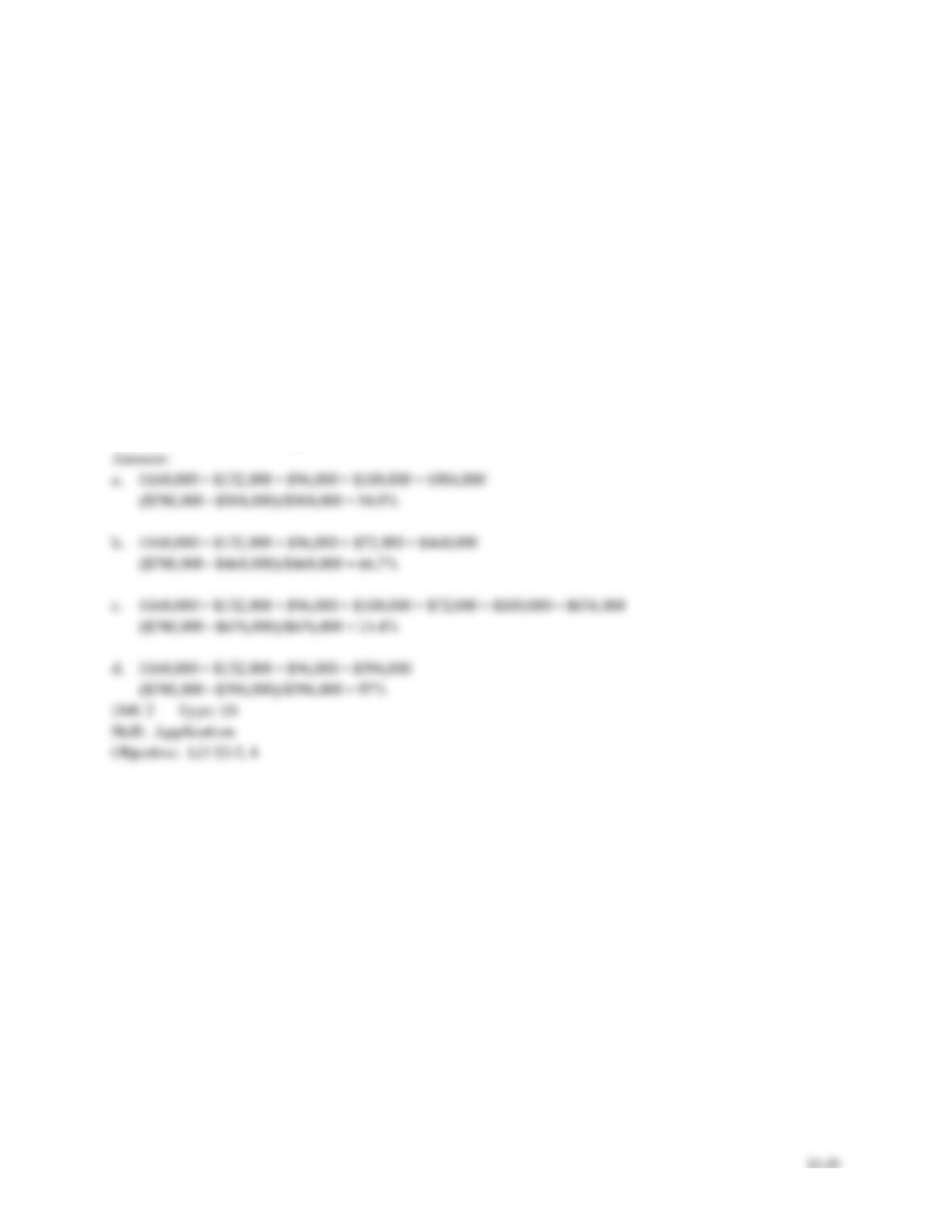
38) Ellingson Company has budgeted sales of $487,500 with the following budgeted costs:
Direct materials $105,000
Direct labour 82,500
Factory overhead:
Variable $60,000
Fixed 67,500
Selling and administrative expenses:
Variable $45,000
Fixed 62,500
Compute the target profit percentage for setting prices as a percentage of:
a. Total manufacturing costs
b. Total variable costs
c. Total costs
d. Variable manufacturing costs
Cost Accounting: A Managerial Emphasis, 6e
Chapter 12 – Pricing Decisions, Product Profitability Decisions, and Cost Management
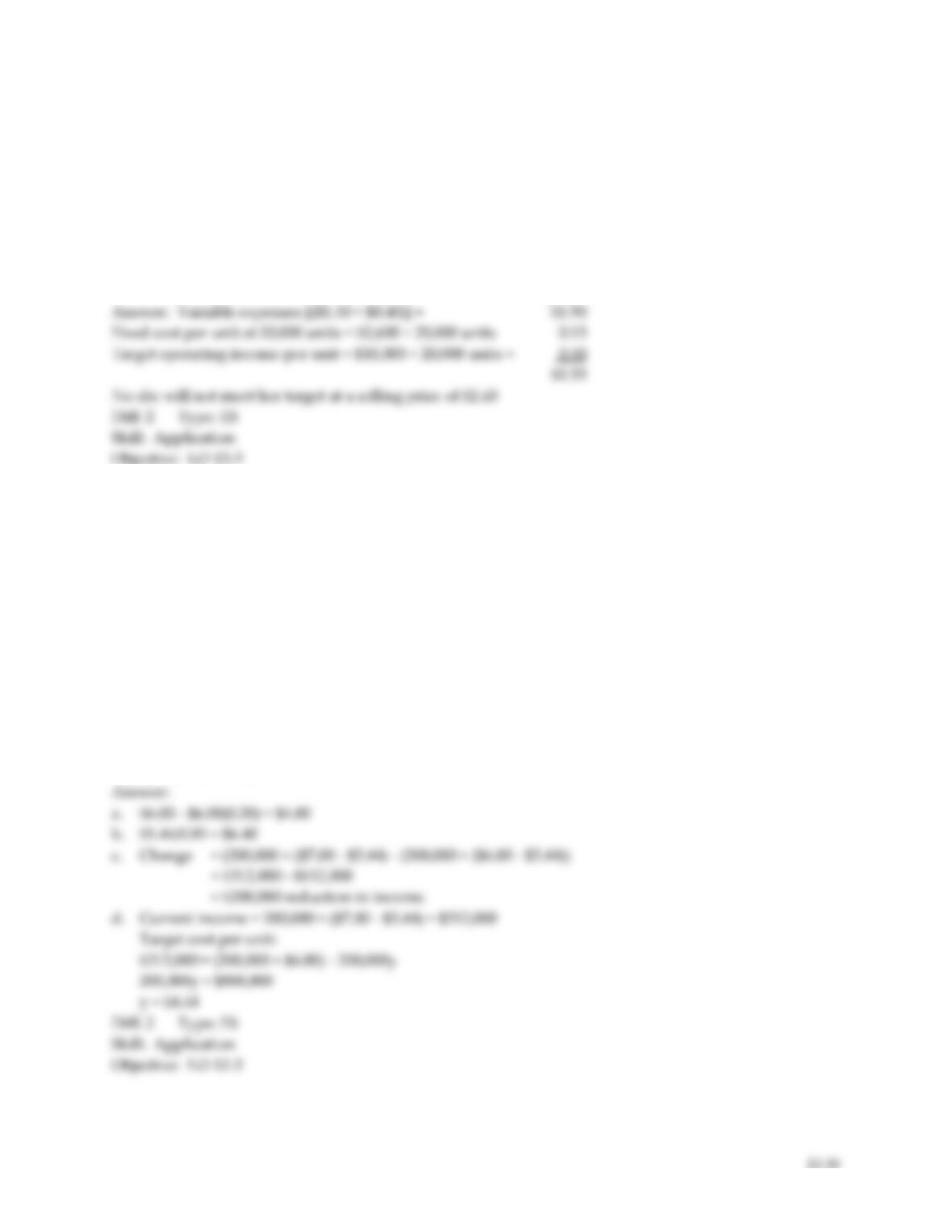
39) Timothy Company has budgeted sales of $780,000 with the following budgeted costs:
Direct materials $168,000
Direct manufacturing labour 132,000
Factory overhead:
Variable 96,000
Fixed 108,000
Selling and administrative expenses:
Variable 72,000
Fixed 100,000
Compute the average markup percentage for setting prices as a percentage of:
a. Total manufacturing costs
b. The variable cost of the product
c. The full cost of the product
d. Variable manufacturing costs
Cost Accounting: A Managerial Emphasis, 6e
Chapter 12 – Pricing Decisions, Product Profitability Decisions, and Cost Management
40) Bridget, a college student, plans to operate a hot dog stand at the beach during the summer for three
months. Her fixed costs for the booth, which include utilities, will be $2,600. Variable costs per hot dog
will be $1.50 for materials and $0.40 for a franchise fee from the hot dog supplier. This year’s sales are
expected to be 20,000 units based upon the operation of the same booth the prior year. Bridget needs to
earn $10,000 so that she can pay part of her college expenses for the coming academic year. Based on
competitor’s prices, her target price is $2.40
Required:
Determine whether she can expect to earn the $10,000 at the target price.
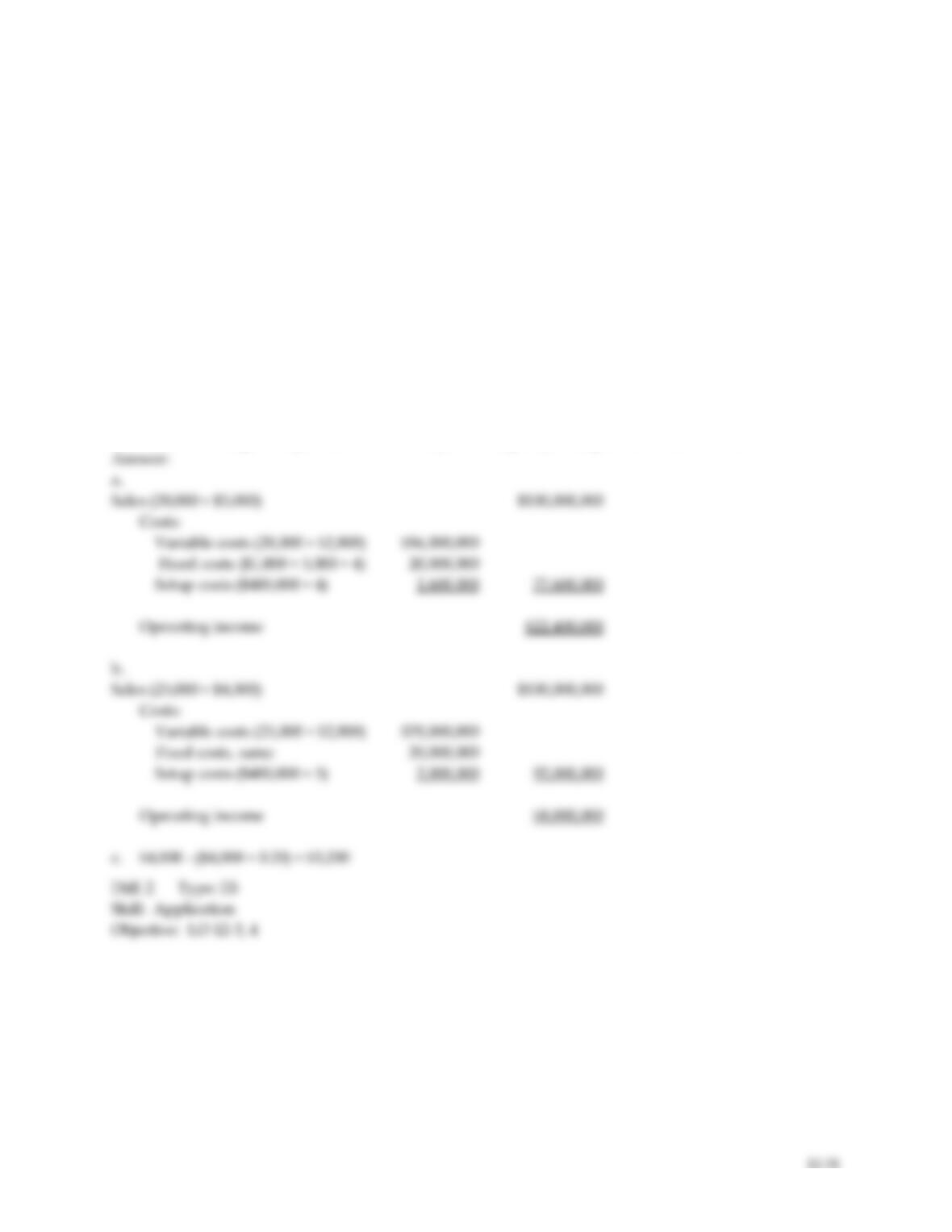
41) Do-It Company manufactures sinker molds for fishing. A sinker mold has a price of $7.00, and costs
currently assigned to it of $5.44. A competitor is introducing a new sinker mold that will sell for $6.00.
Management believes it must lower the price to $6.00 in order to compete in the highly cost-conscious
sinker mold market. Marketing believes that the new price will maintain the current sales level. Do-It
Company’s sales are currently 200,000 molds per year.
Required:
a. What is the target cost for the new price if target profit is 20 percent of sales?
b. What is the target selling price if costs cannot be reduced and target profit is changed to 15 percent of
sales?
c. What is the change in operating income for the year if $6.00 is the new price and costs remain the
same?
d. What is the target cost per unit if the selling price is reduced to $6.00 and the company wants to
maintain its same income level?
Cost Accounting: A Managerial Emphasis, 6e
Chapter 12 – Pricing Decisions, Product Profitability Decisions, and Cost Management
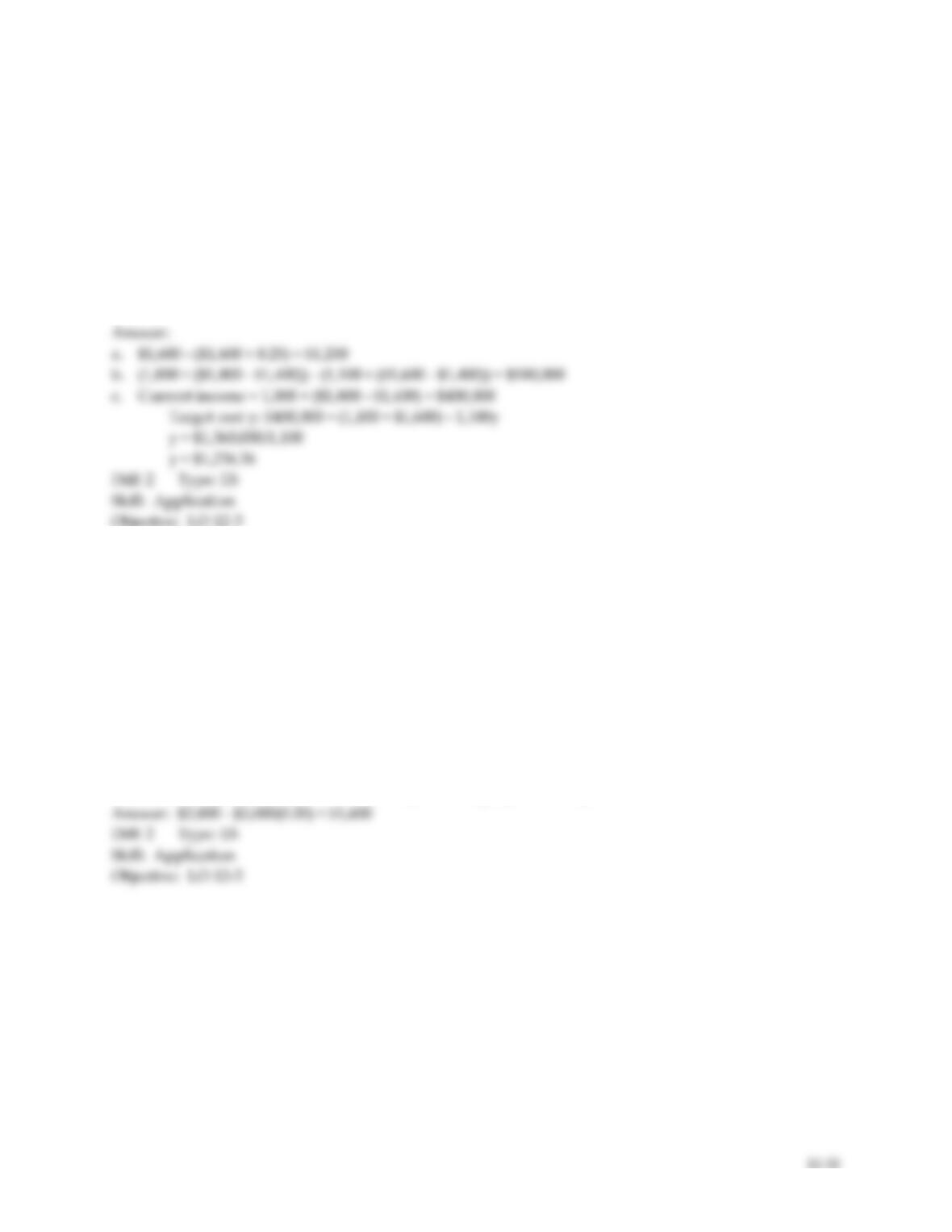
42) Robert’s Medical Equipment Company manufactures hospital beds. Its’ most popular model, Deluxe,
sells for $5,000. It has variable costs of $2,800 and fixed costs of $1,000 per unit, base on an average
production run of 5,000 units. It normally has four production runs a year, with $400,000 in setup costs
each time. Plant capacity can handle up to six runs a year for a total of 30,000 beds.
A competitor is introducing a new hospital bed similar to Deluxe that will sell for $4,000.
Management believes it must lower the price to compete. Marketing believes that the new price will
increase sales by 25% a year. The plant manager thinks that production can increase by 25% with the
same level of fixed costs. The company currently sells all the Deluxe beds it can produce.
Required:
a. What is the annual operating income from Deluxe at the current price of $5,000 and normal
production?
b. What is the annual operating income from Deluxe if the price is reduced to $4,000 and sales in units
increase by 25%?
c. What is the target cost per unit for the new price if target operating income is 20% of sales?
Cost Accounting: A Managerial Emphasis, 6e
Chapter 12 – Pricing Decisions, Product Profitability Decisions, and Cost Management
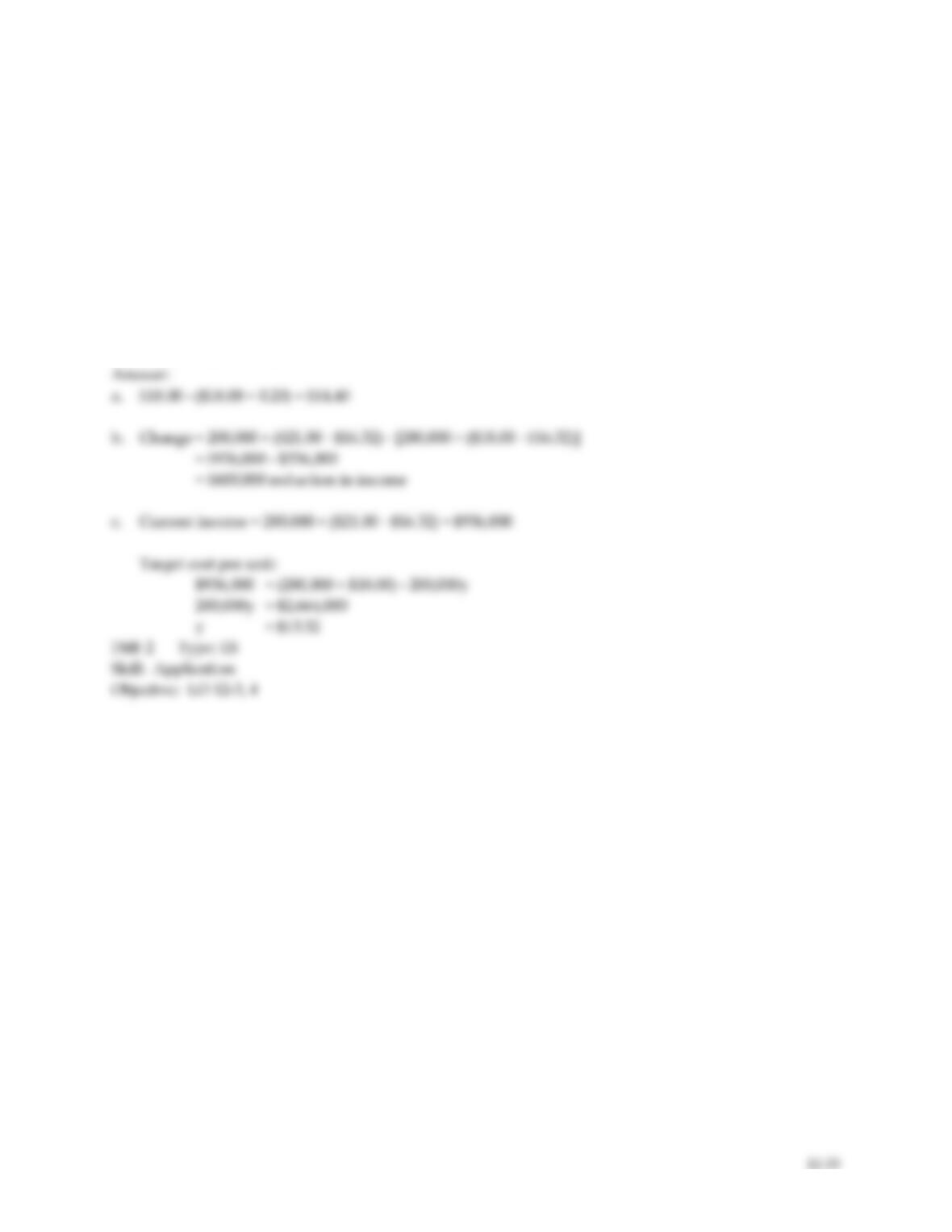
43) Reuter Avionics currently sells radios for $1,800. It has costs of $1,400. A competitor is bringing a new
radio to market that will sell for $1,600. Management believes it must lower the price to $1,600 to
compete in the market for radios. Marketing believes that the new price will cause sales to increase by
10%, even with a new competitor in the market. Reuter’s sales are currently 1,000 radios per year.
Required:
a. What is the target cost if target operating income is 25% of sales?
b. What is the change in operating income if marketing is correct and only the sales price is changed?
c. What is the target cost if the company wants to maintain its same income level, and marketing is
correct?
44) Central Dental Company manufactures dental chairs. Its most popular model, Deluxe, sells for $2,500.
It has variable costs totaling $1,400 and fixed costs of $500 per unit based on an average production run of
5,000 units. It normally has four production runs a year with $200,000 setup costs each time. Plant
capacity can handle up to six runs a year for a total of 30,000 chairs.
A competitor is introducing a new dental chair similar to Deluxe that will sell for $2,000. Management
believes it must lower the price in order to compete. Marketing believes that the new price will increase
sales by 25 percent a year. The plant manager thinks that production can increase by 25 percent with the
same level of fixed costs. The company currently sells all the Deluxe chairs it can produce.
Required:
What is the target cost per unit for the new price if target profit is 20 percent of sales?
Cost Accounting: A Managerial Emphasis, 6e
Chapter 12 – Pricing Decisions, Product Profitability Decisions, and Cost Management
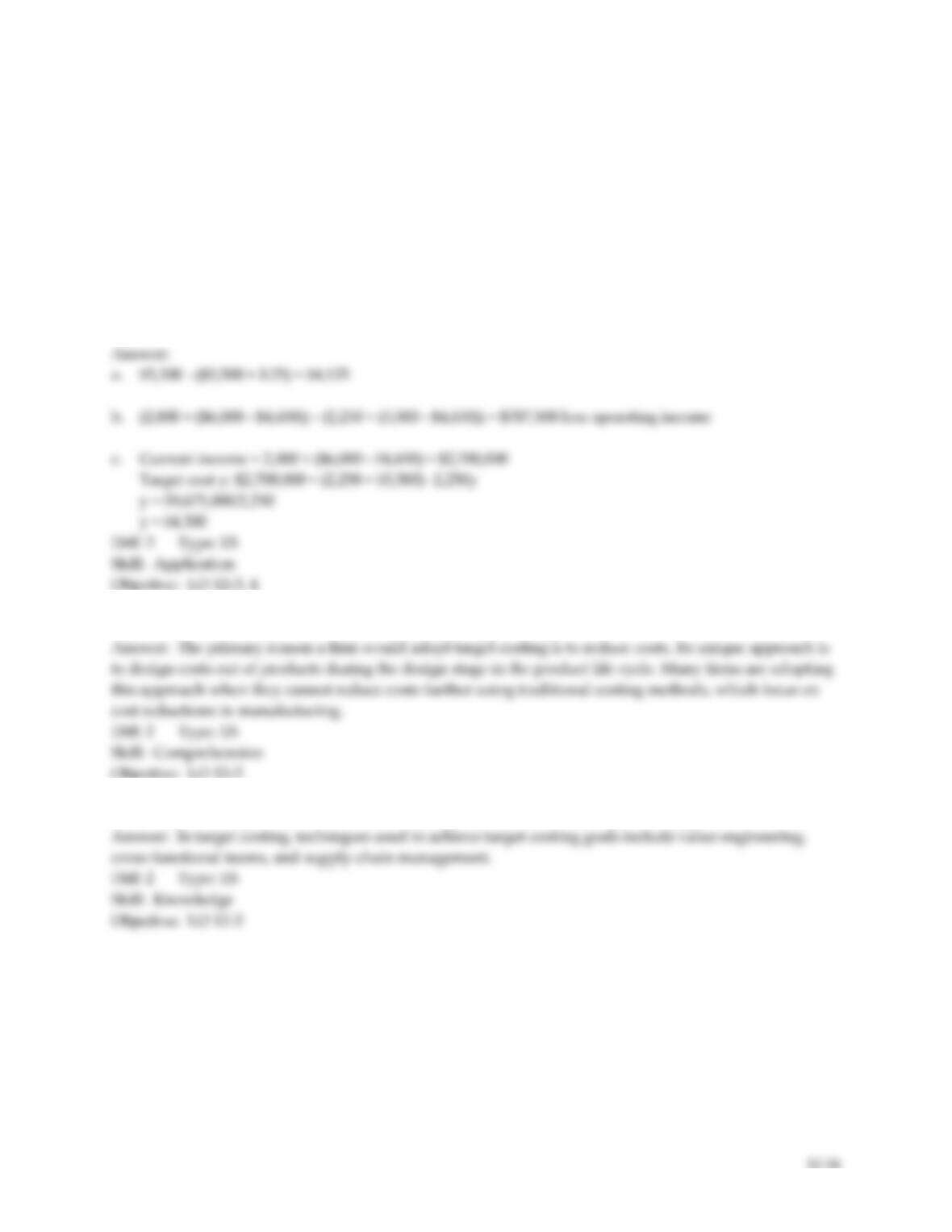
45) Steven Corporation manufactures fishing poles that have a price of $21.00. It has costs of $16.32. A
competitor is introducing a new fishing pole that will sell for $18.00. Management believes it must lower
the price to $18.00 to compete in the highly cost-conscious fishing pole market. Marketing believes that
the new price will maintain the current sales level. Steven Corporation’s sales are currently 200,000 poles
per year.
Required:
a. What is the target cost for the new price if target operating income is 20% of sales?
b. What is the change in operating income for the year if $18.00 is the new price and costs remain the
same?
c. What is the target cost per unit if the selling price is reduced to $18.00 and the company wants to
maintain its same income level?
Cost Accounting: A Managerial Emphasis, 6e
Chapter 12 – Pricing Decisions, Product Profitability Decisions, and Cost Management
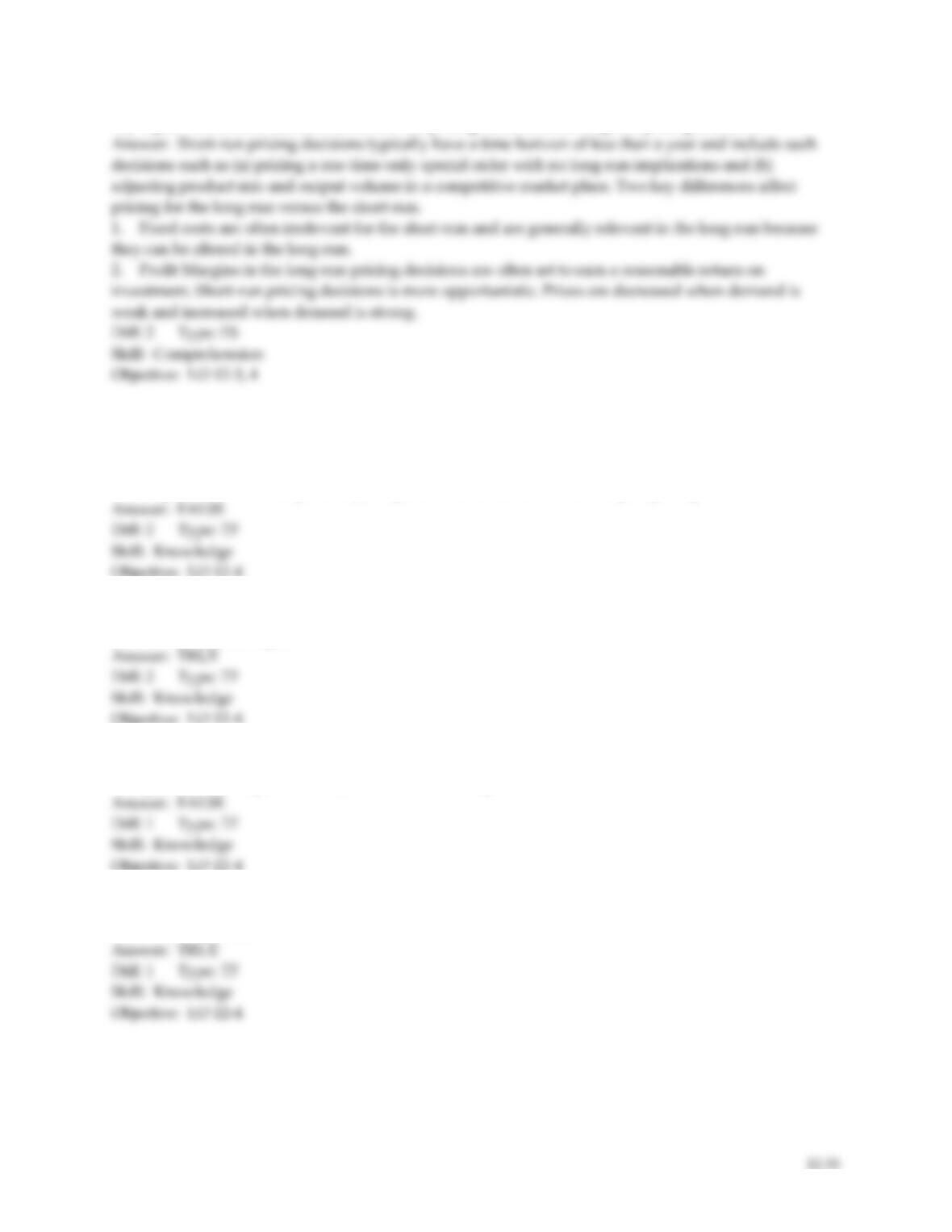
46) Kezer Crafts currently sells motor boats for $6,000. It has costs of $4,650. A competitor is bringing a
new motor boat to the market that will sell for $5,500. Management believes it must lower the price to
$5,500 to compete in the market for motor boats. Marketing believes that the new price will cause sales to
increase by 12.5%, even with a new competitor in the market. Kezer Crafts’ sales are currently 2,000 motor
boats per year.
Required:
a. What is the target cost if target operating income is 25% of sales?
b. What is the change in operating income if marketing is correct and only the sales price is changed?
c. What is the target cost if the company wants to maintain its same income level, and marketing is
correct?
47) What is the primary reason a firm would adopt target costing?
48) In target costing, what are at least two techniques used to achieve target costing goals?
Cost Accounting: A Managerial Emphasis, 6e
Chapter 12 – Pricing Decisions, Product Profitability Decisions, and Cost Management
49) Explain the differences between short-run pricing decisions and long-run pricing decisions.
12.4 Explain how target pricing and cost-plus pricing help achieve long-term operating
income profitability.
1) The “plus” relates to the percentage target return on investment in cost–plus pricing.
2) The target rate of return on investment is the target operating income that an organization must earn
divided by invested capital.
3) Value engineering is a time-and-motion system that can result in: improvements in product designs,
changes in material specifications, or modifications in process methods.
4) Cost systems emphasize cost incurrence by recognizing and recording costs only when a resource is
sacrificed or consumed.
Cost Accounting: A Managerial Emphasis, 6e
Chapter 12 – Pricing Decisions, Product Profitability Decisions, and Cost Management
5) Locked-in costs are costs that have been incurred.
6) The strategy in which companies systematically evaluate all aspects of the value-chain business
functions with the objective of reducing costs to meet customers’ needs is referred to as
A) full costing.
B) value engineering.
C) designed-in costs.
D) value analysis.
E) cost incurrence.
7) Eliminating non-value added activities by reducing their cost drivers, is referred to as
A) value-added pricing.
B) value-added activity base pricing.
C) cost incurrence costing.
D) price engineering.
E) value engineering.
8) When are a product’s direct materials cost most likely to be locked in?
A) when the product is designed
B) when purchasing commits to buying the materials
C) when the bill for the materials is paid
D) when the materials are used in production
E) when materials are received from the supplier
Cost Accounting: A Managerial Emphasis, 6e
Chapter 12 – Pricing Decisions, Product Profitability Decisions, and Cost Management
9) In a graph with cumulative costs per unit as the Y-axis, with two curves, one being the cumulative
costs locked-in, and a second curve showing the cumulative costs per unit incurred in different business
functions, which of the following is true?
A) The graph will show the divergence between the amount of locked-in costs and costs incurred, by the
end of the production cycle.
B) Locked-in costs rise much slower initially than the incurred cost, but joining the incurred cost line at
the completion of the value chain functions.
C) The two cost lines will run parallel.
D) No differences unless the product is manufactured inefficiently.
E) Both curves deal with the same cumulative cost per unit.
10) Which of the following is true concerning value-engineering?
A) The goal of value-engineering is to eliminate locked-in costs.
B) After a product’s design has been value-engineered, costs are difficult to influence.
C) When and how costs are locked in are more important than when and how costs are incurred.
D) Value-engineering does not work when dealing with direct costs.
E) Value-engineering activities reduce both value-added and non-value-added costs.
11) For setting long-term prices a company should use full product costs. Full product costs for pricing
purposes
A) include direct costs only.
B) include all manufacturing costs only.
C) does not include fixed overhead.
D) equals manufacturing and selling costs.
E) include all direct costs plus an appropriate allocation of the indirect costs of all business functions.