
1
Fundamentals of Derivatives Markets (McDonald)
Chapter 12 Financial Engineering and Security Design
12.1 Multiple Choice Questions
1) Mel, Inc. stock is $135.00 per share. The company’s semi–annual dividend is forecasted as
$2.10 per share, indefinitely. What is the price of a zero–coupon equity–linked bond,
promising to pay one share in 3 years, given annual interest rates of 5.0%?
A) $101.35
B) $110.26
C) $123.45
D) $155.22
2) Albert, Inc. stock is $42.00 per share. The company’s quarterly dividend is forecasted as $0.50
per share, increasing 10.0% at the start of every year. What is the price of a zero–coupon
equity–linked bond, promising to pay one share in 3 years, given annual interest rates of
8.0%?
A) $32.60
B) $36.20
C) $42.60
D) $62.40
3) Dawn, Inc. stock is $37.00 per share. The company’s semi–annual dividend is forecasted as
$0.25 per share, increasing every 6 months by 20.0%. What is the price of a zero–coupon
equity–linked bond, promising to pay one share in 4 years, given annual interest rates of
6.0%?
A) $32.29
B) $33.49
C) $34.39
D) $35.69
4) Wayne, Inc. stock is $40.00 per share. The company’s quarterly dividend is forecasted as
$0.45 per share, indefinitely. A coupon equity–linked bond, promising to pay one share of
Wayne, Inc. in 3 years pays a quarterly coupon of $0.50. If annual interest rates are 4.0%,
what is the price of the bond?
A) $40.56
B) $42.60
C) $44.56
D) $46.60

5) Will, Inc. stock is $63.35 per share. The company’s quarterly dividend is forecasted as $0.10
per share, increasing 5.0% every quarter. A coupon equity–linked bond, promising to pay
one share of Will, Inc. in 2
2
1
years pays a semi–annual coupon of $0.20. If annualized interest
rates are 8.0%, what is the price of the bond?
A) $59.55
B) $61.14
C) $63.12
D) $65.22
6) Assume the spot price of pork bellies is 75 cents per pound, the 1–year forward price is 77
cents, and the annual interest rate is 4.5%. What is the price of a zero–coupon note paying 1
pound of pork bellies in one year?
A) 77.00 cents
B) 75.00 cents
C) 72.50 cents
D) 73.61 cents
7) Assume the spot price of pork bellies is 74.50 cents per pound and the 2–year forward price
is 77.30 cents. Annualized 1–year and 2–year forward interest rates are 5.0% and 5.2%,
respectively. For a commodity–linked note to sell at par, what is the annual coupon?
A) 2.309 cents
B) 2.409 cents
C) 2.509 cents
D) 2.609 cents
8) Assume the spot price of corn is $2.30 per bushel and the 3–year forward price is $2.45.
Annualized 1–year, 2–year, and 3 year interest rates are 4.2%, 4.4%, and 4.6%, respectively.
For a commodity–linked note to sell at par, what is the annual coupon?
A) $0.06
B) $0.16
C) $0.26
D) $0.36
9) Assume the price of Mary, Inc. stock is $56.00, interest rates are 4.8%, div yield = 0, and σ =
0.35. What is the price of a $1,000 par value 2–year price–participation note paying a 5.0%
annual coupon and receiving 50.0% of all price appreciation above $65.00?
A) $896.44
B) $996.44
C) $1006.44
D) $1106.44

10) What is the price of a 2–year equity–linked CD under the following terms? No coupon is
paid. At maturity the CD pays 80.0% of the S&P 500 index appreciation. The S&P 500 price =
900, div = 0.02, σ = 0.20, and interest rates are 5.0%.
A) $890.22
B) $990.23
C) $1064.20
D) $1110.55
11) We wish to cap participation in a 3–year equity–linked option at 50.0% return. Our profit
alpha is 3.0%. The S&P 500 price = 950, div = 0.015, σ = 0.22, and interest rates are 4.8%. What
is the implied participation rate?
A) 0.66
B) 0.76
C) 0.96
D) 1.16
12) A commodity linked bond is issued with an embedded call option. The current commodity
price is $110, as is the exercise price on the call option. The call option is priced at $3.41. If
the promised payment on the bond is the same as the issue price of $100, what is the implied
coupon if effective interest rates are 3.0% and the bond has a 1–year maturity?
A) $0.66
B) $0.77
C) $0.88
D) $0.99
13) A commodity linked bond is issued with an embedded call option. The current commodity
price is $52, as is the exercise price on the call option. The call option is priced at $5.56. If the
promised payment on the bond is the same as the issue price of $40, what is the yield on the
bond if effective interest rates are 4.0% and the bond has a 1–year maturity?
A) 2.24%
B) 2.80%
C) 3.50%
D) 4.0%
14) A risky bond promises to pay $1,000 at the end of the year. The bond has a risk neutral
probability of default of 20%. If in default, the bond’s residual payout will be $600. If the risk
free rate is 4%, what is the yield to maturity on this bond?
A) 4.08 %
B) 6.92 %
C) 9.56 %
D) 13.13 %

15) A risky bond promises to pay $1,000 at the end of the year. The bond has a risk neutral
probability of default of 15%. If in default, the bond’s residual payout will be $500. If the risk
free rate is 6%, what is likely price of the bond today?
A) $871
B) $925
C) $943
D) $1,000
16) A risky bond promises to pay $3,000 at the end of two years. The bond has a risk neutral
probability of default of 10%. If in default, the bond’s residual payout will be $2,500. If the
risk free rate is 5%, what is the yield to maturity on this bond?
A) 5.00 %
B) 6.01 %
C) 7.09 %
D) 8.14 %
17) A risky bond promises to pay $4,000 at the end of three years. The bond has a risk neutral
probability of default of 20%. If in default, the bond’s residual payout will be $3,200. If the
risk free rate is 6%, what is likely price of the bond today?
A) $ 3,108
B) $ 3,207
C) $ 3,358
D) $ 4,000
18) In a single name CDS, the counterparty providing the credit insurance is called the ________.
A) Default protector
B) Insurer
C) Protection buyer
D) Swap writer
19) In the following scenario, how much money does the protection buyer receive on this three
year bond? The bond par value = $1,000. Bond market value = $872. Risk free interest rate =
4.0%. Non–defaulted bond value = $889.
A) $111
B) $128
C) $872
D) $889
20) Which CDO claim has the most risk?
A) Senior tranche
B) Mezzanine tranche
C) Junior tranche
D) All are the same.
5
12.2 Short Answer Essay Questions
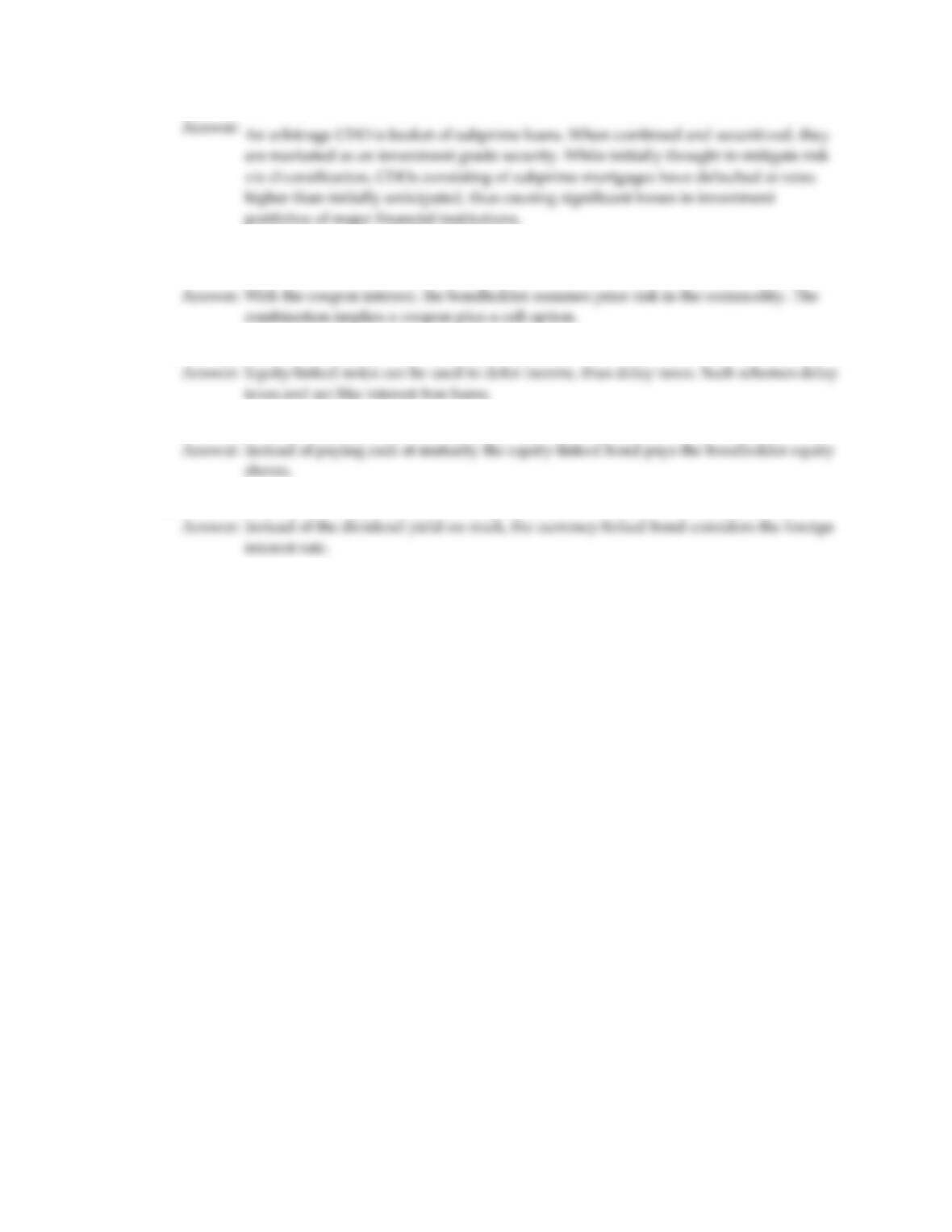
1) Define an arbitrage CDO and explain how such an instrument might facilitate a credit crisis.
2) Instead of issuing a pure commodity–linked debt, why would the commodity producing
firm consider a combining interest plus participation in the commodity price appreciation?
3) What possible tax advantage exists in equity–linked notes?
4) How does a coupon bond differ from an equity–linked bond?
5) What is the primary difference between an equity–linked bond and a currency–linked bond?
12.3 Class Discussion Question
1) The chapter discusses the merging of debt and options. Ask the class why firms would
consider such instruments. Highlight the use of a PERC by a company that has difficulty
issuing debt, yet can offer the carrot of price appreciation.