Chapter 12 – Body Defenses
b.
False
True
52. Vaccination deliberately exposes the person to a pathogen that has been stripped of its disease-inducing capability
(that is, the pathogen is attenuated).
a.
True
b.
False
True
53. The immediate “borrowed” immunity conferred on receipt of preformed antibodies is known as active immunity.
a.
True
b.
False
False
54. A cytotoxic T cell can also indirectly bring about death of an infected host cell by releasing granzymes, which are
enzymes similar to digestive enzymes.
a.
True
b.
False
True
55. Class I MHC glycoproteins, which are recognized by helper (CD6+) T cells, are restricted to the surface of a few
special types of immune cells.
a.
True
b.
False
False
56. About 5 million Americans suffer from some type of autoimmune disease, with the incidence being about three times
higher in males than in females.
a.
True
b.
False
Chapter 12 – Body Defenses
False
57. Exposure of normally inaccessible self-antigens sometimes induces an immune attack against these antigens.
a.
True
b.
False
True
58. Only a fraction of the genetic mutations that occur in the body involve loss of control over the cell’s growth and
multiplication.
a.
True
b.
False
True
59. Lymphocytes and macrophages are responsive to blood-borne signals from the digestive system and from certain
endocrine glands.
a.
True
b.
False
False
60. In a rare hereditary condition known as severe combined immunodeficiency, both B and T cells are lacking.
a.
True
b.
False
True
61. Shared characteristics of the immune reactions to allergens and parasitic worms include IgE antibody production and
increased basophil and eosinophil activity.
a.
True
b.
False
True
62. Poison ivy toxin does not harm the skin on contact, but it activates T cells specific for the toxin, including formation
of a memory component.
a.
True
b.
False
True
63. Keratinocytes synthesize vitamin C in the presence of sunlight.
a.
True
b.
False
False
epidermis
64. Granstein cells act as a “brake” on skin-activated immune responses.
a.
True
b.
False
True
65. Lymphoid tissues, the tonsils and tongue, provide immunological protection against inhaled pathogens near the
beginning of the gastrointestinal system.
a.
True
b.
False
False
66. __________ are not self-sustaining cellular entities — they consist only of nucleic acids enclosed by a protein
__________.
67. Potential pathogens that gain access to lymph are filtered through __________, where they are exposed to
lymphocytes and __________.
68. Activated NLRs trigger formation of cytosolic, multiprotein complexes termed __________.
69. The __________ system, a group of inactive plasma proteins that, when sequentially activated, bring about destruction
of foreign cells by attacking their plasma __________.
70. Localized vasodilation is mainly induced by __________ released from mast cells in the area of tissue damage.
71. On exposure to tissue thromboplastin in the injured tissue and to specific chemicals secreted by phagocytes on the
scene, __________ is converted into __________.
72. Phagocytic cells are attracted to __________, chemical mediators released at the site of damage.
73. Body-produced chemicals that make bacteria more susceptible to phagocytosis are known as __________.
74. Cell-mediated immunity involves the production of activated __________, which directly attack unwanted cells.
75. __________ enhances proliferation of new T cells within the peripheral __________ tissues and augments the
immune capabilities of existing T cells.
76. IgE helps protect against __________ worms and is the antibody mediator for common __________ responses.
77. Properties of the tail portion of the antibody determine the __________ properties of the antibody.
78. In neutralization, antibodies combine with __________ toxins, preventing these harmful chemicals from interacting
with susceptible cells.
79. Lymphocytes that have not yet been exposed to their specific antigen are known as __________ lymphocytes.
80. Unlike B cells, which secrete antibodies that can attack antigens at long distances, __________ must directly contact
their targets, a process known as __________ immunity.
81. __________ T cells do not directly participate in immune destruction of invading pathogens.
82. Cytotoxic T cells, as well as NK cells, destroy a targeted cell by releasing __________ molecules, which penetrate the
target cell’s surface membrane and join to form pore-like channels.
83. Helper T cells secrete T-cell __________, which augments the activity of __________ T cells.
84. TH2 cells promote antibody-mediated immunity, especially __________ production, by B cells and rev up
__________ activity for defense against parasitic worms.
85. Clonal __________ is accomplished by triggering apoptosis of immature cells that would react with the body’s
proteins.
86. The HIV virus invades and incapacitates the critical __________ cells.
87. Slow-reactive substance of anaphylaxis (SRS-A) is a collection of three related __________.
88. The skin is anchored to underlying muscle or bone by the __________.
89. __________ cells, which migrate to the skin from bone marrow, are dendritic cells that serve as antigen-presenting
cells.
90. Within the urogenital system, would–be invaders encounter hostile conditions in the __________ urine and vaginal
secretions.
Chapter 12 – Body Defenses
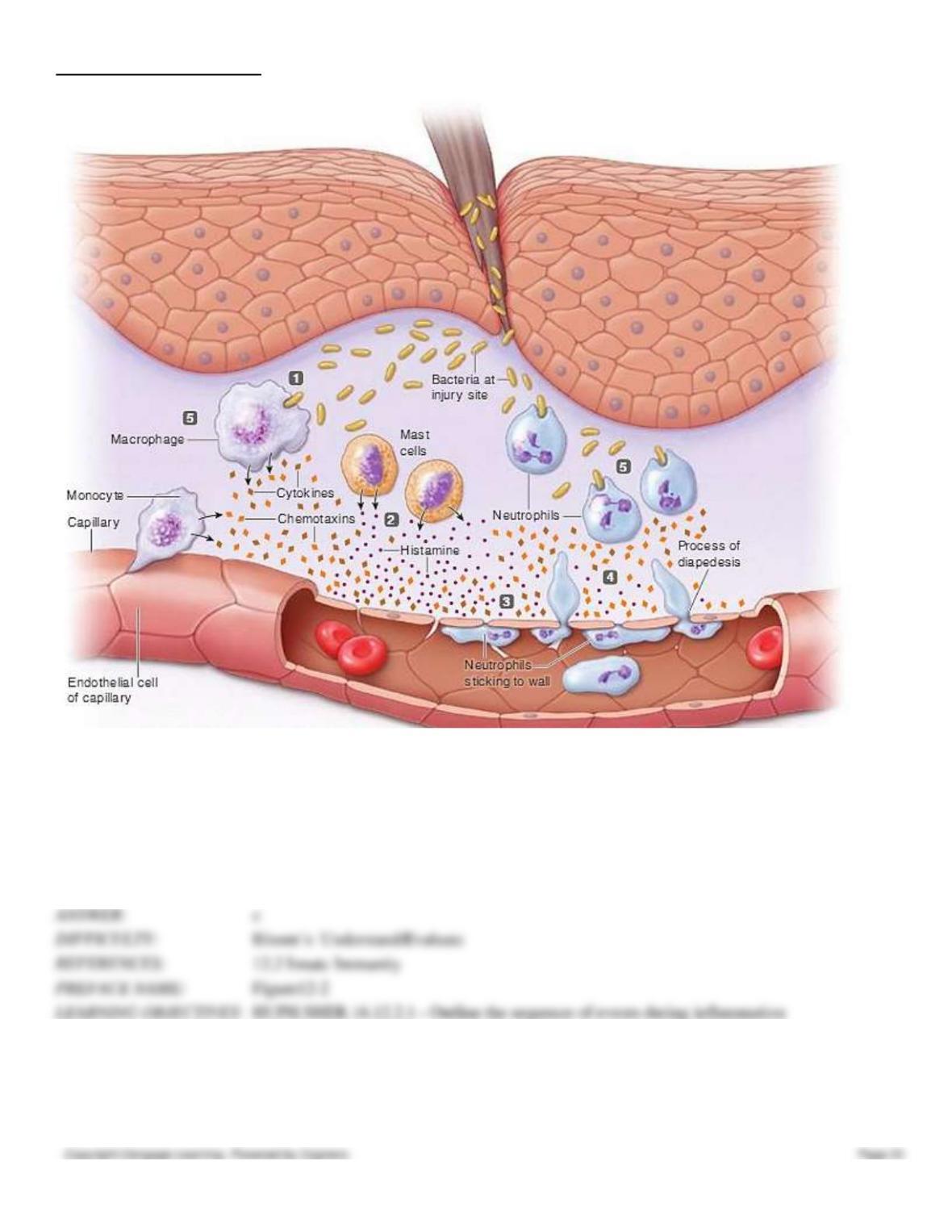
Use the figure above (Figure12–2) to answer the corresponding questions.
91. Which number in the figure represents the site of histamine action?
a.
1
b.
2
c.
3
d.
4
e.
5
92. Which number in the figure represents monocyte-derived macrophages, which engulf pathogens and destroy them?
a.
1
b.
2
c.
3
Chapter 12 – Body Defenses
d.
4
e.
5
93. Which number in the figure represents activated mast cells releasing histamine?
a.
1
b.
2
c.
3
d.
4
e.
5
b
94. Which number in the figure represents phagocytosis of pathogens of macrophages?
a.
1
b.
2
c.
3
d.
4
e.
5
95. Which number in the figure represents chemotaxins attracting neutrophils and monocytes, which display diapedesis?
a.
1
b.
2
c.
3
d.
4
e.
5
d
96. Give an overview of immune system function.
97. Describe the role of plasma cells in immunity.
98. Explain why genetic mutations don’t always lead to cancer.
99. Explain anaphylactic shock.
100. Discuss the defenses of the urinary system.