Chapter 12: Activity-Based Management
98. The maintenance subcycle is defined by what sequence?
a. establish-do-check-act
b. establish-act-do-check
c. do-act-establish-check
d. check-do-plan-act
99. A technique for improving performance of activities and processes that searches for best practices is called
a. value-added reporting.
b. Kaizen costing.
c. trend reporting.
d. benchmarking.
100. Hogwarts Company has developed ideal standards for four activities: labor, materials, inspection, and
receiving. Information is as follows:
Activity
Activity Driver
SQ
AQ
SP
Inspection
Inspection hours
-0-
40,000
$ 4
Labor
Hours
33,000
39,000
7
Materials
Pounds
110,000
115,000
4
Receiving
Orders
150
190
150
The actual prices paid per unit of each activity driver were equal to the standard prices. The non-value-added costs
for labor are
a. $198,000.
b. $34,000.
c. $42,000.
d. $31,000.
Chapter 12: Activity-Based Management
101. Hogwarts Company has developed ideal standards for four activities: labor, materials, inspection, and
receiving. Information is as follows:
Activity
Activity Driver
SQ
AQ
SP
Inspection
Inspection hours
-0-
40,000
$ 4
Labor
Hours
33,000
39,000
7
Materials
Pounds
110,000
115,000
4
Receiving
Orders
150
190
150
The value-added costs for materials are
a. $440,000.
b. $460,000.
c. $40,000.
d. $20,000.
102. When different units that perform the same types of activities within the same organization are compared to the
unit with the best performance, this practice is called
a. variance benchmarking.
b. competitive benchmarking.
c. external benchmarking.
d. internal benchmarking.
103. A technique for improving performance of activities and processes that predicts activity costs as activity
output changes is called
a. value-added reporting.
b. activity flexible budgeting.
c. Kaizen costing.
d. benchmarking.
Chapter 12: Activity-Based Management
104. Mattison Company has developed cost formulas for the drivers of the following production activities:
Driver
Activity
Fixed
Variable
Labor hours
Materials
$ -0-
$20
Labor hours
Labor
-0-
10
Machine hours
Maintenance
10,000
8
Machine hours
Machining
50,000
2
Number of setups
Inspections
30,000
200
Number of setups
Setups
-0-
300
Number of purchase orders
Purchasing
75,000
3
The budgeted inspection cost for 20 setups is
a. $34,000.
b. $40,000.
c. $175,860.
d. $30,000.
Chapter 12: Activity-Based Management
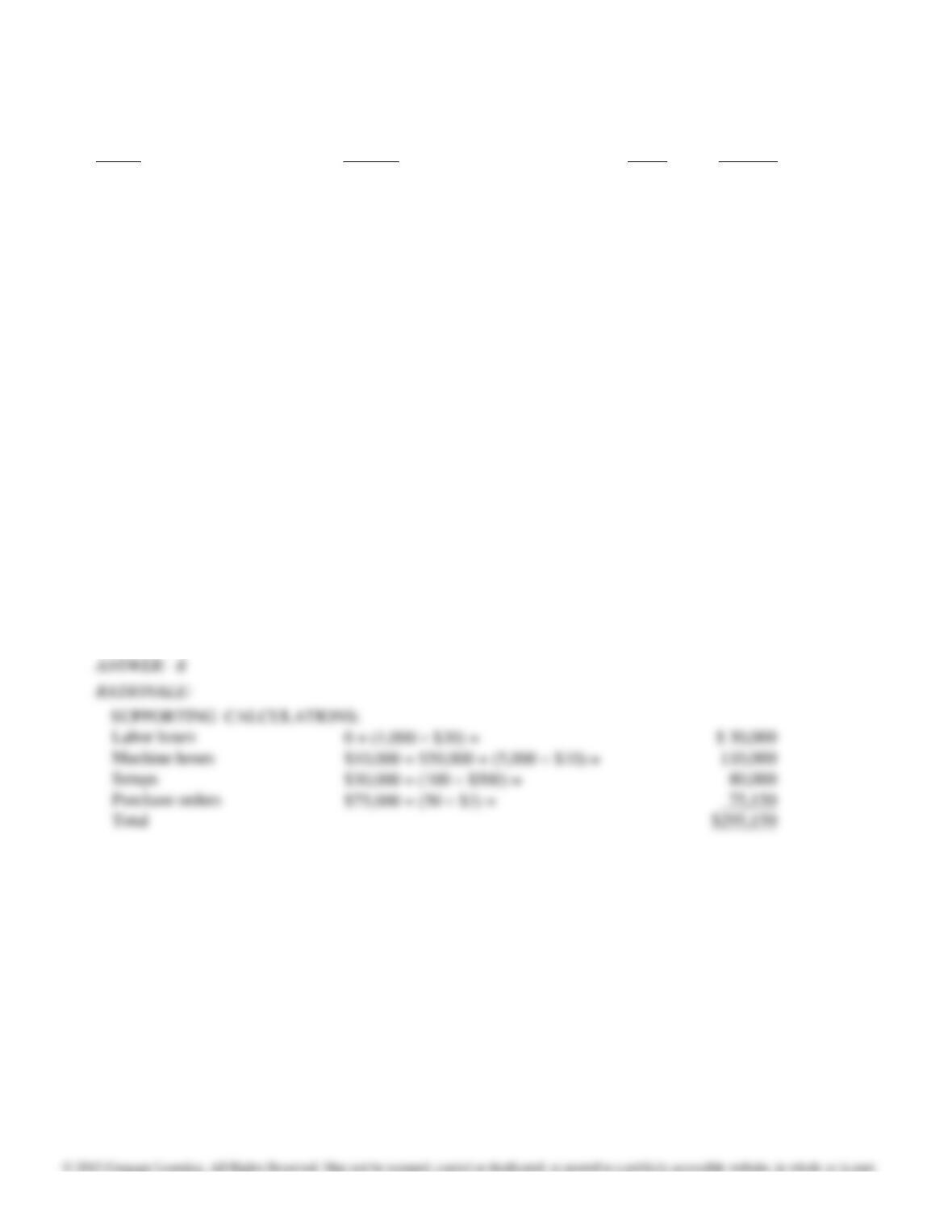
105. Mattison Company has developed cost formulas for the drivers of the following production activities:
Driver
Activity
Fixed
Variable
Labor hours
Materials
$ -0-
$20
Labor hours
Labor
-0-
10
Machine hours
Maintenance
10,000
8
Machine hours
Machining
50,000
2
Number of setups
Inspections
30,000
200
Number of setups
Setups
-0-
300
Number of purchase orders
Purchasing
75,000
3
The activity levels are projected to be as follows:
Labor hours
1,000
Machine hours
5,000
Setups
100
Purchase orders
50
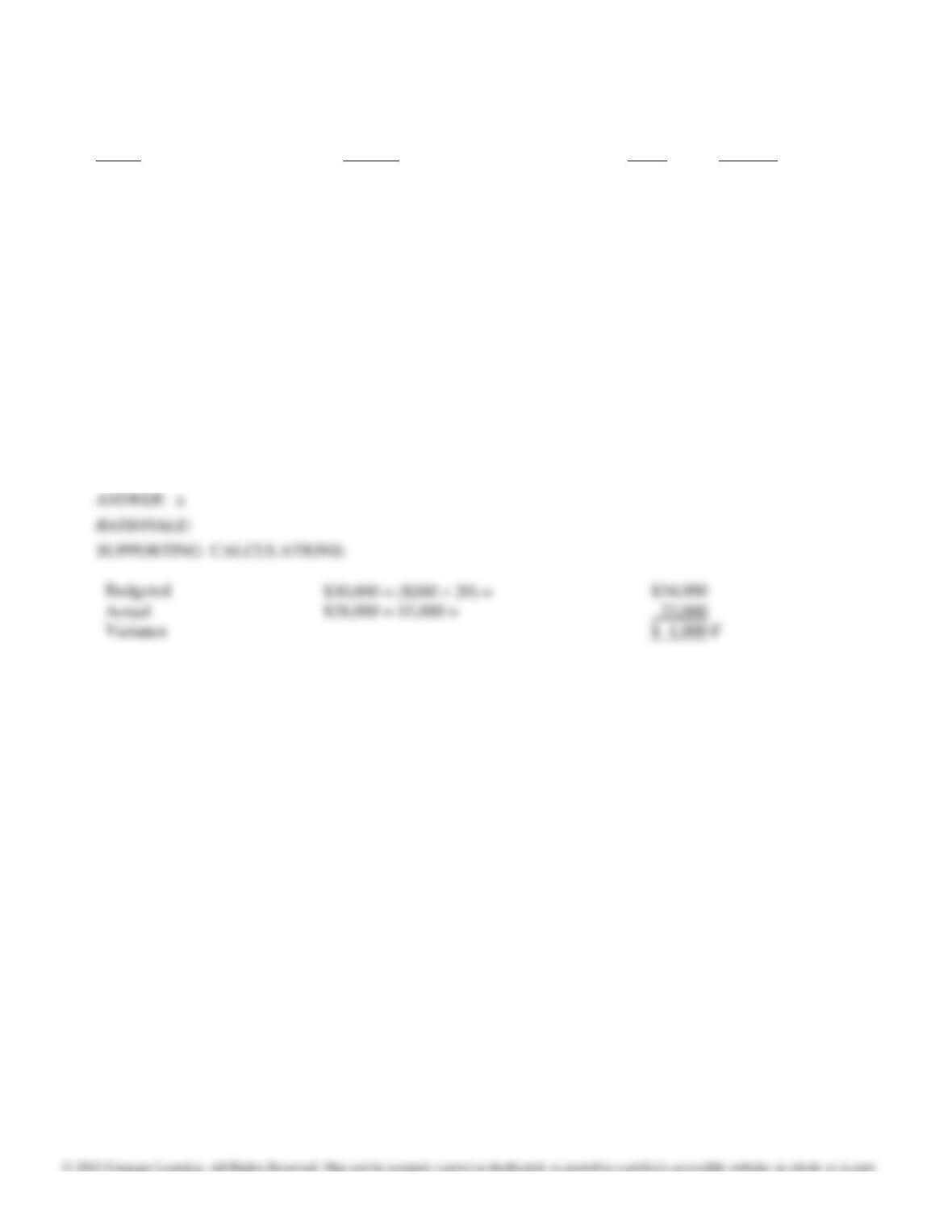
What is budgeted for this projected activity level?
a. $3,504,450
b. $1,655,430
c. $165,543
d. $295,150
Chapter 12: Activity-Based Management
106. Mattison Company has developed cost formulas for the drivers of the following production activities:
Driver
Activity
Fixed
Variable
Labor hours
Materials
$ -0-
$20
Labor hours
Labor
-0-
10
Machine hours
Maintenance
10,000
8
Machine hours
Machining
50,000
2
Number of setups
Inspections
30,000
200
Number of setups
Setups
-0-
300
Number of purchase orders
Purchasing
75,000
3
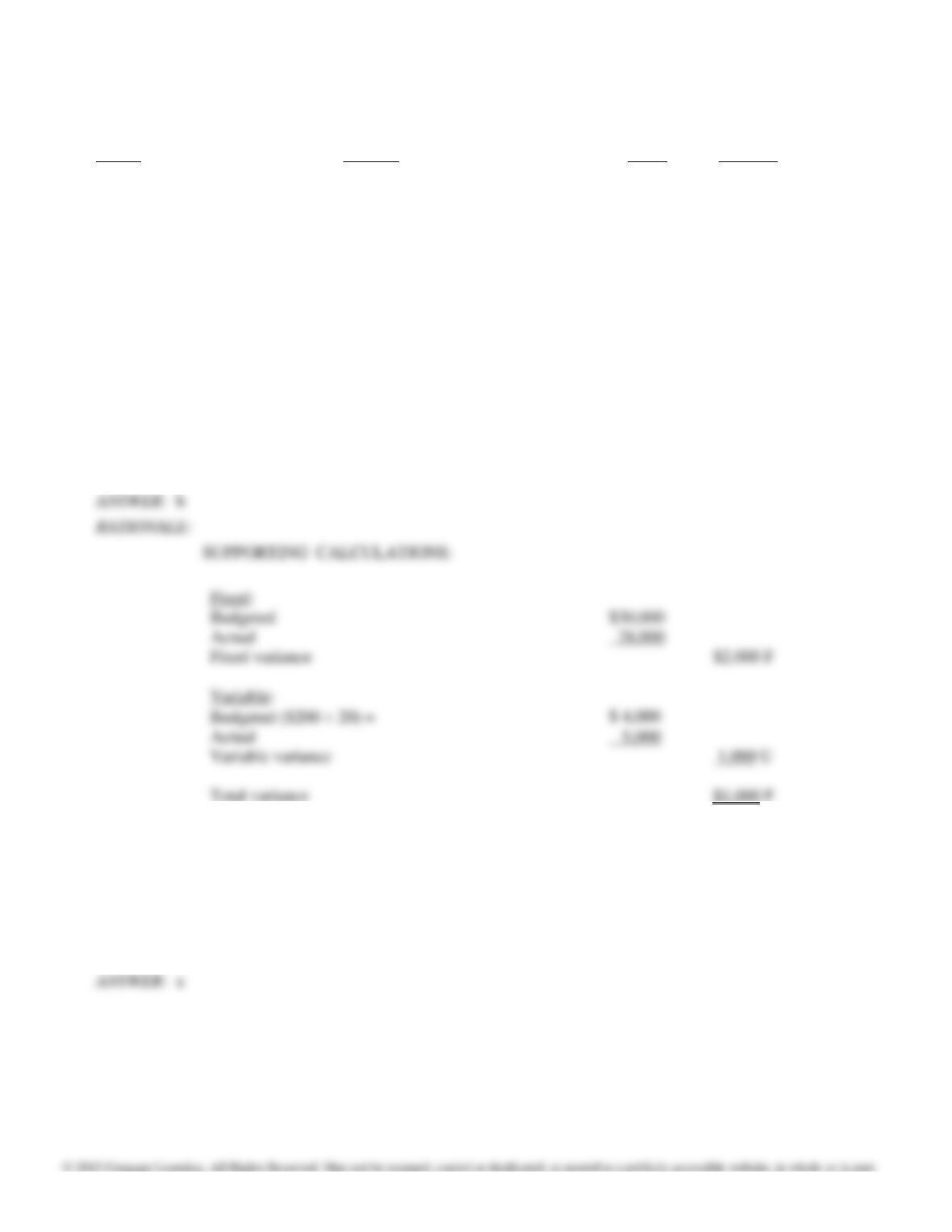
If the actual activity was 20 setups and the actual fixed cost for inspections was $28,000 and the variable cost for
inspections was $5,000, the total variance for inspections is
a. $1,000 favorable.
b. $2,000 favorable.
c. $1,000 unfavorable.
d. $2,000 unfavorable.
Chapter 12: Activity-Based Management
107. Mattison Company has developed cost formulas for the drivers of the following production activities:
Driver
Activity
Fixed
Variable
Labor hours
Materials
$ -0-
$20
Labor hours
Labor
-0-
10
Machine hours
Maintenance
10,000
8
Machine hours
Machining
50,000
2
Number of setups
Inspections
30,000
200
Number of setups
Setups
-0-
300
Number of purchase orders
Purchasing
75,000
3
If the actual activity was 20 setups and the actual fixed cost for inspections was $28,000 and the variable cost for
inspections was $5,000, the total variance for inspections is due to
a. unfavorable variance on fixed costs.
b. favorable variance on fixed costs.
c. favorable variance on variable costs.
d. unfavorable variance on variable costs.
108. The capacity variance is composed of the unused capacity variance and
a. the activity volume variance.
b. the used capacity variance.
c. the activity benchmark.
d. the value-added standard.
Chapter 12: Activity-Based Management
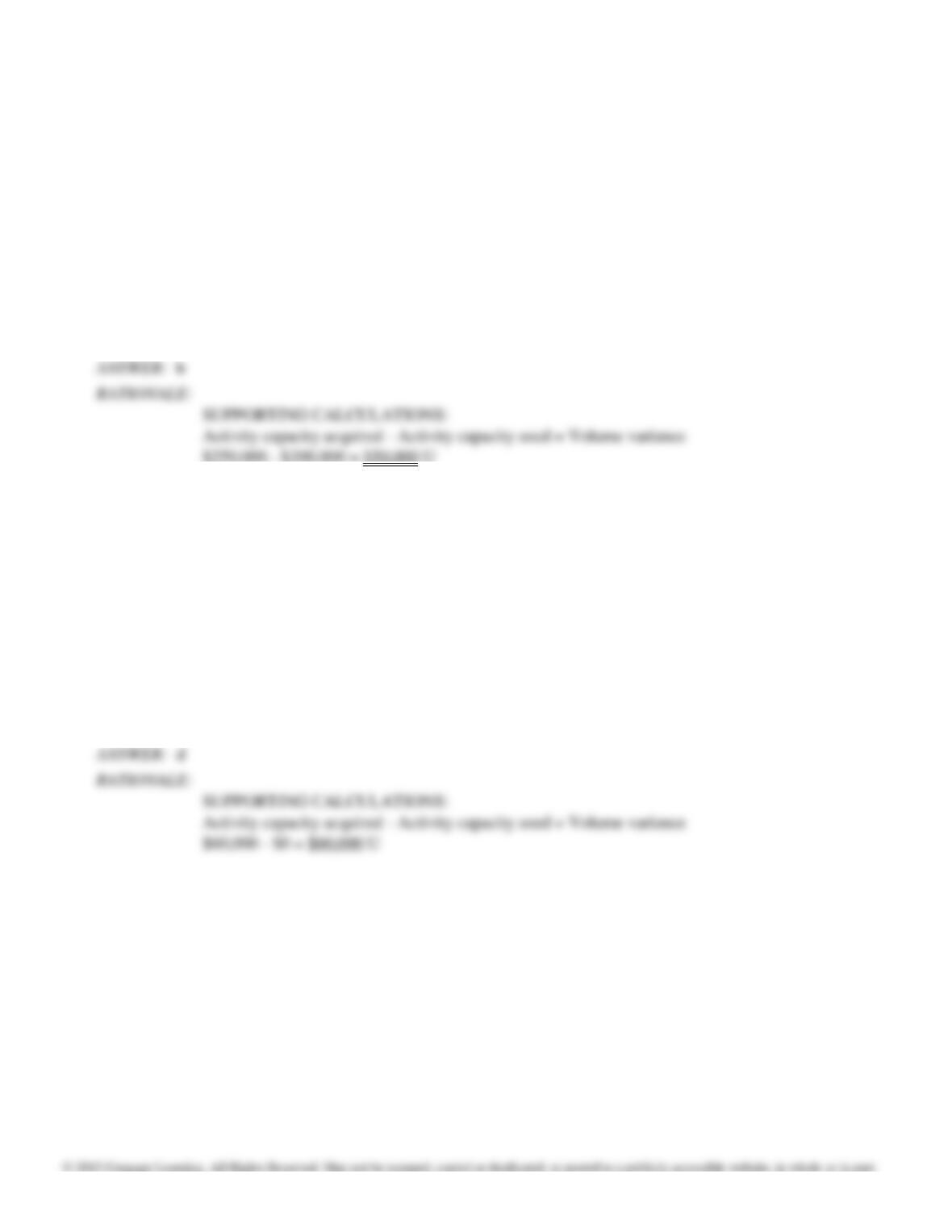
109. Livingston Company has developed capacity standards. Information is as follows:
Standard cost of the activity capacity acquired $250,000
Standard cost of the activity capacity used 200,000
Standard cost of the actual activity used 220,000
The volume variance is
a. there is no variance.
b. $50,000 unfavorable.
c. $20,000 unfavorable.
d. $30,000 unfavorable.
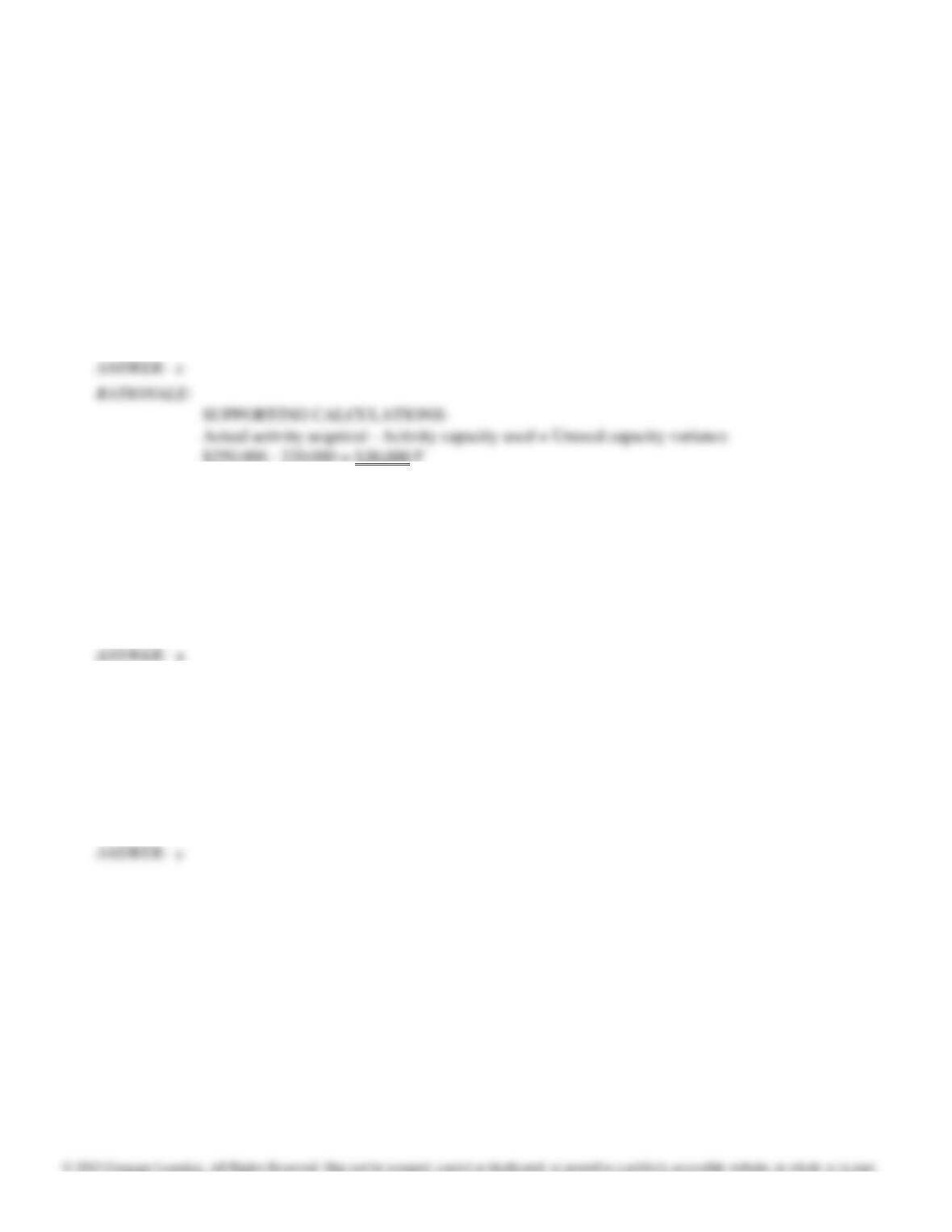
110. Livingston Company has developed capacity standards. Information about a non-value-added activity is as follows:
Standard cost of the activity capacity acquired $60,000
Standard cost of the activity capacity used -0-
Standard cost of the actual activity used 50,000
The volume variance is
a. $10,000 unfavorable.
b. $10,000 favorable.
c. $60,000 favorable.
d. $60,000 unfavorable.
Chapter 12: Activity-Based Management
111. Livingston Company has developed capacity standards. Information is as follows:
Standard cost of the activity capacity acquired $250,000
Standard cost of the activity capacity used 200,000
Standard cost of the actual activity used 220,000
The unused capacity variance is
a. There is no variance.
b. $20,000 favorable.
c. $30,000 favorable.
d. $50,000 favorable.
112. The unused capacity variance is
a. the difference in costs between activity availability and activity usage.
b. the difference in costs between actual activity level acquired and the value-added standard quantity of
activity that should have been used.
c. the difference in costs between practical capacity of activity and the standard capacity of the activity.
d. none of these.
113. A technique for improving performance of activities and processes that compares the number of times an activity
can be performed to the number actually performed is called
a. value-added activity reporting.
b. activity flexible budgeting.
c. activity capacity reporting.
d. activity trend reporting.
Chapter 12: Activity-Based Management
114. Salvador Company has developed capacity standards. Information is as follows for a value-added activity:
Activity capacity acquired
60
Activity capacity used
50
Actual activity usage
30
Standard fixed activity rate
$2,000
The volume variance is
a. There is no variance.
b. $40,000 unfavorable.
c. $60,000 unfavorable.
d. $20,000 unfavorable.
Chapter 12: Activity-Based Management
115. Salvador Company has developed capacity standards. Information is as follows for a value-added activity:
Activity capacity acquired
60
Activity capacity used
50
Actual activity usage
30
Standard fixed activity rate
$2,00
The unused capacity variance is
a. There is no variance.
b. $60,000 favorable.
c. $40,000 favorable.
d. $20,000 favorable.
116. Under what conditions would the activity capacity used be zero?
a. If the activity is value-added.
b. If the activity is non-value-added.
c. If the activity is discretionary.
d. It would never be set at zero.
117. Activity-based management can be viewed as an information system with broad objectives. Which of the
following is NOT on of the broad objectives of ABM?
a. Support continuous improvement through cost reduction.
b. Increase the non-value-added costs through increased collection of more accurate cost accounting
information.
c. Improve decision making through more accurate cost data.
d. All of these are broad objectives of ABM.
118. Which of the following is NOT an objective of activity-based management?
a. to improve decision making through better cost information
b. to increase the number of activities necessary to perform processes
c. to encourage cost reduction through continuous improvement
d. to increase profitability

Chapter 12: Activity-Based Management
119. Which of the following is NOT a reason for ABM implementation failure?
a. lack of support from higher-level managers
b. expected results do not materialize
c. implementation is performed in a timely fashion
d. resistance to change
120. Which of the following is NOT an objective of responsibility accounting?
a. to redesign processes to be more effective
b. to align individual and organizational goals
c. to influence behavior
d. to increase profitability
121. Which of the following is NOT a common step in an ABM implementation model?
a. Systems planning
b. Assess Value Content of Activities
c. Identify, Define, and Classify Activities
d. All of these are common steps.
122. Which of the following is NOT an essential element of responsibility accounting?
a. assigning responsibility
b. establishing performance measures
c. evaluating performance
d. ridiculing poor performers
123. The responsibility accounting system developed for operations in a continuous improvement environment would be
a. financial-based responsibility accounting.
b. functional-based responsibility accounting.
c. activity-based responsibility accounting.
d. strategy-based responsibility accounting.
124. Which of the following is descriptive of activity-based responsibility accounting?
a. It assumes that activities can be collected into independent subgroups.
b. Its focus is the organization.
c. It assigns responsibility to processes.
d. Its standards are engineered and tend to be static.