CHAPTER 12—CAPITAL STRUCTURE
TRUE/FALSE
1. The optimal capital structure is that capital structure which strikes a balance between risk and
return such that the firm’s stock price is maximized.
2. Business risk will not affect a firm’s beta, because beta is determined by the market and thus is
outside the control of the firm.
3. If a firm uses no debt, the uncertainty inherent in projections of future returns on equity can be
described as business risk.
4. The ability of a firm to raise sufficient capital on competitive terms under adverse conditions in
order to sustain steady operations is referred to as financial flexibility.
5. As long as a firm is near its target capital structure it will not have to concern itself with financial
flexibility.
6. The degree of financial risk is the single most important determinant of a firm’s capital structure.
7. Other things held constant, an increase in financial leverage will increase a firm’s market (or
systematic) risk as measured by its beta coefficient.
8. Financial leverage affects both EPS and EBIT, while operating leverage only affects EBIT.
9. The management of a firm can control the degree of total leverage to some extent.
10. Since the degree of total leverage is equal to the degree of operating leverage times the degree of
financial leverage, the degree of total leverage must always be greater than or equal to positive
1.0.
11. The central result from the work of Miller and Modigliani (MM) and subsequent researchers, is
that it is now possible to precisely identify a firm’s optimal capital structure.
Chapter 12 Capital Structure 283
12. Because creditors can foresee, to at least some extent, the costs of bankruptcy, they charge an
interest rate that has a premium built into it to compensate for the present value of bankruptcy
costs.
13. According to MM, in a world without taxes, the optimal capital structure for a firm should
approach 100 percent debt financing.
14. You are the president of a small, publicly traded corporation. Since you believe that your firm’s
stock price is temporarily depressed, all additional capital funds required during the current year
will be raised using debt. Thus, the appropriate marginal cost of capital for the current year is the
after-tax cost of debt.
15. One of the implications of signaling theory for capital structure decisions is that firms should
normally seek to maintain a reserve borrowing capacity.
16. The fact that interest is tax deductible makes corporate debt less expensive than common of
preferred stock.
17. The probability of incurring bankruptcy increase as the firm increases as the debt/equity ratio
decreases.
18. According to the signaling theory of capital structure, the issuance of equity for a firm with
various financing alternatives signals that the firm has very favorable prospects which it wants to
share with new shareholders.
19. According to the signaling theory of capital structure, the issuance of equity for a firm with
various financing alternatives signals that the firm has unfavorable prospects which it wants to
share with new shareholders.
20. Firms which maintain an adequate reserve borrowing capacity will be able to borrow money at
reasonable cost when good investment opportunities arise.
21. Firms in industries that are cyclical, oriented toward research, or subject to huge liability suits
normally will maintain high levels of debt in their capital structure.
22. The TIE ratio depends on the percentage of debt in the capital structure of the firm, the interest
rate on the debt, and the profitability of the firm.
284 Chapter 12 Capital Structure
23. The degree of operating leverage is defined as the percentage change in operating earnings
associated with a given percentage change in sales.
24. Two firms, although they operate in different industries, have the same expected earnings per
share and the same standard deviation of expected EPS. Thus, the two firms must have the same
business risk.
25. A consistent supply of capital is essential for the long-run success of a firm. Although a firm may
have access to capital under all types of economic conditions, the concept of financial flexibility
implies that the firm can obtain capital on acceptable, competitive terms.
26. The benefit to the firm of the tax deductibility of interest can be lowered if the firm’s marginal tax
rate is reduced by accumulated depreciation or tax-loss carry-forwards.
27. An all equity firm has some risk inherent in its operations. When the firm decides to finance some
of its operations with debt, it exposes itself to financial risk and it increases its business risk.
28. Risk can be apportioned between financial and business risk. Financial risk and business risk are
related in that, as business risk increases so does financial risk, although the correlation between
the two is not perfect.
29. The fact that some managers are more aggressive in their use of debt financing in attempting to
boost profits does not influence the optimal or value-maximizing capital structure.
30. If we include the cost of bankruptcy in the MM analysis of capital structure in a world with taxes,
we would tend to believe that the cost of debt increases as leverage increases and that there is
probably an optimal capital structure.
31. As the percentage of debt in a firm’s capital structure increases, its financial risk increases. Once
the firm increases its debt beyond the optimal level, rising interest charges result in an immediate
decrease in EPS.
32. Firm A has a higher degree of business risk than Firm B. Firm A can offset this by using less
financial leverage. Therefore, the variability of both firms’ expected EBITs could actually be
identical.
33. Generally, as debt is substituted for equity, risk, as measured by the coefficient of variation of
EPS, increases. This negative effect works against the positive effect of substituting debt for
equity, which is that higher leverage increases expected EPS.
Chapter 12 Capital Structure 285
34. Although the exact relationship between a firm’s degree of financial leverage and its beta is
difficult to estimate, it has been shown both theoretically and empirically that a firm’s beta
increases with its degree of financial leverage.
35. The weighted average cost of capital (WACC) declines as more of the lowest cost component is
added. What limits a firm from using nearly all debt is that as the debt ratio rises, the absolute
interest expense gets very large. The large interest expense reduces income and results in a debt
ratio limit even though the WACC continues to decline.
36. As the debt ratio rises, the WACC is reduced because the after-tax cost of debt is usually lower
than the cost of equity. What limits the substitution of debt for equity in the capital structure is
that as the debt ratio rises the costs of both components eventually increase.
37. If Miller and Modigliani had considered the cost of bankruptcy, it is unlikely that they would
have concluded that 100 percent debt financing is optimal for the firm.
38. If we consider only agency costs associated with the issuance of debt, then this implies that the
firm should move toward 100 percent debt financing.
39. One implication of information asymmetry between investors and firm managers is that if a firm
raises new capital by issuing debt rather than by selling stock, it signals that the firm has very
good prospects.
40. The announcement of a stock offering by a mature firm that seems to have financing alternatives
is taken as a signal that the firm’s prospects are very good.
41. If the announcement of a stock sale does in fact trigger a decline in stock price, this reinforces the
effects of flotation costs incurred with new equity issues. Further, this implies a larger break in
the MCC schedule.
42. If the firm’s actual debt ratio is below its target level, expansion capital should be raised by
issuing equity in order to preserve the firm’s borrowing capacity.
43. One implication of the signaling theory of capital structure is that firms should borrow as much as
the trade-off theory of capital structure predicts.
44. Generally speaking, companies in Italy and Japan use less debt in their capital structure than
companies in the United States or Canada.
286 Chapter 12 Capital Structure
MULTIPLE CHOICE
1. Which of the following statements is most correct?
a.
Increasing financial leverage is one way to increase a firm’s basic earning power (BEP).
b.
Firms with lower fixed costs tend to have greater operating leverage.
c.
The debt ratio which maximizes EPS generally exceeds the debt ratio which maximizes
share price.
d.
Both a and b are correct.
e.
Both a and c are correct.
2. Business risk is concerned with the operations of the firm. Which of the following is not
associated with (or not a part of) business risk?
a.
Demand variability.
b.
Sales price variability.
c.
The extent to which operating costs are fixed.
d.
Changes in required returns due to financing decisions.
e.
The ability to change prices as costs change.
3. Which of the following factors does not affect a firm’s business risk?
a.
Demand variability.
b.
Input price variability.
c.
Interest cost variability.
d.
Operating leverage.
e.
Sales price variability.
4. Which of the following statements is correct?
a.
As a rule, the optimal capital structure is found by determining the debt-equity mix that
maximizes expected EPS.
b.
The optimal capital structure simultaneously maximizes EPS and minimizes the WACC.
c.
The optimal capital structure minimizes the cost of equity, which is a necessary condition
for maximizing the stock price.
d.
The optimal capital structure simultaneously minimizes the cost of debt, the cost of equity,
and the WACC.
e.
Each of the above statements is false.
Chapter 12 Capital Structure 287
5. The firm’s target capital structure is consistent with which of the following?
a.
Maximum earnings per share.
b.
Minimum cost of debt (kd).
c.
Minimum risk.
d.
Minimum cost of equity (ks).
e.
Minimum weighted average cost of capital.
6. Allyson, who is the CFO of Mundane Minerals & Mining (MMM), is trying to decide whether to
issue debt or common stock to finance the capital budgeting projects she has evaluated as
acceptable (that is, the projects have positive net present values, NPV). Because MMM is a
relatively small company, Allyson believes that the type of capital she uses to finance the projects
will send a signal to investors. As a result, which of the following actions would you recommend
Allyson take?
a.
Issue equity, because investing in positive NPV projects is not in the best interests of the
firm, and the existing stockholders will want to share such “bad news” with new
stockholders.
b.
Issue equity so as to dilute ownership and share the increase in wealth that results from
investing in positive NPV projects with new stockholders.
c.
Issue debt, because debt is riskier than common stock, thus the value of existing
stockholders’ stock will increase more than if new equity is issued.
d.
Issue debt, because investing in positive NPV projects increases the value of the firm, and
the existing stockholders probably prefer not to share such good fortune with new
stockholders.
e.
Investors do not care which source of funds the firm uses as long as the funds are invested
in positive NPV projects; therefore it shouldn’t matter which type of capital is used.
7. The combination of debt and equity that maximizes a firm’s value is known as the
a.
degree of financial leverage (DFL).
b.
maximum WACC.
c.
maximum business risk.
d.
optimal capital structure.
8. A firm should raise capital according to its optimal capital structure so as to maximize its
a.
earnings per share (EPS).
b.
stock price.
c.
weighted average cost of capital (WACC).
d.
net income.
288 Chapter 12 Capital Structure
9. If a firm is operating at its optimal capital structure, then its weighted average cost of capital must
be __________ and its value must be __________.
a.
maximized; maximized
b.
minimized; minimized
c.
maximized; minimized
d.
minimized; maximized
e.
None of the above is a correct answer.
10. Which of the following factors affects business risk?
a.
sales variability
b.
proportion of debt in the firm’s capital structure
c.
taxes
d.
preferred stock dividends
11. A firm that has high interest payments relative to other companies is said to have
a.
a poor finance department.
b.
a high degree of financial leveraging.
c.
no financial leveraging.
d.
a high degree of operating leverage.
12. According to the text DFL stands for
a.
Degree of Financial Leverage
b.
Detrimental Financial Liability
c.
Differential Finance Learning
d.
Departmental Finance League
e.
Derivative Finance Law
13. According to the trade-off theory of capital structure, the __________ benefit of increasing debt
is traded-off against the __________ cost of increasing debt to determine the firm’s optimal
capital structure.
a.
bankruptcy; tax
b.
operating; tax
c.
tax; operating
d.
tax; bankruptcy
e.
operating; bankruptcy

Chapter 12 Capital Structure 289
14. As a general rule, the capital structure that
a.
Maximizes expected EPS also maximizes the price per share of common stock.
b.
Minimizes the interest rate on debt also maximizes the expected EPS.
c.
Minimizes the required rate on equity also maximizes the stock price.
d.
Maximizes the price per share of common stock also minimizes the weighted average cost
of capital.
e.
None of the above.
15. Which of the following statements is most correct?
a.
The optimal capital structure minimizes the WACC.
b.
If the after-tax cost of equity financing exceeds the after-tax cost of debt financing, firms
are always able to reduce their WACC by increasing the amount of debt in their capital
structure.
c.
Increasing the amount of debt in a firm’s capital structure is likely to increase the cost of
both debt and equity financing.
d.
Answers a and c are both correct.
e.
Answers b and c are both correct.
16. If debt financing is used, which of the following is correct?
a.
The percentage change in net operating income is greater than a given percentage change
in net income.
b.
The percentage change in net operating income is equal to a given percentage change in
net income.
c.
The percentage change in net operating income depends on the interest rate charged on
debt.
d.
The percentage change in net operating income is less than the percentage change in net
income.
e.
The degree of operating leverage is greater than 1.
17. Which of the following statements is correct?
a.
The degree of operating leverage (DOL) depends on a company’s fixed costs, variable
costs, and sales. The DOL formula assumes (1) that fixed costs are constant and (2) that
variable costs are a constant proportion of sales.
b.
The degree of total leverage (DTL) is equal to the DOL plus the degree of financial
leverage (DFL).
c.
Arithmetically, financial leverage and operating leverage offset one another so as to keep
the degree of total leverage constant.
d.
The above statements are all true.
e.
The above statements are all false.

290 Chapter 12 Capital Structure
18. Which of the following statements is correct?
a.
Suppose Company A’s EPS is expected to experience a larger percentage change in
response to a given percentage change in sales than Company B‘s EPS. Other things held
constant, Company A would appear to have more business risk than Company B.
b.
Statement a would be correct if the term “EBIT” were substituted for “EPS.”
c.
Statement a would be correct if the term “EBIT” were substituted for “sales.”
d.
Statement a would be correct if the words “financial risk” were substituted for “business
risk.”
e.
The above statements are all false.
19. Which of the following are practical difficulties associated with capital structure and degree of
leverage analyses?
a.
It is nearly impossible to determine exactly how P/E ratios or equity capitalization rates (ks
values) are affected by different degrees of financial leverage.
b.
Managers’ attitudes toward risk differ and some managers may set a target capital structure
other than the one that would maximize stock price.
c.
Managers often have a responsibility to provide continuous service; they must preserve the
long-run viability of the enterprise. Thus, the goal of employing leverage to maximize
short-run stock price and minimize capital cost may conflict with long-run viability.
d.
All of the above.
e.
None of the above represent a serious impediment to the practical application of leverage
analysis to capital structure determination.
20. Which of the following statements is correct?
a.
When financial leverage is used, the graphical probability distribution of net income
would tend to be more peaked than a distribution where no leverage is present, other
things held constant.
b.
From an operational standpoint the goal of maintaining financial flexibility translates into
maintaining adequate reserve borrowing capacity.
c.
While business risk varies form one industry to another and can change over time, it
affects all firms equally within a particular industry.
d.
The optimal capital structure is the one that maximizes EBIT, and this always calls for a
debt ratio which is lower than the one that maximizes expected EPS.
e.
The above statements are all false.
21. Which of the following statements is correct?
a.
There have been no significant observed differences in the capital structures of U.S.
corporations in comparison to their German and Japanese counterparts.
b.
Different countries use essentially the same international accounting conventions with
respect to reporting assets on a historical versus replacement cost basis.
c.
An analysis of both bankruptcy and equity reporting costs leads to the conclusion that U.S.
firms should have more equity and less debt than firms in Japan and Germany.
d.
Equity monitoring costs are higher in the United States than in Japan and Germany.
e.
Debt monitoring costs are probably lower in the United States than in Japan and Germany.

Chapter 12 Capital Structure 291
22. Which of the following is not one of the four primary factors that influence capital structure
decisions?
a.
The firm’s business risk.
b.
The firm’s tax position.
c.
The firm’s financial flexibility.
d.
The firm’s inventory valuation method.
e.
The firm’s managerial attitude.
23. The optimal capital structure is the one that maximizes __________, and this will always be
lower than the debt/equity ratio that maximizes __________.
a.
expected EPS; the firm’s stock price
b.
net income, expected EPS
c.
book value of the firm; net income
d.
expected EPS; book value of the firm
e.
the firm’s stock price; expected EPS
24. If a change in sales results in a greater relative change in operating income (EBIT), we know that
the firm has
a.
a degree of operating leverage greater than one.
b.
a degree of financial leverage greater than one.
c.
a degree of operating leverage less than one.
d.
a degree of financial leverage less than one.
e.
none of the above.
25. If a given change in EBIT results in a larger relative change in EPS then we can definitely say
that the firm has
a.
a degree of operating leverage greater than one.
b.
a degree of operating leverage less than one.
c.
a degree of financial leverage greater than one.
d.
a degree of financial leverage less than one.
e.
a degree of total leverage less than one.
26. If a given change in sales results in a larger relative change in EPS then we can definitely say that
the firm has
a.
a degree of financial leverage greater than one.
b.
a degree of operating leverage less than one.
c.
a degree of total leverage less than one.
d.
a degree of financial leverage less than one.
e.
a degree of total leverage greater than one.
292 Chapter 12 Capital Structure
27. All else equal, if a firm increases its leverage (either operating, financial, or both), its weighted
average cost of capital probably will
a.
increase because risk increases.
b.
decrease because risk decreases.
c.
increase because risk decreases.
d.
remain about the same because risk does not change.
e.
change somehow, but more information is needed to determine the direction.
28. __________ is the situation where investors and managers have the same (identical) information
about the firm’s future prospects.
a.
Symmetric information
b.
Asymmetric information
c.
Leverage
d.
Target capital structure
29. Which of the following is correct?
a.
Generally, debt to total assets ratios do not vary much among different industries although
they do vary for firms within a particular industry.
b.
Utilities generally have very high common equity ratios due to their need for vast amounts
of equity supported capital.
c.
The drug industry has a high debt to common equity ratio because their earnings are very
stable and thus, can support the large interest costs associated with higher debt levels.
d.
Wide variations in capital structures exist between industries and also between individual
firms within industries and are influenced by unique firm factors including managerial
attitudes.
e.
Since most stocks sell at or around their book values, using accounting values provides an
accurate picture of a firm’s capital structure.
30. Quick Launch Rocket Company, a satellite launching firm, expects its sales to increase by 50
percent in the coming year as a result of NASA’s recent problems with the space shuttle. The
firm’s current EPS is $3.25. Its degree of operating leverage is 1.6, while its degree of financial
leverage is 2.1. What is the firm’s projected EPS for the coming year using the DTL approach?
a.
$3.25
b.
$5.46
c.
$10.92
d.
$8.71
e.
$19.63
Chapter 12 Capital Structure 293
31. A firm expects to have a 15 percent increase in sales over the coming year. If it has operating
leverage equal to 1.25 and financial leverage equal to 3.50, then what will be the percentage
change in EPS?
a.
30%
b.
47%
c.
66%
d.
15%
e.
22%
32. Howell Enterprises is forecasting EPS of $4.00 per share for next year. The firm has 10,000
shares outstanding, it pays 12 percent interest on its debt, and it faces a 40 percent marginal tax
rate. Its estimated fixed costs are $80,000 while its variable costs are estimated at 40 percent of
revenue. The firm’s target capital structure is 40 percent equity and 60 percent debt and it has
total assets of $400,000. On what level of sales is Howell basing its EPS forecast?
a.
$1,000,000
b.
$480,400
c.
$316,722
d.
$292,445
e.
$105,280
294 Chapter 12 Capital Structure
33. If the debt ratio is 50 percent, the interest rate on all debt is 8 percent, the tax rate is 50 percent,
and the return on equity is 10 percent, then the ratio of earnings before interest and taxes (EBIT)
to total assets, or the basic earning power ratio, must be
a.
10%.
b.
14%.
c.
12%.
d.
8%.
e.
16%.
34. Assume that a firm has a DFL of 1.25. If sales increase by 20 percent, the firm will experience a
60 percent increase in EPS, and it will have an EBIT of $100,000. What will be the EBIT for this
firm if sales do not increase?
a.
$113,412
b.
$100,000
c.
$84,375
d.
$67,568
e.
$42,115
Chapter 12 Capital Structure 295
35. The “degree of leverage” concept is designed to show how changes in sales will affect EBIT and
EPS. If a 10 percent increase in sales causes EPS to increase from $1.00 to $1.50, and if the firm
uses no debt, then what is its degree of operating leverage?
a.
3.6
b.
4.2
c.
4.7
d.
5.0
e.
5.5
36. Bell Brothers has $3,000,000 in sales. Its fixed costs are estimated to be $100,000, and its
variable costs are equal to fifty cents for every dollar of sales. The company has $1,000,000 in
debt outstanding at a before-tax cost of 10 percent. If Bell Brothers’ sales were to increase by 20
percent, how much of a percentage increase would you expect in the company’s net income?
a.
15.66%
b.
18.33%
c.
19.24%
d.
21.50%
e.
23.08%
296 Chapter 12 Capital Structure
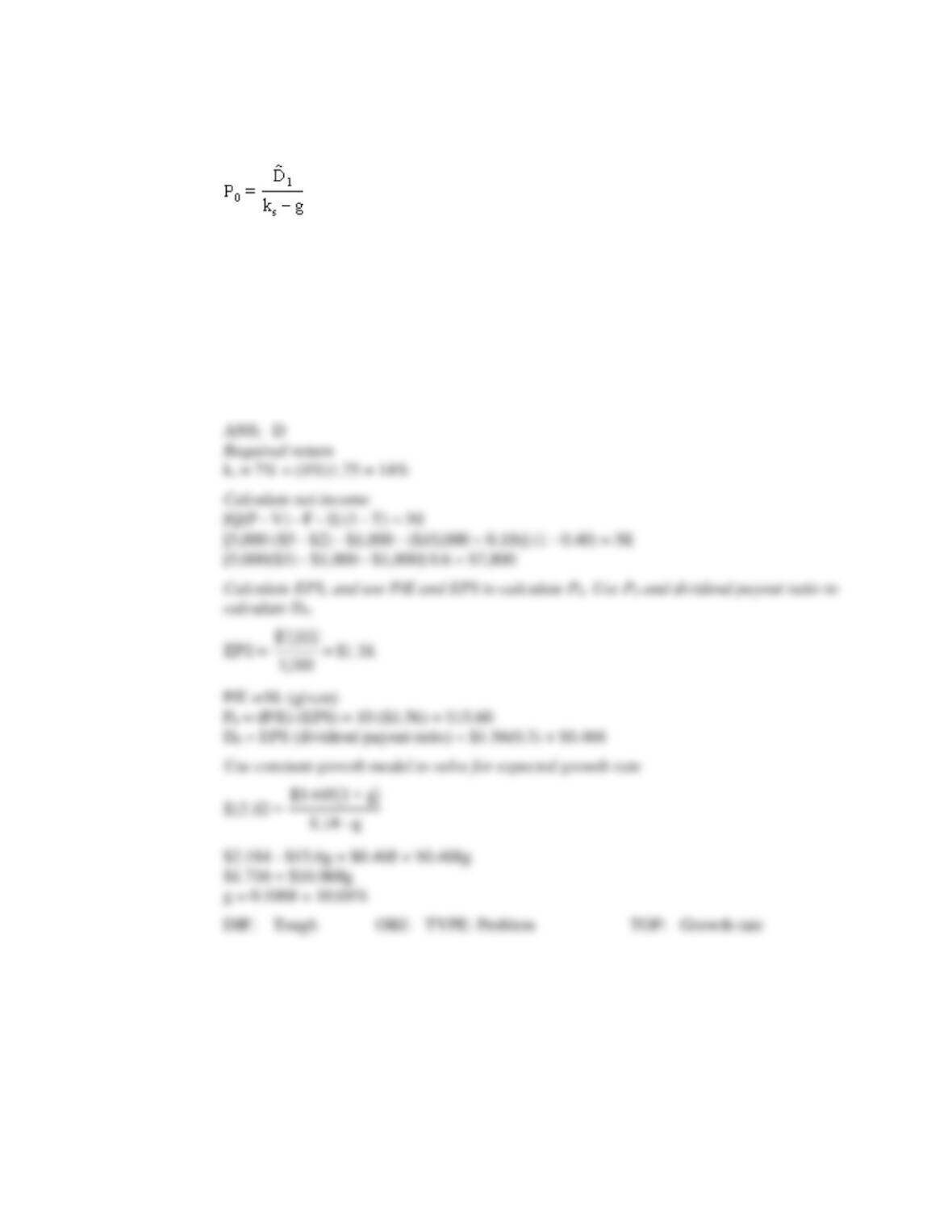
37. Calculate the current price per share (P0) for Olson Corporation, given the following information.
The data all pertain to the year just ended.
Sales
= 10,000 units
Sales price per unit
= $10
Variable cost per unit
= $5
Fixed cost
= $10,000
Long-term debt outstanding
= $15,000
kd on all long-term debt
= 5%
Tax rate
= 30%
Common stock shares outstanding
= 10,000 shares
Beta
= 1.5
kRF
= 5%
kM
= 9%
Dividend payout ratio
= 40%
Growth rate in earnings and
dividends
= 7%
a.
$39.20
b.
$57.84
c.
$29.43
d.
$61.90
e.
None of the above.
Sales (100,000 $10,000)
Variable costs (10,000 $5,000)
Fixed costs
Total costs
EBIT
Interest (0.05 $15,000)
EBT
Taxes (EBT 0.30)
Net income
Chapter 12 Capital Structure 297
38. Given the information below, calculate the expected growth rate (g) of dividends, using the
constant growth model
,
Beta = 1.75; kRF = 7 percent; kM = 11 percent; dividend payout ratio = 30 percent; kd = 10 percent
(paid) on all long-term debt; P/E ratio = 10; sales = 5,000 units; sales price per unit = $5; variable
cost per unit = $2; fixed cost = $1,000; common stock shares outstanding = 5,000; long-term debt
outstanding = $10,000; tax rate = 40 percent. Assume equilibrium exists in the market.
a.
11.34%
b.
6.54%
c.
11.0%
d.
10.68%
e.
10.19%
Copybold Corporation
Copybold Corporation is a start-up firm considering two alternative capital structures—one is
conservative and the other aggressive. The conservative capital structure calls for a D/A ratio =
0.25, while the aggressive strategy call for D/A = 0.75. Once the firm selects its target capital
structure it envisions two possible scenarios for its operations: Feast or Famine. The Feast
scenario has a 60 percent probability of occurring and forecast EBIT in this state is $60,000. The
Famine state has a 40 percent chance of occurring and the EBIT is expected to be $20,000.
Further, if the firm selects the conservative capital structure its cost of debt will be 10 percent,
298 Chapter 12 Capital Structure
while with the aggressive capital structure its debt cost will be 12 percent. The firm will have
$400,000 in total assets, it will face a 40 percent marginal tax rate, and the book value of equity
per share under either scenario is $10.00 per share.
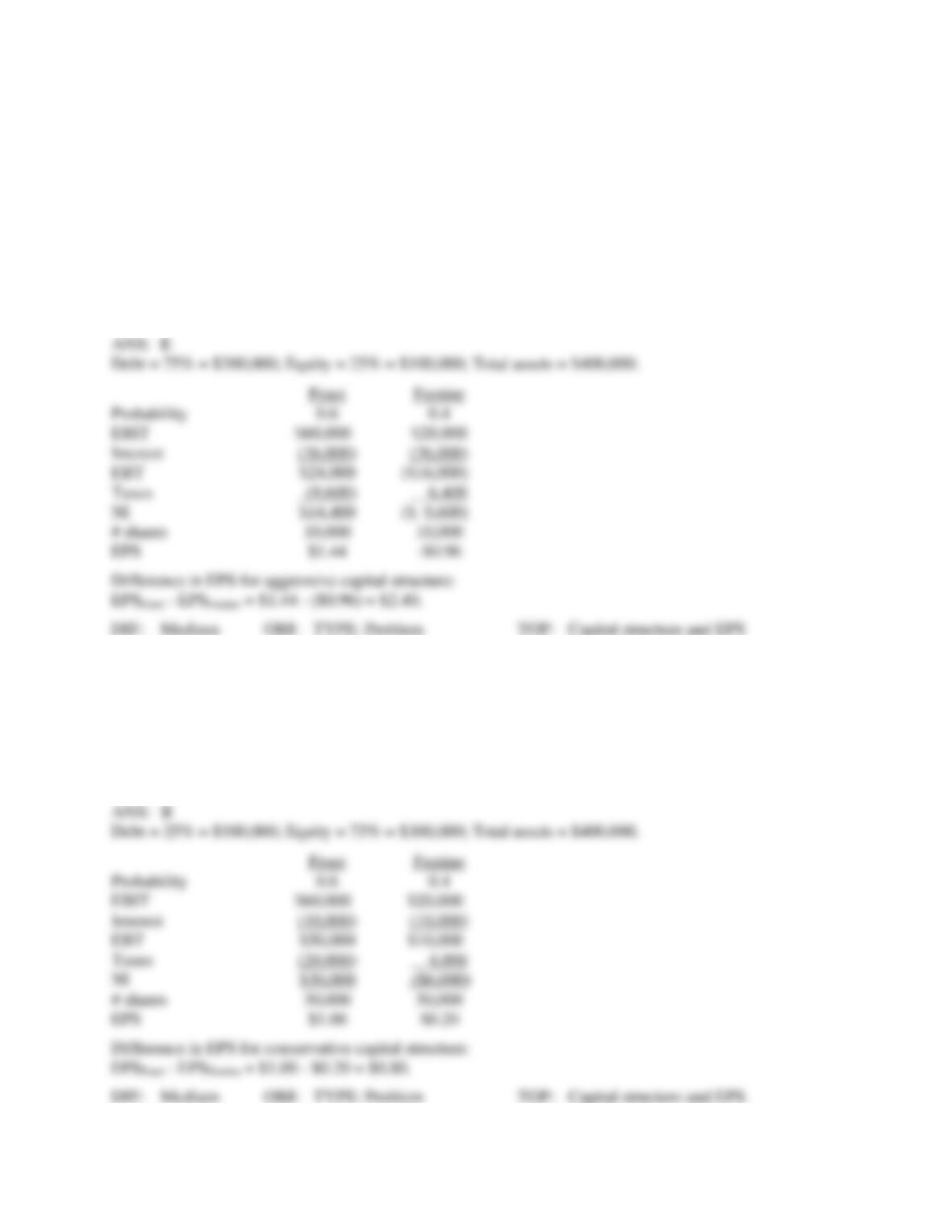
39. Refer to Copybold Corporation. What is the difference between the EPS forecasts for Feast and
Famine under the aggressive capital structure?
a.
$0
b.
$1.48
c.
$0.62
d.
$0.98
e.
$2.40
40. Refer to Copybold Corporation. What is the difference between the EPS forecasts for Feast and
Famine under the conservative capital structure?
a.
$1.00
b.
$0.80
c.
$2.20
d.
$0.44
e.
$0
Chapter 12 Capital Structure 299
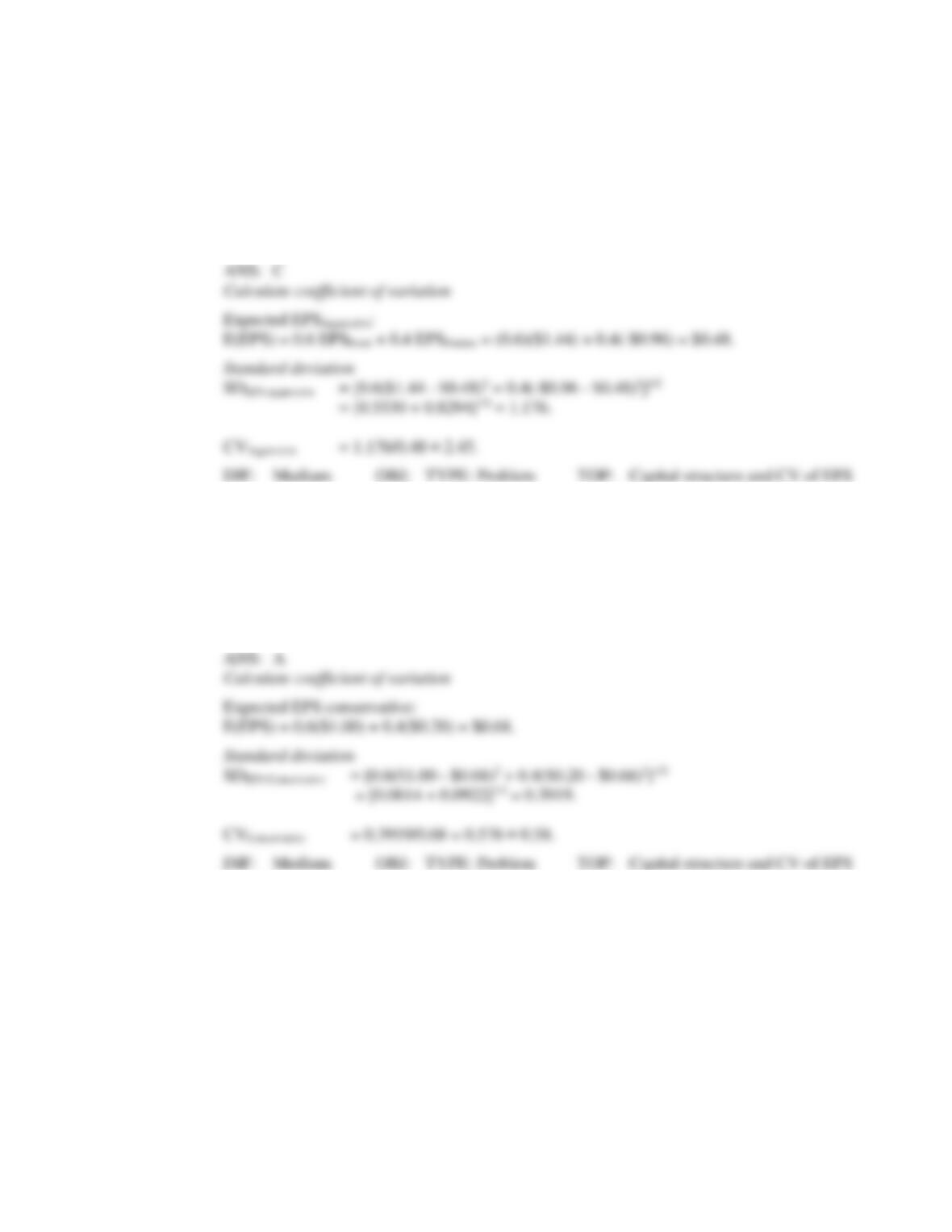
41. Refer to Copybold Corporation. What is the coefficient of variation of expected EPS under the
aggressive capital structure plan?
a.
1.00
b.
1.18
c.
2.45
d.
2.88
e.
3.76
42. Refer to Copybold Corporation. What is the coefficient of variation of expected EPS under the
conservative capital structure plan?
a.
0.58
b.
0.39
c.
0.15
d.
0.23
e.
1.00