
Chapter 12: Special Relativity and Elementary Particles
TRUE/FALSE
1. Special relativity predicts that moving clocks run slow.
2. Special relativity predicts that the length of a moving object will be elongated in the
direction of motion.
3. Einstein’s famous equation E0 = mc2 is a statement of the equivalence of energy and the
square of the speed of light.
4. Because of the equivalence of mass and energy, an electron and a positron, which are two
massive particles, can annihilate when they come together to produce two photons, which
have no mass.
5. Because of the equivalence of energy and mass, a gamma ray, which is a high energy
photon, can “disappear,” and in its place there will be produced an electron and a positron,
which both have mass.
6. Since the rest energy of an electron and its antiparticle a positron is 0.511 MeV, a gamma
ray must have an energy larger than 1.022 MeV to produce an electron-positron pair.
7. According to special relativity, at speeds approaching the speed of light, the kinetic energy
of a moving object is not equal to 1/2 mv2.
8. Because of their short lifetimes, very few muons that are produced in the upper atmosphere
at high speeds should be observed at the surface of the earth. Yet we detect large numbers of
muons at ground level because of the Pauli exclusion principle.
9. Because of time dilation, if a twin goes on a trip in a high speed rocket ship, when she
returns home she will be younger than her twin sister who did not go on the trip.
10. If a 1 kg mass is completely converted into energy, the amount of energy released would be
9 1016 J.
11. The speed of light is a relativistically invariant quantity.
12. The four fundamental forces in nature are the strong, weak, electromagnetic, and
gravitational interactions.
13. Short range interactions generally have carrier particles of greater mass than those for long
range interactions.
14. A fermion has integral spin.
15. A boson has half integral spin.
16. Any particle with spin obeys the Pauli exclusion principle.
17. Hadrons are particles that interact via the strong force.
18. A lepton interacts via the strong interaction.
19. Leptons are built out of quarks.
20. Bosons are force-carrying particles.
21. A photon is a boson.
22. Every particle has a corresponding antiparticle.
23. Some antiparticles are identical to the particles they correspond to.
24. Baryon number is conserved in all interactions.
25. Strangeness is conserved observed in strong and electromagnetic interactions, but not in
weak interactions.
26. The strong force depends upon the electric charge of the particles involved.
27. Electroweak theory results in models for combining the electromagnetic, weak and strong
nuclear interactions into a single basic force.
28. Steven Weinberg, Abdus Salam, and Sheldon Glashow shared the 1979 Nobel prize in
physics for their development of GUTs.
29. Leptons are the fundamental particles that are the building blocks of hadrons.
30. Quarks are held together by the color force.Electrons are made of quarks.
31. All quarks have 1/3 the electric charge of an electron.
32. Charm, beauty, and truth are three quantum numbers for quarks.
33. The quark structure of the proton is uud.
34. The quark structure of the neutron is udd.
35. There are three flavors of quarks.
36. The color force between quarks is carried by mesons.
37. The color force is carried by gluons but gluons do not have color charge themselves.
38. The quark and antiquark in a meson are always of the same flavor.
39. According to the standard model of elementary particle physics, there are six flavors of
quarks, each of which comes in three colors.
40. Recent experiments suggest that the lifetime of the proton is over 1033 years, more than what
is predicted by the simplest grand unified theories.
41. All neutrinos are left handed.
42. An elementary particle has a measurable size.
43. The spin of elementary particles is quantized.
44. In a particle reaction, the number of baryons going into the reaction must equal the number
emerging from the reaction..
45. Mesons are composed of three-quark combinations.
46. Quarks, originally isolated in cosmic ray showers, are elementary particles possessing
electric charge equal to 1/3 or 2/3 the magnitude of the charge of a proton.
MULTIPLE CHOICE
1. What is meant by neutrino oscillations?
a.
oscillating movement of neutrinos
b.
one neutrino type (e.g., muon neutrinos) changing into another (e.g., tau neutrinos)
c.
random changes in mass of neutrinos
d.
none of the above
2. What is the symbol for a neutrino?
a.
n
c.
b.
d.
none of the above
3. If you are driving down a highway at 65 mph with your headlights on, the speed of the light
emitted from your headlights as seen by a person standing on the side of the road is
a.
c
b.
c + 65 mph
c.
slightly greater than c
d.
none of the above
4. Two observers, A and B, move relative to each other. A claims B’s clocks run slow. In this
case, B will claim A’s clocks
a.
run fast
c.
are no good
b.
run slow, too
d.
none of the above
5. The prediction of special relativity that moving clocks run slow is

a.
time dilation
b.
length contraction
c.
the equivalence of mass and energy
d.
the principle of relativity
e.
none of the above
6. The prediction from special relativity that the length of a moving object will be shortened in
the direction of motion is
a.
time dilation
b.
length contraction
c.
the equivalence of mass and energy
d.
the principle of relativity
e.
none of the above
7. Einstein’s famous equation E0 = mc2 is a statement of
a.
time dilation
b.
length contraction
c.
the equivalence of mass and energy
d.
the principle of relativity
e.
none of the above
8. What is the mass of an electron in MeV/c2?
a.
0.511 MeV/c2
b.
105.7 MeV/c2
c.
1777 MeV/c2
d.
none of the above
9. An electron and a positron, which are two massive particles, can annihilate when they come
together to produce two photons, which have no mass. This pair annihilation is an example
of
a.
time dilation
b.
length contraction
c.
the equivalence of mass and energy
d.
the principle of relativity
e.
none of the above
10. What is different between a particle and its antiparticle?
a.
opposite electric charge
b.
opposite strangeness
c.
opposite charm
d.
all of the above
11. When a particle and antiparticle meet, they are said to annihilate each other. What does this
mean?
a.
They explode into tiny fragments.
b.
They are destroyed, and turned into an equivalent amount of energy.
c.
They merge and simply disappear.
d.
none of the above
12. The notation used to represent an antiparticle is
a.
the particle symbol with a bar over it
b.
e+, in the case of the positron
c.
m+, in the case of the antimuon
d.
all of the above
13. When it comes near a heavy nucleus, a gamma ray, which is a high energy photon, can
“disappear,” and in its place there will be produced an electron and a positron, which both
have mass. This pair production is an example of
a.
time dilation
b.
length contraction
c.
the equivalence of mass and energy
d.
the principle of relativity
e.
none of the above
14. What is the symbol for a photon?
a.
n
c.
b.
d.
none of the above
15. The rest energy of an electron and its antiparticle, a positron, is 0.511 MeV. In order to
produce an electron-positron pair, a gamma ray must have an energy larger than 1.022 MeV
because of
a.
time dilation
b.
length contraction
c.
the equivalence of mass and energy
d.
the principle of relativity
e.
none of the above
16. If you do an experiment on earth, and then do an identical experiment in a jet plane moving
uniformly at a high speed, you get identical results from both experiments. This is an
example of
a.
time dilation
b.
length contraction
c.
the equivalence of mass and energy
d.
the principle of relativity
e.
none of the above
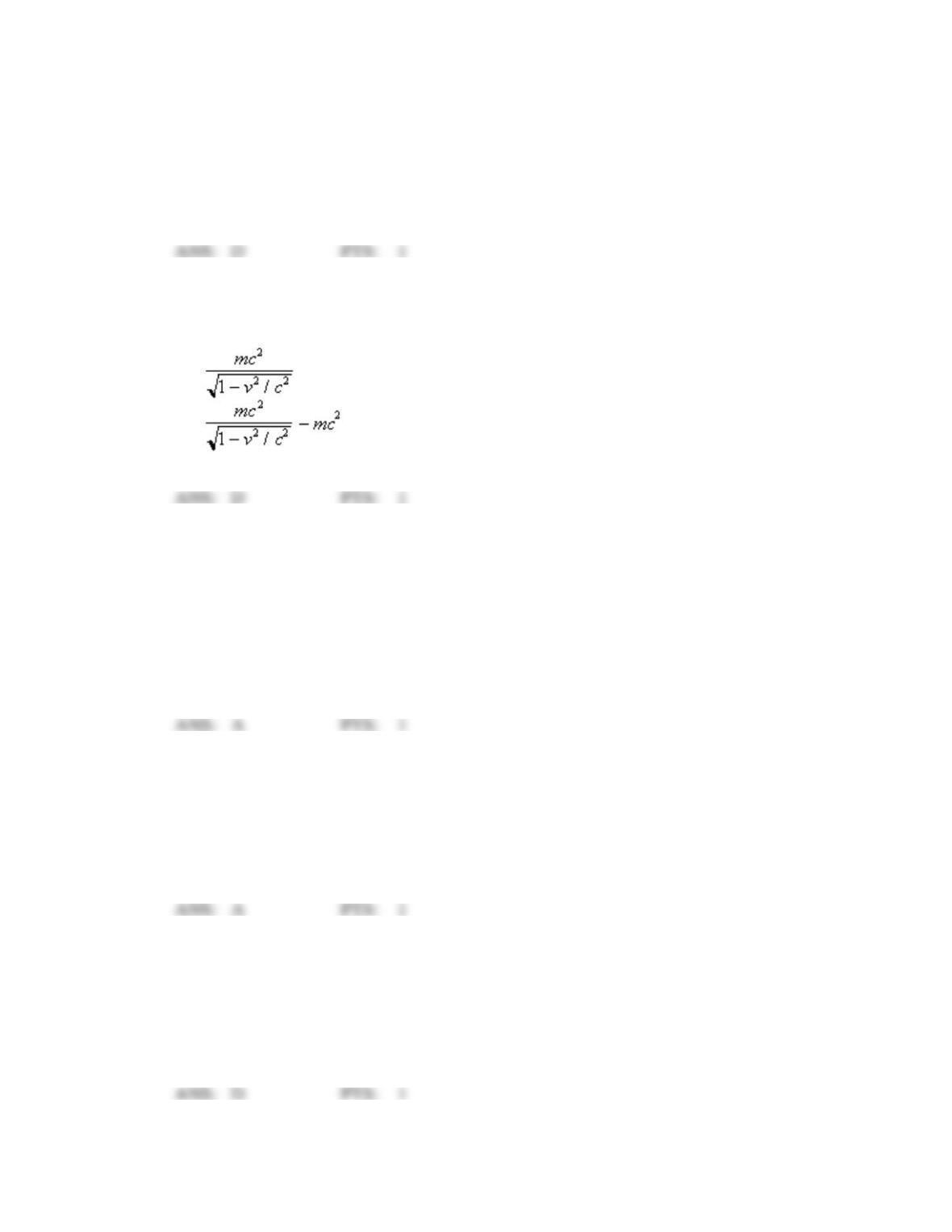
17. At speeds approaching the speed of light, the kinetic energy of a moving object is equal to
a.
1/2 mv2
b.
1/2 mc2
c.
d.
e.
none of the above
18. Because of their short lifetimes, very few muons that are produced in the upper atmosphere
at high speeds should be observed at the surface of the earth. Yet we detect large numbers of
muons at ground level because of
a.
time dilation
b.
length contraction
c.
the equivalence of mass and energy
d.
the principle of relativity
e.
none of the above
19. From the point of view of an observer on the earth, a muon produced high in the atmosphere
can reach the ground before decaying because
a.
relativity gives it extra time to get there
b.
of the uncertainty principle
c.
it is a short distance to the ground
d.
relativity shortens the distance to the ground
20. From the point of view of a muon produced high in the atmosphere, the reason it can get to
the ground before it decays is because
a.
relativity gives it extra time to get there
b.
of the uncertainty principle
c.
it is a short distance to the ground
d.
relativity shortens the distance to the ground

21. If a twin goes on a trip in a high speed rocket ship, when she returns home she will be
younger than her twin sister who did not go on the trip because of
a.
time dilation
b.
length contraction
c.
the equivalence of mass and energy
d.
the principle of relativity
e.
none of the above
22. If a 1 kg mass is completely converted into energy, the amount of energy released would be
a.
0.333 J
b.
1 J
c.
3 108 J
d.
9 1016 J
e.
none of the above
23. A fundamental force in nature is the
a.
strong interaction
b.
weak interaction
c.
electromagnetic interaction
d.
gravitational interaction
e.
all of the above
24. A particle with an integer spin is a
a.
boson
b.
lepton
c.
fermion
d.
hadron
e.
muon
25. A particle with a half integer spin is a
a.
boson
b.
lepton
c.
fermion
d.
hadron
e.
muon
26. A particle with ____________ obeys the Pauli exclusion principle.
a.
zero rest mass
b.
very high energy
c.
half integral spin

d.
integral spin
e.
charm
27. “Half integral spin” means spin
a.
1/2
c.
1/2, 3/2, 5/2, …
b.
1/2, 1, 3/2, 2, …
d.
none of the above
28. Electrons are “spin one–half,” photons are
a.
also spin one-half
c.
spin one
b.
spin zero
d.
none of the above
29. What is the quark structure of a proton?
a.
uud
b.
udd
c.
uuu
d.
ddd
e.
the question does not make sense
30. What’s the quark structure of an antiproton?
a.
ddu
c.
b.
bbt
d.
none of the above
31. What is the quark structure of a neutron?
a.
uud
b.
udd
c.
uuu
d.
ddd
e.
the question does not make sense
32. What is the quark structure of an electron?
a.
uud
b.
udd
c.
uuu
d.
ddd
e.
the question does not make sense
33. How many quark flavors are there?
a.
1
c.
6

b.
3
d.
none of the above
34. How many quark colors are there?
a.
1
c.
6
b.
3
d.
none of the above
35. The color force between quarks is carried by
a.
mesons
b.
the strong force
c.
leptons
d.
gluons
e.
none of the above
36. Gluons
a.
are carriers of the color force
b.
posses color charge
c.
can interact with each other via the color force
d.
can form glueballs
e.
all of the above
37. The top quark
a.
is the only quark not yet detected experimentally
b.
has been shown not to exist
c.
was discovered at Fermilab
d.
none of the above
38. A spin-1/2 particle that does not interact via the strong interaction is a(n)
a.
lepton
b.
baryon
c.
meson
d.
intermediate (or gauge) boson
e.
hadron
39. Why do strange particles have long lifetimes compared to other strongly interacting
particles?
a.
No one knows—this is why they are called “strange.”
b.
They only decay via the weak interaction.
c.
They are more massive.
d.
none of the above

40. A force-carrying particle is a(n)
a.
lepton
b.
baryon
c.
meson
d.
intermediate (or gauge) boson
e.
hadron
41. Conservation of ___________ is observed in all interactions.
a.
baryon number
b.
lepton number
c.
strangeness
d.
charm
e.
beauty
42. Conservation of ____________ is observed in strong and electromagnetic interactions but
not in weak interactions.
a.
baryon number
b.
lepton number
c.
strangeness
d.
charm
e.
beauty
43. A model for combining the electromagnetic, weak and strong nuclear interactions into a
single basic force is a(n)
a.
electroweak theory
b.
GUT
c.
quark theory
d.
generalized theory of relativity
e.
theory of strangeness
44. Steven Weinberg, Abdus Salam, and Sheldon Glashow shared the 1979 Nobel prize in
physics for their development of a(n)
a.
electroweak theory
b.
GUT
c.
quark theory
d.
generalized theory of relativity
e.
theory of strangeness
45. The fundamental particles that are the building blocks of hadrons are