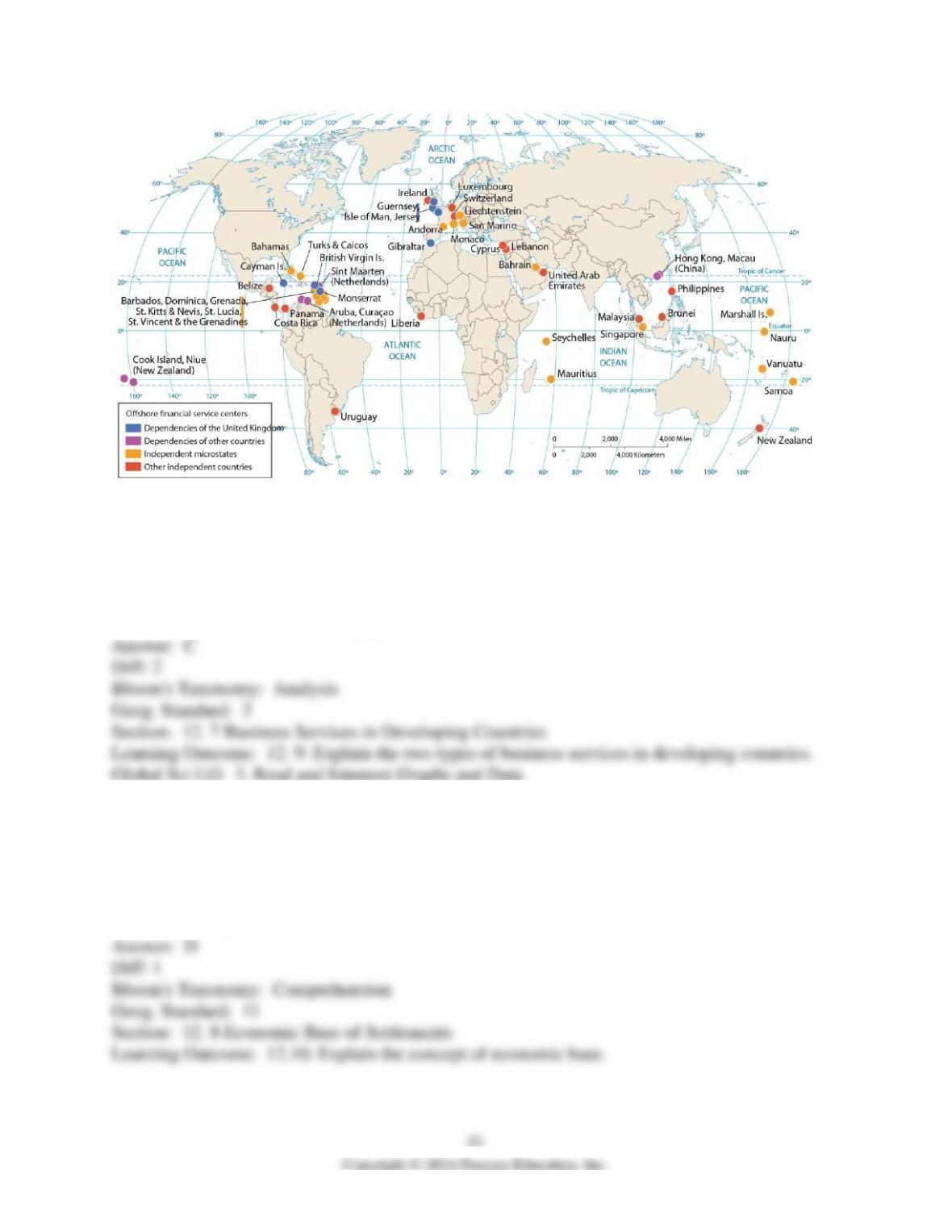
42) This map of offshore financial centers indicates that
A) Gibraltar is an independent microstate that is also an offshore banking center.
B) New Zealand is an independent microstate that is also an offshore banking center.
C) Mauritius is an independent microstate that is also an offshore banking center.
D) Mauritius is a dependency that is also an offshore banking center.
E) there are more offshore banking centers in Asia than in the Caribbean.
43) Which of the following is most likely a basic economic activity?
A) video rental store
B) grocery store
C) gas station
D) steel mill
E) travel agency
44) A firm that sells its products primarily to consumers outside its settlement is a
A) basic industry.
B) functional classification.
C) nonbasic industry.
D) primate city.
E) consumer service.
45) One of the most important basic activities in the southern Great Lakes region is
A) manufacturing of durable goods.
B) manufacturing of textiles.
C) entertainment and recreation facilities.
D) government and education.
E) high technology services.
46) Richard Florida’s research identified a relationship between the distribution of
A) talent and diversity.
B) central places.
C) talent and economic prosperity.
D) rural and urban settlements.
E) business and consumer services.

47) Attracting a new basic industry is important to a community, primarily because it
A) changes the community’s functional classification.
B) stimulates new nonbasic industries.
C) disrupts the central place hierarchy.
D) changes the nation’s rank-size distribution of settlements.
E) replaces obsolete industry.
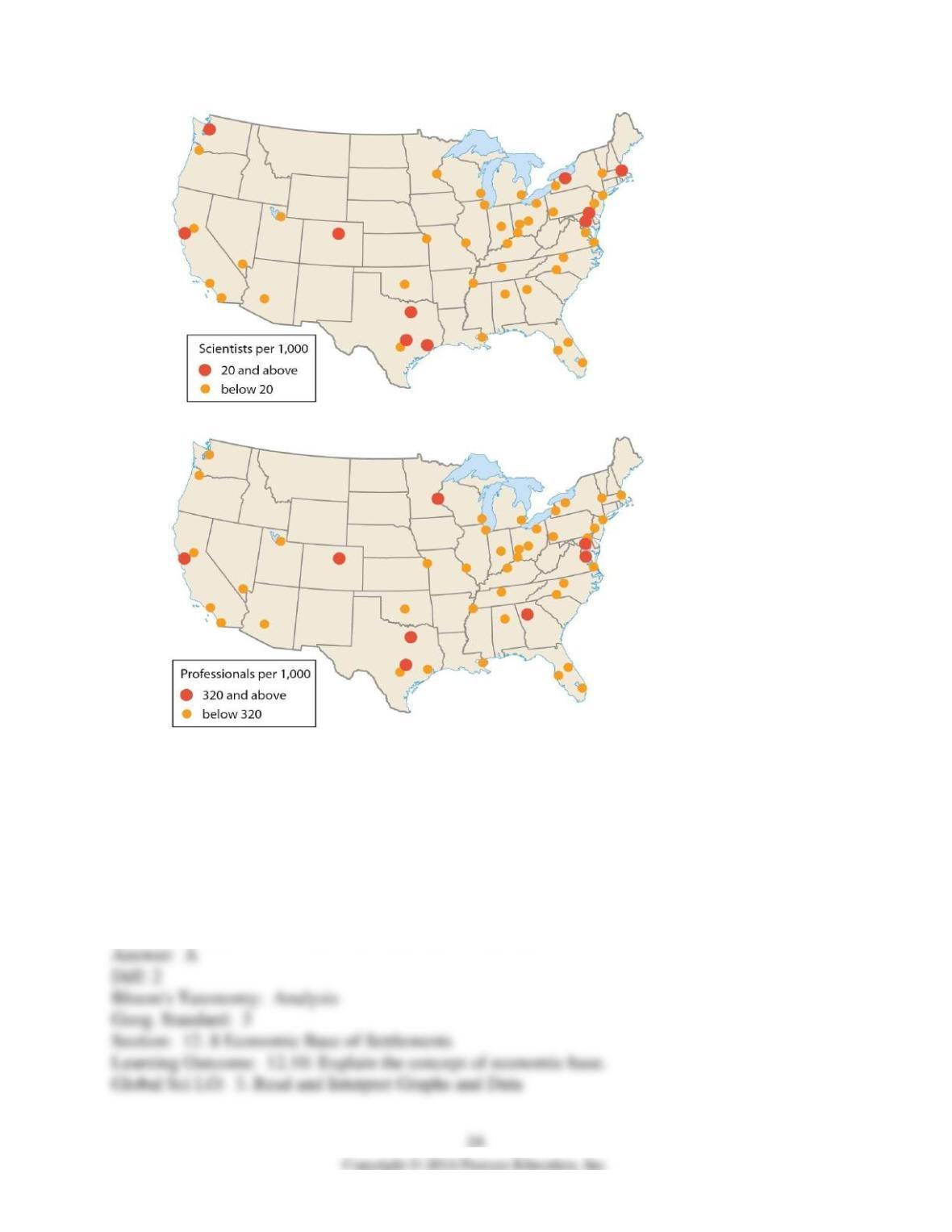
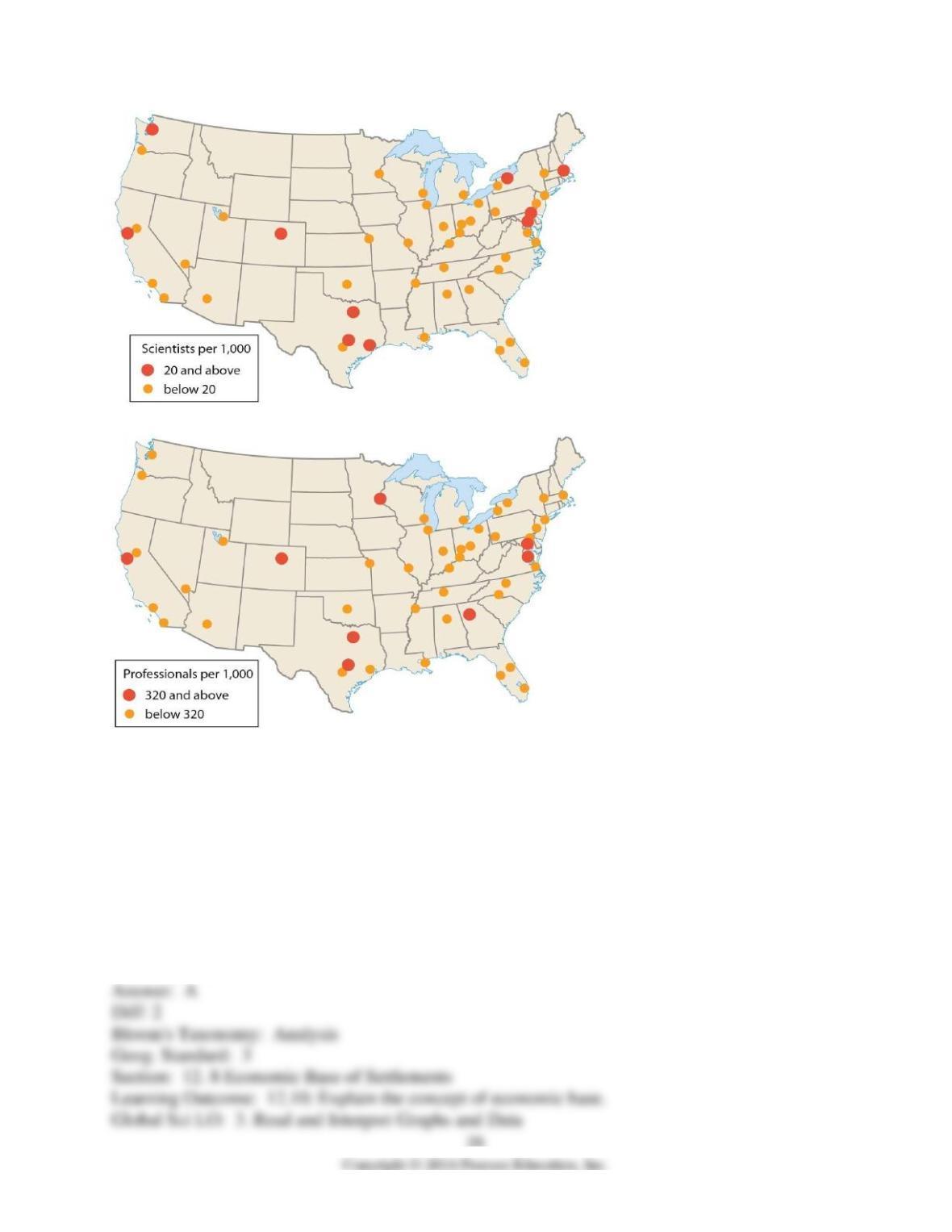
48) According to these “geography of talent” maps,
A) scientists in the western states are partly concentrated in and around Seattle, Denver, and San
Francisco.
B) scientists in the western states are mainly concentrated in Arizona, New Mexico, Montana,
Wyoming, and Nevada.
C) in the Midwest, the percentage of scientists in Chicago is greater than the percentage in St.
Louis.
D) scientists in the eastern states are mainly concentrated in South Carolina and West Virginia.
E) there are almost no scientists in California or Arizona.
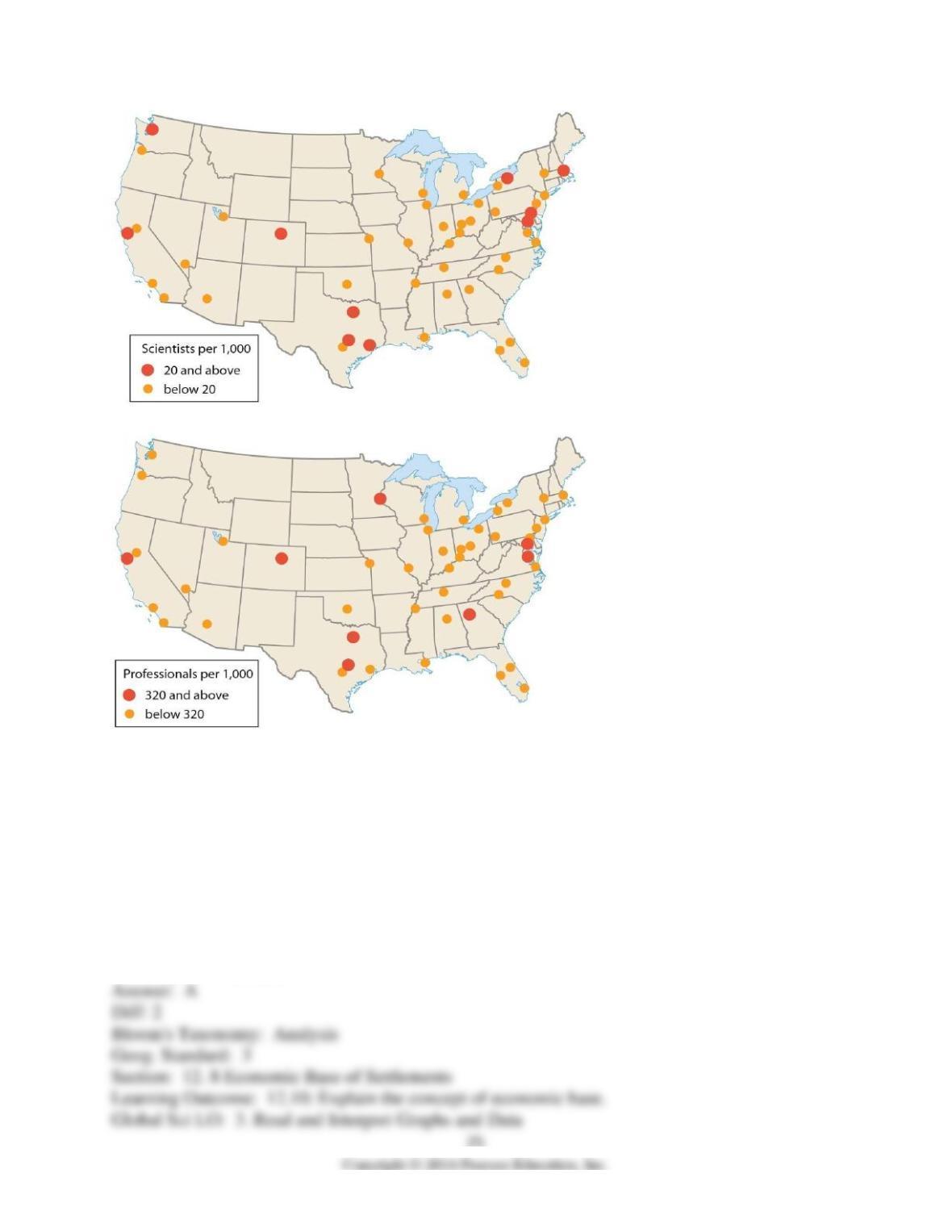
49) According to these “geography of talent” maps,
A) the proportion of professionals in the Minneapolis-St. Paul area is greater than the proportion
in the Chicago area.
B) the proportion of professionals in the Phoenix area is greater than the proportion in the
Denver area.
C) the proportion of professionals in the Phoenix and San Diego areas is greater than the
proportion in the Denver and St. Louis areas.
D) the proportion of professionals in the Las Vegas area is greater than the proportion in the
Milwaukee area.
E) the proportion of professionals in the Miami area is greater than the proportion in the
Washington, D.C., area.
50) According to these “geography of talent” maps,
A) the share of university graduates in the Atlanta area is greater than the share in the Memphis,
Los Angeles, Miami, and Chicago areas.
B) the share of university graduates in the Atlanta area is greater than the share in the Memphis,
Los Angeles, Miami, Boston, San Francisco, Washington, D.C., and Chicago areas.
C) the share of university graduates in the Los Angeles area is greater than the share in the
Memphis, Boston, and Chicago areas.
D) the share of university graduates in the Los Angeles area is greater than the share in the
Washington, D.C. area.
E) the share of university graduates in the Dallas area is greater than the share in the Boston and
Atlanta areas.

51) The French long-lot system was developed primarily because of
A) collective land ownership.
B) common grazing land.
C) inheritance laws.
D) need for access to a river.
E) long distance between farms.
52) The most significant impact that Great Britain’s enclosure movement made on the rural
landscape was to
A) produce more of a dispersed rural settlement pattern.
B) reinforce the traditional clustered rural settlement pattern.
C) discourage urbanization.
D) increase the rural population.
E) improve transportation.
53) Clustered rural settlements were most common in which region of colonial America?
A) Middle Atlantic
B) New England
C) Southeast
D) Coastal margins
E) West
54) The most prominent structure in the ancient city of Ur was the stepped temple called the
________, which was built about 4,000 years ago.
A) pyramid
B) Great Pyramid
C) Ziggurat
D) cathedral
E) Parthenon
55) The most prominent structure in the ancient city of Athens was the ________, which still
overlooks the city.
A) pyramid
B) Great Pyramid
C) Parthenon
D) cathedral
E) Ziggurat
56) Because of its centrality in an ancient communications network, we still have the old saying
“All roads lead to ________.”
A) Paris
B) Athens
C) Rome
D) Genoa
E) London
57) Which of the following is considered to be a hearth of urban settlement?
A) Rome
B) North Africa
C) southern Africa
D) Australia
E) Mesopotamia
58) Heterogeneity is more a characteristic of
A) suburban and rural communities.
B) ancient urban centers than modern urban centers.
C) manufacturing centers and rural populations.
D) rural and urban centers.
E) urban centers than rural communities.
59) Urban residents are generally more tolerant of ________ than are the residents of rural
communities, but residents of urban settlements often feel that they are surrounded by people
who are indifferent and reserved.
A) discrimination
B) political insiders
C) tax shelters
D) uniform social behavior
E) diverse social behavior
60) Urbanization can be analyzed by looking at the increase in the ________ of people living in
cities.
A) number and percentage
B) number and homogeneity
C) percentage and density
D) density and heterogeneity
E) size and density
61) Which statement best describes the relationship between urbanization and the Industrial
Revolution in Europe?
A) Urbanization ultimately promoted the Industrial Revolution.
B) The Industrial Revolution ultimately promoted urbanization.
C) Urbanization preceded the Industrial Revolution by thousands of years.
D) Urbanization preceded the Industrial Revolution by hundreds of years.
E) Urbanization and the Industrial Revolution are largely unrelated.
62) Higher social heterogeneity in urban settlements means that
A) the people you know socially are probably the same ones you see at work.
B) the people are more alike than in rural settlements.
C) people compete for limited space.
D) there are many different kinds of people in cities.
E) people play a specialized role in the urban economy.
63) The most significant anticipated benefit of the enclosure movement was to
A) destroy traditional village life.
B) promote agricultural efficiency.
C) replace abandoned villages with new farmsteads.
D) discourage urbanization.
E) create an aristocracy.
64) The fall of the Roman Empire in the fifth century A.D. brought about what change in urban
settlements?
A) development of city-states
B) rapid urbanization
C) reduction in urban population
D) revival of urban life
E) increased trade
65) Typical medieval European urban settlements were characterized by the
A) dispersal of palaces, churches, and other important buildings throughout the town.
B) placement of buildings around a central market square.
C) demolition of ancient walls surrounding the town.
D) provision of parks and open space surrounding important churches.
E) broad avenues in residential districts.
66) The city-state is an example of
A) an early form of rural settlement.
B) a state dominated by its major city.
C) a functional region.
D) a local government of the Roman Empire.
E) diffuse political functions.
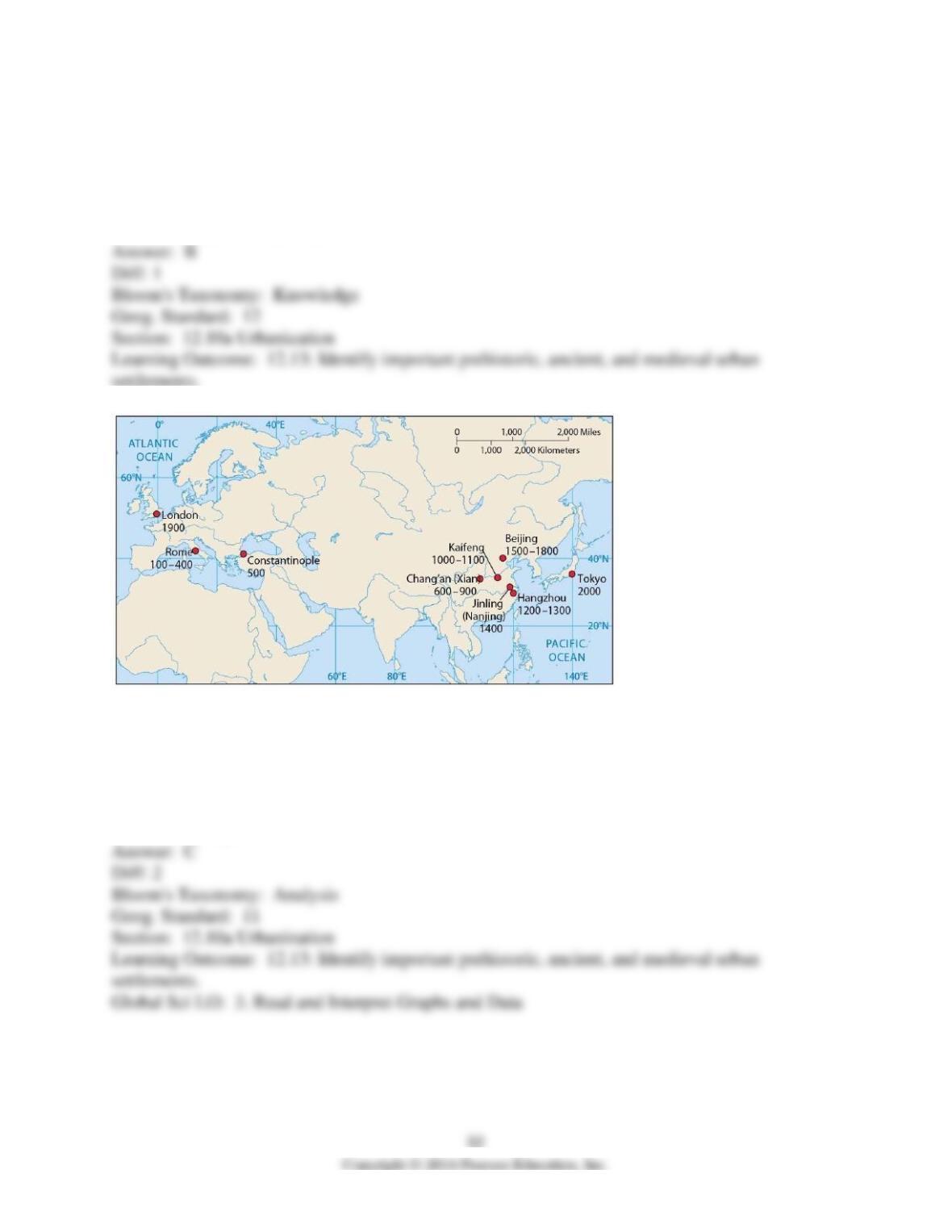
67) This map of early urban settlements indicates that by 1 A.D.
A) Beijing was smaller than London.
B) Tokyo was smaller than London.
C) Rome was one of the largest cities in the world.
D) London was the largest city in Europe.
E) Constantinople was still a minor settlement.
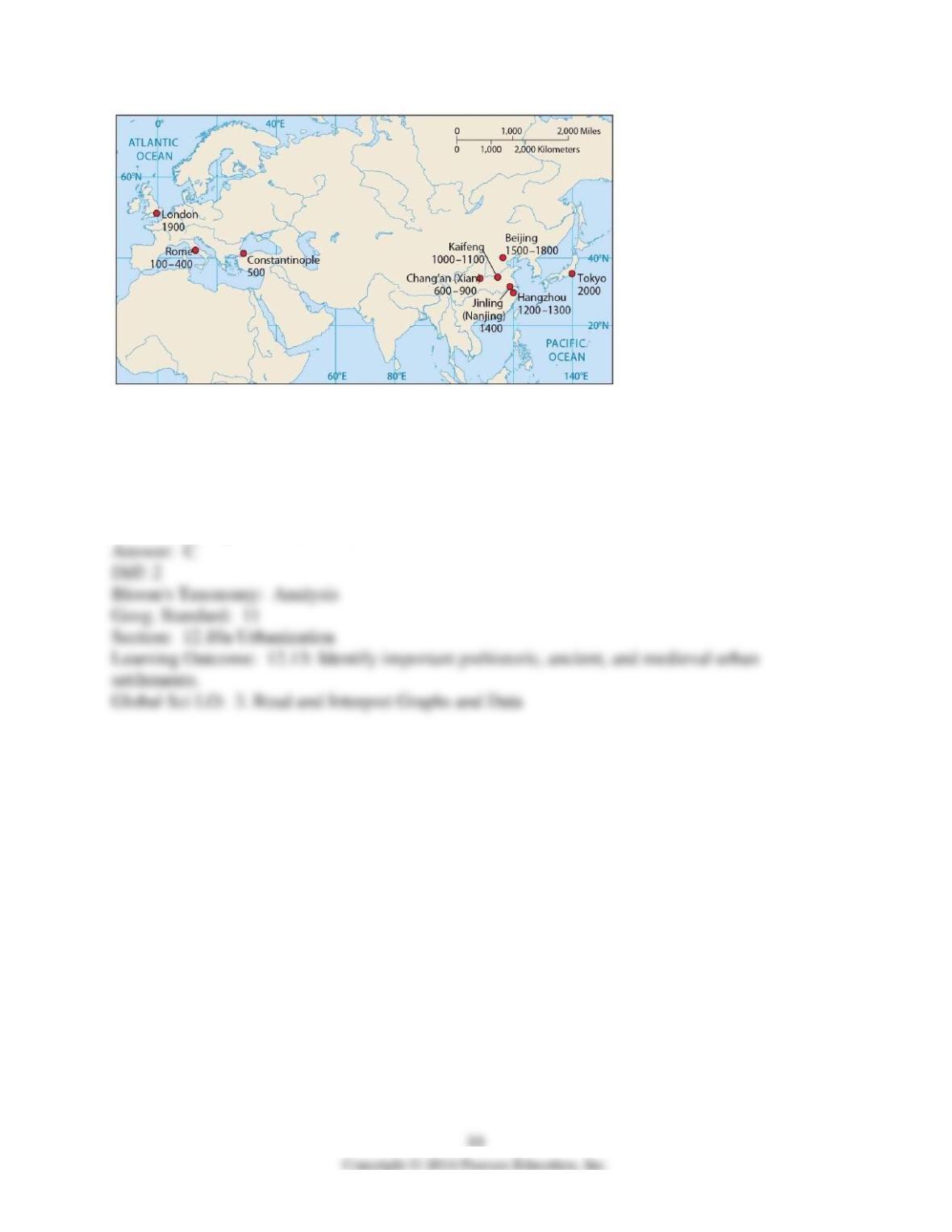
68) This map of early urban settlements indicates that by 1 A.D.
A) Beijing was still a small settlement.
B) Rome was the largest city in the world.
C) Tokyo was one of the largest cities in the world.
D) London was the largest city in the world.
E) Constantinople was still a small settlement.
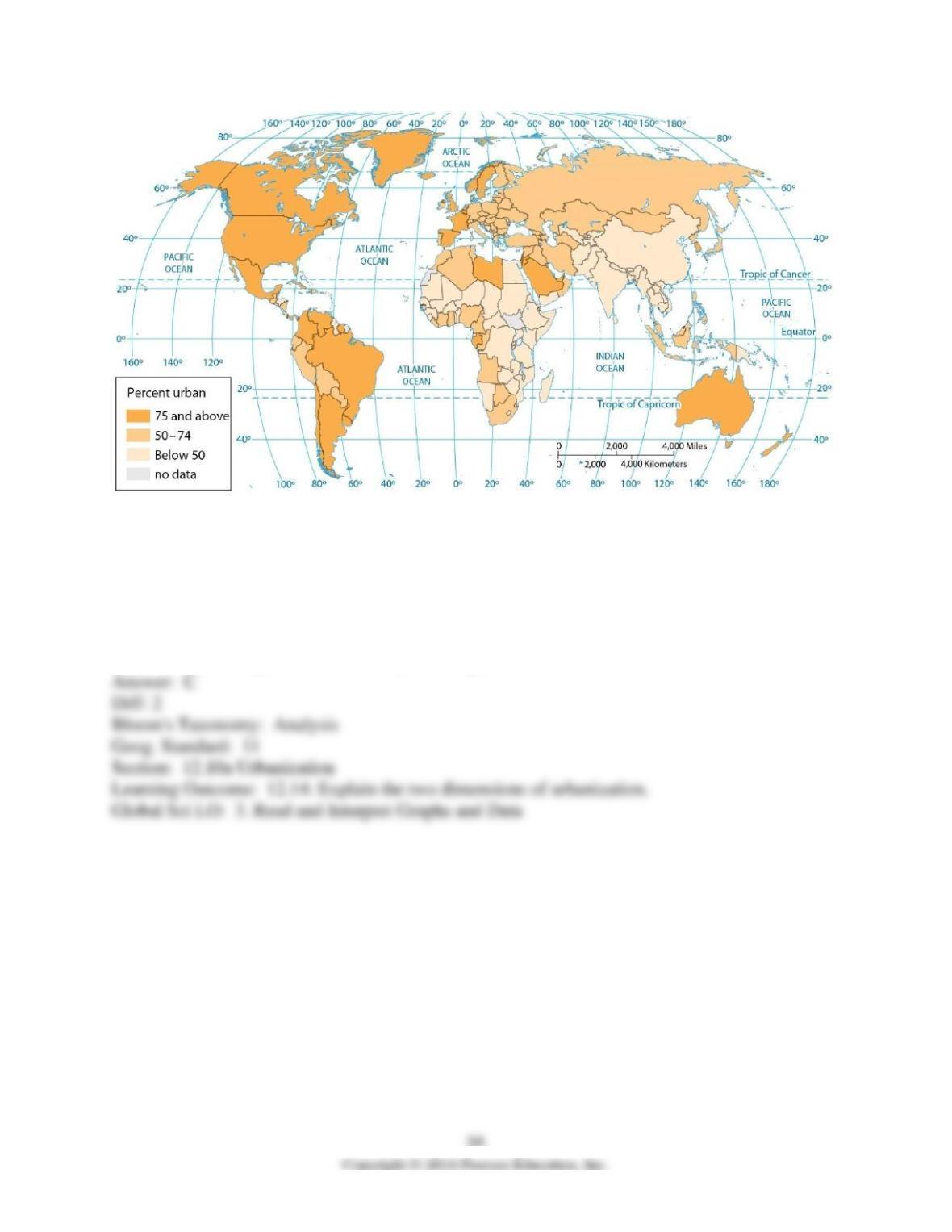
69) This map of the percentage living in urban settlements indicates that the following countries
are more than 75 percent urban:
A) South Africa, Kenya, Tanzania, Namibia, and Libya.
B) Mexico, Peru, Bolivia, China, India, and Australia.
C) Brazil, Argentina, Chile, Mexico, and Libya.
D) India, China, Russia, Australia, and Spain.
E) France, Germany, Romania, Russia, and Bulgaria.
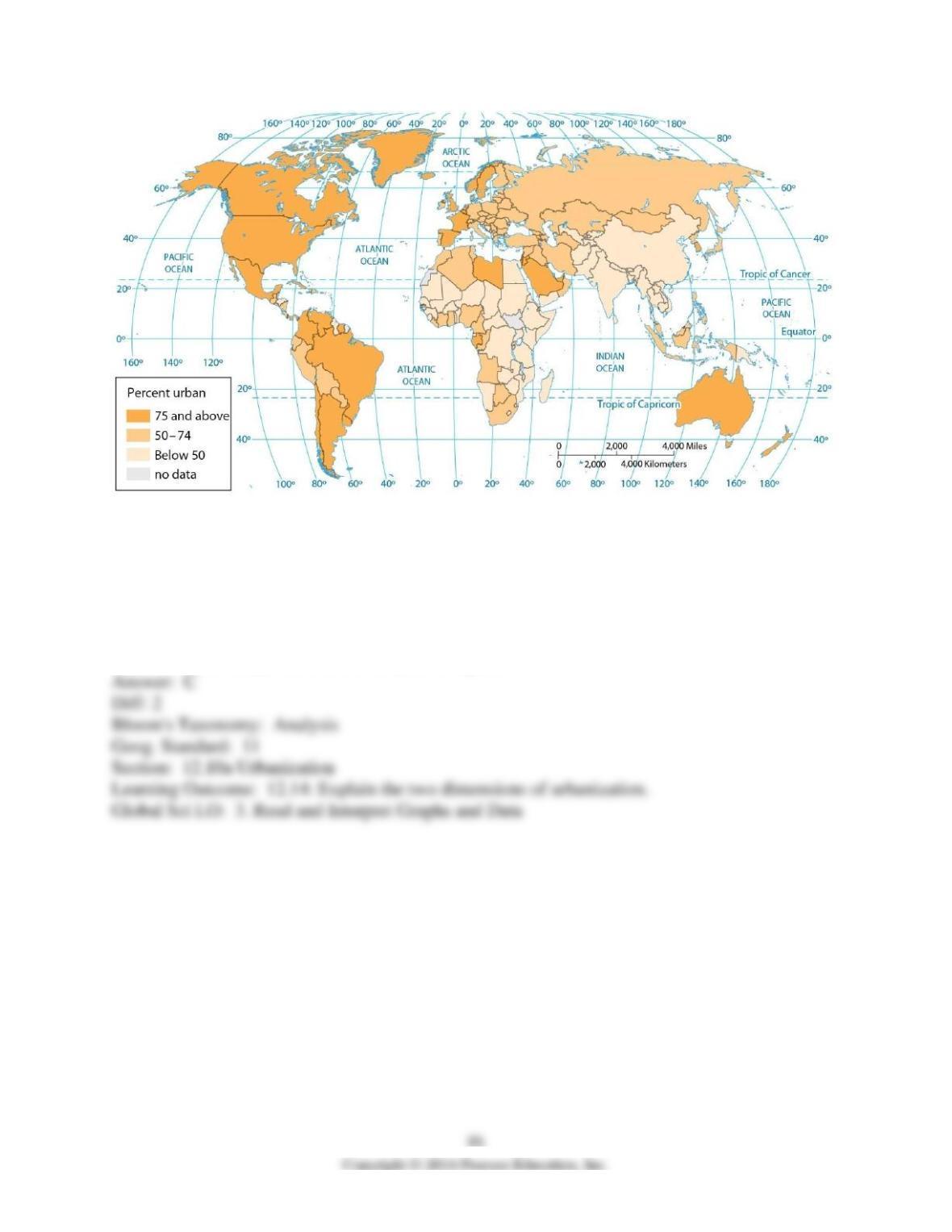
70) This map of the percentage living in urban settlements indicates that in the following
countries, less than half of the people live in urban areas:
A) South Africa, Kenya, Tanzania, Namibia, and Libya.
B) Mexico, India, China, Saudi Arabia, and Libya.
C) Niger, Chad, the Central African Republic, Kenya, Tanzania, and China.
D) Niger, Chad, the Central African Republic, India, Australia, and South Africa.
E) France, Germany, Romania, Russia, and Bulgaria.