CHAPTER 12—GEOLOGY AND NONRENEWABLE MINERALS
MULTIPLE CHOICE
1. Gold is removed from the rock that contains it by a series of leaching operations that all involve the
use of
a.
sulfuric acid
b.
nitric acid
c.
arsenic
d.
highly toxic cyanide salts
e.
mercury
2. The spill of cyanide into the Tisza and Danube Rivers in 2000 could have been prevented if
a.
the computer systems monitoring the cyanide volume had not crashed
b.
fewer people had withdrawn water from the rivers so the overall flow rate was lower
c.
an earthquake warning system had been in place to warn dam managers of the impending
quake that broke the dam
d.
the mining company had installed a stronger containment dam and a backup settling pond
to prevent leakage
e.
a newer, more technologically sound settling pond had been in place
3. In 2010, the world’s top gold producing countries were, in order
a.
South Africa, United States, China, Australia and Russia
b.
China, Australia, South Africa, United States and Russia
c.
Russia, India, China, United States, Brazil
d.
India, Brazil, China, United States and Canada
e.
Brazil, United States, China, Canada and Australia
4. Which of the following is true?
a.
A portion of the mantle is solid rock and a portion of it is molten.
b.
The inner core is liquid, whereas the outer core is solid.
c.
Extreme pressure makes the interior of the Earth liquid.
d.
The core of the Earth occupies most of its volume.
e.
The thickest zone is the crust.
5. The asthenosphere is
a.
the outer atmosphere
b.
the inner core of Earth
c.
a zone of hot, partly melted rock, in the crust, that has been compared to pizza dough
d.
a zone of hot, partly melted rock, under the mantle, that has been compared to pizza dough
e.
a solid region in the mantle
6. The majority of earthquakes and volcanoes occur
a.
in the interior of continents
b.
on oceanic islands
c.
along the edge of plate boundaries
d.
in the open ocean
e.
in the U.S.
7. Which of the following is true of the lithosphere?
a.
It is a combination of crust, mantle, and molten rock.
b.
It is only composed of molten rock.
c.
It is a combination of crust and the rigid, outermost part of the mantle
d.
It is a combination of solid rock and molten rock.
e.
It is the rock and mineral area underneath large bodies of water (hydrosphere)
8. The epicenter of an earthquake is located
a.
deep underground at the very source of the earthquake
b.
at the point on land where the majority of movement, and the majority of damage, occurs
c.
at the point on land where the earthquake is first detected by a seismograph
d.
at the exact middle point of the earthquake’s origin along the length of two faults
e.
on the earth’s surface directly above the focus of the earthquake
9. Tectonic plates can slide and grind past each other at a(n)
a.
ocean ridge
b.
convection cell
c.
transform fault
d.
subduction zone
e.
seam fault
10. The movement of tectonic plates is significant because it
a.
explains the formation of waterfalls and river canyons
b.
predicts where earthquakes are likely to occur
c.
explains the formation of ocean currents
d.
predicts where endangered species might be found
e.
explains the formation of weather
11. One of the reasons the 2004 tsunami in the Indian Ocean caused so much devastation and death is
a.
the lack of attention to dire predictions from emergency warning centers
b.
the fact that early detection systems indicated the tsunami was not very powerful
c.
the lack of buoys or gauges in place to signal the danger to human settlements
d.
more than one of these answers is correct
e.
this is the first tsunami in recent history, so they have not been considered a danger until
this event
12. Convection cells or currents
a.
move large volumes of rock and heat within the earth’s mantle like giant conveyer belts
b.
occur during tsunamis and create an effect of amplifying the waves that repetitively strike
a shoreline
c.
operate in the ocean and in the atmosphere, but not in any part of the lithosphere
d.
are part of the process of earth movement during earthquakes
e.
are a feature of the mantle that geologists are just beginning to recognize, but as yet do not
understand
13. Which of the following is not a characteristic of a mineral?
a.
crystal structure
b.
Organic
c.
naturally occurring
d.
solid
e.
inorganic
14. All of the following are broad classes of rock except
a.
sedimentary
b.
igneous
c.
metamorphic
d.
crystal
e.
limestone
15. A friend of yours has granite counter tops installed in her kitchen, and asks you what you know about
this type of rock. A reasonable answer would be:
a.
it is a type of sedimentary rock (made up of the sediments of dead plant and animal
remains)
b.
it is a type of rock that is formed by high pressure
c.
it is a type of rock that is only found on the ocean floor
d.
it is a type of igneous rock that is formed underground
e.
it is a type of igneous rock that is formed above ground
16. The change of rocks from one type to another is known as
a.
Metamorphism
b.
the rock cycle
c.
Petrography
d.
Consolidation
e.
Hydrogeology
17. Which of the following rocks is most likely to be formed from compacted shells and skeletons?
a.
coal
b.
limestone
c.
rock salt
d.
marble
e.
granite
18. Which of the following rocks is most likely to be formed from compacted plant remains?
a.
coal
b.
limestone
c.
rock salt
d.
marble
e.
granite
19. Lignite and bituminous coal are ____ rocks.
a.
metamorphic
b.
igneous
c.
tectonic
d.
ore
e.
sedimentary
20. Heat and pressure convert
a.
igneous rock into sedimentary rock
b.
sedimentary rock into metamorphic rock
c.
metamorphic rock into igneous rock
d.
sedimentary rock into igneous rock
e.
metamorphic into sedimentary rock
21. Slate and marble are ____ rocks.
a.
Primary
b.
Secondary
c.
Metamorphic
d.
Igneous
e.
Sedimentary
22. Mineral resources are best categorized as which of the following?
a.
renewable resources
b.
nonrenewable resources
c.
alternative energy resources
d.
subduction resources
e.
organic resources
23. The most widely used nonmetallic minerals are
a.
nitrates and phosphates
b.
aluminum and steel
c.
carbon and chlorophyll
d.
sand and gravel
e.
rock and ore
24. Surface mining techniques are used to extract ____% of the coal used in the United States.
a.
20
b.
40
c.
60
d.
80
e.
100
25. Environmental impact would be greatest mining for ____ ore.
a.
a high-grade
b.
a moderate-grade
c.
a low-grade
d.
a plentiful
e.
a low- to moderate-grade
26. United States dependence on foreign countries for mineral resources other than oil could occur in the
future because of the emerging demand for
a.
lithium for cell phone, laptop and electric car batteries
b.
lithium for LED lights
c.
silver nitrate for cell phone, laptop and electric car batteries
d.
mercury for digital camera batteries
e.
granite kitchen counter tops
27. Fish populations in one area of Borneo have dropped by 70% due to
a.
mining for lithium using mercury
b.
mining for plutonium
c.
strip mining
d.
arsenic pollution secondary to gold mining
e.
extracting gold from stream sediments using mercury
28. According to the United States Environmental Protection Agency
a.
mining has polluted about 10% of western watersheds
b.
mining has polluted about 40% of western watersheds
c.
recent changes in the Clean Water Act has resulted in recovery of 40% of western
watersheds
d.
mining produces fewer toxic emissions than any other industry in the United States
e.
mine explosions are the greatest cause of deaths amongst working age males in the United
States
29. Mountaintop removal has been used extensively in the state of _____ where over _____ have been
removed.
a.
Michigan, 100
b.
Colorado, 50
c.
West Virginia, 500
d.
Virginia, 400
e.
Kentucky, 300
30. Metals such as gold, iron, and copper are often mined via this method.
a.
mountaintop removal
b.
area strip mining
c.
subsurface mining
d.
open pit mining
e.
minimum impact mining
31. Since the 1960’s South Korea has imported iron and copper because
a.
it has never had the natural reserves of these nonrenewable minerals
b.
industrial applications that require these metals has surged since then
c.
it exported large amounts of these nonrenewable minerals in the 1950’s and since then has
not had enough to meet its own demands
d.
rapid economic growth alone has outstripped the country’s ability to meet demands
e.
it is both cheaper and less polluting to import the minerals rather than mine for them in
their own country
32. Which of the following statements is false?
a.
Market prices clearly reflect dwindling mineral supplies.
b.
High prices would encourage recycling and reuse.
c.
Low mineral prices are caused by failure to include the external costs of mining.
d.
Low prices encourage waste and faster depletion.
e.
Two of these choices are false.
33. Advantages of using microorganisms for mining include all of the following except reduced
a.
land disturbance
b.
air pollution
c.
water pollution
d.
time to remove minerals
e.
water and air pollution
34. Which of the following is not a problem associated with extracting mineral resources from the ocean?
a.
Many of the mineral resources that are found in seawater are in low concentrations.
b.
This can be extremely expensive given current technologies.
c.
There might be ecological impacts associated with aquatic life.
d.
There might be disagreement as to who has legal access and rights to certain resources.
e.
There are no valuable mineral resources in the ocean.
35. As nonrenewable mineral resources are depleted, experts are particularly concerned about manganese,
cobalt, chromium, and platinum, which are
a.
trace metal resources
b.
strategic metal resources
c.
biogenic metal resources
d.
magma metal resources
e.
trace metal resources
36. The rare earth elements that are considered extremely important for widely used modern technologies
include
a.
scandium and yttrium
b.
scandium, yttrium and the 15 lanthanides
c.
yttrium, cobalt and the 15 lanthanides
d.
scandium, nobelium and the 15 lanthanides
e.
the 17 lanthanides alone
37. The U.S. General Mining Law of 1872 was in effect until
a.
1873
b.
1900
c.
1950
d.
1995
e.
This law is still in effect today.
38. Which statement best fits as a description of the U.S. General Mining Law of 1872?
a.
Land could be purchased at market price for purposes of extracting minerals.
b.
A statement had to be made by the prospective owner that the land likely contains hard
rock miners.
c.
A statement had to be made by the prospective owner that $500 would be spent to improve
the land for mineral development.
d.
$120 per year had to be paid each year for a 20-acre parcel.
e.
All of these except land could be purchased at market price for purposes of extracting
minerals.
39. Which of the following is true of the current materials revolution that is occurring?
a.
New materials are being created that act as ideal replacements for many materials.
b.
Nanotechnology is likely to be a large component of the materials revolution.
c.
Many new materials are more efficient and cost-effective than their counterparts.
d.
The production and use of many new materials are far less environmentally damaging.
e.
All of these answers are true.
40. Which of the following is NOT a method by which to achieve more sustainable use of nonrenewable
mineral resources?
a.
Reduce waste, recycle, and reuse.
b.
Slow population growth.
c.
Find substitutes.
d.
Reduce mining subsidies.
e.
Remove minerals faster so the mining processes do not pollute the air for as long a time
period.
41. Which of the following best describes a sustainable use of nonrenewable minerals?
a.
recycle and reuse 60-80% of mineral resources
b.
stop focusing on population growth as a factor
c.
stop all mining of nonrenewable mineral resources
d.
reduce mining subsidies
e.
reduce mining subsidies and recycle and reuse 60-80% of mineral resources
42. The Pollution Prevention Pays program was initiated by Minnesota Mining and Manufacturing (3M) in
1975. Which of the following are actions that have been taken by 3M as part of this program?
a.
There has been less use of hazardous raw materials.
b.
Nanotechnology has replaced heavy metals used in production.
c.
Overall waste production has not increased, but stayed level through 1998.
d.
More than one of these choices are correct.
e.
Nanotechnology has replaced heavy metals used in production and nanotechnology has
replaced heavy metals used in production.
43. The term urban mine refers to
a.
the vast amount of plastic in computer modules that can be recycled
b.
a mine located within a city’s limits
c.
vast amounts of gold, platinum and rare earth metals found in electronic wastes
d.
recycling plants in your local neighborhood
e.
community gardens that also have recycling plants
TRUE/FALSE
1. Nonrenewable mineral resources renew over millions to billions of years.
2. Mountaintop removal is more damaging to the environment than subsurface mining.
3. The dirt wall left after contour mining is called a spoil.
4. High risk zones for earthquakes and tsunamis are not well known, and so events like the recent
tsunami in Japan cannot be anticipated and preparations cannot be made in advance.
5. Volcanoes are normally associated with transform faults.
6. Plate tectonics has helped to promote global biodiversity over geologic time.
7. The 2000 leakage of a cyanide leaching pond in Romania that release toxic metals into the Danube and
Tisza Rivers was an entirely preventable event.
8. Surface mining can result in deforestation.
9. Important nonrenewable mineral resources in the Earth’s crust are distributed relatively evenly across
the planet.
10. The United States National Academy of Sciences says that the federal government is not doing enough
to evaluate potential risks from engineered nanomaterials.
11. Underwater mountains or ridges usually form at the subduction zone, where two oceanic plates collide.
12. The San Andreas fault in California is an example of a transform fault.
13. The amount of ground movement in a 5.0 earthquake is 20 times greater than in a 3.0 earthquake.
14. Mangrove forests can be helpful in damping down the effects of tsunamis. However, coral reefs do not
have any beneficial role in the face of a tsunami.
15. The world’s reserves of the strategic mineral tungsten are found in the United States and China, with
about half of the total located in each of the two countries
16. Slate and shale are types of sedimentary rock.
17. The purpose of the 1872 U.S. General Mining Law was to encourage mineral exploration on public
lands and help develop the western territories
18. Nanotechnologists envision that in the future garbage can be turned into edible food.
COMPLETION
1. ____________________ forms when a preexisting rock is subjected to high temperatures.
2. Mining waste accounts for about ___________________of all U.S. solid waste.
3. The inner portion of the mantle is the ____________________, a zone of hot, partly melted flowing
pliable rock.
4. The external process that results in the breaking down of rocks into smaller particles is best described
as ____________________.
5. A(n) ____________________ is an element or inorganic compound that occurs naturally in the Earth’s
crust.
6. A volcano is created when ____________________ rises in a plume through the lithosphere.
7. The Richter scale measures the amplitude of ____________________.
8. So far ____________________ methods are economically feasible only with low-grade ores for which
conventional mining methods are too expensive.
9. Of the actions recommended for preserving our supply of nonrenewable metals and minerals, the one
that has the lowest environmental impact is to____________________.
10. One of the environmental problems with gold mining is the leach ponds that contain
____________________.
11. Earthquakes and volcanoes are caused by ____________________as they separate, collide, and slide
past one another.
12. Granite is a type of ____________________ rock.
265
13. Heating ores to release the metals they contain is called ____________________.
14. The slowest of the cycles that occur on earth is the ____________cycle.
15. A ____________ _____________can be formed when two tectonic slide and grind past each other at a
fracture in the lithosphere.
MATCHING
Match the items listed below with the appropriate choice
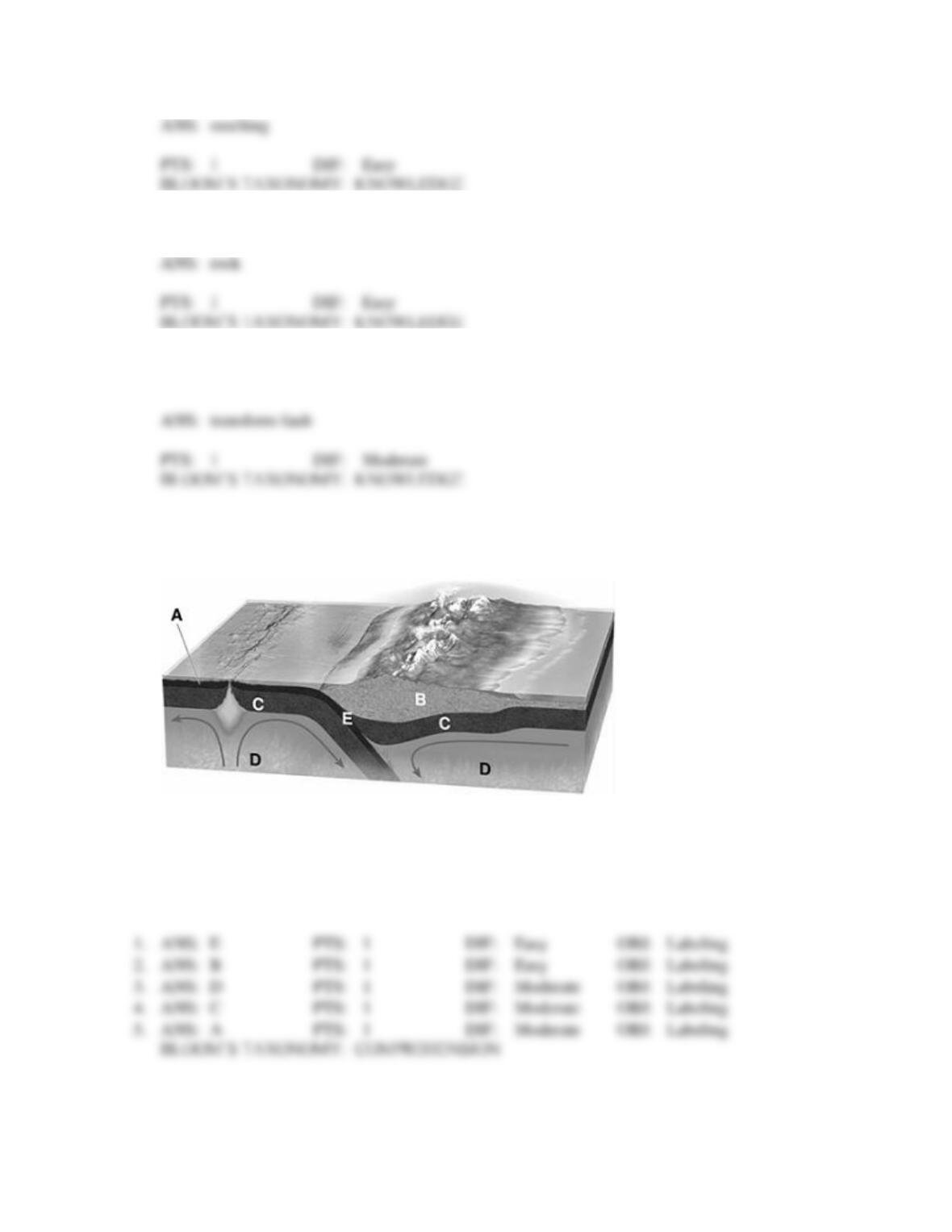
1. On the figure of the tectonic plates, choose the letter that represents the subduction zone.
2. On the figure of the tectonic plates, choose the letter that represents the continental crust.
3. On the figure of the tectonic plates, choose the letter that represents the asthenosphere.
4. On the figure of the tectonic plates, choose the letter that represents the lithosphere.
5. On the figure of the tectonic plates, choose the letter that represents the oceanic crust.
266
Match the items listed below with the appropriate choice
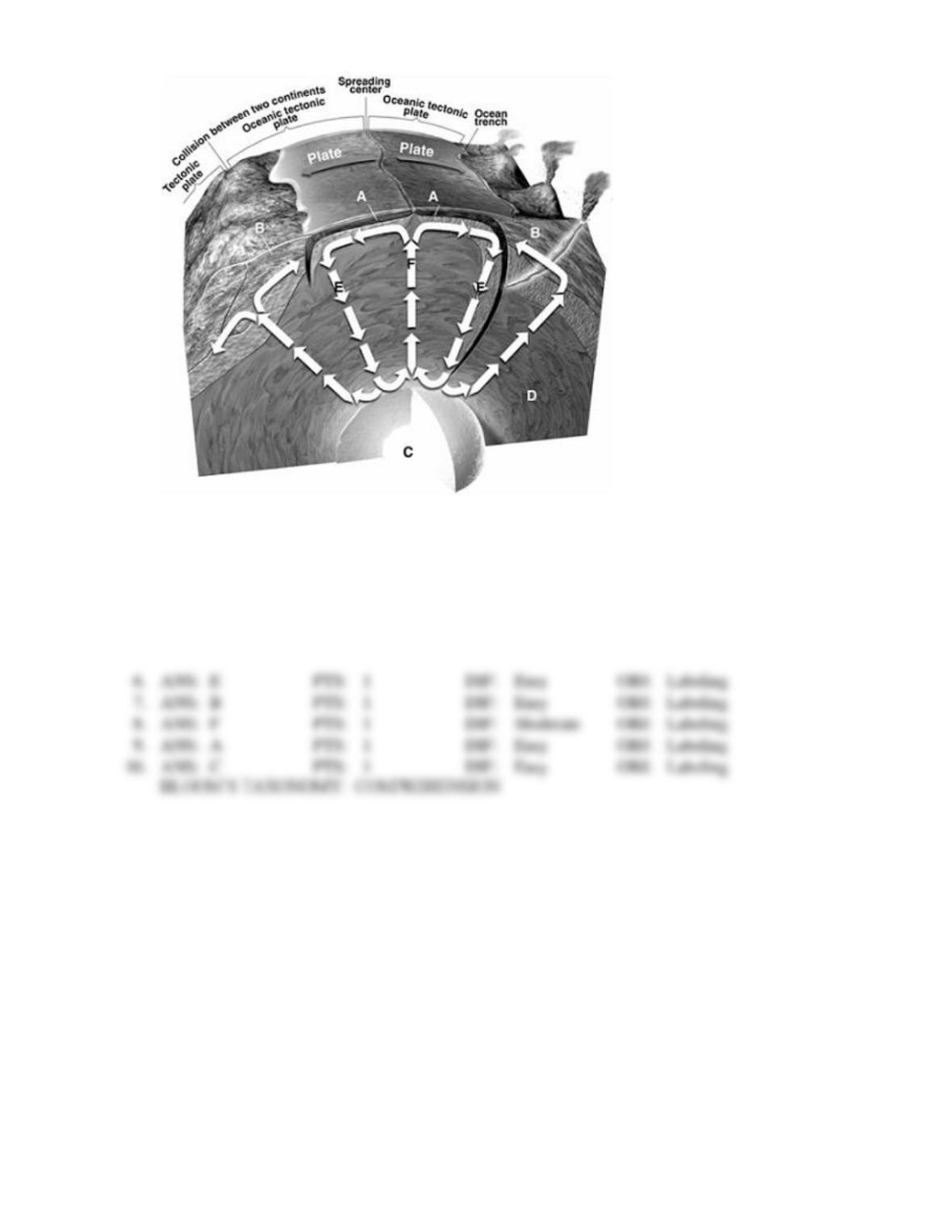
6. On the figure of the earth’s crust, choose the letter that represents cold dense materials falling through
the mantle.
7. On the figure of the earth’s crust, choose the letter that represents the continental crust.
8. On the figure of the earth’s crust, choose the letter that represents hot material rising through the
mantle.
9. On the figure of the earth’s crust, choose the letter that represents the oceanic crust.
10. On the figure of the earth’s crust, choose the letter that represents the inner core.
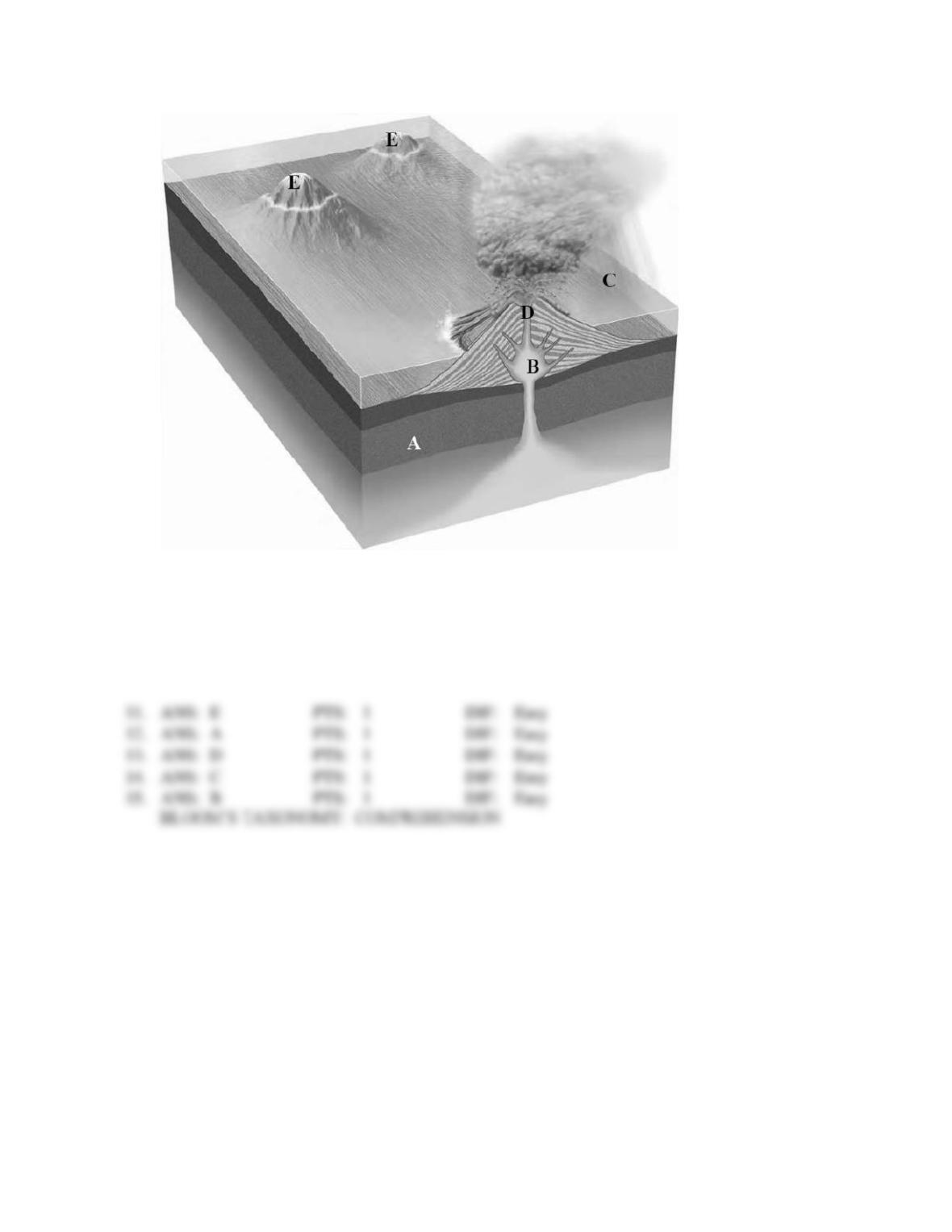
267
Match the items listed below with the appropriate choice
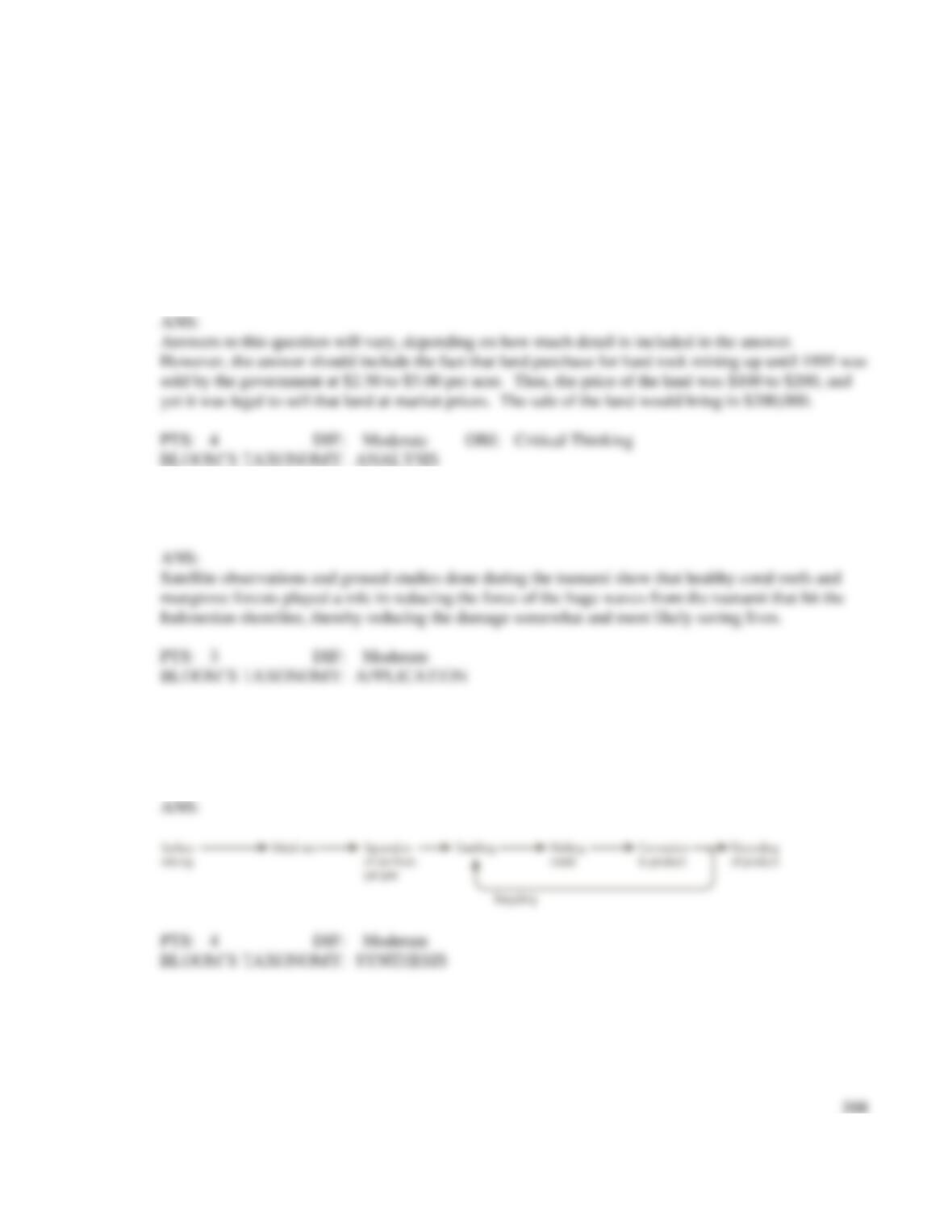
11. Which area on the graphic represents an extinct volcano?
12. Which area on the graphic represents solid lithosphere?
13. Which area on the graphic represents the magma conduit?
14. Which area on the graphic represents ash acid rain?
15. Which area on the graphic represents the magma reservoir?
SHORT ANSWER
1. Assume that the year is 1990 and you are a seeking to establish a business for yourself. Trained as a
business person, you wish to become an entrepreneur. You purchase a plot of 40 acres of land,
declaring to the federal government that you intend to carry out hard rock mining on this 40 acres,
since you believe there are valuable minerals underground on this land. After a couple of years of
effort, you decide to pursue other business ventures and sell this land at $5,000 per acre to a person
who wishes to establish a dude ranch resort.
Using the U.S. General Mining Law of 1872 as your reference, discuss your original financial
investment and your ending financial situation. (Exclude the cost of buildings and equipment for this
particular instance.)
2. Briefly explain how healthy mangrove forests and coral reefs helped to reduce the death toll during the
2004 tsunami in Indonesia.
ESSAY
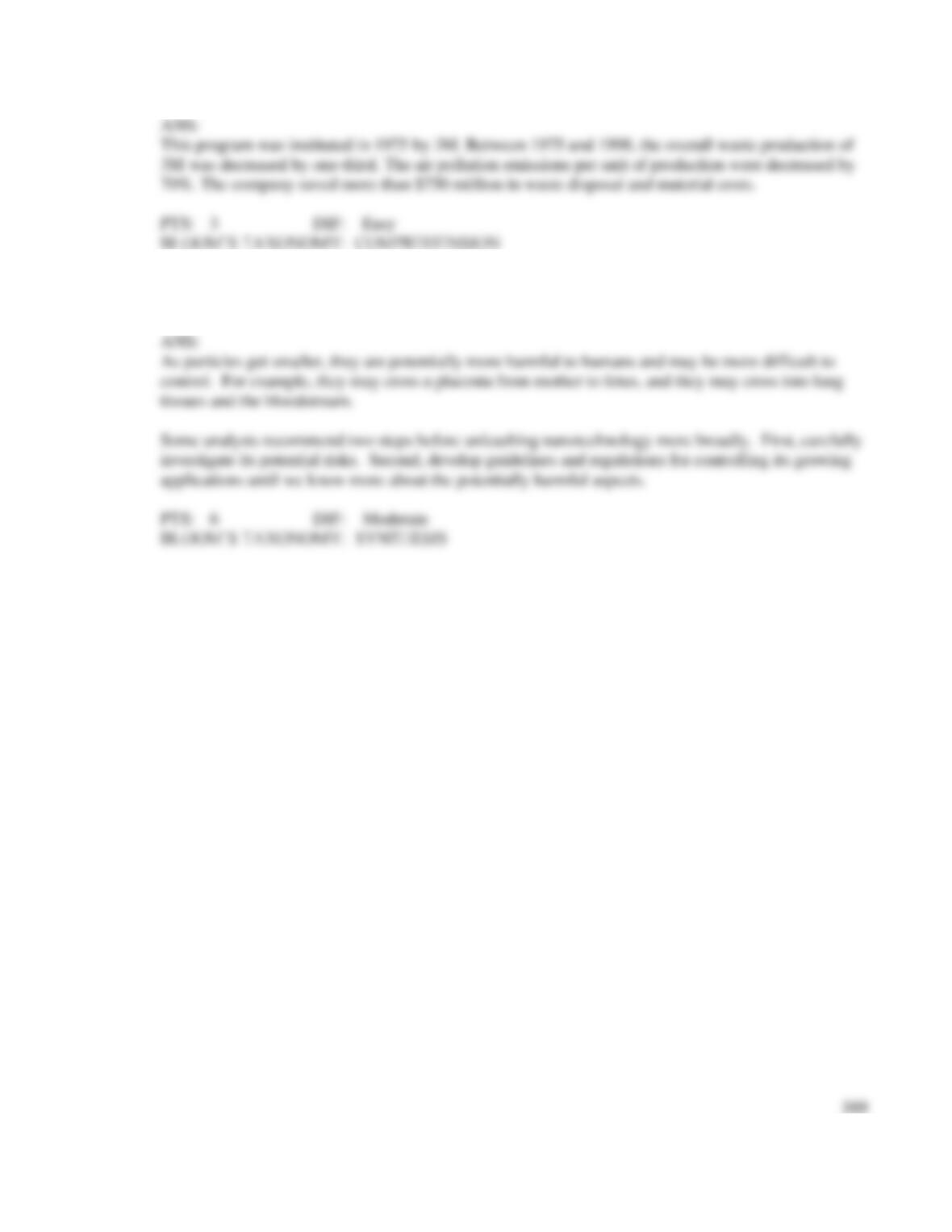
1. Draw the flow chart that explains the life cycle of a metal resource.
2. Discuss the Minnesota Mining and Manufacturing (3M) company’s Pollution Prevention Pays
program.
3. Briefly explain why caution is advised in proceeding with the new and powerful use of
nanotechnology.