
Chapter 12: Strategic Investment Decisions
Learning Questions
True /
False
Multiple Choice
Matching
Exercises
Short
Answer
Problems
1. How are strategic
investment decisions
made?
1-4
23, 26, 39-42
1
5
2. What cash flows are
relevant for strategic
investment decisions?
5-7
(Included in questions for
other learning questions)
W: 97
2
3. How is net present value
analysis performed and
interpreted?
8-10
1-3, 5, 6, 8, 9, 11, 12, 15-
19, 21, 22, 43, 59-61,
63, 65, 67, 68
S: 74, 76, 78, 80, 84, 86,
87
W: 91, 94, 99, 100, 103-
106
1, 2, 3
1
2, 3, 4, 5
4. What are the uncertainties
and limitations of NPV
analysis?
11–13
43–46
8, 9
4
5. What alternative methods
are used for long-term
decision making?
14–16
4, 7, 10, 13, 14, 20, 24, 25,
38, 58, 62, 64
S: 73, 75, 79, 82, 83, 85
W: 88, 89, 92, 93, 102
1, 2, 4, 5
1, 2, 3,
4
3, 5
6. What additional issues
should be considered for
strategic investment
decisions?
17
47, 48
W: 96
8
3, 5
7. How do income taxes
affect strategic investment
decision cash flows?
18, 19
27-37, 49-51, 66, 69-72
S: 81
W:
6
2, 4
8. (Appendix 12A) How are
the real and nominal
methods used to address
inflation in an NPV
analysis?
20, 21
52–57
S: 77
W: 90, 95, 98, 101
7, 8
5, 6, 7
1
S: Questions from the study guide
W: Questions from web quizzes on the student web site
Level of Complexity*
True /
False
Multiple
Choice
Matching
Exercises
Short
Answer
Problems
Foundation: Repeat or paraphrase
information; Reason to single correct
solution; Perform computations; etc.
All
All
All
All
5, 7
All
Step 1: Identify the problem, relevant
information, and uncertainties
1, 2, 3, 4,
6, 8
1, 2, 3, 4,
5
Step 2: Explore interpretations and
connections
9
1, 4
Step 3: Prioritize alternatives and
implement conclusions
Step 4: Envision and direct strategic
innovation
*Based on level in Steps for Better Thinking (Exhibit 1.10, textbook p. 16):
Note: Step 1, 2, 3, and 4 questions in this test bank are intentionally open-ended and subjective, giving students the
opportunity to demonstrate skills such as judgment, reasoning, identification of uncertainties, identification or analysis of
pros and cons, and so on. Therefore, student answers may not exactly match those shown in the solutions.

12-2 Cost Management
True / False
1. Capital budgeting is a process managers use when choosing investments with multi-year cash flows.
2. The first step in addressing capital budgeting decisions is to identify relevant cash flows.
3. Sensitivity analysis is usually performed after applying quantitative analysis techniques in a capital
budgeting decision.
4. Managers should consider qualitative information in making capital budgeting decisions.
5. Cash flows to be considered in capital budgeting decisions generally fall into three major groups:
initial investment, incremental operating cash flows, and terminal cash flows.
6. Incremental operating cash flows can be associated with changes in capacity or product quality in
capital budgeting decisions.
7. The cost of disposing of an old asset is considered irrelevant in capital budgeting decisions.
8. The time value of money is important in completing a net present value analysis.
9. In general, the initial project investment does not require discounting in a net present value analysis.
10. Under the general quantitative rule, a project with a net present value less than zero should not be
accepted.
11. A capital investment’s expected useful life is inversely correlated with the uncertainty of its cash
flows.
12. Uncertainty is very often a factor when estimating a project’s terminal value for an NPV analysis.
13. Managers responsible for proposing a project are likely to be favorably biased in their estimates of
future project cash flows.
14. The accrual accounting rate of return method does not consider the time value of money.
15. The internal rate of return method assumes that future cash flows can be reinvested to earn the same
return generated by a capital investment project.
16. Because of its complex calculation, few managers rely on the payback period as a capital budgeting
analysis tool.
17. The effect of a strategic investment decision on a company’s reputation is often difficult to quantify.
18. Income taxes have a major effect on capital budgeting decisions.
19. In capital budgeting decisions, depreciation shields part of operating income from the effect of
income taxes.
20. (Appendix 12A) Cash flows for a capital budgeting analysis are often affected by inflation, but not by
deflation.
21. (Appendix 12A) The nominal method of NPV analysis adjusts future cash flows for the impact of
inflation.

Chapter 12: Strategic Investment Decisions 12-3
Multiple Choice
1. Last semester a class gave a professor $810 to fly to Borneo. However, he decided not to go until he
had enough money to fly back, an additional $690. If he invests the $810 at 8%, when can he make
the trip, assuming no change in ticket prices?
a. 8 years
b. 6 years
c. 4 years
d. 2 years
2. Walter borrows $10,000 from his mother. He will repay her $2,000 at the end of each of the next four
years and the balance at the end of the fifth year. If the interest rate is 12%, what is the amount to be
paid at the end of the fifth year?
a. $3,926.00
b. $6,924.16
c. $5,869.65
d. $2,000.00
3. You are currently entering college and you want to buy your uncle’s Mercedes when you graduate.
He has promised to sell it to you for $18,000. How much will you have to deposit now, in an account
earning 8%, to have enough money buy the car in 4 years?
a. $6,122
b. $4,500
c. $13,230
d. $3,060
Use the following information for the next 2 questions.
Phoxco is considering automating its production line at a cost of $40,000 to acquire the necessary equipment.
The annual cost savings are expected to be $8,000 for 14 years. The firm requires a 20% rate of return.
Ignore income taxes.
4. What is the internal rate of return on this investment?
a. Less than 20%
b. Equal to 20%
c. More than 20%
d. Cannot be determined
5. The net present value for this investment is
a. Positive
b. Zero
c. Negative
d. Cannot be determined
6. Elkins Co. is considering an investment in equipment for a new product line with a cost of $48,625, a
terminal value of $6,283, and a useful life of 5 years. The project will provide an annual contribution
margin of $12,500. The required rate of return is 12%. Ignore income taxes. This project is
a. Unacceptable, because it earns a rate below 12%.
b. Acceptable, because it has a positive NPV.
c. Unacceptable, because it has a 0 NPV.
d. Acceptable, because it earns exactly 12%.

12-4 Cost Management
7. Green Inc. has invested in a project with a cost of $36,504, annual net cash flows of $12,000, a
terminal value of $4,000, and a 5-year useful life. The firm uses a 16% discount rate. Compute the
internal rate of return to the nearest tenth of a percent. Ignore income taxes.
a. 19.2%
b. 20.8%
c. 19.8%
d. 18.8%
8. Early, Inc. has chosen four potential investment projects. Listed below are some relevant data on
these projects:
Project Investment Net Present Value
1 $125,000 $62,500
2 150,000 45,000
3 75,000 52,500
4 112,500 45,000
Use the profitability index to rank these investments in terms of preference.
a. 1, 3, 2, 4
b. 2, 1, 4, 3
c. 1, 2, 3, 4
d. 3, 1, 4, 2
9. The local school board is considering the purchase of a computer. It will cost $100,000 and will be
sold back to the dealer at the end of 6 years for $8,000. If the required rate of return is 14%, what is
the minimal annual cost saving required to justify the purchase? Ignore income taxes.
a. $25,714
b. $23,142
c. $24,776
d. $23,656
10. The Conroy Co. wants to purchase a machine for a new product line that costs $138,750. The
company’s engineering department estimates the machine will last 10 years and provide an annual
contribution margin of $25,000. Ignore income taxes. The internal rate of return to the nearest tenth
of a percent is
a. 12.4%
b. 11.6%
c. 13.46%
d. 12.64%
11. Phoxco would like to automate its calligraphy operation. The equipment will cost $150,000 plus
freight, installation, and testing costs of $5,500. The expected life of the project is 8 years, with
annual cost savings of $20,000. The minimum rate of return is 12% and estimated terminal value is
$3,000. Ignore income taxes. The profitability index of the project is
a. 1.55
b. 1.57
c. 0.67
d. 0.65
12. Alien Corp. is considering the purchase of a new truck which costs $14,340. The truck is expected to
save $3,600 in operating costs annually for the next 7 years. How low can the annual cost savings be
and still provide a 15% return? Ignore income taxes.
a. $5,967
b. $475
c. $7,458
d. $3,441

Chapter 12: Strategic Investment Decisions 12-5
13. Phoxco is considering automating its production line. It will cost $40,000 to acquire the necessary
equipment. The annual cost savings are expected to be $8,000 per year for 14 years The firm requires
a 20% return.
Ignoring income taxes, what is the payback period?
a. 3 years
b. 4.2 years
c. 5 years
d. 6 years
14. The Bonkers Corp. is contemplating the purchase of a piece of equipment with the following cash
flow data:
Incremental
Year Initial Cost Contribution Terminal Value
0 $84,000
1 $30,000
2 25,000
3 20,000
4 15,000 $9,000
Ignoring income taxes, what is the payback period?
a. 3.00 years
b. 3.33 years
c. 3.60 years
d. 3.50 years
15. The time value of money means
a. A dollar received today will be worth more than a dollar received in the future
b. A dollar received today will be worth less than a dollar received in the future
c. Ignoring the profitability of a capital investment
d. The more you invest, the smaller your return is
16. The net present value method is
a. Used to appraise a capital project’s qualitative factors.
b. Used to show how long the initial investment will be at risk.
c. The sum of the cash inflows, discounted to time zero.
d. The sum of the projected cash inflows and outflows valued in today’s dollars.
17. For a particular investment project, the present value of the benefits is exactly equal to the present
value of the investment. Given this, which of the following statements is true?
a. The net present value is positive.
b. The internal rate of return is less than the required rate of return.
c. The profitability index is less than one.
d. The project is acceptable.
18. A firm’s required rate of return is the rate which makes the
a. Net present value equal to zero.
b. Internal rate of return equal to the average rate of return.
c. Profitability index greater than zero.
d. Determination of the NPV possible.
12-6 Cost Management
19. Uniform cash flows from a capital project are necessary for which of the following calculations?
I. Net present value
II. Internal rate of return
III. Profitability index
a. I and II only
b. II and III only
c. I and III only
d. None of the above (not I, II, or III)
20. If the internal rate of return exceeds the discount rate, the net present value is
a. Zero
b. Less than one
c. Positive
d. Negative
21. The rate of return that results in a zero net present value for a project is called the
a. Average rate of return
b. Internal rate of return
c. Required rate of return
d. Discount rate of return
22. A negative net present value means that the
a. Internal rate of return is less than the required rate of return
b. Project is acceptable
c. Present value of the inflows exceeds the present value of the outflows
d. Company chose the wrong discount rate
23. The process that managers use when they evaluate multi-year investments is called
a. Capital budgeting
b. Activity-based budgeting
c. Short-term decision making
d. Breakeven analysis
24. The payback period is deficient as a decision criterion for capital projects because it
I. Disregards relative profitability
II. Ignores income beyond the payback period
III. Does not take into account the time value of money
a. I only
b. II only
c. III only
d. I, II, and III
25. Which of the following capital budgeting methods ignores the time value of money?
a. Internal rate of return
b. Net present value
c. Profitability index
d. Payback period
26. Capital budgeting decisions typically fall into which of the following major categories?
I. Developing or expanding products or services
II. Allocating costs to products or services
III. Replacing or reorganizing assets or services
a. I and II only
b. II and III only
c. I and III only
d. I, II, and III

Chapter 12: Strategic Investment Decisions 12-7
27. Apex Co. has $100,000 available for long-term investment. Which projects should be selected from
the list below?
Project Cost IRR NPV Profitability Index
1 $60,000 16% $3,413 1.057
2 40,000 20% 7,563 1.190
3 40,000 24% 8,036 1.201
4 20,000 14% 1,313 1.066
5 60,000 18% 14,583 1.243
a. 4 and 5
b. 2, 3, and 4
c. 3 and 5
d. 2 and 5
Use the following information for the next 6 questions. Some amounts are rounded.
Arnold Company is acquiring a new machine with a life of 5 years for use on its production line. The
following data relate to this purchase:
Cost of new machine $100,000
Annual cost savings in cash expenses 45,000
Terminal value 8,000
Maintenance required in the 4th year 5,000
Book value of the old machine 20,000
The new machine would replace an old fully-depreciated machine. The old machine can be sold for $15,000
at the time the new equipment is acquired. The income tax rate is 30%, and the discount rate is 12%. Arnold
uses the straight-line method for depreciation on all machines (ignore the half-year convention).
28. The present value of the total savings (excluding the maintenance in year 4) in annual cash operating
costs is
a. $48,667.50
b. $162,225.00
c. $113,557.50
d. $50,167.50
29. The present value of the maintenance cost in year 4 is
a. $2,226
b. $3,180
c. $954
d. $420
30. The present value of the total tax savings from the depreciation tax shield is
a. $21,630.00
b. $46,432.40
c. $50,470.00
d. $19,899.60
31. The present value of the cash flows from the sale of the old machine is
a. $15,000
b. $13,395
c. $16,340
d. $17,860
32. The present value of the terminal cash flows is
a. $8,000
b. $4,536
c. $1,361
d. $3,175

12-8 Cost Management
33. The present value of the cash flows for year 4 is
a. $21,319
b. $28,951
c. $23,545
d. $21,624
Use the following information for the next 4 questions.
Bailey Corporation is considering modernizing its production by purchasing a new machine and selling an old
machine. The following data have been collected on this investment:
Old Machine
New Machine
Cost
$40,000
Cost
$19,000
Accumulated depreciation
$20,000
Estimated useful life
4 years
Remaining life
4 years
Salvage value in 4 years
$5,000
Current salvage value
$5,000
Annual cash operating costs
$14,000
Salvage value in 4 years
$-0-
Annual cash operating costs
$18,000
The income tax rate is 40%, and the required rate of return is 16%. Depreciation is $5,000 per year for the old
machine. The new machine would be depreciated $7,600 in 20×1, $5,700 in 20x2, $3,800 in 20×3, and
$1,900 in 20×4. Assume Bailey would purchase the new machine in December 20×0 and dispose of the old
machine in January 20×1.
34. Bailey’s 20×0 depreciation tax shield for the old machine is
a. $5,000
b. $4,000
c. $3,000
d. $2,000
35. The net cash flow associated with selling the old machine in January 20×1 (i.e., the value of the sale
and any tax consequences) would be
a. $5,000
b. $15,000
c. $20,000
d. $11,000
36. The relevant annual pretax cash operating cost associated with Bailey’s decision will be
a. $4,000
b. $14,000
c. $18,000
d. $2,400
37. The tax effect of selling the new machine in 20×4 would be
a. $5,000
b. $3,000
c. $2,000
d. $0

Chapter 12: Strategic Investment Decisions 12-9
38. Valley Hospital is considering the purchase of new medical equipment for $25,000. The old
equipment has zero salvage value. The costs associated with operating the equipment are:
Old Equipment New Equipment
Labor $9,000 $4,500
Maintenance 2,000 1,200
Miscellaneous 1,500 1,300
Depreciation 8,000 4,750
If the new machine is purchased and ignoring income taxes, the payback period is
a. 3.57 years
b. 2.13 years
c. 2.86 years
d. 4.55 years
39. Which of the following is the best example of a capital budgeting decision?
a. Deciding the price of a product for the next six months
b. Forecasting accrual basis profits for the next five years
c. Purchasing a piece of equipment with an expected life of eight years
d. Deciding which product to emphasize when there are constrained resources
40. Which of the following is not a step in the process for addressing capital budgeting decisions?
a. Identify decision alternatives.
b. Identify financial statement effects.
c. Apply quantitative analysis techniques.
d. Perform sensitivity analysis.
41. Some of the steps in the process for addressing capital budgeting decisions are listed below. Which
lettered choice puts the steps in the proper order?
1. Identify relevant cash flows.
2. Perform sensitivity analysis.
3. Apply quantitative techniques.
a. 1, 2, 3
b. 2, 3, 1
c. 3, 1, 2
d. 1, 3, 2
42. Which of the following is not a quantitative technique commonly used in capital budgeting decisions?
a. Net present value
b. Activity-based budgeting
c. Internal rate of return
d. Payback
43. Which of the following statements regarding NPV analysis is true?
a. Uncertainties increase as the dollar value of an investment increases
b. The discount rate can be calculated with certainty if it is based on the weighted average cost of
capital
c. Managers should generally accept projects with an NPV greater than zero
d. The timing of incremental revenues and costs is irrelevant in NPV analysis
44. Which of the following factors are subject to uncertainty in an NPV analysis?
I. Project life
II. Appropriate discount rate
III. Terminal value
a. I and II only
b. II and III only
c. I and III only
12-10 Cost Management
d. I, II, and III
45. Sebastian is presenting a capital budgeting project to Viola, his division manager. Which one of the
following is likely to have the least amount of bias when evaluating this project?
a. Sebastian
b. Viola
c. The company’s accountant
d. Cannot be determined
46. In completing a sensitivity analysis for a capital budgeting project, which of the following would
typically be varied?
I. Discount rate
II. Future cash flows
III. Future accrual-basis revenues and expenses
a. I and III only
b. II and III only
c. I and II only
d. I, II, and III
47. Qualitative factors often influence strategic investment decisions. Which of the following is the best
example of such a factor?
a. Changes in product prices based on consumer demand
b. Changes in consumer demand based on product prices
c. Increased ability to ship product in a timely manner
d. Discount rate estimates
48. DBR Corporation is considering the purchase and implementation of an enterprise-wide information
system. Which of the following would be the least biased source of qualitative information about the
project?
a. Information technology staff who would implement the system
b. The software vendor
c. Other companies that have implemented the same system
49. A depreciable asset’s taxable basis is calculated as its
a. Cost
b. Net book value on the balance sheet
c. Market value at the time of disposal
d. Cost less accumulated tax depreciation
50. Which of the following is the best example of a tax shield for an asset?
a. Its periodic depreciation
b. Its cost basis
c. Its disposal cost
d. Its trade-in value
51. The incremental cash tax flow for a capital budgeting project is calculated using which of the
following formulas?
a. Annual depreciation × marginal income tax rate
b. Annual depreciation × (1 – marginal income tax rate)
c. (Operating cash flow + annual depreciation) × marginal income tax rate
d. Operating cash flow × marginal income tax rate

Chapter 12: Strategic Investment Decisions 12-11
52. (Appendix 12A) Inflation refers to the
a. Exchange rate between two different currencies
b. Decline in general purchasing power of a monetary unit
c. Increase in general purchasing power of a monetary unit
d. Time value of money
53. (Appendix 12A) In a capital budgeting analysis, nominal cash flow is generally calculated as
a. Real cash flow × (1 + inflation rate)t
b. Real cash flow / (1 + inflation rate)t
c. Real cash flow (1 + inflation rate)×t
d. (1 + inflation rate) × t × real cash flow
54. (Appendix 12A) Which of the following NPV analysis methods requires adjustment of a project’s
terminal value for inflation?
Real Nominal
a. Yes Yes
b. No No
c. Yes No
d. No Yes
55. (Appendix 12A) The real and nominal methods are most closely associated with
a. Internal rate of return
b. Payback
c. Net present value
d. Cost of capital
56. (Appendix 12A) If nominal cash flow is calculated as real cash flow × (1 + i)t in an NPV analysis, i
denotes the
a. Weighted average cost of capital
b. Risk-free interest rate
c. Discount rate
d. Rate of inflation
57. (Appendix 12A) The tax savings cash flows are treated differently under the nominal and real
methods. Which of the following reflects this treatment?
Real Nominal
a. Inflated Deflated
b. Deflated Used as is
c. Used as is Deflated
d. Deflated Inflated
More Difficult Multiple Choice
These multiple choice questions require more complex computations or present information differently than
in the textbook.
58. George Shaw & Co. invested in a project that was to last for 2 years. The project has an internal rate
of return of 12%. The project is expected to produce cash inflows of $70,000 in the first year and
$80,000 in the second year. The project cost is
a. $143,760
b. $142,510
c. $150,000
d. $126,270
12-12 Cost Management
59. Benjamin Company invested in a 3-year project and expects a 15% rate of return. Annual cash
inflows from the project are: year 1 $8,000; year 2 $8,500; and year 3 $9,500. The net present value
is $4,000. What was the amount of the original investment? Ignore income taxes.
a. $17,637
b. $15,637
c. $19,637
d. $23,637
60. Bell Company is considering a project that would provide a single cash inflow eight years from now
of $80,000. What is the most that Bell would be willing to spend on this project if the discount rate is
16%?
a. $262,295
b. $24,400
c. $288,400
d. $22,191
61. Allen Co. invested in a machine that has a 3-year useful life. The company’s discount rate is 12%,
and the net present value of the investment is $(573). Annual cost savings are: year 1 $3,000; year 2
$4,000; and year 3 $5,000. Determine the original cost of the machine. Ignore income taxes.
a. $12,000
b. $8,500
c. $10,000
d. $9,500
62. Rams, Inc. has invested in a machine with a cost of $37,164 and annual cost savings of $6,000. The
discount rate is 8%, and the machine’s internal rate of return is 12%. Ignore income taxes. The
estimated life of the machine is
a. 6.2 years
b. 8 years
c. 12 years
d. Cannot be determined
63. A firm is currently buying a part at a cost of $12 each. It is considering buying a machine that will
produce the part at a variable cost of $8. Each unit of input produces the part plus a by-product, which
is sold for $1. The machine will cost $40,000 and will have a useful life of 5 years. The firm requires
an 8% return. What annual volume is necessary to justify making the investment? Ignore income
taxes.
a. 2,558 units
b. 3,198 units
c. 12,792 units
d. 8,000 units
64. An organization that provides housing for abused women has limited housing, so it pays rent for
several families. The director is considering expanding the housing facilities by purchasing a small
triplex that has a useful life of 10 years. The estimated cost is $100,000. Using a discount rate of 15%,
the present value of the future savings on rent is $120,000. To yield an internal rate of return that is at
least 15%, the actual cost cannot exceed the estimated cost of $100,000 by more than
a. $10,038
b. $3,985
c. $20,000
d. $2,000

Chapter 12: Strategic Investment Decisions 12-13
65. Bern Company invested in a project that cost $100,000. It had a net present value of $15,975 and a
useful life of 8 years. The firm uses a 14% discount rate, and the project has an internal rate of return
of 16%. What are the annual cost savings provided by the project?
a. $25,000
b. $26,698
c. $9,263
d. $8,600
66. What is the net present value of a capital project to buy new equipment for replacing old equipment,
given the following data and a minimum return of 12%? Ignore income taxes.
Old New
Equipment Equipment
Purchase price $21,600 $36,000
Accumulated depreciation 7,200 0
Remaining useful life (years) 8 8
Current salvage value 12,000 0
Salvage value in 8 years 1,000 2,000
Annual operating costs 14,000 8,000
a. $6,616
b. $(5,788)
c. $4,596
d. $7,020
67. Martin Corporation has the following equity structure:
Market Value Pretax Cost After-Tax Cost
Long-term debt $300,000 10% 6%
Preferred stock 500,000 10 10
Common stock 200,000 15 15
Martin’s weighted average cost of capital is
a. 9.8%
b. 10.3%
c. 11.0%
d. 12.5%
68. Allen Corporation has the following equity structure:
Market Value Cost
Long-term debt $700,000 15%
Preferred stock 50,000 5
Common stock 250,000 15
The weighted average cost of capital is
a. 14.5%
b. 8.2%
c. 8.7%
d. 10.3%
69. In January, Wilson Company purchased a new machine for $80,000 that has a useful life of 10 years
and a terminal value of $5,000. Annual cash operating savings from the machine are $20,000. The
income tax rate is 40%. What is the after-tax payback period?
a. 4.00 years
b. 5.26 years
c. 4.85 years
d. 6.67 years

12-14 Cost Management
Use the following information for the next 3 questions. Disquotek, Inc., is a software manufacturer.
Managers are considering a new equipment proposal. The income tax rate is 40%, and the discount rate is
10%. The following data are available:
Old Equipment New Equipment
Purchase cost $12,000 $36,000
Annual depreciation 1,500 4,500
Remaining useful life (years) 8 8
Current selling price 14,400 not applicable
Selling price in 8 years 1,000 2,000
Annual operating costs 14,000 8,000
70. The after-tax cash flows from selling the old equipment are
a. $12,000
b. $13,440
c. $12,960
d. $11,040
71. What is the relevant after-tax annual cash operating cost associated with this decision?
a. $8,000
b. $6,000
c. $3,600
d. $2,400
72. What is the relevant after-tax cash flow associated with disposing of the new equipment at its salvage
value in 8 years?
a. $2,000
b. $1,200
c. $0
d. $800
Multiple Choice from Study Guide
s73. The internal rate of return is that rate which
a. Management wants to earn
b. Equates the cash inflows and outflows
c. Results in a positive NPV
d. Is greater than the required rate of return
s74. A zero NPV may indicate that a project
a. Is unacceptable
b. Has a profitability index less than 1.0
c. Has a payback period equal to its life
d. Has an IRR equal to the discount rate used in the NPV analysis
s75. If project X has a lower IRR than project Y, then project X would tend to have a
a. Shorter payback period
b. Longer payback period
c. Higher NPV
d. Lower NPV
Chapter 12: Strategic Investment Decisions 12-15
s76. What is the NPV of a project with an initial outlay of $10,000, cash inflows of $1,000 at the end of
years 1 through 9, and a cash inflow of $4,000 at the end of year 10? Assume an 8% discount rate.
a. $(1,438)
b. $(1,901)
c. $3,000
d. $8,909
s77. (Appendix 12A) The real rate of interest is 15%, and inflation is estimated at 5%. What is the
nominal rate of interest?
a. 20.00%
b. 15.75%
c. 20.75%
d. 19.25%
s78. Carri Company is negotiating for the purchase of a new machine. The machine is expected to
generate operating cost savings of $225,000 per year for 4 years. Carri uses a 12% discount rate.
What is the most Carri would be willing to pay for this machine? Ignore income taxes.
a. $683,325
b. $197,935
c. $540,450
d. $380,250
s79. Which capital budgeting method computes the discount rate that sets the NPV to zero?
a. Accrual accounting rate of return
b. IRR method
c. NPV method
d. Payback method
s80. A project has an NPV = 0 and the initial investment is $360,000. If the discount rate is 12%, compute
the annual cash inflows, if the project’s life is 4 years.
a. $133,080
b. $118,538
c. $82,267
d. $123,682
s81. Shamus Corp. sold a piece of equipment for $80,000. The asset originally cost $272,000, and
accumulated depreciation on the equipment at the date of sale was $174,400. What is the after-tax
cash inflow (outflow) from the sale of the equipment, assuming the income tax rate is 40%?
a. $(7,040)
b. $7,040
c. $100,800
d. $87,040
s82. Suppose a project’s profitability index is 1.12. Then the project’s IRR is
a. Greater than the discount rate
b. Less than the discount rate
c. Equal to the discount rate
d. Cannot be determined
s83. Project A has a payback period of 4 years, and Project B has a payback period of 6 years. Which
project is more profitable?
a. Project A
b. Project B
c. They are equally profitable
d. Cannot be determined

12-16 Cost Management
s84. Which of the following statements is false?
a. The discount rate does not need to be determined in advance for the IRR method
b. The discount rate does not need to be determined in advance for the NPV method
c. The discount rate does not need to be determined in advance for the payback method
d. The discount rate does not need to be determined in advance for the accrual accounting rate of
return method
s85. The payback method ignores
a. Time value of money
b. Cash flows at the end of the project’s life
c. Initial investment
d. Both (a) and (b)
s86. Using a discount rate of 12%, a company determined the NPV of a project to be $12,300. If the NPV
was recomputed using a 10% discount rate, the new NPV will be
a. Higher
b. Lower
c. The same ($12,300)
d. Cannot be determined
s87. Wiess Corp. is considering the purchase of a new machine. The machine will generate cost savings
of $15,000 in year 1, $22,000 in year 2, and $32,000 in year 3. Wiess uses a discount rate of 10%.
What is the most that Wiess would be willing to pay for the new machine? Ignore income taxes.
a. $69,000
b. $131,411
c. $55,839
d. None of the above
Multiple Choice from Web Quizzes (Available on Student Web Site)
w88. An investment of $60,000 will return $18,000 per year. What is its payback period?
a. 2 years
b. 3 years
c. 3.33 years
d. 4 years
w89. Several methods are used to make long-term strategic decisions, including
I. Net present value
II. Internal rate of return
III. Cost-volume-profit
a. II and III only
b. I and II only
c. I and III only
d. III only
w90. (Appendix 12A) The nominal method is preferred to the real method for NPV analysis because
I. Cash flows can be inflated at different rates
II. It includes a risk premium
III. It includes the risk-free rate
a. I only
b. I and II only
c. II only
d. II and III only
Chapter 12: Strategic Investment Decisions 12-17
w91. Net Present Value analysis is
I. A long-term decision making method
II. Incorporates the time value of money
III. Used frequently in the U.S.
a. I and II only
b. I, II, and III
c. II and III only
d. III only
w92. The payback method is
I. A long-term decision making method
II. Uses the time value of money
III. Uses accounting earnings in the calculation
a. I only
b. III only
c. I and II only
d. II only
w93. Internal rate of return
a. Is used for short term decisions
b. Does not incorporate the time value of money
c. Calculates the net present value of a project
d. Calculates the return at which the net present value is zero
w94. As the number of periods increases for a project having uniform cash flows, the present value of each
future discounted cash flow becomes
a. Smaller
b. Does not change
c. Irrelevant
d. Larger
w95. (Appendix 12A) An approach that allows analysis of different future rates of inflation or deflation for
different cash flows is the
a. NPV analysis
b. Payback method
c. Accrual Accounting Rate of Return
d. Target costing method
w96. Qualitative factors that might override the acceptance of a positive NPV project include
a. The time value of money
b. A negative environmental impact that could harm an organization’s reputation
c. The discount rate
d. The risk free rate
w97. Relevant cash flows for long-term decisions include
I. Revenues for new projects or services
II. Variable costs for new projects or services
III. Labor or electricity savings for replacement of old equipment
a. II and III only
b. I and III only
c. I and II only
d. I, II, and III
12-18 Cost Management
w98. (Appendix 12A) Depreciation tax savings are
I. The savings on taxes because business equipment can be depreciated
II. The income tax rate times the allowed depreciation for that year
III Measured in nominal dollars
a. I only
b. I and II only
c. I, II, and III
d. III only
w99. If Erika Lee invests $5,000 in a certificate of deposit that pays 5%, compounded annually, what
amount will she have in 10 years?
a. $8,954
b. $8,144
c. $12,969
d. $7,401
w100. The time value of money is taken in account when calculating
I. Mortgage payments
II. Car payments
III. Future values of savings accounts
a. I only
b. I and II only
c. I, II, and III
d. I and III only
w101. (Appendix 12A) The risk premium for a particular project is
a. The estimate of a rate of return for a project with similar risk
b. The weighted average cost of capital for a firm
c. Something that can be found in risk tables in text books
d. Usually the same for all of the projects an organization would consider.
w102. The most appropriate method(s) for long term decisions
a. Incorporate the time value of money
b. Is the payback method
c. Is the accounting rate of return method
d. Incorporates allocated costs
w103. (CMA) The net present value (NPV) method of investment project analysis assumes that the
project’s cash flows are reinvested at the
a. Computed internal rate of return
b. Risk-free interest rate
c. Discount rate used in the NPV calculation
d. Firm’s accounting rate of return

Chapter 12: Strategic Investment Decisions 12-19
Use the following information for the next 3 questions.
Capital Invest, Inc. uses a 12% hurdle rate for all capital expenditures and has done the following analysis for
four projects for the upcoming year.
Project 1 Project 2 Project 3 Project 4
Initial capital outlay $200,000 $298,000 $248,000 $272,000
Annual cash inflows:
Year 1 $65,000 $100,000 $880,000 $95,000
Year 2 70,000 135,000 95,000 125,000
Year 3 80,000 90,000 90,000 90,000
Year 4 40,000 65,000 80,000 60,000
Net present value (3,789) 4,276 14,064 14,662
Profitability Index 0.98 1.01 1.06 1.05
Internal rate of return 11% 13% 14% 15%
w104. (CMA) Which projects should Capital Invest, Inc. undertake during the upcoming year assuming it
has no budget restrictions?
a. All of the projects
b. Projects 1, 2, and 3
c. Projects 2, 3, and 4
d. Projects 1, 3, and 4
w105. (CMA) Which project(s) should Capital Invest, Inc. undertake during the upcoming year if it has
only $600,000 of funds available?
a. Projects 1 and 3
b. Projects 2, 3, and 4
c. Projects 2 and 3
d. Projects 3 and 4.
w106. (CMA) Which project(s) should Capital Invest, Inc. undertake during the upcoming year if it has
only $300,000 of capital funds available?
a. Project 1
b. Projects 2, 3, and 4
c. Projects 3 and 4
d. Project 3
Matching
1. The steps in making capital budgeting decisions are listed below. Number the steps in the correct
order (1 through 6).
____ A. Apply one or more quantitative analysis techniques
____ B. Consider qualitative and quantitative information and make a decision
____ C. Identify and analyze qualitative factors
____ D. Identify decision alternatives
____ E. Identify relevant cash flows
____ F. Perform sensitivity analysis

12-20 Cost Management
2. Kevin and Sally are considering opening a new franchise restaurant, Cucamonga Hot Wings (CHW).
CHW will sell six flavors of chicken wings at an anticipated price of $10 per dozen. Sally’s parents,
who previously owned a similar business, will donate all the equipment they need. Kevin and Sally
will maintain CHW’s accounting information system using accrual-basis accounting principles.
Indicate whether each item in the following list is (R) relevant or (N) not relevant to an NPV analysis
of this proposed investment.
____ 1. Initial payment to purchase a CHW franchise
____ 2. Expected decrease in total taxes paid by Kevin and Sally once CHW opens
____ 3. Depreciation on equipment from Sally’s parents
____ 4. Value of the equipment from Sally’s parents
____ 5. Cash cost of leasing a building
____ 6. Cash costs to remodel the leased facility
____ 7. Travel costs that Kevin and Sally incurred to identify a good franchise
____ 8. Advertising fees paid to a local newspaper announcing CHW’s opening
Exercises
1. The City of Walford is considering the purchase of new road repair equipment costing $40,000 to
achieve cash savings of $8,000 per year in operating costs. The estimated useful life is 10 years, with
no terminal value. The city’s minimum expected return is 14%.
a. What is the net present value of this investment?
b. What is the internal rate of return?
c. What is the accounting rate of return based on the initial investment?
d. What is the payback period?
2. Fortin Co. is acquiring a machine that costs $90,000 and requires $2,628 in transportation and
installation. A discount rate of 13% is appropriate for the 8 years the machine will last. Annual cost
savings are estimated to be $18,000. Ignore income taxes.
a. Compute the net present value. Should the machine be purchased?
b. Compute the internal rate of return.
c. Compute the profitability index.
3. A manufacturing company is considering the purchase of equipment costing $160,000 that will
provide cost savings of $60,000; $40,000; $50,000; $70,000; and $30,000 over the 5-year estimated
life. The discount rate is 14%. Ignore income taxes.
a. Determine the net present value.
b. Determine the profitability index.
c. What is the highest price the company would be willing to pay for the equipment?
d. Assume the equipment costs $160,000 and that the annual cost savings are uniform (i.e., the same
amount every year). What is the minimum amount of annual cost savings that would be needed
to earn at least a 14% return?

Chapter 12: Strategic Investment Decisions 12-21
4. Branch Brothers is considering the purchase of a machine that will cost $37,800. The company
estimates the machine will generate the following cost savings and terminal value:
Cost Terminal
Year Savings Value
1 $10,800 —
2 9,000 —
3 5,600 —
4 4,800 —
5 4,200 —
6 4,000 —
7 2,100 $800
Compute the payback period, ignoring income taxes.
5. Williams Company is evaluating a new project. The project will cost $300,000 and have a 10-year
life. Annual revenues will be $200,000 and annual operating expenses, including depreciation, will be
$188,000. The terminal value is $20,000, and the company requires a 16% rate of return. Ignore
income taxes.
Compute the accrual accounting rate of return.
6. Phil’s Lawn Care Service is considering the purchase of a new company truck. Selected data, which
may or may not be relevant to Phil’s decision, appear below:
Cost of new truck $60,000
Incremental annual operating cash flows 25,000
Useful economic life (years) 3
Terminal value of new truck 5,000
Cost of fully depreciated old truck 35,000
Phil plans to depreciate the new truck using the straight-line method (ignore the half-year
convention). His company’s marginal income tax rate is 25%, and the appropriate discount rate is
12%. He plans to give the fully-depreciated old truck to his son for personal use.
Calculate the net present value of the investment in the new truck.
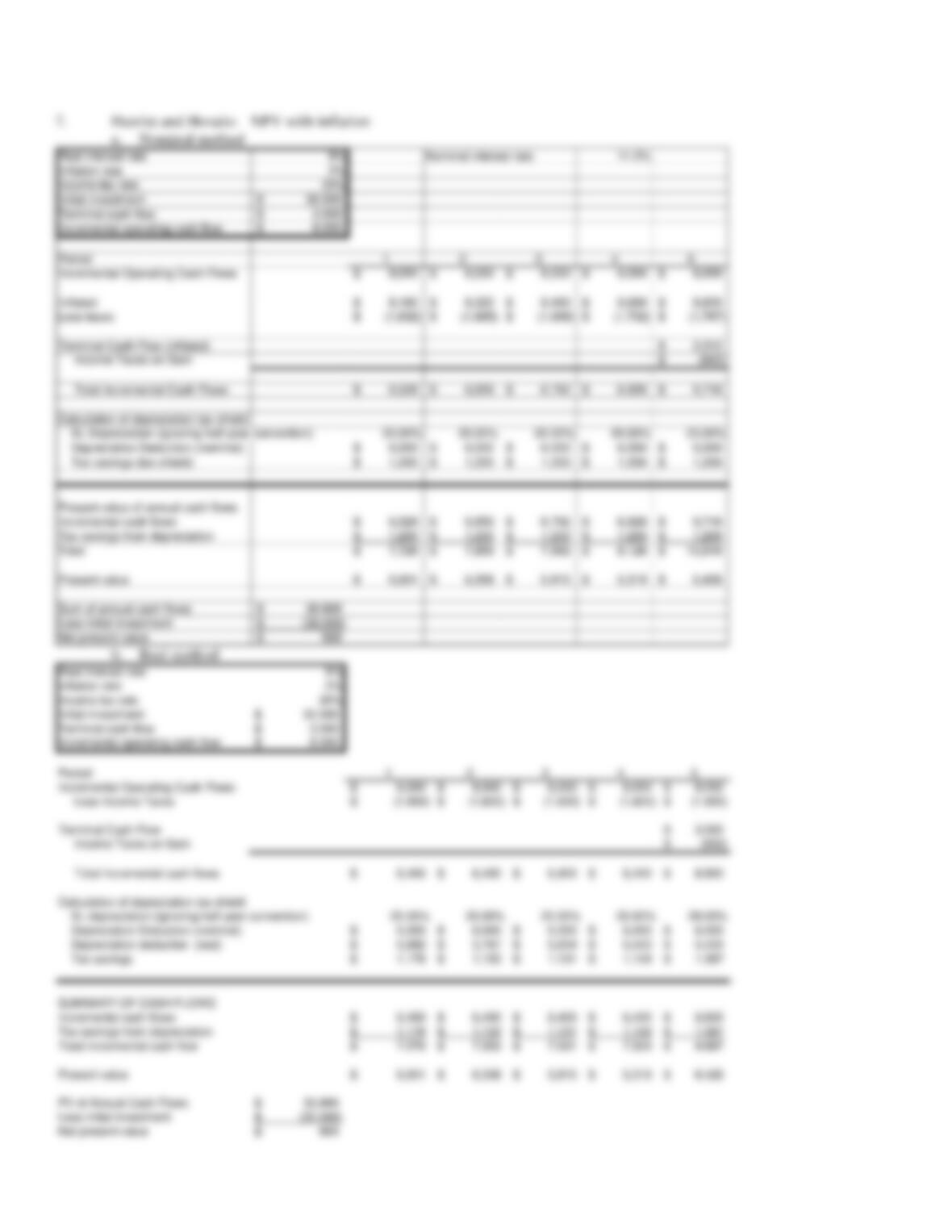
7. (Appendix 12A) Hamlet and Horatio are gravediggers. They are currently considering investing in a
new machine to replace their outdated shovels. The new machine would cost $30,000 and have an
expected useful life of five years. If Hamlet and Horatio buy the new machine, their annual cash
flows would increase by $8,000. The machine’s estimated terminal value is $3,000. Hamlet and
Horatio assume an inflation rate of 2%, a risk-free rate of 4%, and a risk premium of 5%. Their
marginal income tax rate is 20%, and they plan to use straight-line depreciation for income taxes
(ignore the half-year convention).
a. Calculate the net present value of the new machine using the nominal method.
b. Calculate the net present value of the new machine using the real method.

12-22 Cost Management
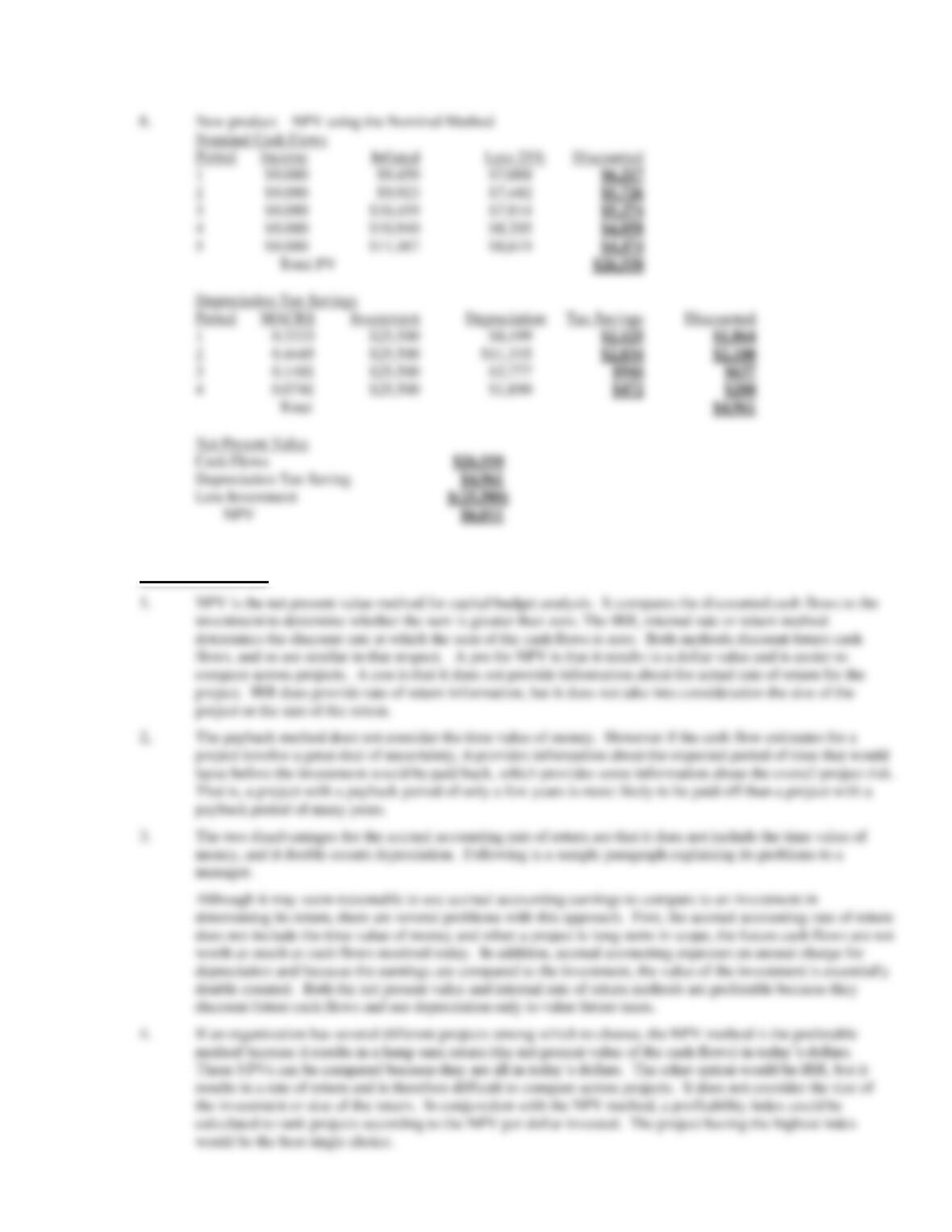
8. (Appendix 12A) Following is a capital budget schedule for a new product that will increase revenues.
Fill in the blanks for the following capital budgeting schedule.
Cash Flows Discount rate Tax rate 25%
Increase in revenue $12,000 Risk free rate 0.03
Variable costs $2,000 Risk premium 0.06
Fixed costs $1,000 Inflation rate 0.05
Net $9,000 Discount rate 0.1445 – round to 0.14
Investment
Purchase $25,000
Delivery $300
Renovation $200
Total $25,500
Nominal Cash Flows
Period Income Inflated Less 25% Discounted
1 $9,000 $9,450 $7,088 _________
2 $9,000 $9,923 $7,442 _________
3 $9,000 $10,419 $7,814 _________
4 $9,000 $10,940 $8,205 _________
5 $9,000 $11,487 $8,615 _________
Total PV _________
Depreciation Tax Savings
Period MACRS Investment Depreciation Tax Savings Discounted
1 0.3333 $25,500 $8,499 _________ _________
2 0.4445 $25,500 $11,335 _________ _________
3 0.1481 $25,500 $3,777 _________ _________
4 0.0741 $25,500 $1,890 _________ _________
Total PV _________
Net Present Value
Cash Flows _________
Depreciation Tax Saving _________
Less Investment _________
NPV _________
Short Answer
1. Distinguish between NPV and IRR. Give one pro and one con for each method.
2. List one pro and one con for using the payback method.
3. Write a brief paragraph to a manager discouraging use of the accrual accounting rate of return for
long-term investment decisions and recommending an alternative method.
4. Suppose that an organization has three different capital budget projects under consideration but can
choose only one. Identify the method you would recommend to determine the best project and
explain your choice.
5. (Appendix 12A) When inflation is expected to affect the cash flows in a capital budget analysis,
either the real method or the nominal method can be used. Distinguish between these two methods.

Chapter 12: Strategic Investment Decisions 12-23
6. (Appendix 12A) Under what conditions would it be most appropriate to use the nominal method for
capital budget analysis?
7. (Appendix 12A) The real discount rate can be decomposed into two pieces. Describe each one.
8. Roger is considering opening a restaurant located near the local university. He has considerable
management experience in the restaurant business, but has never before been an owner. He found
that the net present value for this investment is positive. List one uncertainty and one qualitative
factor that might influence this decision, and explain your reasoning.
9. How does sensitivity analysis allow managers to consider uncertainties in capital budgeting
decisions?
Problems
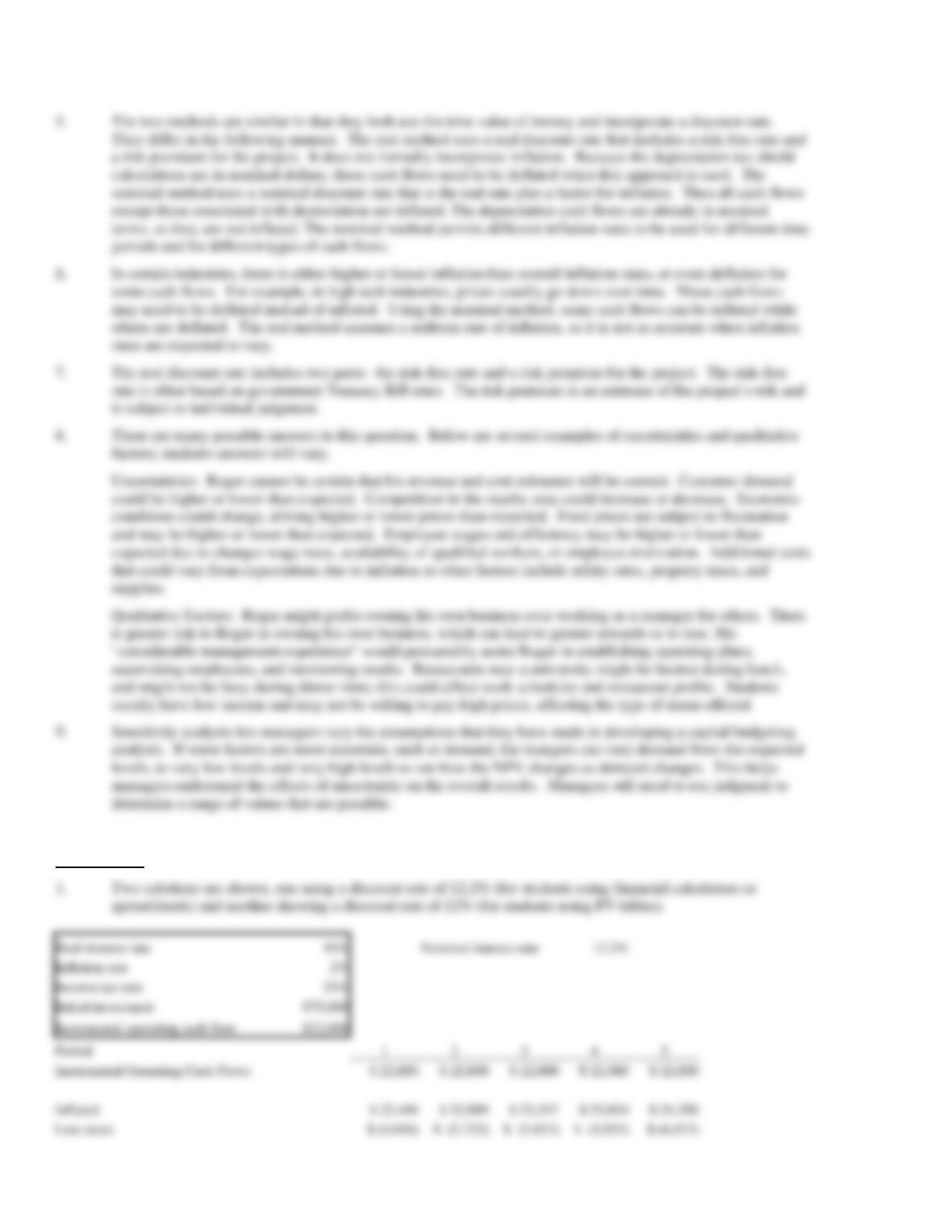
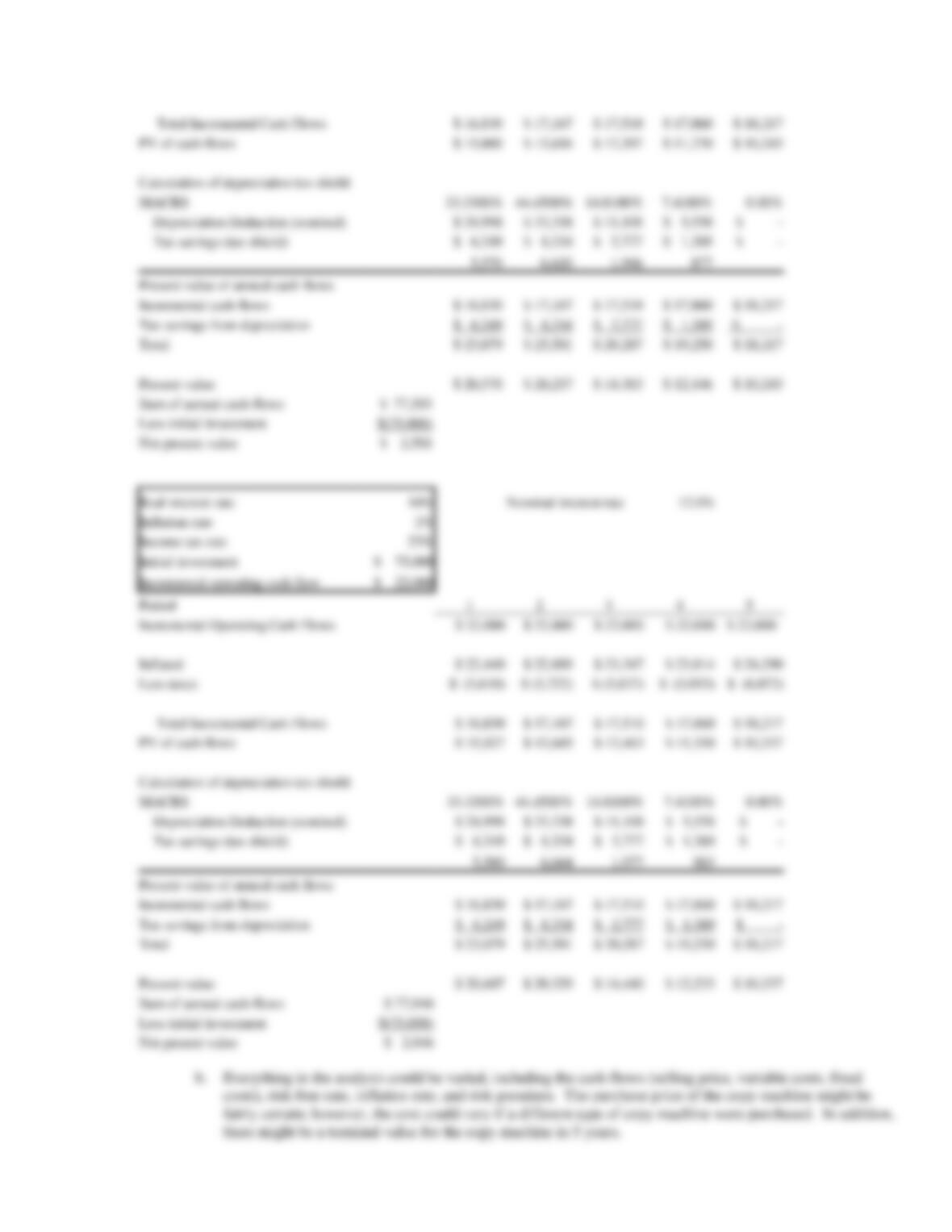
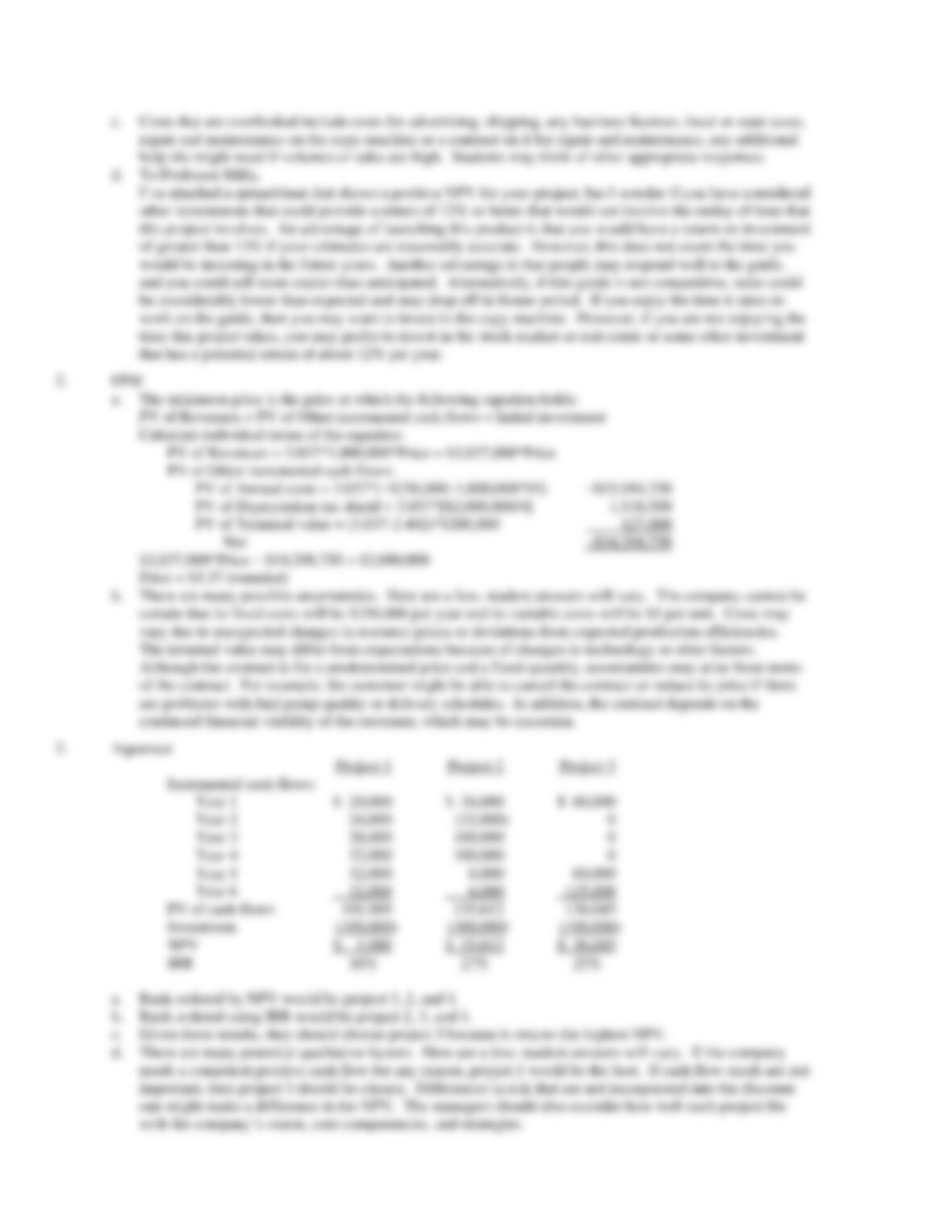
1. (Appendix 12A) Professor Mills is thinking about publishing a self-help guide for people who wish
to prepare their own income tax returns. She has spent the last year working on the book and
estimates that she spent roughly 200 hours on it. Her time is worth $20 per hour. She plans to
publish the book herself. To do this, she has to purchase a copy machine costing $75,000 and employ
someone to run the machine at $8,000 per year. The variable cost per book will be about $2.00. She
will sell the books for $8.00. She is planning to update the book each year for five years. Updates
will require about 50 hours per year of her time. Mills believes that she can sell about 5,000 books
per year. The copy machine qualifies for the three-year MACRS category (0.3333 first year, 0.4445
second year, 0.1481 third year, and 0.0741 fourth year). Her marginal income tax rate is 25%. If she
does not invest in this opportunity, she can invest the $75,000 in a mutual fund that has been
returning 10%-15% per year over the last few years. Mills has asked you to help her decide whether
she should buy the machine and become a publisher.
a. Create a cash flow schedule using the nominal method, assuming a risk-free rate of 4%, a risk
premium of 6%, and an inflation rate of 2%. Determine the NPV.
b. When you present your calculations to Professor Mills, she suggests that some of the costs or
rates might change over time. You have already thought about this, and you present her with
some sensitivity analysis. (She is very impressed.) Identify three things that you varied in your
analysis, and explain your choices.
c. Identify two potential costs for this project that Professor Mills might have overlooked.
d. Write a brief paragraph for Professor Mills that discusses the pros and cons of launching the
project.
2. Fuel Pump Manufacturers (FPM) is negotiating with Pop’s Auto Supply, a national chain, to supply
fuel pumps for the next 4 years. Pop’s guarantees to purchase 1 million fuel pumps each year at a
predetermined price. FPM would need to invest in additional machinery at a cost of $2 million.
Other incremental costs associated with the order include $250,000 per year for fixed costs and $5 per
fuel pump for variable costs. FPM has already spent $20,000 in legal fees and travel costs attempting
to land this contract with Pop’s. The terminal value of the machinery is expected to be $200,000 at
the end of 4 years. The machinery would be depreciated for income tax purposes using straight line
depreciation over a 4-year life and ignoring the half-year convention. FPM’s marginal income tax
rate is 30%, and its discount rate is 12%.
The present value annuity factors for 12% are: 1 year = 0.893, 2 years = 1.690, 3 years = 2.402, 4
years = 3.037 and 5 years = 3.605.
a. What is the minimum acceptable price for the fuel pumps? Hint: This is the price that would
result in an NPV of zero.
b. Describe three uncertainties about the NPV computations in part (a).

12-24 Cost Management
3. Aquanaut Industries has $100,000 available to invest in new equipment. Management is considering
three different equipment investments, each of which requires $100,000. The expected after-tax cash
flows for each project are as follows:
Year
1 2 3 4 5 6
Project 1 $20,000 $24,000 $28,000 $32,000 $32,000 $32,000
Project 2 36,000 (32,000) 100,000 100,000 6,000 6,000
Project 3 60,000 0 0 0 60,000 125,000
a. Rank-order the project in terms of desirability using NPV as the criterion, with a discount rate of
15%.
b. Rank-order the projects in terms of desirability using the internal rate of return for each project as
the criterion.
c. Given the quantitative results in parts (a) and (b), which project should the company choose?
Explain.
d. List one qualitative factor that should be considered in making this investment decision.
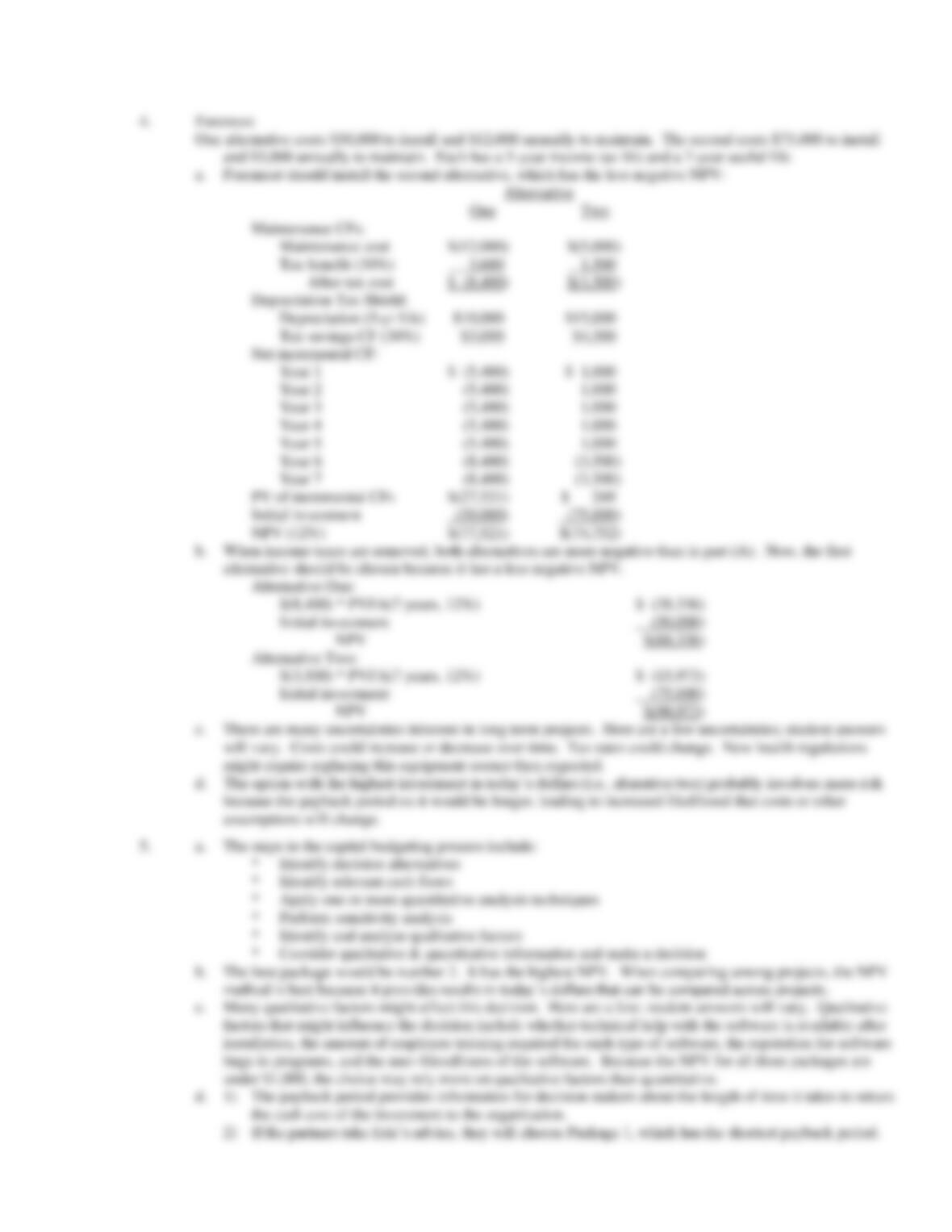
4. Foremost Restaurant Suppliers is considering the purchase of new equipment that will improve both
the efficiency and quality of the frozen food products. Two alternative pieces of equipment are being
considered. Either alternative would enable Foremost to reduce liability insurance costs and better
meet health department requirements, so the managers have decided to install new equipment.
However, they are not certain which alternative is the most appropriate. One alternative costs
$50,000 to install and $12,000 annually to maintain. The second costs $75,000 to install and $5,000
annually to maintain. Each has a 5-year income tax life and a 7-year useful life. Foremost’s discount
rate is 12%, and its income tax rate is 30%. It uses straight line depreciation (ignore the half-year
convention).
a. Which system should be installed? Provide computations to support your answer.
b. If Foremost were a not-for-profit organization that provided meals for public schools and did not
pay income taxes on its operations, which system should be installed? Provide computations to
support your answer.
c. Explain why the managers of Foremost cannot be certain that the organization will achieve the
NPV results.
d. Which option involves greater risk to Foremost? Explain.
5. Eric, Benjamin, and Julia are partners in the Nannies Network of Omaha (NNO). NNO maintains a
pool of qualified nannies seeking both permanent and temporary employment in the greater Omaha
area. To manage their human resources more effectively, the three partners are considering an
investment in new computer software. They are evaluating three different software solutions. Data
for each is presented in the table below:
Package 1 Package 2 Package 3
Net present value $(100) $1,000 $500
Internal rate of return 7% 6% 4%
Payback (years) 2 4 3
Accrual accounting rate of return 4% 5% 3%
a. List the steps NNO has taken, or will take, to evaluate the three software packages.
b. Based only on the results in the table above, which software package would you recommend?
Why?
c. List two qualitative factors that could affect this decision.
(continued)
Chapter 12: Strategic Investment Decisions 12-25
d. Eric is strongly in favor of basing a decision on the payback period.
1) In your own words, explain the concept of “payback period.”
2) If the partners take Eric’s advice, which package will they purchase? Explain.
3) List one advantage and one disadvantage for using the payback method to make this
decision.
e. Several terms associated with the net present value method are listed below. Define each term in
your own words, and explain how each is used in completing an NPV analysis.
1) Present value
2) Incremental cash flows
3) Discount rate
12-26 Cost Management
Answers
True / False
Multiple Choice
Chapter 12: Strategic Investment Decisions 12-27
Matching
12-28 Cost Management
Exercises
Chapter 12: Strategic Investment Decisions 12-29
12-30 Cost Management
Chapter 12: Strategic Investment Decisions 12-31
Short Answer
12-32 Cost Management
Problems
Chapter 12: Strategic Investment Decisions 12-33
12-34 Cost Management
Chapter 12: Strategic Investment Decisions 12-35
12-36 Cost Management