Operations Management, 11e (Heizer/Render)
Chapter 12 Inventory Management
Section 1 The Importance of Inventory
1) According to the global company profile, Amazon.com’s advantage in inventory management comes
from its almost fanatical use of economic order quantity and safety stock calculations.
2) A major challenge in inventory management is to maintain a balance between inventory investment
and customer service.
3) Which item to order and with which supplier the order should be placed are the two fundamental
issues in inventory management.
4) One function of inventory is to take advantage of quantity discounts.
5) Work-in-process inventory is devoted to maintenance, repair, and operating materials.
6) Which of the following statements regarding Amazon.com is FALSE?
A) The company was opened by Jeff Bezos in 1995.
B) The company was founded as, and still is, a “virtual” retailer with no inventory.
C) The company is now a world-class leader in warehouse automation and management.
D) The company uses both United Parcel Service and the U.S. Postal Service as shippers.
E) Amazon obtains its competitive advantage through inventory management.
7) Which of the following is a function of inventory?
A) to decouple various parts of the production process
B) to provide a selection of goods for anticipated customer demand and to separate the firm from
fluctuations in that demand
C) to take advantage of quantity discounts
D) to hedge against inflation
E) All of the above are functions of inventory.
8) Which of the following would NOT generally be a motive for a firm to hold inventories?
A) to decouple various parts of the production process
B) to provide a selection of goods for anticipated customer demand and to separate the firm from
fluctuations in that demand
C) to take advantage of quantity discounts
D) to minimize holding costs
E) to hedge against inflation
9) Which of the following is NOT one of the four main types of inventory?
A) raw material inventory
B) work-in-process inventory
C) maintenance/repair/operating supply inventory
D) safety stock inventory
E) finished-goods inventory
10) Amazon’s original concept of operating without inventory has given way to a model in which
Amazon is a world-class leader in ________.
11) Inventory that separates various parts of the production process performs a(n) ________ function.
12) ________ inventory is material that is usually purchased, but has yet to enter the manufacturing
process.
13) Explain what “decoupling” means in the context of inventory management.
14) What are the four functions of inventory?
15) Identify the four types of inventory.
16) What is MRO an acronym for? What is the function of MRO inventories?
Section 2 Managing Inventory
1) ABC analysis classifies inventoried items into three groups, usually based on annual units or quantities
used.
2) In ABC analysis, “A” items are the most tightly controlled.
3) ABC analysis is based on the presumption that carefully controlling all items is necessary to produce
important inventory savings.
4) Cycle counting is an inventory control technique exclusively used for cyclical items.
5) One advantage of cycle counting is that it maintains accurate inventory records.
6) In cycle counting, the frequency of item counting and stock verification usually varies from item to
item depending upon the item’s classification.
7) Retail inventory that is unaccounted for between receipt and time of sale is known as shrinkage.
8) Which of the following statements about ABC analysis is FALSE?
A) ABC analysis is based on the presumption that controlling the few most important items produces the
vast majority of inventory savings.
B) In ABC analysis, “A” items should have tighter physical inventory control than “B” or “C” items have.
C) In ABC analysis, forecasting methods for “C” items may be less sophisticated than for “A” items.
D) ABC analysis is based on the presumption that all items must be tightly controlled to produce
important cost savings.
E) Criteria other than annual dollar volume, such as high holding cost or delivery problems, can
determine item classification in ABC analysis.
9) All EXCEPT which of the following statements about ABC analysis are true?
A) In ABC analysis, inventory may be categorized by measures other than dollar volume.
B) ABC analysis categorizes on-hand inventory into three groups based on annual dollar volume.
C) ABC analysis is an application of the Pareto principle.
D) ABC analysis suggests that all items require the same high degree of control.
E) ABC analysis suggests that there are the critical few and the trivial many inventory items.
10) ABC analysis is based upon the principle that:
A) all items in inventory must be monitored very closely.
B) there are usually a few critical items, and many items that are less critical.
C) an item is critical if its usage is high.
D) more time should be spent on class “C” items because there are many more of them.
E) as with grade distributions in many MBA courses, there should be more medium-level “B” items than
either “A” or “C” items.
11) ABC analysis divides on-hand inventory into three classes, generally based upon which of the
following?
A) item quality
B) unit price
C) the number of units on hand
D) annual demand
E) annual dollar volume
12) Cycle counting:
A) is a process by which inventory records are verified once a year.
B) eliminates annual inventory adjustments.
C) provides a measure of inventory turnover.
D) assumes that all inventory records must be verified with the same frequency.
E) assumes that the most frequently used items must be counted more frequently.
13) Which of the following statements regarding control of service inventories is TRUE?
A) Service inventory is a fictional concept, because services are intangible.
B) Service inventory needs no safety stock, because there’s no such thing as a service stockout.
C) Effective control of all goods leaving the facility is one applicable technique.
D) Service inventory has carrying costs but no setup costs.
E) Good personnel selection, training, and discipline are easy.
14) Among the advantages of cycle counting is that it:
A) makes the annual physical inventory more acceptable to management.
B) does not require the detailed records necessary when annual physical inventory is used.
C) does not require highly trained people.
D) allows more rapid identification of errors and consequent remedial action than is possible with annual
physical inventory.
E) does not need to be performed for less expensive items.
15) ________ is a method for dividing on-hand inventory into three classifications based on annual dollar
volume.
16) ________ is a continuing reconciliation of inventory with inventory records.
17) Describe ABC inventory analysis in one sentence. Identify three policies that may be based upon the
results of an ABC analysis.
18) What is cycle counting?
19) Define shrinkage. Identify three or more examples of shrinkage.
20) Identify three techniques to control service inventories.
21) Your company has compiled the following data on the small set of products that comprise the
specialty repair parts division. Perform ABC analysis on the data. Which products do you suggest the
firm keep the tightest control over? Explain.
SKU
Annual Demand
Unit Cost
R11
250
$250
S22
75
$90
T33
20
$60
U44
150
$150
V55
100
$75
22) Perform an ABC analysis on the following set of products.
Item
Annual
Demand
Unit Cost
A211
1200
$9
B390
100
$90
C003
4500
$6
D100
400
$150
E707
35
$2000
F660
250
$120
G473
1000
$90
H921
100
$75
Cumulative
Cumulative
Section 3 Inventory Models
1) The demand for automobiles would be considered as independent demand.
2) Insurance and taxes on inventory are part of the costs known as setup or ordering costs.
3) Which of the following is an element of inventory holding costs?
A) housing costs
B) material handling costs
C) investment costs
D) pilferage, scrap, and obsolescence
E) All of the above are elements of inventory holding costs.
4) Which category of inventory holding costs has a much higher percentage than average for rapid–
change industries such as PCs and cell phones?
A) housing costs
B) material handling costs
C) labor cost
D) investment costs
E) pilferage, scrap, and obsolescence
5) Several inventory models assume “independent demand.” Explain what that term means and why the
assumption is important.
6) Identify the typical components that constitute inventory holding or carrying costs.
7) Identify the typical cost components that constitute ordering costs in inventory systems.
Section 4 Inventory Models for Independent Demand
1) If setup costs are reduced by substantial reductions in setup time, the production order quantity is also
reduced.
2) The EOQ model is best suited for items whose demand is dependent on other products.
3) In the simple EOQ model, if annual demand were to increase, the EOQ would increase
proportionately.
4) At the economic order quantity, holding costs are equal to product costs.
5) In the simple EOQ model, if the carrying cost were to double, the EOQ would also double.
6) In the production order quantity (POQ) model, inventory does not arrive in a single moment but flows
in at a steady rate, resulting in a larger production/order quantity than in an otherwise identical EOQ
problem.
7) The reorder point is the inventory level at which action is taken to replenish the stocked item.
8) In the quantity discount model, it is possible to have a cost-minimizing solution where annual ordering
costs do not equal annual carrying costs.
9) In the quantity discount model, the cost of acquiring goods (product cost) is not a factor in determining
lot size.
10) The two most basic inventory questions answered by the typical inventory model are:
A) timing of orders and cost of orders.
B) order quantity and cost of orders.
C) timing of orders and order quantity.
D) order quantity and service level.
E) ordering cost and carrying cost.
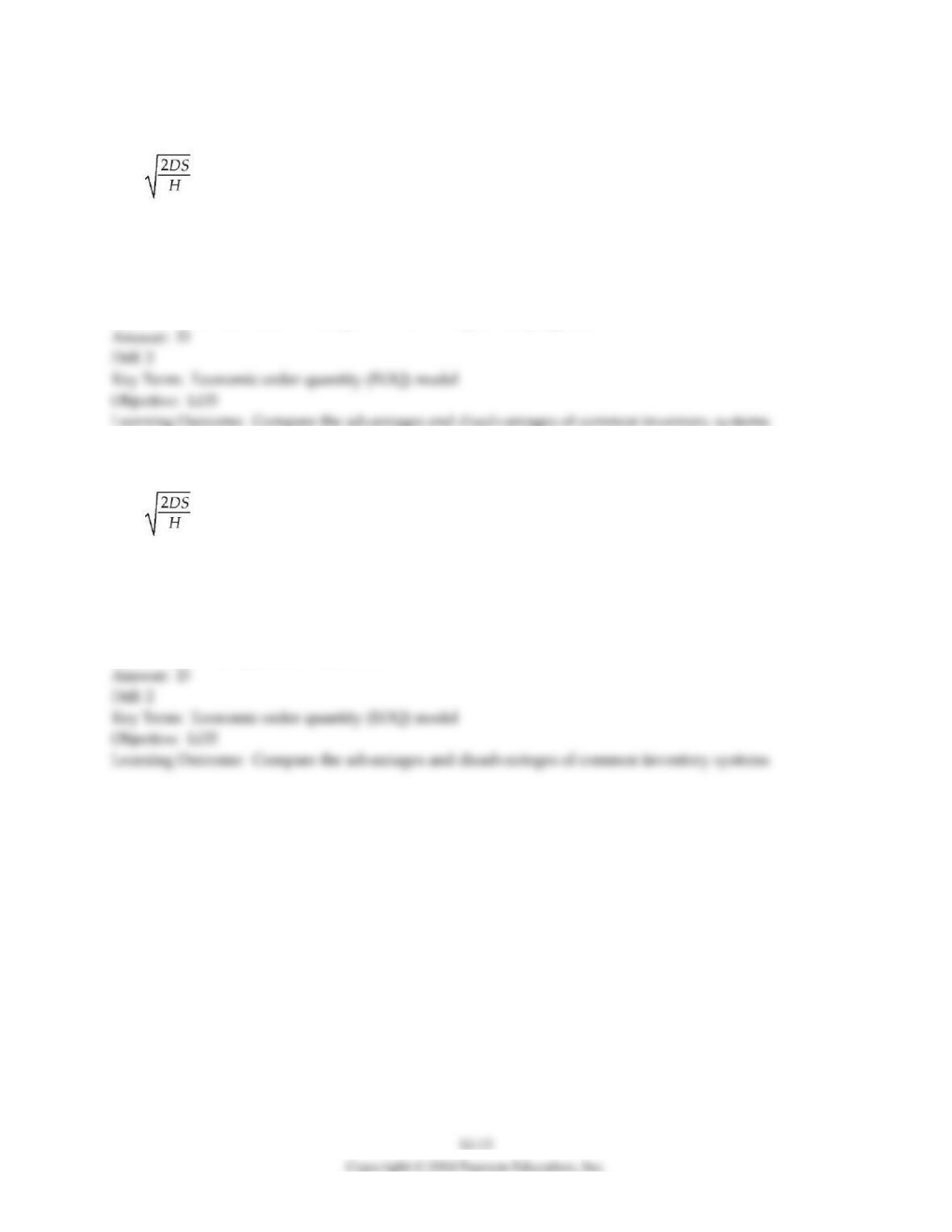
11) Which of the following is NOT an assumption of the economic order quantity model shown below?
Q* =
A) Demand is known, constant, and independent.
B) Lead time is known and constant.
C) Quantity discounts are not possible.
D) Production and use can occur simultaneously.
E) The only variable costs are setup cost and holding (or carrying) cost.
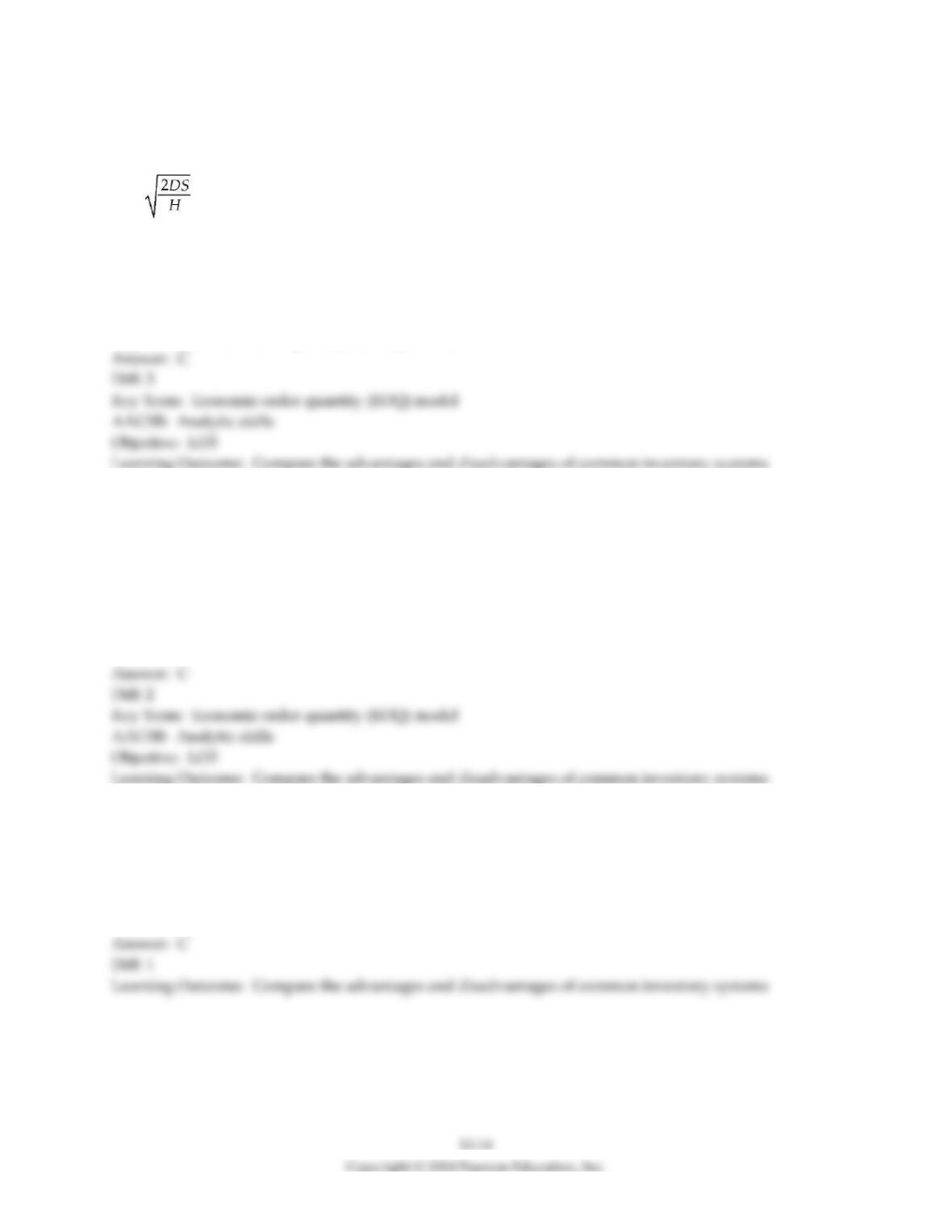
12) What is the primary purpose of the basic economic order quantity model shown below?
Q* =
A) to calculate the reorder point, so that replenishments take place at the proper time
B) to minimize the sum of carrying cost and holding cost
C) to maximize the customer service level
D) to minimize the sum of setup cost and holding cost
E) to calculate the optimum safety stock
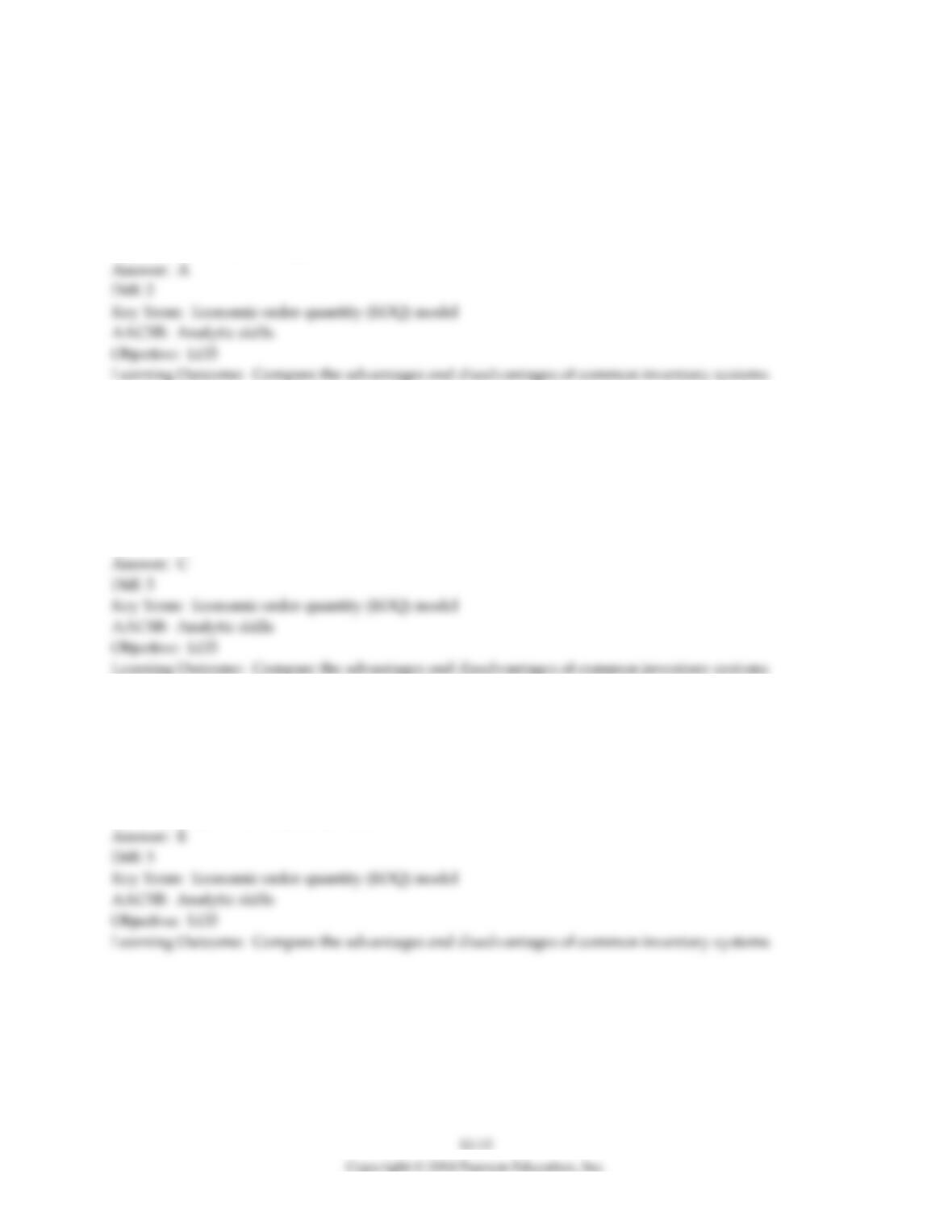
13) If the actual order quantity is the economic order quantity in a problem that meets the assumptions of
the economic order quantity model shown below, the average amount of inventory on hand:
Q* =
A) is smaller than the holding cost per unit.
B) is zero.
C) is one-half of the economic order quantity.
D) is affected by the amount of product cost.
E) goes down if the holding cost per unit goes down.
14) A certain type of computer costs $1,000, and the annual holding cost is 25% of the value of the item.
Annual demand is 10,000 units, and the order cost is $150 per order. What is the approximate economic
order quantity?
A) 16
B) 70
C) 110
D) 183
E) 600
15) Most inventory models attempt to minimize:
A) the likelihood of a stockout.
B) the number of items ordered.
C) total inventory-based costs.
D) the number of orders placed.
E) the safety stock.
16) In the basic EOQ model, if the cost of placing an order doubles, and all other values remain constant,
the EOQ will:
A) increase by about 41%.
B) increase by 100%.
C) increase by 200%.
D) increase, but more data is needed to say by how much.
E) either increase or decrease.
17) In the basic EOQ model, if D = 6000 per year, S = $100, and holding cost = $5 per unit per month, what
is the economic order quantity?
A) 24
B) 100
C) 141
D) 490
E) 600
18) Which of the following statements about the basic EOQ model is TRUE?
A) If the ordering cost were to double, the EOQ would rise.
B) If annual demand were to double, the EOQ would increase.
C) If the carrying cost were to increase, the EOQ would fall.
D) If annual demand were to double, the number of orders per year would increase.
E) All of the above statements are true.
19) Which of the following statements about the basic EOQ model is FALSE?
A) If the setup cost were to decrease, the EOQ would fall.
B) If annual demand were to double, the number of orders per year would increase.
C) If the ordering cost were to increase, the EOQ would rise.
D) If annual demand were to double, the EOQ would also double.
E) All of the above statements are true.
20) A product whose EOQ is 40 units experiences a decrease in ordering cost from $90 per order to $10
per order. The revised EOQ is:
A) three times as large.
B) one-third as large.
C) nine times as large.
D) one-ninth as large.
E) cannot be determined
21) A product whose EOQ is 400 units experiences a 50% increase in demand. The new EOQ is:
A) unchanged.
B) increased by less than 50%.
C) increased by 50%.
D) increased by more than 50%.
E) cannot be determined
22) For a certain item, the cost-minimizing order quantity obtained with the basic EOQ model is 200
units, and the total annual inventory (carrying and setup) cost is $600. What is the inventory carrying cost
per unit per year for this item?
A) $1.50
B) $2.00
C) $3.00
D) $150.00
E) not enough data to determine
23) A product has a demand of 4000 units per year. Ordering cost is $20, and holding cost is $4 per unit
per year. The EOQ model is appropriate. The cost-minimizing solution for this product will cost ________
per year in total annual inventory (holding and setup) costs.
A) $400
B) $800
C) $1200
D) Zero; this is a class C item.
E) Cannot be determined because the unit price is not known.
24) A product has a demand of 4000 units per year. Ordering cost is $20, and holding cost is $4 per unit
per year. The cost-minimizing solution for this product is to order:
A) all 4000 units at one time.
B) 200 units per order.
C) every 20 days.
D) 10 times per year.
E) none of the above
25) Which of the following statements regarding the reorder point is TRUE?
A) The reorder point is that quantity that triggers an action to restock an item.
B) There is a reorder point even if lead time and demand during lead time are constant.
C) The reorder point is larger than d × L if safety stock is present.
D) A shorter lead time implies a smaller reorder point.
E) All of the above are true.
26) An inventory decision rule states, “When the inventory level goes down to 14 gearboxes, 100
gearboxes will be ordered.” Which of the following statements is TRUE?
A) One hundred is the reorder point, and 14 is the order quantity.
B) Fourteen is the reorder point, and 100 is the order quantity.
C) The number 100 is a function of demand during lead time.
D) Fourteen is the safety stock, and 100 is the reorder point.
E) None of the above is true.
27) Which of the following statements regarding the production order quantity model is TRUE?
A) It applies only to items produced in the firm’s own production departments.
B) It relaxes the assumption that all the order quantity is received at one time.
C) It relaxes the assumption that the demand rate is constant.
D) It minimizes the total production costs.
E) It minimizes inventory.
28) Which of these statements about the production order quantity model is FALSE?
A) The production order quantity model is appropriate when the assumptions of the basic EOQ model
are met, except that receipt is noninstantaneous.
B) Because receipt is noninstantaneous, some units are used immediately and not stored in inventory.
C) Average inventory is less than one-half of the production order quantity.
D) All else equal, the smaller the ratio of demand rate to production rate, the larger is the production
order quantity.
E) None of the above is false.
29) The assumptions of the production order quantity model are met in a situation where annual demand
is 3650 units, setup cost is $50, holding cost is $12 per unit per year, the daily demand rate is 10 and the
daily production rate is 100. What is the production order quantity for this problem?
A) 139
B) 174
C) 184
D) 365
E) 548
30) A production order quantity problem has a daily demand rate = 10 and a daily production rate = 50.
The production order quantity for this problem is approximately 612 units. What is the average inventory
for this problem?
A) 61
B) 245
C) 300
D) 306
E) 490
31) When quantity discounts are allowed, the cost-minimizing order quantity:
A) is always an EOQ quantity.
B) minimizes the sum of holding and ordering costs.
C) minimizes the unit purchase price.
D) may be a quantity below that at which one qualifies for that price.
E) minimizes the sum of holding, ordering, and product costs.
32) Which of the following statements about quantity discounts is FALSE?
A) The cost-minimizing solution may or may not be where annual holding costs equal annual ordering
costs.
B) In inventory management, item cost becomes relevant to order quantity decisions when a quantity
discount is available.
C) If carrying costs are expressed as a percentage of value, EOQ is larger at each lower price in the
discount schedule.
D) The larger the annual demand, the less attractive a discount schedule will be.
E) The smaller the ordering cost, the less attractive a discount schedule will be.
33) ________ is the time between placement and receipt of an order.
34) In an economic order quantity problem, the total annual cost curve is at its ________ where annual
holding costs equal annual setup costs.