223
CHAPTER 12: INTEREST RATE FORWARDS AND OPTIONS
MULTIPLE CHOICE TEST QUESTIONS
1. Which of the following is a 1 x 4 FRA?
a. The FRA expires in one month, and the underlying Eurodollar expires in three months.
b. The FRA expires in four months, and the underlying Eurodollar expires in one month.
c. The FRA expires in one month, and the underlying Eurodollar expires in four months.
d. The FRA expires in three months, and the underlying Eurodollar expires in four months.
e. The FRA expires in one month, and the underlying Eurodollar expires in five months.
2. Determine the value of an interest rate call option at the maturity of a loan if the call has a strike of 12 percent,
a face value of $50 million, the loan matures 90 days after the call is exercised, the call expires in 60 days, the
call premium is $200,000, and LIBOR ends up at 13 percent.
a. $125,000
b. $83,333
c. $208,000
d. –$75,000
e. none of the above
3. A bank makes a $5 million 180-day pure discount loan at LIBOR of 9 percent. At the same time, however, it
exercises an interest rate put that has a strike of 11 percent. Find the annualized rate of return on the loan.
Ignore the cost of the put.
a. 9.34 percent
b. 11.47 percent
c. 9 percent
d. 11 percent
e. none of the above
4. Which of the following best describes an interest rate cap?
a. a cash-and-carry hedge
b. a series of forward contracts
c. a series of interest rate calls
d. a call option spread
e. none of the above
5. A bank buys an interest rate floor in conjunction with a loan it holds that will make four semiannual payments
starting six months from now. The floor has a strike of 9 percent. LIBOR at the beginning of the four payment
periods is 10, 11, 8, and 8.6 percent. On which dates will the floor writer make a payment to the bank?
a. now and in 24 months
b. in 18 and 24 months
c. in 12 and 18 months
d. in 6, 12, 18 and 24 months
e. none of the above
6. The advantage of a collar over a cap is
a. it lowers the out-of–pocket cost
b. it offers the possibility of greater returns
c. it eliminates the risk
d. it has lower transaction costs
e. none of the above
7. An FRA is most like which of the following transactions
224
a. an interest rate cap
b. an interest rate floor
c. an interest rate collar
d. a forward contract
e. none of the above
8. The payoff to the holder of a long FRA on 90-day LIBOR with a fixed rate of 8.75 percent, a notional amount
of $20 million if the underlying is 9 percent at expiration is
a. $12,500
b. –$12,500
c. –$12,225
d. $12,225
e. –$48,900
9. The fixed rate on an FRA expiring in 30 days on 180-day LIBOR with the 30-day rate being 5 percent and the
210 day rate being 6 percent is
a. 6 percent
b. 6.14 percent
c. 5 percent
d. 5.5 percent
e. 5.15 percent
10. Swaptions are like forward swaps in which of the following ways
a. Both are free of credit risk
b. Both require the execution of a swap at expiration
c. They have the same price
d. Both are traded on swaption exchanges
e. none of the above
11. Find the premium of a correctly priced interest rate call on 30-day LIBOR if the current forward rate is 7
percent, the strike is 7 percent, the continuously compounded risk-free rate is 6.2 percent, the volatility is 12
percent and the option expires in one year. The notional amount is $30 million.
a. $.0031
b. $93,000
c. $7,817
d. $0.0012
e. $36,000
12. Which of the following is a limitation of using the Black model to price interest rate options?
a. the risk-free rate is not constant
b. the volatility is not constant
c. interest rates are not lognormally distributed
d. all of the above
e. none of the above
13. An FRA differs from an interest rate swap in which of the following ways?
a. An FRA has more credit risk
b. FRAs are federally regulated
c. Traditionally the payment in an FRA is delayed
d. FRAs are used only by banks and swaps are used only by corporations
e. none of the above
14. Which of the following is not required to determine a swaption payoff at expiration?
225
a. the exercise rate
b. the term structure of zero coupon rates at the swaption expiration
c. the maturity of the underlying swap
d. the yield on a bond of equivalent maturity as the swap
e. none of the above
15. Find the payoff of an interest rate call option on the annual rate with an exercise rate of 10 percent if the one-
period rate at expiration is 11 percent. (No days/360 adjustment is necessary and assume a $1 notional
amount.)
a. 0.12
b. zero
c. 0.01
d. 0.0090
e. none of the above
16. Find the approximate market value of a long position in an FRA at a fixed rate of 5 percent in which the
contract expires in 20 days, the underlying is 180-day LIBOR, the notional amount is $25 million, the 20-day
rate is 7 percent, and the 200-day rate is 8.5 percent.
a. $433,658
b. –$454,954
c. $322,819
d. –$322,819
e. $454,954
17. Find the rate on a pure discount loan hedged with a long FRA if the loan is for $10 million and matures in 30
days, the FRA is 30-day LIBOR, the fixed rate on the FRA is 4 percent, and LIBOR at the time the loan is
taken out is 5 percent.
a. 4.87 percent
b. 0.25 percent
c. 5.18 percent
d. 4.13 percent
e. 2.04 percent
18. A long position in an interest rate call would be appropriate for which of the following situations:
a. a bond trader expects falling interest rates
b. a borrower expects rising interest rates
c. a lender expects rising interest rates
d. a derivatives dealer is exposed to the risk of falling interest rates
e. a party holding a short position in Eurodollar futures is concerned about losing money
19. A payer swaption is equivalent to which of the following instruments.
a. a call option on a bond
b. a long Treasury bond futures option
c. a long Eurodollar futures
d. an interest rate cap
e. a put option on a bond
20. Which of the following strategies replicates a long position in an FRA?
a. long a long term Eurodollar time deposit and short a short-term Eurodollar time deposit
b. long a Eurodollar futures and short a Eurodollar option
c. long a Eurodollar option on a futures
d. short a long-term Treasury bond futures and short a short-term Treasury bond futures
e. long a receiver swaption
226
21. An FRA in which the rate is not set according to rates in the market is called
a. a short FRA
b. a long FRA
c. an off-market FRA
d. a hedged FRA
e. an FRA spread
22. If a lender uses a collar, the transactions would be
a. buy a floor at one exercise price, sell a floor at another exercise price
b. buy a floor, sell a cap
c. sell a floor, buy a cap
d. buy a cap at one exercise price, sell a floor at another exercise price
e. buy a cap and sell a floor at the same exercise price
23. A payer swaption is expiring. The underlying swap has a two year maturity. Th e present value factors are
0.9259 (one year) and 0.8651 (two years). The strike rate is 7 percent. What is the value of the swaption per
$1 notional amount.
a. 0.0000, since it is out–of–the-money
b. 1.0000
c. 0.0753
d. 0.0095
e. none of the above
24. Find the fixed rate on a forward swap expiring in 90 days in which the underlying swap has a maturity of 180
days and makes payments every 90 days. The prices of zero coupon bonds are 0.9877 (90 days), 0.9732 (180
days), and 0.9597 (270 days).
a. 5.97 percent
b. 5.6 percent
c. 5.5 percent
d. 5.78 percent
e. 5 percent
25. All of the following are uses of swaptions except
a. to speculate on interest rates
b. to give a firm flexibility in future borrowings
c. to borrow money
d. to create callable from non-callable bonds
e. none of the above
26. Suppose your firm issued a callable bond two years ago and it has three more years to go before the first call
date. If interest rates have fallen over the past two years and you believe rates will not stay this low and that it
would be in the firm’s best interest to lengthen the duration of the liabilities, which of the following is one
potential strategy to accomplish the objective of lengthening the duration while also securing the lowering
interest rate.
a. buy a payer swaption
b. sell a payer swaption
c. buy a receiver swaption
d. sell a receiver swaption
e. buy an interest rate floor
27. Suppose your firm invested in a callable bond recently when interest rates were high and the bond has three
more years to go before the first call date. If interest rates are expected to fall over the next three years, which
227
of the following is one potential strategy would take advantage of this view.
a. buy a payer swaption
b. sell a payer swaption
c. buy a receiver swaption
d. sell a receiver swaption
e. buy an interest rate floor
28. Which of the following best describes a zero cost collar within the context of interest rate derivatives?
a. A zero cost collar is a long (short) position in an interest rate cap and a short (long) position in an
interest rate floor where the cost of the cap (floor) exactly offsets the revenue from the floor (cap).
b. A zero cost collar is a long (short) position in an interest rate cap and a short (long) position in an
interest rate floor where the cost of the cap (floor) is less than the revenue from the floor (cap).
c. A zero cost collar is a long (short) position in an interest rate cap and a short (long) position in an
interest rate floor where the cost of the cap (floor) is greater than the revenue from the floor (cap).
d. A zero cost collar is an option that pays off only if interest rates remain within a designated range.
e. A zero cost collar is an option that pays off only if interest rates fall outside of a designated range.
29. Suppose you have a floating rate loan tied to 90-day LIBOR and have hedged the interest rate risk with an
interest rate cap. The effective annual rate actually paid on the loan with the cap is found using a methodology
equivalent to
a. computing the Black-Scholes-Merton option call price
b. computing the net present value
c. computing the internal rate of return
d. computing the Black commodity option call price
e. computing the WACC
30. When valuing an interest rate call option, one approach is to use the Black call option price adjusted for the
present value
a. over the m days of the underlying option using the continuously compounded forward rate.
b. over the m days of the underlying rate using the continuously compounded spot rate.
c. over the days remaining of the option using the continuously compounded forward rate.
d. over the days remaining of the option using the continuously compounded spot rate.
e. over the m days of the underlying rate using the continuously compounded forward rate.
228
CHAPTER 12: INTEREST RATE FORWARDS AND OPTIONS
TRUE/FALSE TEST QUESTIONS
T F 1. The convention for calculating interest on an interest rate derivative is to multiply the
notional amount times the payoff function times 90 over 360 or 365.
T F 2. If interest rates increase, the holder of a long FRA benefits.
T F 3. For firms that may need to enter into a swap in the future, a forward swap serves as well as
a swaption.
T F 4. FRA payoffs are discounted by the current interest rate.
T F 5. A short FRA would be appropriate for a party anticipating an increase in interest rates.
T F 6. The Black model’s accuracy in pricing interest rate options is greatest when the options
have short maturities.
T F 7. When pricing interest rates in the Black model, the underlying is the forward rate.
T F 8. Buying an interest rate call results in a limited loss if interest rates fall.
T F 9. A long interest rate cap is an appropriate strategy for a party that lends money.
T F 10. Pricing an interest rate cap is done by pricing the component caplets and adding up their
values.
T F 11. The payoff of a long interest rate floor is equivalent to the payoff of a short receiver
swaption.
T F 12. In a zero cost collar, the exercise price on the floor is set such that the floor premium more
than offsets the cap premium.
T F 13. The pricing of a forward swap is done in the same manner as pricing a spot started today,
except that forward rates are used instead of spot rates.
T F 14. An interest rate payer swaption is more like an interest rate put than an interest rate call.
T F 15. Payer swaptions can be used to hedge put features on bonds.
T F 16. An interest rate collar is the purchase of a cap and a floor.
T F 17. In a 12 x 18 FRA, the derivative expires in one year and the underlying matures in 18
months.
T F 18. Interest rate caps are equivalent to a series of interest rate call options.
T F 19. The appropriate fixed rate on an FRA is the forward rate in the term structure.
T F 20. A long cap and a long floor with the exercise price set at the swap rate is equivalent to a
swap.
229
T F 21. In an FRA on an m-day rate, payment is made when the interest rate is determined rather
than m days later.
T F 22. An off-market FRA is one constructed outside of the over-the-counter market.
T F 23. FRAs, caps and floors are guaranteed against default.
T F 24. Payer swaptions can be used to convert callable to non-callable debt.
T F 25. Receiver swaptions allow a firm to receive a floating rate.
T F 26. An interest rate put option gives the holder the right to make an interest payment at a
floating rate and receive an interest payment at a fixed rate.
T F 27. Pricing an interest rate option is a complex process, but a simple approach can be taken by
applying the Cox model in this context.
T F 28. An FRA is similar to any type of forward contract, but the payoff is based on an interest
rate, rather than the price of an asset.
T F 29. The value of an FRA is obtained by determining the value of a strategy of long a long-term
underlying time deposit and short a short-term underlying time deposit.
T F 30. An interest rate floor is a combination of interest rate puts designed to protect a lender in a
floating-rate loan against interest rate increases.
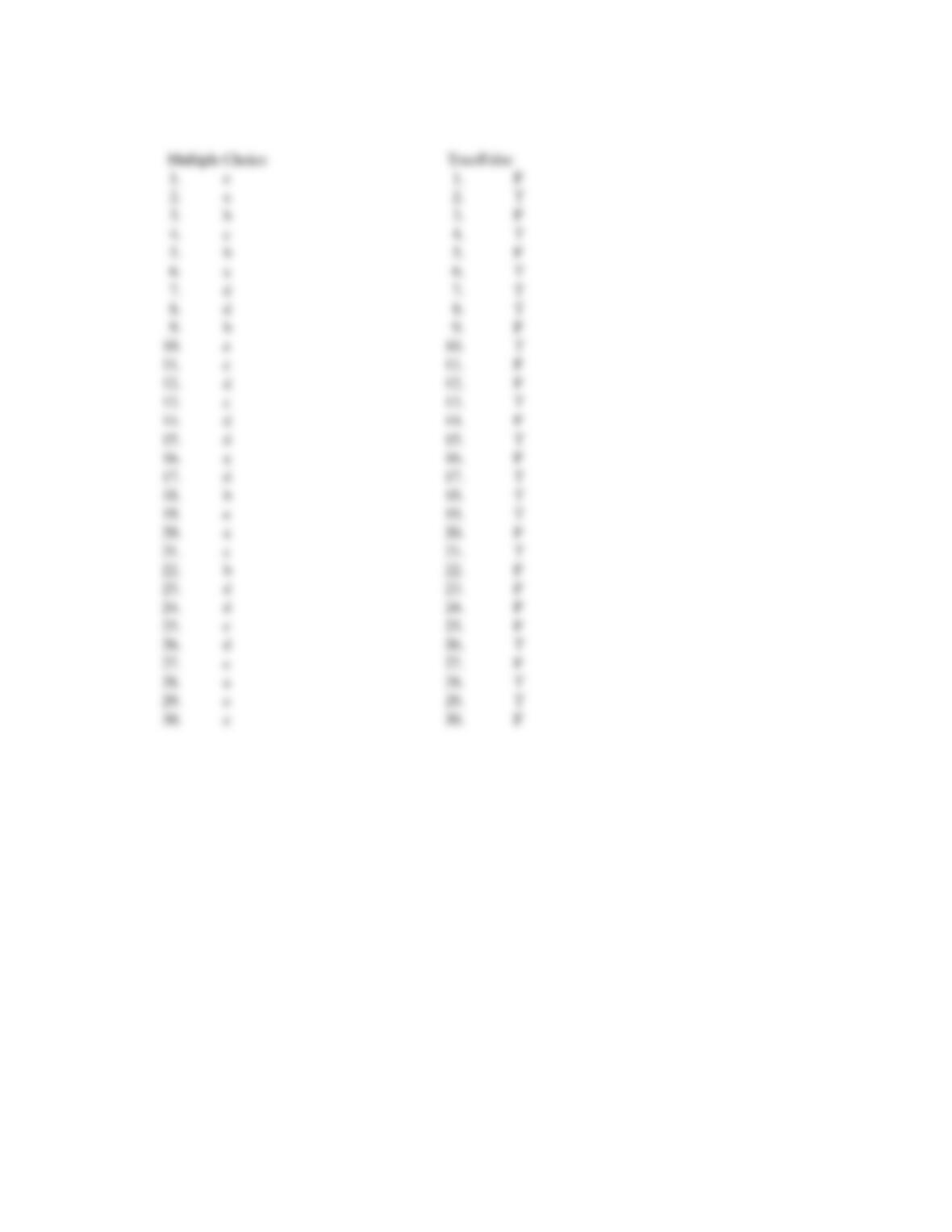
230
CHAPTER 12