a.
leptons
b.
baryons
c.
mesons
d.
intermediate (or gauge) bosons
e.
quarks
46. Quarks are bound together in hadrons by
a.
the strong force
c.
intermediate (or gauge) bosons
b.
the weak force
d.
the color force
47. A quantum number for a quark is
a.
strangeness
b.
beauty
c.
charm
d.
truth
e.
all of the above
48. Which of the following is not a fundamental force of nature:
a.
strong nuclear force
c.
weak nuclear force
b.
electroweak force
d.
electromagnetic interaction
49. The spins of all known particles are either integral or half-integral multiples of
a.
the baryon number
c.
the Gravitational constant
b.
Plank’s constant
d.
the speed of light
50. Which of the following particle is unaffected by the Strong Force?
a.
protons
c.
mesons
b.
neutrons
d.
gauge bosons
51. Mesons are composed of
a.
antiquarks
c.
quarks
b.
quark-antiquark pairs
d.
three-quark combinations
52. Which of the following is considered anitmatter?
a.
u
c.
e+
b.
e–
d.
d
MULTIPLE RESPONSE
1. Which of the following are not relativistically invariant quantities?
a.
the speed of light, c
c.
mass
b.
time
d.
energy
2. The positron
a.
is an antielectron
b.
was the first antimatter particle discovered
c.
is the same as a proton
d.
all of the above
3. Quarks come in what flavors?
a.
up, down and strange
c.
red, green and blue
b.
charm, top and bottom
d.
all of the above
4. A particle that interacts via the strong force is a(n)
a.
lepton
b.
baryon
c.
meson
d.
intermediate (or gauge) boson
e.
hadron
5. In interactions taking place by the strong force, which of the following quantities are
conserved?
a.
electric charge
b.
baryon number
c.
mass-energy
d.
strangeness
e.
linear momentum
f.
angular momentum (spin)
6. In interactions taking place by the weak force, which of the following quantities are
conserved?
a.
electric charge
b.
baryon number
c.
mass-energy
d.
strangeness
e.
linear momentum
f.
angular momentum (spin)
7. The electron
a.
is an absolutely stable particle
c.
has zero mass
b.
decays via the weak interaction
d.
is a lepton
8. Quarks have electric charges of magnitude
a.
e
b.
1/3 e
c.
2/3 e
d.
0
e.
none of the above
9. t and b quarks are named
a.
truth and beauty
b.
up and down
c.
top and bottom
d.
Itchy and Scratchy
e.
none of the above
10. Particles possessing half-integral spins are called _________ and particles with integral
spins are called ________.
a.
quarks
c.
bosons
b.
fermions
d.
antiquarks
COMPLETION
1. __________ is the prediction of special relativity that moving clocks run slow.
2. The prediction from special relativity that the length of a moving object will be shortened in
the direction of motion is called __________.
3. Einstein’s famous equation E0 = mc2 is a statement of __________.
4. An electron and a positron, which are two massive particles, can annihilate when they come
together to produce two photons, which have no mass. According to special relativity, this
pair annihilation is an example of __________.
5. When it comes near a heavy nucleus, a gamma ray, which is a high energy photon, can
“disappear,” and in its place there will be produced an electron and a positron, which both
have mass. According to special relativity, this pair production is an example of
__________.
6. The mass of an electron and its antiparticle, a positron, is 0.511 MeV/c2. In order to produce
an electron-positron pair, a gamma ray must have an energy larger than 1.022 MeV because
__________.
7. If you do an experiment on earth, and then do an identical experiment in a jet plane moving
uniformly at a high speed, you get identical results from both experiments. This is an
example of __________.
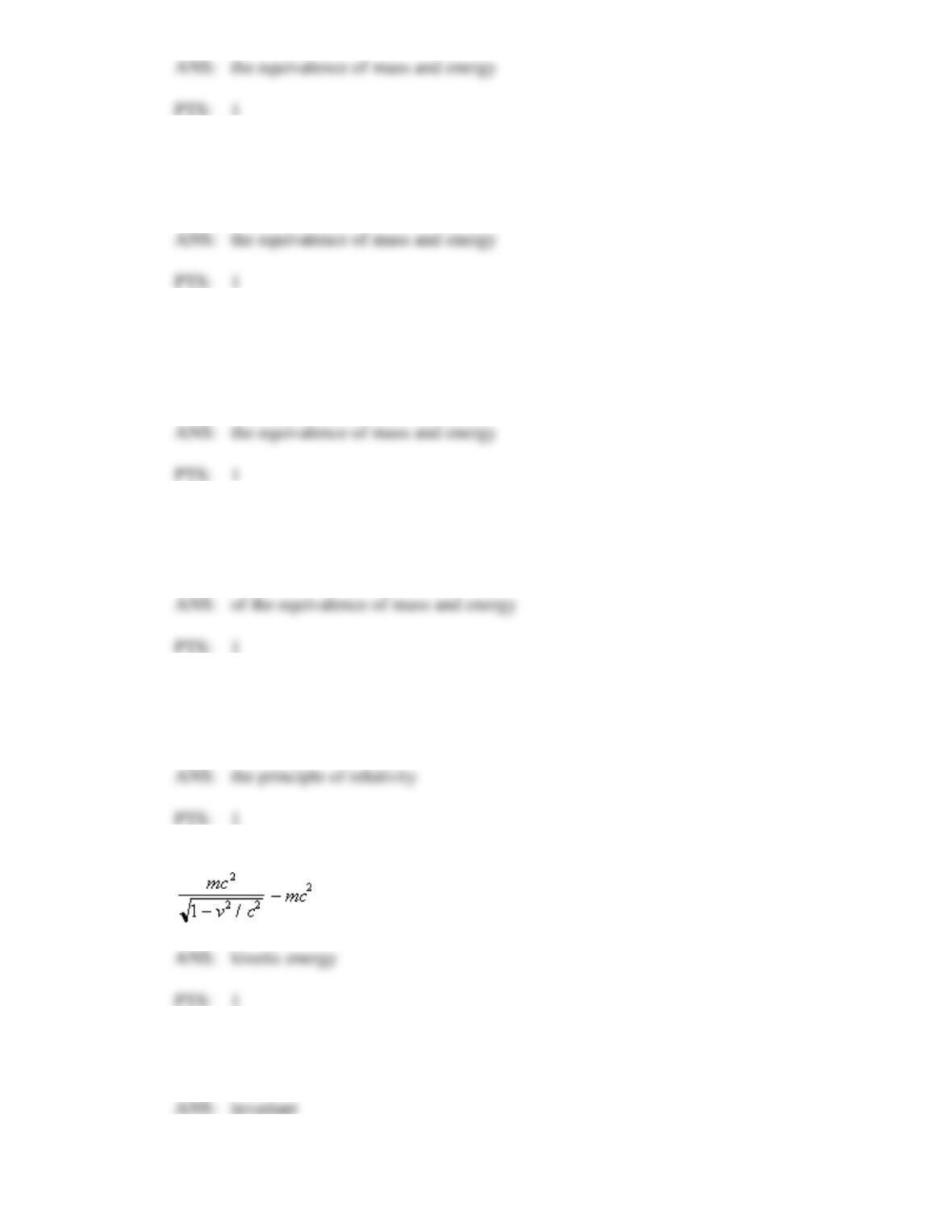
8. According to special relativity the __________ of a moving object is equal to
.
9. Since the mass of an object is the same for all observers, it is a relativistically
____________ quantity.
10. Because of their short lifetimes, very few muons that are produced in the upper atmosphere
at high speeds should be observed at the surface of the earth. Yet we detect large numbers of
muons at ground level because of the special relativistic effect of __________.
11. If a twin goes on a trip in a high speed rocket ship, when she returns home she will be
younger than her twin sister who did not go on the trip because of the special relativistic
effect of __________.
12. If a 1 kg mass is completely converted into energy, the amount of energy released would be
__________.
13. A __________ has integral spin.
14. A __________ has half integral spin.
15. A particle with __________ obeys the Pauli exclusion principle.
16. __________ is the collective name given for particles that interact via the strong force.
17. A __________ does not interact via the strong interaction.
18. The __________ are force-carrying particles.
19. In all interactions __________ number is conserved.
20. Conservation of __________ is observed in strong and electromagnetic interactions, but not
in weak interactions.
21. Models for combining the electromagnetic, weak and strong nuclear interactions into a
single basic force are __________.
22. Steven Weinberg, Abdus Salam, and Sheldon Glashow shared the 1979 Nobel prize in
physics for their development of __________.
23. According to the Weinberg-Salam model, the massless carriers of the electroweak
interaction acquire mass in the process of ______________.
24. The fundamental particles that are the building blocks of hadrons are __________.
25. The __________ binds quarks together.
26. The six quantum numbers for quarks are __________, __________, __________,
__________, __________, and __________.
27. The ______________ interaction alone can change one type of quark into another.
28. The quark structure of the proton is __________.
29. The quark structure of the neutron is __________.
30. The color force between quarks is carried by __________.
31. A __________ interacts via the strong interaction.
32. If the electron is a lepton, then the antilepton is a(n) __________.
33. It takes approximately ___________ seconds for a particle moving at the speed of light to
travel the 150 million kilometers from the Sun to Earth.
MATCHING
Match each item with the correct statement below.
a.
time dilation
i.
strange particles
b.
elementary particle
j.
quarks
c.
antiparticle
k.
charm
d.
spin
l.
electroweak interaction
e.
fermions
m.
GUTs
f.
bosons
n.
intermediate bosons
g.
baryons
o.
mesons
h.
leptons
1. intrinsic angular momentum carried by subatomic particles quantized in units of h/2p
2. fractionally charged particles; building blocks of all hadrons
3. subatomic particles not subject to the Pauli Exclusion Principle
4. prediction of special relativity that moving clocks run slow
5. quantum “charge” first explicitly manifested in the D0 meson
6. models for combining the electromagnetic, weak and strong nuclear interactions into a
single basic force
7. may annihilate upon collision with a particle to produce gamma rays
8. subatomic particles belonging to one of three families that do not participate in the strong
interaction
9. subatomic particles which possess a quantum “charge” that is conserved in strong and
electromagnetic interactions, but not in weak interactions
10. theory for which S. Weinberg and A. Salam shared the 1979 Nobel prize in physics
11. strongly interacting spin 0 or 1 particles
12. carrier particles for the fundamental forces
13. strongly interacting spin 1/2 or 3/2 particles
14. spin 1/2 particles that do not interact via the strong force
15. these particles possess half-integral spins
SHORT ANSWER
1. The four fundamental forces in nature are the __________, __________, __________, and
__________.
PROBLEM
1. The lifetime of a free neutron is 887 s. If a neutron moves with a speed 2.9 108 m/s
relative to an observer in the lab, what does the observer measure the neutron’s lifetime to
be?
2. (a) What is the rest energy (in joules) of a subatomic particle whose (rest) mass is 6.7 10–
31 kg? (b) How many MeV’s of energy is this?
3. The rest energy of a particular subatomic particle is 1200 MeV. If this particle is traveling at
90% the speed of light, what is its total relativistic energy?
4. Indicate the validity of the following decay processes. For any reactions which are not valid
(that is, not permitted), give a reason.
(a) S0 —> L0 + p0
(b) p– —> m– + nm
(c) K0 —> p0 + p0 + p+
5. Use the conservation laws to identify the missing particle in each of the following reactions.
(a) K– + p —> S+ + __________.
(b) K+ —> nm + _________.
(c) p + p —> p + p+ + ___________.
6. What is the quark composition of the strange K+ meson?
7. What is the quark composition of the D++? It has no strangeness, no charm, and no top-ness
or bottom-ness. Its spin is 3/2.
8. If the average lifetime of a proton was 1033 years, about how many protons would you have
to assemble together and observe simultaneously in order to witness a total of 100 proton
decays in one year?
9. A light year is defined as the distance light can travel at 3 108 m/s in one year (365 days).
How far is one light year in kilometers? Enter your answer accurate to two decimal places
in scientific notation.