Chapter 12 – Corporations: Organization, Stock Transactions, and Dividends
129. A corporation has 50,000 shares of $28 par stock outstanding that has a current market value of $150 per share. If
the corporation issues a 4-for-1 stock split, the market value of the stock will fall to approximately
a.
$7.00
b.
$112.00
c.
$37.50
d.
$600.00
= $150 / 4 = $37.50
130. The primary purpose of a stock split is to
a.
increase paid-in capital
b.
reduce the market price of the stock per share
c.
increase the market price of the stock per share
d.
increase retained earnings
131. Which of the following statements is not true about a 2-for-1 split?
a.
Par value per share is reduced to half of what it was before the split.
b.
Total contributed capital increases.
c.
The market price will probably decrease.
d.
A stockholder with ten shares before the split owns twenty shares after the split.
Chapter 12 – Corporations: Organization, Stock Transactions, and Dividends
132. A corporation has 50,000 shares of $25 par stock outstanding that has a current market value of $150 per share. If
the corporation issues a 5-for-1 stock split, the market value of the stock after the split will be approximately
a.
$25
b.
$150
c.
$5
d.
$30
of stock split = $150 / 5 = $30
133. A corporation has 50,000 shares of $25 par stock outstanding that has a current market value of $120. If the
corporation issues a 5-for-1 stock split, the par value of the stock after the split will be
a.
$5
b.
$60
c.
$25
d.
$24
134. Nevada Corporation has 30,000 shares of $25 par stock outstanding that has a current market value of $120. If the
corporation issues a 5-for-1 stock split, the number of shares outstanding will be
a.
60,000
b.
6,000
c.
150,000
d.
15,000
Chapter 12 – Corporations: Organization, Stock Transactions, and Dividends
135. Earnings per share
a.
is the earnings available to common shareholders
b.
must be reported by public company
c.
helps compare companies of different sizes
d.
all of the answers are correct
LEARNING OBJECTIVES:
FNMN.WARD.17.12-ADM – LO: 12–ADM
BUSPROG: Analytic
136. Oregon, Inc. reported net income of $105,000. During the current year, the company had 5,000 shares of $100 par,
5% preferred stock and 10,000 of $5 par common stock outstanding. The company declared and paid all preferred
dividends. Oregon’s earnings per share is
a.
$8.00
b.
$18.00
c.
$5.08
d.
$5.00
($105,000 – $25,000) / 10,000 = $80,000 / 10,000 = $8
DIFFICULTY:
Bloom’s: Applying
LEARNING OBJECTIVES:
FNMN.WARD.17.12-ADM – LO: 12–ADM
Match each of the following stockholders’ equity concepts to the appropriate term (a-h).
a.
articles of incorporation
b.
limited liability
c.
bylaws
d.
corporation
e.
public corporation
f.
board of directors
g.
private corporation
h.
dividends
DIFFICULTY:
Bloom’s: Remembering
Moderate

Chapter 12 – Corporations: Organization, Stock Transactions, and Dividends
LEARNING OBJECTIVES:
FNMN.WARD.17.12-01 – LO: 12–01
FNMN.WARD.17.12-02 – LO: 12–02
ACCREDITING STANDARDS:
ACCT.ACBSP.APC.20 – Accounting for Corporations
ACCT.AICPA.FN.03 – Measurement
ACCT.AICPA.FN.04 – Reporting
BUSPROG: Analytic
137. A legal entity, separate from the people who create and operate it
138. A company whose shares can be bought and sold in public markets
139. The rules and procedures for conducting a corporation’s affairs
140. A company whose shares are not bought or sold in public markets
141. Document which formally creates a corporation
142. Creditors cannot pursue stockholders’ personal assets to satisfy claims
143. Group which meets periodically to establish corporate policies
144. Corporate income distributed to stockholders
Match each of the following stockholders’ equity concepts to the most appropriate term (a-h).
a.
authorized shares
b.
issued shares
c.
outstanding shares
d.
par value
e.
common stock
f.
preferred stock
g.
Paid-In Capital in Excess of Par
h.
transfer agent
DIFFICULTY:
Bloom’s: Remembering
Moderate
LEARNING OBJECTIVES:
FNMN.WARD.17.12-02 – LO: 12–02
ACCREDITING STANDARDS:
ACCT.ACBSP.APC.20 – Accounting for Corporations
ACCT.AICPA.FN.03 – Measurement
BUSPROG: Analytic

Chapter 12 – Corporations: Organization, Stock Transactions, and Dividends
145. The account used to record the difference when issue price exceeds par value of stock
146. The dollar amount assigned to each share of stock
147. The number of shares currently held by stockholders
148. A class of stock having first rights to dividends of a corporation
149. The maximum number of shares a company can issue to shareholders
150. The number of shares sold to stockholders
151. A class of stock that provides no preference rights to shareholders
152. A financial institution that records and maintains records of another company’s stockholders.
Match the following stockholders’ equity concepts to the appropriate term (a-h).
a.
cash dividend
b.
date of record
c.
Stock Dividends Distributable
d.
date of declaration
e.
treasury stock
f.
preferred stock
g.
date of payment
h.
Paid-In Capital in Excess of Par
DIFFICULTY:
Bloom’s: Remembering
Moderate
LEARNING OBJECTIVES:
FNMN.WARD.17.12-03 – LO: 12–03
FNMN.WARD.17.12-05 – LO: 12–05
ACCREDITING STANDARDS:
ACCT.ACBSP.APC.20 – Accounting for Corporations
ACCT.AICPA.FN.03 – Measurement
ACCT.AICPA.FN.04 – Reporting
BUSPROG: Analytic
153. Equity account reflecting shares “owed” to stockholders
154. Shares of common stock that were issued and then reacquired by a company

Chapter 12 – Corporations: Organization, Stock Transactions, and Dividends
155. Owners of this class of stock are entitled to receive dividends first
156. Cash distribution of a company’s earnings to stockholders
157. Account used when shares are issued for an amount greater than par value
158. The day of the event that creates a liability to company
159. The date that is used to determine the owners of stock who will receive the current dividend
160. The date when dividends are actually distributed to stockholders
For the current year ended, ABC had the following transactions:
– Issued 10,000 shares of $2.00 par value common stock for $12.00 per share.
– Issued 3,000 shares of $50 par value 6% preferred stock for $70 per share.
– Purchased 1,000 shares of previously issued common stock for $15.00 per share.
– Reported net income of $200,000.
– Declared and paid a total dividend of $40,000.
Assume that retained earnings had a beginning balance of $75,000.
The company does not have any stock outstanding as of the beginning of the current year.
a.
Treasury stock
b.
Retained earnings
c.
Preferred stock
d.
Excess of issue price over par (preferred)
e.
Common stock
f.
Total paid-in capital
g.
Excess of issue price over par (common)
h.
Total stockholders’ equity
DIFFICULTY:
Bloom’s: Remembering
Challenging
LEARNING OBJECTIVES:
FNMN.WARD.17.12-02 – LO: 12–02
FNMN.WARD.17.12-03 – LO: 12–03
FNMN.WARD.17.12-05 – LO: 12–05
FNMN.WARD.17.12-06 – LO: 12–06
ACCREDITING STANDARDS:
ACCT.ACBSP.APC.20 – Accounting for Corporations
ACCT.AICPA.FN.03 – Measurement
ACCT.AICPA.FN.04 – Reporting
BUSPROG: Analytic
161. $150,000
Chapter 12 – Corporations: Organization, Stock Transactions, and Dividends
162. $100,000
163. $60,000
164. $20,000
165. $235,000
166. $330,000
167. $550,000
168. $15,000
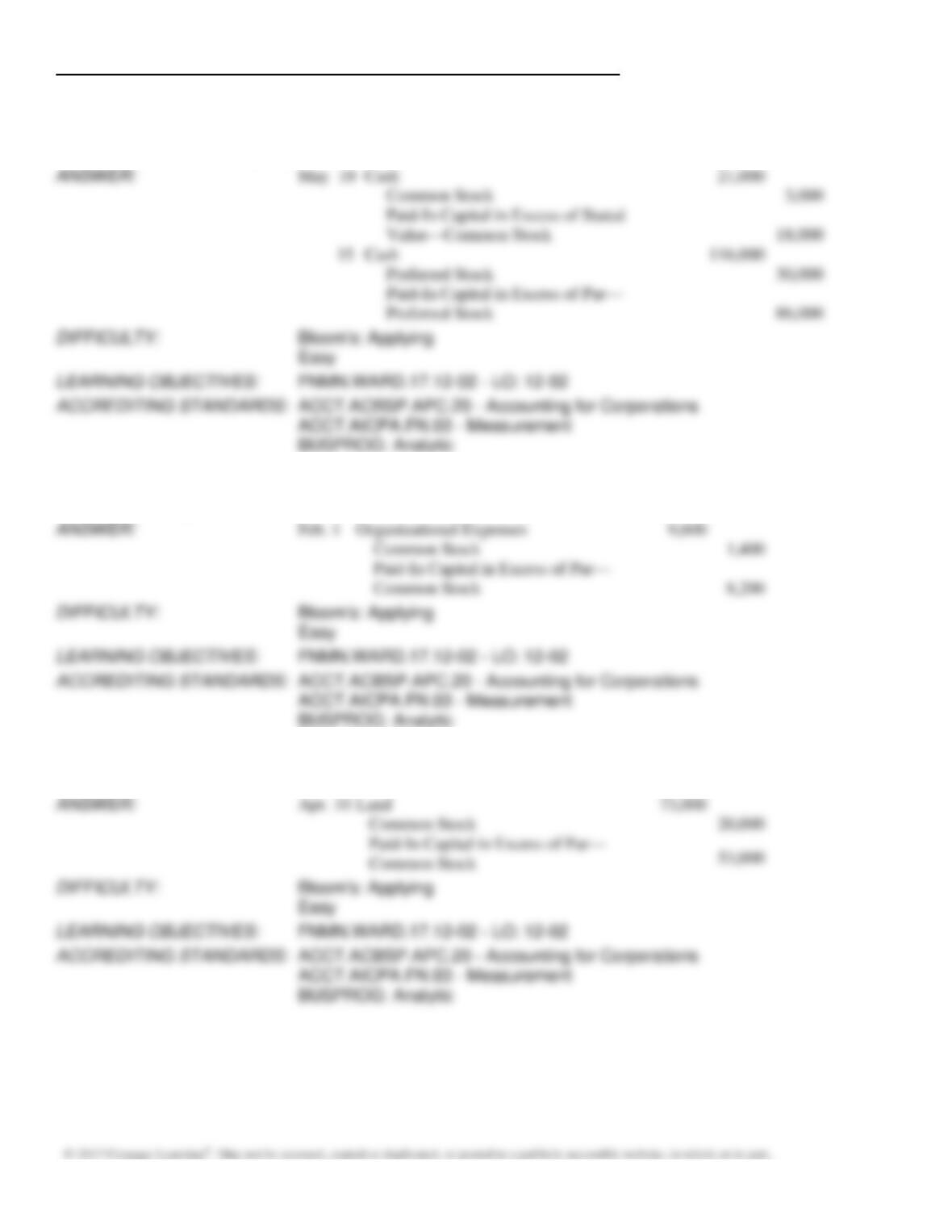
169. On April 1, 10,000 shares of $5 par common stock were issued at $22, and on April 7, 5,000 shares of $50 par
preferred stock were issued at $104. Journalize the entries for April 1 and 7.
Chapter 12 – Corporations: Organization, Stock Transactions, and Dividends
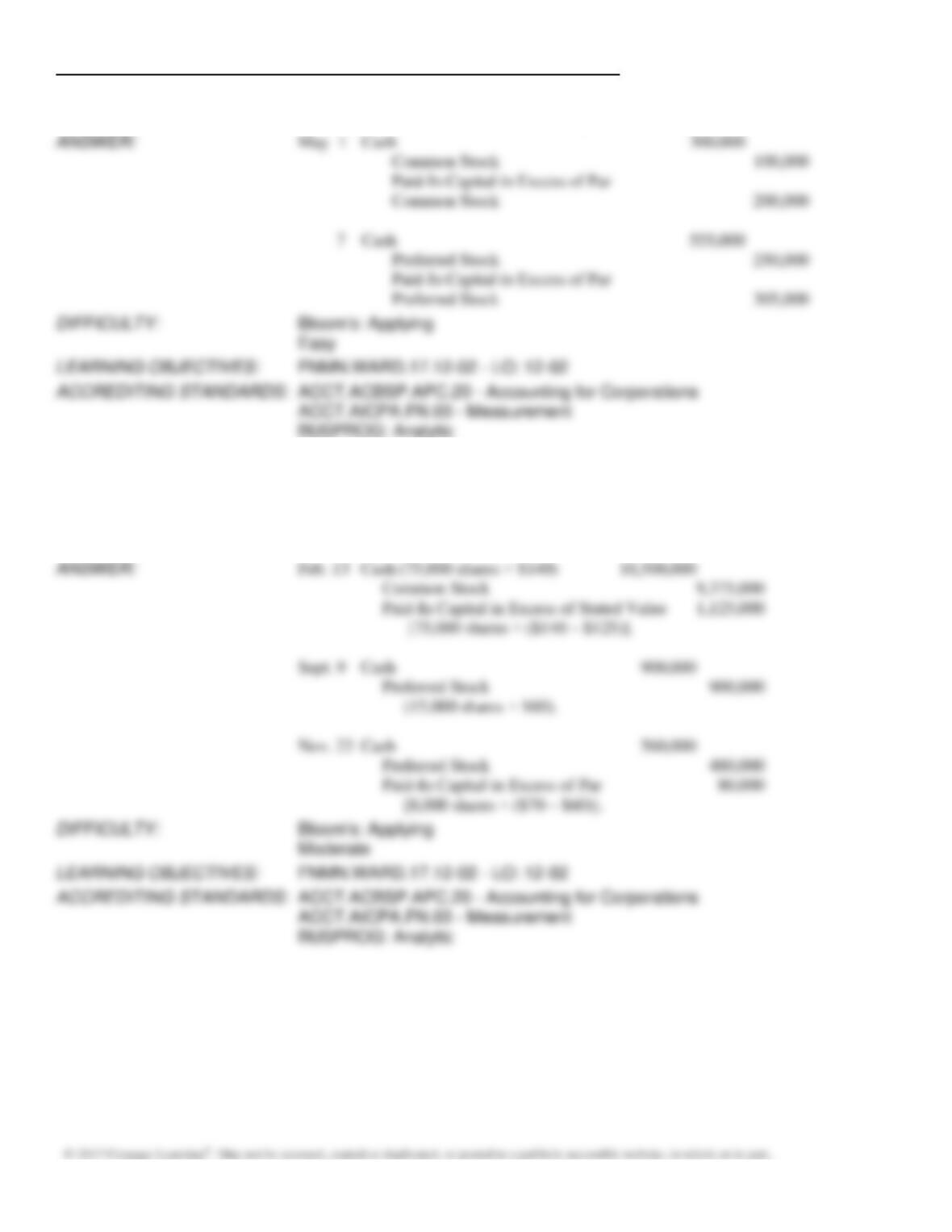
170. On May 10, a company issued for cash 1,500 shares of no-par common stock (with a stated value of $2) at $14, and
on May 15, it issued for cash 2,000 shares of $15 par preferred stock at $58.
Journalize the entries for May 10 and 15, assuming that the common stock is to be credited with the stated value.
171. On February 1 of the current year, Motor, Inc. issued 700 shares of $2 par common stock to an attorney in return for
preparing and filing the articles of incorporation. The value of the services is $9,600. Journalize this transaction.
172. On April 10, a company acquired land in exchange for 1,000 shares of $20 par common stock with a current market
price of $73. Journalize this transaction.
Chapter 12 – Corporations: Organization, Stock Transactions, and Dividends
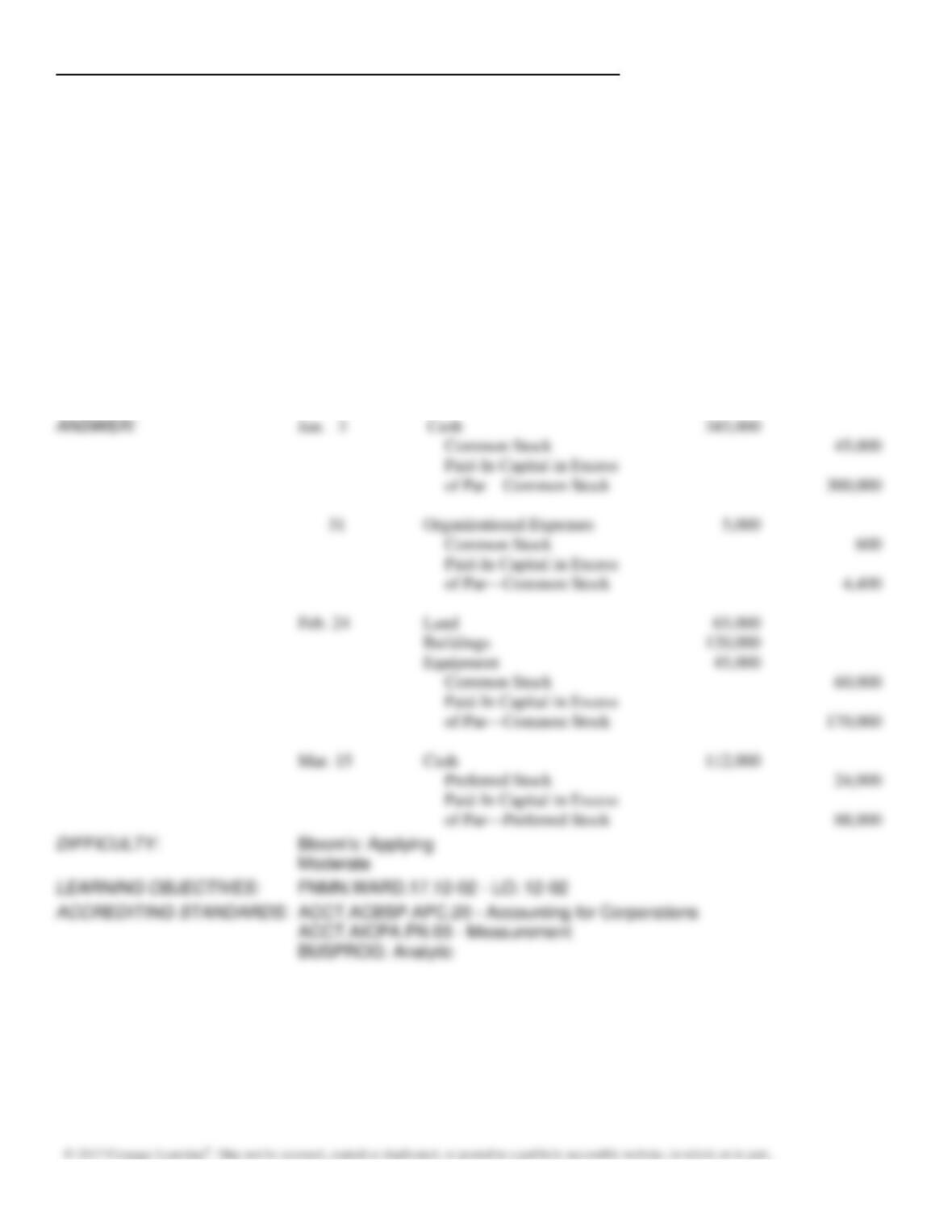
173. On May 1, 10,000 shares of $10 par common stock were issued at $30, and on May 7, 5,000 shares of $50 par
preferred stock were issued at $111. Journalize the entries for May 1 and May 7.
174. On February 13, Epperson Company issue for cash 75,000 shares of no-par common stock (with a stated value of
$125) at $140. On September 9, Epperson issued at par 15,000 shares of 1%, $60 par preferred stock at par for cash. On
November 23, Epperson issued for cash 8,000 shares of 1%, $60 par preferred stock at $70.
Journalize the entries to record the February 13, September 9, and November 23 transactions.
Chapter 12 – Corporations: Organization, Stock Transactions, and Dividends
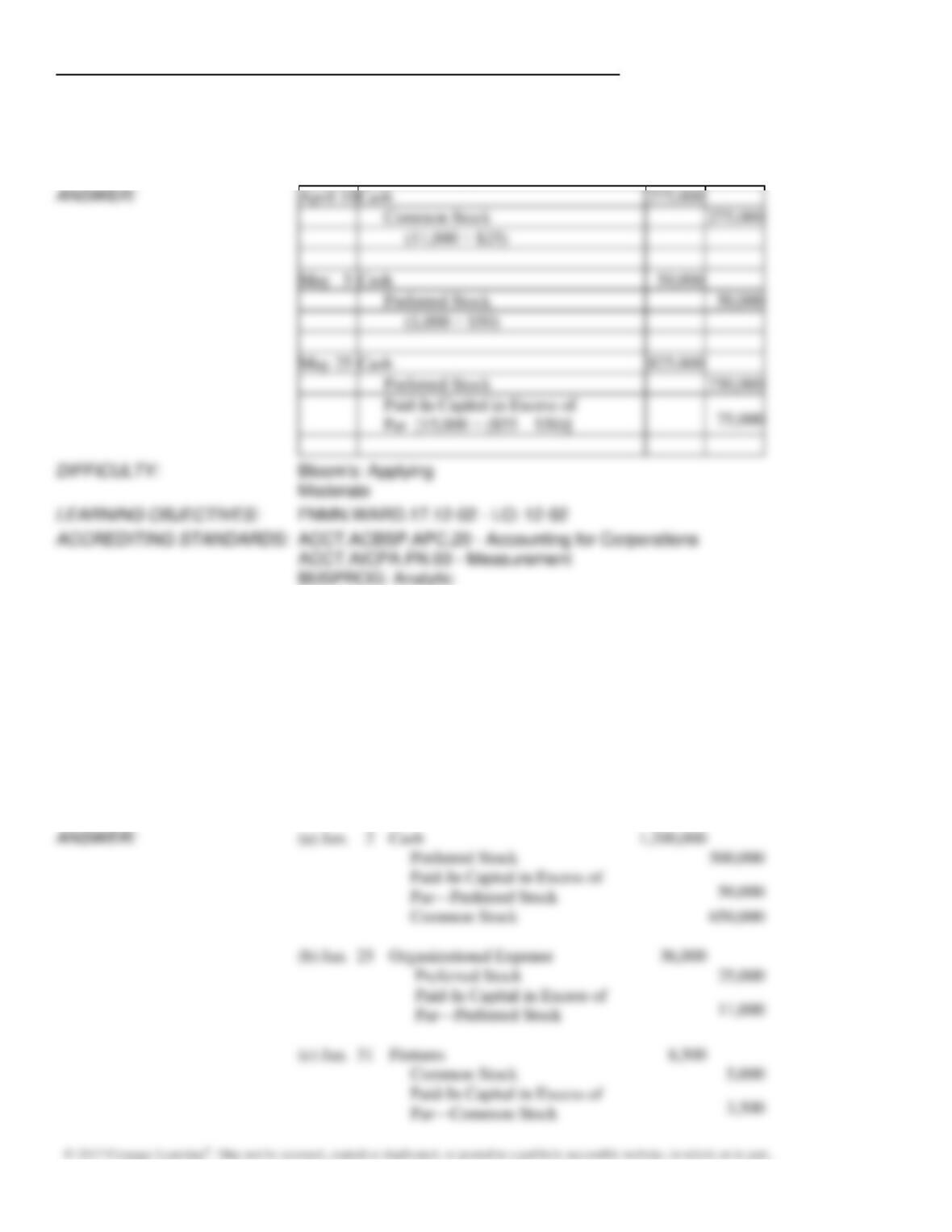
175. A corporation was organized on January 1 of the current year, with an authorization of 20,000 shares of 4%, $12 par
preferred stock, and 100,000 shares of $3 par common stock.
The following selected transactions were completed during the first year of operations:
Jan. 3
Issued 15,000 shares of common stock at $23 per share for cash.
31
Issued 200 shares of common stock to an attorney in payment of legal fees for
organizing the corporation. The value of the stock at the time of payment was $25
per share.
Feb. 24
Issued 20,000 shares of common stock in exchange for land, buildings, and
equipment with fair market prices of $65,000, $120,000, and $45,000 respectively.
Mar. 15
Issued 2,000 shares of preferred stock at $56 for cash.
Journalize the transactions.
Jan. 3
Cash
Common Stock
Paid-In Capital in Excess
Organizational Expenses
Common Stock
of Par—Common Stock
Feb. 24
Land
Equipment
Common Stock
Paid-In Capital in Excess
Mar. 15
Cash
Preferred Stock
Paid-In Capital in Excess
of Par—Preferred Stock
Chapter 12 – Corporations: Organization, Stock Transactions, and Dividends
176. On April 10, Maranda Corporation issued for cash 11,000 shares of no-par common stock at $25. On May 5,
Maranda issued at par 1,000 shares of 4%, $50 par preferred stock for cash. On May 25, Maranda issued for cash 15,000
shares of 4%, $50 par preferred stock at $55.
Journalize the entries to record the April 10, May 5, and May 25 transactions.
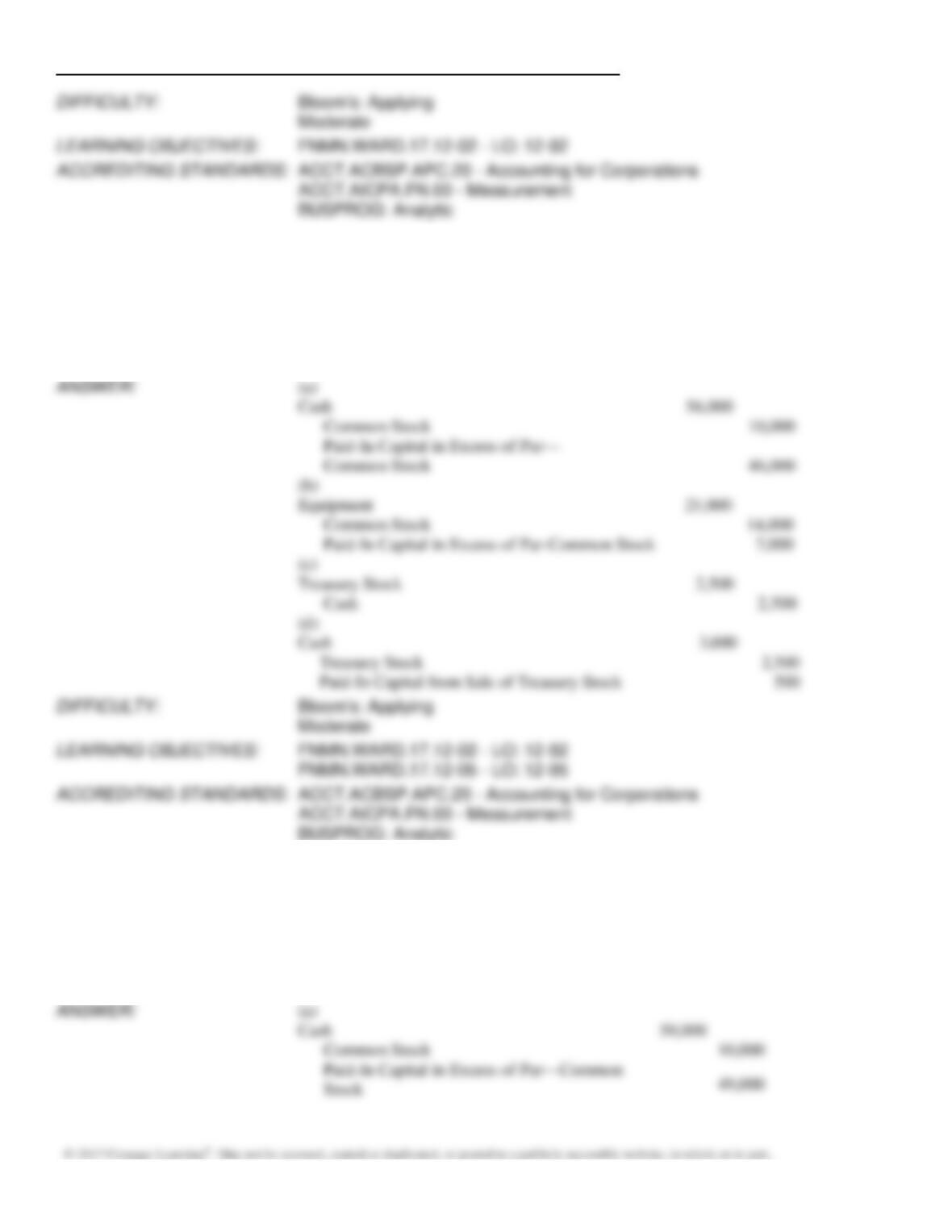
177. Wonder Sales is authorized to issue 100,000 shares of 2%, $100 par preferred stock and 1,000,000 shares of $10 par
common stock. Journalize the following transactions.
(a) On January 2, Wonder Sales issues 5,000 shares of preferred stock for $110 per share and 65,000 shares of
common stock at $10 per share.
(b) On January 25, Wonder Sales issued 250 shares of preferred stock to a Morton Law Firm for settlement of a $36,000
invoice for incorporation services.
(c) On January 31, Wonder Sales issues 500 shares of common stock to Setup Inc. for fixtures that have a fair market
value of $8,500.
Chapter 12 – Corporations: Organization, Stock Transactions, and Dividends
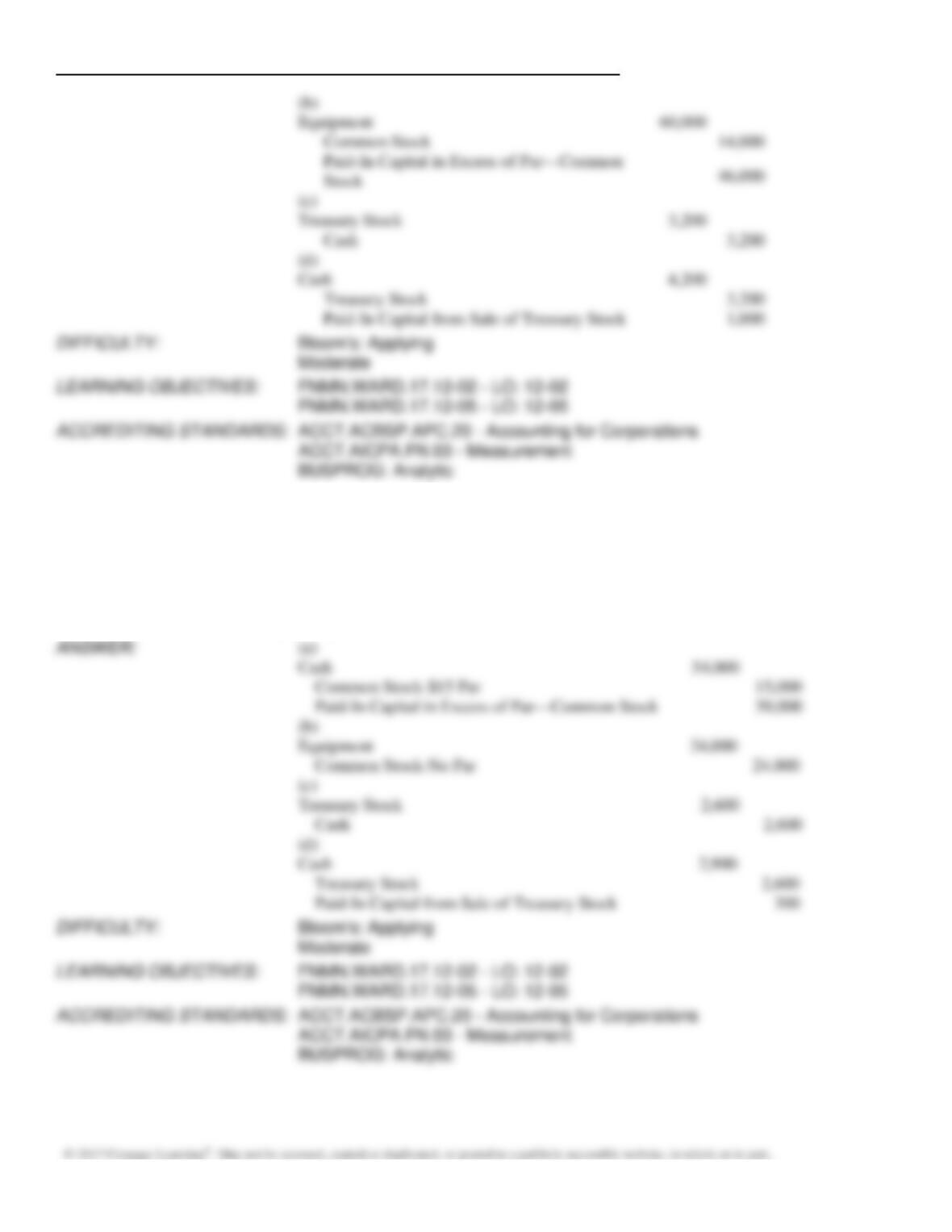
178. Prepare entries to record the following:
(a)
Issued 1,000 shares of $10 par common stock at $56.
(b)
Issued 1,400 shares of $10 par common stock in exchange for equipment with a fair
market price of $21,000.
(c)
Purchased 100 shares of treasury stock at $25.
(d)
Sold the 100 shares of treasury stock purchased in (c) at $30.
Cash
Equipment
Treasury Stock
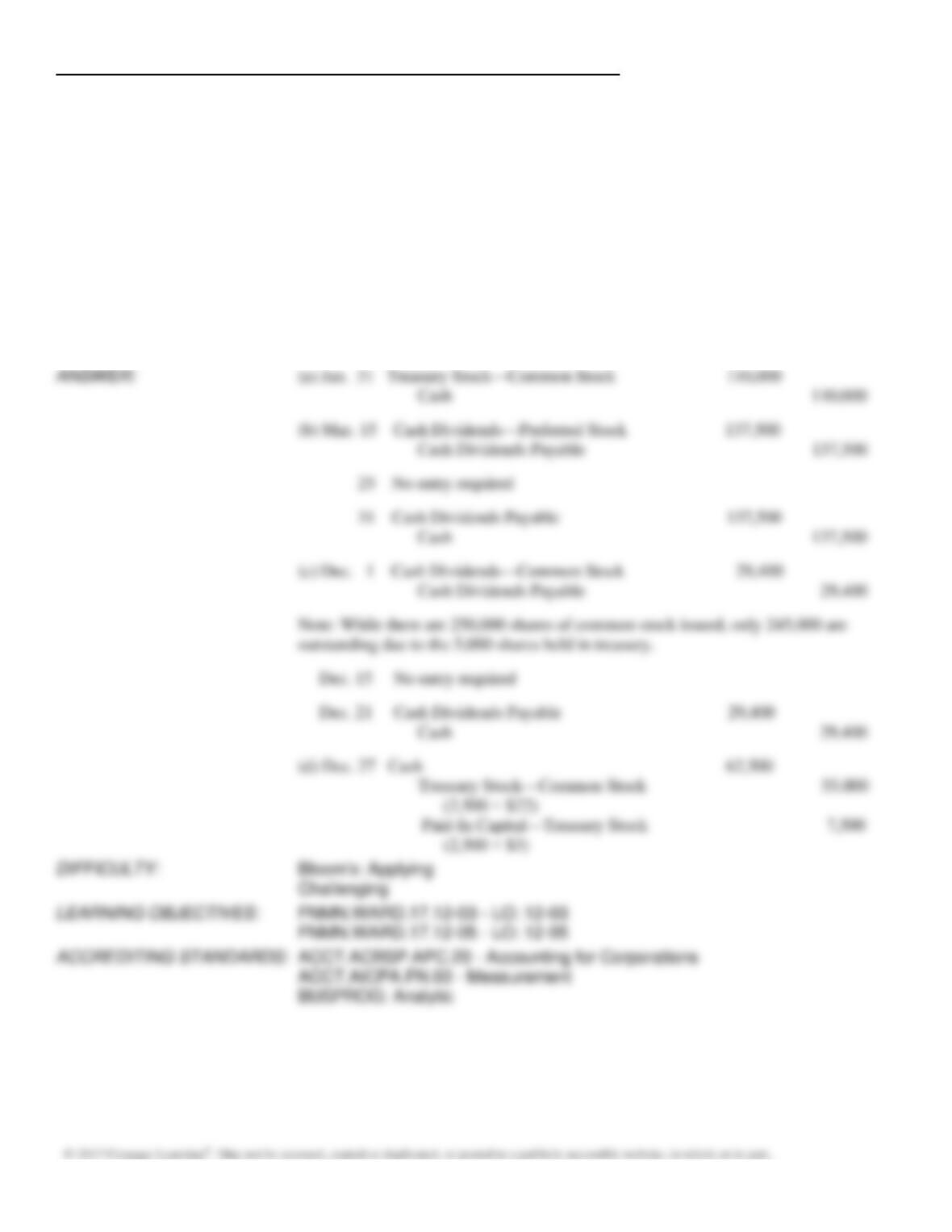
179. Prepare entries to record the following:
(a)
Issued 1,000 shares of $10 par common stock at $59 for cash.
(b)
Issued 1,400 shares of $10 par common stock in exchange for equipment with a fair
market price of $60,000.
(c)
Purchased 100 shares of treasury stock at $32.
(d)
Sold the 100 shares of treasury stock purchased in (c) at $42.
Cash
Chapter 12 – Corporations: Organization, Stock Transactions, and Dividends
Equipment
Treasury Stock
Cash
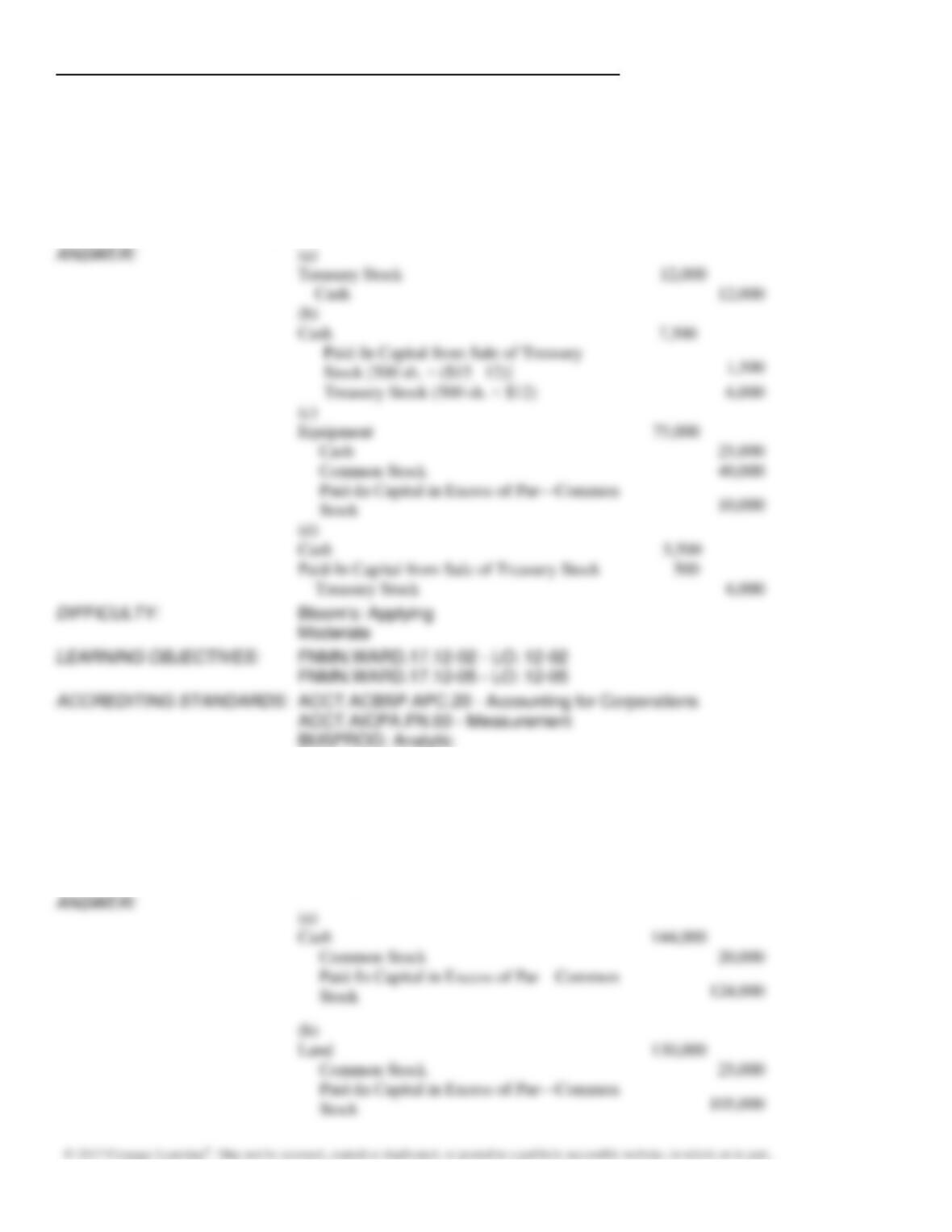
180. Prepare entries to record the following:
(a)
Issued 1,000 shares of $15 par common stock at $54 for cash.
(b)
Issued 1,400 shares of no-par common stock in exchange for equipment with a fair
market price of $24,000.
(c)
Purchased 100 shares of treasury stock at $26.
(d)
Sold 100 shares of treasury stock purchased in (c) at $29.
Cash
Equipment
Treasury Stock
Cash
Chapter 12 – Corporations: Organization, Stock Transactions, and Dividends
181. Carmen Company is a corporation that has issued both preferred and common stock. As of January 1, it had 50,000
shares of 2.75% $100 par, preferred stock outstanding and 250,000 shares of $10 par common stock outstanding.
Journalize the following transactions.
(a) On January 31, the board of directors issues a requirement to purchase 5,000 shares of its common stock at
market price. The shares are purchased at a market price of $22 per share.
(b) On March 15, Carmen declares a dividend on preferred stock of $2.75 per share. The date of record is
March 25 and the date of payment is March 31.
(c) On December 1, Carmen declares a cash dividend on common stock of $0.12 per share. The date of record is
December 15 and the date of payment is December 21.
(d) On December 27, the board orders that 2,500 shares of the treasury stock purchased in (a) be sold. The sale price is
$25 per share.
Chapter 12 – Corporations: Organization, Stock Transactions, and Dividends
182. A company has 10,000 shares of $10 par common stock outstanding. Prepare entries to record the following:
(a)
Purchased 1,000 shares of treasury stock at $12. The treasury stock is accounted for by the
cost method. There were no previous purchases of treasury shares.
(b)
Sold 500 shares of treasury stock at $15.
(c)
Purchased equipment for $75,000, paying $25,000 in cash and issuing 4,000 shares of
common stock for the remaining.
(d)
Sold 500 shares of treasury stock at $11.
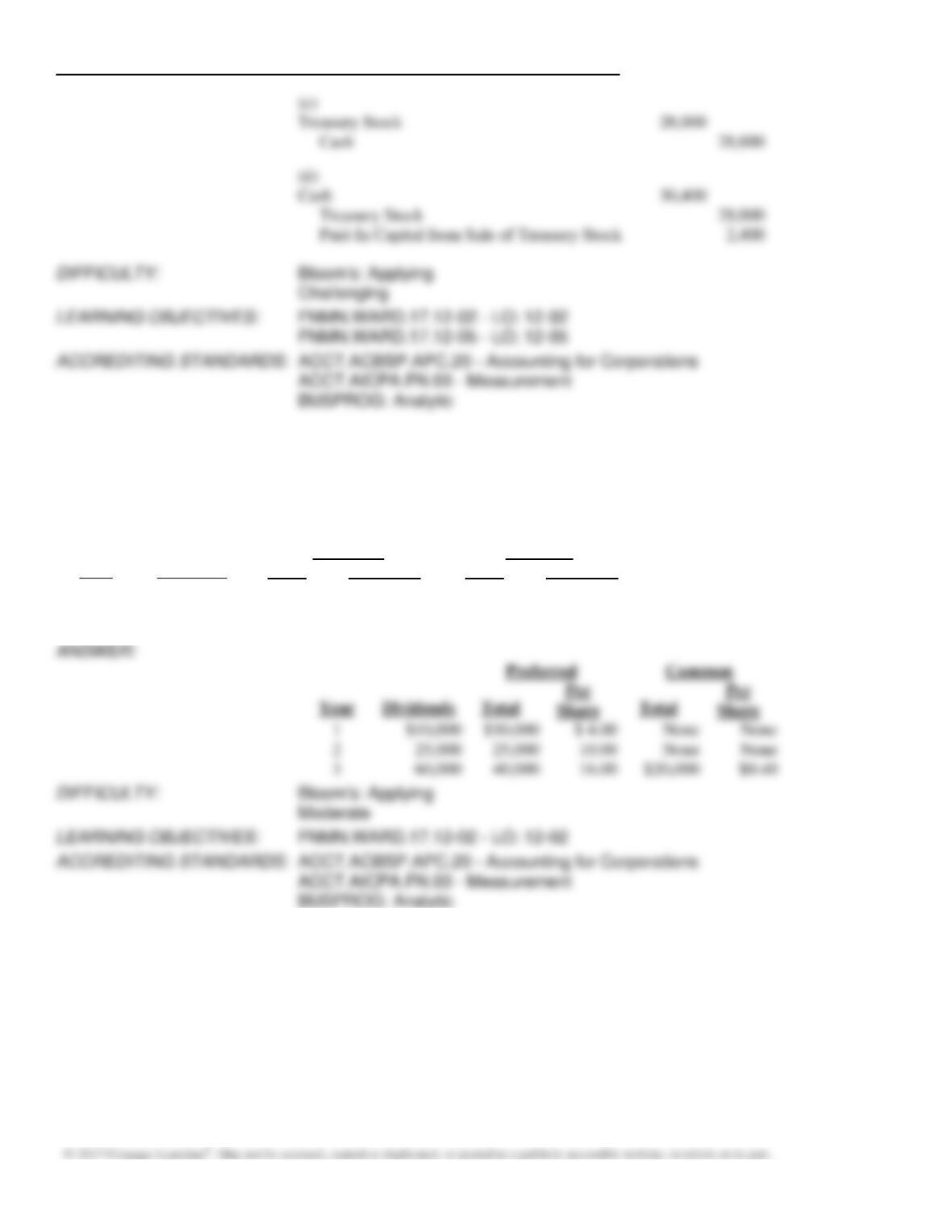
Treasury Stock
Cash
Stock [500 sh. × ($15 –12)]
Equipment
75,000
Cash
Paid-In Capital from Sale of Treasury Stock
183. Prepare entries to record the transactions for Maine Corp.:
(a)
Issued 2,000 shares of $10 par common stock at $72 for cash.
(b)
Issued 2,500 shares of common stock in exchange for land with a fair market price of
$130,000.
(c)
Purchased 400 shares of treasury stock at $70.
(d)
Sold the 400 shares of treasury stock purchased in (c) at $76.
Cash
Stock
Land
Stock
Chapter 12 – Corporations: Organization, Stock Transactions, and Dividends
Treasury Stock
Cash
2,400
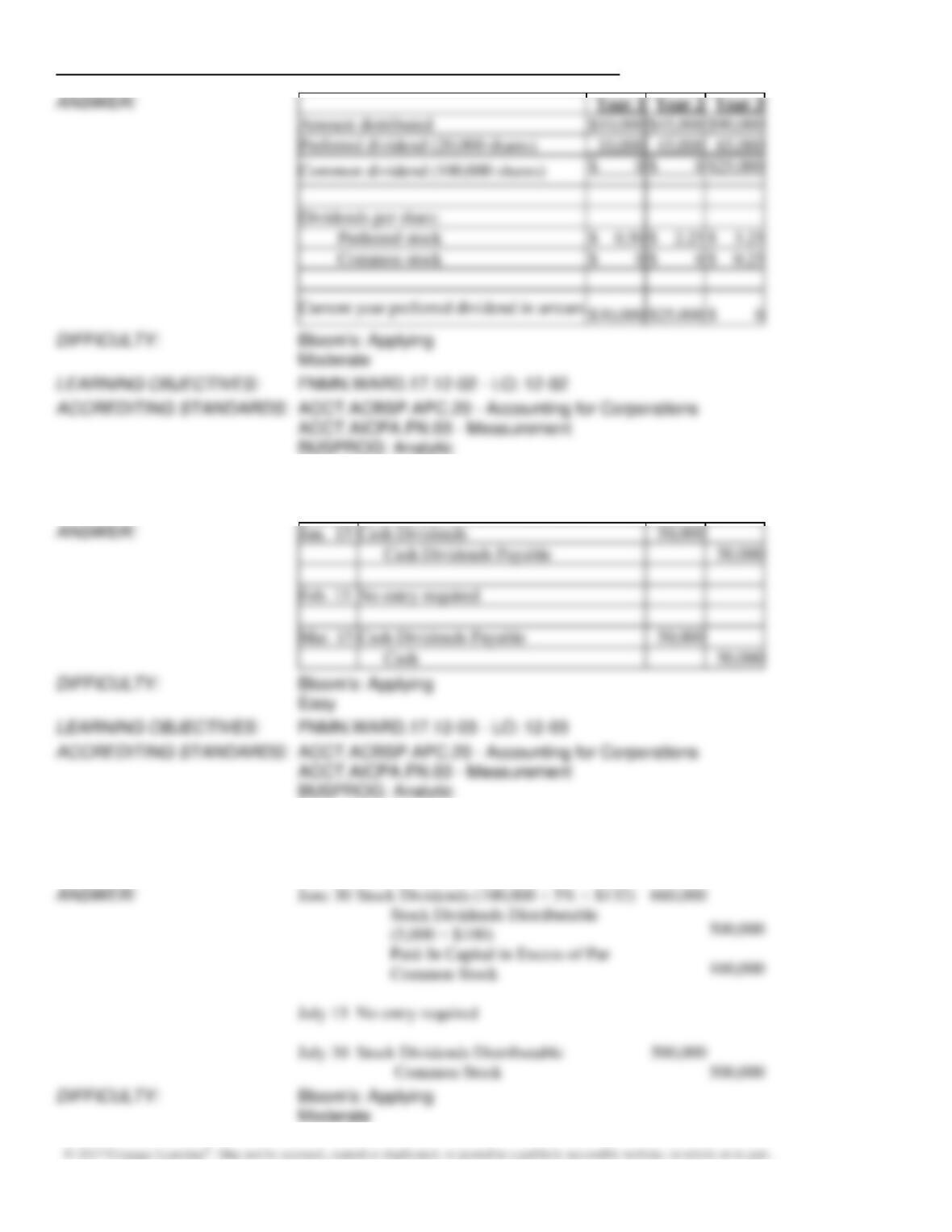
184. A company had stock outstanding as follows during each of its first three years of operations: 2,500 shares of 10%,
$100 par, cumulative preferred stock and 50,000 shares of $10 par common stock. The amounts distributed as dividends
are presented below. Determine the total and per-share dividends for each class of stock for each year by completing the
schedule.
Preferred
Common
Year
Dividends
Total
Per Share
Total
Per Share
1
$10,000
_________
_________
_________
_________
2
25,000
_________
_________
_________
_________
3
60,000
_________
_________
_________
_________
$10,000
$10,000
25,000
40,000
185. Sabas Company has 20,000 shares of $100 par, 2% cumulative preferred stock and 100,000 shares of $50 par
common stock. The following amounts were distributed as dividends:
Year 1:
$10,000
Year 2:
45,000
Year 3:
90,000
Determine the dividends per share for preferred and common stock for each year.
Chapter 12 – Corporations: Organization, Stock Transactions, and Dividends
186. The dates of importance in connection with a cash dividend of $50,000 on a corporation’s common stock are January
15, February 15, and March 15. Journalize the entries required on each date.
187. Vincent Corporation has 100,000 shares of $100 par common stock outstanding. On June 30, Vincent Corporation
declared a 5% stock dividend to be issued on July 30 to stockholders of record July 15. The market price of the stock was
$132 a share on June 30. Journalize the entries required on June 30, July 15, and July 30.