Chapter 12 – Differential Analysis: The Key to Decision Making
143. Humes Corporation makes a range of products. The company’s predetermined overhead
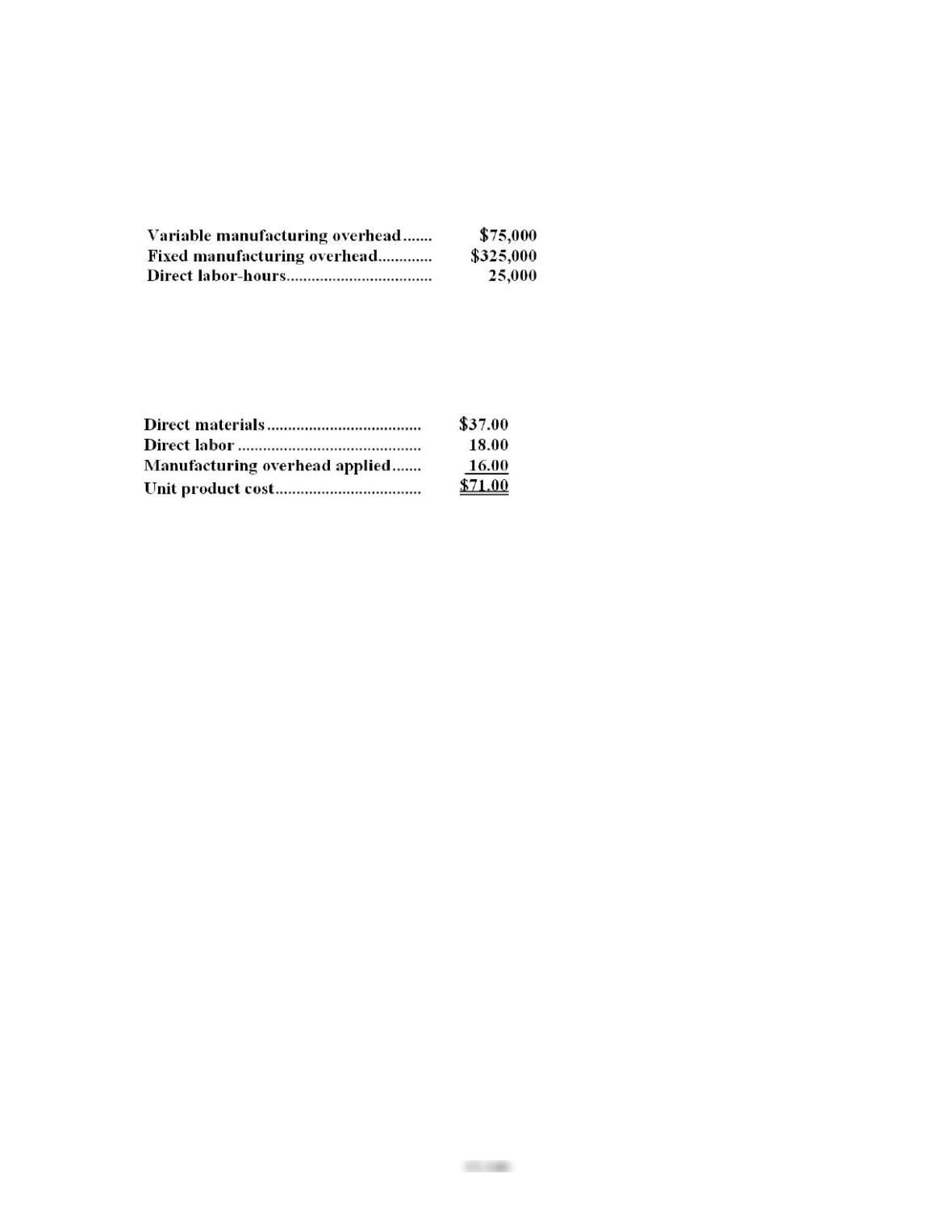
rate is $16 per direct labor-hour, which was calculated using the following budgeted data:
Management is considering a special order for 700 units of product J45K at $64 each. The
normal selling price of product J45K is $75 and the unit product cost is determined as
follows:
If the special order were accepted, normal sales of this and other products would not be
affected. The company has ample excess capacity to produce the additional units. Assume that
direct labor is a variable cost, variable manufacturing overhead is really driven by direct
labor-hours, and total fixed manufacturing overhead would not be affected by the special
order.
Required:
If the special order were accepted, what would be the impact on the company’s overall profit?
Chapter 12 – Differential Analysis: The Key to Decision Making
Chapter 12 – Differential Analysis: The Key to Decision Making
144. A customer has asked Twiner Corporation to supply 5,000 units of product D05, with
some modifications, for $40.20 each. The normal selling price of this product is $52.80 each.
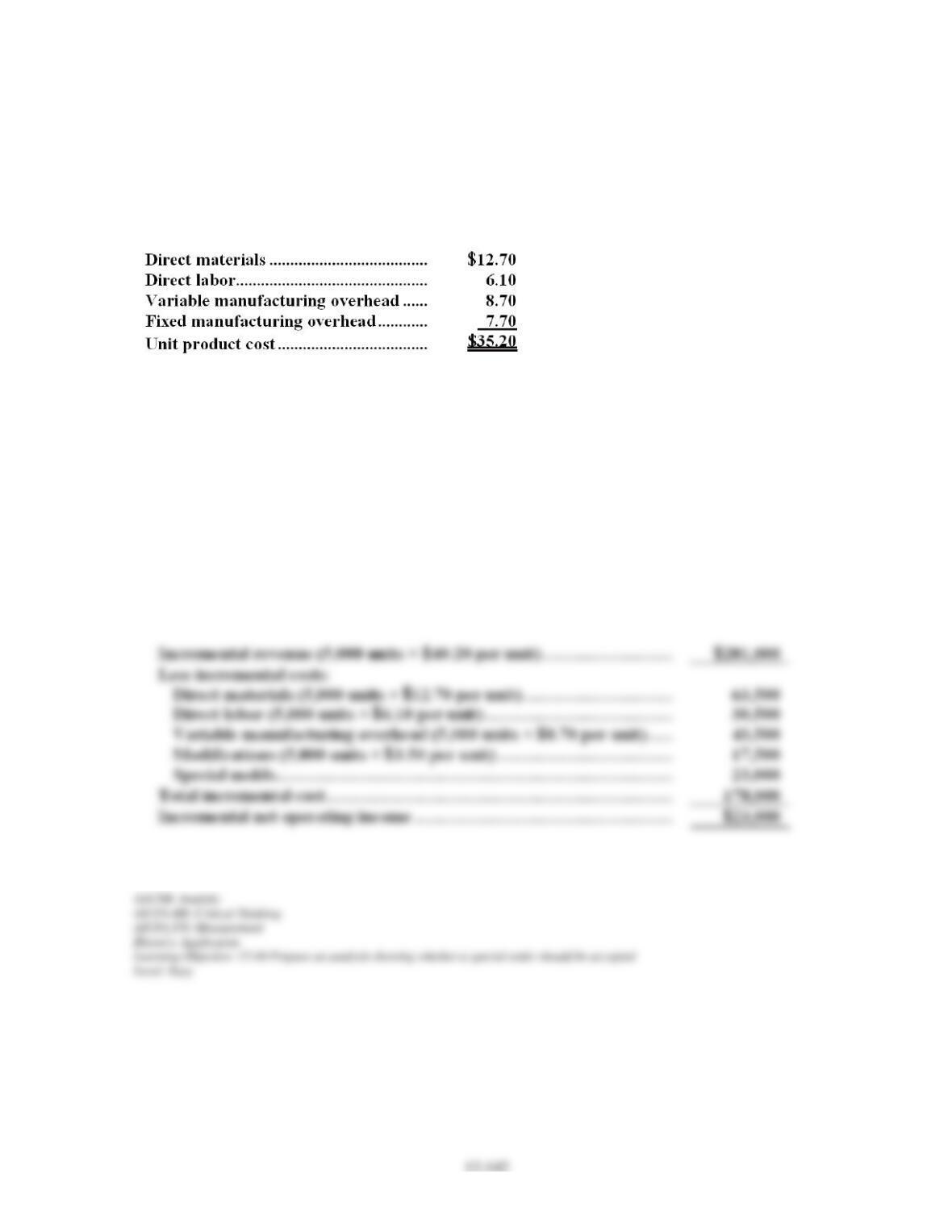
The normal unit product cost of product D05 is computed as follows:
Direct labor is a variable cost. The special order would have no effect on the company’s total
fixed manufacturing overhead costs. The customer would like some modifications made to
product D05 that would increase the variable costs by $3.50 per unit and that would require a
one-time investment of $23,000 in special molds that would have no salvage value. This
special order would have no effect on the company’s other sales. The company has ample
spare capacity for producing the special order.
Required:
Determine the effect on the company’s total net operating income of accepting the special
order. Show your work!
Chapter 12 – Differential Analysis: The Key to Decision Making
12-143
145. Jumonville Company produces a single product. The cost of producing and selling a
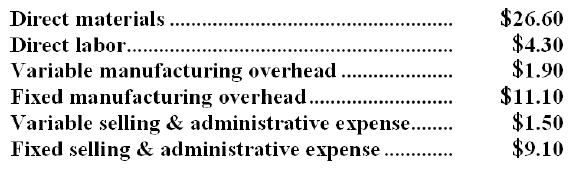
single unit of this product at the company’s normal activity level of 70,000 units per month is
as follows:
The normal selling price of the product is $56.70 per unit.
An order has been received from an overseas customer for 2,000 units to be delivered this
month at a special discounted price. This order would have no effect on the company’s normal
sales and would not change the total amount of the company’s fixed costs. The variable selling
and administrative expense would be $0.70 less per unit on this order than on normal sales.
Direct labor is a variable cost in this company.
Required:
a. Suppose there is ample idle capacity to produce the units required by the overseas customer
and the special discounted price on the special order is $51.20 per unit. By how much would
this special order increase (decrease) the company’s net operating income for the month?
b. Suppose the company is already operating at capacity when the special order is received
from the overseas customer. What would be the opportunity cost of each unit delivered to the
overseas customer?
c. Suppose there is not enough idle capacity to produce all of the units for the overseas
customer and accepting the special order would require cutting back on production of 700
units for regular customers. What would be the minimum acceptable price per unit for the
special order?
Chapter 12 – Differential Analysis: The Key to Decision Making
Chapter 12 – Differential Analysis: The Key to Decision Making
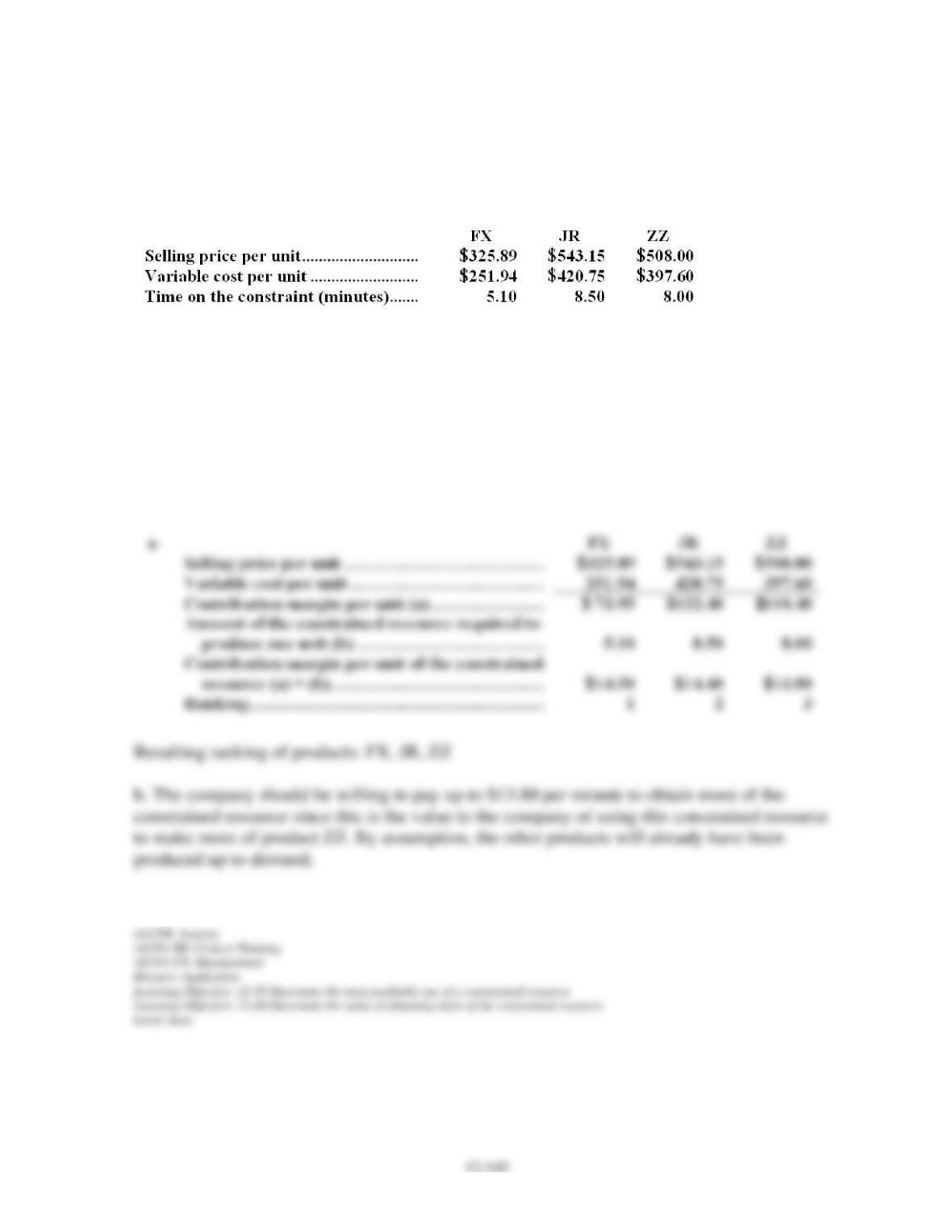
146. Block Corporation makes three products that use the current constraint, which is a
particular type of machine. Data concerning those products appear below:
Required:
a. Rank the products in order of their current profitability from the most profitable to the least
profitable. In other words, rank the products in the order in which they should be emphasized.
Show your work!
b. Assume that sufficient constraint time is available to satisfy demand for all but the least
profitable product. Up to how much should the company be willing to pay to acquire more of
the constrained resource?
Chapter 12 – Differential Analysis: The Key to Decision Making
12-146
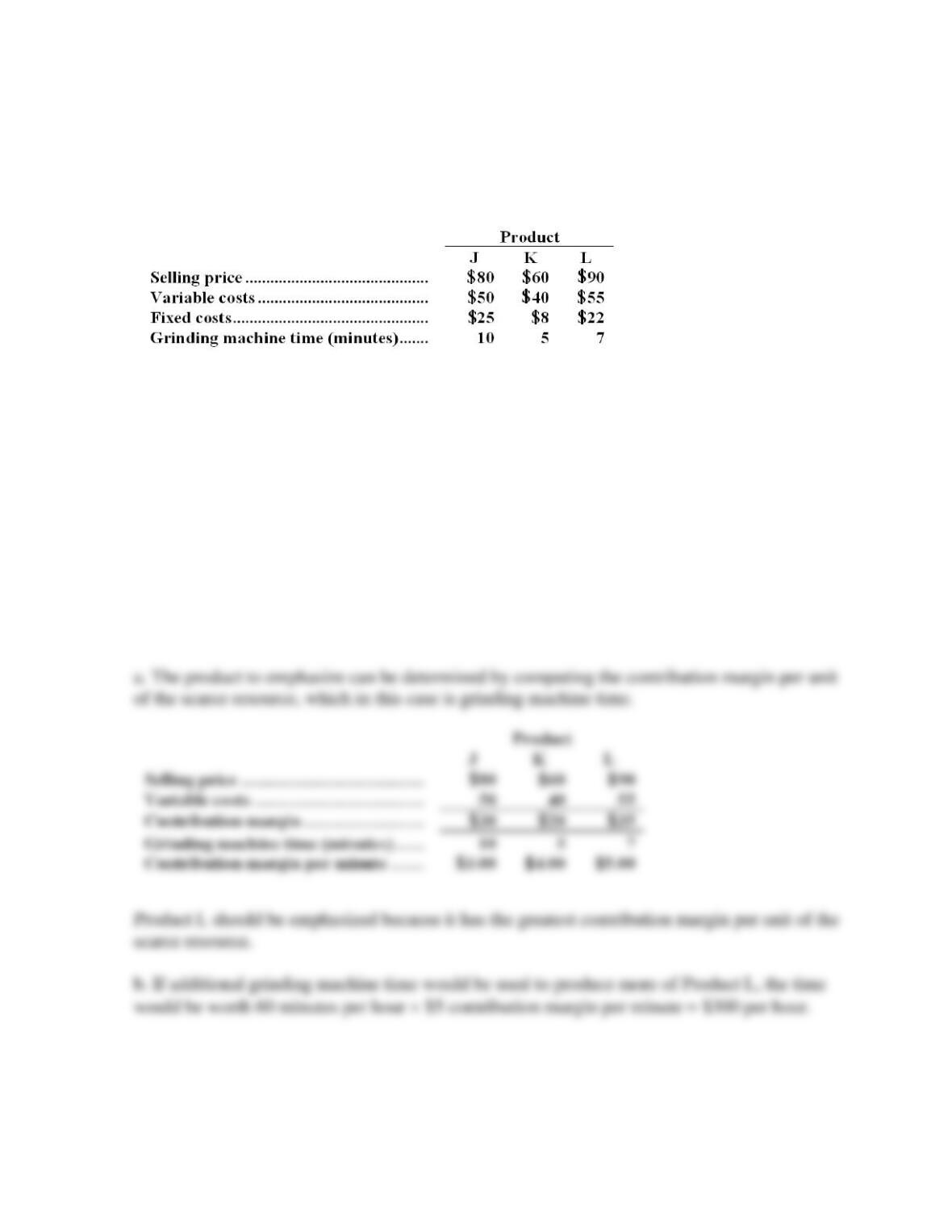
147. Redner, Inc. produces three products. Data concerning the selling prices and unit costs of
the three products appear below:
Fixed costs are applied to the products on the basis of direct labor hours.
Demand for the three products exceeds the company’s productive capacity. The grinding
machine is the constraint, with only 2,400 minutes of grinding machine time available this
week.
Required:
a. Given the grinding machine constraint, which product should be emphasized? Support your
answer with appropriate calculations.
b. Assuming that there is still unfilled demand for the product that the company should
emphasize in part (a) above, up to how much should the company be willing to pay for an
additional hour of grinding machine time?

Chapter 12 – Differential Analysis: The Key to Decision Making
Chapter 12 – Differential Analysis: The Key to Decision Making
12-148
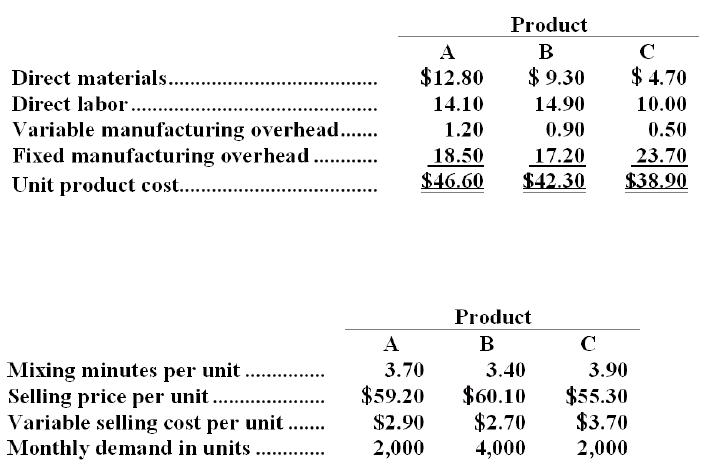
148. Glunn Company makes three products in a single facility. These products have the
following unit product costs:
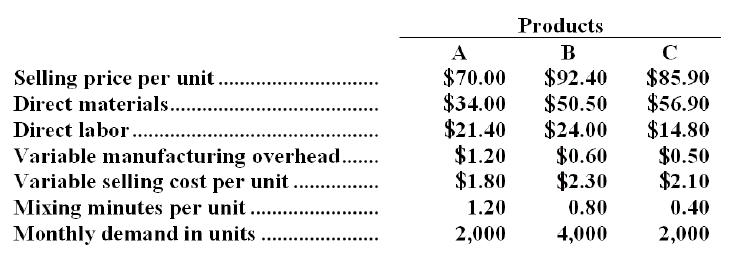
Additional data concerning these products are listed below.
The mixing machines are potentially the constraint in the production facility. A total of
24,200 minutes are available per month on these machines.
Direct labor is a variable cost in this company.
Required:
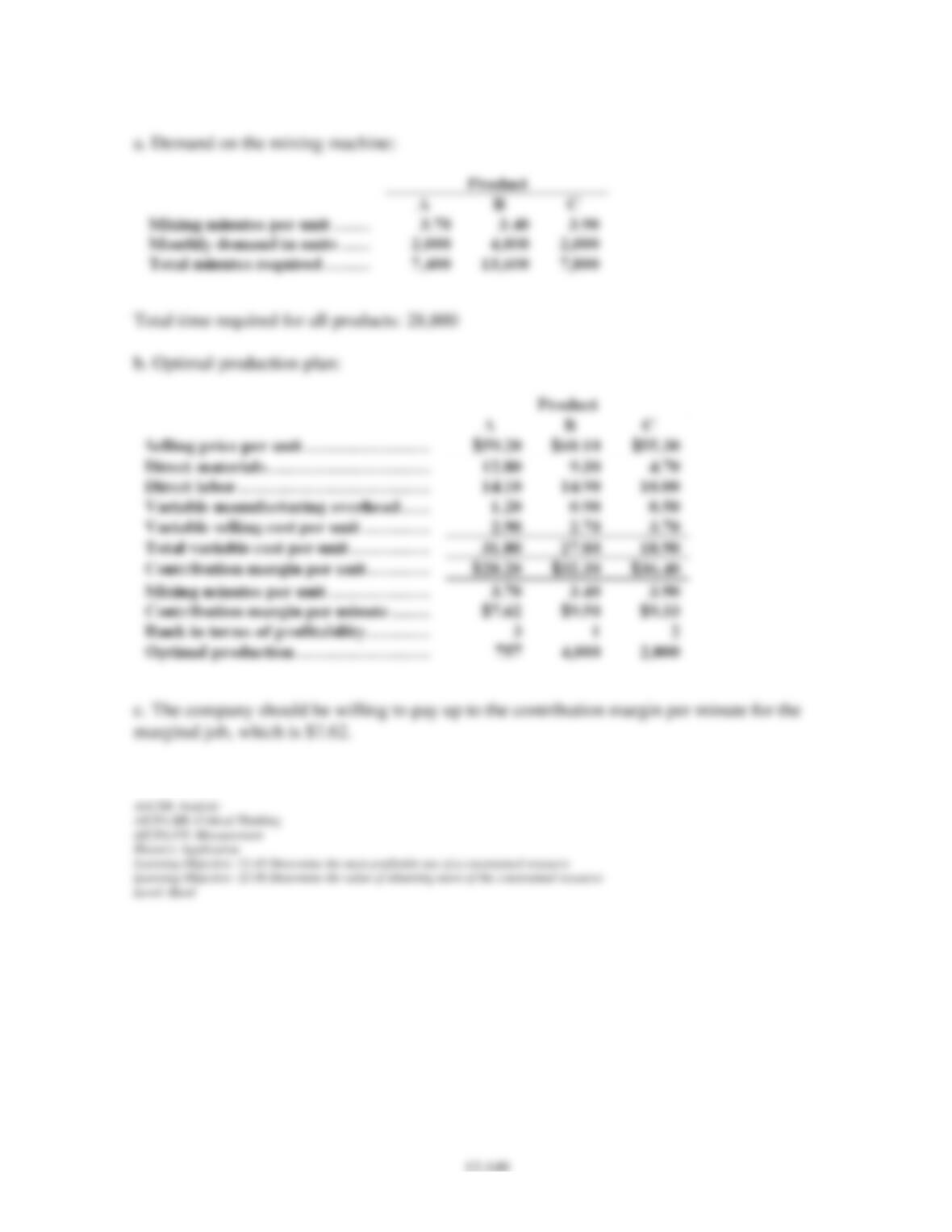
a. How many minutes of mixing machine time would be required to satisfy demand for all
three products?
b. How much of each product should be produced to maximize net operating income? (Round
off to the nearest whole unit.)
c. Up to how much should the company be willing to pay for one additional hour of mixing
machine time if the company has made the best use of the existing mixing machine capacity?
(Round off to the nearest whole cent.)
Chapter 12 – Differential Analysis: The Key to Decision Making
Chapter 12 – Differential Analysis: The Key to Decision Making
12-150
149. Holvey Company makes three products in a single facility. Data concerning these
products follow:
The mixing machines are potentially the constraint in the production facility. A total of 6,300
minutes are available per month on these machines. Direct labor is a variable cost in this
company.
Required:
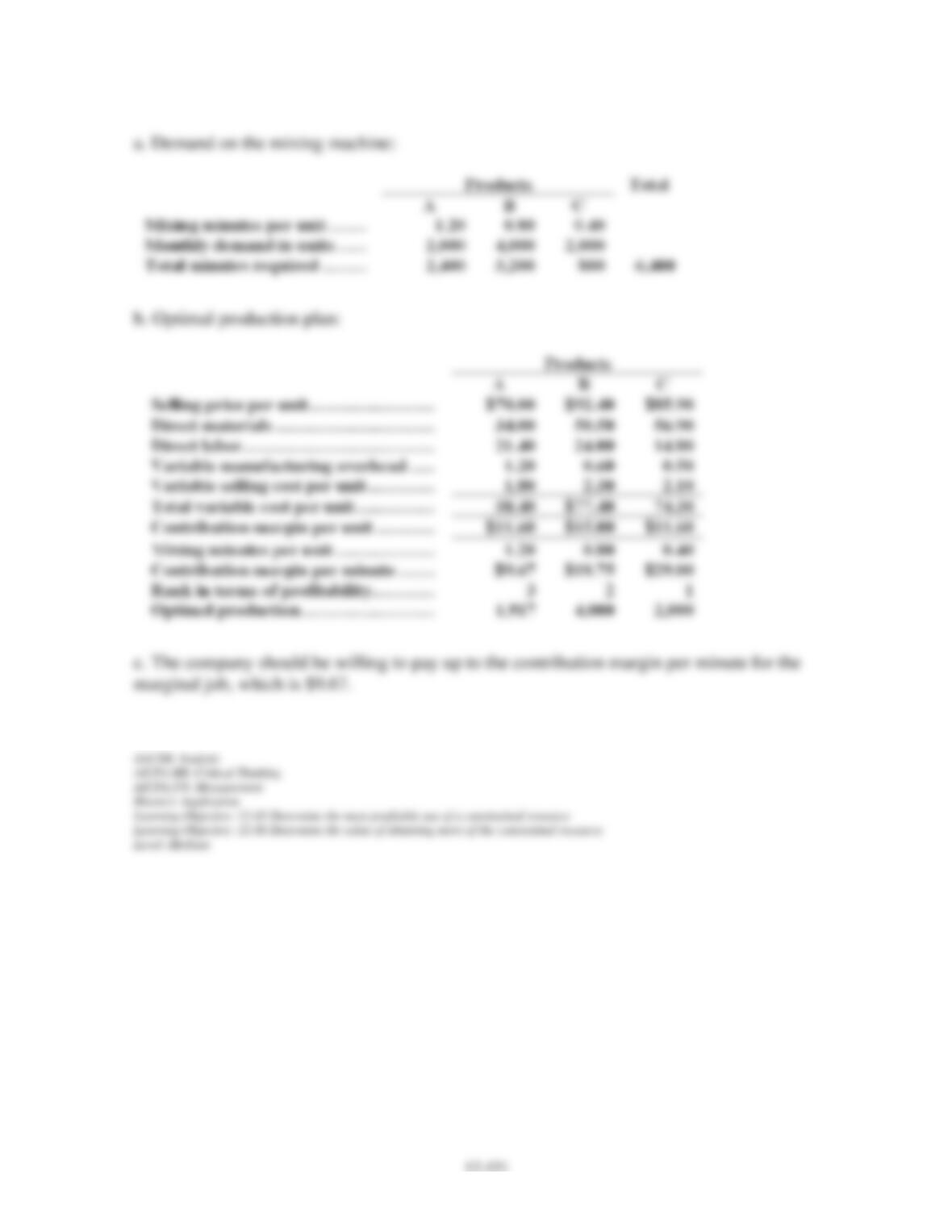
a. How many minutes of mixing machine time would be required to satisfy demand for all
three products?
b. How much of each product should be produced to maximize net operating income? (Round
off to the nearest whole unit.)
c. Up to how much should the company be willing to pay for one additional hour of mixing
machine time if the company has made the best use of the existing mixing machine capacity?
(Round off to the nearest whole cent.)
Chapter 12 – Differential Analysis: The Key to Decision Making
Chapter 12 – Differential Analysis: The Key to Decision Making
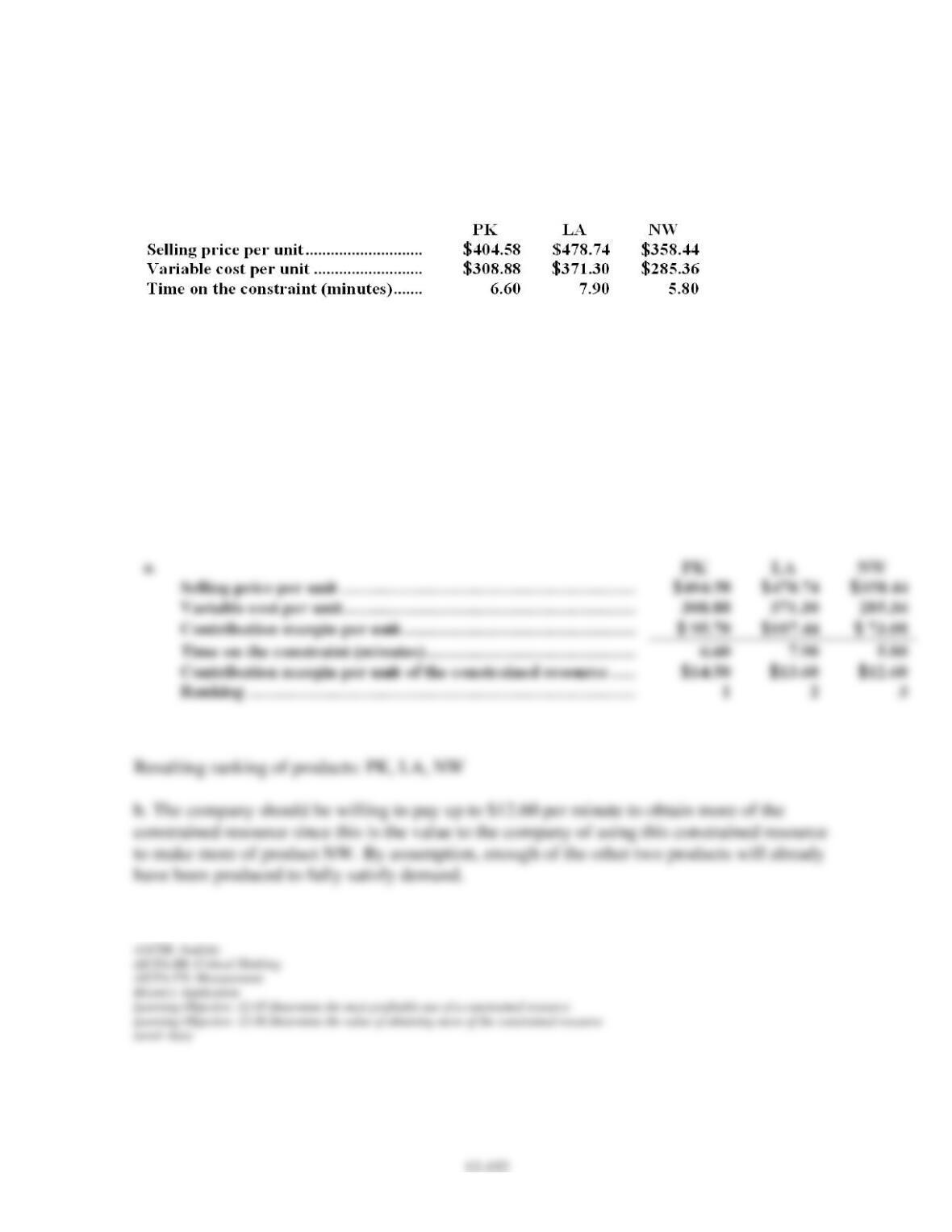
150. The constraint at Vrana Inc. is an expensive milling machine. The three products listed
below use this constrained resource.
Required:
a. Rank the products in order of their current profitability from the most profitable to the least
profitable. In other words, rank the products in the order in which they should be emphasized.
Show your work!
b. Assume that sufficient constraint time is available to satisfy demand for all but the least
profitable product. Up to how much should the company be willing to pay to acquire more of
the constrained resource?
Chapter 12 – Differential Analysis: The Key to Decision Making
12-153
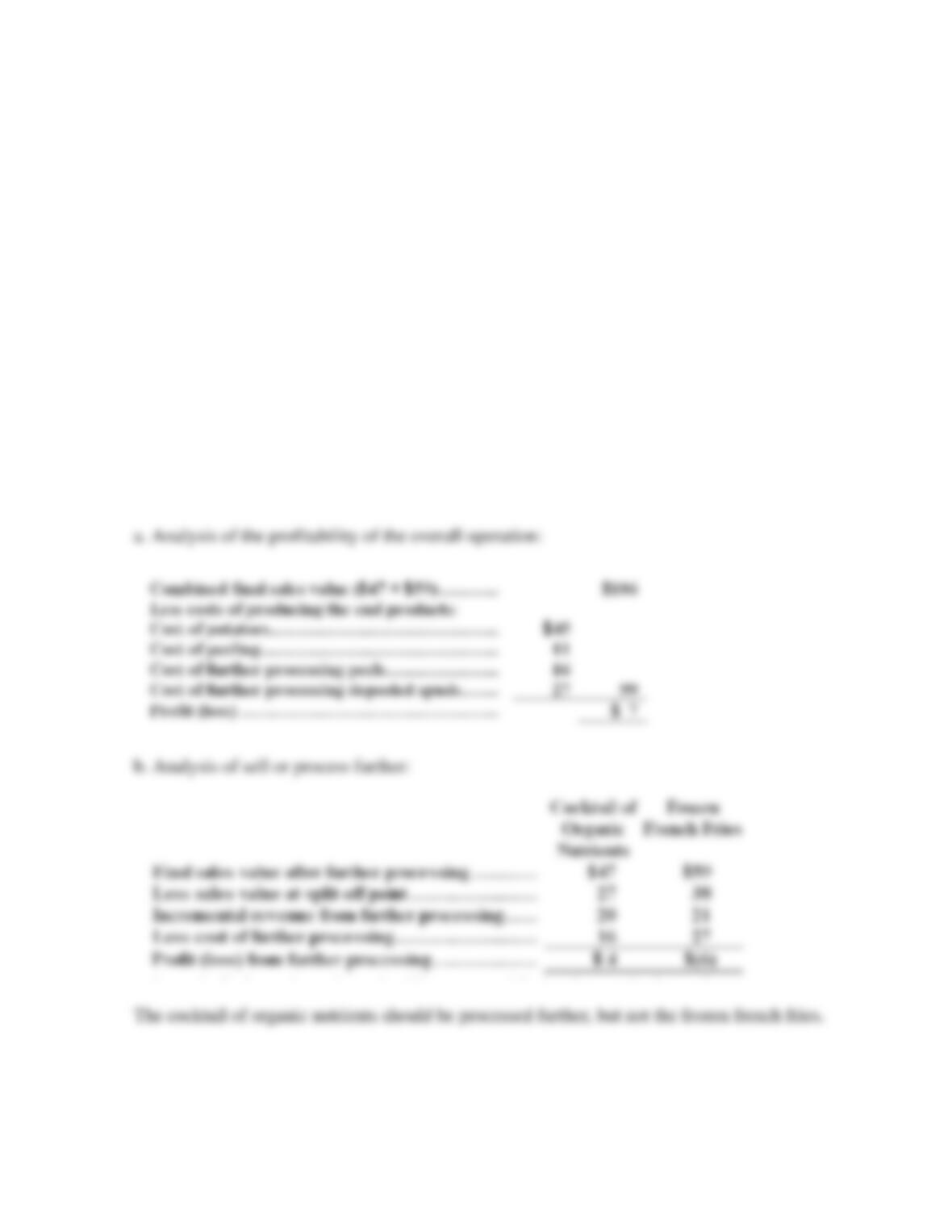
151. Prevatte Corporation purchases potatoes from farmers. The potatoes are then peeled,
producing two intermediate products-peels and depeeled spuds. The peels can then be
processed further to make a cocktail of organic nutrients. And the depeeled spuds can be
processed further to make frozen french fries. A batch of potatoes costs $45 to buy from
farmers and $11 to peel in the company’s plant. The peels produced from a batch can be sold
as is for animal feed for $27 or processed further for $16 to make the cocktail of nutrients that
are sold for $47. The depeeled spuds can be sold as is for $38 or processed further for $27 to
make frozen french fries that are sold for $59.
Required:
a. Assuming that no other costs are involved in processing potatoes or in selling products,
how much money does the company make from processing one batch of potatoes into the
cocktail of organic nutrients and frozen french fries? Show your work!
b. Should each of the intermediate products, peels and depeeled spuds, be sold as is or
processed further into an end product? Explain.

Chapter 12 – Differential Analysis: The Key to Decision Making
Chapter 12 – Differential Analysis: The Key to Decision Making
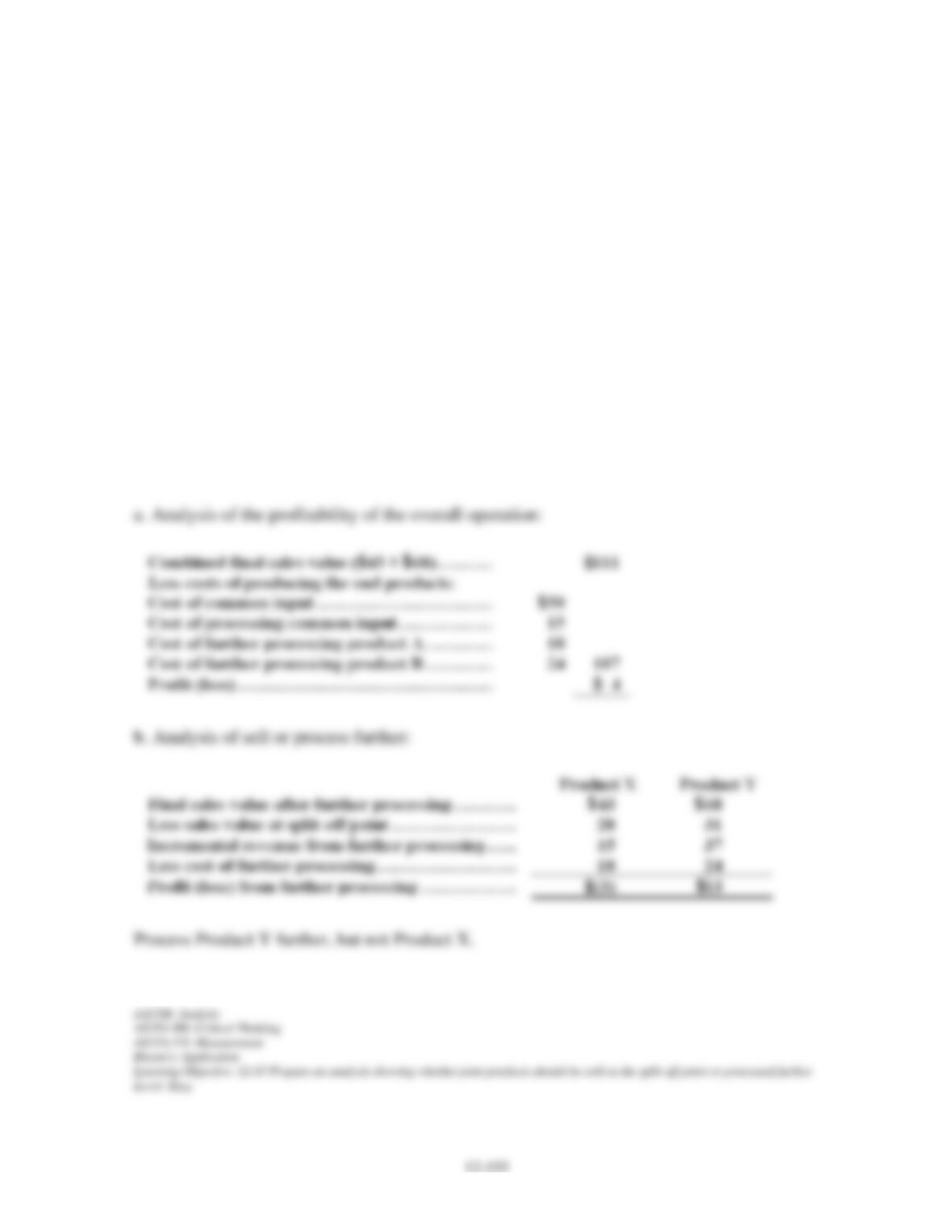
152. Spurrier Corporation produces two intermediate products, A and B, from a common
input. Intermediate product A can be further processed into end product X. Intermediate
product B can be further processed into end product Y. The common input is purchased in
batches that cost $50 each and the cost of processing a batch to produce intermediate products
A and B is $15. Intermediate product A can be sold as is for $28 or processed further for $18
to make end product X that is sold for $43. Intermediate product B can be sold as is for $31 or
processed further for $24 to make end product Y that is sold for $68.
Required:
a. Assuming that no other costs are involved in processing potatoes or in selling products,
how much money does the company make from processing one batch of the common input
into the end products X and Y? Show your work!
b. Should each of the intermediate products, A and B, be sold as is or processed further into
an end product? Explain.
Chapter 12 – Differential Analysis: The Key to Decision Making
153. Harris Corp. manufactures three products from a common input in a joint processing
operation. Joint processing costs up to the split-off point total $200,000 per year. The
company allocates these costs to the joint products on the basis of their total sales value at the
split-off point.
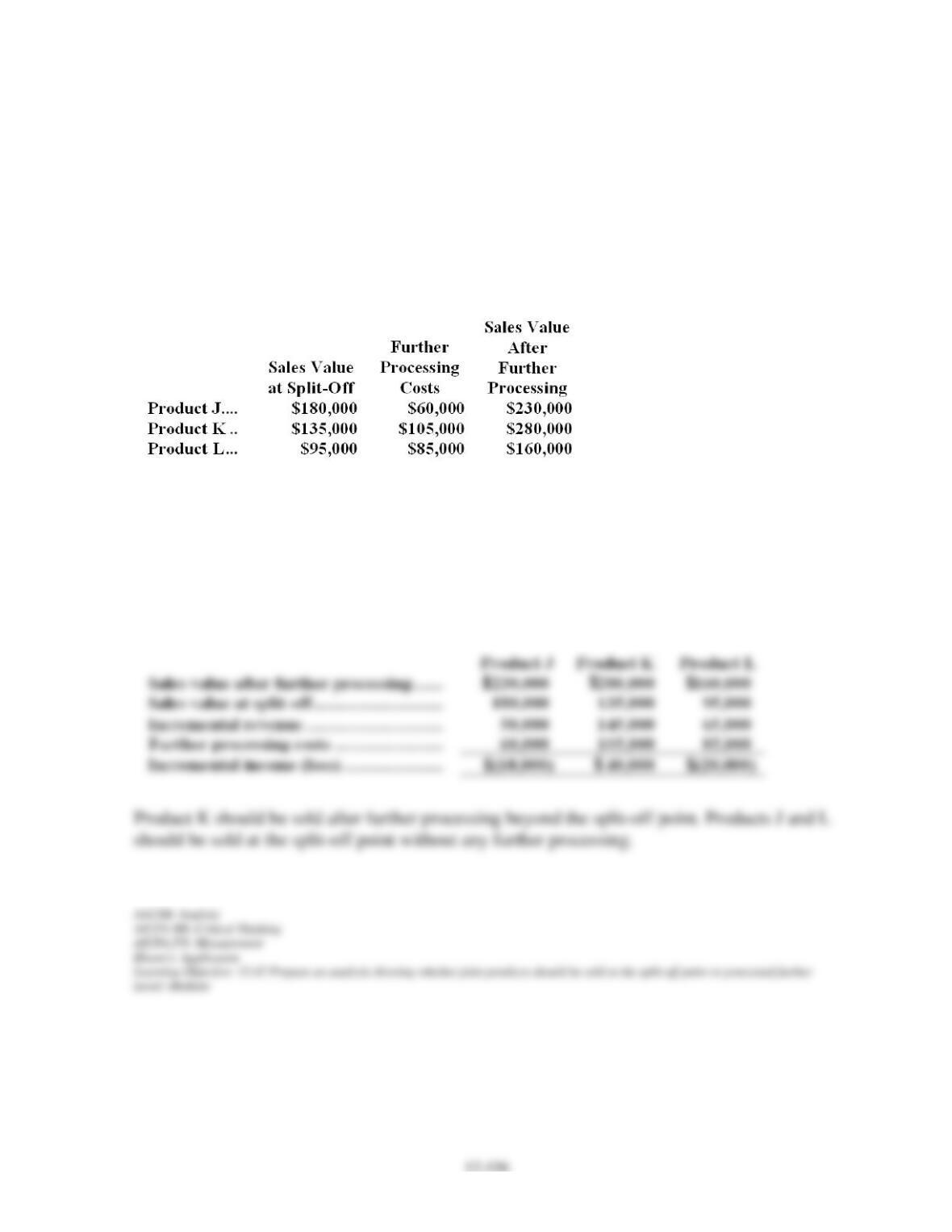
Each product may be sold at the split-off point or processed further. The additional processing
costs and sales value after further processing for each product (on an annual basis) are:
The “Further Processing Costs” consist of variable and avoidable fixed costs.
Required:
Which product or products should be sold at the split-off point, and which product or products
should be processed further? Show computations.
Chapter 12 – Differential Analysis: The Key to Decision Making
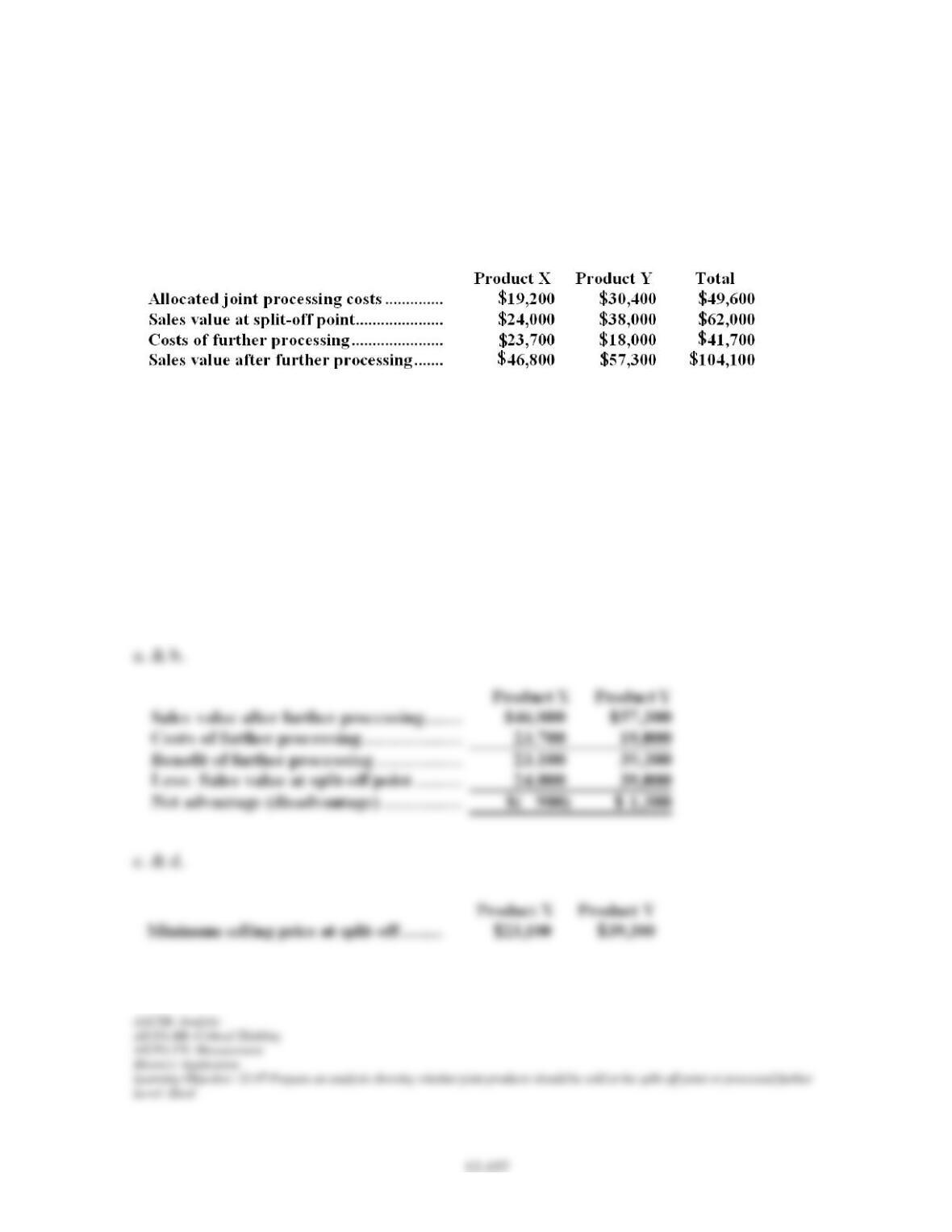
154. Iaukea Company makes two products from a common input. Joint processing costs up to
the split-off point total $49,600 a year. The company allocates these costs to the joint products
on the basis of their total sales values at the split-off point. Each product may be sold at the
split-off point or processed further. Data concerning these products appear below:
Required:
a. What is the net monetary advantage (disadvantage) of processing Product X beyond the
split-off point?
b. What is the net monetary advantage (disadvantage) of processing Product Y beyond the
split-off point?
c. What is the minimum amount the company should accept for Product X if it is to be sold at
the split-off point?
d. What is the minimum amount the company should accept for Product Y if it is to be sold at
the split-off point?