71.
Your firm needs a computerized machine tool lathe that costs $50,000, requires $10,000 in
installation, $5,000 in freight charges, and another $12,000 in maintenance for each year
of its three-year life. After three years, this machine will be replaced. The machine falls
into the MACRS three-year class life category. Assume a tax rate of 30 percent and a
discount rate of 12 percent. Calculate the depreciation tax shield for this project in year 1.
72.
Your firm needs a computerized machine tool lathe that costs $50,000, requires $10,000 in
installation, $5,000 in freight charges, and another $12,000 in maintenance for each year
of its three-year life. After three years, this machine will be replaced. The machine falls
into the MACRS three-year class life category. Assume a tax rate of 30 percent and a
discount rate of 12 percent. If the lathe can be sold for $7,000 at the end of year 3, what is
the after-tax salvage value?
73.
Your firm needs a computerized machine tool lathe that costs $50,000, requires $10,000 in
installation, and another $12,000 in maintenance for each year of its three-year life. After
three years, this machine will be replaced. The machine falls into the MACRS three-year
class life category. Assume a tax rate of 30 percent and a discount rate of 12 percent. If
the lathe can be sold for $7,000 at the end of year 3, what is the after-tax salvage value?
74.
Your firm needs a computerized machine tool lathe that costs $50,000 and another
$12,000 in maintenance for each year of its three-year life. After three years, this machine
will be replaced. The machine falls into the MACRS three-year class life category. Assume
a tax rate of 30 percent and a discount rate of 12 percent. If the lathe can be sold for
$6,000 at the end of year 3, what is the after-tax salvage value?
75.
You have been asked by the president of your company to evaluate the proposed
acquisition of a new special-purpose truck for $50,000. The truck falls into the MACRS
three-year class, and it will be sold after three years for $20,000. Use of the truck will
require an increase in NWC (spare parts inventory) of $2,000. The truck will have no effect
on revenues, but it is expected to save the firm $20,000 per year in before–tax operating
costs, mainly labor. The firm’s marginal tax rate is 40 percent. What will the free cash
flows for this project be?
76.
You are evaluating a project for The Tiff-any golf club, guaranteed to correct that nasty
slice. You estimate the sales price of The Tiff-any to be $375 per unit and sales volume to
be 1,000 units in year 1; 1,400 units in year 2; and 1,325 units in year 3. The project has a
three-year life. Variable costs amount to $225 per unit and fixed costs are $100,000 per
year. The project requires an initial investment of $165,000 in assets that will be
depreciated straight-line to zero over the three-year project life. The actual market value
of these assets at the end of year 3 is expected to be $35,000. NWC requirements at the
beginning of each year will be approximately 10 percent of the projected sales during the
coming year. The tax rate is 34 percent and the required return on the project is 10
percent. What change in NWC occurs at the end of year 1?
77.
You are evaluating a project for The Ultimate recreational tennis racket, guaranteed to
correct that wimpy backhand. You estimate the sales price of The Ultimate to be $300 per
unit and sales volume to be 1,000 units in year 1; 1,250 units in year 2; and 1,325 units in
year 3. The project has a three-year life. Variable costs amount to $200 per unit and fixed
costs are $50,000 per year. The project requires an initial investment of $150,000 in assets
that will be depreciated straight-line to zero over the three-year project life. The actual
market value of these assets at the end of year 3 is expected to be $25,000. NWC
requirements at the beginning of each year will be approximately 10 percent of the
projected sales during the coming year. The tax rate is 30 percent and the required return
on the project is 10 percent. What will the free cash flow for this project be in year 2?
78.
You are evaluating a project for The Ultimate recreational tennis racket, guaranteed to
correct that wimpy backhand. You estimate the sales price of The Ultimate to be $300 per
unit and sales volume to be 1,000 units in year 1; 1,250 units in year 2; and 1,325 units in
year 3. The project has a three-year life. Variable costs amount to $200 per unit and fixed
costs are $50,000 per year. The project requires an initial investment of $150,000 in assets
which will be depreciated straight-line to zero over the three-year project life. The actual
market value of these assets at the end of year 3 is expected to be $25,000. NWC
requirements at the beginning of each year will be approximately 10 percent of the
projected sales during the coming year. The tax rate is 30 percent and the required return
on the project is 10 percent. What will the free cash flow for this project be in year 3?
79.
A new project would require an immediate increase in raw materials in the amount of
$12,000. The firm expects that accounts payable will automatically increase $8,500. How
much must the firm expect its investment in net working capital to change if they accept
this project?
80.
A new project would require an immediate increase in raw materials in the amount
$17,000. The firm expects that accounts payable will automatically increase $7,000. How
much must the firm expect its investment in net working capital to increase if they accept
this project?
81.
To correctly project cash flows, we need to consider all of the factors EXCEPT:
82.
A financial analyst calculated that the after-tax salvage value for a machine was $10,200.
The current book value of the asset is $25,000 and the firm’s tax rate is 20 percent. How
much could the machine be sold for today?
83.
A financial analyst calculated that the after-tax salvage value for a machine was $10,200.
The current book value of the asset is $12,000 and the firm’s tax rate is 30 percent. How
much could the machine be sold for today?
84.
Which of the following statements is correct?
85.
Which of the following statements is correct?
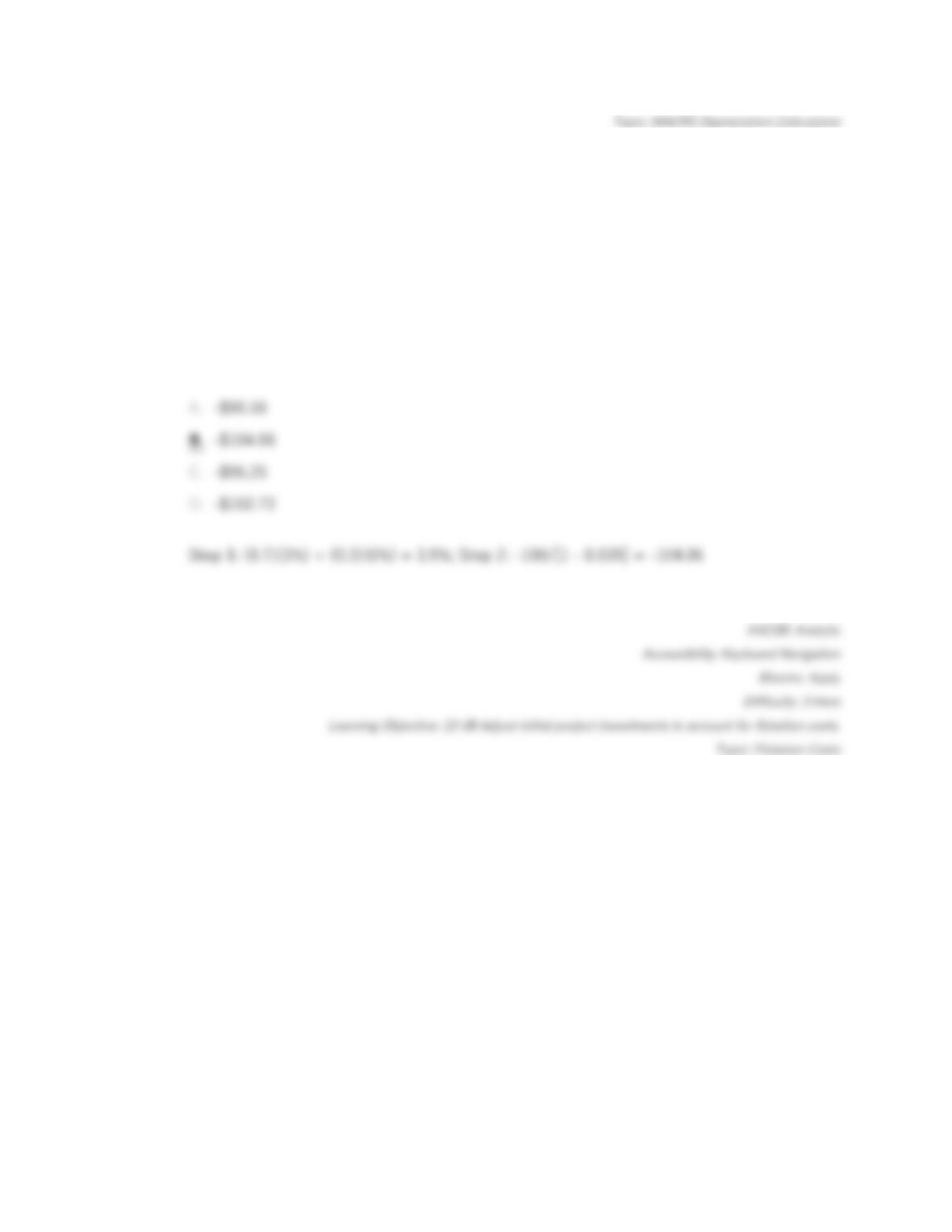
86.
Your company is considering a project that will cost $100. The project will generate after–
tax cash flows of $37.50 per year for five years. The WACC is 10 percent and the firm’s
D/A ratio is 0.70. The flotation cost for equity is 6 percent, the flotation cost for debt is 3
percent, and your firm does not plan on issuing any preferred stock within its capital
structure. If your firm follows the practice of incorporating flotation costs into the project’s
initial investment, what is the firm’s flotation–adjusted cash flow in year 0?
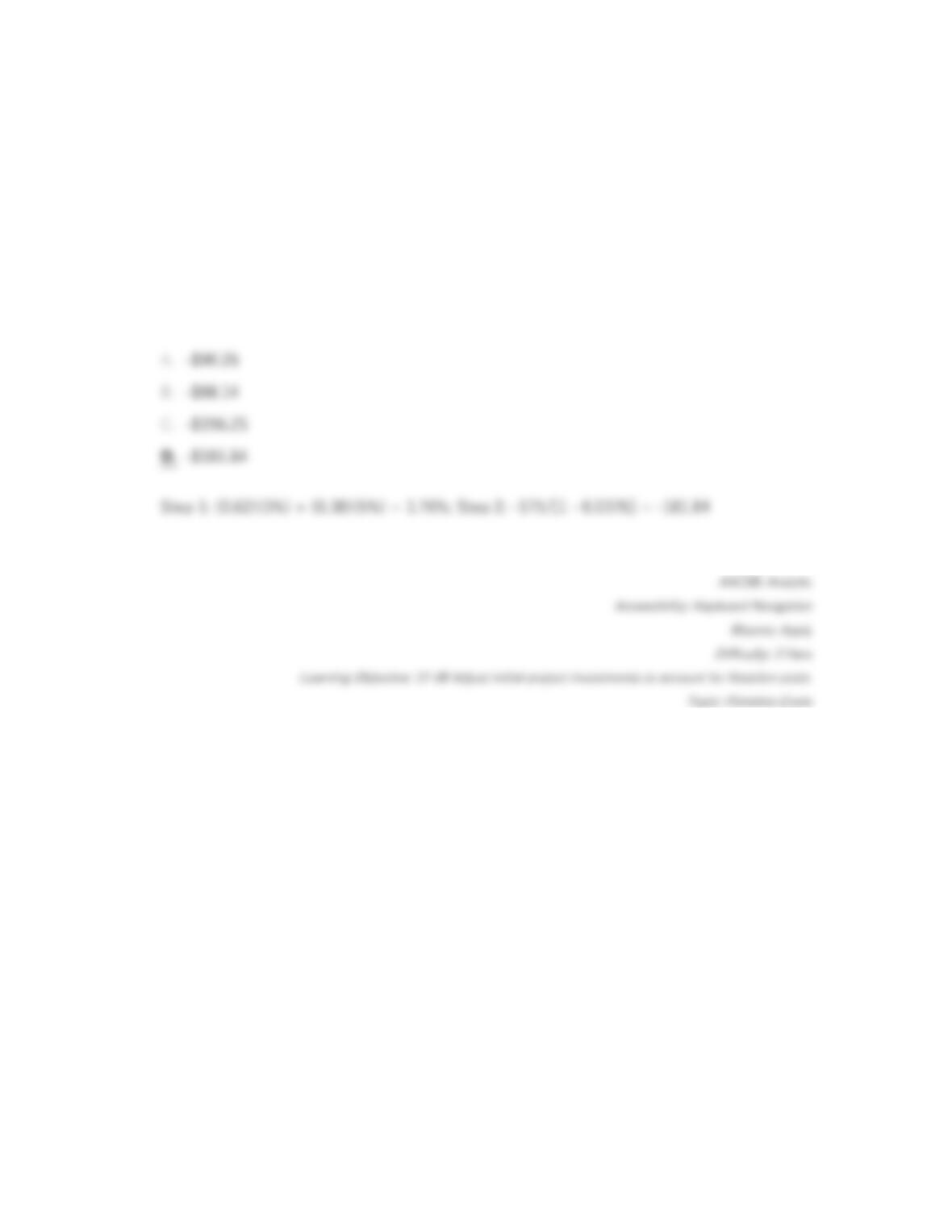
87.
Your company is considering a project that will cost $175. The project will generate after–
tax cash flows of $37.50 per year for five years. The WACC is 10 percent and the firm’s
D/A ratio is 0.62. The flotation cost for equity is 5 percent, the flotation cost for debt is 3
percent, and your firm does not plan on issuing any preferred stock within its capital
structure. If your firm follows the practice of incorporating flotation costs into the project’s
initial investment, what is the firm’s flotation–adjusted cash flow in year 0?
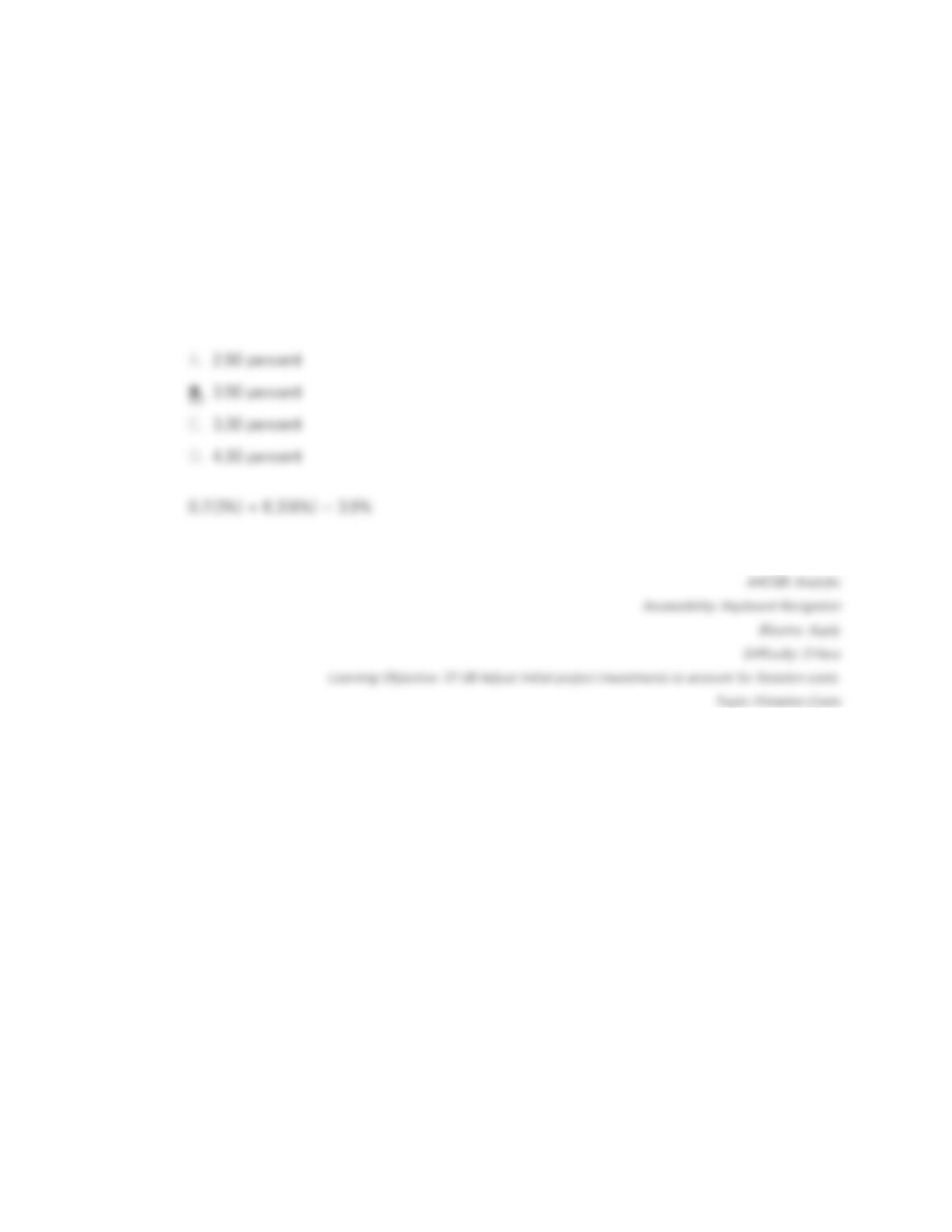
88.
Your company is considering a project that will cost $100. The project will generate after–
tax cash flows of $37.50 per year for five years. The WACC is 10 percent and the firm’s
D/A ratio is 0.70. The flotation cost for equity is 6 percent, the flotation cost for debt is 3
percent, and your firm does not plan on issuing any preferred stock within its capital
structure. If your firm follows the practice of incorporating flotation costs into the project’s
initial investment, what is the weighted-average flotation cost for the firm?
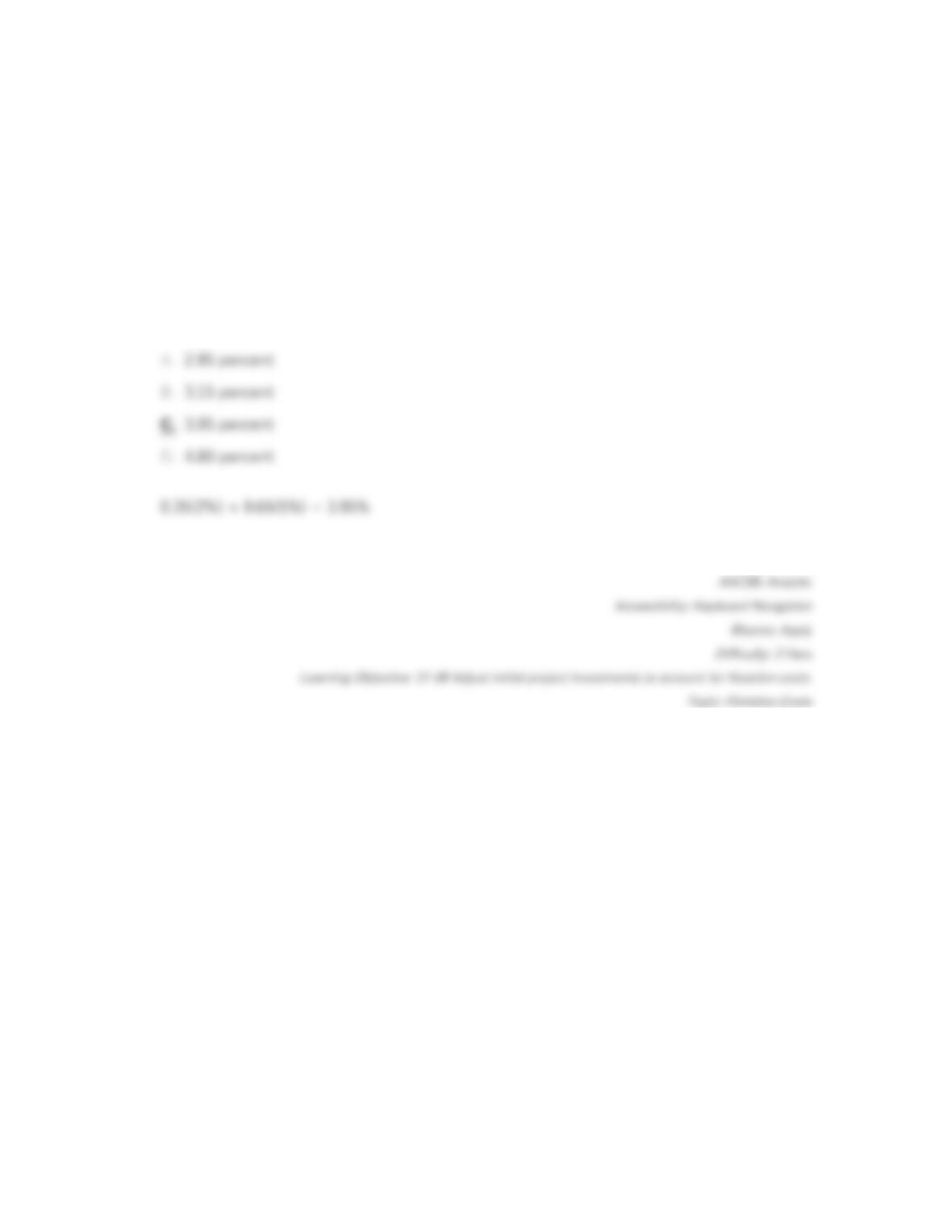
89.
Your company is considering a project that will cost $100. The project will generate after–
tax cash flows of $37.50 per year for five years. The WACC is 10 percent and the firm’s
D/A ratio is 0.35. The flotation cost for equity is 5 percent, the flotation cost for debt is 2
percent, and your firm does not plan on issuing any preferred stock within its capital
structure. If your firm follows the practice of incorporating flotation costs into the project’s
initial investment, what is the weighted-average flotation cost for the firm?
90.
Your company is considering a project that will cost $100. The project will generate after–
tax cash flows of $37.50 per year for five years. The WACC is 10 percent and the firm’s
D/A ratio is 0.40. The flotation cost for equity is 3 percent, the flotation cost for debt is 2
percent, and your firm does not plan on issuing any preferred stock within its capital
structure. If your firm follows the practice of incorporating flotation costs into the project’s
initial investment, what is the weighted-average flotation cost for the firm?
91.
Suppose you sell a fixed asset for $99,000 when its book value is $75,000. If your
company’s marginal tax rate is 39 percent, what is the gain or loss on the sale of the
asset?
92.
You are trying to pick the least expensive car for your new delivery service. You have two
choices: the Scion xA, which will cost $13,000 to purchase and which will have OCF of –
$1,200 annually throughout the vehicle’s expected life of three years as a delivery vehicle;
and the Toyota Prius, which will cost $23,000 to purchase and which will have OCF of –
$550 annually throughout that vehicle’s expected five-year life. Both cars will be worthless
at the end of their life. If you intend to replace whichever type of car you choose with the
same thing when its life runs out, again and again out into the foreseeable future, and if
your business has a cost of capital of 12 percent, what is the difference in the EAC of the
two cars?