Chapter 12 – Differential Analysis: The Key to Decision Making
12–61
74. Cosmo is considering a promotional campaign at the Town Store that would not affect the
Mall Store. Increasing annual promotional expenses at the Town Store by $60,000 in order to
increase Town Store sales by ten percent would result in a monthly increase (decrease) in
Cosmo’s operating income of:
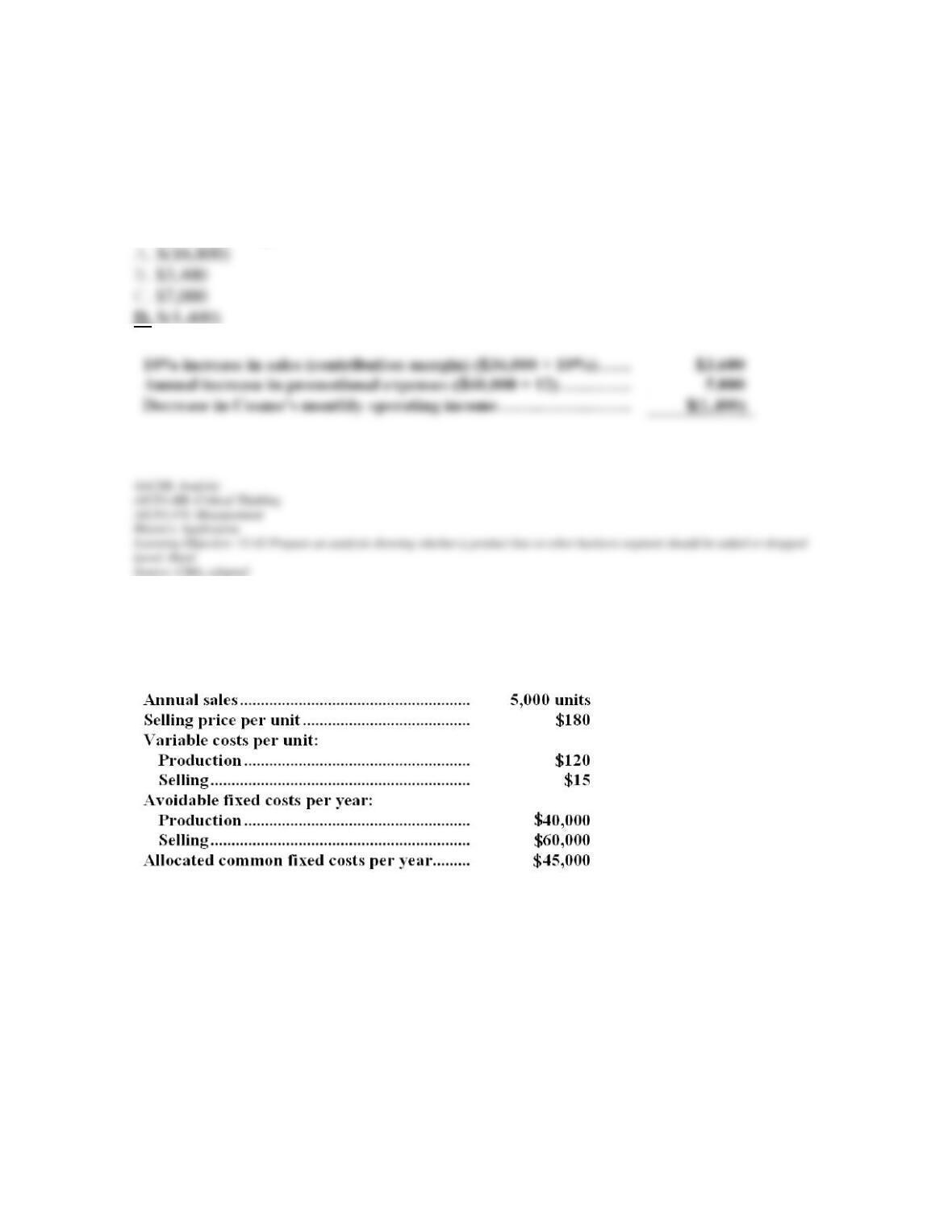
The Cabinet Shoppe is considering the addition of a new line of kitchen cabinets to its current
product lines. Expected cost and revenue data for the new cabinets are as follows:
If the new cabinets are added, it is expected that the contribution margin of other product lines
at the cabinet shop will drop by $20,000 per year.
Chapter 12 – Differential Analysis: The Key to Decision Making
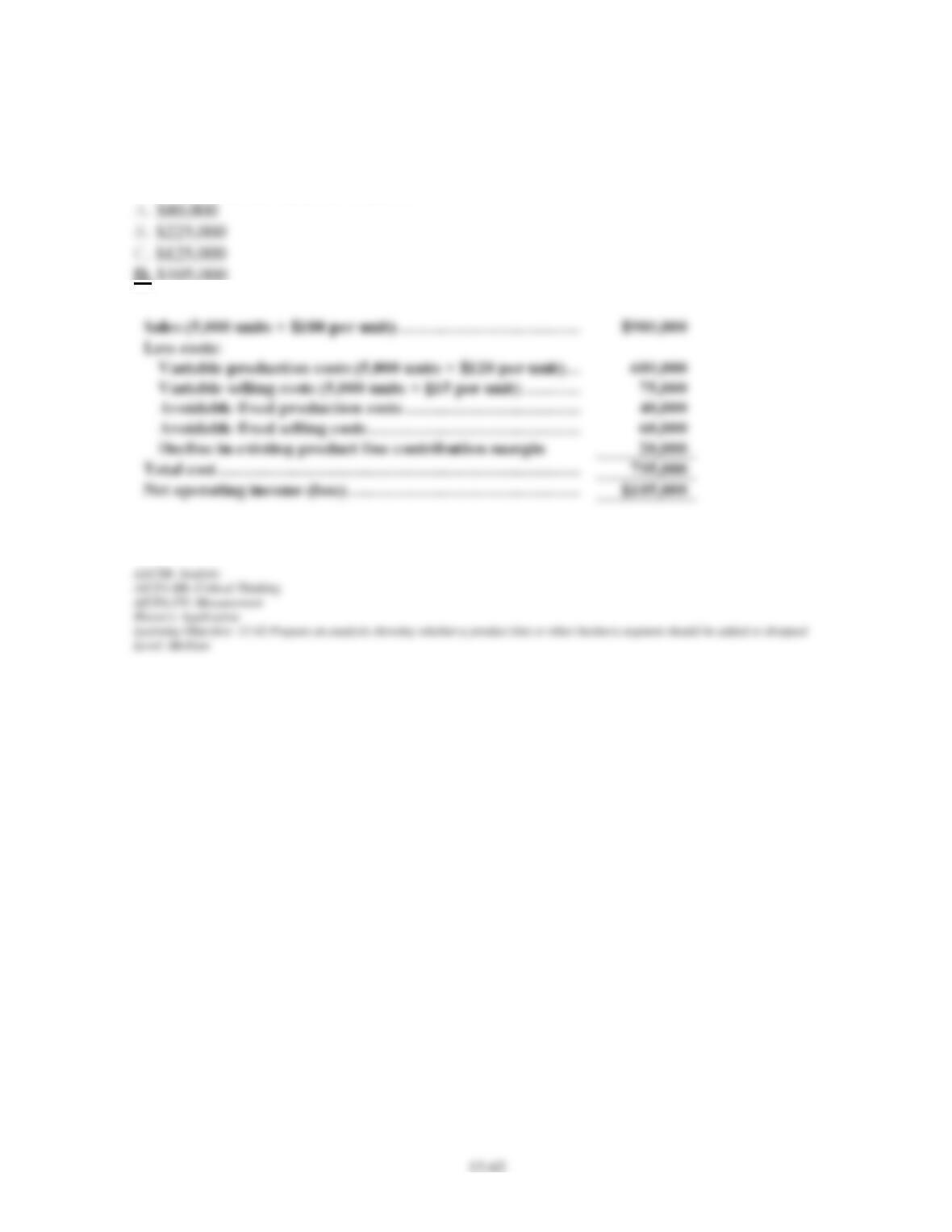
75. If the new cabinet product line is added next year, the increase in net operating income
resulting from this decision would be:
Chapter 12 – Differential Analysis: The Key to Decision Making
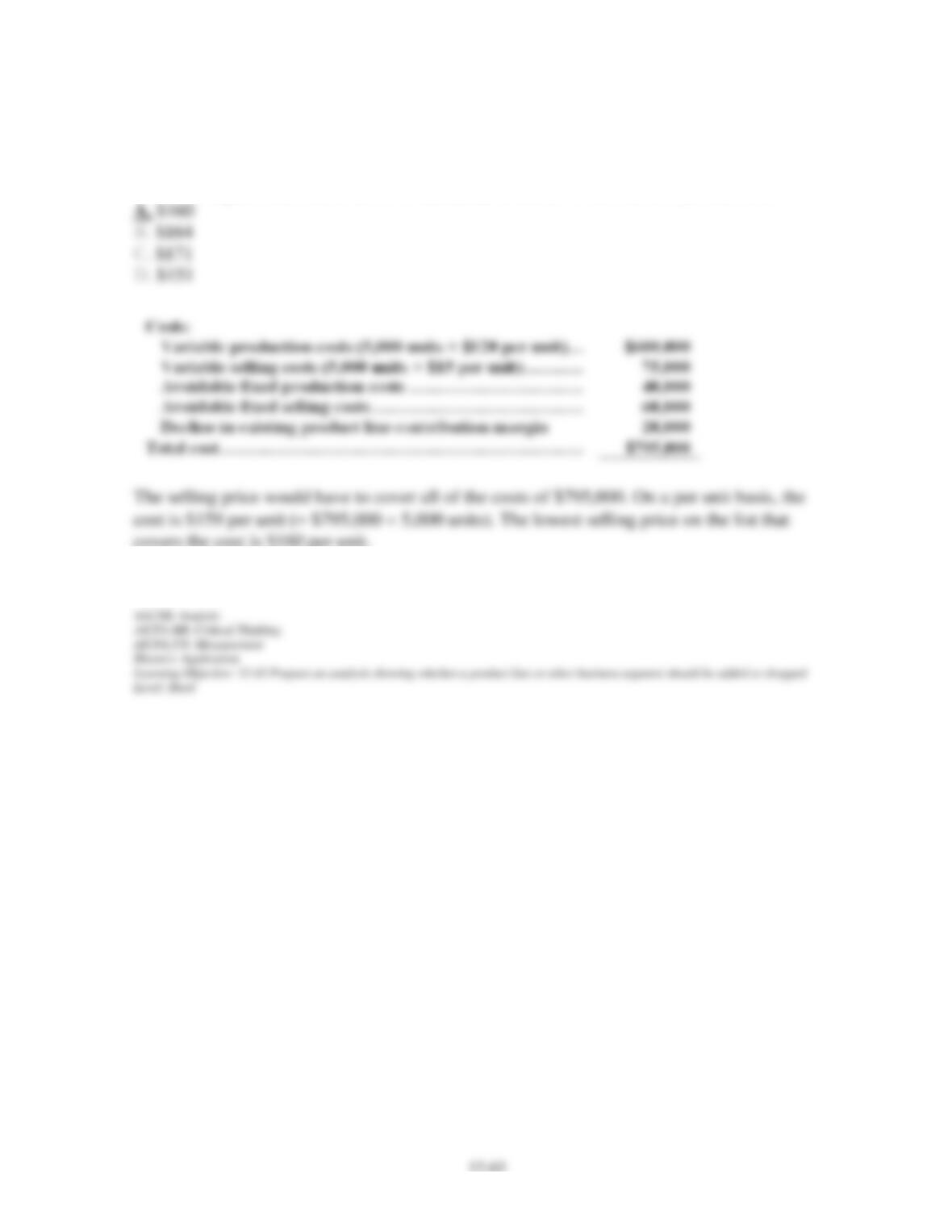
76. What is the lowest selling price per unit that could be charged for the new cabinets from
the following list and still make it economically desirable to add the new product line?
Chapter 12 – Differential Analysis: The Key to Decision Making
12–64
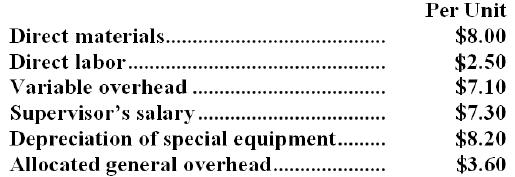
Knaack Corporation is presently making part R20 that is used in one of its products. A total
of 18,000 units of this part are produced and used every year. The company’s Accounting
Department reports the following costs of producing the part at this level of activity:
An outside supplier has offered to produce and sell the part to the company for $27.70 each. If
this offer is accepted, the supervisor’s salary and all of the variable costs, including direct
labor, can be avoided. The special equipment used to make the part was purchased many
years ago and has no salvage value or other use. The allocated general overhead represents
fixed costs of the entire company, none of which would be avoided if the part were purchased
instead of produced internally.
Chapter 12 – Differential Analysis: The Key to Decision Making
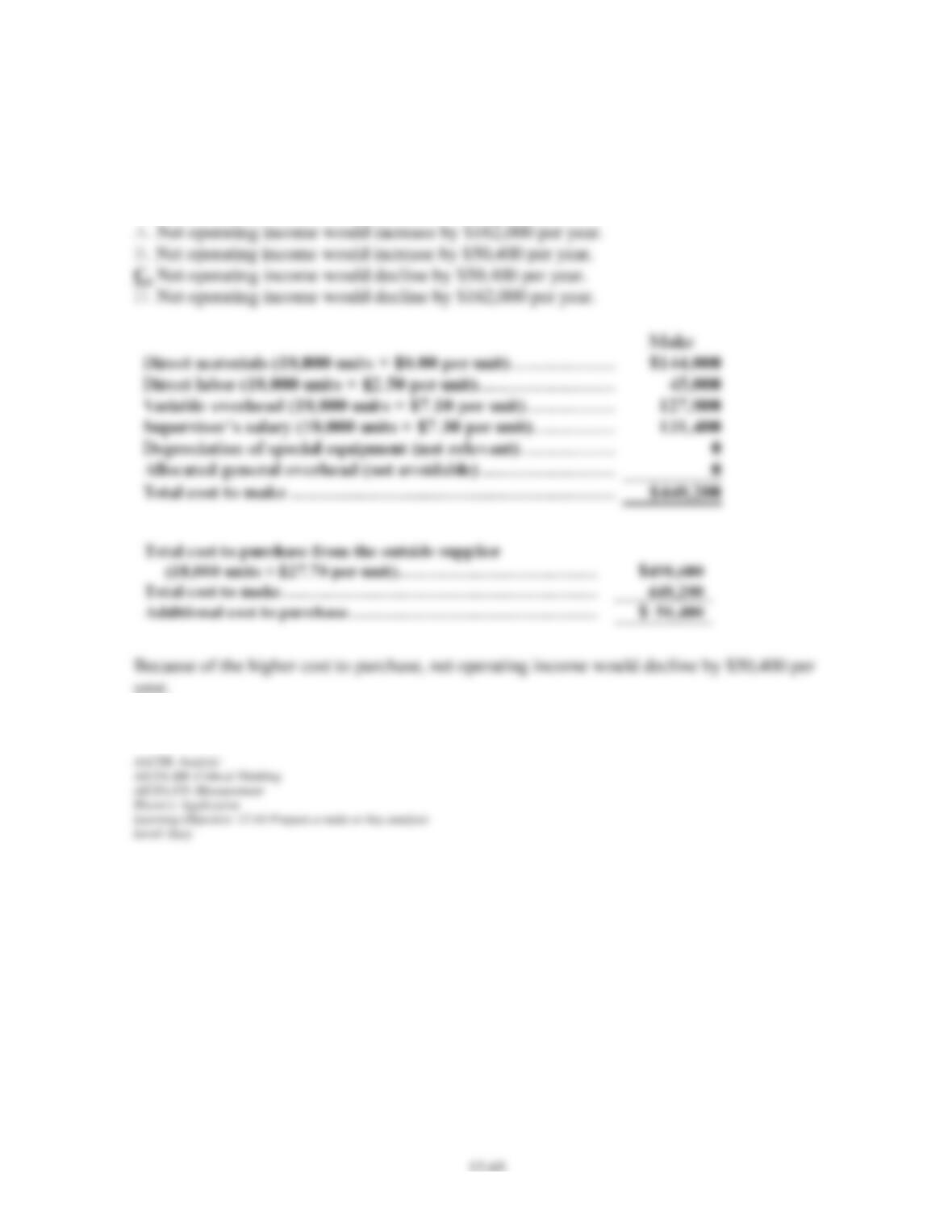
77. If management decides to buy part R20 from the outside supplier rather than to continue
making the part, what would be the annual impact on the company’s overall net operating
income?
Chapter 12 – Differential Analysis: The Key to Decision Making
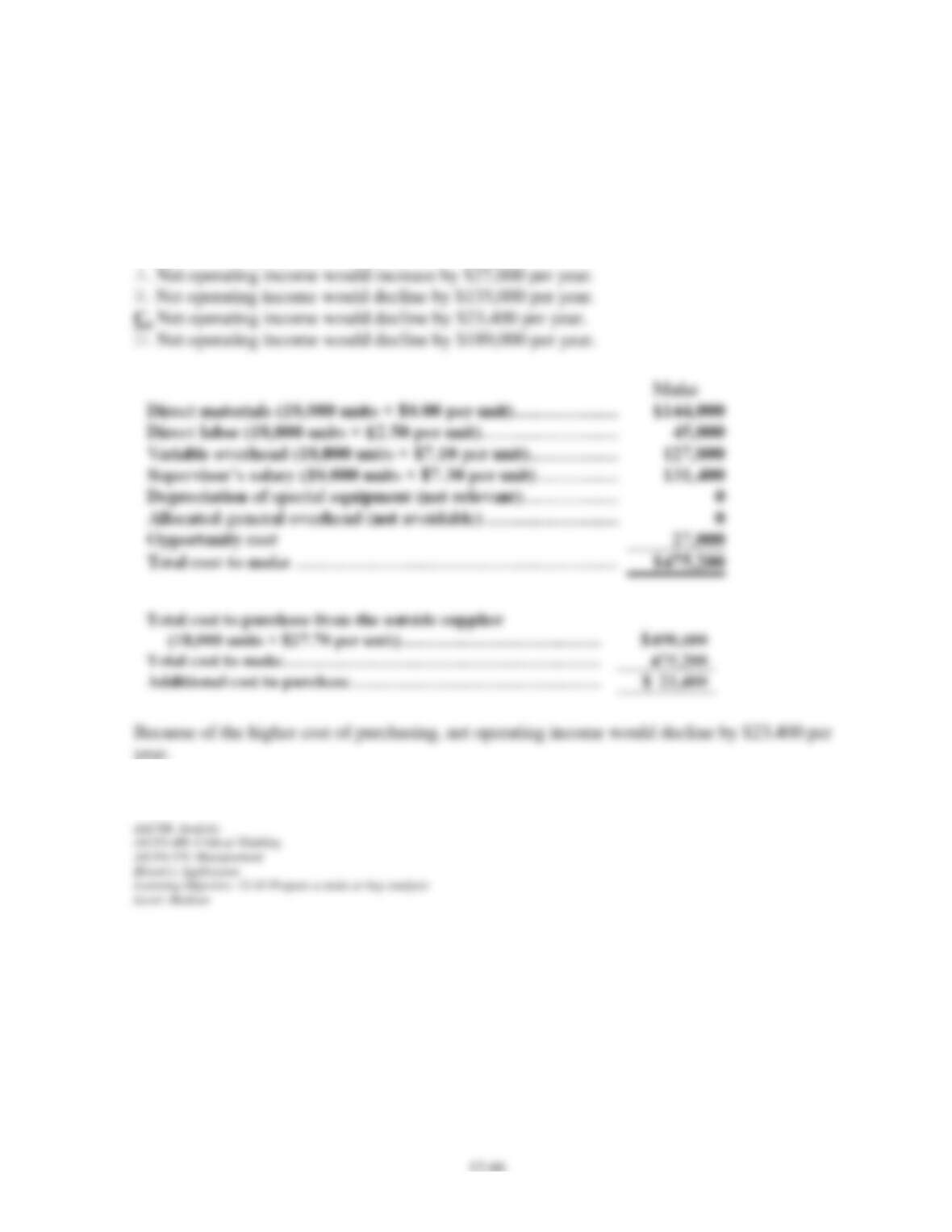
78. In addition to the facts given above, assume that the space used to produce part R20 could
be used to make more of one of the company’s other products, generating an additional
segment margin of $27,000 per year for that product. What would be the impact on the
company’s overall net operating income of buying part R20 from the outside supplier and
using the freed space to make more of the other product?
Chapter 12 – Differential Analysis: The Key to Decision Making
12–67
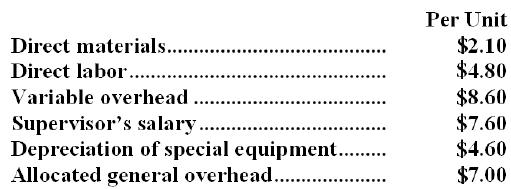
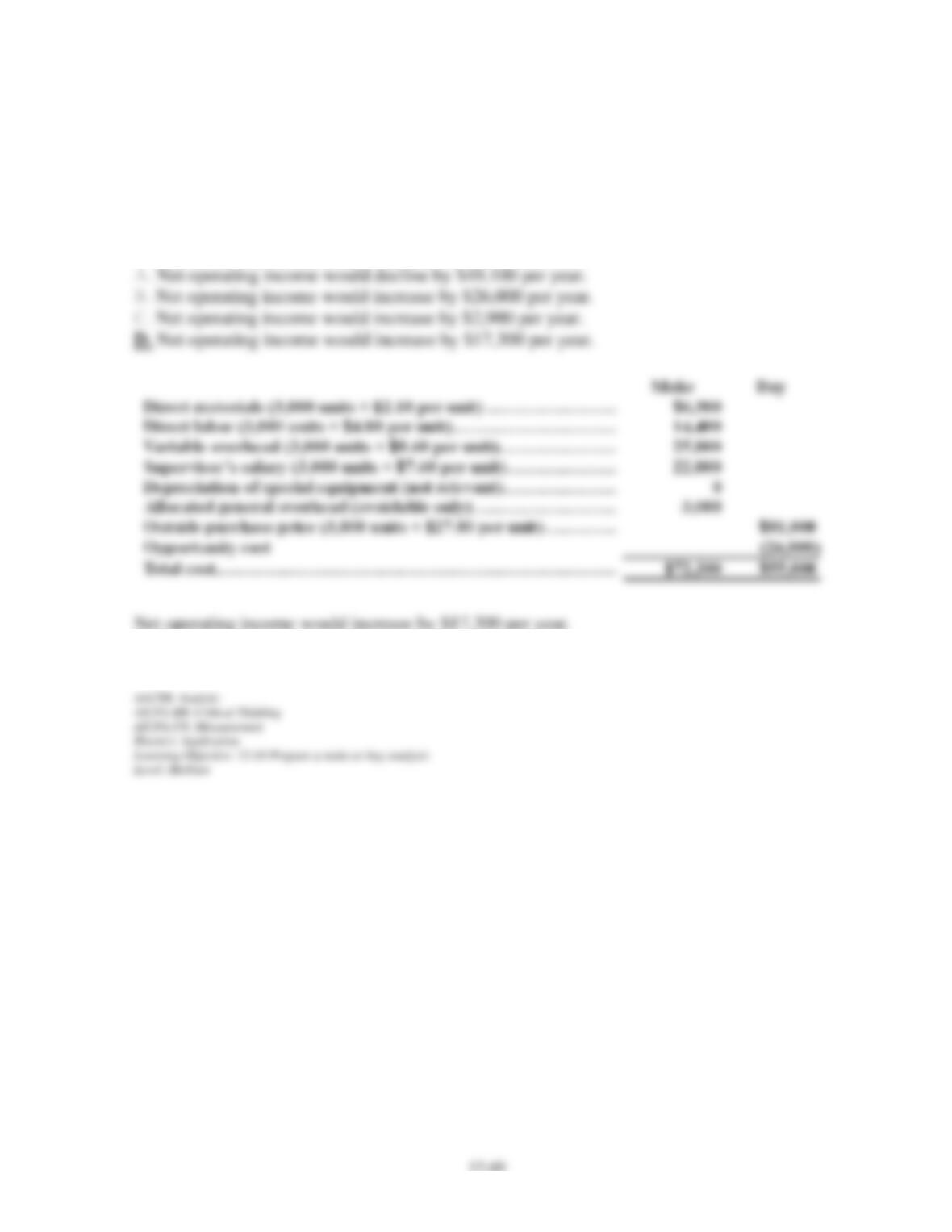
Meltzer Corporation is presently making part O13 that is used in one of its products. A total
of 3,000 units of this part are produced and used every year. The company’s Accounting
Department reports the following costs of producing the part at this level of activity:
An outside supplier has offered to produce and sell the part to the company for $27.00 each. If
this offer is accepted, the supervisor’s salary and all of the variable costs, including direct
labor, can be avoided. The special equipment used to make the part was purchased many
years ago and has no salvage value or other use. The allocated general overhead represents
fixed costs of the entire company. If the outside supplier’s offer were accepted, only $3,000 of
these allocated general overhead costs would be avoided.
Chapter 12 – Differential Analysis: The Key to Decision Making
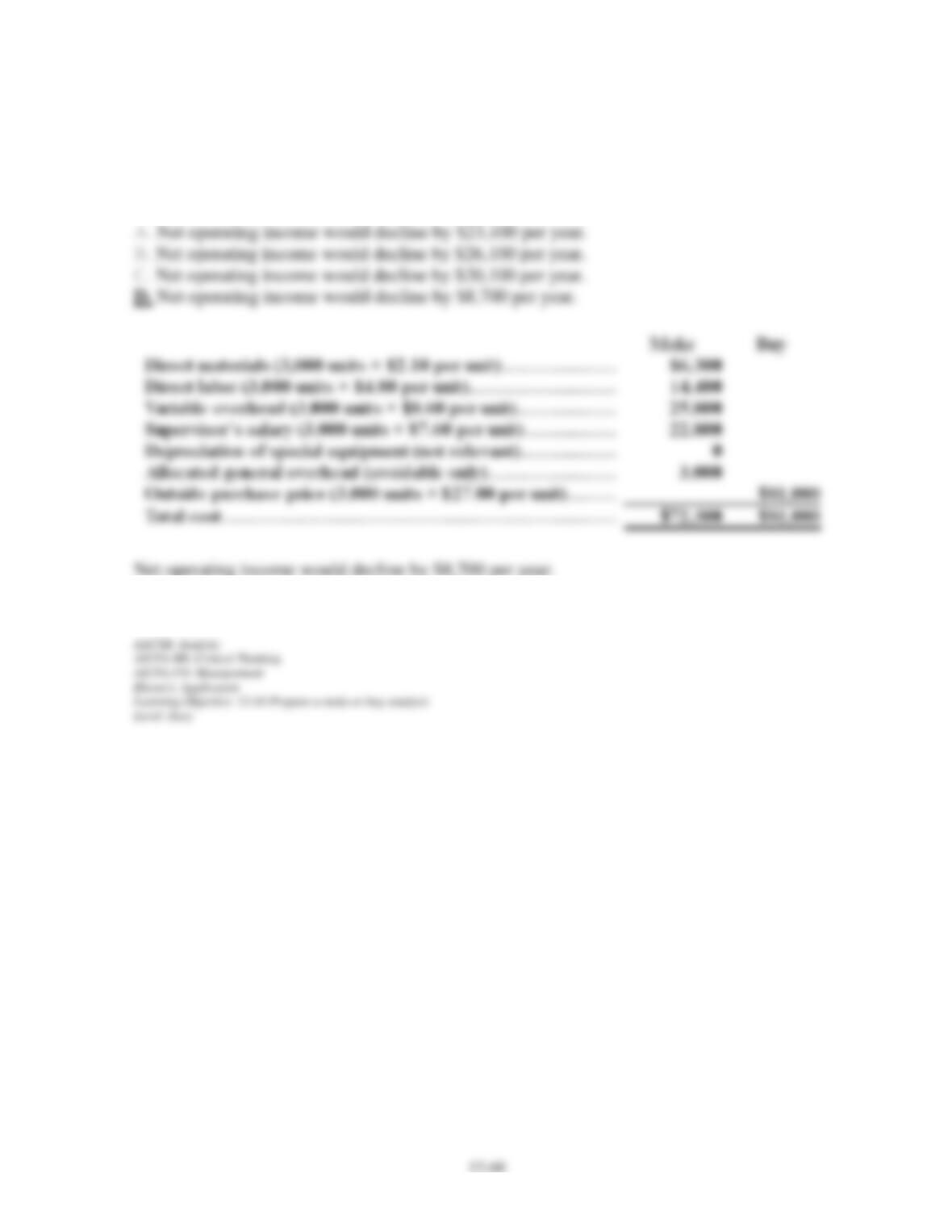
79. If management decides to buy part O13 from the outside supplier rather than to continue
making the part, what would be the annual impact on the company’s overall net operating
income?
Chapter 12 – Differential Analysis: The Key to Decision Making
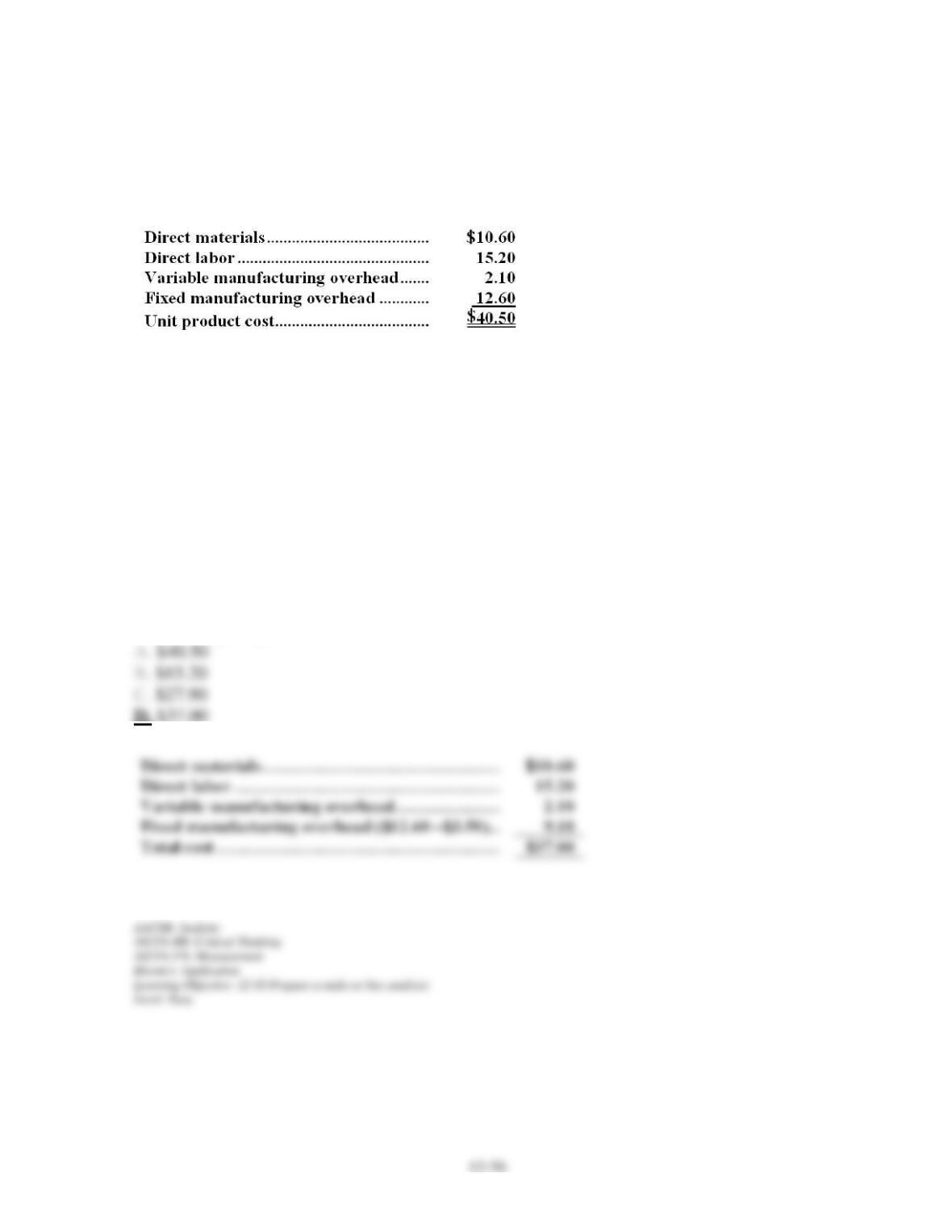
80. In addition to the facts given above, assume that the space used to produce part O13 could
be used to make more of one of the company’s other products, generating an additional
segment margin of $26,000 per year for that product. What would be the impact on the
company’s overall net operating income of buying part O13 from the outside supplier and
using the freed space to make more of the other product?
Chapter 12 – Differential Analysis: The Key to Decision Making
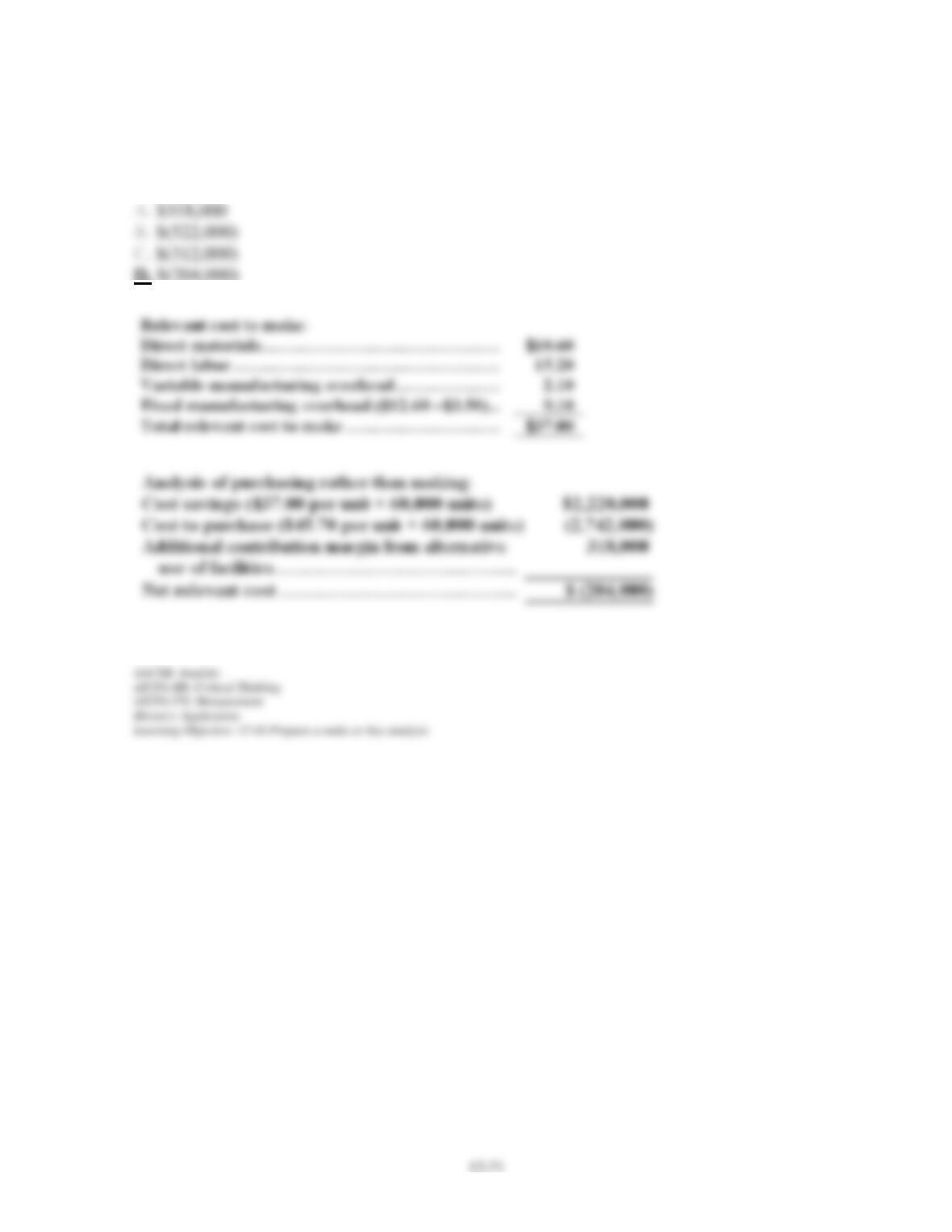
Ahsan Company makes 60,000 units per year of a part it uses in the products it manufactures.
The unit product cost of this part is computed as follows:
An outside supplier has offered to sell the company all of these parts it needs for $45.70 a
unit. If the company accepts this offer, the facilities now being used to make the part could be
used to make more units of a product that is in high demand. The additional contribution
margin on this other product would be $318,000 per year.
If the part were purchased from the outside supplier, all of the direct labor cost of the part
would be avoided. However, $3.50 of the fixed manufacturing overhead cost being applied to
the part would continue even if the part were purchased from the outside supplier. This fixed
manufacturing overhead cost would be applied to the company’s remaining products.
81. How much of the unit product cost of $40.50 is relevant in the decision of whether to
make or buy the part?
Chapter 12 – Differential Analysis: The Key to Decision Making
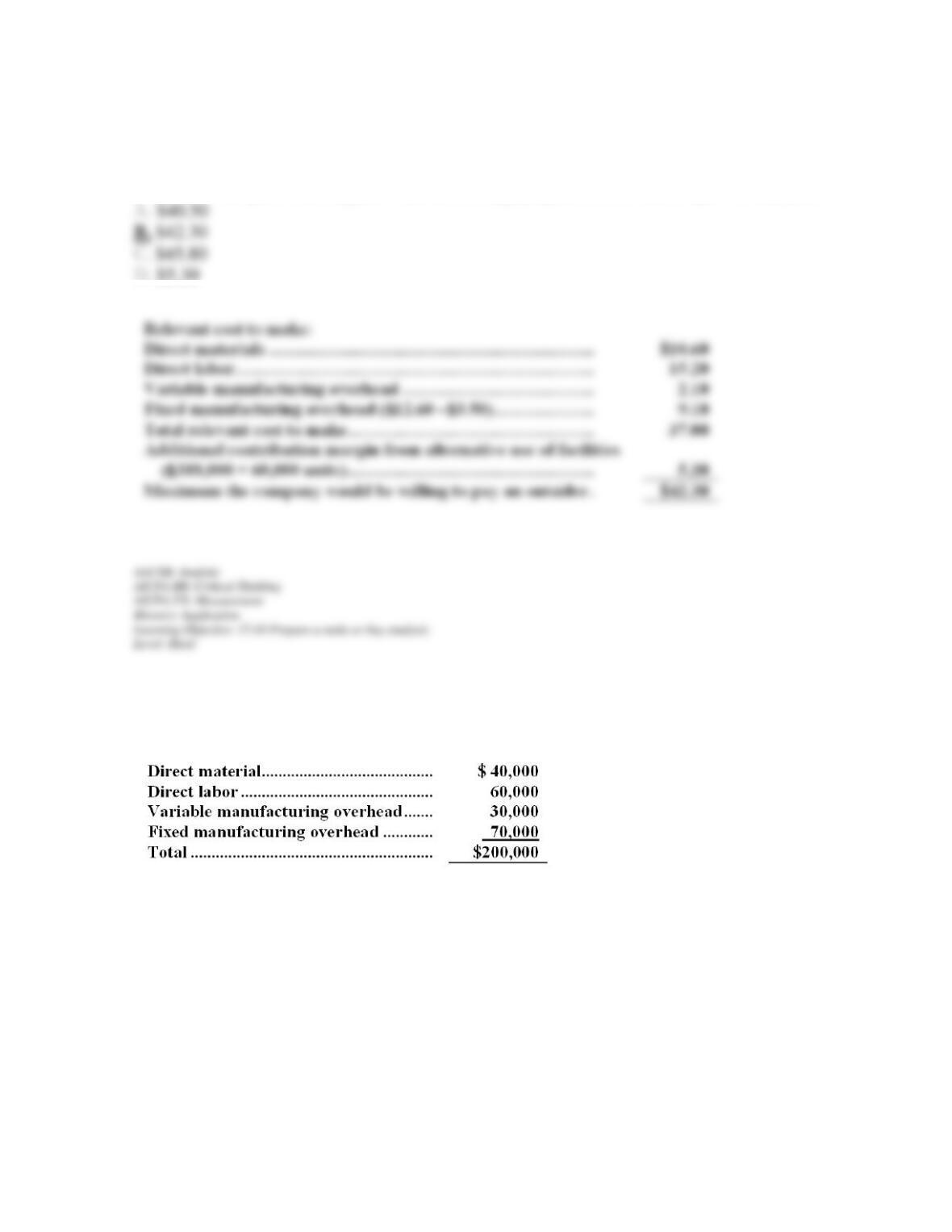
82. What is the net total dollar advantage (disadvantage) of purchasing the part rather than
making it?
Chapter 12 – Differential Analysis: The Key to Decision Making
12–72
83. What is the maximum amount the company should be willing to pay an outside supplier
per unit for the part if the supplier commits to supplying all 60,000 units required each year?
Talboe Company makes wheels which it uses in the production of children’s wagons.
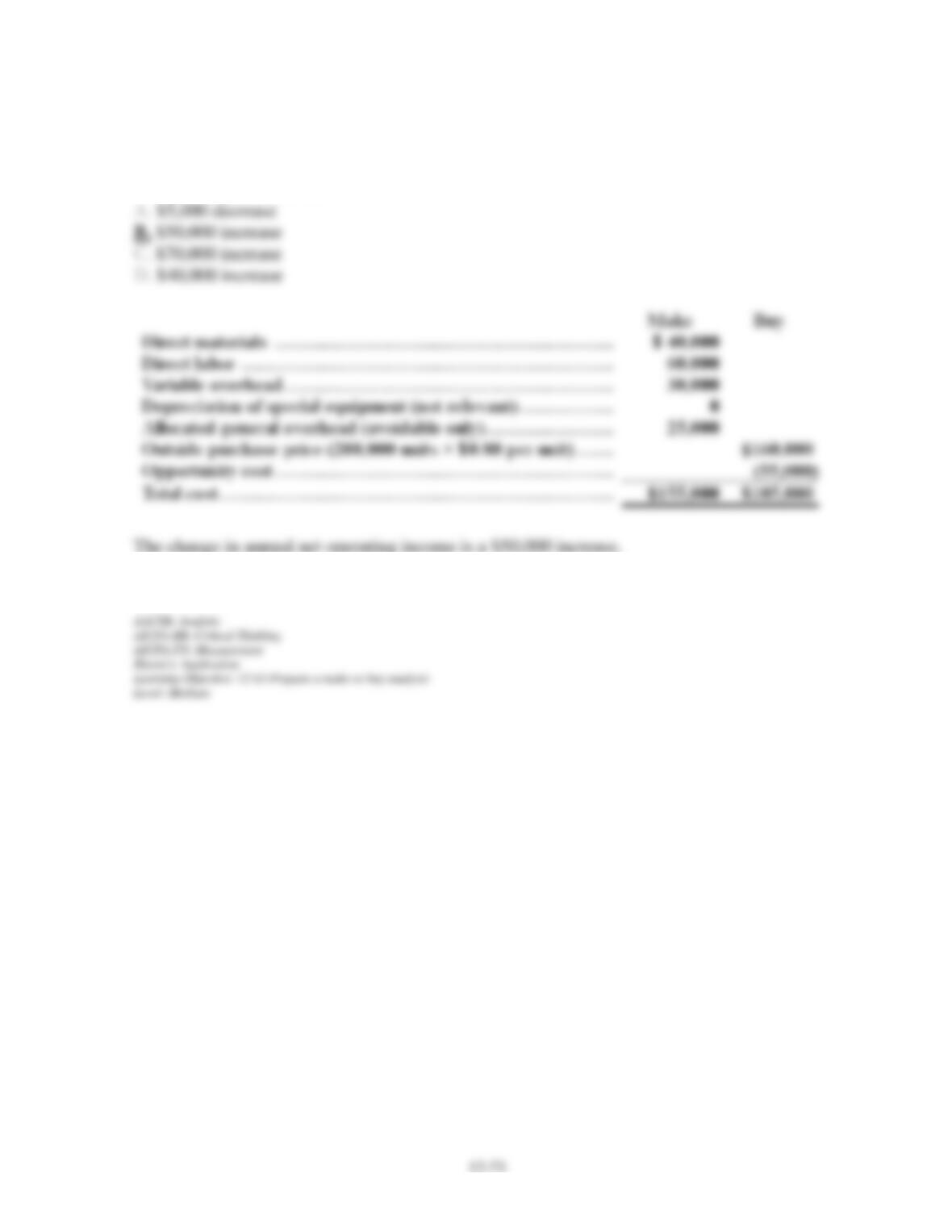
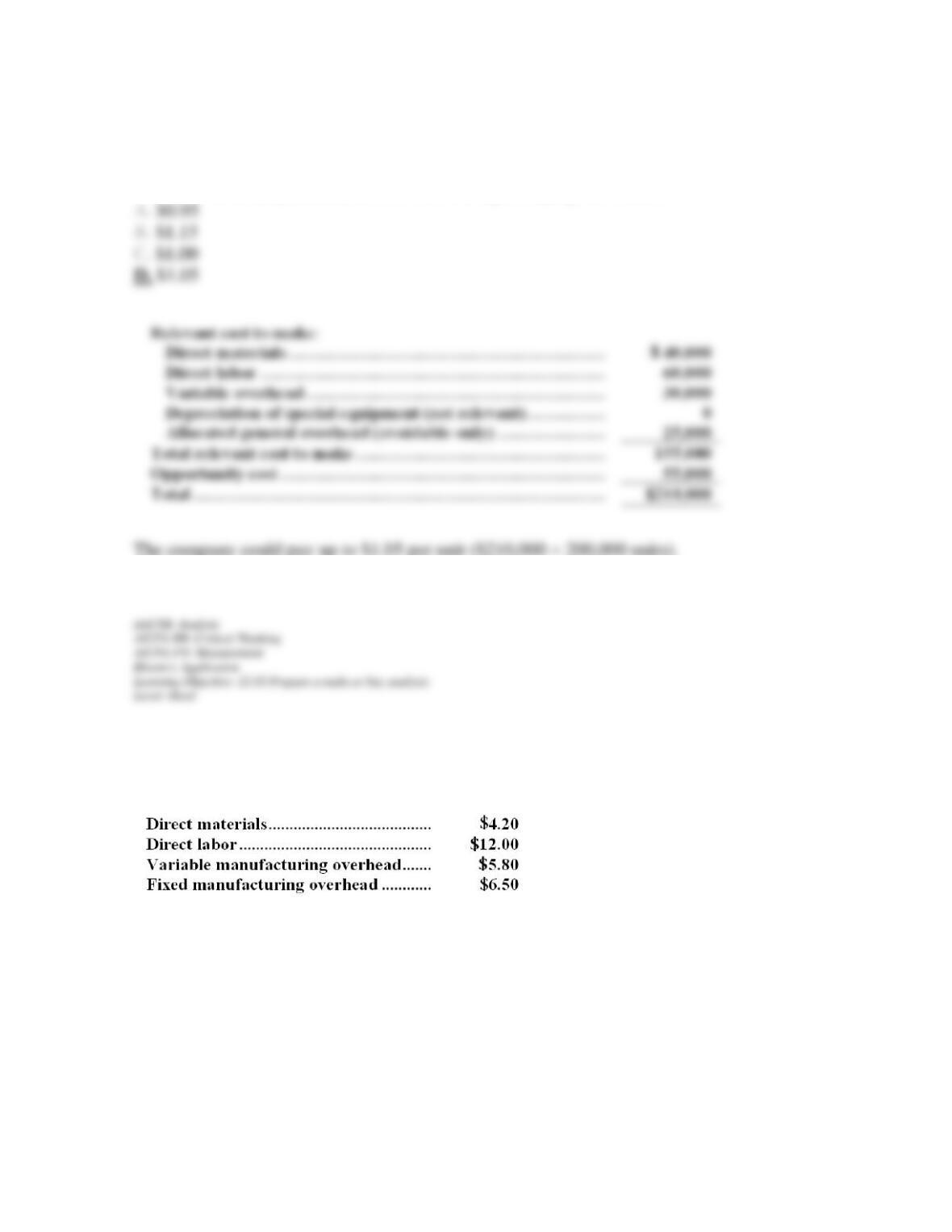
Talboe’s costs to produce 200,000 wheels annually are as follows:
An outside supplier has offered to sell Talboe similar wheels for $0.80 per wheel. If the
wheels are purchased from the outside supplier, $25,000 of annual fixed manufacturing
overhead would be avoided and the facilities now being used to make the wheels would be
rented to another company for $55,000 per year.
Chapter 12 – Differential Analysis: The Key to Decision Making
84. If Talboe chooses to buy the wheel from the outside supplier, then the change in annual
net operating income is a:
Chapter 12 – Differential Analysis: The Key to Decision Making
12–74
85. What is the highest price that Talboe could pay the outside supplier for each wheel and
still be economically indifferent between making or buying the wheels?
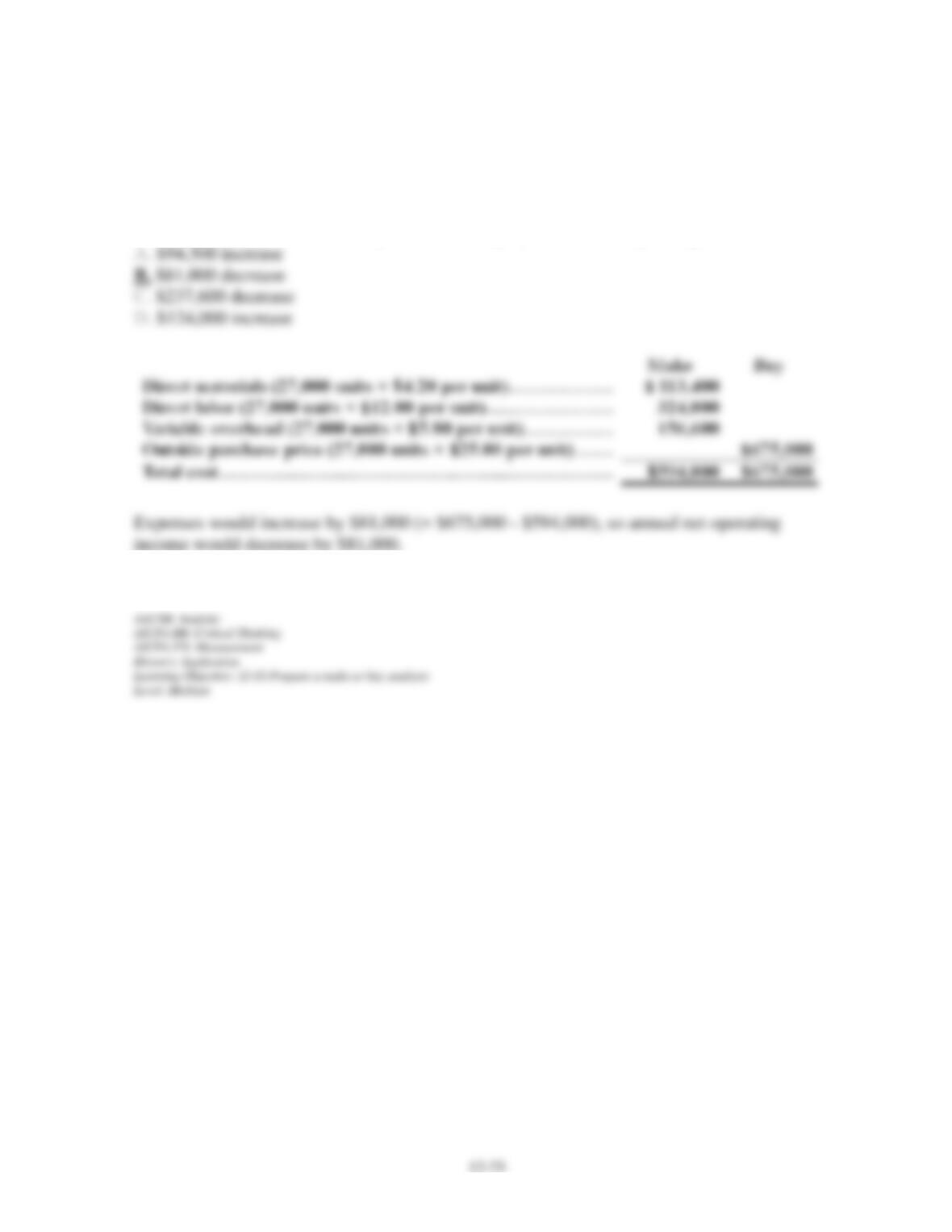
The Rodgers Company makes 27,000 units of a certain component each year for use in one
of its products. The cost per unit for the component at this level of activity is as follows:
Rodgers has received an offer from an outside supplier who is willing to provide 27,000 units
of this component each year at a price of $25 per component. Assume that direct labor is a
variable cost. None of the fixed manufacturing overhead would be avoidable if this
component were purchased from the outside supplier.
Chapter 12 – Differential Analysis: The Key to Decision Making
86. Assume that there is no other use for the capacity now being used to produce the
component and the total fixed manufacturing overhead of the company would be unaffected
by this decision. If Rodgers Company purchases the components rather than making them
internally, what would be the impact on the company’s annual net operating income?
Chapter 12 – Differential Analysis: The Key to Decision Making
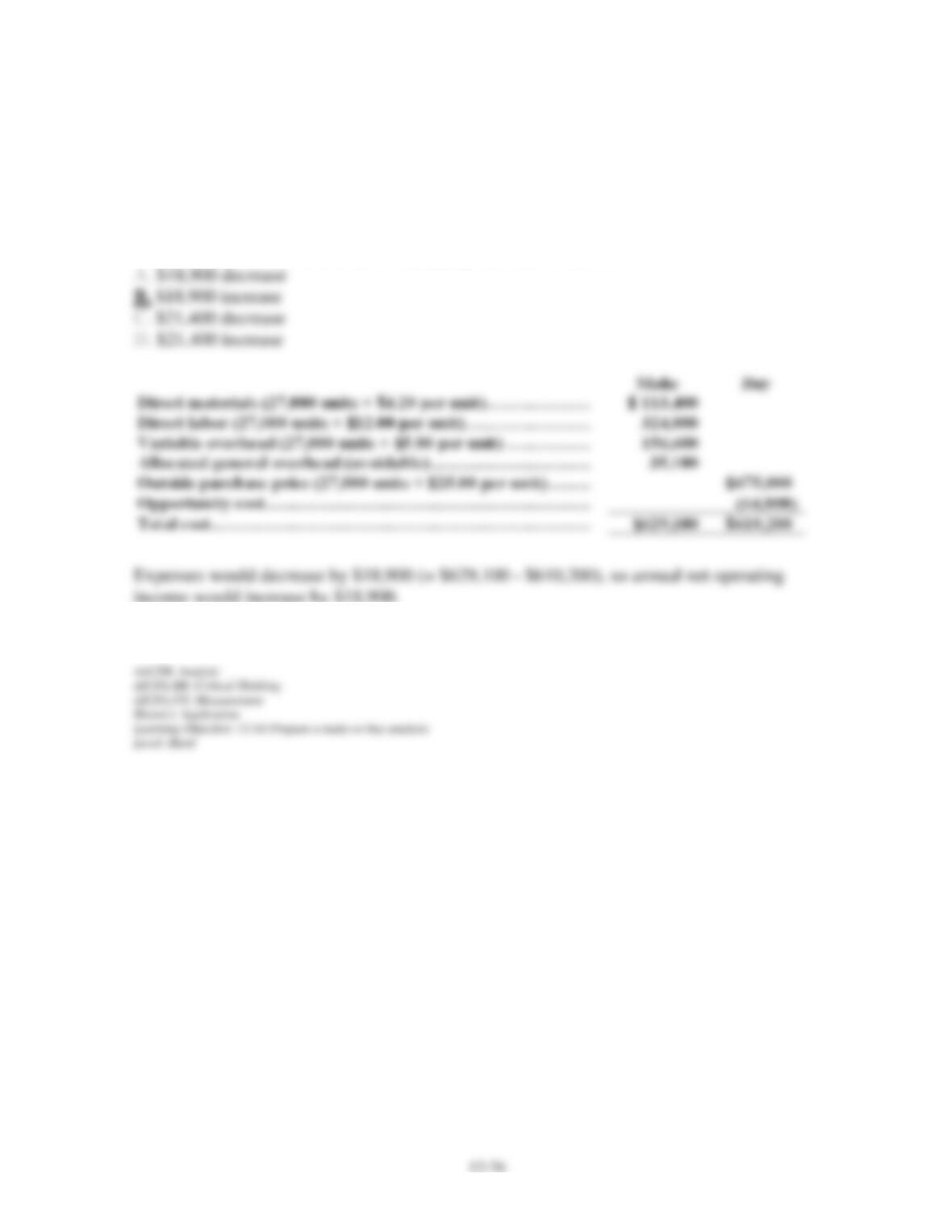
87. Assume that if the component is purchased from the outside supplier, $35,100 of annual
fixed manufacturing overhead would be avoided and the facilities now being used to make the
component would be rented to another company for $64,800 per year. If Rodgers chooses to
buy the component from the outside supplier under these circumstances, then the impact on
annual net operating income due to accepting the offer would be:
Chapter 12 – Differential Analysis: The Key to Decision Making
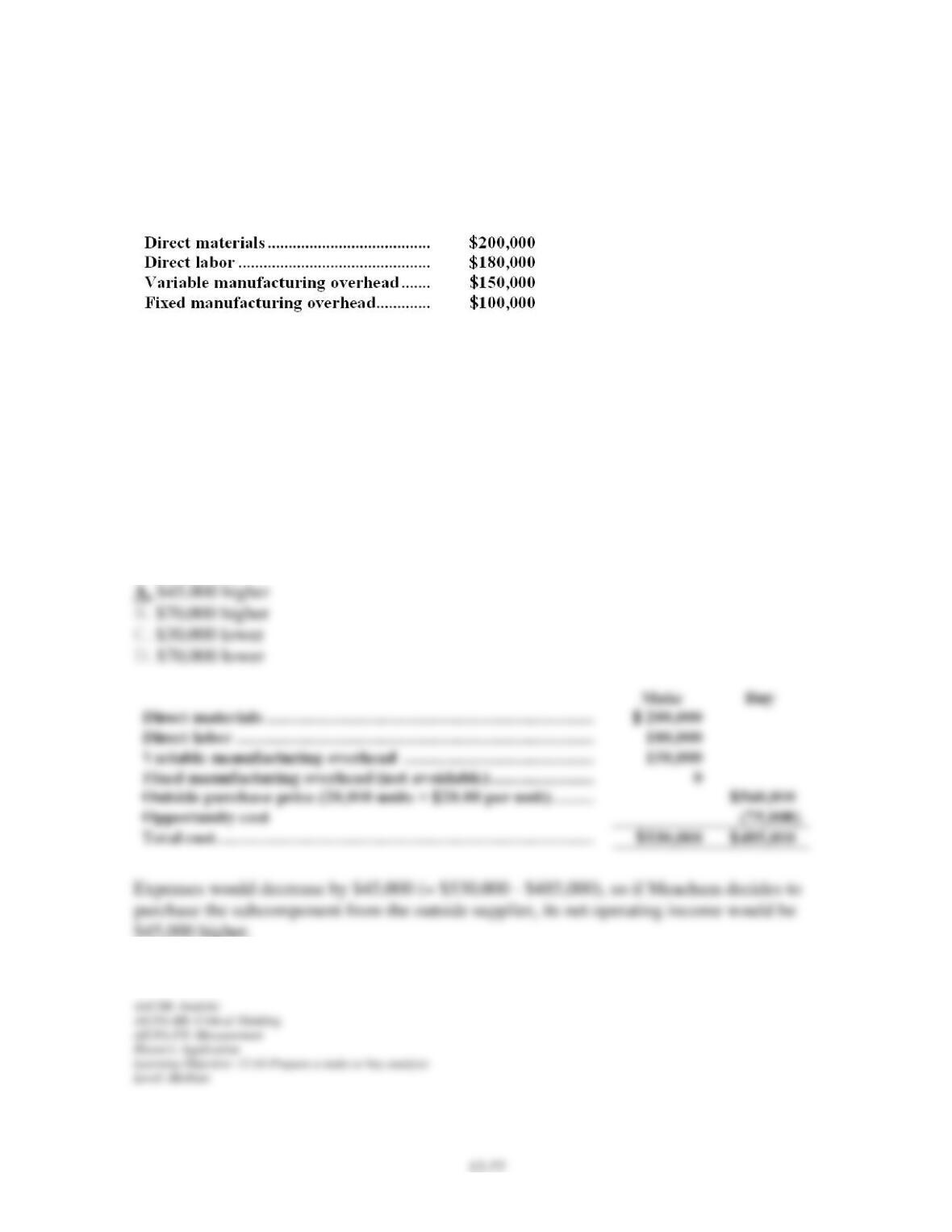
Meacham Company has traditionally made a subcomponent of its major product. Annual
production of 20,000 subcomponents results in the following costs:
Meacham has received an offer from an outside supplier who is willing to provide 20,000
units of this subcomponent each year at a price of $28 per subcomponent. Meacham knows
that the facilities now being used to make the subcomponent would be rented to another
company for $75,000 per year if the subcomponent were purchased from the outside supplier.
Otherwise, the fixed overhead would be unaffected.
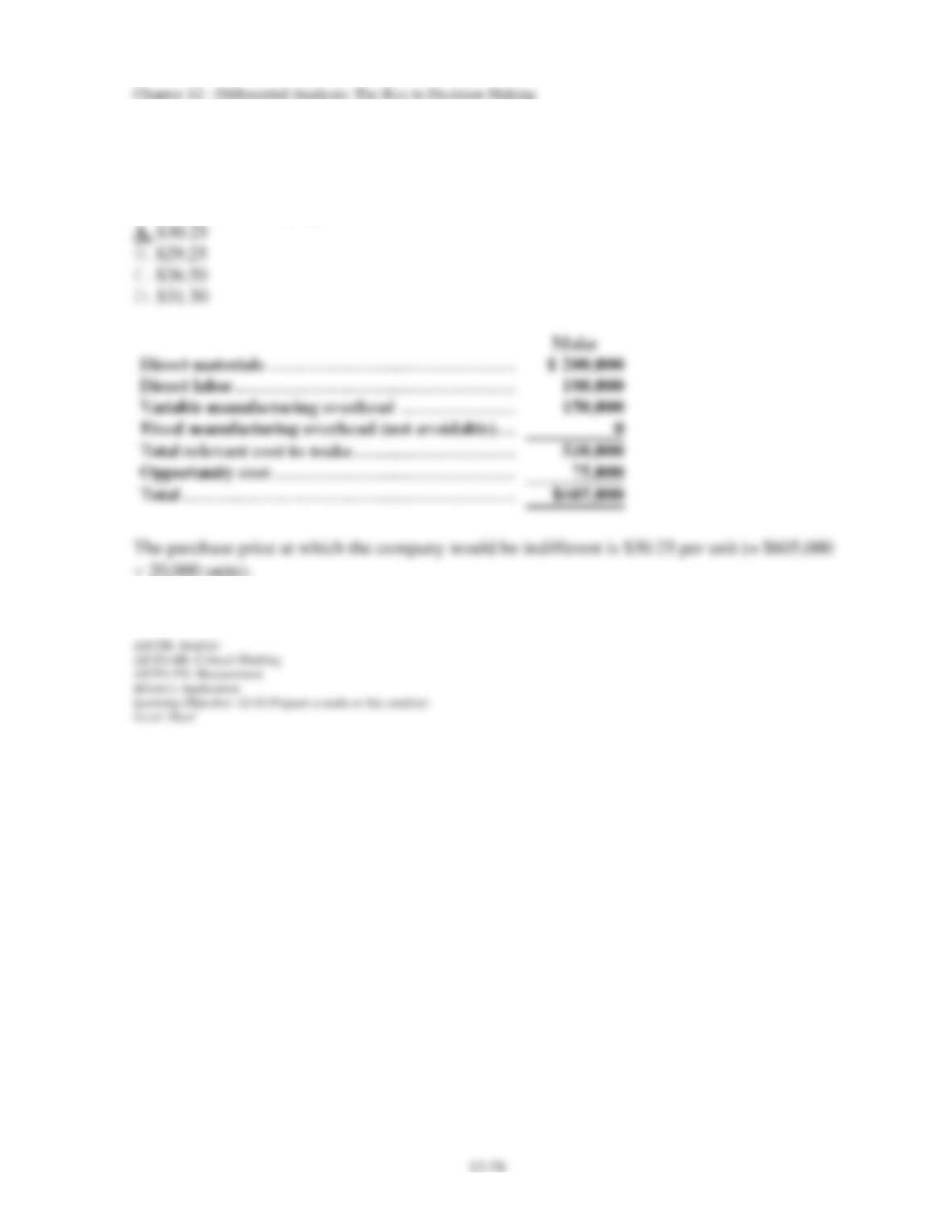
88. If Meacham decides to purchase the subcomponent from the outside supplier, how much
higher or lower will net operating income be than if Meacham continued to make the
subcomponent?
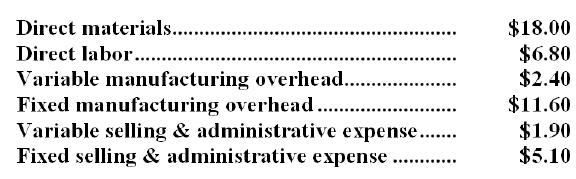
89. Suppose the price for the subcomponent has not been set. At what price per unit charged
by the outside supplier would Meacham be economically indifferent between making the
subcomponent or buying it from the outside?
Chapter 12 – Differential Analysis: The Key to Decision Making
12–79
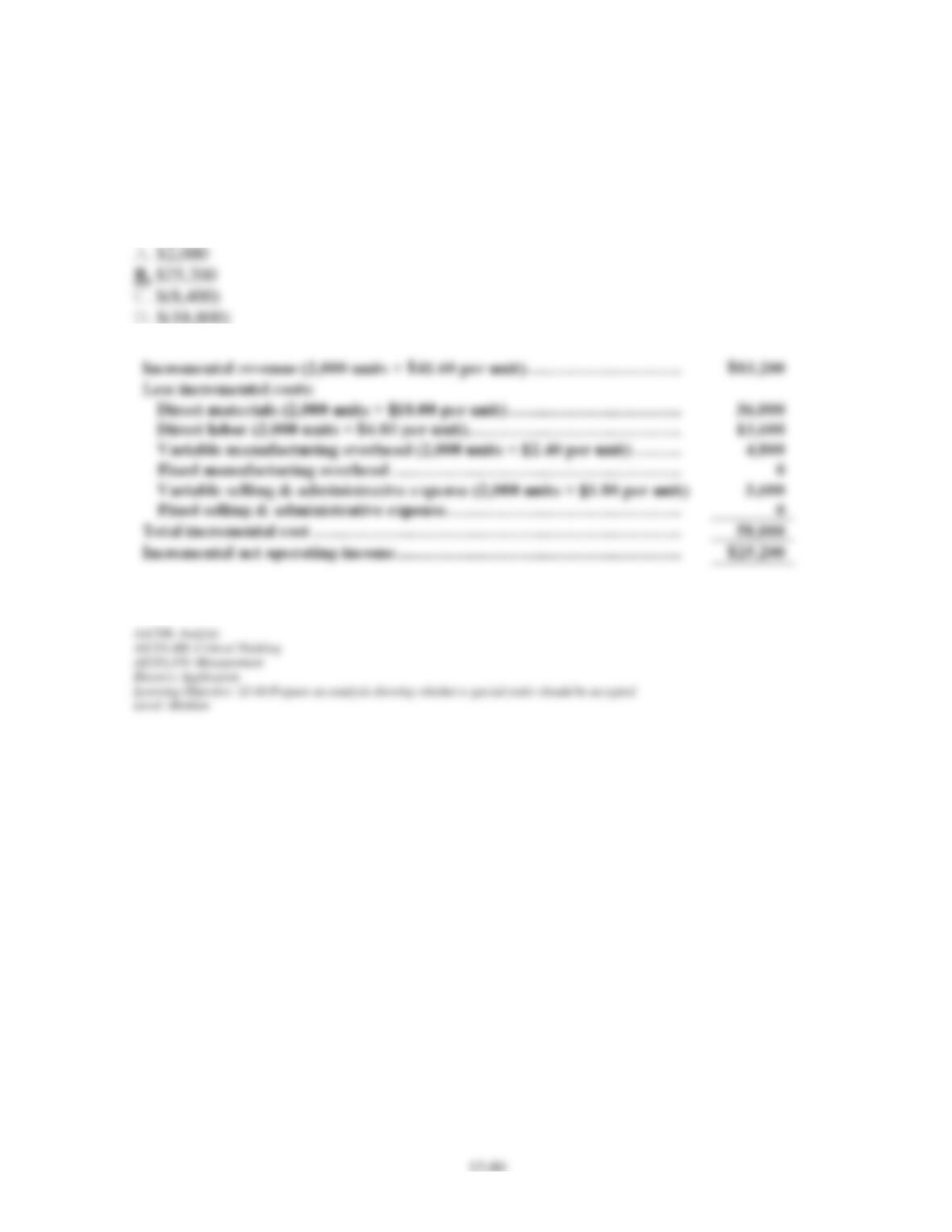
Elhard Company produces a single product. The cost of producing and selling a single unit of
this product at the company’s normal activity level of 40,000 units per month is as follows:
The normal selling price of the product is $51.10 per unit.
An order has been received from an overseas customer for 2,000 units to be delivered this
month at a special discounted price. This order would have no effect on the company’s normal
sales and would not change the total amount of the company’s fixed costs. The variable selling
and administrative expense would be $0.10 less per unit on this order than on normal sales.
Direct labor is a variable cost in this company.
Chapter 12 – Differential Analysis: The Key to Decision Making
90. Suppose there is ample idle capacity to produce the units required by the overseas
customer and the special discounted price on the special order is $41.60 per unit. By how
much would this special order increase (decrease) the company’s net operating income for the
month?