5) The cost of equity increases with increasing financial leverage in order to compensate the
stockholders for the higher degree of financial risk.
6) As financial leverage increases, the cost of debt initially remains constant and then rises, while
the cost of equity always rises.
7) If we assume that EBIT is constant, the value of a firm is maximized by minimizing the
weighted average cost of capital.
8) In theory, a firm’s optimal capital structure is that which minimized the firm’s overall cost of
capital resulting in a maximization of the market value of a firm.
9) The overriding objective of the capital structure decision should be to choose the level of debt
that results in the largest possible share price.
10) The optimal capital structure is the one that balances ________.
A) return and risk factors in order to maximize profits
B) return and risk factors in order to maximize earnings per share
C) return and risk factors in order to maximize market value
D) return and risk factors in order to maximize dividends
11) Beginning with a zero-leverage company, as debt is substituted for equity in the capital
structure ________.
A) the overall cost of capital first rises, reaches a maximum, and then declines
B) the overall cost of capital declines
C) the overall cost of capital first declines, reaches a minimum, and then rises
D) the overall cost of capital rises
12) Poor capital structure decisions can result in ________ the cost of capital, resulting in
________ acceptable investments.
A) increasing; fewer
B) decreasing; more
C) increasing; more
D) decreasing; fewer
13) According to the traditional approach to capital structure, the value of a firm will be
maximized when ________.
A) the financial leverage is maximized
B) the cost of debt is minimized
C) the weighted average cost of capital is minimized
D) the dividend payout is maximized
14) In the traditional approach to capital structure, as the amount of debt increases in a firm’s
capital structure, ________.
A) the cost of equity rises faster than the cost of debt
B) the cost of debt rises faster than the cost of equity
C) debt becomes less risky
D) equity cost is unaffected
15) The value of a firm at optimum capital structure is computed as ________.
A) earnings before interest and taxes times one less tax rate divided by one plus weighted
average cost of capital
B) earnings before interest and taxes times one less tax rate divided by weighted average cost of
capital
C) operating cash flow divided by weighted average cost of capital
D) operating cash flow divided by one plus weighted average cost of capital
16) A firm has an operating profit of $300,000, interest of $35,000, and a tax rate of 40 percent.
The firm has an after-tax cost of debt of 5 percent and a cost of equity of 15 percent. The firm’s
target capital structure is set at a mix of 40 percent debt and 60 percent equity. Assuming this as
the optimum capital structure, the value of the firm is ________.
A) $1.4 million
B) $2.2 million
C) $1.8 million
D) $6.0 million
17) A firm is analyzing two possible capital structures—30 and 50 percent debt ratios. The firm
has total assets of $5,000,000 and common stock valued at $50 per share. The firm has a
marginal tax rate of 40 percent on ordinary income. The number of common shares outstanding
for each of the capital structures would be ________.
A) 30 percent debt ratio: 30,000 shares and 50 percent debt ratio: 50,000 shares
B) 30 percent debt ratio: 50,000 shares and 50 percent debt ratio: 70,000 shares
C) 30 percent debt ratio: 70,000 shares and 50 percent debt ratio: 100,000 shares
D) 30 percent debt ratio: 70,000 shares and 50 percent debt ratio: 50,000 shares
18) A firm is analyzing two possible capital structures—30 and 50 percent debt ratios. The firm
has total assets of $5,000,000 and common stock valued at $50 per share. The firm has a
marginal tax rate of 40 percent on ordinary income. If the interest rate on debt is 7 percent and 9
percent for the 30 percent and the 50 percent debt ratios, respectively, the amount of interest on
the debt under each of the capital structures being considered would be ________.
A) 30 percent debt ratio: $105,000 and 50 percent debt ratio: $225,000
B) 30 percent debt ratio: $245,000 and 50 percent debt ratio: $225,000
C) 30 percent debt ratio: $105,000 and 50 percent debt ratio: $250,000
D) 30 percent debt ratio: $135,000 and 50 percent debt ratio: $175,000
12.5 Discuss the EBIT—EPS approach to capital structure.
1) The EBIT-EPS approach to capital structure involves selecting the capital structure that
maximizes earnings before interest and taxes (EBIT) over the expected range of earnings per
share (EPS).
2) The EBIT-EPS analysis tends to concentrate on maximization of earnings rather than
maximization of owners’ wealth.
3) Financial breakeven point represents the level of earnings after interest and taxes necessary for
a firm to cover its fixed operating and financial changes—that is, the point at which dividends
per share is equal to zero.
4) The higher the financial breakeven point and the steeper the slope of the capital structure line,
the greater the financial risk.
5) The higher the degree of financial leverage (DFL), the greater the leverage a given financing
plan has, and the steeper its slope when plotted on EBIT-EPS axes.
6) The steeper the slope of the EBIT-EPS capital structure line, the lower is the financial risk.
7) Because risk premiums increase with increases in financial leverage, maximizing EPS does
not assure owners’ wealth maximization.
8) The basic shortcoming of EBIT-EPS analysis is that this model focuses on the maximization
of earnings rather than on the maximization of owner wealth as reflected in a firm’s stock price.
9) The basic shortcoming of EBIT-EPS analysis is that this model focuses on the maximization
of stock returns rather than on the maximization of share price.
10) In the EBIT-EPS approach to capital structure, risk is represented by ________.
A) the slope of the capital market line
B) shifts in the cost of debt capital
C) the slope of the capital structure line
D) shifts in the times-interest-earned ratio
11) In the EBIT-EPS approach to capital structure, a constant level of EBIT is assumed
________.
A) to ease the calculations of owners’ equity
B) to isolate the impact on returns of the financing costs associated with alternative capital
structures
C) to emphasize the relationship between interest expenses and taxes
D) to concentrate on the effect of revenue and expense on capital structure decisions
12) A firm has a current capital structure consisting of $400,000 of 12 percent annual interest
debt and 50,000 shares of common stock. The firm’s tax rate is 40 percent on ordinary income. If
the EBIT is expected to be $200,000, the firm’s earnings per share will be ________.
A) $2.40
B) $3.04
C) $7.04
D) $1.82
13) The EBIT-EPS approach to capital structure proposes that an optimal capital structure be
selected which ________.
A) maximizes the weighted average cost of capital
B) minimizes the cost of debt
C) maximizes the EPS
D) minimizes dividends
14) A firm has interest expense of $145,000, preferred dividends of $25,000, and a tax rate of 40
percent. The firm’s financial breakeven point is ________.
A) $ 25,000
B) $170,000
C) $186,667
D) $145,000
15) A firm has a current capital structure consisting of $400,000 of 12 percent annual interest
debt and 50,000 shares of common stock. The firm’s tax rate is 40 percent on ordinary income. If
the EBIT is expected to be $200,000, two EBIT-EPS coordinates for the firm’s existing capital
structure are ________.
A) ($36,000, $0) and ($200,000, $3.04)
B) ($48,000, $0) and ($200,000, $1.82)
C) ($0, $48,000) and ($200,000, $1.82)
D) ($152,000, $3.50) and ($150,000, $1.82)
16) The major shortcoming of the EBIT-EPS approach to capital structure is that ________.
A) the technique does not promote the maximization of shareholder wealth
B) the technique does not consider the cost of capital
C) the technique only considers leverage-related risk
D) the technique does not maximize earnings per share
17) The basic shortcoming of the EBIT-EPS approach to capital structure is ________.
A) that the optimal capital structure is difficult to compute
B) its disregard for the presence of preferred stock in the capital structure
C) its disregard for the firm’s dividend policy
D) that it concentrates on the maximization of EPS rather than the maximization of owner’s
wealth
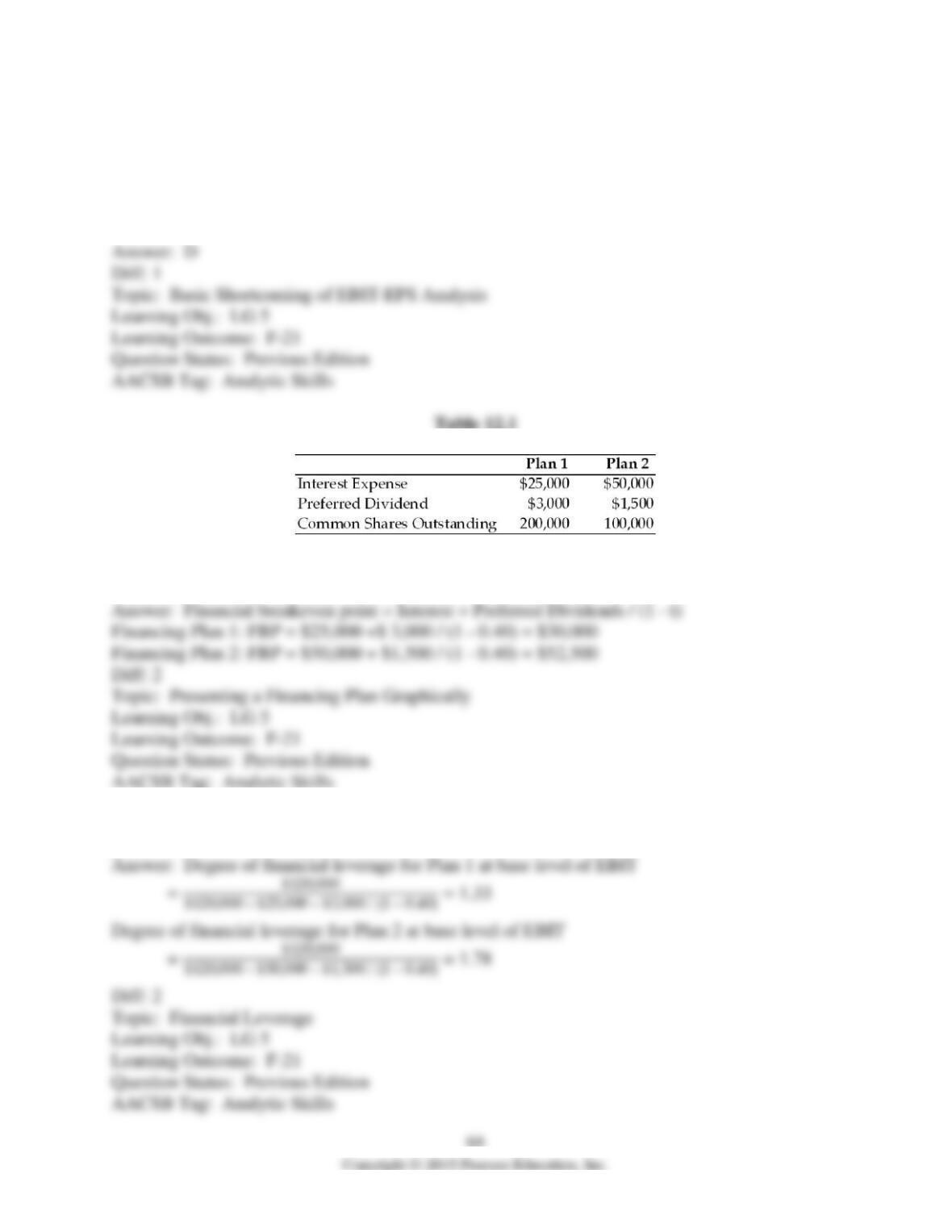
18) Assuming a 40 percent tax rate, what is the financial breakeven point for each plan? (See
Table 12.1)
19) What is the degree of financial leverage at a base level EBIT of $120,000 for both financing
plans? The firm has a 40 percent tax rate. (See Table 12.1)
20) What is the EPS under Financing Plan 1, if the firm projects EBIT of $200,000 and has a tax
rate of 40 percent? (See Table 12.1)
21) At about what EBIT level should the financial manager be indifferent to either plan? (See
Table 12.1)
22) Which plan has a higher degree of financial leverage and financial risk? (See Table 12.1)
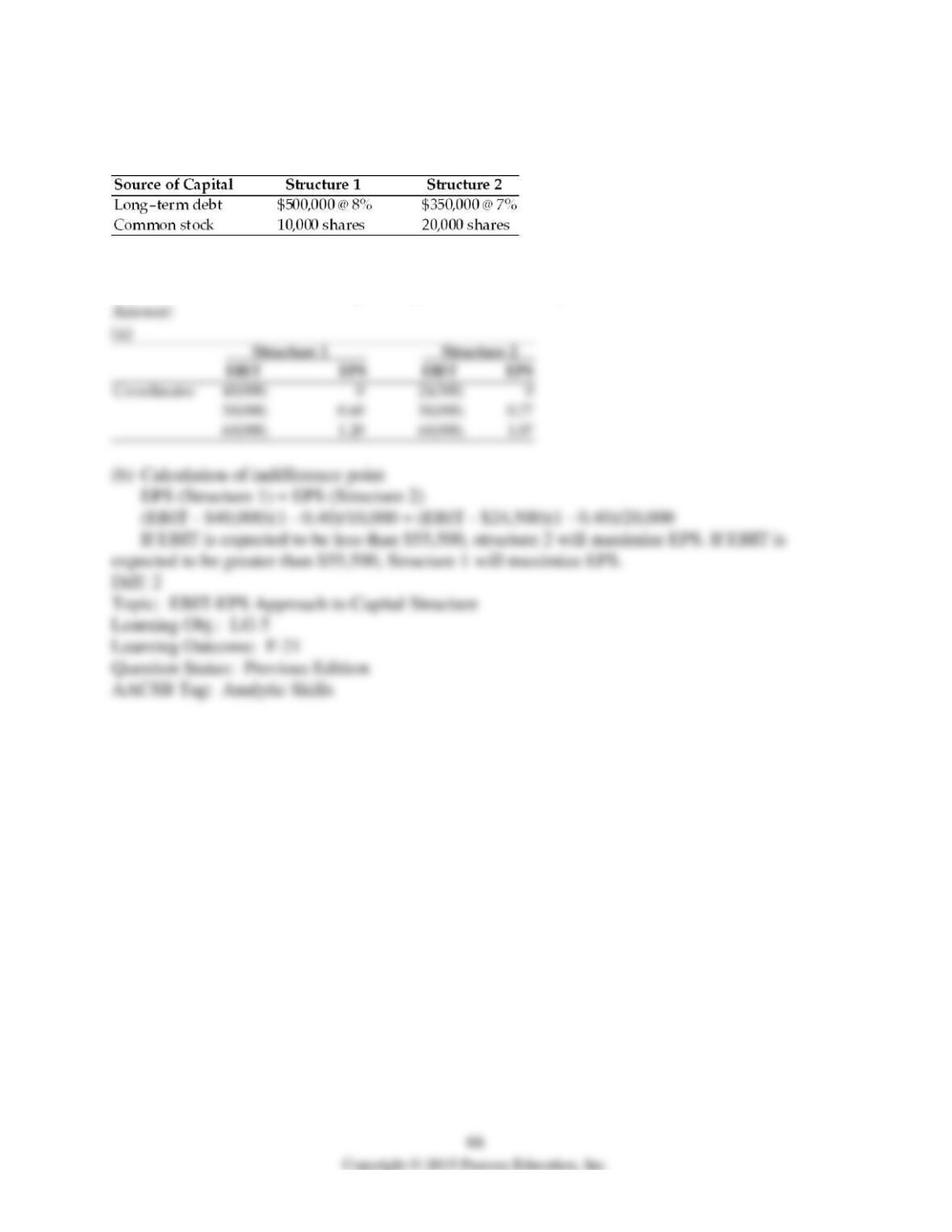
23) Frankline Coin, Inc. is considering two capital structures. The key information follows.
Assume a 40 percent tax rate and expected EBIT of $50,000.
(a) Calculate two EBIT-EPS coordinates for each of the structures.
(b) Indicate over what EBIT range, if any, each structure is preferred.
12.6 Review the return and risk of alternative capital structures, their linkage to market value,
and other important considerations related to capital structure.
1) Firms having stable and predictable revenues can more safely employ highly leveraged capital
structures than can firms with volatile patterns of sales revenue.
2) Harry Trading Company must choose its optimal capital structure. Currently, the firm has a 20
percent debt ratio and the firm expects to generate a dividend next year of $5.44 per share.
Dividends are expected to remain at this level indefinitely. Stockholders currently require a 12.1
percent return on their investment. Harry is considering changing its capital structure if it would
benefit shareholders. The firm estimates that if it increases the debt ratio to 30 percent, it will
increase its expected dividend to $5.82 per share. Again, dividends are expected to remain at this
new level indefinitely. However, because of the added risk, the required return demanded by
stockholders will increase to 12.6 percent. Based on this information, should Harry make the
change?
A) Yes, since the value of the firm will increase by $1.23 per share.
B) No, since the value of the firm will decrease by $1.23 per share.
C) Yes, since the value of the firm will increase by $0.25 per share.
D) No, since the value of the firm will decrease by $0.25 per share.
3) The reason why maximizing share value and maximizing EPS do not give the same optimal
capital structure is because ________.
A) EPS maximization does not consider risk
B) share value maximization does not consider risk
C) EPS maximization considers cash flows
D) EPS maximization does consider risk
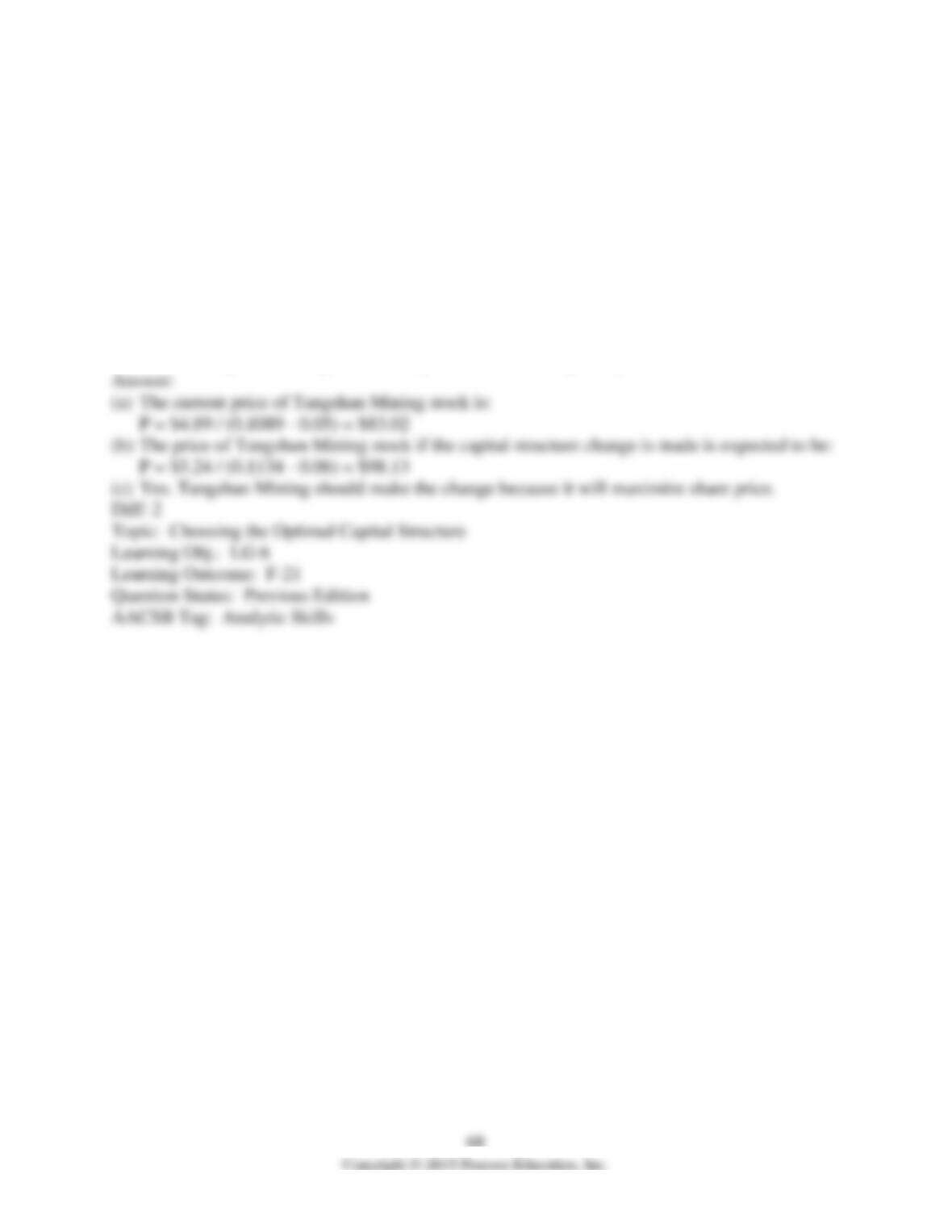
4) Tangshan Mining Company must choose its optimal capital structure. Currently, the firm has a
40 percent debt ratio and the firm expects to generate a dividend next year of $4.89 per share and
dividends are expected to grow at a constant rate of 5 percent for the foreseeable future.
Stockholders currently require a 10.89 percent return on their investment. Tangshan Mining is
considering changing its capital structure if it would benefit shareholders. The firm estimates that
if it increases the debt ratio to 50 percent, it will increase its expected dividend to $5.24 per
share. Because of the additional leverage, dividend growth is expected to increase to 6 percent
and this growth will be sustained indefinitely. However, because of the added risk, the required
return demanded by stockholders will increase to 11.34 percent.
(a) What is the value per share for Tangshan Mining under the current capital structure?
(b) What is the value per share for Tangshan Mining under the proposed capital structure?
(c) Should Tangshan Mining make the capital structure change? Explain.