Chapter 12 – Differential Analysis: The Key to Decision Making
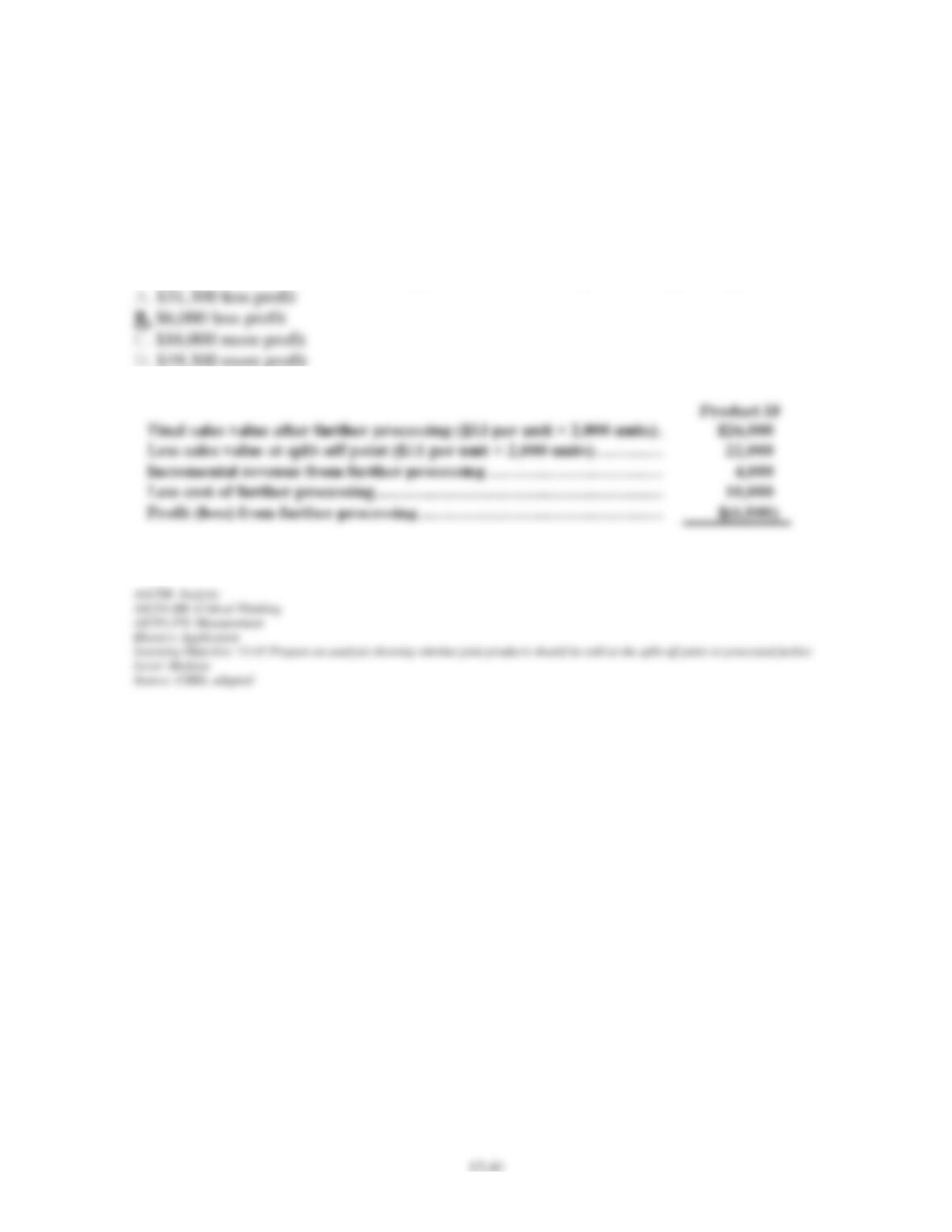
52. Two products, IF and RI, emerge from a joint process. Product IF has been allocated
$25,300 of the total joint costs of $46,000. A total of 2,000 units of product IF are produced
from the joint process. Product IF can be sold at the split-off point for $11 per unit, or it can
be processed further for an additional total cost of $10,000 and then sold for $13 per unit. If
product IF is processed further and sold, what would be the effect on the overall profit of the
company compared with sale in its unprocessed form directly after the split-off point?
Chapter 12 – Differential Analysis: The Key to Decision Making
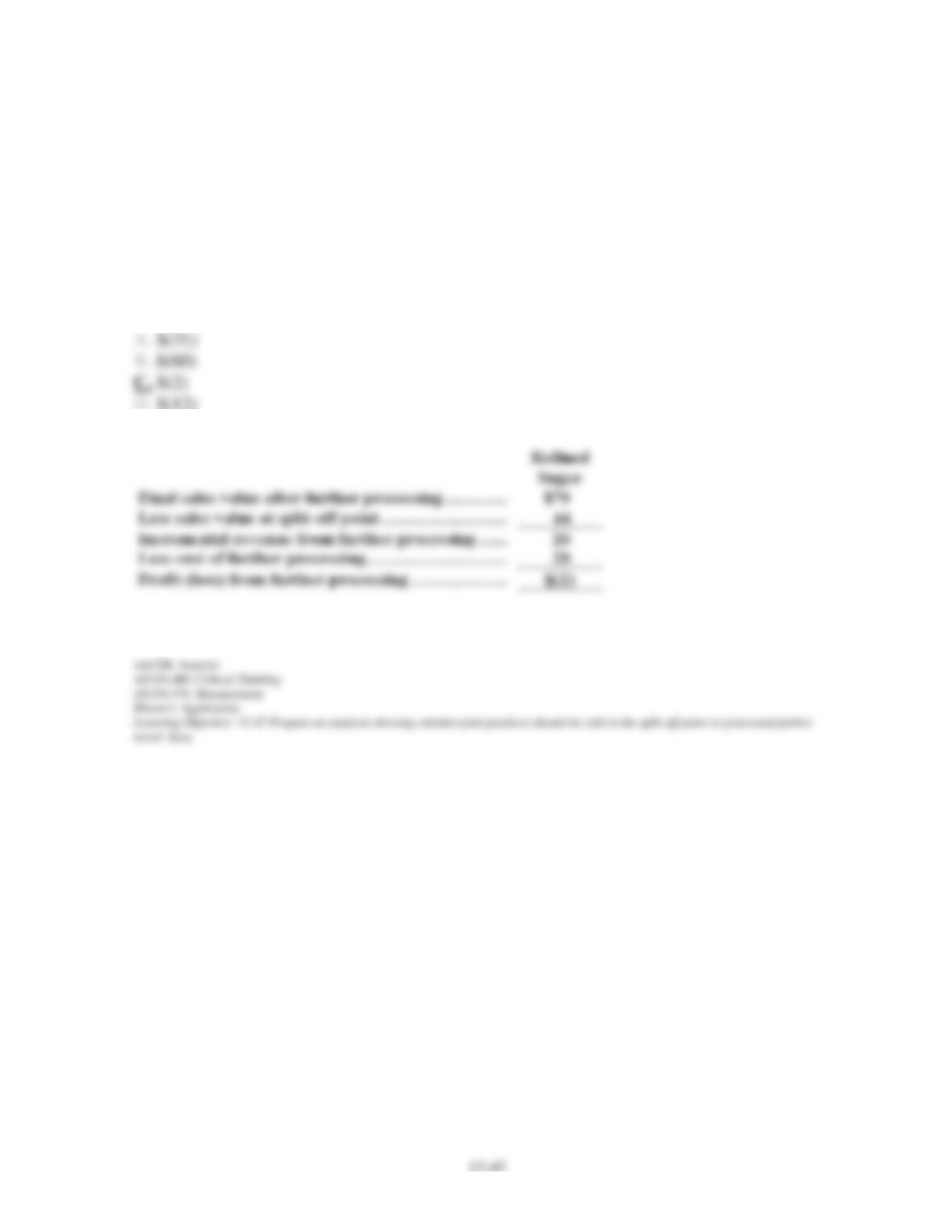
53. Coakley Beet Processors, Inc., processes sugar beets in batches. A batch of sugar beets
costs $48 to buy from farmers and $10 to crush in the company’s plant. Two intermediate
products, beet fiber and beet juice, emerge from the crushing process. The beet fiber can be
sold as is for $24 or processed further for $16 to make the end product industrial fiber that is
sold for $36. The beet juice can be sold as is for $44 or processed further for $28 to make the
end product refined sugar that is sold for $70. How much profit (loss) does the company make
by processing the intermediate product beet juice into refined sugar rather than selling it as
is?
Chapter 12 – Differential Analysis: The Key to Decision Making
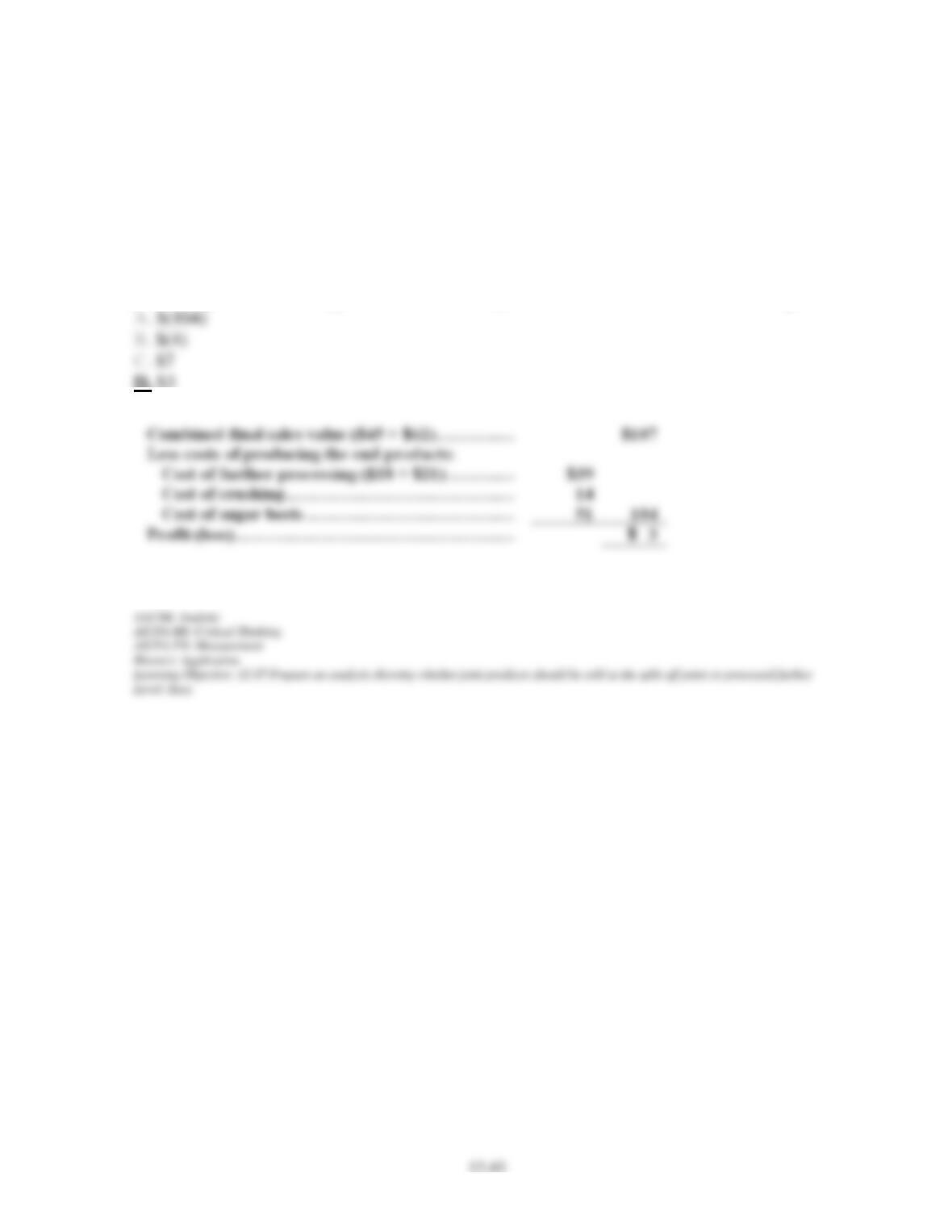
54. Galluzzo Corporation processes sugar beets in batches. A batch of sugar beets costs $51 to
buy from farmers and $14 to crush in the company’s plant. Two intermediate products, beet
fiber and beet juice, emerge from the crushing process. The beet fiber can be sold as is for $20
or processed further for $18 to make the end product industrial fiber that is sold for $45. The
beet juice can be sold as is for $41 or processed further for $21 to make the end product
refined sugar that is sold for $62. How much profit (loss) does the company make by
processing one batch of sugar beets into the end products industrial fiber and refined sugar?
Chapter 12 – Differential Analysis: The Key to Decision Making
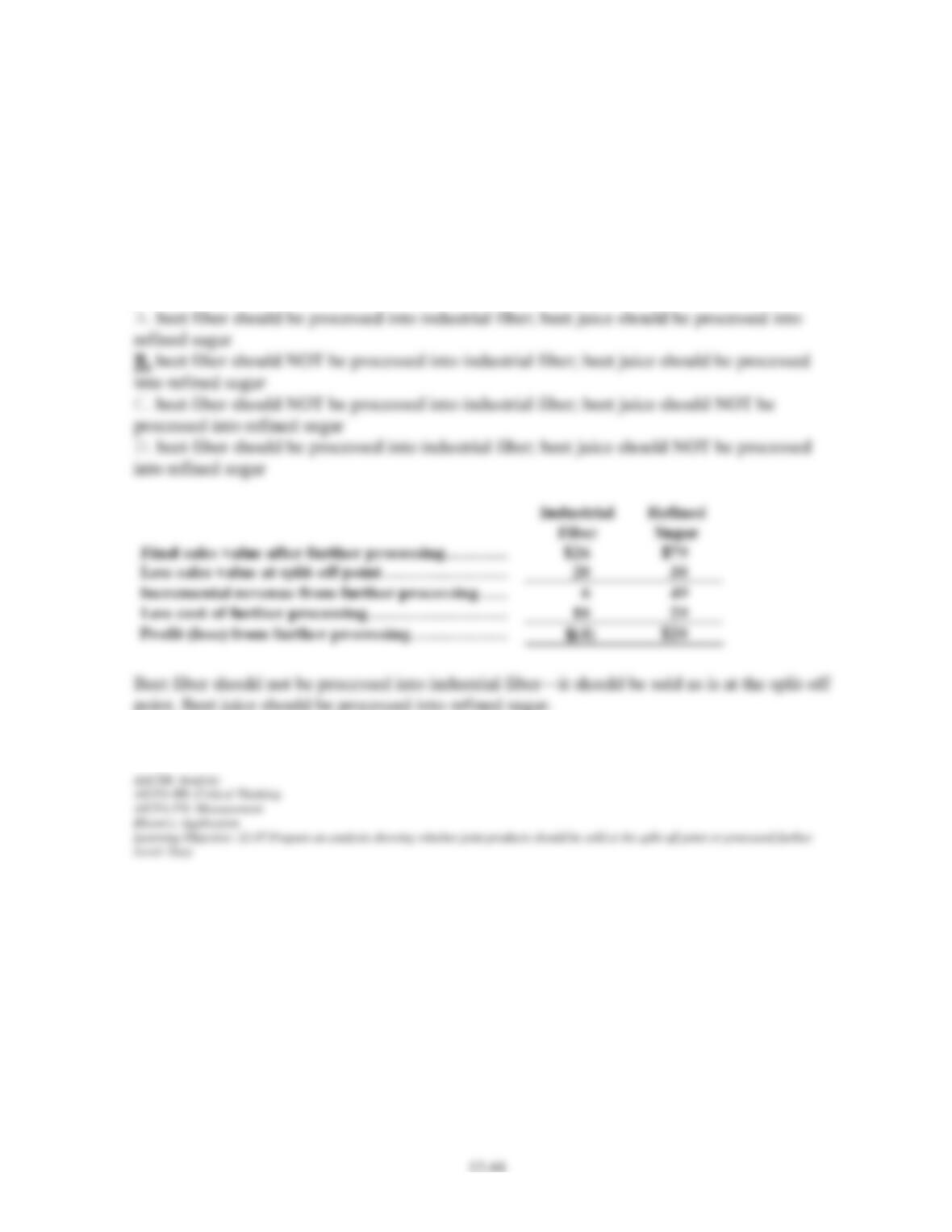
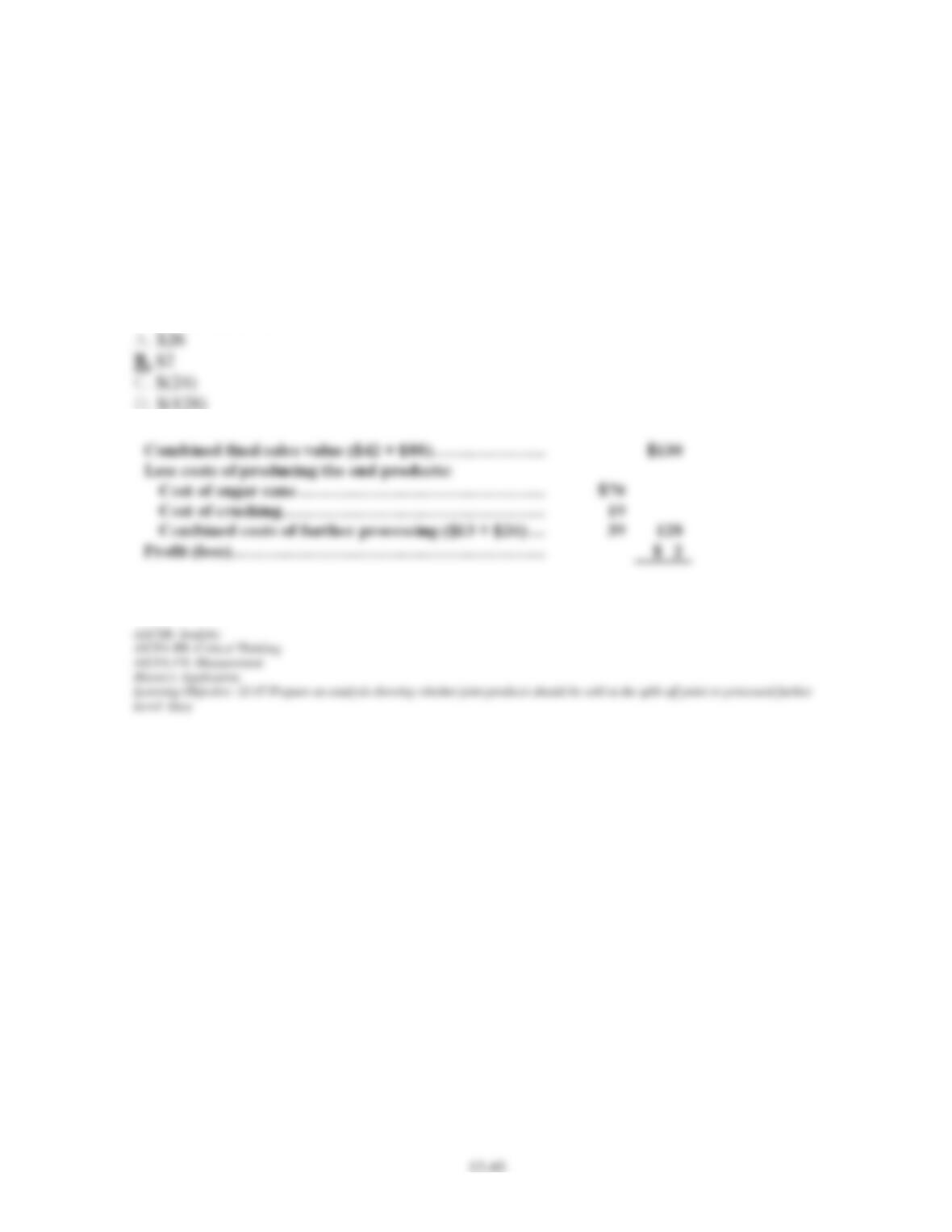
55. Beilke Corporation processes sugar beets in batches that it purchases from farmers for $53
a batch. A batch of sugar beets costs $12 to crush in the company’s plant. Two intermediate
products, beet fiber and beet juice, emerge from the crushing process. The beet fiber can be
sold as is for $20 or processed further for $10 to make the end product industrial fiber that is
sold for $26. The beet juice can be sold as is for $30 or processed further for $29 to make the
end product refined sugar that is sold for $79. Which of the intermediate products should be
processed further?
Chapter 12 – Differential Analysis: The Key to Decision Making
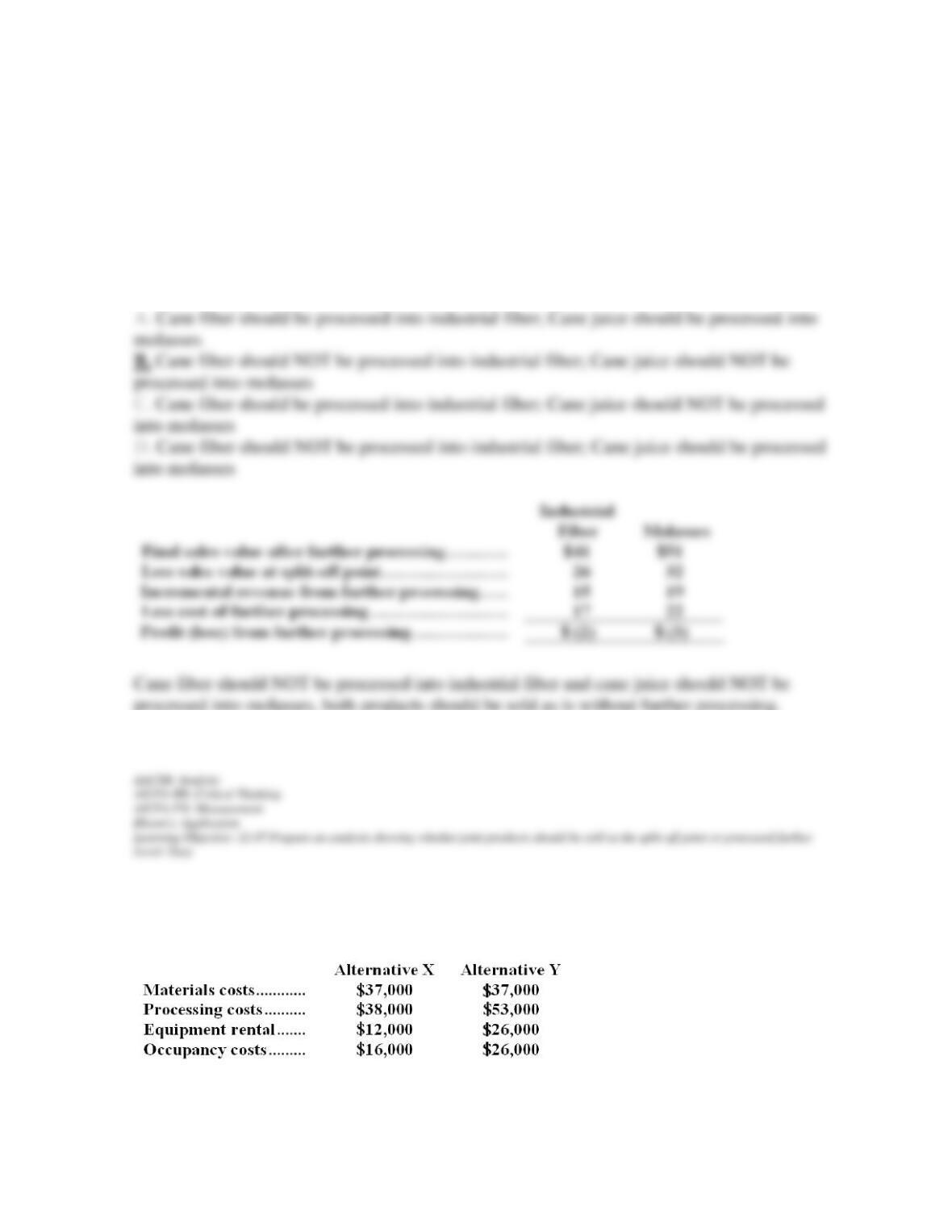
56. Zollars Cane Products, Inc., processes sugar cane in batches. The company buys a batch
of sugar cane from farmers for $70 which is then crushed in the company’s plant at a cost of
$19. Two intermediate products, cane fiber and cane juice, emerge from the crushing process.
The cane fiber can be sold as is for $21 or processed further for $13 to make the end product
industrial fiber that is sold for $42. The cane juice can be sold as is for $44 or processed
further for $26 to make the end product molasses that is sold for $88. How much profit (loss)
does the company make by processing one batch of sugar cane into the end products industrial
fiber and molasses?
Chapter 12 – Differential Analysis: The Key to Decision Making
12–46
57. Kempler Corporation processes sugar cane in batches. The company purchases a batch of
sugar cane for $34 from farmers and then crushes the cane in the company’s plant at the cost
of $15. Two intermediate products, cane fiber and cane juice, emerge from the crushing
process. The cane fiber can be sold as is for $26 or processed further for $17 to make the end
product industrial fiber that is sold for $41. The cane juice can be sold as is for $32 or
processed further for $22 to make the end product molasses that is sold for $51. Which of the
intermediate products should be processed further?
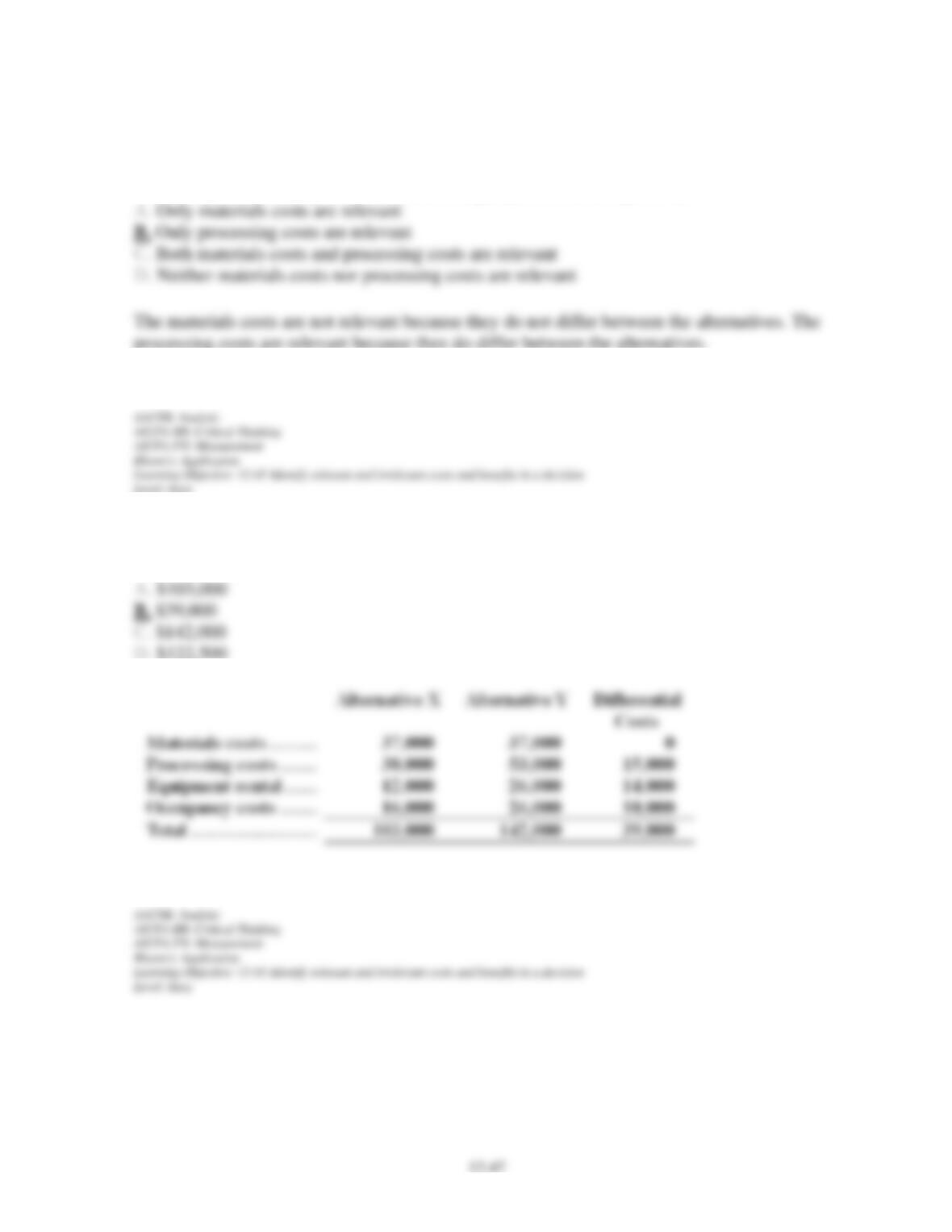
Two alternatives, code-named X and Y, are under consideration at Afalava Corporation.
Costs associated with the alternatives are listed below.
Chapter 12 – Differential Analysis: The Key to Decision Making
58. Are the materials costs and processing costs relevant in the choice between alternatives X
and Y? (Ignore the equipment rental and occupancy costs in this question.)
59. What is the differential cost of Alternative Y over Alternative X, including all of the
relevant costs?
Chapter 12 – Differential Analysis: The Key to Decision Making
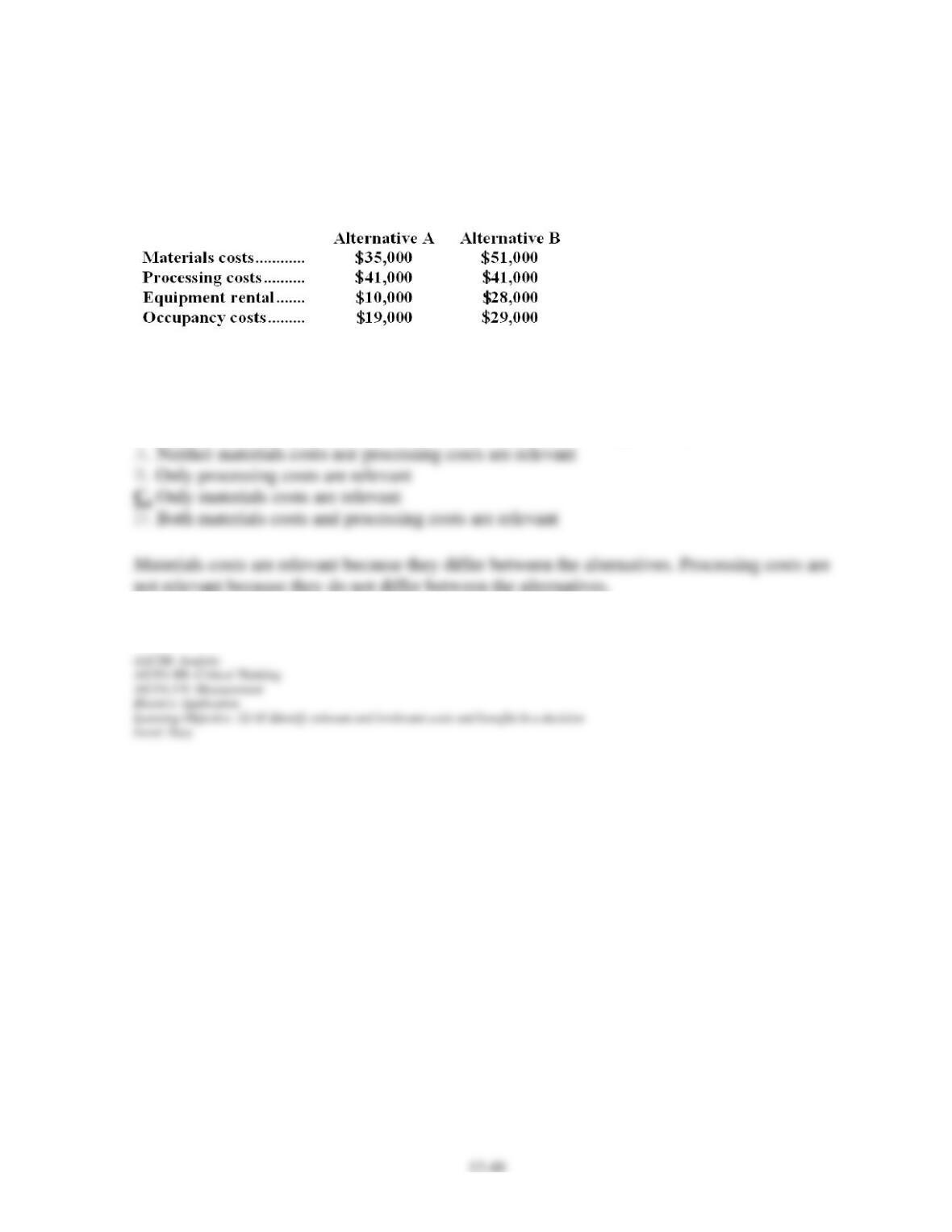
Zurasky Corporation is considering two alternatives: A and B. Costs associated with the
alternatives are listed below:
60. Are the materials costs and processing costs relevant in the choice between alternatives A
and B? (Ignore the equipment rental and occupancy costs in this question.)
Chapter 12 – Differential Analysis: The Key to Decision Making
12–49
61. What is the differential cost of Alternative B over Alternative A, including all of the
relevant costs?
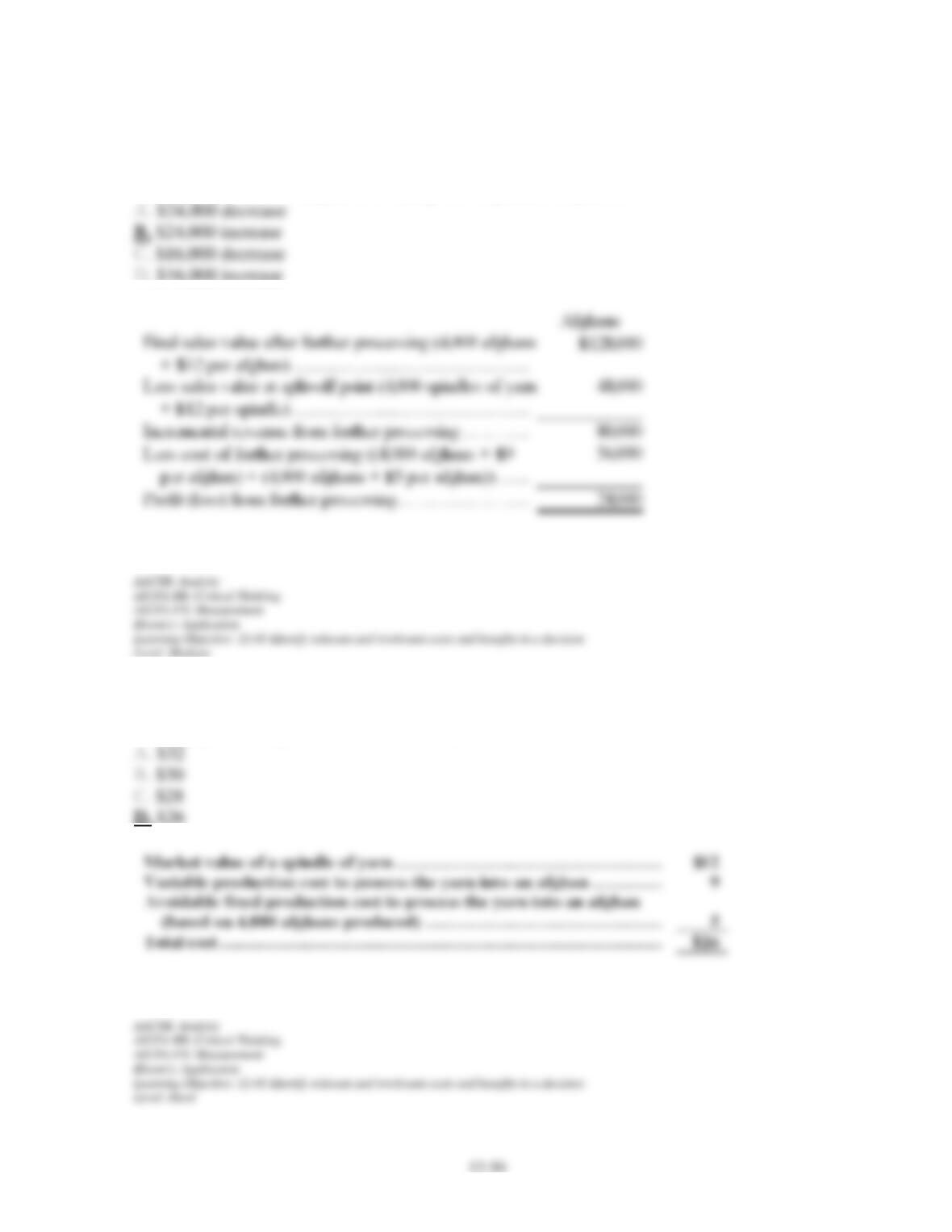
Austin Wool Products purchases raw wool and processes it into yarn. The spindles of yarn
can then be sold directly to stores or they can be used by Austin Wool Products to make
afghans. Each afghan requires one spindle of yarn. Current cost and revenue data for the
spindles of yarn and for the afghans are as follows:
Each month 4,000 spindles of yarn are produced that can either be sold outright or processed
into afghans.
Chapter 12 – Differential Analysis: The Key to Decision Making
62. If Austin chooses to produce 4,000 afghans each month, the change in the monthly net
operating income as compared to selling 4,000 spindles of yarn is:
63. What is the lowest price Austin should be willing to accept for one afghan as long as it
can sell spindles of yarn to the outside market for $12 each?
Chapter 12 – Differential Analysis: The Key to Decision Making
The Tingey Company has 500 obsolete microcomputers that are carried in inventory at a total
cost of $720,000. If these microcomputers are upgraded at a total cost of $100,000, they can
be sold for a total of $160,000. As an alternative, the microcomputers can be sold in their
present condition for $50,000.
64. The sunk cost in this situation is:
65. What is the net advantage or disadvantage to the company from upgrading the computers
rather than selling them in their present condition?
Chapter 12 – Differential Analysis: The Key to Decision Making
12–52
66. Suppose the selling price of the upgraded computers has not been set. At what selling
price per unit would the company be as well off upgrading the computers as if it just sold the
computers in their present condition?
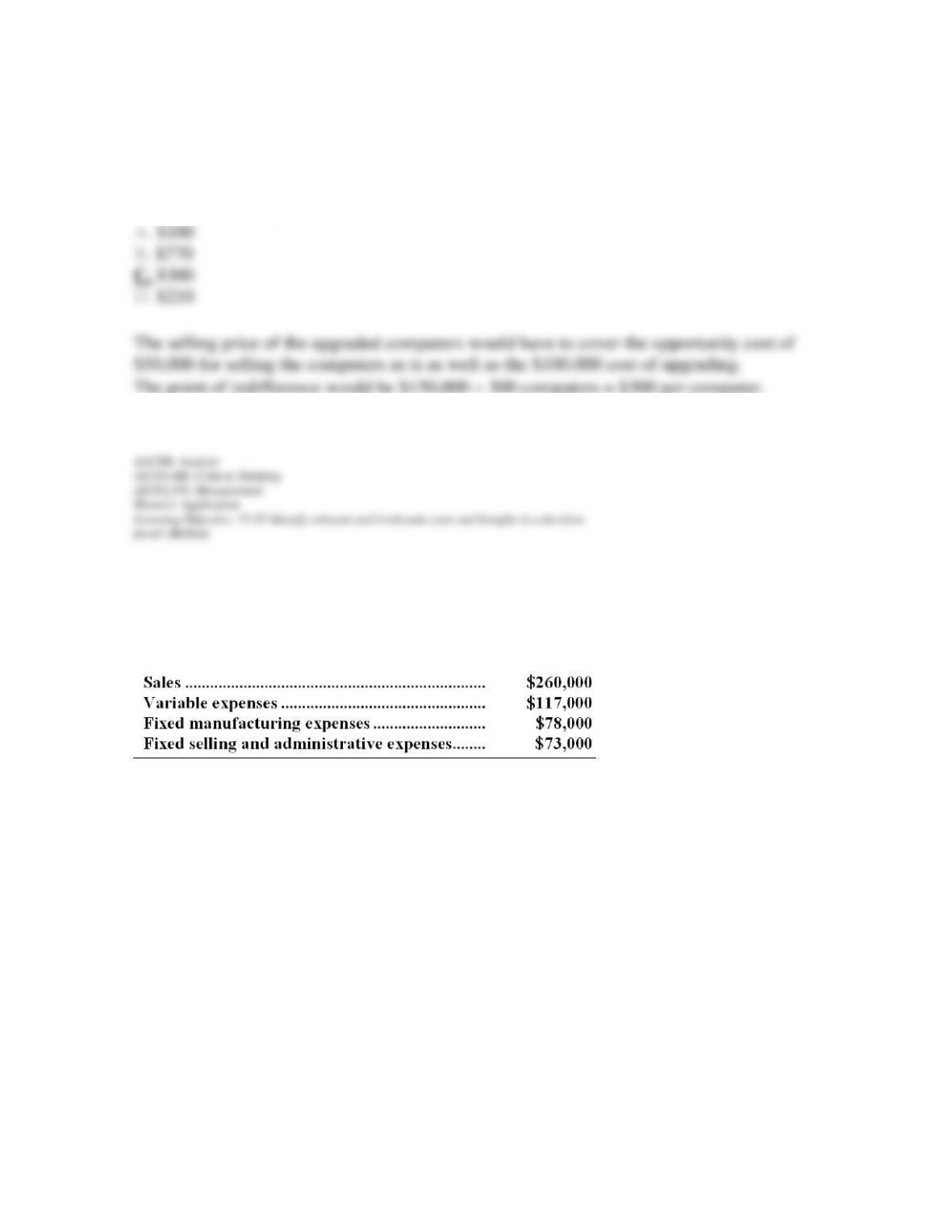
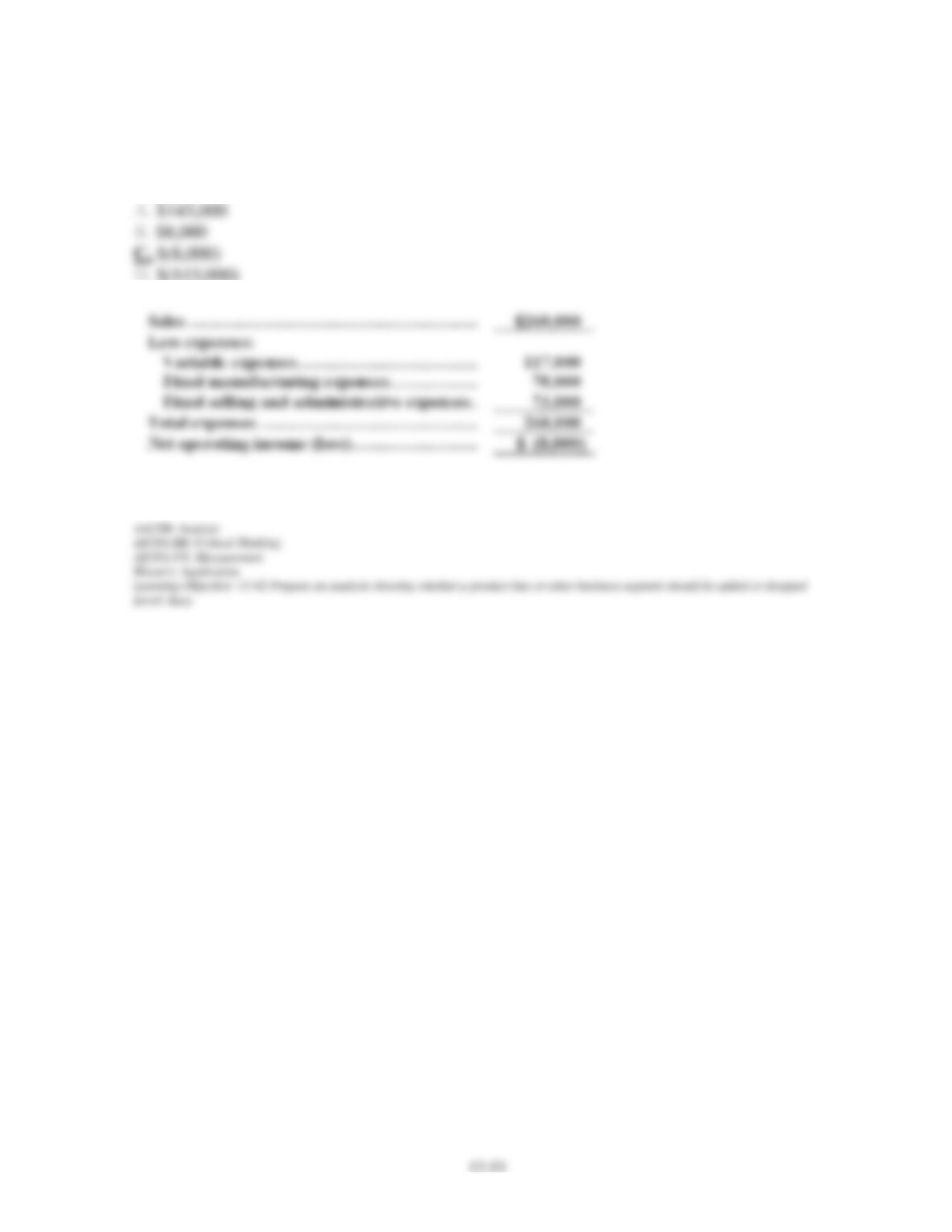
The management of Fries Corporation has been concerned for some time with the financial
performance of its product R89H and has considered discontinuing it on several occasions.
Data from the company’s accounting system appear below:
In the company’s accounting system all fixed expenses of the company are fully allocated to
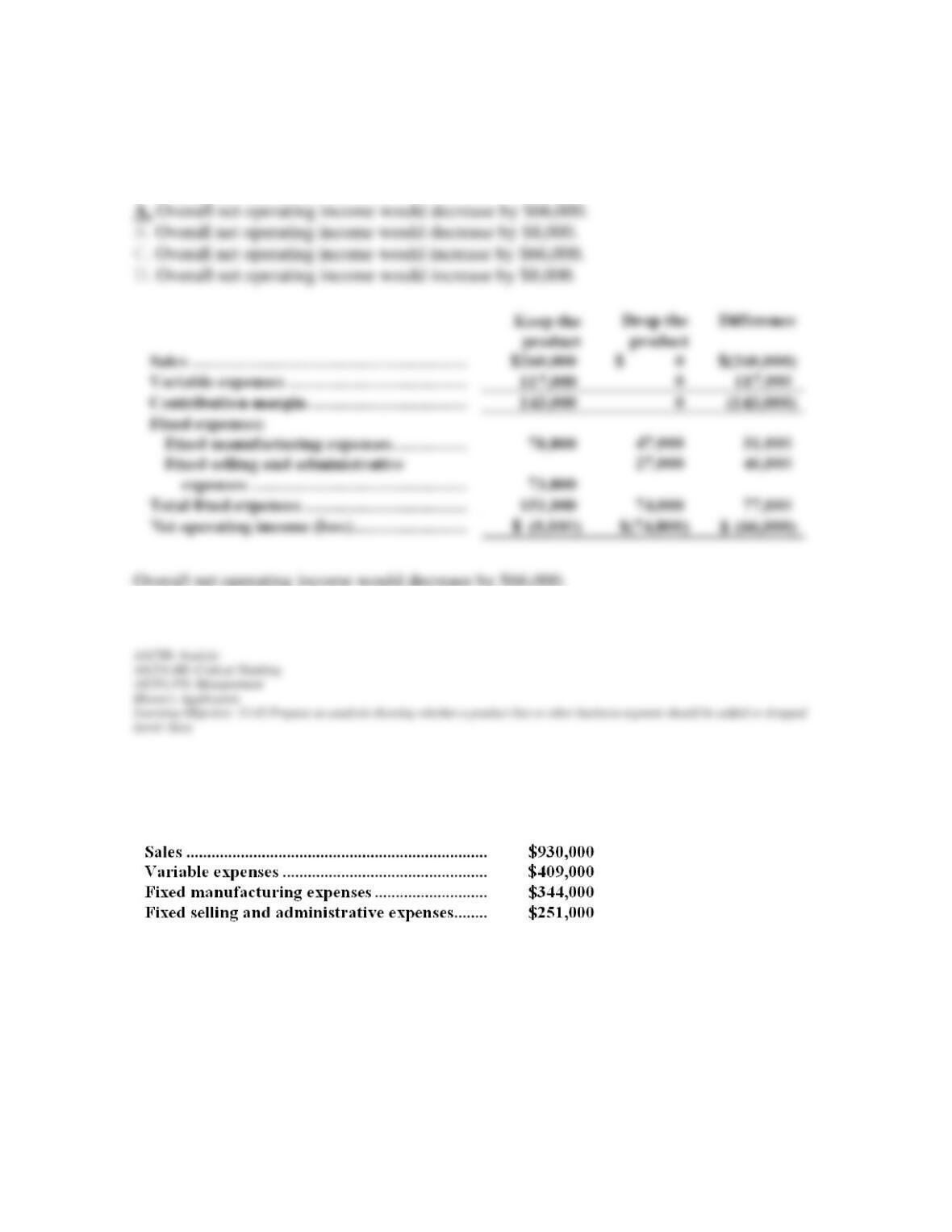
products. Further investigation has revealed that $31,000 of the fixed manufacturing expenses
and $46,000 of the fixed selling and administrative expenses are avoidable if product R89H is
discontinued.
Chapter 12 – Differential Analysis: The Key to Decision Making
67. According to the company’s accounting system, what is the net operating income earned
by product R89H?
Chapter 12 – Differential Analysis: The Key to Decision Making
12–54
68. What would be the effect on the company’s overall net operating income if product R89H
were dropped?
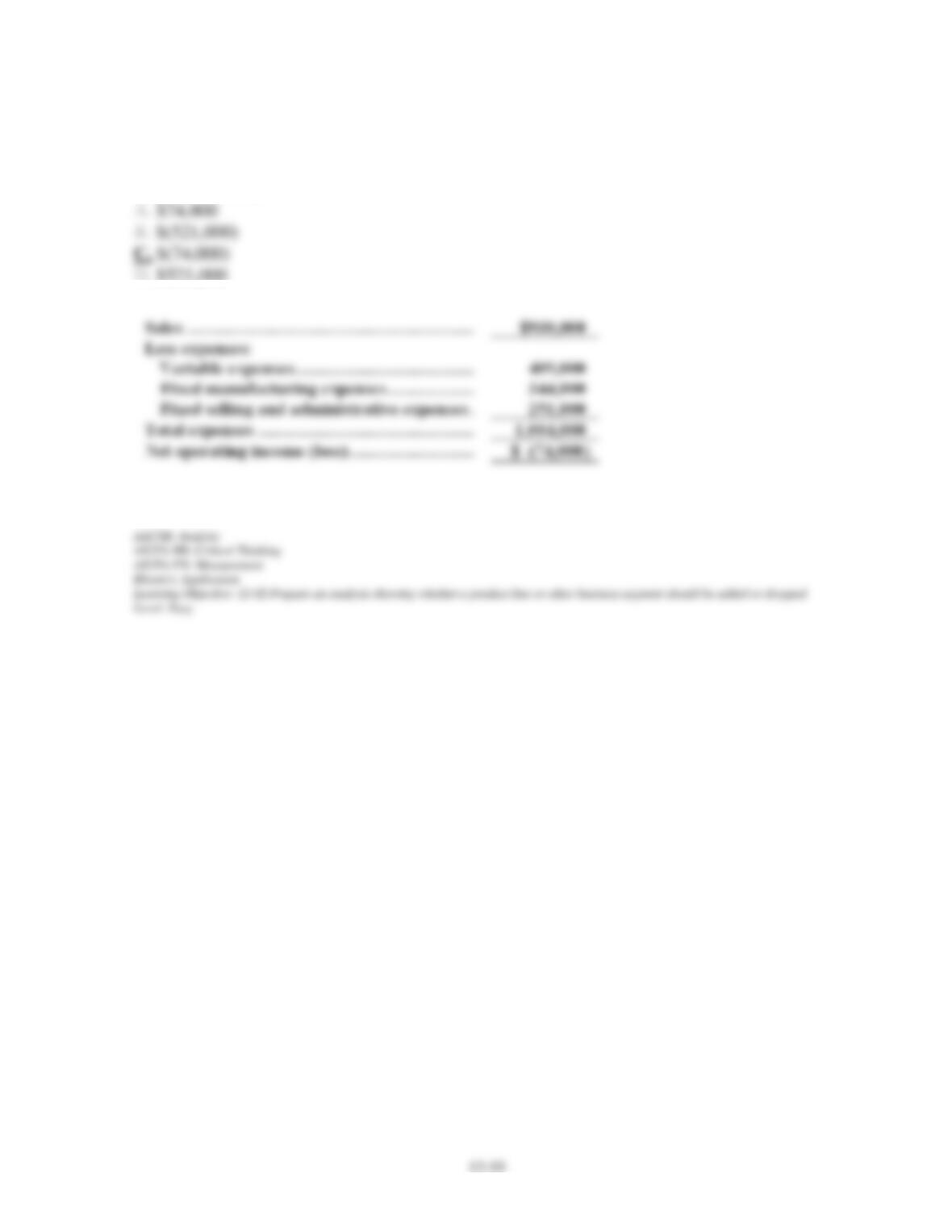
The management of Freshwater Corporation is considering dropping product C11B. Data
from the company’s accounting system appear below:
All fixed expenses of the company are fully allocated to products in the company’s accounting
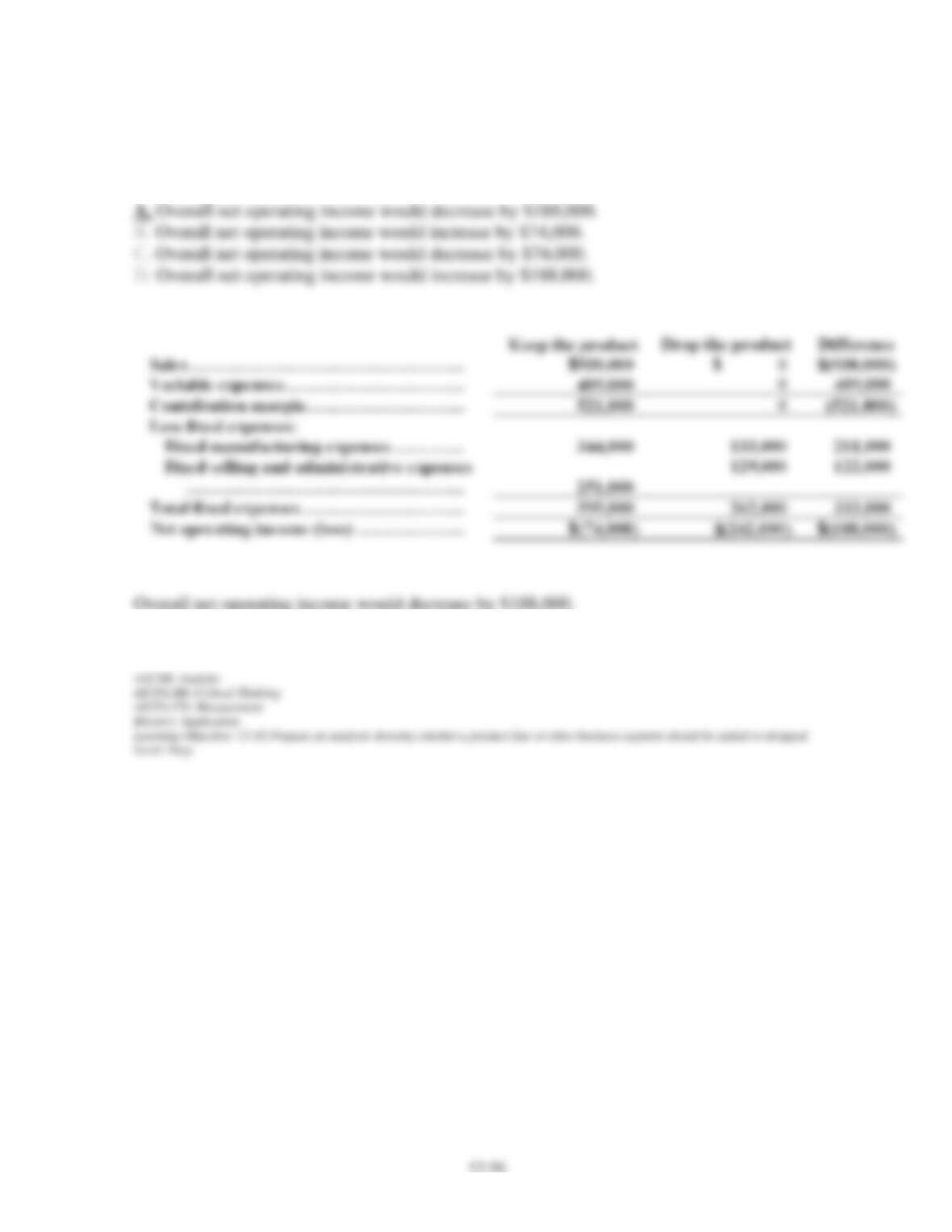
system. Further investigation has revealed that $211,000 of the fixed manufacturing expenses
and $122,000 of the fixed selling and administrative expenses are avoidable if product C11B
is discontinued.
Chapter 12 – Differential Analysis: The Key to Decision Making
69. According to the company’s accounting system, what is the net operating income earned
by product C11B?
Chapter 12 – Differential Analysis: The Key to Decision Making
70. What would be the effect on the company’s overall net operating income if product C11B
were dropped?
Chapter 12 – Differential Analysis: The Key to Decision Making
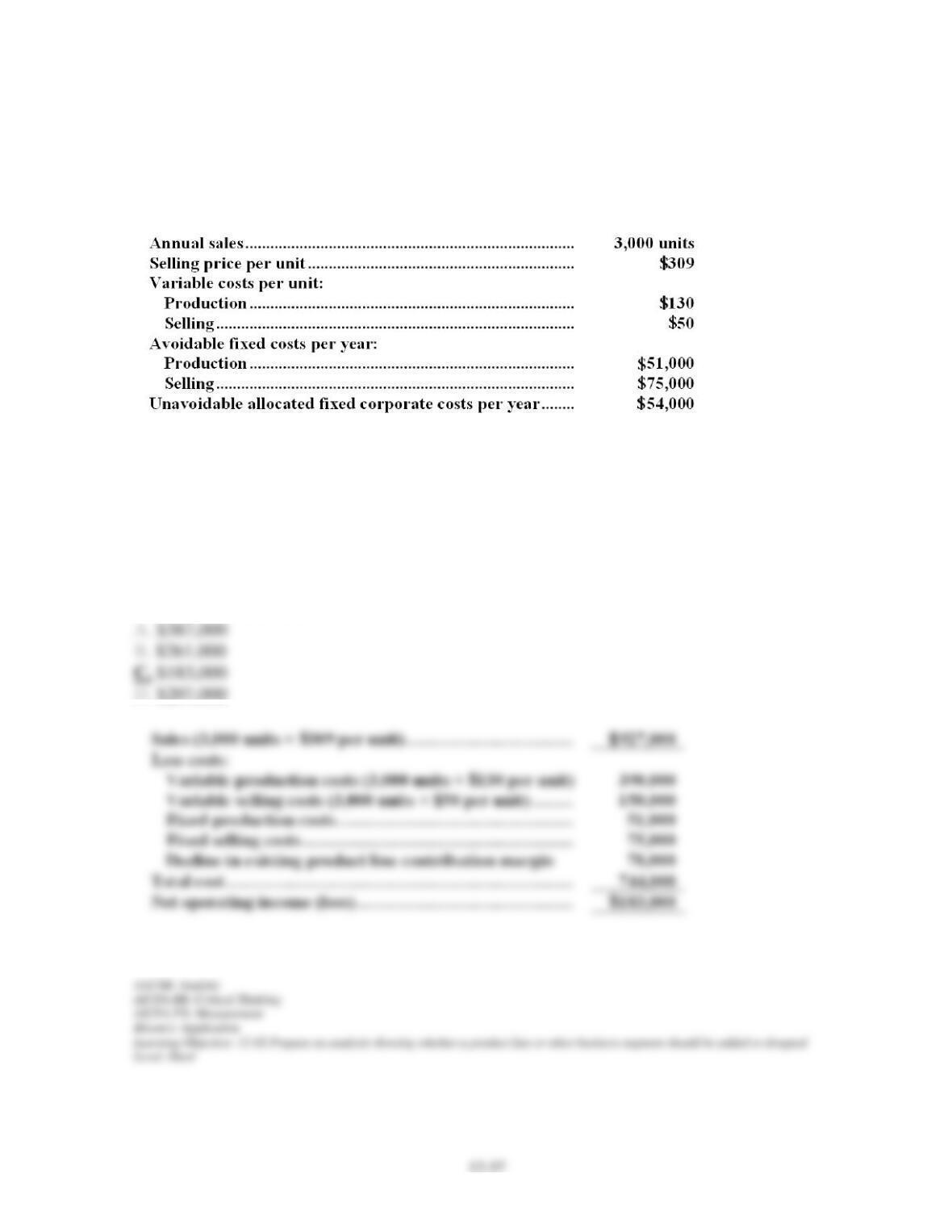
The Western Company is considering the addition of a new product to its current product
lines. The expected cost and revenue data for the new product are as follows:
If the new product is added to the existing product line, then sales of existing products will
decline. As a consequence, the contribution margin of the other existing product lines is
expected to drop $78,000 per year.
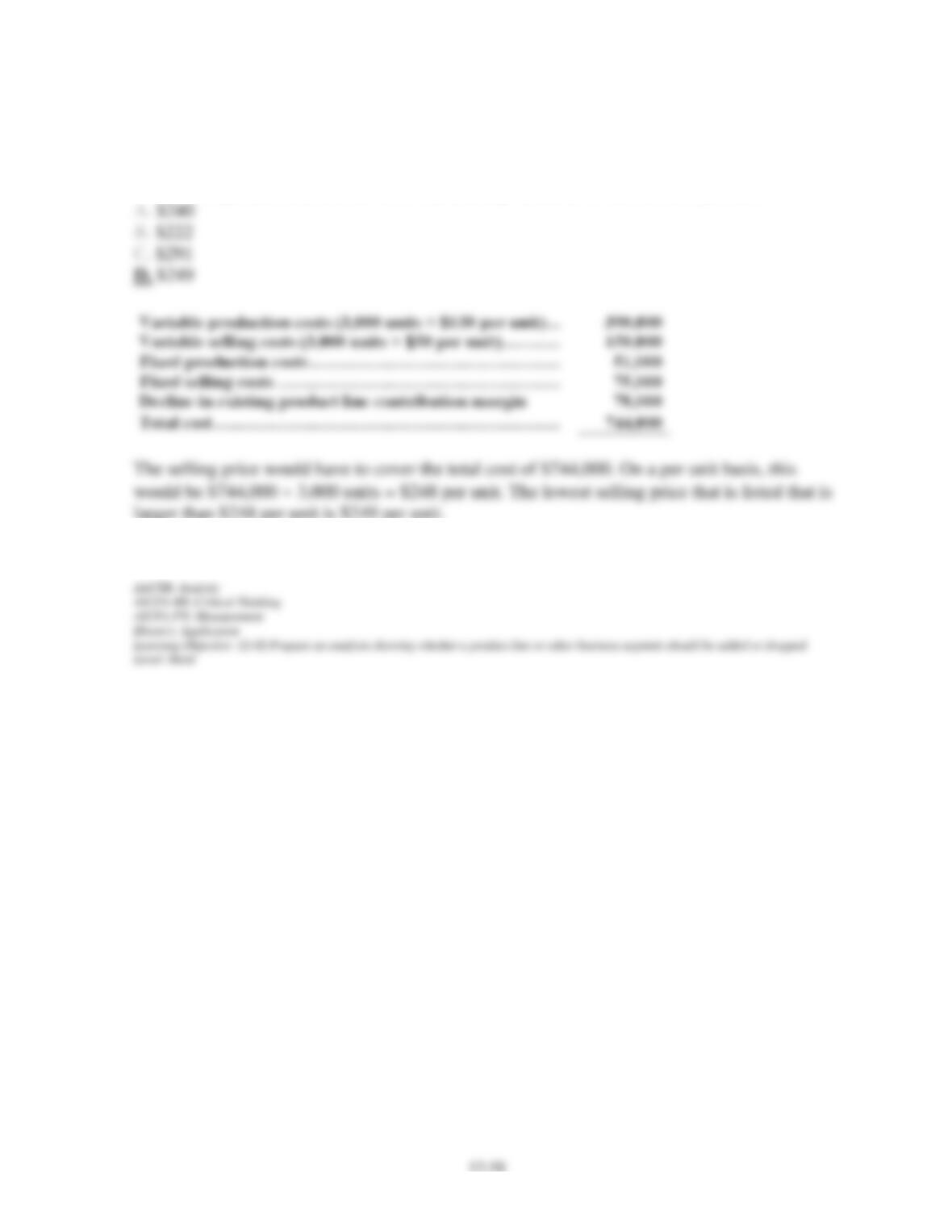
71. If the new product is added next year, the increase in net operating income resulting from
this decision would be:
Chapter 12 – Differential Analysis: The Key to Decision Making
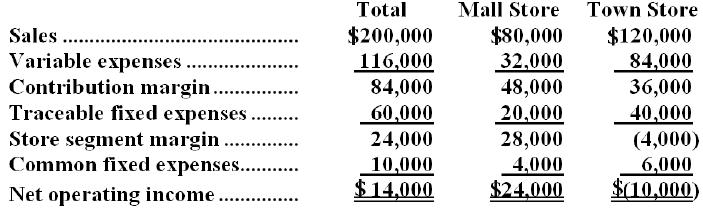
72. What is the lowest selling price per unit among those listed below that could be charged
for the new product and still make it economically desirable to add the new product?
Chapter 12 – Differential Analysis: The Key to Decision Making
12–59
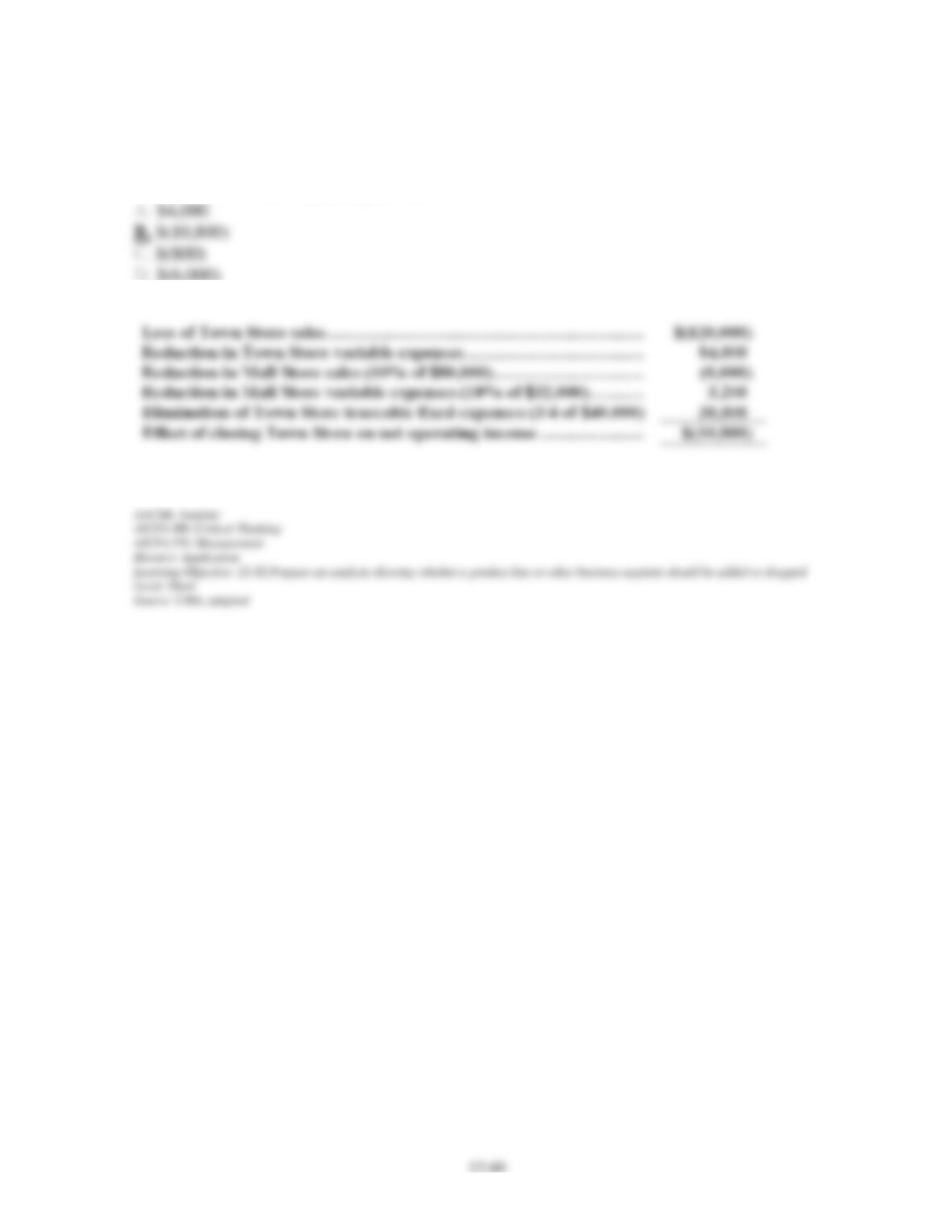
Condensed monthly operating income data for Cosmo Inc. for November is presented below.
Additional information regarding Cosmo’s operations follows the statement.
Three-quarters of each store’s traceable fixed expenses are avoidable if the store were to be
closed.
Cosmo allocates common fixed expenses to each store on the basis of sales dollars.
Management estimates that closing the Town Store would result in a ten percent decrease in
Mall Store sales, while closing the Mall Store would not affect Town Store sales.
The operating results for November are representative of all months.
Chapter 12 – Differential Analysis: The Key to Decision Making
73. A decision by Cosmo Inc. to close the Town Store would result in a monthly increase
(decrease) in Cosmo’s operating income of: