
Current Liabilities:
Accounts Payable $ 75 $ 45
Accrued Wages Payable 29 10
Accrued Income Taxes Payable 16 12
Accrued Interest Payable 9 9
Unearned Sales Revenue — 5
Current Portion of
Long–Term Notes Payable 80 —
Total Current Liabilities $209 $ 91
Long–Term Liabilities:
Notes Payable 140 220
Total Liabilities $349 $301
Stockholders’ Equity:
Common Stock $102 $102
Retained Earnings 365 287
Total Stockholders’ Equity $467 $389
Total Liabilities and
Stockholders’ Owners’ Equity $816 $690
12.4-1) Referring to Table 12–6, what is the interest coverage for Howard Company in 2X10? Has the
interest coverage improved or not improved since 2X09?
A) 12.7, unknown
B) 7.7, not improved
C) 7.7, improved
D) 8.7, improved
E) 8.7, not improved
12.4-2) Referring to Table 12–6, what is the return on stockholders’ equity for Howard Company in 2X10?
Has the return on stockholders’ equity improved or not improved since 2X09?
A) 32.2%, improved
B) 32.2%, unknown
C) 29.6%, not improved
D) 31.6%, not improved
E) 29.6%, improved

34
Table 12–5
The following are the income statements and balance sheets for Amazon Pools and Spas at and for the
years ended December 31, 2X10, 2X09, and 2X08:
Amazon Pools and Spas
Combined Statements of Income
For the Years Ended December 31, 2X10, 2X09, and 2X08
2X10 2X09 2X08
Sales (all credit sales) $800 $740 $675
Less Cost of Goods Sold 525 490 450
Gross Profit $275 $250 $225
Less Operating Expenses 150 140 125
Operating Income $125 $110 $100
Less Other Expense: Interest 10 8 5
Income before Tax $115 $102 $ 95
Less Income Tax Expense 51 46 43
Net Income $ 64 $ 56 $ 52
Amazon Pools and Spas
Consolidated Balance Sheets
December 31, 2X10, 2X09, and 2X08
2X10 2X09 2X08
Current Assets:
Cash $ 25 $ 20 $ 15
Accts Receivable 90 70 60
Inventory 65 50 40
Prepaid Rent 10 15 5
Total Current Assets $190 $155 $120
Long–Term Assets:
Equipment $160 $155 $140
Accumulated Depreciation (100) (95) (85)
Total Long–Term Assets $ 60 $ 60 $ 55
Total Assets $250 $215 $175

Current Liabilities:
Accounts Payable $ 50 $ 30 $ 20
Wages Payable 20 10 5
Taxes Payable 10 5 15
Current Long–Term Debt 10 15 5
Total Current Liabilities $ 90 $ 60 $ 45
Long–Term Liabilities:
Long–Term Debt 35 45 40
Total Liabilities $125 $105 $ 85
Stockholders’ Equity:
Common Stock $5 par $ 50 $ 50 $ 50
Retained Earnings 75 60 40
Total Stockholders’ Equity $125 $110 $ 90
Total Liab. & Stk. Equity $250 $215 $175
December 31 market price $ 50 $ 47 $ 45 per share
12.4-3) Referring to Table 12–5, what is the interest coverage for Amazon Pools and Spas in 2X10? Has the
interest coverage improved or not improved since 2X09?
A) 12.5, not improved
B) 6.4, not improved
C) 11.5, improved
D) 12.5, improved
E) 6.4, improved
12.4-4) Referring to Table 12–5, what is the return on stockholders’ equity for Amazon Pools and Spas in
2X10? Has the return on stockholders’ equity improved or not improved since 2X09?
A) 25.6%, improved
B) 25.6%, not improved
C) 54.5%, improved
D) 54.5%, not improved
E) 128.0%, improved
12.4-5) Birchtec, Inc., has a weighted–average cost of capital of 12%; $320,000 in long term assets; $80,000
in current assets; and $400,000 in capital. What amount must Birchtec, Inc.’s net operating profit after tax
be to add value?
A) $26,400
B) $38,400
C) $ 7,200
D) $16,800
E) $48,000
12.4-6) Debt is often a more attractive vehicle for financing long–term investments for which of the
following reasons?
1. Debt is less risky than common stock.
2. Debt may be converted into common stock in a tax-free exchange.
3. Interest payments are tax deductible, and dividend payments are not.
4. Ownership rights are kept by the present stockholders.
A) 3 and 4
B) 1 and 3
C) 2 and 4
D) 1 and 2
E) 1, 2, 3, and 4
12.4-7) ROE = Return on sales × Total asset turnover × Financial Leverage.
12.4-8) Financial management is concerned with where a company gets cash and how it uses that cash to
its benefit.
12.4-9) The rate of return on investment is equal to invested capital divided by income.
12.4-10) Income may be expressed as net earnings, pretax income from operations, or earnings before
interest and taxes in financial ratios.
12.4-11) Debt is often a less attractive vehicle for long–term financing since the interest expense incurred
on debt reduces net income.
12.4-12) Trading on the equity refers to using money borrowed at fixed interest rates to try to enhance the
rate of return on common shareholders’ equity.
12.4-13) Economic value added is a performance measure stating that a company must earn more than it
must pay for its capital if it is to increase in value.
12.4-14) The use of debt is generally less costly to corporations than is equity.
38
12.4-15) The following table describes certain financial results for three companies during 2X08, 2X09 and
2X10:
Income Before Interest and Taxes
2X08 Tree Company $50,000
Shrubs Company 50,000
Flower Company 50,000
2X09 Tree Company $30,000
Shrubs Company 30,000
Flower Company 30,000
2X10 Tree Company $15,000
Shrubs Company 15,000
Flower Company 15,000
Each company has total assets of $250,000 in each year. Tree Company has no debt, Shrubs Company has
$100,000 of debt at an interest rate of 10%, and Flower Company has $150,000 of debt at a 14% interest
rate. Shrubs and Flower have no other debt or liabilities. Assume no taxes.
a. For each company, and for each year, determine
1. the rate of return on total assets, and
2. the rate of return on stockholders’ equity.
b. For each company, and for each year, state whether the company’s use of debt leverage is favorable,
unfavorable, or not applicable.
12.4-16) With respect to whether a company should issue debt or preferred stock to finance an investment
in plant assets, provide three issues that need to be considered before such a decision is made.
Learning Objective 12.5 Questions
Table 12–7
Victoria Gardens has net income of $725,000. Throughout the year, the company had 150,000 shares of
common stock outstanding. Also, the company has 25,000 shares of preferred stock that pay a dividend of
$5.00 per share that is convertible into 5 shares of common stock for each share of preferred. The
preferred stock is considered to be dilutive. The tax rate for Victoria Gardens is 40%.
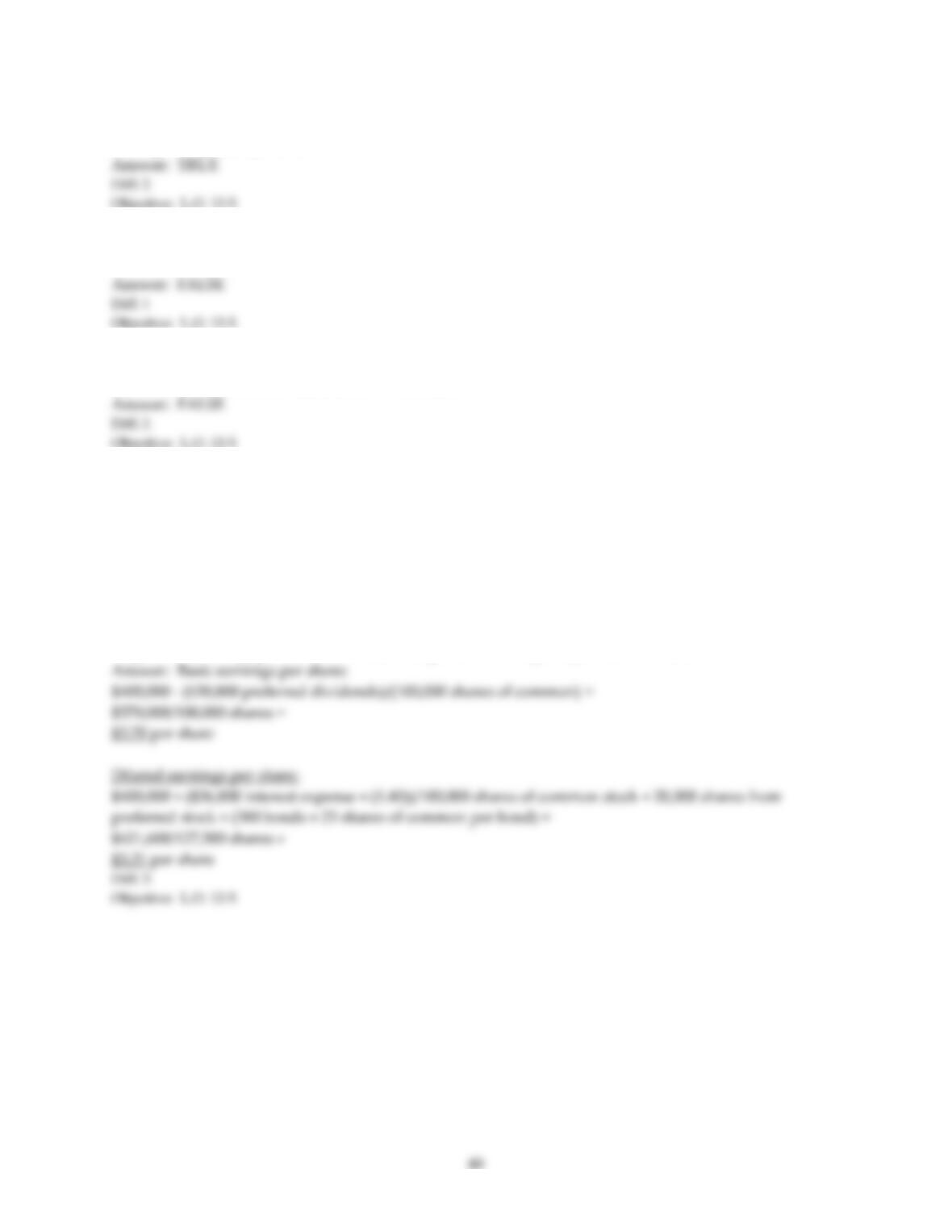
12.5-1) Referring to Table 12–7, what is the basic earnings per share for Victoria Gardens?
A) $2.50
B) $2.71
C) $2.86
D) $3.64
E) $4.00
12.5-2) Referring to Table 12–7, what are the diluted earnings per share for Victoria Gardens?
A) $2.00
B) $2.25
C) $2.50
D) $2.64
E) $4.00
12.5-3) Diluted earnings per share assume all convertible securities are converted into common stock at
the beginning of the period.
12.5-4) The denominator in the earnings per share ratio is the number of common shares outstanding at
the end of the period.
12.5-5) When companies have convertible securities or stock options outstanding, the earnings per share
available for the common shareholder is increased.
12.5-6) Whispering Woods Retreat has net income of $400,000. The company’s tax rate is 40%. The
company had 100,000 shares of common stock outstanding throughout the year. The company also has
two other securities:
a. Preferred stock; 6%; $100 par; 5,000 shares issued and outstanding. Each share of preferred stock is
convertible into 4 shares of common stock.
b. 12% long–term bonds payable; $300,000 face value. Each $1,000 bond is convertible into 25 shares of
common stock.
Prepare the earnings per share information required for Whispering Woods Retreat.
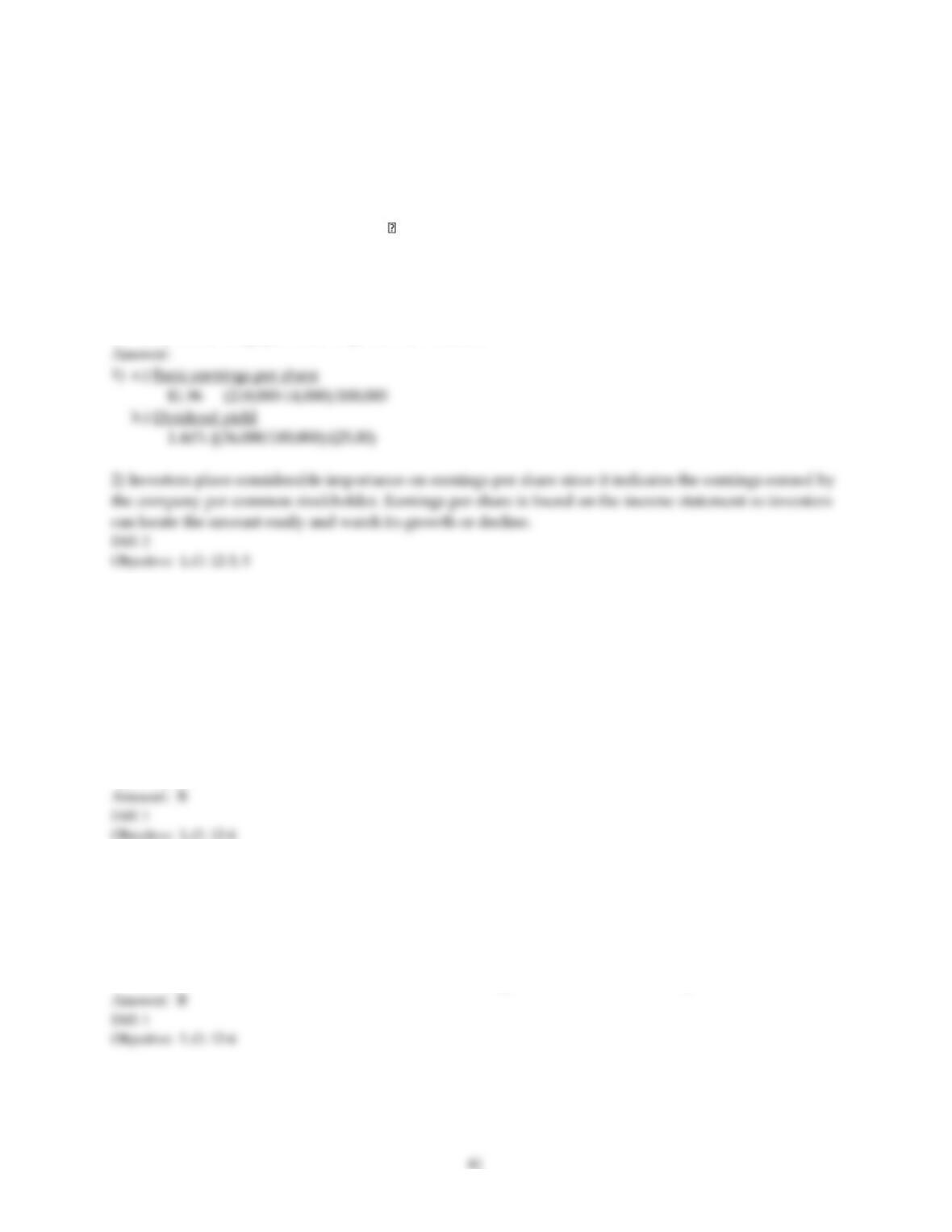
Table 12–8
Net income $210,000
Cash dividends on preferred stock 14,000
Cash dividends on common stock 36,000
Weighted average number of common shares outstanding 100,000
Market price per share of common stock 12/31/2X10 $25.00
12.5-7) Referring to Table 12–8, calculate the following ratios:
1. a) Basic earnings per share–common
b) Dividend yield
2. Why are earnings per share important to investors?
Learning Objective 12.6 Questions
12.6-1) Sliding Enterprises sells one of its four swing sets. How shall the gain on the sale be classified on
the income statement?
A) Extraordinary item
B) Ordinary income
C) Accounting Change
D) Discontinued Operation
E) Recapture
12.6-2) It is now 2X09; Jump N’ Fun is restructuring operations by selling its trampoline in 2X10.
A) When the announcement is made, the restructuring charges will be included in the income statement.
B) The balance sheet assets will immediately be reduced for the amount of the charge.
C) Jump N’ Fun can take the charges over time so as to manage earnings.
D) When the cash expenditure is made in 2X10, it will be recognized on the income statement.
E) This type of event will have no effect unless there is a gain on the sale of the trampoline.
12.6-3) Extraordinary items occur when
A) a company sells an entire segment of the business.
B) a company shuts down a location.
C) a significant FASB rule changes the business valuation.
D) the event is unusual and infrequent.
E) a company writes up the value of its intangible assets.
12.6-4) How are discontinued operations, extraordinary items, and cumulative effects of a change in
accounting principles disclosed on the income statement?
A) Discontinued operations and extraordinary items are added together while cumulative effects of a
change in accounting principles are shown separately.
B) Discontinued operations and cumulative effects of a change in accounting principles are added
together while extraordinary items are shown separately.
C) Extraordinary items and cumulative effects of a change in accounting principles are added together
while discontinued operations are shown separately.
D) Discontinued operations, extraordinary items, and cumulative effects of a change in accounting
principles are all added together and shown together.
E) Discontinued operations, extraordinary items, and cumulative effects of a change in accounting
principles are each treated separately.
12.6-5) The evaluation of operating performance should exclude extraordinary items.
12.6-6) To be considered an extraordinary item, it must be both unusual in nature and infrequent in
occurrence.
12.6-7) Special items appear in the income statement as part of the operating expenses.
12.6-8) The write–downs of receivables and inventory are generally regarded as extraordinary items.
12.6-9) Income or loss from discontinued operations is reported in the income statement before the tax
effect.
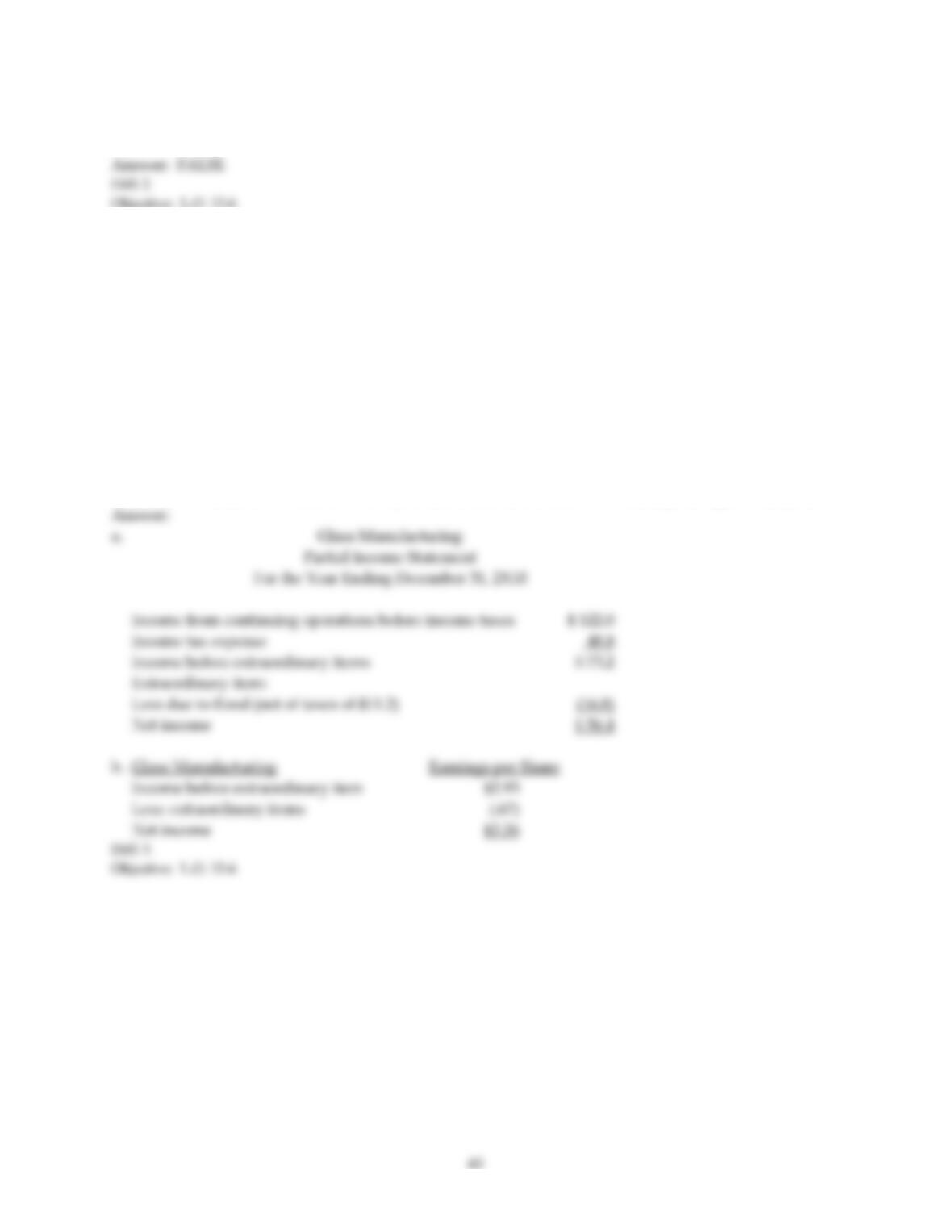
12.6-10) Glass Manufacturing has an income tax rate of 40% and income from continuing operations
before income taxes of $100. The following additional activity occurred during the year, 2X10:
1) Glass Manufacturing disposed of a product line by selling it to Paper Company. The income before
taxes from this product line, before it was sold, was $25, and the sale resulted in a $7 loss.
2) Glass Manufacturing had a gain of $4 on the extinguishment of long–term debt that was a current
liability.
3) Glass Manufacturing incurred a loss of $28 due to a flood in a place that has floods once in 100 years.
Prepare the following:
a. Beginning with income from continuing operations before income taxes of $100, complete the
remainder of Glass Manufacturing’s income statement.
b. Prepare the necessary earnings per share disclosure, assuming that Glass Manufacturing has no
convertible securities or common stock equivalents and has 25 shares outstanding throughout the year.
Learning Objective 12.7 Questions
12.7-1) When the PEG ratio is less than .5, investors will be more likely to
A) sell the stock.
B) hold the stock.
C) buy the stock.
D) short the stock.
E) write a put option.
12.7-2) If a company capitalizes costs that it should have expensed in 2X10 (assume no income tax effect),
A) cash flows will be higher in 2X10.
B) cash flows will be lower in 2X10.
C) net income will be lower in 2X10.
D) net income will be higher in 2X10.
E) no income statement effect will occur.
12.7-3) To compute the PEG ratio, divide the P–E ratio by the earnings growth rate.
12.7-4) Growth stocks generally have a PEG ratio less than one.
12.7-5) Earnings quality is a well–defined and well–understood concept.
12.7-6) a. Describe earnings quality.
b. How is knowledge of earnings quality helpful in the analysis of financial statements?