Rewrite the given expression as a single logarithm. Assume that all variables are defined in such a way that variable
expressions are positive and bases are positive numbers not equal to 1.
142)
logx28 –logx7
142)
A)
logx28
logx7
B)
logx196
C)
logx4
D)
logx21
Find the logarithm. Give an approximation to four decimal places.
143)
log 2.38
143)
A)
0.3945
B)
0.3579
C)
0.8671
D)
0.3766
Solve the problem. Round your answer to the nearest tenth, when appropriate. Use the formula pH = – log H3O+, as
needed.
144)
Find the pH if [H3O+] =7.9 × 10⁻⁶.
144)
A)
6.1
B)
5.1
C)
5.9
D)
6.9
Solve the problem.
145)
The number of bacteria growing in an incubation culture increases with time according to
B(x) =7500(5)x, where x is time in days. After how many days will the number of bacteria in the
culture be 4,687,500?(Hint: Let B(x) =4,687,500.)
145)
A)
4 days
B)
10 days
C)
6 days
D)
1 day
41
If the following defines a one–to–one function, find its inverse. If not, write “Not one–to–one.”
146)
{(–3, 1
2), (–2, –3), (–1
3, 2), (–9, 3
8)}
146)
A)
Not one–to–one
B)
{(1
2, 3), (–3, 2), (2, 1
3), (–3
8, –9)}
C)
{(1
2, –3), (–3, –2), (2, –1
3), ( 3
8, –9)}
D)
{(1
3, –3), (–3, –2), (2, –1
2), ( 3
8, –9)}
Use a calculator and the change–of–base formula to find the logarithm to four decimal places.
147)
log337.25
147)
A)
12.4167
B)
0.3037
C)
1.5711
D)
3.2929
Evaluate the logarithm.
148)
log 9
1
81
148)
A)
–9
B)
2
C)
–2
D)
9
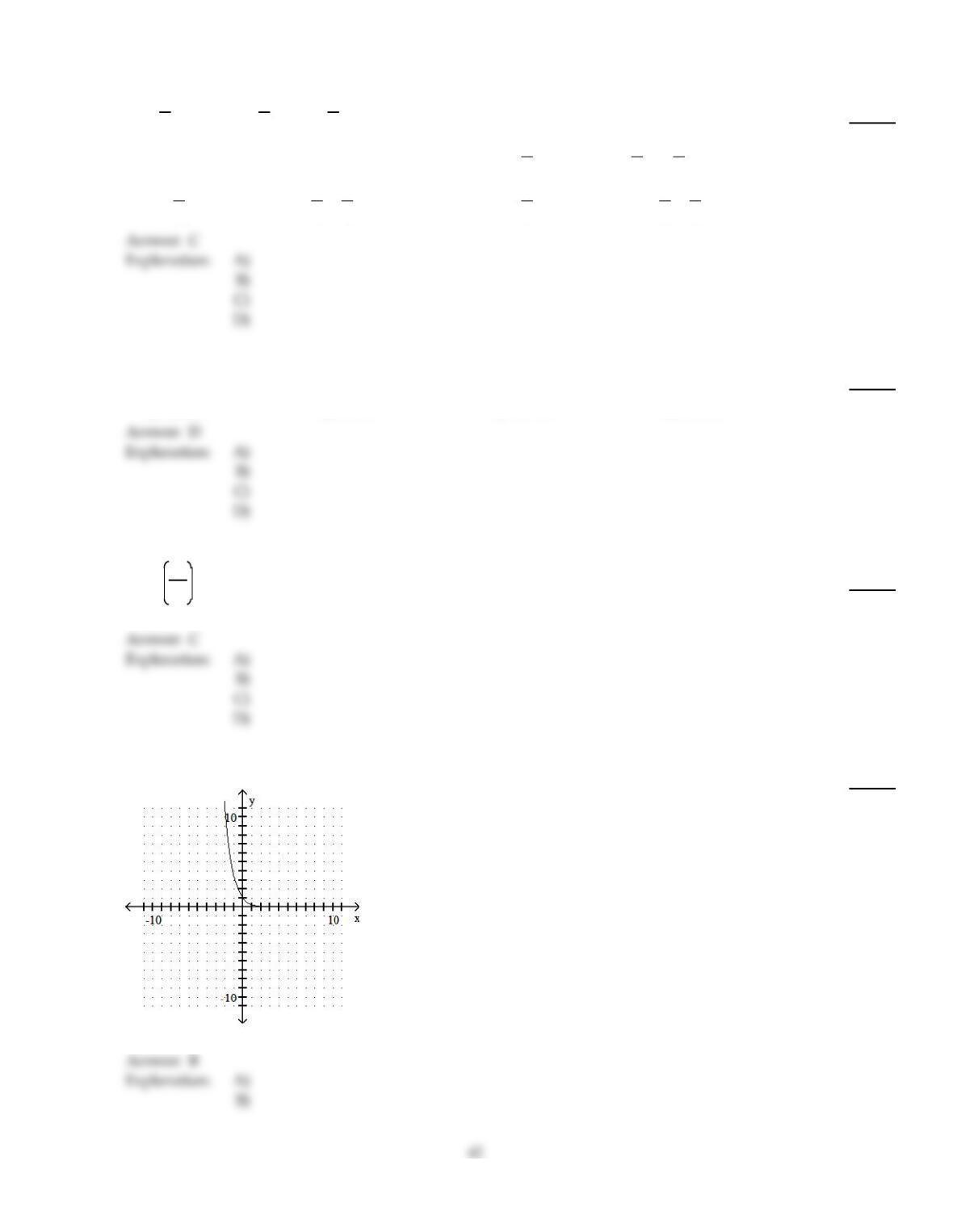
Determine whether or not the function is one–to–one.
149)
149)
A)
No
B)
Yes
Provide an appropriate response.
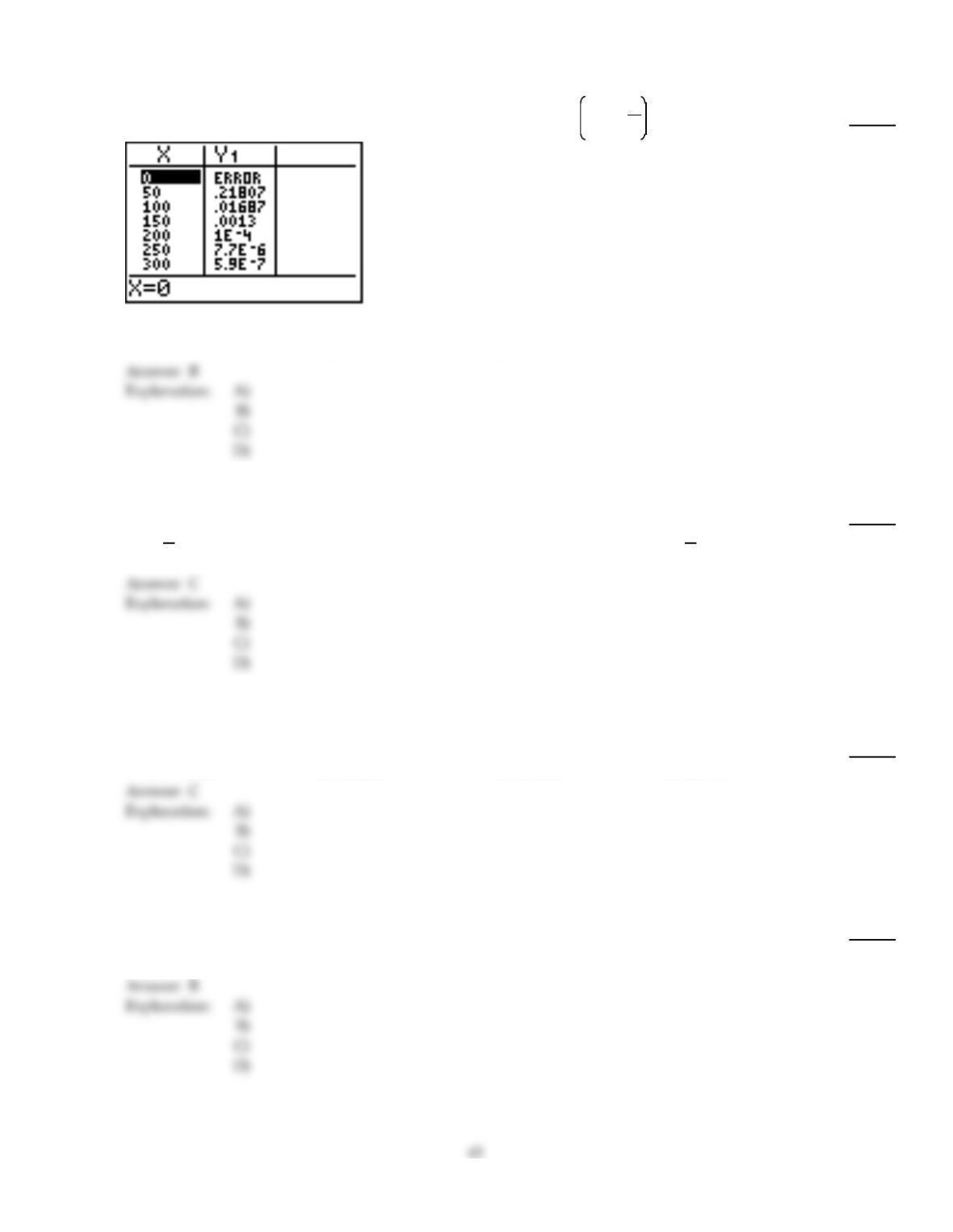
150)
The screen shows a table of values for the function defined by Y1=0.95 +1
X
X.
What number does the function value seem to approach as x takes on larger and larger values?
150)
A)
5.9
B)
0
C)
300
D)
–7
Find the indicated value.
151)
Let f(x) =3x. f–1(81)
151)
A)
1
3
B)
3
C)
4
D)
4
3
Solve the equation. Use natural logarithms. When appropriate, give solutions to three decimal places unless otherwise
indicated.
152)
e–0.405x=16
152)
A)
{–0.146}
B)
{1.123}
C)
{–6.846}
D)
{2.773}
Solve the equation.
153)
log28 x = 0
153)
A)
{0}
B)
{1}
C)
{–1}
D)
{28}
Write in exponential form.
154)
log 525 =2
154)
A)
52=25
B)
252=5
C)
25=25
D)
525 =2
Solve the problem.
155)
A certain noise has an intensity I of 5.64 ×10⁻⁴. Given that decibel level D is related to intensity by
D = 10 log I
Io, where Io is 10–12, determine the decibel level of the noise. Round your answer to
the nearest decibel.
155)
A)
202 decibels
B)
78 decibels
C)
88 decibels
D)
9 decibels
Solve the equation. Give the solution to three decimal places.
156)
8–x – 1 =54
156)
A)
{–2.918 }
B)
{–3.918 }
C)
{–1.918 }
D)
{–7.295 }
Solve the equation.
157)
log x9=2
157)
A)
{2, –2}
B)
{3}
C)
{3, –3}
D)
{2}
Solve the problem.
158)
Use the formula N = Iekt, where N is the population at time t, I is the initial population, and k is a
growth constant equal to the percent of growth (expressed in decimal form) per unit of time. How
long will it take for the population of a certain country to double if its annual growth rate is 3.5 %?
Round your answer to the nearest year.
158)
A)
20 yr
B)
9 yr
C)
1 yr
D)
57 yr
Solve the equation.
159)
log25 x =1
2
159)
A)
{25}
B)
{–5}
C)
{5}
D)
1
5
Solve the equation. Give the exact solution or solutions.
160)
log ( 3+ x) – log (x – 5 ) = log 5
160)
A)
B)
{7}
C)
{3.5}
D)
{–7}
Solve the problem.
161)
Susan invested $8500 at 6% compounded semiannually. In how many years will Susan‘s
investment have quadrupled? Round your answer to the nearest tenth of a year.
161)
A)
7.2 years
B)
2.6 years
C)
23.1 years
D)
23.4 years
Find the logarithm. Give an approximation to four decimal places.
162)
log 0.00284
162)
A)
–2.5622
B)
–2.5467
C)
–5.8640
D)
–2.5317
Solve the equation. Give the exact solution.
163)
9x=81(3x – 2)
163)
A)
1
5
B)
–4
5
C)
4
5
D)
1
Solve the problem.
164)
The half–life of a certain radioactive substance is 20 years. Suppose that at time t = 0, there are 30 g
of the substance. Then after t years, the number of grams of the substance remaining will be N(t) =
30(1/2)t/20. How many grams of the substance will remain after 80 years?
164)
A)
0.23 g
B)
0.47 g
C)
1.88 g
D)
0.94 g
165)
The number of books in a small library increases according to the function B =9300e0.05t, where t is
measured in years. How many books will the library have after 2 years?
165)
A)
21,414
B)
10,278
C)
11,708
D)
9300
Evaluate the logarithm.
166)
log 1/88
166)
A)
1
B)
2
C)
–2
D)
–1
Solve the equation.
167)
log1/5 x = – 3
167)
A)
{125}
B)
{243}
C)
1
243
D)
1
125
Use the change–of–base rule to express the given logarithm in terms of common logarithms, in terms of natural
logarithms, and correct to four decimal places.
168)
log26 46.66
log 26
168)
A)
log 26
log 46.66 ; ln 26
ln 46.66 ; 0.8478
B)
46.66
26 ; 1.7946
C)
log 46.66
log 10 ; ln 46.66
ln 10 ; 1.6689
D)
log 46.66
log 26 ; ln 46.66
ln 26 ; 1.1795
Solve the problem.
169)
The sales of a new product (in items per month) can be approximated by
S(x) =300 +300 log10(3t + 1), where t represents the number of months after the item first becomes
available. Find the number of items sold per month 33 months after the item first becomes
available.
169)
A)
6300 items per month
B)
90,000 items per month
C)
900 items per month
D)
3300 items per month
Solve the equation.
170)
log 2x = – 3
170)
A)
1
8
B)
–1
C)
1
9
D)
–6
171)
log 6= x
171)
A)
65
B)
5
C)
56
D)
6
Solve the problem.
172)
The number of acres in a landfill is given by the function B =4700e–0.05t, where t is measured in
years. How many acres will the landfill have after 5 years? (Round to the nearest acre.)
172)
A)
2830
B)
6516
C)
2643
D)
3660
Solve the problem. Round your answer to the nearest tenth, when appropriate. Use the formula pH = – log H3O+, as
needed.
173)
Find the pH if [H3O+] =7.7 × 10 –5.
173)
A)
5.9
B)
–5.9
C)
4.6
D)
4.1
Solve the equation.
174)
27x=81(3x – 5)
174)
A)
5
2
B)
–20
9
C)
5
9
D)
20
9
Determine whether or not the function is one–to–one.
175)
f(x) =4– x2
175)
A)
No
B)
Yes
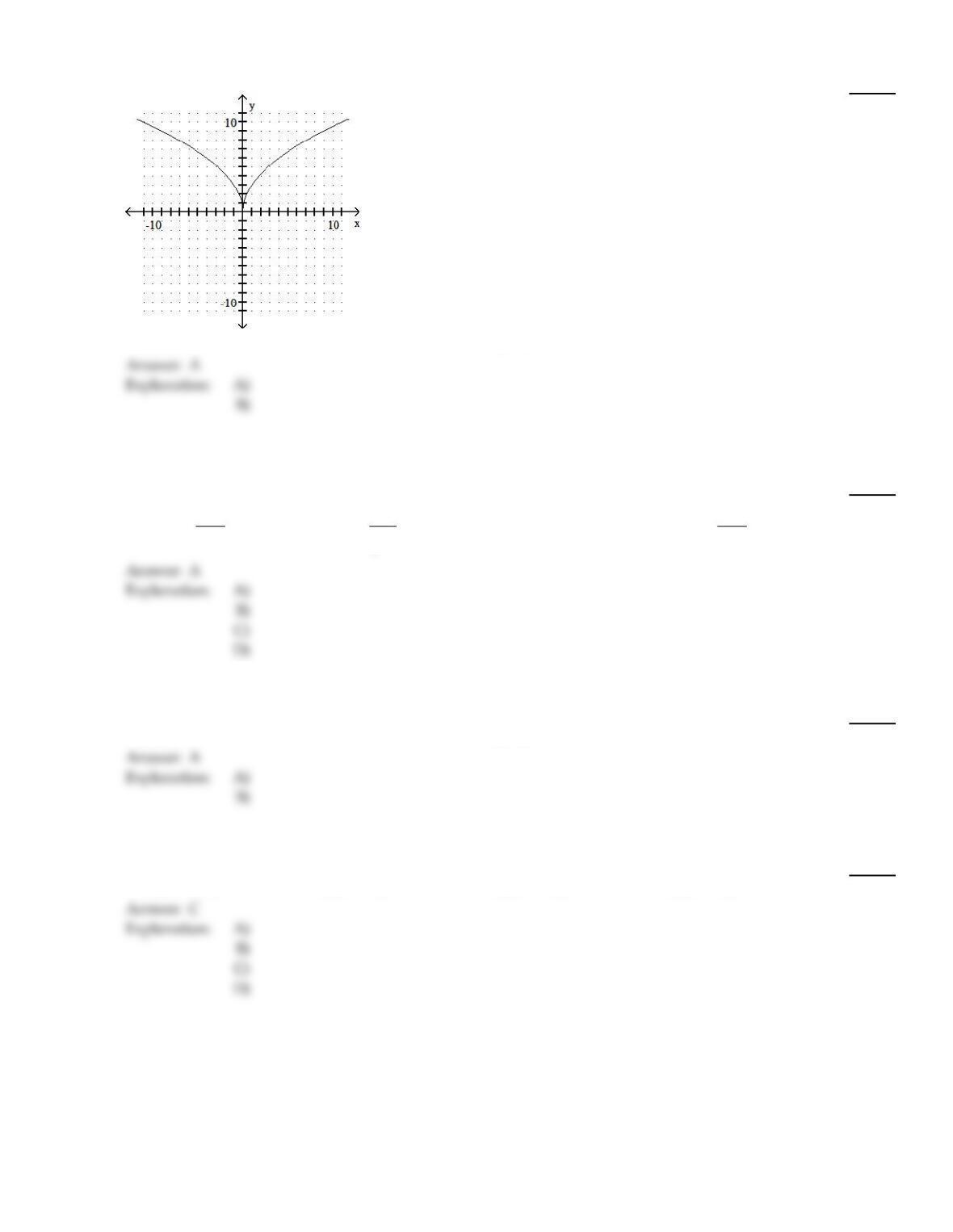
176)
176)
A)
No
B)
Yes
Rewrite the given expression as a single logarithm. Assume that all variables are defined in such a way that variable
expressions are positive and bases are positive numbers not equal to 1.
177)
(logqq–logqr) +5logqp
177)
A)
logq
qp5
r
B)
logq
q
p5r
C)
logqqp5r
D)
logq
5qp
r
Determine whether or not the function is one–to–one.
178)
f(x) = x3+ 7
178)
A)
Yes
B)
No
Solve the equation. Give the solution to three decimal places.
179)
10 –x + 1=94
179)
A)
{–2.973 }
B)
{9.461 }
C)
{–0.973}
D)
{1.973 }
49
Find the logarithm. Give an approximation to four decimal places.
180)
ln ( 8.57 × e –4)
180)
A)
2.1504
B)
2.1483
C)
6.1483
D)
–1.8517
Use properties of logarithms to write each expression as a single logarithm. Assume that variables represent positive real
numbers, with base 1.
181)
3log bq–2
5log br+1
3log bf– 4 log bp
181)
A)
log bq3r2/5
f1/3p4
B)
log bq3p4
f1/3r2/5
C)
log bq3f1/3
r2/5 p4
D)
log b (3 q –2
5r+1
3f– 4 p )
Solve the equation.
182)
2
3
x
=27
8
182)
A)
–3
B)
1
3
C)
3
D)
–1
3
Decide whether the statement is true or false.
183)
log 315 +15 =log 315 +log 315
183)
A)
True
B)
False
50
Find the indicated value.
184)
Let f(x) =3x. f(–2)
184)
A)
9
B)
1
9
C)
1
3
D)
1
6
Solve the equation.
185)
log 2
1
4= x
185)
A)
–2
B)
1
8
C)
1
2
D)
2
Solve the problem.
186)
What will be the amount in an account with initial principal $7000 if interest is compounded
continuously at an annual rate of 3.25% for 8 years?
186)
A)
$2151.01
B)
$7000.00
C)
$9078.51
D)
$7231.24
Solve the equation. Give the exact solution or solutions.
187)
log x5=4
187)
A)
45
B)
C)
54
D)
5
4
Solve the problem.
188)
The annual depreciation rate r (0 < r < 1) of a car purchased for P dollars and worth A dollars after t
years can be modeled by the following formula:
log (1 – r) =1
t log A
P.
Find the depreciation rate of a car that is purchased for $37,000 and is sold 5 years later for $15,000.
Express your answer as a percentage, and round the answer to the nearest whole percentage.
188)
A)
83%
B)
17%
C)
–17%
D)
–83%
Write in logarithmic form.
189)
5
2
5
=3125
32
189)
A)
log 5/2
3125
32 =5
B)
log 53125
log 532 =5
2
C)
log 5
5
2=3125
32
D)
log 5/2 5=3125
32
If the following defines a one–to–one function, find its inverse. If not, write “Not one–to–one.”
190)
{(–6, –17), (–17, 14), (1, 4)}
190)
A)
{(–17, –6), (14, –17), (4, 1)}
B)
{(–6, 14), (–6, –17), (4, 1)}
C)
{(–17, –6), (1, –17), (4, 14)}
D)
Not one–to–one
191)
f(x) =6x3– 7
191)
A)
f–1(x) =3x – 7
6
B)
Not one–to–one
C)
f–1(x) =3 x
6
+ 7
D)
f–1(x) =3x + 7
6
Solve the equation.
192)
log 4x = 1
192)
A)
1
B)
0
C)
1
4
D)
4
Answer Key
Testname: C12
54
Answer Key
Testname: C12
Answer Key
Testname: C12
56
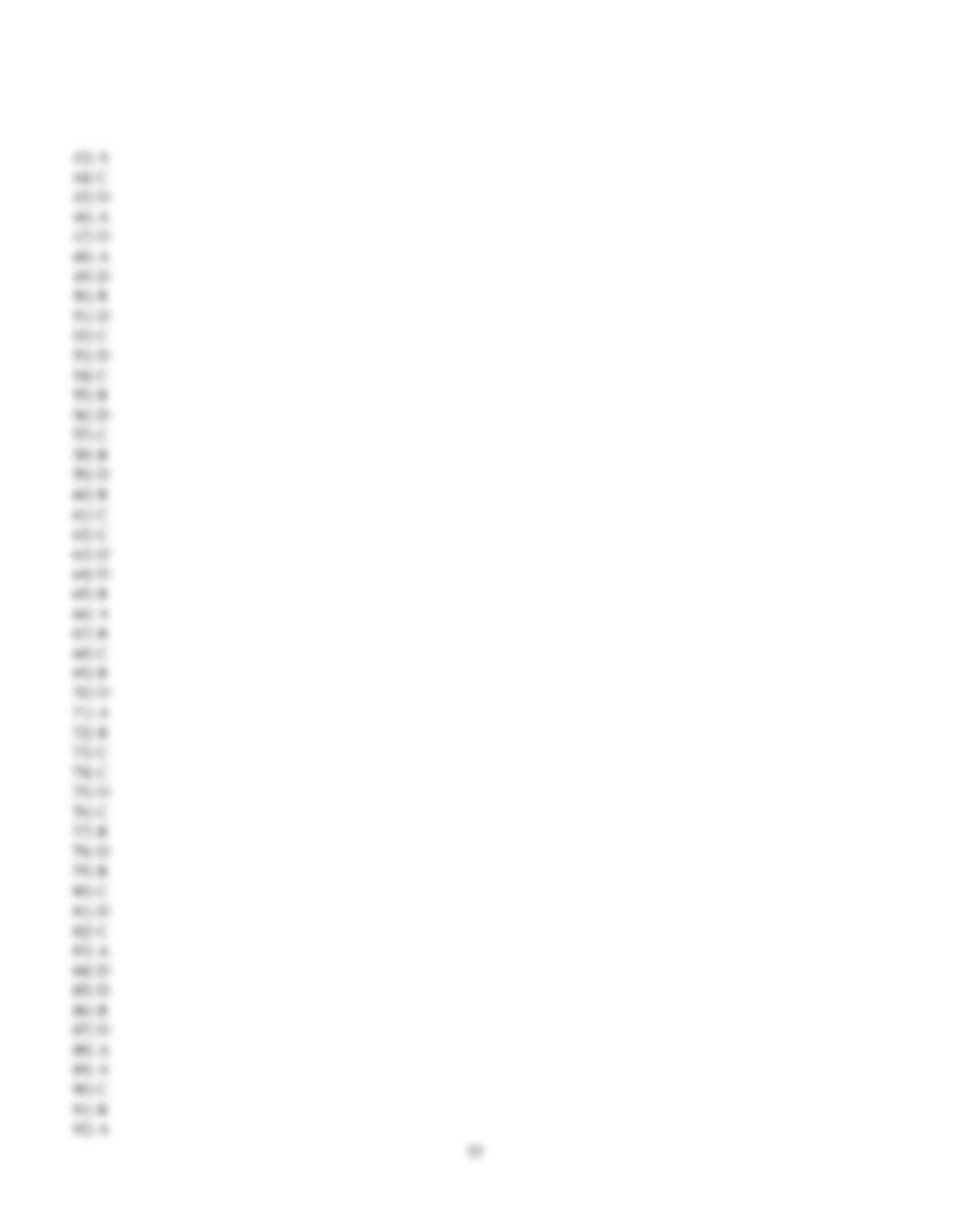
Answer Key
Testname: C12
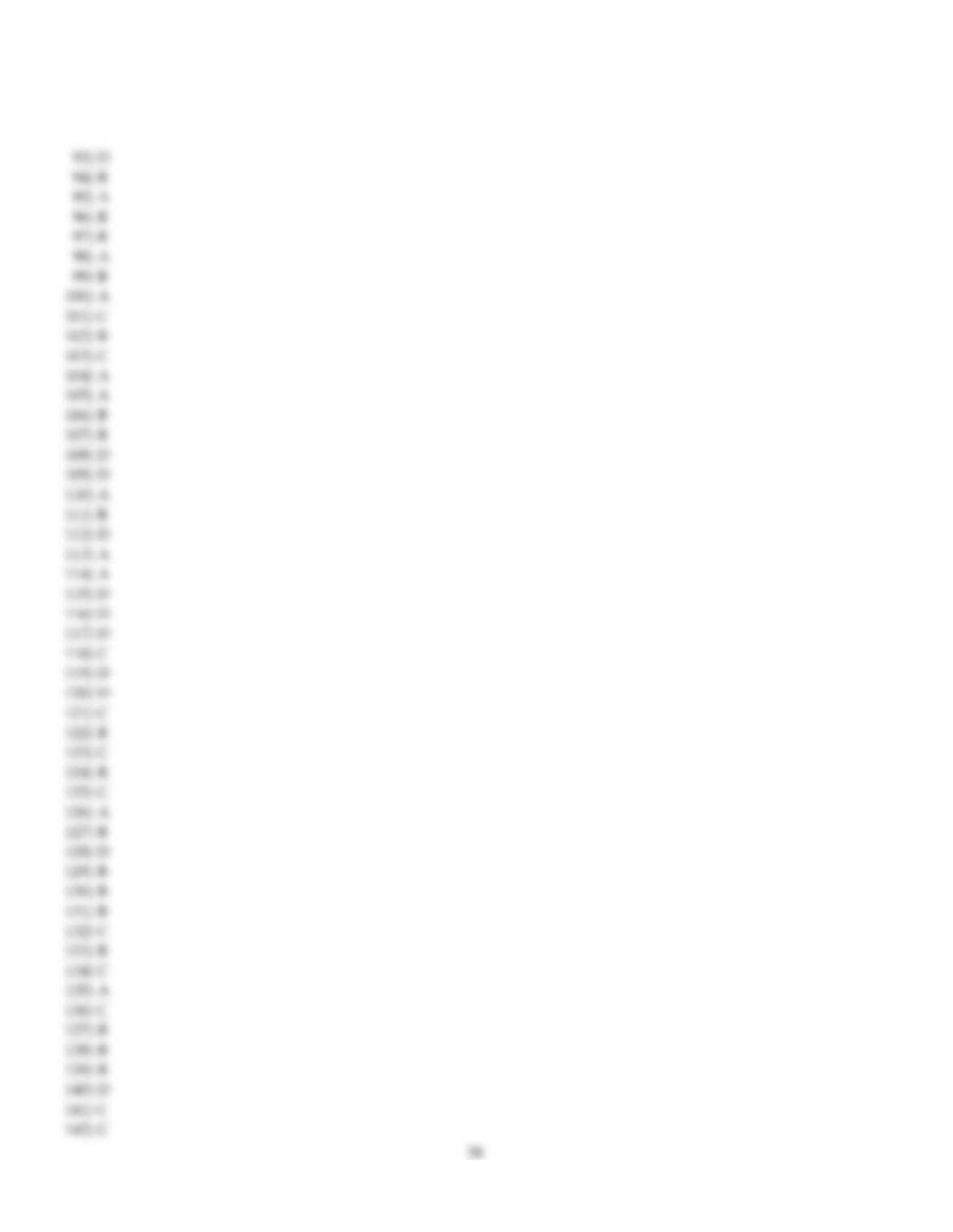
Answer Key
Testname: C12
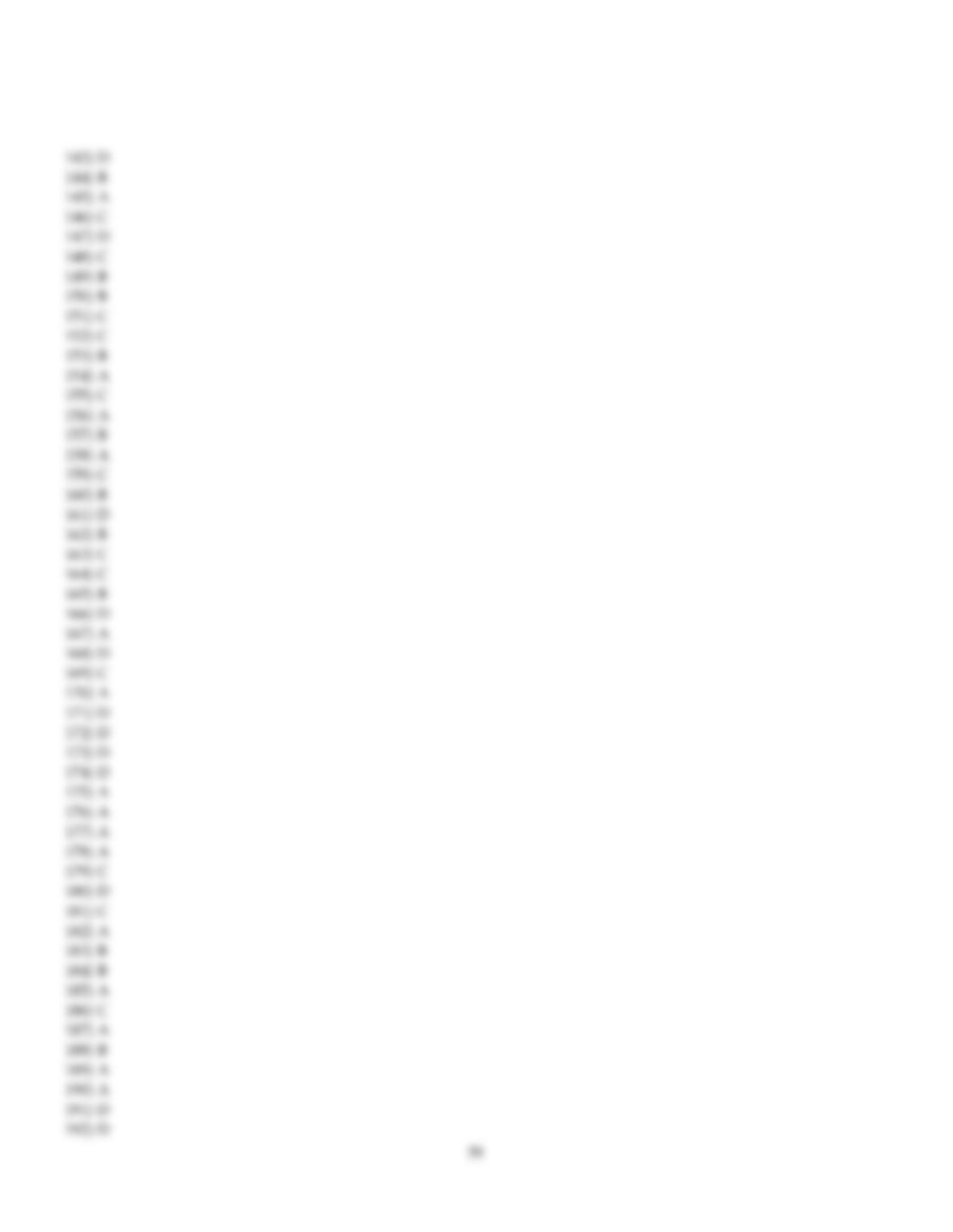
Answer Key
Testname: C12