100) A rod, with sides insulated to prevent heat loss, has one end immersed in boiling water at
100°C and the other end in a water-ice mixture at 0°C. The rod has uniform cross-sectional area
and length The heat conducted by the rod melts the ice at a rate of 1.0 g every 11
seconds. What is the thermal conductivity of the rod? Recall that the heat of fusion of water is
3.34 × 10⁵ J/kg.
101) In an experiment to measure the thermal conductivity of a certain material, a slab of
material 10.0 mm thick separates a steam chamber from a block of ice with a square cross-
section with dimensions 8.00 cm × 8.00 cm. After 5.00 min of running the experiment, 64.0 g of
ice have melted. What is the thermal conductivity of this material? The latent heat of fusion of
water is 33.5 × 10⁴ J/kg, the latent heat of vaporization of water is 2.256 × 10⁶ J/kg, and both the
ice and water are under 1.00 atm of pressure.
A) 0.130 W/m ∙ K
B) 0.250 W/m ∙ K
C) 0.440 W/m ∙ K
D) 0.620 W/m ∙ K
E) 1.12 W/m ∙ K
102) A sphere of surface area 1.25 m2 and emissivity 1.0 is at a temperature of 100°C. At what
rate does it radiate heat into empty space? (σ = 5.67 × 10⁻⁸ W/m2 ∙ K4)
A) 7.1 W
B) 0.71 mW
C) 1.4 kW
D) 9.9 mW
E) 3.7 W
103) The cylindrical filament in a light bulb has a diameter of 0.050 mm, an emissivity of 1.0,
and a temperature of 3000°C. How long should the filament be in order to radiate 60 W of
power? (σ = 5.67 × 10⁻⁸ W/m2 ∙ K4)
A) 11 cm
B) 9.4 cm
C) 8.6 cm
D) 7.2 cm
E) 5.9 cm

104) How much power does a sphere with a radius of 10 cm radiate into empty space if is has an
emissivity of 1.0 and is kept at a temperature of 400 K? (σ = 5.67 × 10⁻⁸ W/m2 ∙ K4)
A) 60 W
B) 70 W
C) 180 W
D) 210 W
E) 360 W
105) A blacksmith is flattening a steel plate having dimensions 10 cm × 15 cm × 1 mm. He has
heated the plate to 900 K. If the emissivity of the plate is 0.75, at what rate does it lose energy by
radiation? Ignore any heat exchange with the surroundings. (σ = 5.67 × 10⁻⁸ W/m2 ∙ K4)
A) 360 W
B) 760 W
C) 790 W
D) 850 W
E) 880 W
106) What is the net power that a person with surface area of 1.20 m2 radiates if his emissivity is
0.895, his skin temperature is 27°C, and he is in a room that is at a temperature of 17°C? (σ =
5.67 × 10⁻⁸ W/m2 ∙ K4)
A) 60.3 W
B) 62.6 W
C) 65.7 W
D) 68.4 W
E) 64.8 W
107) What is the net power radiated by a little animal with a surface area of 0.075 m2 if his
emissivity is 0.75, his skin temperature is 315 K, and he is in a room with a temperature of 290
K? (σ = 5.67 × 10⁻⁸ W/m2 ∙ K4)
A) 8.8 W
B) 6.0 W
C) 8.0 W
D) 15 W
E) 18 W

108) The radius of a star is 6.95 × 10⁸ m, and its rate of radiation has been measured to be 5.32 ×
1026 W. Assuming that it is a perfect emitter, what is the temperature of the surface of this star?
(σ = 5.67 × 10⁻⁸ W/m2 ∙ K4)
A) 6.27 × 10³ K
B) 8.25 × 10³ K
C) 8.87 × 10³ K
D) 3.93 × 10⁷ K
E) 5.78 × 10⁷ K
109) A giant star radiates energy at the rate of 3.0 × 1030 W, and its surface temperature has
been measured to be 3000 K. Assuming that it is a perfect emitter, what is the radius of this
star?(σ = 5.67 × 10⁻⁸ W/m2 ∙ K4)
A) 7.8 × 10¹⁰ m
B) 8.7 × 10¹⁰ m
C) 1.4 × 10¹⁰ m
D) 1.9 × 10¹¹ m
E) 2.3 × 10¹¹ m
110) Two identical objects are placed in a room with a temperature of 20°C. Object A has a
temperature of 50°C, while object B has a temperature of 90°C. What is the ratio of the net
power emitted by object B to the power emitted by object A?
A) 1.7
B) 2.8
C) 81
D) 17
E) 21
111) In an electric furnace used for refining steel, the temperature is monitored by measuring the
radiant power emitted through a small hole in the wall of the furnace, of area 0.5 cm2. This hole
acts like a perfect blackbody radiator having the same temperature as the interior of the furnace.
If the temperature of the furnace (and therefore of the hole) is to be maintained at 1650°C, how
much power will the hole radiate?
A) 20 W
B) 30 W
C) 40 W
D) 50 W
112) Originally 2.00 mol of gas are at STP. If the temperature changes to 47.0°C and the
pressure decreases to half of what it was, how many liters do the two moles now occupy? (1 atm
= 101 kPa, R = 8.31 J/mol ∙ K)
113) How many molecules are in (a) 1.0 cm3 of air at STP and (b) 1.0 cm3 of helium at STP? (R
= 8.31 J/mol . K, NA = 6.022 × 10²³ molecules/mol)
114) If a certain sample of an ideal gas has a temperature of 104°C and exerts a pressure of 2.3 ×
104 Pa on the walls of its container, how many gas molecules are present in each cubic
centimeter of volume? The ideal gas constant is R = 8.31 J/mol × K and Avogadro’s number is
NA = 6.022 × 10²³ molecules/mol.
115) A jar holds 2.0 L of ideal nitrogen gas, N2, at STP. The atomic mass of nitrogen is 14.0
g/mol, the ideal gas constant is R = 8.31 J/mol ∙ K, Avogadro’s number is NA = 6.022 × 10²³
molecules/mol, and 1.00 atm = 101 kPa.
(a) How many moles of nitrogen are in the jar?
(b) How many nitrogen molecules are in the jar?
(c) What is the mass of the nitrogen in the jar?
116) How many moles are there in 2.00 kg of copper? The atomic weight of copper is 63.5
g/mol and its density is 8.90 g/cm3.
A) 15.3
B) 31.5
C) 51.3
D) 53.1
117) An ideal gas has a pressure of 2.5 atm, a volume of 1.0 L at a temperature of 30°C. How
many molecules are there in this gas? (R = 8.31 J/mol ∙ K,1.00 atm = 101 kPa, NA = 6.022 ×
1023)
A) 6.1 × 10²³
B) 6.0 × 10²²
C) 2.4 × 10²²
D) 2.3 × 10²³
118) A car starts out when the air temperature is 288 K and the absolute (total) air pressure in the
tires is 500 kPa. After driving a while, the temperature of the air in the tires increases to 298 K.
What is the pressure in the tires at that point, assuming their volume does not change?
A) 129 kPa
B) 483 kPa
C) 507 kPa
D) 517 kPa
E) 532 kPa
119) An ideal gas occupies 6.00 × 102 cm3 at 20°C. At what temperature will it occupy 1.20 ×
103 cm3 if the pressure is held constant?
A) 10°C
B) 40°C
C) 100°C
D) 313°C
120) A balloon originally has a volume of 1.0 m3 when the gas in it is at 20°C and under a
pressure of 1.0 atm. As it rises in the earth’s atmosphere, its volume expands. What will be its
new volume if its final temperature and pressure are -40°C and 0.10 atm?
A) 2.0 m3
B) 4.0 m3
C) 6.0 m3
D) 8.0 m3

121) A certain automobile tire has a volume of 0.0185 m3. If the absolute (or total) pressure in
the tire is 500 kPa and the temperature is 298 K, how many molecules are there inside the tire?
(R = 8.31 J/mol ∙ K, NA = 6.022 x 10²³ molecules/mol)
A) 2.25 × 10²³ molecules
B) 2.25 × 1024 molecules
C) 3.25 × 10²³ molecules
D) 3.25 × 1024 molecules
E) 3.25 × 1025 molecules
122) On a cold day, you take in 4.2 L of air into your lungs at a temperature of 0°C. If you hold
your breath until the temperature of the air in your lungs reaches 37°C, what is the volume of the
air in your lungs at that point, assuming the pressure does not change?
A) 4.2 L
B) 4.4 L
C) 4.6 L
D) 4.8 L
E) 5.0 L
123) Your lungs hold 4.2 L of air at a temperature of 27°C and a pressure of 101.3 kPa. How
many moles of air do your lungs hold? (R = 8.31 J/mol ∙ K)
A) 0.15 moles
B) 0.17 moles
C) 0.19 moles
D) 0.21 moles
E) 0.23 moles
124) A 20.0-L pressure vessel holds 2.00 mol of oxygen at 30°C. What is the pressure inside the
vessel? (R = 8.31 J/mol ∙ K)
A) 101 Pa
B) 101 kPa
C) 1.01 MPa
D) 2.52 MPa
E) 252 kPa

125) A weather balloon containing 2.0 m3 of hydrogen gas rises from a location at which the
temperature is 22°C and the pressure is 101 kPa to a location where the temperature is -39°C and
the pressure is 20 kPa. If the balloon is free to expand so that the pressure of the gas inside is
equal to the ambient pressure, what is the new volume of the balloon?
A) 4.0 m3
B) 6.0 m3
C) 8.0 m3
D) 10 m3
E) 12 m3
126) A laboratory vacuum pump can reduce the pressure in a chamber to 1.0 × 10⁻⁷ Pa. If the
volume of the chamber is 0.500 m3 and the temperature is 27°C, how many molecules are left
inside the chamber? (NA = 6.022 × 10²³ molecules/mol, R = 8.31 J/mol ∙ K)
A) 1.2 × 10¹³
B) 2.4 × 10¹³
C) 1.2 × 10¹²
D) 2.4 × 10¹²
E) 1.2 × 10¹⁴
127) A refrigerator has an interior volume of 0.500 m3. The temperature inside the refrigerator in
282 K, and the pressure is 101 kPa. If the molecular weight of air is 29 g/mol, what is the mass
of air inside the refrigerator? (R = 8.31 J/mol × K)
A) 625 g
B) 513 g
C) 447 g
D) 329 g
E) 243 g
128) A vertical cylinder, closed at the bottom end, contains 0.0100 mol of ideal gas. It is fitted at
the top with a piston that can move freely. The mass of the piston is 14.0 kg and the initial height
of the piston above the bottom of the cylinder is 25 cm. What is the temperature of the gas? (R =
8.31 J/mol ∙ K)
A) 290 K
B) 413 K
C) 3620 K
D) 405 K
E) 500 K

129) A gas-filled vertical cylinder, closed at the bottom end, is fitted at the top with a piston that
can move freely. The mass of the piston is 10.0 kg, and the initial height of the piston above the
bottom of the cylinder is 25 cm. A mass of 8.0 kg is placed on the piston. What is the resulting
height of the piston, assuming that the temperature of the ideal gas is kept constant?
A) 12 cm
B) 13 cm
C) 14 cm
D) 15 cm
E) 16 cm
130) A quantity of an ideal gas is kept in a rigid container of constant volume. If the gas is
originally at a temperature of 19°C, at what temperature will the pressure of the gas double from
its original value?
A) 91°C
B) 38°C
C) 311°C
D) 273°C
E) 122°C
131) A 5.3 L flask of ideal neon gas (which is monatomic) is at a pressure of 6.0 atm and a
temperature of The atomic mass of neon is 20.2 g/mol. What is the mass of the neon gas in
the flask. (R = 8.31 J/mol ∙ K, 1 atm = 101 kPa, NA = 6.022 × 10²³ molecules/mol)
A) 2.7 × 10⁻²
B) 1.6 × 10⁻²
C) 1.3 × 101
D) 2.7 × 101
E) 2.7 × 10³
132) A 4.2-L flask of ideal neon gas (which is monatomic) is at a pressure of 3.3 atm and a
temperature of 450 K. The atomic mass of neon is 20.2 g/mol. How many neon atoms are in the
flask? (R = 8.31 J/mol ∙ K, 1 atm = 101 kPa, NA = 6.022 × 10²³ molecules/mol)
A) 2.3 × 10²³
B) 2.3 × 10²²
C) 6.9 × 10²³
D) 2.3 × 1025
E) 6.9 × 10²²

133) A 3.9-L volume of ideal neon gas (monatomic) is at a pressure of 5.6 aym and a
temperature of The atomic mass of neon is The temperature of the gas is now
increased to 430 K and the volume is increased to What is the final pressure of the gas?
A) 4.8 atm
B) 4.3 atm
C) 5.3 atm
D) 5.8 atm
E) 6.3 atm
134) A 0.40- gas tank holds 7.0 moles of ideal diatomic nitrogen gas at a temperature of
The atomic mass of nitrogen is . What is the pressure of the gas? (R = 8.31 J/mol ∙ K, 1
atm = 101 kPa)
A) 42 atm
B) 37 atm
C) 32 atm
D) 27 atm
E) 22 atm
135) A 24.0-L tank contains ideal helium gas at 27°C and a pressure of 22.0 atm. How many
moles of gas are in the tank? (R = 8.31 J/mol ∙ K, 1 atm = 101 kPa)
A) 238 mol
B) 138 mol
C) 17.5 mol
D) 21.4 mol
E) 76.0 mol
136) A sealed cylinder fitted with a movable piston contains ideal gas at 27°C, pressure 0.500 ×
105 Pa, and volume 1.25 m3. What will be the final temperature if the gas is compressed to
0.800 m3 and the pressure rises to 0.820 × 10⁵ Pa?
A) 42°C
B) 68°C
C) 130°C
D) 250°C
E) 150°C

137) A sealed container holds 0.020 moles of ideal nitrogen (N2) gas, at a pressure of 1.5 atm
and a temperature of 290 K. The atomic mass of nitrogen is 14.0 g/mol. How many molecules of
nitrogen are in the container? (R = 8.31 J/mol ∙ K, 1 atm = 101 kPa)
A) 1.5 × 10²¹ mol
B) 3.0 × 10²¹ mol
C) 6.0 × 10²¹ mol
D) 1.2 × 10²² mol
E) 2.4 × 10²² mol
138) What is the total translational kinetic energy of the gas in a classroom filled with nitrogen at
at The dimensions of the classroom are The
Boltzmann constant is 1.3806503 × 10⁻²³ J/K, R = 8.31 J/mol ∙ K, and NA = 6.022 × 10²³
molecules/mol.
139) A flask contains a mixture of argon and neon gases at a stabilized temperature. The root-
mean-square speed of the argon gas is determined to be 1.21 km/s. What is the root-mean-square
speed of the neon gas? The atomic mass of argon is 39.95 g/mol, and that of neon is 20.18
g/mol.
140) (a) At what Celsius temperature is the average kinetic energy of a helium gas atom equal to
6.21 × 10⁻²¹ J? The Boltzmann constant is 1.38 × 10⁻²³ J/K .
(b) What would be the temperature for radon gas?
141) What is the average translational kinetic energy of an ideal gas at The Boltzmann
constant is 1.38 × 10⁻²³ J/K.
A) 1.70 x 10⁻²⁰ J
B) 5.65 x 10⁻²¹ J
C) 1.13 x 10⁻¹⁷ J
D) 3.77 x 10⁻¹⁹ J

142) A sealed container holds 0.020 moles of ideal nitrogen (N2) gas, at a pressure of 1.5 atm
and a temperature of 290 K. The atomic mass of nitrogen is 14.0 g/mol. What is the average
translational kinetic energy of a nitrogen molecule? The Boltzmann constant is 1.38 × 10⁻²³ J/K.
A) 4.0 ×10²¹ J
B) 6.0 ×10²¹ J
C) 8.0 ×10²¹ J
D) 10 ×1021 J
E) 12 ×1021 J
143) The rms speed of a certain sample of carbon dioxide molecules, with a molecular weight of
44.0 g/mole, is 396 m/s. What is the rms speed of water vapor molecules, with a molecular
weight of 18.0 g/mol, at the same temperature as the carbon dioxide?
A) 253 m/s
B) 387 m/s
C) 421 m/s
D) 506 m/s
E) 619 m/s
144) What is the average translational kinetic energy of a nitrogen molecule in the air in a room
in which the air temperature is 17°C? The Boltzmann constant is 1.38 × 10⁻²³ J/K.
A) 6.01 × 10⁻²¹ J
B) 4.00 × 10⁻²¹ J
C) 5.00 × 10⁻²¹ J
D) 7.00 × 10⁻²¹ J
E) 9.00 × 10⁻²¹ J
145) The molecular weight of nitrogen, N2, is 28 g/mol. What is the rms speed of nitrogen
molecules in a cooler at 8.0°C? The Boltzmann constant is 1.38 × 10⁻²³ J/K and NA = 6.022 ×
1023 molecules/mol.
A) 450 m/s
B) 500 m/s
C) 550 m/s
D) 600 m/s
E) 650 m/s

146) At what temperature is the rms speed of hydrogen molecules, H2, which have a molecular
weight of 2.02 g/mole, equal to 2.0 km/s? The Boltzmann constant is 1.38 × 10⁻²³ J/K and NA =
6.022 × 10²³ molecules/mol.
A) 17°C
B) 34°C
C) 51°C
D) 68°C
E) 72°C
147) A 0.50 gas tank holds 3.0 moles of ideal diatomic nitrogen gas at a temperature of
The atomic mass of nitrogen is . What is the rms speed of the molecules? (The
Boltzmann constant is 1.38 × 10⁻²³ J/K, NA = 6.022 × 10²³ molecules/mol.)
A) 560
B) 790
C) 390
D) 21
E) 97
148) At what temperature would the root mean square speed of oxygen molecules, O2, be
if oxygen behaves like an ideal gas? The mass of one O2 molecule is 5.312 × 10⁻²⁶ kg,
and the Boltzmann constant is 1.38 × 10⁻²³ J/K.
A) 0.251 K
B) 2090 K
C) 6270 K
D) 1.52 × 10²³ K
149) If the temperature of a gas is increased from 20°C to 100°C, by what factor does the rms
speed of an ideal molecule change?
A) 1.1
B) 1.3
C) 2.2
D) 1.6

150) An oxygen molecule, O2, falls in a vacuum. From what height must it fall so that its
translational kinetic energy at the bottom of its fall equals the average translational kinetic
energy of an oxygen molecule at 920 K? The mass of one O2 molecule is 5.312 × 10⁻²⁶ kg, and
the Boltzmann constant is 1.38 × 10⁻²³ J/K. Neglect air resistance and assume that g remains
constant at 9.8 m/s2 throughout the fall of the molecule.
A) 49 km
B) 12 km
C) 24 km
D) 37 km
E) 5.2 km
151) Dust particles in a grain elevator frequently have masses of the order of 1.0 × 10⁻⁹ kg. If, to
a first approximation, we model the dust particles as an ideal gas, what would be the rms speed
of such a particle in air at 27°C? The Boltzmann constant is 1.38 × 10⁻²³ J/K .
A) 3.5 × 10⁻⁶ m/s
B) 5.6 × 10⁻⁵ m/s
C) 7.8 × 10⁻⁴ m/s
D) 5.2 × 10⁻³ m/s
E) 4.9 × 10⁻² m/s
152) At what temperature would the root-mean-square speed of hydrogen, H2, molecules equal
11.2 km/s (the earth’s escape speed)? The mass of a hydrogen atom is 1.67 × 10⁻²⁷ kg, and the
Boltzmann constant is 1.38 × 10⁻²³ J/K.
A) 1.01 × 10² K
B) 1.01 × 10⁴ K
C) 1.01 × 10⁶ K
D) 1.01 × 10⁸ K
153) If the temperature of an ideal gas is increased from 20°C to 40°C, by what percent does the
speed of the molecules increase?
A) 3%
B) 30%
C) 70%
D) 100%

154) If an ideal gas molecule has a speed of 0.50 km/s at 20°C, what is its speed at 80°C?
A) 500 m/s
B) 550 m/s
C) 1000 m/s
D) 2000 m/s
155) How much heat is required to raise the temperature of 2.00 moles of an ideal monatomic
gas by 10 C° at constant volume? (R = 8.31 J/mol ∙ K).
A) 249 J
B) 416 J
C) 208 J
D) 200 J
E) 125 J
156) A rigid container is filled with 4.0 mol of air with CV = 2.5R. How much does the internal
(thermal) energy of the air change if its temperature rises from to (R = 8.31 J/mol ∙
K)
A) 35,800 J
B) 430 J
C) 3580 J
D) 8940 J
157) How much heat is required to increase the temperature of 1.70 moles of an ideal monatomic
gas by 23.0 K at constant pressure? (R = 8.31 J/mol ∙ K)
A) 812 J
B) 346 J
C) 751 J
D) 391 J
E) 290 J
158) If we add 700 J of heat to 12 moles of an ideal monatomic gas at constant volume, what
will be the change in temperature of the gas? (R = 8.31 J/mol ∙ K)
A) 4.7 K
B) 5.2 K
C) 5.8 J
D) 6.8 K
E) 9.3 K

159) A sealed 87- tank is filled with 6000 moles of ideal oxygen gas O2 at an initial
temperature of 270 K. The gas is heated to a final temperature of 460 K. The atomic mass of
oxygen is 16.0 g/mol. How much heat is transferred to the gas during this process? (R = 8.31
J/mol ∙ K)
A) 24 MJ
B) 28 MJ
C) 19 MJ
D) 14 MJ
E) 9.1 MJ
160) A container with rigid walls is filled with 4.00 mol of air at 17°C with CV = 2.5R. What is
the final temperature of the air if its internal energy is increased by 28 kJ? (R = 8.31 J/mol ∙ K)
A) 337°C
B) 354°C
C) 337 K
D) 354 K
E) 610 K
161) A sample of ideal monatomic gas is cooled by 50.0 C° at constant volume by removing 831
J of energy from it. How many moles of gas are in the sample? (R = 8.31 J/mol ∙ K)
A) 2.50 mol
B) 1.50 mol
C) 1.33 mol
D) 1.00 mol
162) The temperature of an ideal gas in a sealed rigid 0.60- container is reduced from 460 K
to The final pressure of the gas is The molar heat capacity at constant volume of
the gas is 28.0 J/mol ∙ K. How much heat is absorbed by the gas during this process? (R = 8.31
J/mol ∙ K)
A) -130 kJ
B) -170 kJ
C) 130 kJ
D) 170 kJ
E) 0 kJ
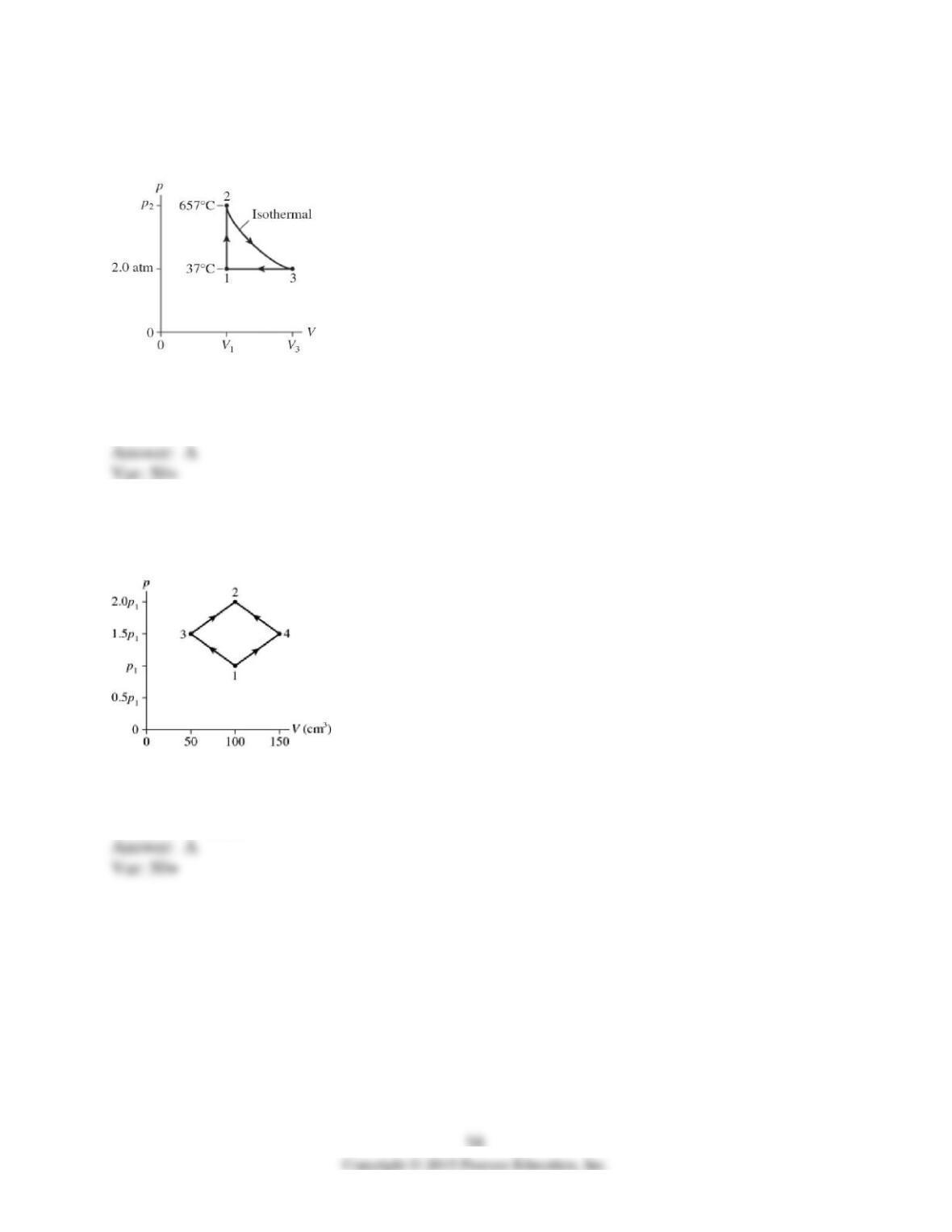
163) The figure shows a pV diagram for 2.6 g of ideal helium gas that undergoes the process 1 →
2 → 3. Find the value of volume V3. The atomic mass of helium is 4.0 g/mol, and R = 8.31 J/mol
∙ K.
A) 25 L
B) 99 L
C) 50 L
D) 12 L
164) The figure shows a pV diagram for 8.3 g of ideal nitrogen gas N2 in a sealed container. The
temperature of state 1 is 59°C, the atomic mass of the nitrogen atom is 14 g/mol, and R = 8.31
J/mol ∙ K. What are (a) pressure p1 and (b) temperature T2?
A) (a) 81 atm, (b) 660°C
B) (a) 14 atm, (b) 660°C
C) (a) 81 atm, (b) 120°C
D) (a) 14 atm, (b) 120°C
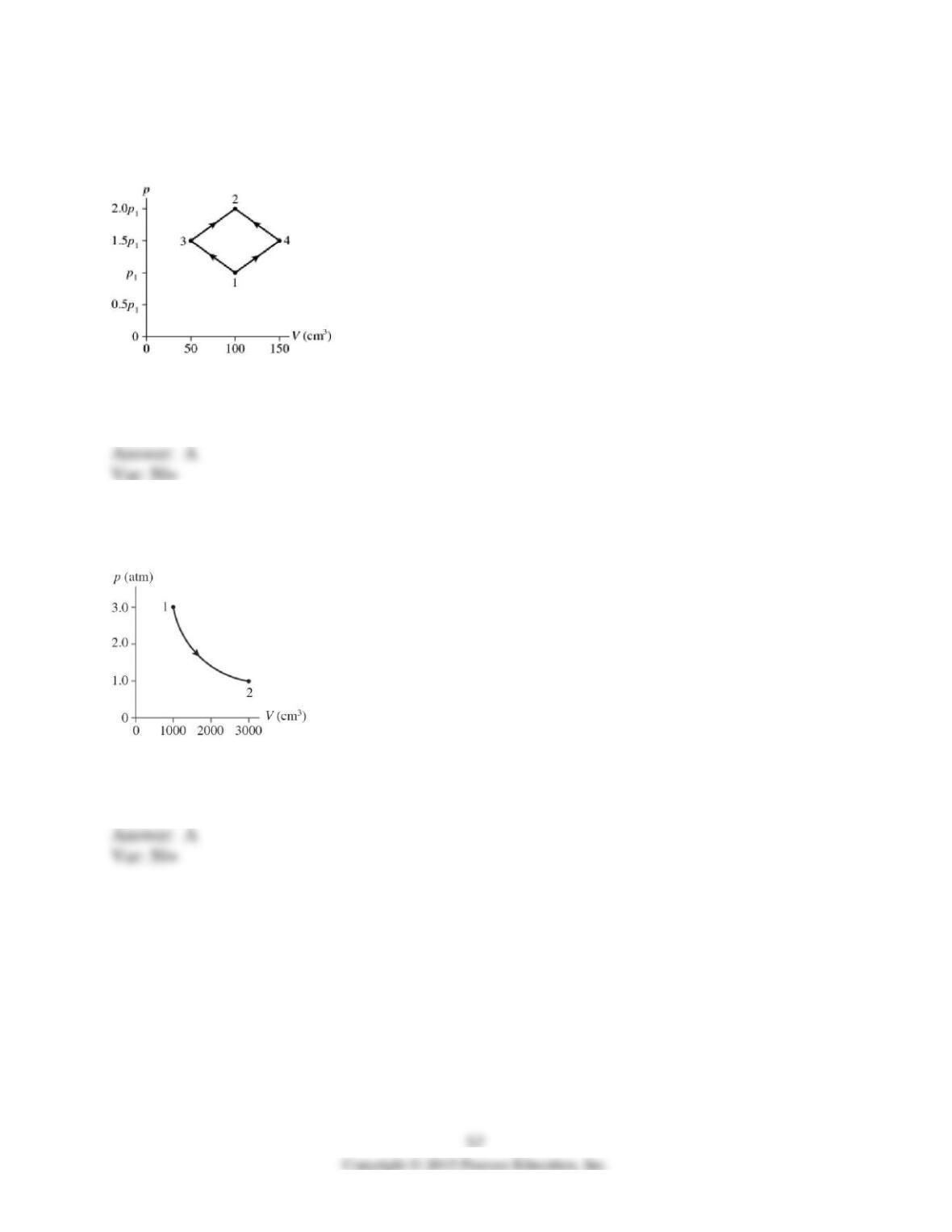
165) The figure shows a pV diagram for 2.9 g of ideal oxygen gas O2 in a sealed container. The
temperature of state 1 is 76° C, the atomic mass of the oxygen atom is 16 g/mol, and R = 8.31
J/mol ∙ K. What are the temperatures T3 and T4?
A) -11° C and 510° C
B) 57° C and 170° C
C) 260° C and 790° C
D) 38° C and 110° C
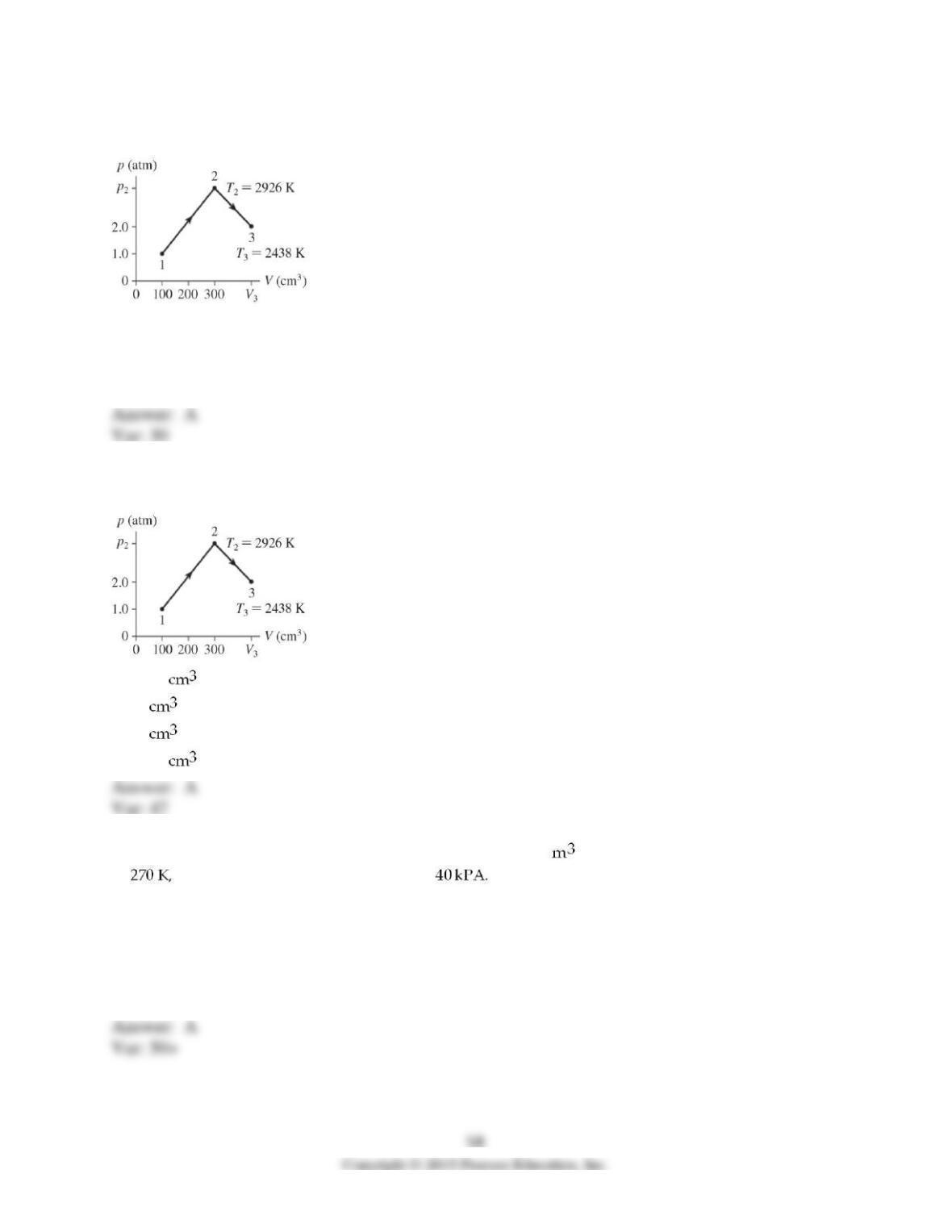
166) The figure shows a pV diagram for 0.98 mol of ideal gas that undergoes the process 1 → 2.
The gas then undergoes an isochoric heating from point 2 until the pressure is restored to the
value it had at point 1. What is the final temperature of the gas? (R = 8.31 J/mol ∙ K).
A) -160°C
B) 12°C
C) 380°C
D) 110°C
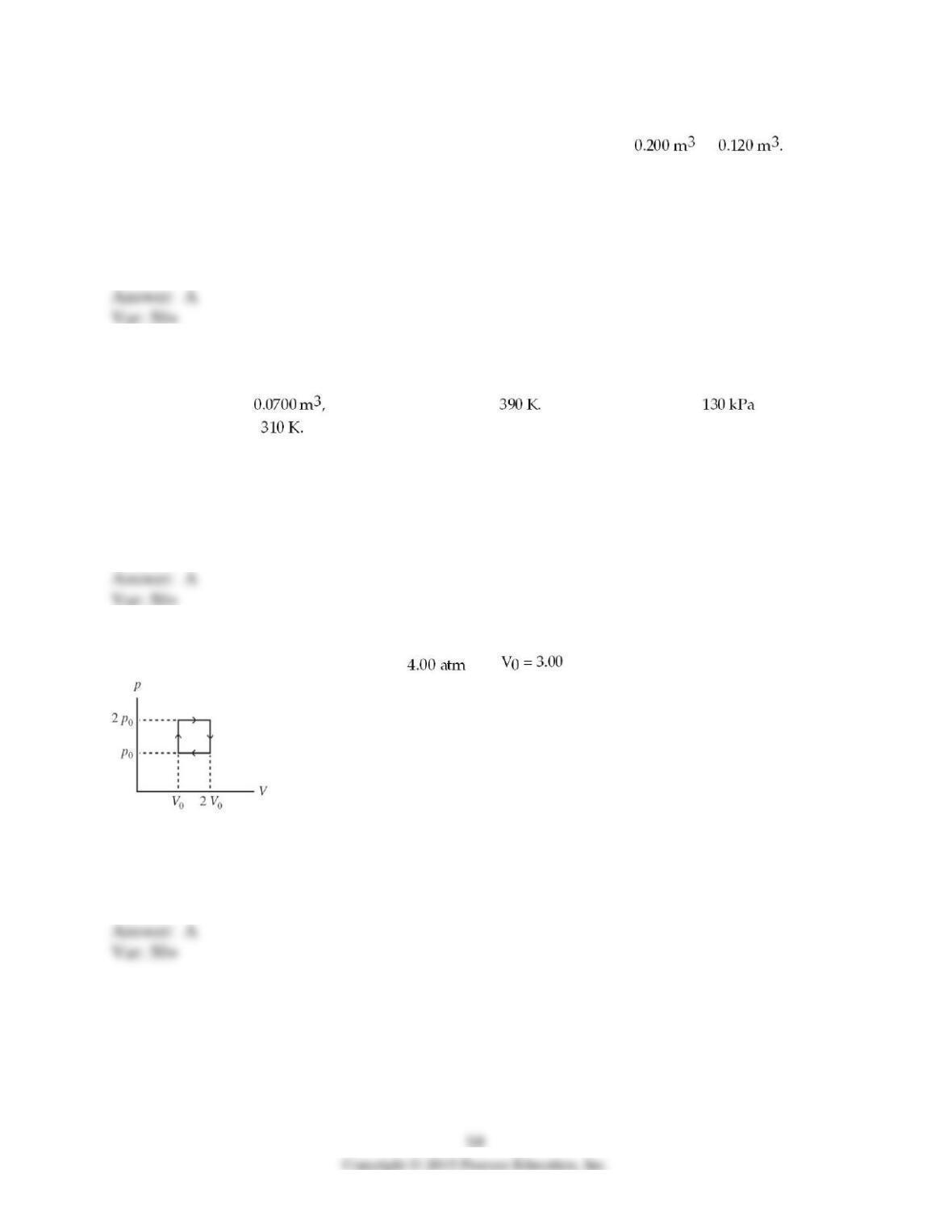
167) The figure shows a pV diagram for 0.0061 mol of ideal gas that undergoes the process 1 →
2 → 3. What is the pressure p2? (R = 8.31 J/mol ∙ K)
A) 4.9 atm
B) 4.9 × 10⁵ atm
C) 15 atm
D) 1.5 × 10⁶ atm
168) The figure shows a pV diagram for 0.0077 mol of ideal gas that undergoes the process 1 →
2 → 3. What is the volume V3? (R = 8.31 J/mol ∙ K)
the volume V3?
A) 770
B) 0
C) 0
D) 400
169) The temperature of an ideal gas in a sealed rigid 0.20- container is reduced from 360 K
to and the final pressure of the gas is How much work is done by the gas during
this process? (R = 8.31 J/mol ∙ K)
A) 0 kJ
B) -9.0 kJ
C) -12 kJ
D) 9.0 kJ
E) 12 kJ
170) A compression at a constant pressure of 200 kPa is performed on 8.00 moles of an ideal
monatomic gas. The compression reduces the volume of the gas from to How
much work was done by the gas during this process?
A) -16 kJ
B) 16 kJ
C) -40 kJ
D) 40 kJ
E) 0 kJ
171) An expansion process on an ideal diatomic ideal gas has a linear path between the initial
and final coordinates on a pV diagram. The coordinates of the initial state are: the pressure is 300
kPa, the volume is and the temperature is The final pressure is and the
final temperature is How much work is done by the gas during this process? (R = 8.31
J/mol ∙ K)
A) 13,000 J
B) 6300 J
C) 9400 J
D) 16,000 J
E) 19,000 J
172) The figure shows a pV diagram for an ideal gas that is carried around a cyclic process. How
much work is done in one cycle if p0 = and L? (1.00 atm = 101 kPa)
A) 1210 J
B) 485 J
C) 2280 J
D) 2420 J
E) 4850 J
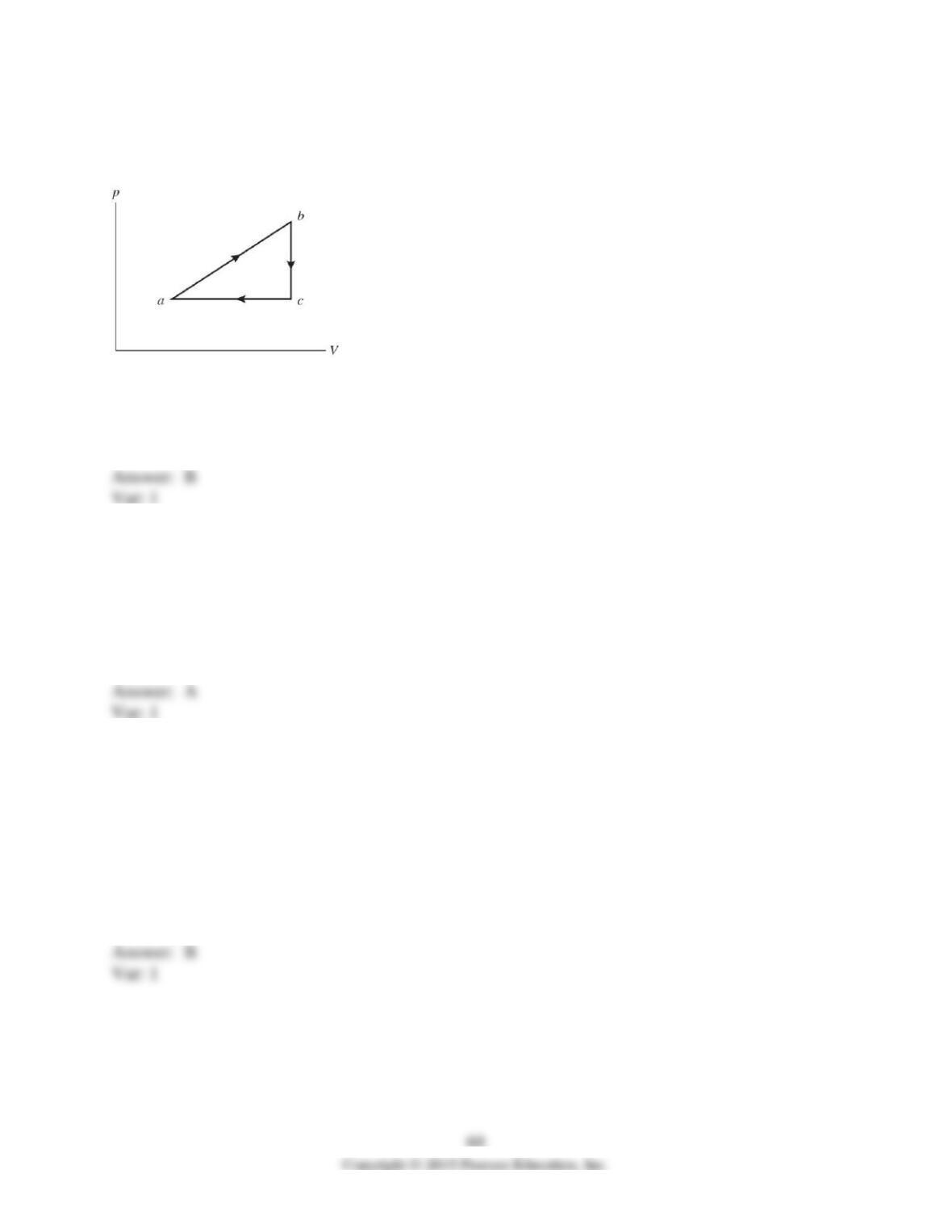
173) An ideal gas undergoes the process a→b→c→a shown in the pV diagram. In this figure, Pa
= Pc = 3.60 × 10⁵ Pa, Vb = Vc = 68.00 L, Va = 35 L, and Pb = 5.60 × 10⁵ Pa. How much work
is done by the system in this process?
A) 2300 J
B) 3300 J
C) 2800 J
D) 3800 J
E) 3000 J
174) A gas expands from an initial volume of 30.0 L to a final volume of 65.0 L at a constant
pressure of 110 kPa. How much work is done by the gas during this expansion?
A) 3.85 kJ
B) 10.4 kJ
C) 3850 kJ
D) 10.4 MJ
E) 3.85 MJ
175) A gas expands from an initial volume of 0.040 m3 to a final volume of 0.085 m3 while its
pressure increases linearly with the volume (so that the process follows a straight-line path in a
pV diagram) from 110 kPa to 225 kPa. How much work is done by the gas during this
expansion?
A) 5.2 kJ
B) 7.5 kJ
C) 7.8 kJ
D) 11 kJ
E) 12 kJ