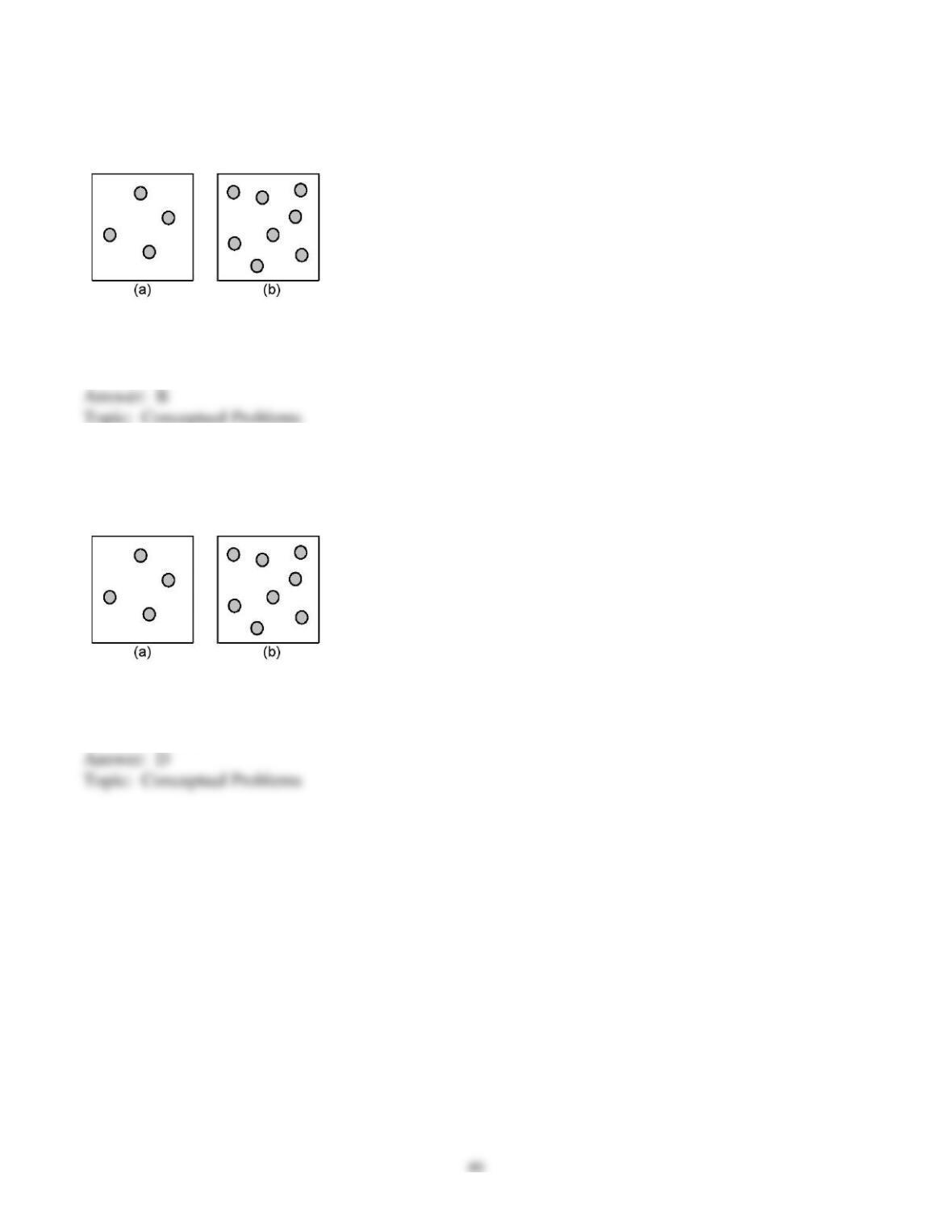
134) Consider the first-order decomposition of A molecules (shaded spheres) in two vessels of equal
volume. How will the rate of decomposition in vessel (a) be affected if the volume of the vessel is
decreased by a factor of 2?
A) decrease by 1/2
B) increase by 2
C) increase by 4
D) stay the same
135) Consider the first-order decomposition of A molecules (shaded spheres) in two vessels of equal
volume. How will the half-life of decomposition in vessel (a) be affected if the volume of the vessel is
decreased by a factor of 2?
A) decrease by 1/2
B) increase by 2
C) increase by 4
D) stay the same
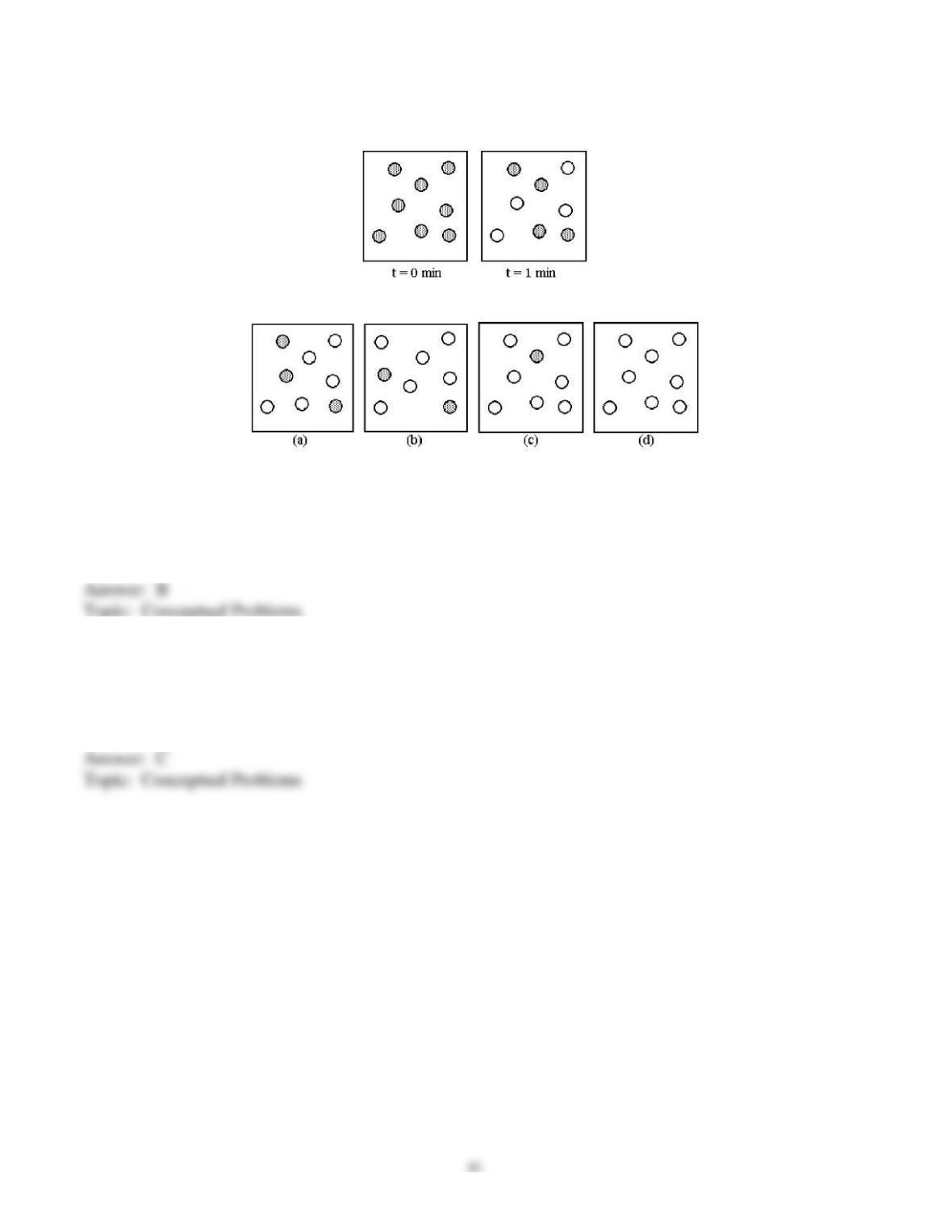
Consider the first-order reaction A → B in which A molecules (shaded spheres) are converted to B
molecules (unshaded spheres).
136) Which drawing (a)-(d) represents the reaction mixture at t = 2 minutes?
A) drawing (a)
B) drawing (b)
C) drawing (c)
D) drawing (d)
137) Which drawing (a)-(d) represents the reaction mixture at t = 3 minutes?
A) drawing (a)
B) drawing (b)
C) drawing (c)
D) drawing (d)
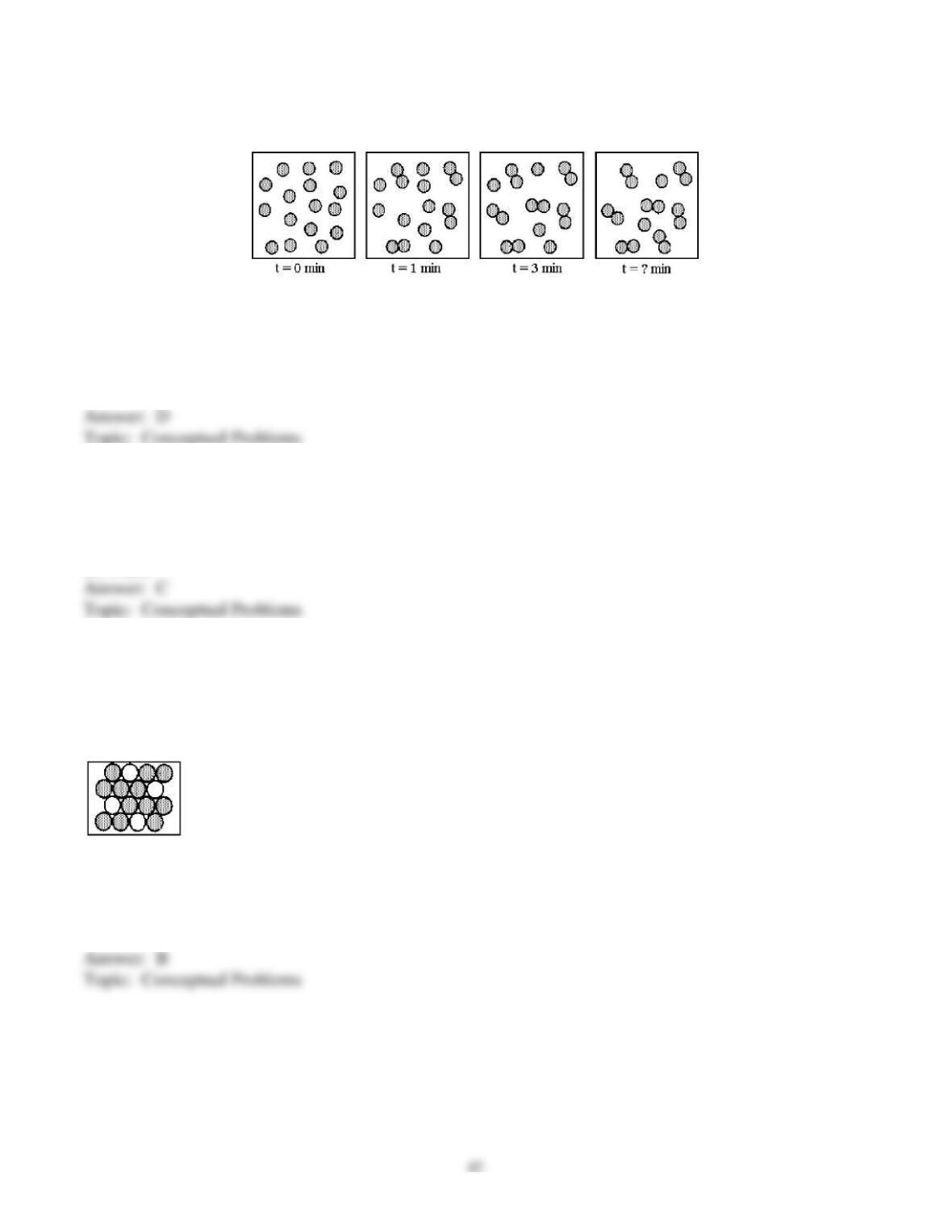
The following pictures represent the progress of a reaction in which two A molecules combine to give a
more complex molecule A2, 2A → A2.
138) What is the order of reaction with respect to A?
A) 0
B) 1/2
C) 1
D) 2
139) What is the time required to achieve the molecular mixture in drawing (d)?
A) 4 min
B) 5 min
C) 7 min
D) 8 min
140)
242Cm
96
decays by alpha emission to give
238Pu
94
. If unshaded spheres represent
242Cm
96
atoms
and shaded spheres represent
238Pu
94
atoms, how many half-lives have passed in the following
example?
A) 1 half-life
B) 2 half-lives
C) 3 half-lives
D) 4 half-lives
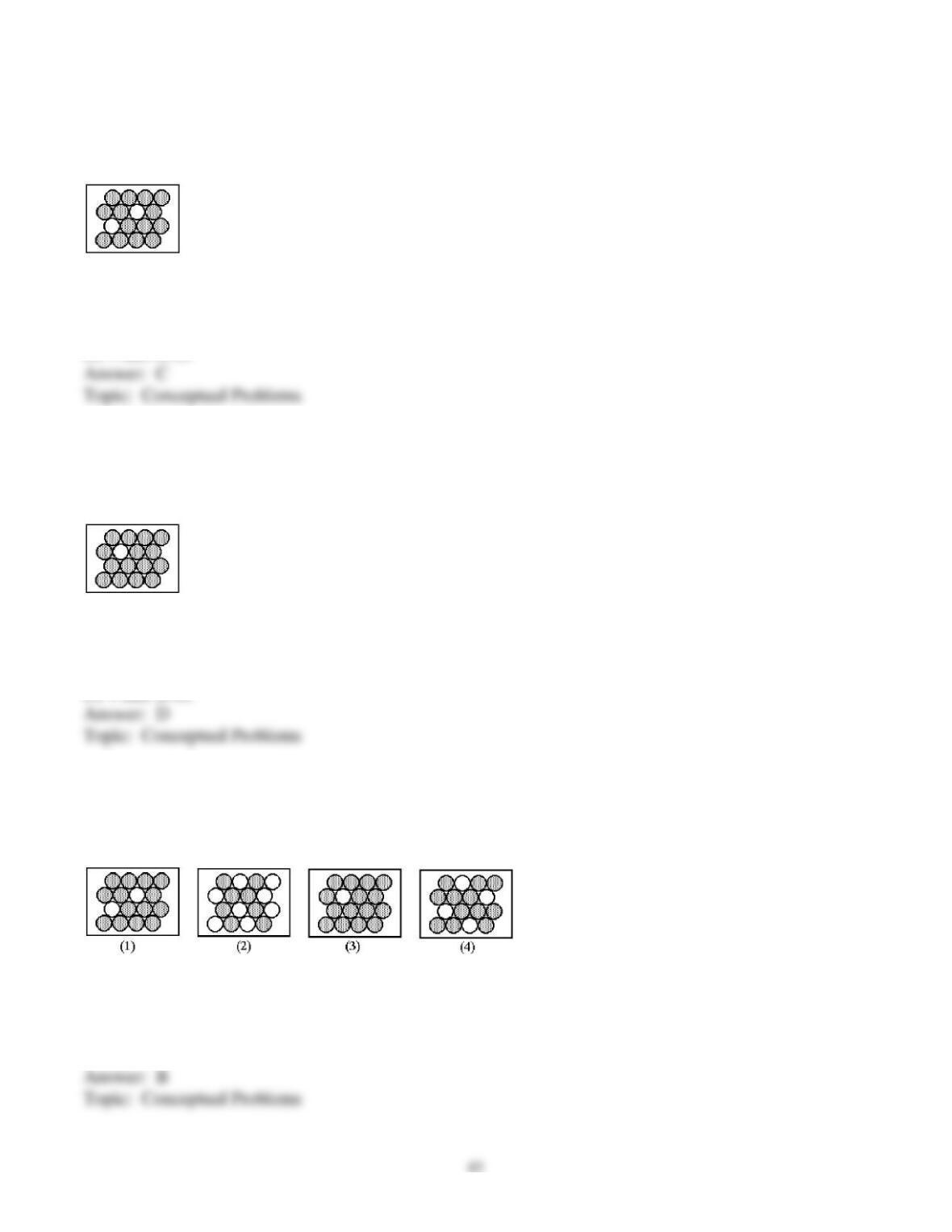
141)
14C
6
decays by beta emission to give
14 N
7
. If unshaded spheres represent
14C
6
atoms and shaded
spheres represent
14 N
7
atoms, how many half-lives have passed in the following example?
A) 1 half-life
B) 2 half-lives
C) 3 half-lives
D) 4 half-lives
142)
204Po
84
decays by electron capture to give
204Bi
83
. If unshaded spheres represent
204Po
84
atoms and
shaded spheres represent
204Bi
83
atoms, how many half-lives have passed in the following example?
A) 1 half-life
B) 2 half-lives
C) 3 half-lives
D) 4 half-lives
143) Which of the following figures represents the beta decay of
28Mg
12
to give
28Al
13
after one half-life
has passed? Unshaded spheres represent
28Mg
12
atoms and shaded spheres represent
28Al
13
atoms.
A) figure (1)
B) figure (2)
C) figure (3)
D) figure (4)
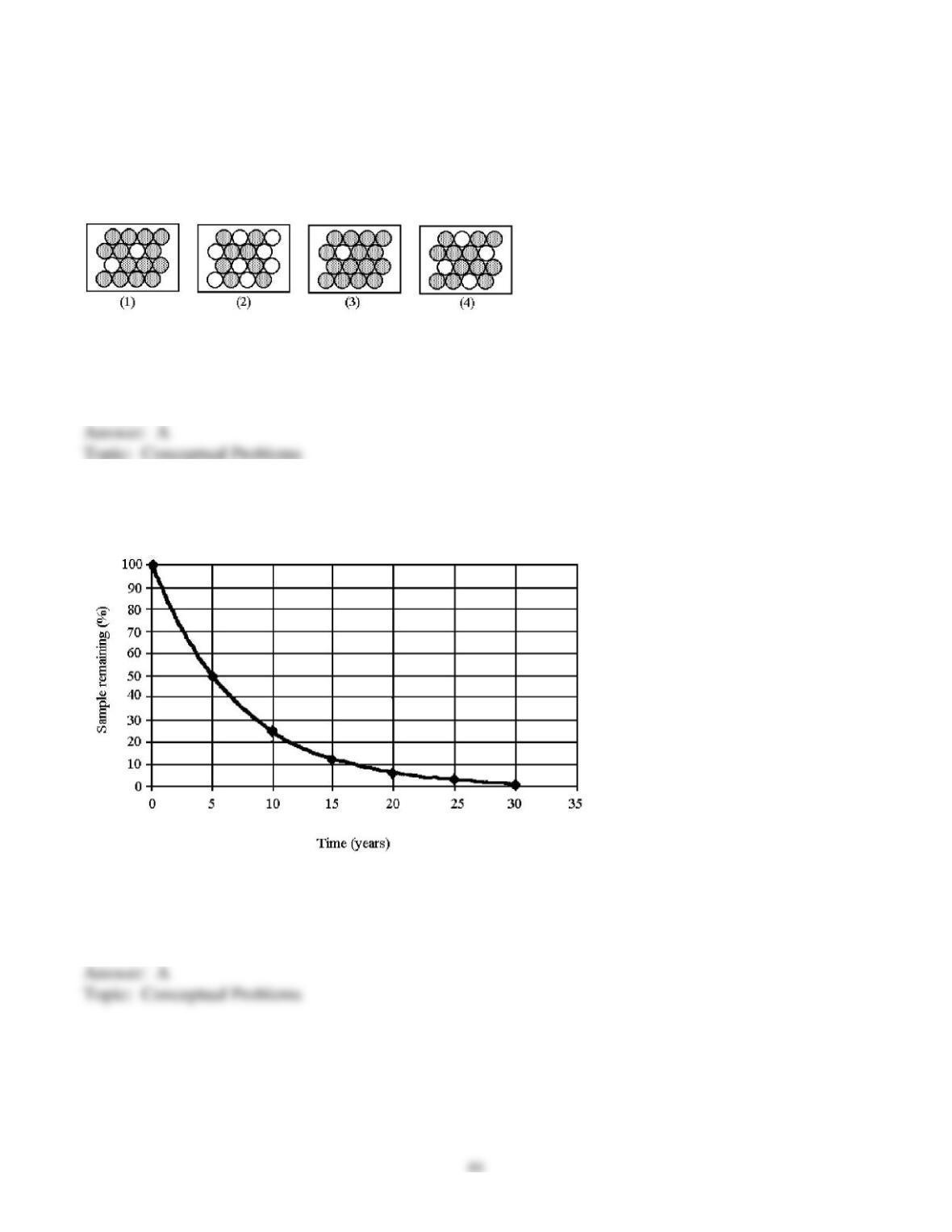
144) Which of the following figures represents the decay of
40K
19
by positron emission to give
40Ar
18
after three half-lives has passed? Unshaded spheres represent
40K
19
atoms and shaded spheres represent
40Ar
18
atoms.
A) figure (1)
B) figure (2)
C) figure (3)
D) figure (4)
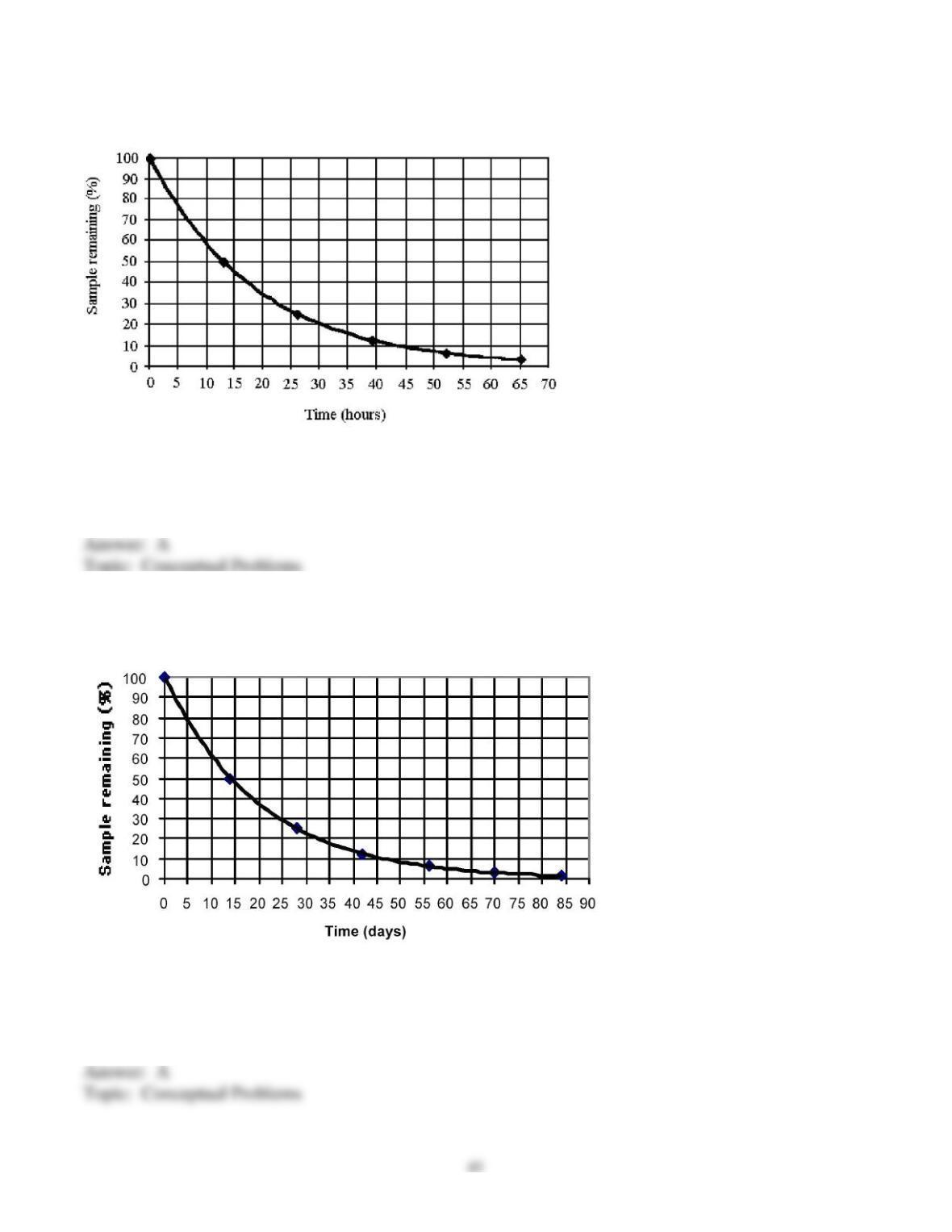
145) The decay curve shown below approximates the decay of cobalt-60. What is the approximate half-
life of cobalt-60?
A) 5 years
B) 12.5 years
C) 15 years
D) 17.5 years
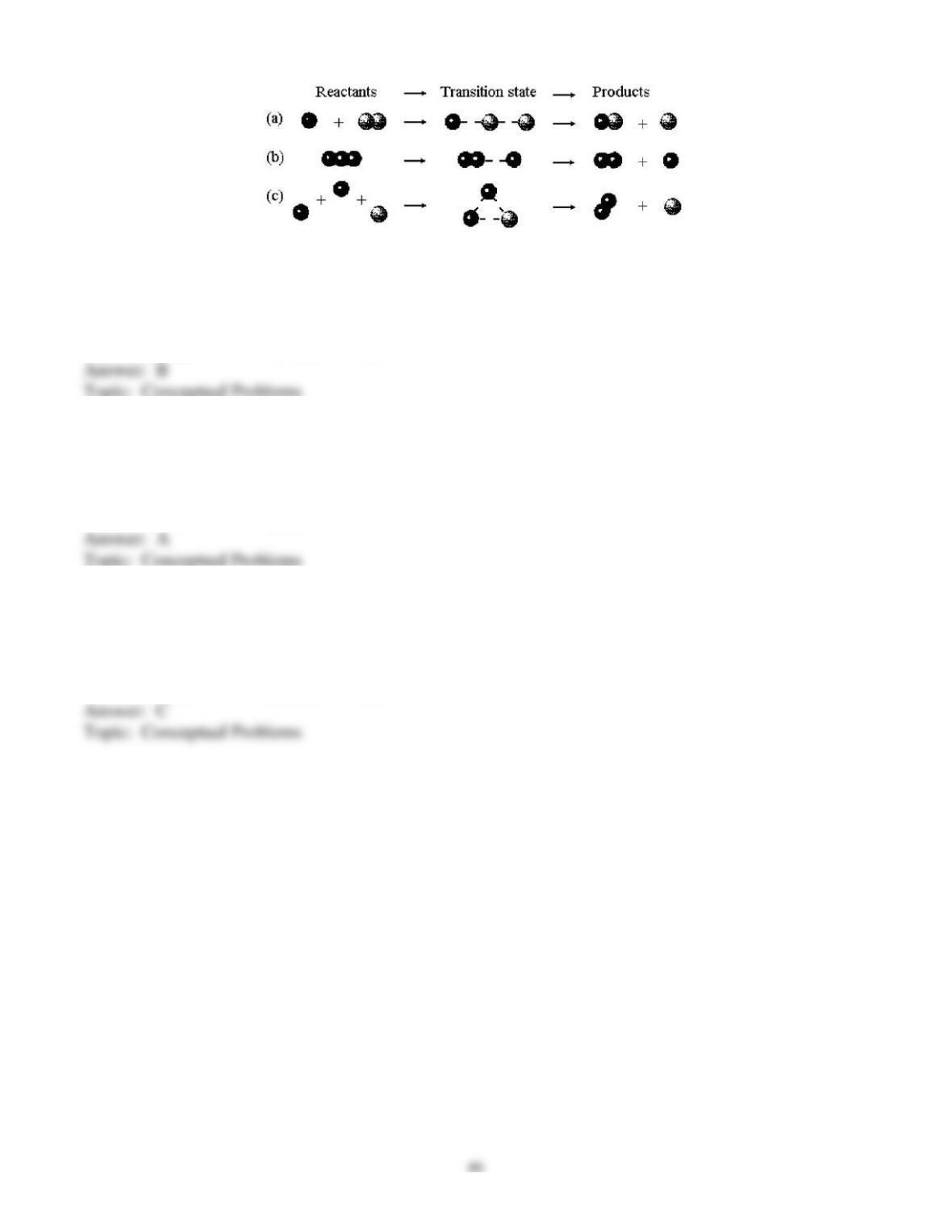
146) The decay curve shown below approximates the decay of iodine-123. What is the approximate
half-life of iodine-123?
A) 13 hours
B) 26 hours
C) 32.5 hours
D) 35 hours
147) The decay curve shown below approximates the decay of phosphorus-32. What is the approximate
half-life of phosphorus-32?
A) 14 days
B) 27 days
C) 35 days
D) 37.5 days
148) Which of the elementary reactions shown above has a molecularity of one?
A) elementary reaction (a)
B) elementary reaction (b)
C) elementary reaction (c)
D) elementary reactions (a), (b), and (c)
149) Which of the elementary reactions shown above has a molecularity of two?
A) elementary reaction (a)
B) elementary reaction (b)
C) elementary reaction (c)
D) elementary reactions (a), (b), and (c)
150) Which of the elementary reactions shown above has a molecularity of three?
A) elementary reaction (a)
B) elementary reaction (b)
C) elementary reaction (c)
D) elementary reactions (a), (b), and (c)
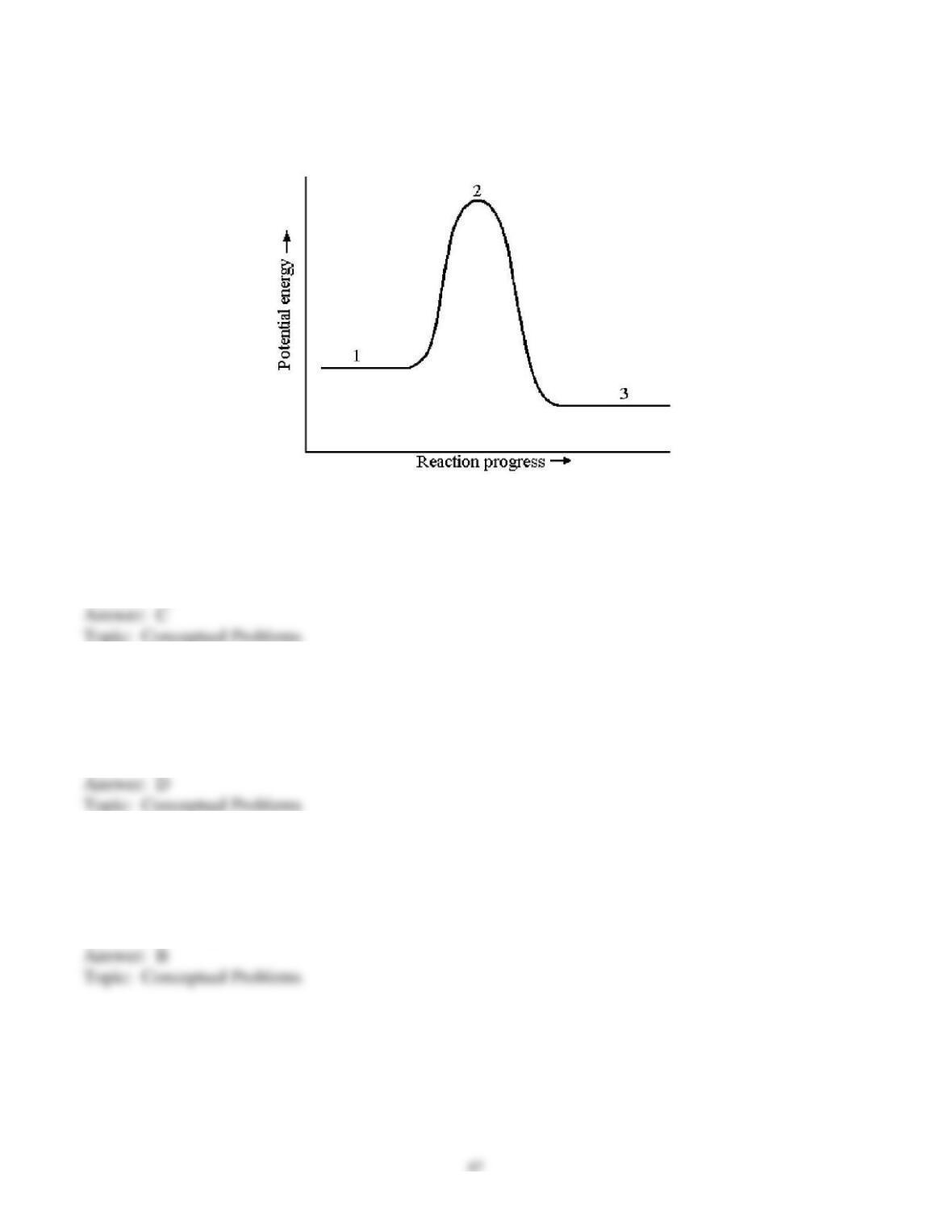
Consider a reaction that occurs by the following one-step mechanism:
A2 + B2 → 2 AB
The potential energy profile for this reaction is shown below.
151) What is the species present at reaction stage 1?
A) an intermediate
B) a product
C) a reactant
D) a transition state
152) What is the species present at reaction stage 2?
A) an intermediate
B) a product
C) a reactant
D) a transition state
153) What is the species present at reaction stage 3?
A) an intermediate
B) a product
C) a reactant
D) a transition state
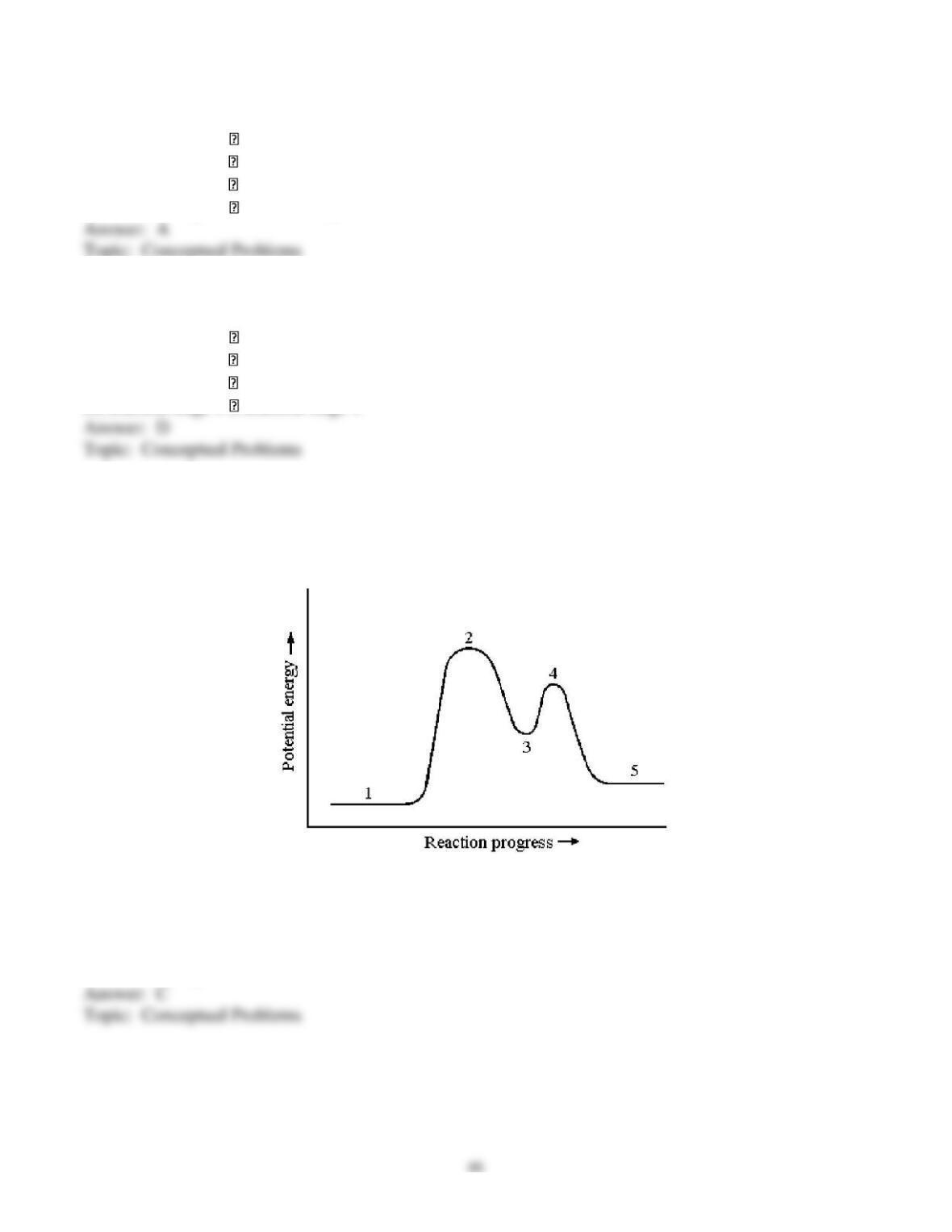
154) The activation energy for the forward reaction is given by the difference in energy between which
two reaction stages?
A) reaction stage 2 reaction stage 1
B) reaction stage 2 reaction stage 3
C) reaction stage 1 reaction stage 3
D) reaction stage 3 reaction stage 1
155) The energy of reaction, ΔE, is given by the difference in energy between which two reaction
stages?
A) reaction stage 2 reaction stage 1
B) reaction stage 2 reaction stage 3
C) reaction stage 1 reaction stage 3
D) reaction stage 3 reaction stage 1
Consider a reaction that occurs by the following mechanism:
A + BC → AC + B
AC + D → A + CD
The potential energy profile for this reaction is shown below.
156) Transition states occur at which reaction stages?
A) reaction stages 1 and 5
B) reaction stages 2, 3, and 4
C) reaction stages 2 and 4
D) reaction stage 3
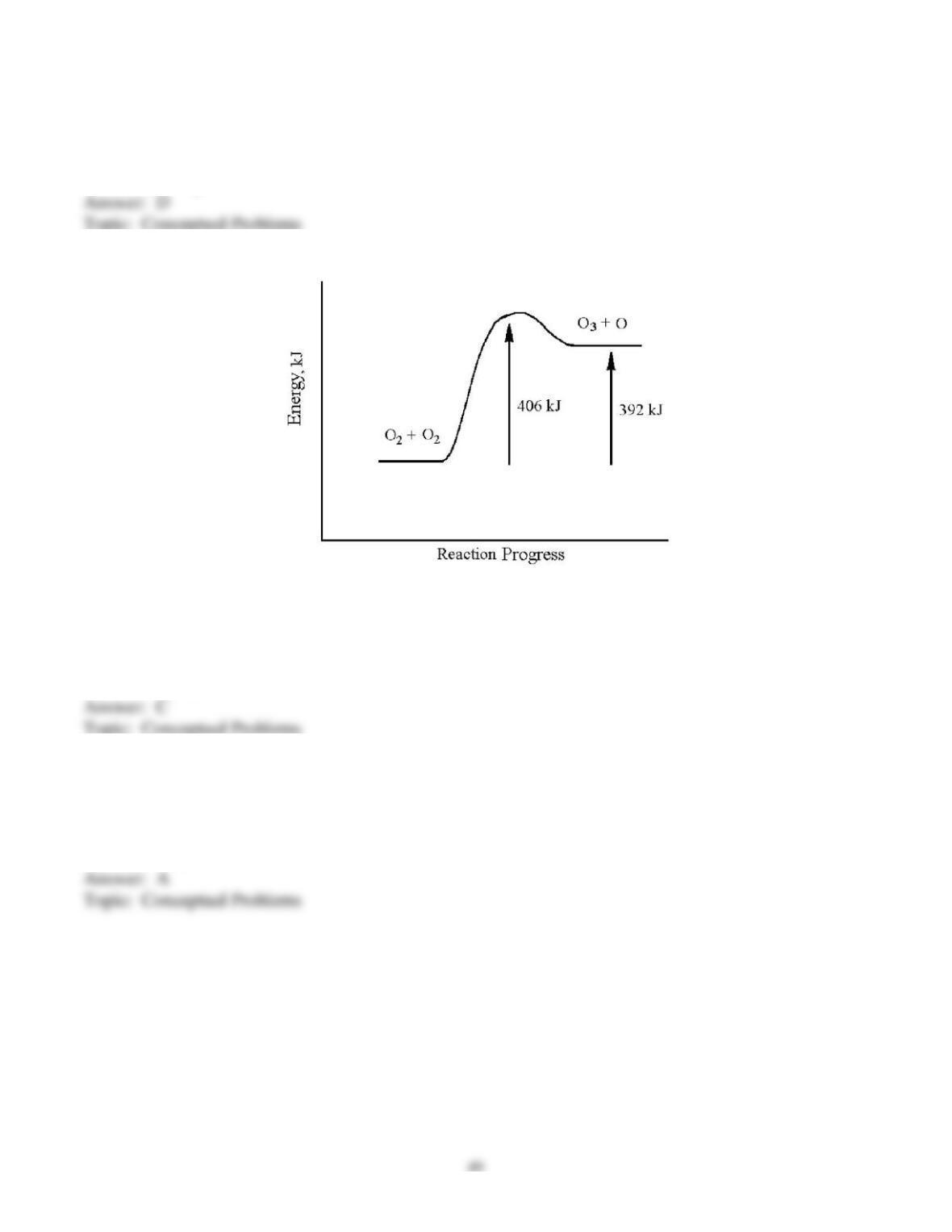
157) Intermediates occur at which reaction stages?
A) reaction stages 1 and 5
B) reaction stages 2, 3, and 4
C) reaction stages 2 and 4
D) reaction stage 3
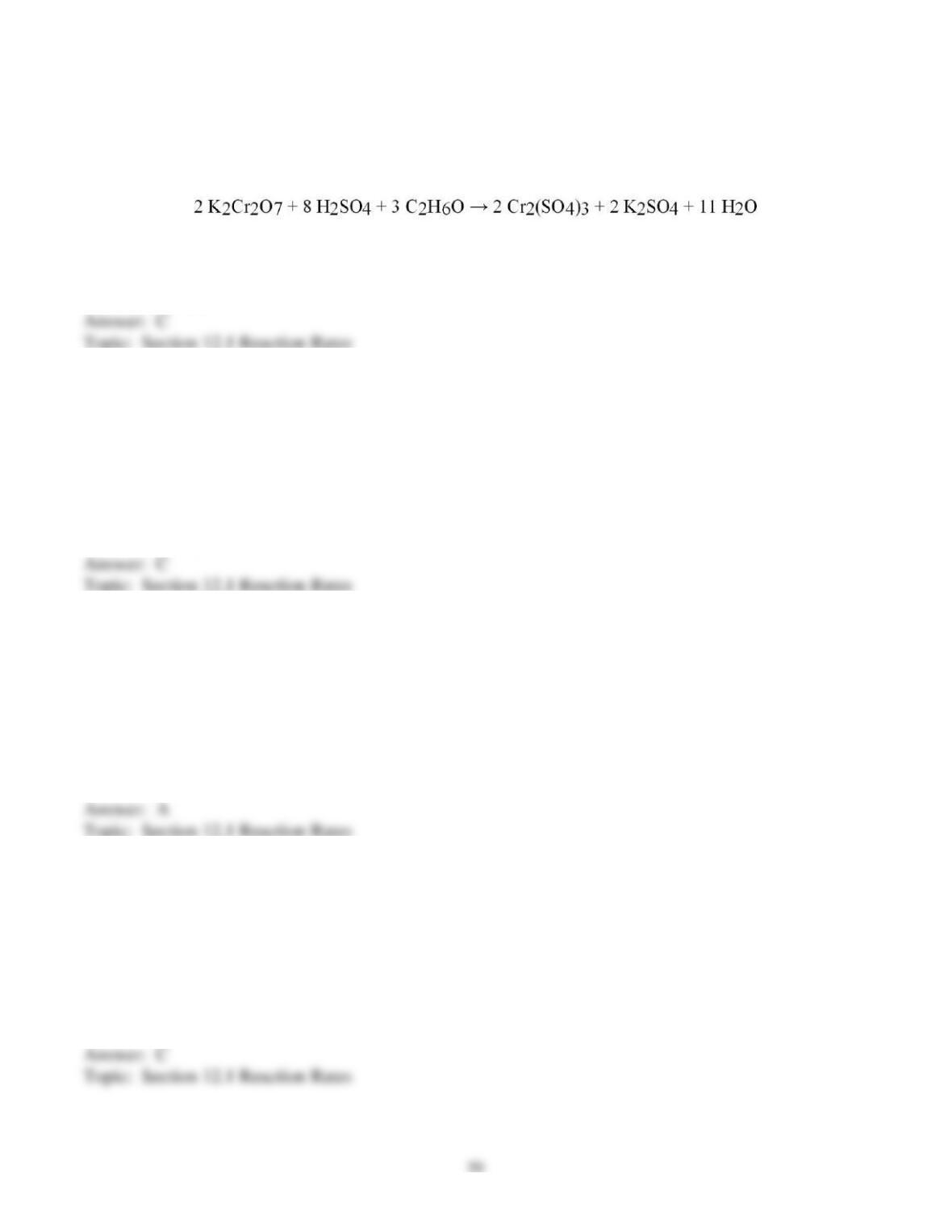
158) What is the activation energy for the formation of ozone?
A) 14 kJ
B) 392 kJ
C) 406 kJ
D) none of these
159) What is the activation energy for the destruction of ozone?
A) 14 kJ
B) 392 kJ
C) 406 kJ
D) none of these
12.2 Algorithmic Questions
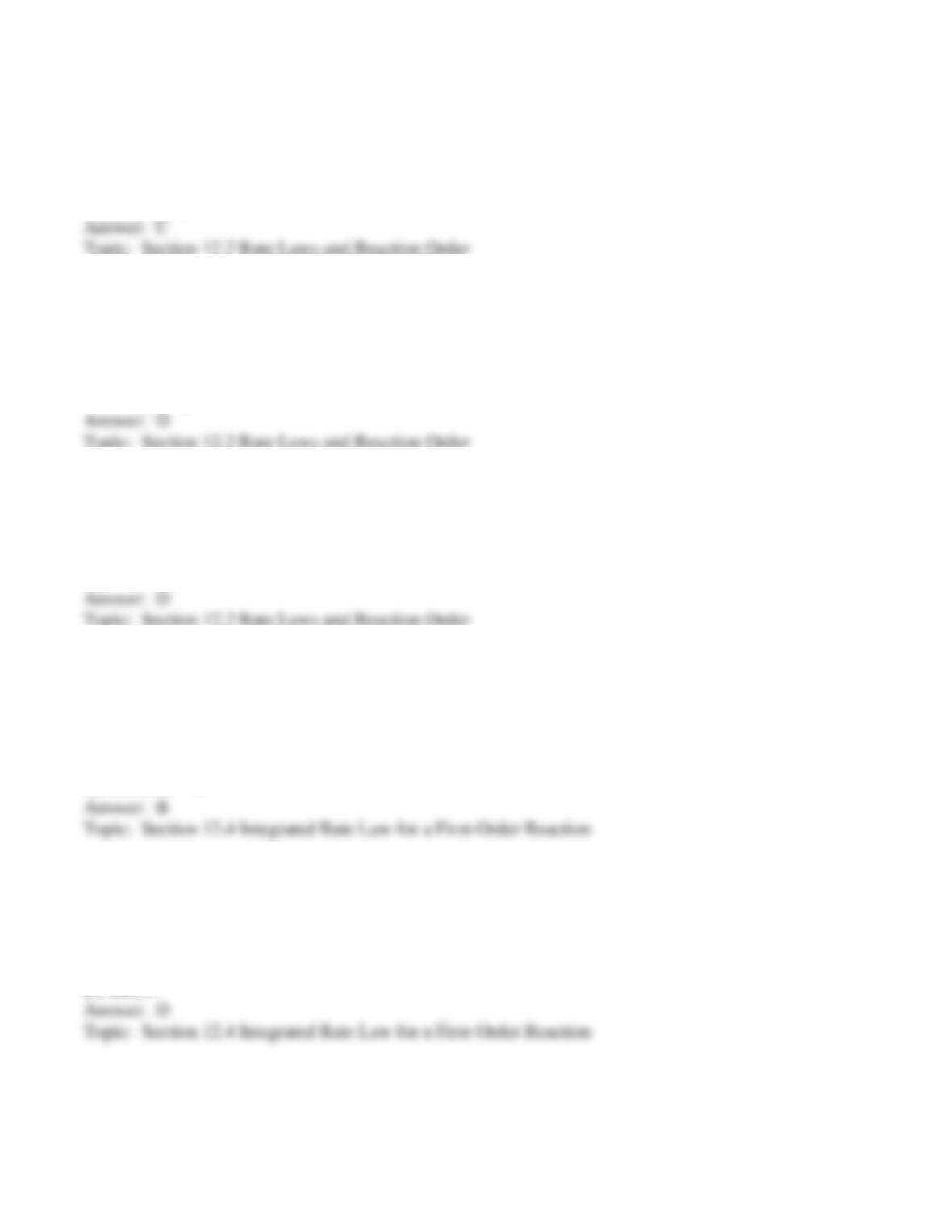
1) The reaction that occurs in a Breathalyzer, a device used to determine the alcohol level in a person’s
bloodstream, is given below. If the rate of appearance of Cr2(SO4)3 is 1.64 mol/min at a particular
moment, what is the rate of disappearance of C2H6O at that moment?
A) 0. 547 mol/min
B) 1.09 mol/min
C) 2.46 mol/min
D) 4.92 mol/min
2) The decomposition of dinitrogen pentoxide is described by the chemical equation
2 N2O5(g) → 4 NO2(g) + O2(g)
If the rate of disappearance of N2O5 is equal to 1.60 mol/min at a particular moment, what is the rate of
appearance of NO2 at that moment?
A) 0.800 mol/min
B) 1.60 mol/min
C) 3.20 mol/min
D) 6.40 mol/min
3) The decomposition of dinitrogen pentoxide is described by the chemical equation
2 N2O5(g) → 4 NO2(g) + O2(g)
If the rate of appearance of NO2 is equal to 0. 560 mol/min at a particular moment, what is the rate of
appearance of O2 at that moment?
A) 0. 140 mol/min
B) 0. 280 mol/min
C) 1. 12 mol/min
D) 2.24 mol/min
4) The decomposition of dinitrogen pentoxide is described by the chemical equation
2 N2O5(g) → 4 NO2(g) + O2(g)
If the rate of appearance of O2 is equal to 3.00 mol/min at a particular moment, what is the rate of
disappearance of N2O5 at that moment?
A) 0. 750 mol/min
B) 1. 50 mol/min
C) 6.00 mol/min
D) 12.0 mol/min
51
5) For a reaction that follows the general rate law, Rate = k[A][B]2, what will happen to the rate of
reaction if the concentration of A is increased by a factor of 5.00? The rate will
A) decrease by a factor of 1/ 25.0.
B) decrease by a factor of 1/ 5.00.
C) increase by a factor of 5.00.
D) increase by a factor of 25.0.
6) For a reaction that follows the general rate law, Rate = k[A][B]2, what will happen to the rate of
reaction if the concentration of B is increased by a factor of 3.00? The rate will
A) decrease by a factor of 1/ 9.00.
B) decrease by a factor of 1/ 3.00.
C) increase by a factor of 3.00.
D) increase by a factor of 9.00.
7) What is the overall reaction order for the reaction that has the rate law: Rate = k[ O2] [ NO ]2?
A) zero order
B) first order
C) second order
D) third order
8) For a particular first-order reaction, it takes 24 minutes for the concentration of the reactant to
decrease to 25% of its initial value. What is the value for rate constant (in s-1) for the reaction?
A) 2.0 × 10– 4 s-1
B) 9.6 × 10– 4 s-1
C) 1.2 × 10– 2 s-1
D) 5.8 × 10– 2 s-1
9) The first-order reaction, SO2Cl2 → SO2 + Cl2, has a rate constant equal to 2.20 × 10⁻⁵ s-1 at 593 K.
What percentage of the initial amount SO2Cl2 will remain after 6.00 hours?
A) 1.00%
B) 37.8%
C) 40.2%
D) 62.2%
10) The first-order reaction, 2 N2O(g) → 2 N2(g) + O2(g), has a rate constant equal to 0.76 s-1 at
1000 K. How long will it take for the concentration of N2O to decrease to 12% of its initial
concentration?
A) 0. 62 s
B) 2.8 s
C) 6.3 s
D) 8.4 s
11) The isomerization reaction, CH3NC → CH3CN, is first order and the rate constant is equal to
0.46 s-1 at 600 K. What is the concentration of CH3NC after 0.20 minutes if the initial concentration is
0. 30 M?
A) 1.2 × 10– 3 M
B) 2.7 × 10– 3 M
C) 1.2 × 10– 1 M
D) 2.7 × 10– 1 M
12) The following reaction is first order, C2H6 → 2 CH3. If the rate constant is equal to 5.5 × 10⁻⁴ s-1
at 1000 K, how long will it take for 0.35 mol of C2H6 in a 1.00 L container to decrease to 0. 20 mol in
the same container?
A) 4.5 min
B) 17 min
C) 53 min
D) 65 min
13) The rate constant, k, for a first-order reaction is equal to 4.2 × 10⁻⁴ s-1. What is the half-life for the
reaction?
A) 2.9 × 10⁻⁴ s
B) 1.2 × 10³ s
C) 1.7 × 10³ s
D) 2.4 × 10³ s
14) The first-order reaction, SO2Cl2 → SO2 + Cl2, has a half-life of 8.75 hours at 593 K. How long will
it take for the concentration of SO2Cl2 to fall to 16.5% of its initial value?
A) 0. 143 hr
B) 2.28 hr
C) 6.99 hr
D) 22.7 hr
15) For the first-order reaction, 2 N2O(g) → 2 N2(g) + O2(g), what is the concentration of N2O after 3
half-lives if 0.25 mol of N2O is initially placed into a 1.00-L reaction vessel?
A) 1.6 × 10– 2 M
B) 3.1 × 10– 2 M
C) 6.2 × 10– 2 M
D) 1.2 × 10– 1 M
16) Neptunium-239 has a half-life of 2.35 days. How many days must elapse for a sample of 239Np to
decay to 0.100% of its original quantity?
A) 0.0 427 days
B) 1.491 days
C) 2.04 days
D) 23.4 days
17) What percentage of a radioactive substance remains after 7.00 half-lives have elapsed?
A) 0.391%
B) 0.78%
C) 1.56%
D) 3.12%
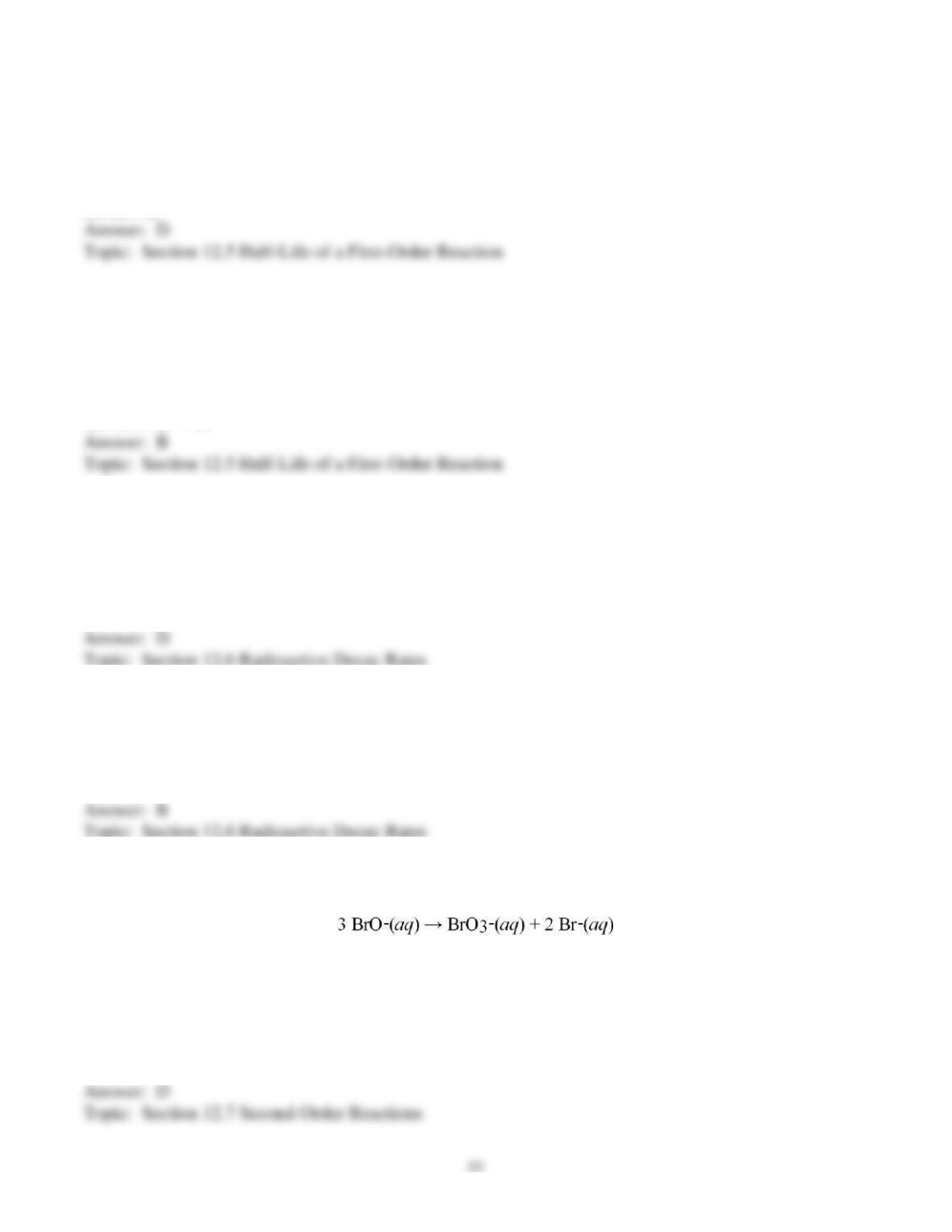
18) In aqueous solution, hypobromite ion, BrO–, reacts to produce bromate ion, BrO3–, and bromide ion,
Br–, according to the following chemical equation.
A plot of 1/[BrO–] vs. time is linear and the slope is equal to 0.056 M-1s-1. If the initial concentration of
BrO– is 0.80 M, how long will it take one-half of the BrO– ion to react?
A) 4.5 × 10⁻² s
B) 7.1 s
C) 12 s
D) 22 s
19) The second-order reaction 2 Mn(CO)5 → Mn2(CO)10, has a rate constant equal to
3.0 × 10⁹ M-1 s-1 at 25°C. If the initial concentration of Mn(CO)5 is 2.0 × 10⁻⁵ M, how long will it
take for 90.% of the reactant to disappear?
A) 6.7 × 10– 16 s
B) 7.4 × 10– 15 s
C) 1.5 × 10– 4 s
D) 6.0 × 10³ s
20) Nitrogen dioxide decomposes at 300°C via a second-order process to produce nitrogen monoxide
and oxygen according to the following chemical equation.
2 NO2(g) → 2 NO(g) + O2(g).
A sample of NO2(g) is initially placed in a 2.50-L reaction vessel at 300°C. If the half-life and the rate
constant at 300°C are 11 seconds and 0.54 M-1 s-1, respectively, how many moles of NO2 were in the
original sample?
A) 0. 17 mol
B) 0. 42 mol
C) 5.9 mol
D) 15 mol
21) Hydrogen iodide decomposes at 800 K via a second-order process to produce hydrogen and iodine
according to the following chemical equation.
2HI(g) → H2(g) + I2(g)
At 800 K it takes 142 seconds for the initial concentration of HI to decrease from 6.75 × 10⁻² M to
3.50 × 10⁻² M. What is the rate constant for the reaction at this temperature?
A) 5.12 × 10– 4 M-1s-1
B) 9.69 × 10⁻² M-1s-1
C) 10.3 M-1s-1
D) 1.95 × 10³ M-1s-1
55
22) The aquation of tris(1,10-phenanthroline)iron(II) in acid solution takes place according to the
equation:
Fe(phen)32+ + 3 H3O+ + 3 H2O → Fe(H2O)62+ + 3 phenH+.
If the activation energy, Ea, is 126 kJ/mol and the rate constant at 30°C is 9.8 × 10⁻³ min-1, what is the
rate constant at 35°C?
A) 4.4 × 10– 3 min-1
B) 2.2 × 10– 2 min-1
C) 4.5 × 101 min-1
12.3 Short Answer Questions
1) For the reaction shown below, if the rate of formation of O2 is 6.0 × 10⁻⁶ M/s, the rate of
decomposition of N2O5 over the same time interval is ________.
2 N2O5(g) → 4 NO2(g) + O2(g)
2) For the reaction shown below, the rate of reaction of Br– is ________ times the rate of formation of
Br2
over the same time period.
ClO2–(aq) + 4 Br–(aq) + 4 H+(aq)→ Cl–(aq) + 2 Br2(aq) +2 H2O(l)
3) For the reaction shown below, if the rate of formation of Br2 is 1.2 × 10⁻⁶ M/s, over the same time
period the rate of consumption of H+ is ________ M/s.
ClO2–(aq) + 4 Br–(aq) + 4 H+(aq)→ Cl–(aq) + 2 Br2(aq) +2 H2O(l)
4) The reaction below is first order in H2 and one-half order in Br2. The rate law for this reaction is
________.
H2(g) + Br2(g) → 2 HBr(g)
5) The reaction shown below has the rate law: Rate = k[BrO3–][Br–][H+]2. The order of reaction with
respect to H+ is ________ and the overall order is ________.
BrO3–(aq) + 5 Br–(aq) + 6 H+(aq) → 3 Br2(aq) + 3 H2O(l)
56
6) A reaction has the rate law Rate = k[NO]2[H2]. If the concentration of NO is reduced by 1/3, the rate
of reaction will be ________ (increased, decreased) by ________.
7) A reaction has the rate law Rate = k[NO]2[H2]. If the concentration of NO is reduced by half and the
concentration of H2 is quadrupled, the rate of reaction will ________ (increase, decrease, not change).
8) The reaction below is second order in ClO2 and first order in OH–. If the rate is expressed in M/s, the
rate constant, k, has the units ________.
2 ClO2(aq) + 2 OH–(aq) → ClO3–(aq) + ClO2–(aq) + H2O(l)
9) The reaction below is second order in ClO2 and first order in OH–. When the concentration of ClO2 is
0.020 M and the concentration of OH– is 0.10 M, the initial rate of reaction is 8.00 × 10⁻⁴ M/s. What is
the rate constant, k, for this reaction?
2 ClO2(aq) + 2 OH–(aq) → ClO3–(aq) + ClO2–(aq) + H2O(l)
10) A reaction is second order in NO and first order in O2 has a rate constant, k = 1.4 × 10⁴ M-2s-1.
What is the initial rate of reaction when the concentrations of NO and O2 are 0.015 M and 0.030 M,
respectively?
11) At 300°C decomposition of NO2(g) occurs with a rate law: Rate = – k[NO2]x. If the initial rate of
decomposition is 3.2 × 10⁻⁵ M/s when [NO2]o = 8.0 × 10⁻³ M and the initial rate of decomposition is
8.0 × 10⁻⁶ M/s when [NO2]o = 4.0 × 10⁻³ M, then the order of reaction with respect to NO2, x =
________.
12) The decomposition of hydrogen peroxide occurs according to the equation
2 H2O2(aq) → 2 H2O(l) + O2(g)
A concentration-time study of this reaction produces a straight line when ln[H2O2] is plotted versus
time. Therefore, this is a ________ order reaction.
13) At 55° the decomposition of N2O5 is first order, having a rate constant, k = 1.7 × 10⁻³ s-1. If the
initial concentration of N2O5 is 6.4 × 10⁻³ M, the number of half-lives that are required for the N2O5
concentration to fall to 2.0 × 10⁻⁴ M is ________, and the amount of time required is ________
minutes.
14)
14C
6
has a decay constant, k = 1.209 × 10⁻⁴ yr–1 and a half-life of ________ years.
15) At an elevated temperature the decomposition of a gaseous oxide, AO2 occurs with a rate constant,
k = 0.54 M–1s–1. If the half-life of this reaction is 926 seconds when [AO2] = 2.0 × 10⁻³ M and 462
seconds when [AO2] = 4.0 × 10⁻³ M, this reaction is ________ order.
16) A gaseous compound, C, undergoes catalytic decomposition at an initial rate of 0.45 M/s when
[C]o = 3.0 × 10⁻³ M and 0.45 M/s when [C]o = 9.0 × 10⁻³ M. Therefore, this is a ________ order
reaction.
17) The rate-determining step in a reaction is shown below. The molecularity of this reaction is
________.
NO2(g) + NO2(g) → NO(g) + NO3(g)
18) A reaction occurs by a two-step mechanism, shown below.
Step 1: AX2(g) → AX(g) + X(g)
Step 2: AX2(g) + X(g) → AX + X2(g)
The intermediate in this reaction is ________, and the molecularity of the second step is ________.
19) A gaseous reaction occurs by a two-step mechanism, shown below.
Step 1: AX +Y2 → AXY2
Step 2: AXY2 + AX → 2 AXY
If the rate law for this reaction is Rate = k[AX]2[Y2], the intermediate is ________, and step ________
is the rate-determining step.
20) A reaction has a rate constant, k = 1.2 × 10⁻¹² s-1 at 273 K and k = 5.1 × 10⁻⁷ s-1 at 373 K has an
activation energy, Ea = ________ kJ/mol.
21) A reaction with an activation energy, Ea = 51.2 kJ/mol will proceed ________ times faster when the
temperature is raised from 20 °C to 30 °C.
22) A reaction with an activation energy, Ea = 103 kJ/mol has a rate constant, k = 3.5 × 10⁻⁵ s-1 at
25°C. For this reaction the rate constant at 45°C is ________.
23) An aqueous reaction occurs by a two-step mechanism, shown below.
Step 1: A2X2 + Y → A2X + XY
Step 2: A2X2 + XY → A2X + X2 + Y
In this reaction the intermediate is ________, and the catalyst is ________.
24) Hydrochloric acid in the hydrolysis of an ester to form an alcohol and a carboxylic acid is an
example of a ________ (heterogeneous, homogeneous) catalyst.
25) Platinum in the catalytic converter of an automobile catalyzes the conversion of CO to CO2 is an
example of a ________ (heterogeneous, homogeneous) catalyst.