9) When a firm has fixed operating costs, operating leverage is present. In that case, an increase
in sales results in a more-than-proportional increase in EBIT, and a decrease in sales results in a
more-than-proportional decrease in EBIT.
10) Whenever the percentage change in EBIT resulting from a given percentage change in sales
is greater than the percentage change in sales, operating leverage exists.
11) The closer the base sales level used is to the operating breakeven point, the smaller the
operating leverage.
12) The base level of EBIT must be held constant to compare the financial leverage associated
with different levels of fixed financial costs.
13) The effect of financial leverage is such that an increase in a firm’s earnings before interest
and taxes (EBIT) results in a more than proportional increase in the firm’s earnings per share
(EPS), while a decrease in the firm’s EBIT results in a less than proportional decrease in EPS.
14) Whenever the percentage change in earnings per share (EPS) resulting from a given
percentage change in sales is greater than the percentage change in sales, financial leverage
exists.
15) Financial leverage results from the presence of variable financial costs in a firm’s income
stream.
16) Financial leverage may be defined as the potential use of variable financial costs to magnify
the effects of changes in earnings before interest and taxes (EBIT) on a firm’s earnings per share
(EPS).
17) The relationship between operating and financial leverage is additive rather than
multiplicative.
18) The total leverage measures the combined effect of operating and financial leverage on a
firm’s risk.
19) Total leverage exists whenever the percentage change in earnings per share (EPS) resulting
from a given percentage change in sales is greater than the percentage change in sales.
20) The base level of sales must be held constant to compare the total leverage associated with
different levels of fixed costs.
21) With the existence of fixed operating costs, an increase in sales will result in ________
increase in EBIT.
A) a proportional
B) an equal
C) a less than proportional
D) a more than proportional
22) ________ leverage is concerned with the relationship between sales revenues and earnings
before interest and taxes.
A) Investing
B) Operating
C) Variable
D) Total
23) ________ is the potential use of fixed operating costs to magnify the effects of changes in
sales on earnings before interest and taxes.
A) Financial leverage
B) Operating leverage
C) Operating budget
D) Ratio analysis
24) With the existence of fixed operating costs, a decrease in sales will result in ________ in
EBIT.
A) a proportional increase
B) an equal increase
C) a less than proportional decrease
D) a more than proportional decrease
25) A decrease in fixed operating costs will result in ________ in the degree of financial
leverage.
A) a decrease
B) an increase
C) no change
D) an undetermined change
26) An increase in fixed operating costs will result in ________.
A) a decrease in the degree of operating leverage
B) an increase in the degree of operating leverage
C) a decrease in the degree of financial leverage
D) an increase in the degree of financial leverage
27) A firm has fixed operating costs of $650,000, a sales price per unit of $20, and a variable
cost per unit of $13. At a base sales level of 500,000 units, the firm’s degree of operating
leverage is ________.
A) 1.07
B) 1.11
C) 1.18
D) 1.23
28) A firm has fixed operating costs of $175,000, total sales revenue of $3,000,000 and total
variable costs of $2,250,000. The firm’s degree of operating leverage is ________.
A) 0.77
B) 1.30
C) 0.81
D) 4.29
29) As fixed operating costs increase and all other factors are held constant, ________.
A) the degree of operating leverage will increase
B) the degree of operating leverage will decrease
C) the degree of total leverage will decrease
D) the degree of total leverage will increase
30) Operating leverage measures the effect of fixed operating costs on the relationship between
________.
A) sales and EBIT
B) sales and EPS
C) EBIT and EPS
D) EBIT and dividend
31) Financial leverage measures the effect of fixed financial costs on the relationship between
________.
A) sales and EBIT
B) sales and EPS
C) EBIT and EPS
D) EBIT and preference dividend
32) ________ leverage is concerned with the relationship between earnings before interest and
taxes and earnings per share.
A) Financial
B) Operating
C) Variable
D) Total
33) In theory, a firm should maintain financial leverage consistent with a capital structure that
________.
A) meets the industry standards
B) meets the investor expectations
C) maximizes the owner’s wealth
D) maximizes dividends
34) The degree of financial leverage is the ratio of ________ to percentage change in EBIT.
A) operating profit
B) percentage change in sales
C) percentage change in EPS
D) long-term debt
35) ________ is the potential use of fixed financial charges to magnify the effects of changes in
earnings before interest and taxes on a firm’s earnings per share.
A) Financial leverage
B) Operating leverage
C) Total leverage
D) Degree of operating leverage
36) Financial leverage measures the effect of fixed financing costs on the relationship between
________.
A) sales and EBIT
B) sales and EPS
C) EBIT and EPS
D) net income and sales
37) ________ leverage measures the effect of fixed ________ costs on the relationship between
EBIT and EPS.
A) Operating; operating
B) Financial; financial
C) Operating; financial
D) Financial; operating
38) Fixed financial charges include ________.
A) common stock dividends and bond interest expense
B) common stock dividends and preferred stock dividends
C) bond interest expense and preferred stock dividends
D) stock repurchase expense
39) Higher financial leverage causes ________ to increase more for a given increase in
________.
A) EBIT; sales
B) EPS; sales
C) EPS; EBIT
D) EBIT; EPS
40) ________ is the potential use of fixed costs to magnify the effect of changes in sales on the
firm’s earnings per share.
A) Investing leverage
B) Total leverage
C) Operating leverage
D) Financial leverage
41) Through the effects of financial leverage, when EBIT increases, ________.
A) earnings per share will increase
B) earnings per share will decrease
C) fixed operating costs will decrease
D) fixed operating costs will increase
42) A firm has EBIT of $375,000, interest expense of $75,000, preferred dividends of $6,000 and
a tax rate of 40 percent. The firm’s degree of financial leverage at a base EBIT level of $375,000
is ________.
A) 0.97
B) 1.29
C) 1.27
D) 1.09
43) ________ leverage is concerned with the relationship between sales revenue and earnings
per share.
A) Financial
B) Operating
C) Variable
D) Total
44) At a base sales level of $400,000, a firm has a degree of operating leverage of 2 and a degree
of financial leverage of 1.5. The firm’s degree of total leverage is ________.
A) 3.5
B) 3.0
C) 0.5
D) 1.3
45) Because the degree of total leverage is multiplicative and not additive, when a firm has very
high operating leverage it can moderate its total risk by ________.
A) increasing sales
B) using a higher level of financial leverage
C) increasing EBIT
D) using a lower level of financial leverage
46) Total leverage measures the effect of fixed costs on the relationship between ________.
A) sales and EBIT
B) sales and EPS
C) EBIT and EPS
D) EBIT and dividend
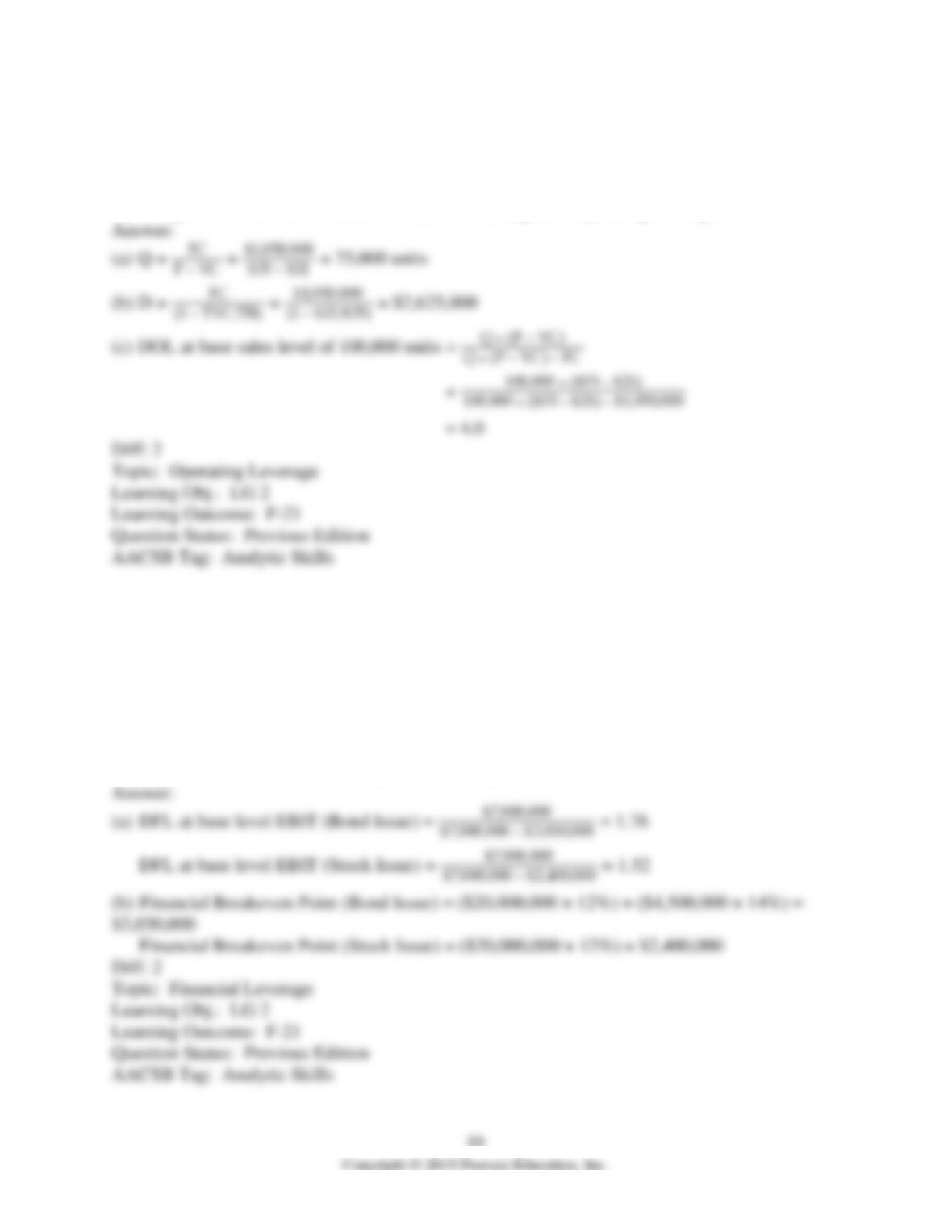
47) Bamboo manufacturing sells its finished product for an average of $35 per unit with a
variable cost per unit of $21. The company has fixed operating costs of $1,050,000.
(a) Calculate the firm’s operating breakeven point in units.
(b) Calculate the firm’s operating breakeven point in dollars.
(c) Using 100,000 units as a base, what is the firm’s degree of operating leverage?
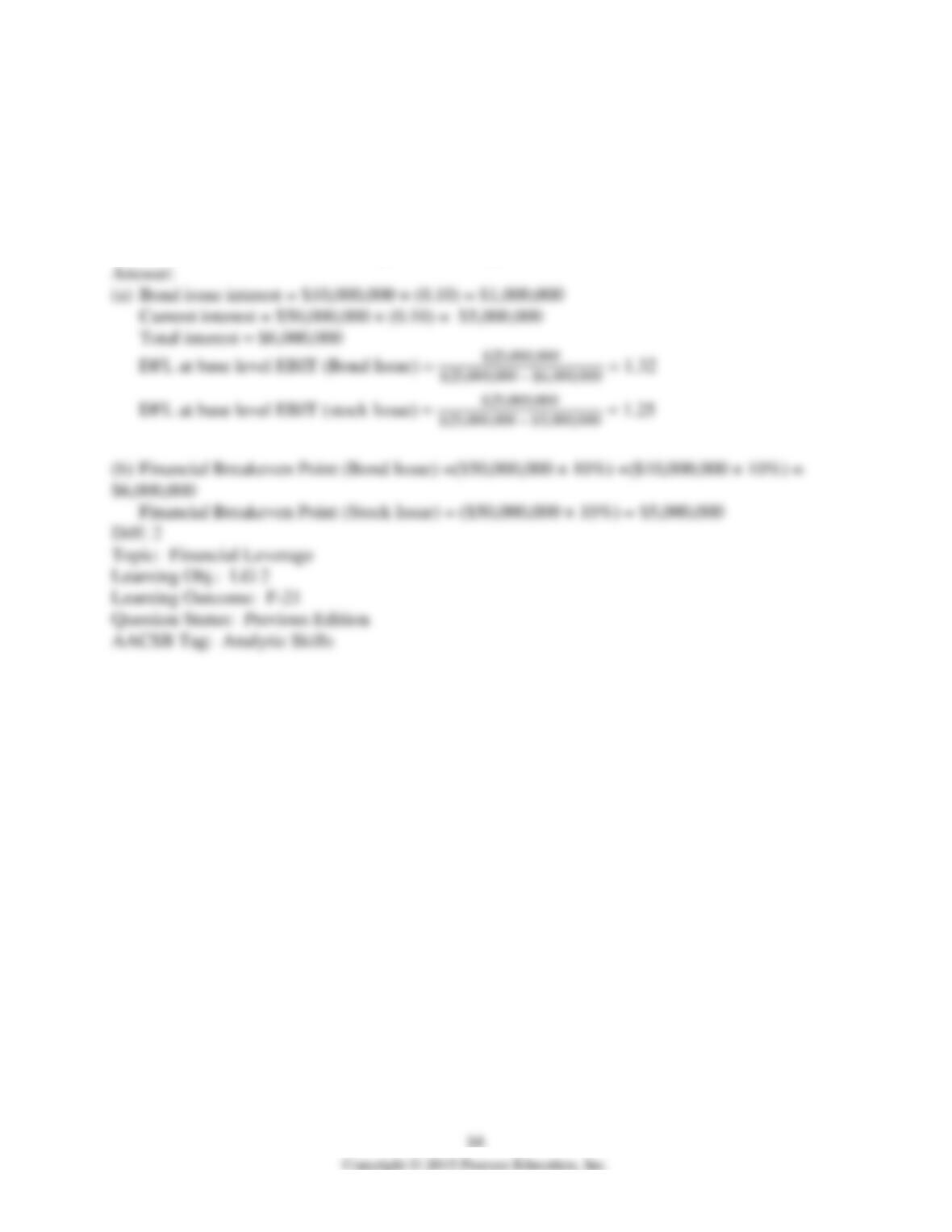
48) Beijing Bearings is considering purchasing a small firm in the same line of business. The
purchase would be financed by the sale of common stock or a bond issue. The financial manager
needs to evaluate how the two alternative financing plans will affect the earnings potential of the
firm. Total financing required is $4.5 million. The firm currently has $20,000,000 of 12 percent
bonds and 600,000 common shares outstanding. The firm can arrange financing of the $4.5
million through a 14 percent bond issue or the sale of 100,000 shares of common stock. The firm
has a 40 percent tax rate.
(a) What is the degree of financial leverage for each plan at $7,000,000 of EBIT?
(b) What is the financial breakeven point for each plan?
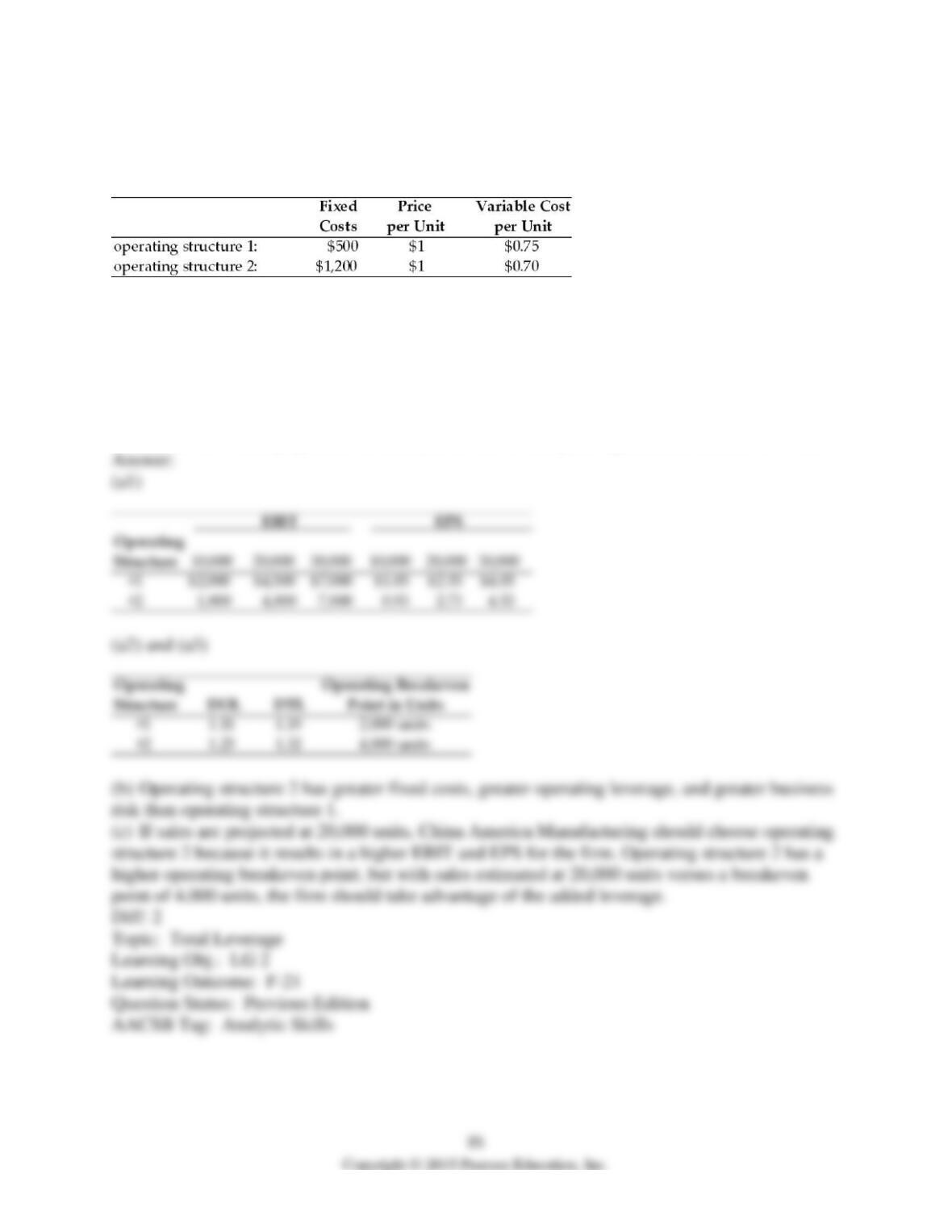
49) Yongman Electronics has decided to invest $10,000,000 in a new headquarters and needs to
determine the best way to finance the construction. The firm currently has $50,000,000 of 10
percent bonds and 4,000,000 common shares outstanding. The firm can obtain the $10,000,000
of financing through a 10 percent bond issue or the sale of 1,000,000 shares of common stock.
The firm has a 40 percent tax rate.
(a) What is the degree of financial leverage for each plan at $25,000,000 of EBIT?
(b) What is the financial breakeven point for each plan?
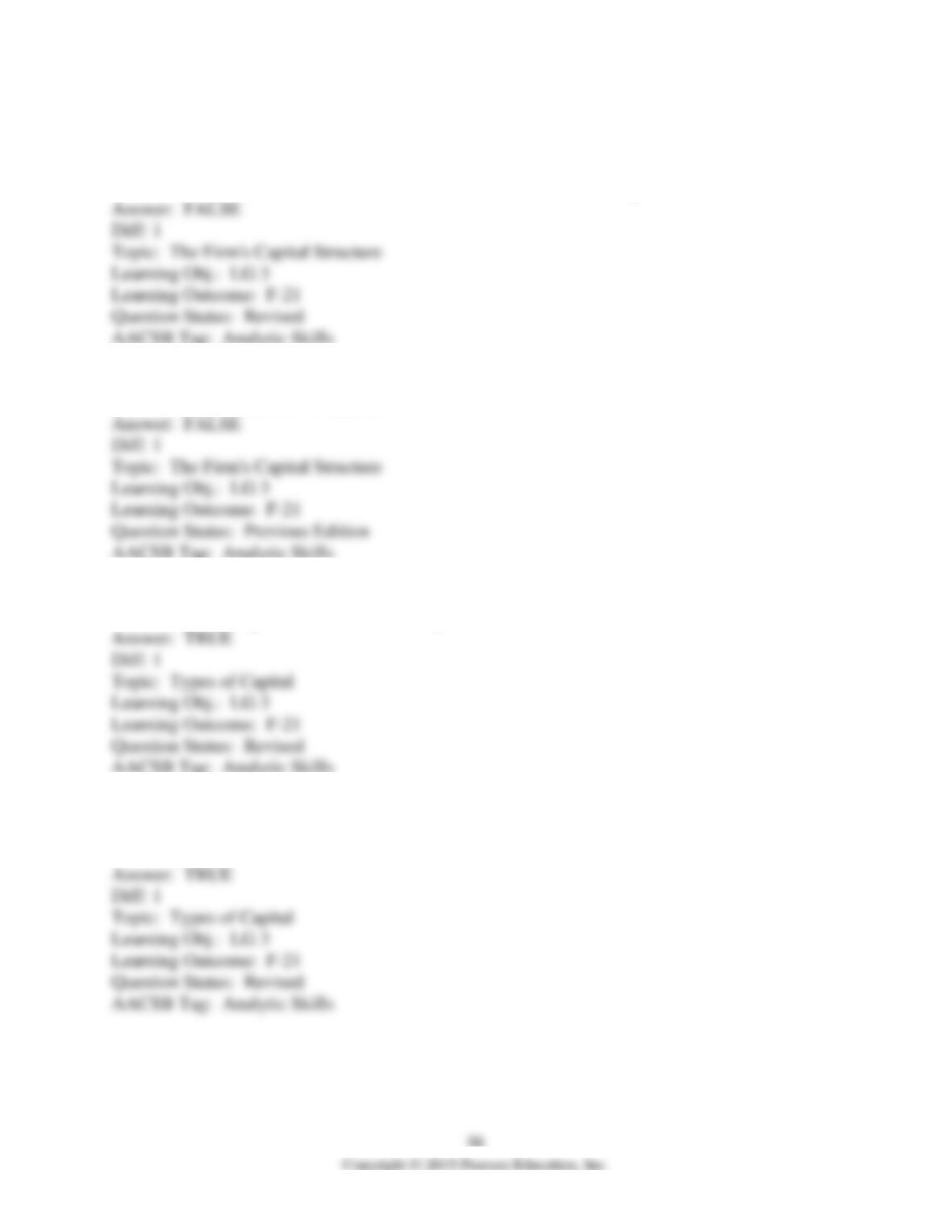
50) China America Manufacturing is evaluating two different operating structures which are
described below. The firm has annual interest expense of $250, common shares outstanding of
1,000, and a tax rate of 40 percent.
(a) For each operating structure, calculate
(a1) EBIT and EPS at 10,000, 20,000, and 30,000 units.
(a2) the degree of operating leverage (DOL) and degree of total leverage (DTL) using 20,000
units as a base sales level.
(a3) the operating breakeven point in units.
(b) Which operating structure has greater operating leverage and business risk?
(c) If China America projects sales of 20,000 units, which operating structure is recommended?
12.3 Describe the types of capital, external assessment of capital structure, the capital structure
of non-U.S. firms, and capital structure theory.
1) A firm’s capital structure is the mix of short-term liabilities and long-term debt.
2) Poor capital structure decisions can result in a high cost of capital, thereby making some
unacceptable investments acceptable.
3) The relative inexpensiveness of debt capital is due to the fact that the lenders take the least
risk among the long-term contributors of capital.
4) Debt capital is less risky than equity capital because a firm is legally obligated to pay interest
to bondholders but they are not legally obligated to pay dividends to preferred or common
stockholders.
5) Due to its secondary position relative to equity, suppliers of debt capital face greater risk and
therefore must be compensated with higher expected returns than suppliers of equity capital.
6) All items on the right-hand side of a firm’s balance sheet, excluding current liabilities are
sources of capital.
7) Generally, the greater a firm’s times interest earned ratio, the less able it is to meet payments
as they come due.
8) A firm’s capital structure can significantly affect the firm’s value by affecting its risk and
return.
9) In general, low times interest earned ratio and fixed-payment coverage ratio are associated
with a high degree of financial leverage.
10) The probability that a firm will become bankrupt is largely dependent on its level of both
business and financial risk.
11) Holding all other factors constant, a firm that is subject to a greater level of business risk
should employ more total leverage than an otherwise equivalent firm that is subject to a lesser
level of business risk.
12) In general, the greater a firm’s operating leverage, the higher its business risk.
13) Business risk is the risk to a firm of being unable to cover operating costs.
14) Financial risk is the risk to a firm of being unable to cover operating costs.
15) Business risk is the risk to the firm of being unable to cover required financial obligations.
16) The more fixed cost financing a firm has in its capital structure, the greater is its financial
leverage and risk.
17) Asymmetric information results when managers of a firm have more information about the
firm’s operations and future prospects than investors have.
18) In general, non-U.S. companies have much higher debt ratios than their U.S. counterparts
because financial markets are much more developed in the United States than elsewhere.
19) Effective capital structure decisions can lower the cost of capital, resulting in higher NPVs
and more acceptable projects, thereby increasing the value of a firm.
20) Pecking order is a hierarchy of financing beginning with retained earnings, followed by debt
financing, and finally external equity financing.
21) A shift toward more fixed costs increases business risk, which in turn causes earnings before
interest and taxes to increase by less for a given increase in sales.