21
A) [C] vs. t
B) ln[C] vs. t
C) 1/[C] vs. t
D) [C]2 vs. t
72) For the zeroth-order reaction: A → products, what will happen to the rate of reaction if the
concentration of A is doubled?
A) The rate will be halved.
B) The rate will be doubled.
C) The rate will be quadrupled.
D) The rate will remain the same.
73) Which statement below regarding the half-life of a zeroth-order reaction is true?
A) Each half-life is half as long as the preceding half-life.
B) Each half-life is twice as long as the preceding half-life.
C) Each half-life is four times as long as the preceding half-life.
D) The half-life remains unchanged throughout the course of the reaction.
74) The elementary reaction representing the formation of ozone:
is an example of a ________ reaction.
A) unimolecular
B) bimolecular
C) termolecular
D) tetramolecular
75) The elementary reaction: 2 HI → H2 + I2, is an example of a ________ reaction.
A) unimolecular
B) bimolecular
C) termolecular
D) tetramolecular
76) A mechanism for a naturally occurring reaction that destroys ozone is:
Step 1: O3(g) + HO(g) → HO2(g) + O2(g)
Step 2: HO2(g) + O(g) → HO(g) + O2(g)
Which species is an intermediate?
A) HO
B) HO2
C) O
D) O3
77) The decomposition of ozone in the stratosphere can occur by the following two-step mechanism:
Step 1: Br + O3 → BrO + O2
Step 2: BrO + O → Br + O2
Which species is an intermediate in this mechanism?
A) Br
B) BrO
C) O
D) O3
78) A mechanism for a naturally occurring reaction that destroys ozone is:
Step 1: O3(g) + HO(g) → HO2(g) + O2(g)
Step 2: HO2(g) + O(g) → HO(g) + O2(g)
What is the molecularity of the overall reaction?
A) unimolecular
B) bimolecular
C) none of these because molecularity is the difference of the exponents in the rate law
D) none of these because molecularity only refers to elementary steps
79) A three-step mechanism has been suggested for the formation of carbonyl chloride:
Step 1: Cl2 → 2 Cl
Step 2: Cl + CO → COCl
Step 3: COCl + Cl2 → COCl2 + Cl
Which species is an intermediate in the mechanism?
A) Cl
B) CO
C) COCl
D) COCl2
80) The slowest step in a reaction mechanism is called the ________ step.
A) activation
B) elementary
C) rate law
D) rate-determining
81) Which of the following statements are true about reaction mechanisms?
I. A rate law can be written from the molecularity of the slowest elementary step.
II. The final rate law can include intermediates.
III. The rate of the reaction is dependent on the fastest step in the mechanism.
IV. A mechanism can never be proven to be the correct pathway for a reaction.
A) I, II, III
B) II, IV
C) I, III
D) I, IV
82) Which general rate law below corresponds to an elementary bimolecular reaction?
A) Rate = k[A]
B) Rate = k[A][B][C]
C) Rate = k[A]2[B]
D) Rate = k[A][B]
83) What is the rate law for the elementary reaction shown below?
2 HI → H2 + I2
A) Rate = k[HI]
B) Rate = k[HI]2
C) Rate = k[H2][I2]
D) Rate = k[H2][I2]/[HI]2
84) A three-step mechanism has been suggested for the formation of carbonyl chloride:
Step 1: Cl2→ 2 Cl (fast, equilibrium)
Step 2: Cl + CO → COCl (fast, equilibrium)
Step 3: COCl + Cl2 → COCl2 + Cl (slow)
What is the molecularity of the rate-determining step?
A) unimolecular
B) bimolecular
C) termolecular
D) none of these
85) When the concentration of A is doubled, the rate for the reaction: 2 A + B → 2 C quadruples.
When the concentration of B is doubled the rate remains the same. Which mechanism below is
consistent with the experimental observations?
A) Step 1: A + B ⇌ D (fast equilibrium)
Step 2: A + D → 2 C (slow)
B) Step 1: A + B → D (slow)
Step 2: A + D ⇌ 2 C (fast equilibrium)
C) Step 1: 2 A → D (slow)
Step 2: B + D → E (fast)
Step 3: E → 2 C (fast)
D) Step 1: 2 A ⇌ D (fast equilibrium)
Step 2: B + D → E (slow)
Step 3: E → 2 C (fast)
86) A gaseous reaction occurs by a two-step mechanism, shown below.
Step 1: AX +Y2 ⇌ AXY2 fast
Step 2: AXY2 + AX → 2 AXY slow
Including concentration of only reactants and products, what is the rate law for this reaction?
A) Rate = k[AX][Y2]
B) Rate = k[AXY2]/[AX][Y2]
C) Rate = k[AX]2[Y2]
D) Rate = k[AXY]2/[AXY2][AX]
87) What is the minimum energy barrier that must be overcome for a chemical reaction to occur?
A) activation energy
B) net energy
C) potential energy
D) rate limiting energy
88) What factor affects the rate of a chemical reaction?
A) collision frequency
B) fraction of collisions with sufficient energy
C) orientation of molecules
D) All of these
89) A gas molecule at 298 K and 1 atm pressure undergoes a collision with another gas molecule
approximately every ________ seconds.
A) 10-15
B) 10-9
C) 10-6
D) 10-3
90) The fraction of collisions with sufficient energy to react is equal to
A) A
B) Ea
C) e-Ea/RT
D) p
91) What fraction of collisions will have sufficient energy to react for a gas whose activation energy is
68 kJ/mol at 25°C?
A) 1.2 × 10⁻¹²
B) 2.7 × 10⁻²
C) 0.96
D) 8.3 × 10¹¹
92) When the temperature of a gas whose activation energy is 55 kJ/mol is increased from 300 K to 320
K, the fraction of collisions with sufficient energy to react
A) decreases by a factor of 2.
B) decreases by a factor of 4.
C) increases by a factor of 2.
D) increases by a factor of 4.
93) A common rule of thumb in organic chemistry is that increasing the temperature of a reaction at
room temperature by 10°C doubles the rate. Calculate Ea for a reaction that follows this rule of thumb
Assume room temperature is 25°C.
A) 0.576 kJ
B) 12.2 kJ
C) 38.4 kJ
D) 52.9 kJ
94) Consider a bimolecular reaction in the gas phase. Which one of the following changes in condition
will not cause an increase in the rate of the reaction?
A) add a catalyst
B) increase the temperature at constant volume
C) increase the volume at constant temperature
D) All of these will increase the rate of reaction.
95) Which part of the Arrhenius equation contains a term which measures the number of molecules that
have the correct orientation for reaction?
A) activation energy
B) e-Ea/RT
C) frequency factor
D) none of these
96) The reaction for the decomposition of dinitrogen monoxide gas to form oxygen radicals is:
N2O(g) → N2(g) + O(g). If the rate constant is 3.04 × 10⁻² s-1 and the frequency factor is
8.00 × 10¹¹ s-1, what is the activation energy for the first-order reaction at 700°C?
A) 0.262 kJ/mol
B) 38.2 kJ/mol
C) 180 kJ/mol
D) 250 kJ/mol
97) The reaction for the decomposition of dinitrogen monoxide gas to form an oxygen radical is:
N2O(g) → N2(g) + O(g). If the activation energy is 250 kJ/mol and the frequency factor is 8.0 × 10¹¹ s–
1, what is the rate constant for the first-order reaction at 1000 K?
A) 1.1 × 10⁻³ s-1
B) 7.0 × 10⁻² s-1
C) 1.6 × 10¹³ s-1
D) 9.1 × 1024 s-1
98) The aquation of tris(1, 10-phenanthroline)iron(II) in acid solution takes place according to the
equation:
Fe(phen)32+ + 3 H3O+ + 3 H2O → Fe(H2O)62+ + 3 phenH+
If the activation energy is 126 kJ/mol and frequency factor is 8.62 × 10¹⁷ s–1, at what temperature is the
rate constant equal to 3.63 × 10⁻³ s-1 for the first-order reaction?
A) 0°C
B) 36°C
C) 50°C
D) 94°C
99) The aquation of tris(1, 10-phenanthroline)iron(II) in acid solution takes place according to the
equation:
Fe(phen)32+ + 3 H3O+ + 3 H2O → Fe(H2O)62+ + 3 phenH+
If the activation energy, Ea, is 126 kJ/mol and the rate constant at 30°C is 9.8 × 10⁻³ min-1, what is the
frequency factor, A?
A) 2 × 10-24 min-1
B) 2 × 10-20 min-1
C) 5 × 10¹⁹ min-1
D) 5 × 10²³ min-1
100) The aquation of tris(1, 10-phenanthroline)iron(II) in acid solution takes place according to the
equation:
Fe(phen)32+ + 3 H3O+ + 3 H2O → Fe(H2O)62+ + 3 phenH+.
If the activation energy, Ea, is 126 kJ/mol and the rate constant at 30°C is 9.8 × 10⁻³ min-1, what is the
rate constant at 50°C?
A) 4.4 × 10⁻⁴ min-1
B) 2.2 × 10⁻¹ min-1
C) 4.6 × 100 min-1
D) 2.3 × 10³ min-1
101) The first-order isomerization reaction: cyclopropane → propene, has a rate constant of
1.10 × 10⁻⁴s-1 at 470°C and 5.70 × 10⁻⁴s-1 at 500°C. What is the activation energy, Ea, for the
reaction?
A) 46 kJ/mol
B) 110 kJ/mol
C) 260 kJ/mol
D) 380 kJ/mol
102) The first-order isomerization reaction: cyclopropane → propene, has a rate constant of
1.10 × 10⁻⁴s-1 at 470°C and an activation energy of 264 kJ/mol. What is the temperature of the reaction
when the rate constant is equal to 4.36 × 10⁻³s-1?
A) 126°C
B) 411°C
C) 510°C
D) 540°C
103) A catalyst increases the rate of a reaction by providing a different reaction pathway that
A) lowers only the activation energy.
B) lowers only the energy of the products.
C) lowers only the energy of the reactants.
D) All of these are affected by the presence of a catalyst.
104) The decomposition of hydrogen peroxide is given by the following reaction:
2 H2O2(aq) → 2 H2O(l) + O2(g)
In the presence of KI the reaction is thought to occur by the following mechanism:
Step 1: H2O2 + I– → H2O + IO–
Step 2: IO– + H2O2 → H2O + O2 + I–
What is the role of I– in this mechanism?
A) catalyst
B) frequency factor
C) intermediate
D) transition state
105) A mechanism for a naturally occurring reaction that destroys ozone is:
Step 1: O3(g) + HO(g) → HO2(g) + O2(g)
Step 2: HO2(g) + O(g) → HO(g) + O2(g)
Which species is a catalyst?
A) HO
B) HO2
C) O
D) O3
106) The decomposition of ozone in the stratosphere can occur by the following two-step mechanism:
Br + O3 → BrO + O2
BrO + O → Br + O2
Which species is a catalyst in this mechanism?
A) Br
B) BrO
C) O
D) O3
107) Which of the following does not affect the rate of a bimolecular reaction?
A) concentrations of reactants
B) presence of a catalyst
C) temperature
D) All of these affect the rate.
108) An aqueous reaction occurs by a two-step mechanism, shown below.
Step 1: A2X2 + Y → A2X + XY
Step 2: A2X2 + XY → A2X + X2 + Y
What is the catalyst in this reaction?
A) A2X
B) X2
C) XY
D) Y
109) A mechanism for a naturally occurring reaction that destroys ozone is:
Step 1: O3(g) + HO(g) → HO2(g) + O2(g)
Step 2: HO2(g) + O(g) → HO(g) + O2(g)
Which species is a catalyst and what type of catalysis is occurring?
A) HO, homogeneous
B) HO, heterogeneous
C) HO2, homogeneous
D) HO2, heterogeneous
110) The Haber process is the synthesis of ammonia gas from hydrogen and nitrogen on a hot metal
surface. What is the catalyst and what type of catalysis is occurring?
A) H2, homogeneous
B) N2, homogeneous
C) NH3, homogeneous
D) metal surface, heterogeneous
111) Biological reactions are catalyzed by
A) carbohydrates.
B) enzymes.
C) lipids.
D) steroids.
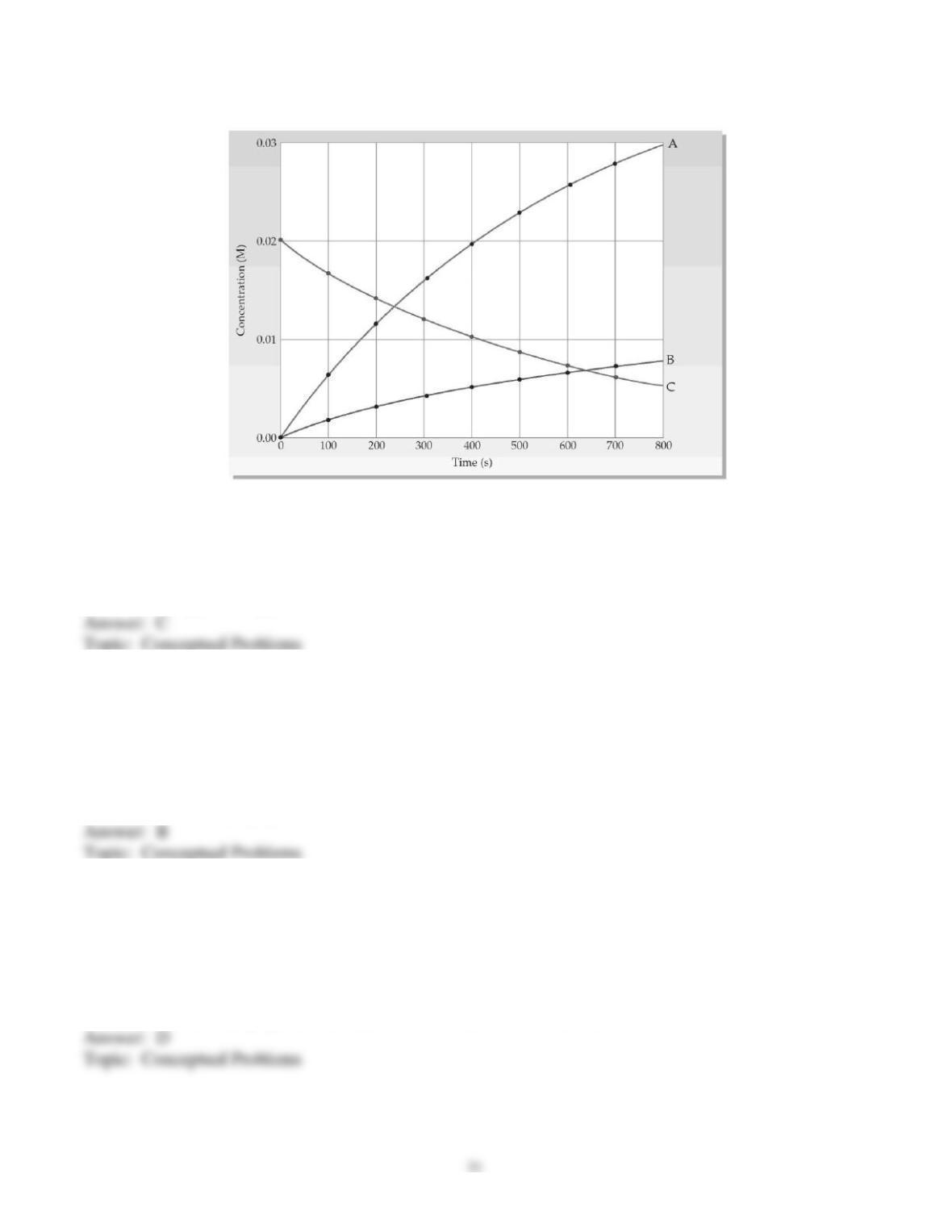
Shown is a concentration versus time plot for a reaction involving gases A, B, and C.
112) Which equation best represents the reaction?
A) 4A(g) → B(g) + 2C(g)
B) 4A(g) + B(g) → 2C(g)
C) 2C(g) → 4A(g) + B(g)
D) 2C(g) + B(g) → 4A(g)
113) Over the time interval 300 to 400 seconds, the rate of reaction with respect to A is Δ[A]/Δt = 3.7 ×
10-5 M/s. Over the same time interval what is the rate of reaction with respect to B, Δ[B]/Δt?
A) Δ[B]/Δt = Δ[A]/Δt = 3.7 × 10⁻⁵ M/s
B) Δ[B]/Δt = (1/4)(Δ[A]/Δt) = (1/4)(3.7 × 10-5 M/s) = 9.2 × 10⁻⁶ M/s
C) Δ[B]/Δt = (1/2)(Δ[A]/Δt) = (1/2)(3.7 × 10-5 M/s) = 1.8 × 10⁻⁵ M/s
D) Δ[B]/Δt = –(1/2)(Δ[A]/Δt) = -(1/2)(3.7 × 10-5 M/s) = -1.8 × 10⁻⁵ M/s
114) Over the time interval 300 to 400 seconds, the rate of reaction with respect to A is Δ[A]/Δt =
3.7 × 10⁻⁵ M/s. Over the same time interval what is the rate of reaction with respect to C, Δ[C]/Δt?
A) Δ[C]/Δt = Δ[A]/Δt = 3.7 × 10⁻⁵ M/s
B) Δ[C]/Δt = (1/4)(Δ[A]/Δt) = (1/4)(3.7 × 10-5 M/s) = 9.2 × 10⁻⁶ M/s
C) Δ[C]/Δt = (1/2)(Δ[A]/Δt) = (1/2)(3.7 × 10-5 M/s) = 1.8 × 10⁻⁵ M/s
D) Δ[C]/Δt = –(1/2)(Δ[A]/Δt) = -(1/2)(3.7 × 10-5 M/s) = -1.8 × 10⁻⁵ M/s
115) Over the time interval 300 to 400 seconds, the rate of reaction with respect to A is Δ[A]/Δt =
3.7 × 10⁻⁵ M/s. What is the rate of reaction with respect to A over the time interval 700 to 800 seconds?
A) 0 M/s
B) less than 3.7 × 10⁻⁵ M/s
C) 3.7 × 10⁻⁵ M/s
D) greater than 3.7 × 10⁻⁵ M/s
116) Over the time interval 300 to 400 seconds, the rate of reaction with respect to A is Δ[A]/Δt =
3.7 × 10⁻⁵ M/s. What is the rate of reaction with respect to A over the time interval 0 to 100 seconds?
A) 0 M/s
B) less than 3.7 × 10⁻⁵ M/s
C) 3.7 × 10⁻⁵ M/s
D) greater than 3.7 × 10⁻⁵ M/s
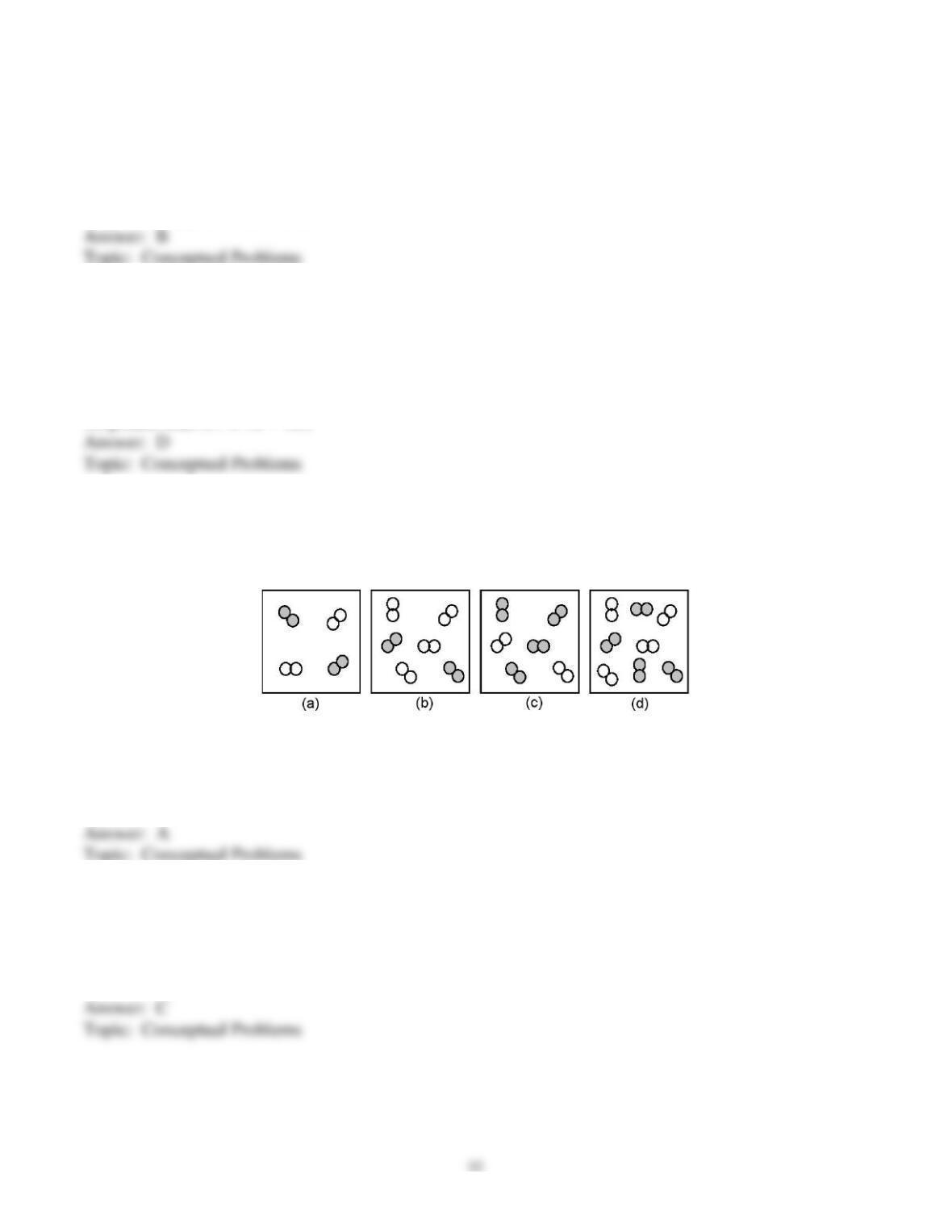
The relative initial rates of the reaction A2 + B2 → products in vessels (a)-(d) are 1:1:4:4. Unshaded
spheres represent A2 molecules, and shaded spheres represent B2 molecules present at the beginning of
the reaction.
117) What is the order of reaction with respect to A2?
A) 0
B) 1
C) 2
D) 3
118) What is the order of reaction with respect to B2?
A) 0
B) 1
C) 2
D) 3
119) What is the overall order of reaction?
A) 0
B) 1
C) 2
D) 3
120) What is the rate law for this reaction?
A) Rate = k[A2]2
B) Rate = k[B2]2
C) Rate = k[A2][B2]
D) Rate = k[A2]2[B2]2
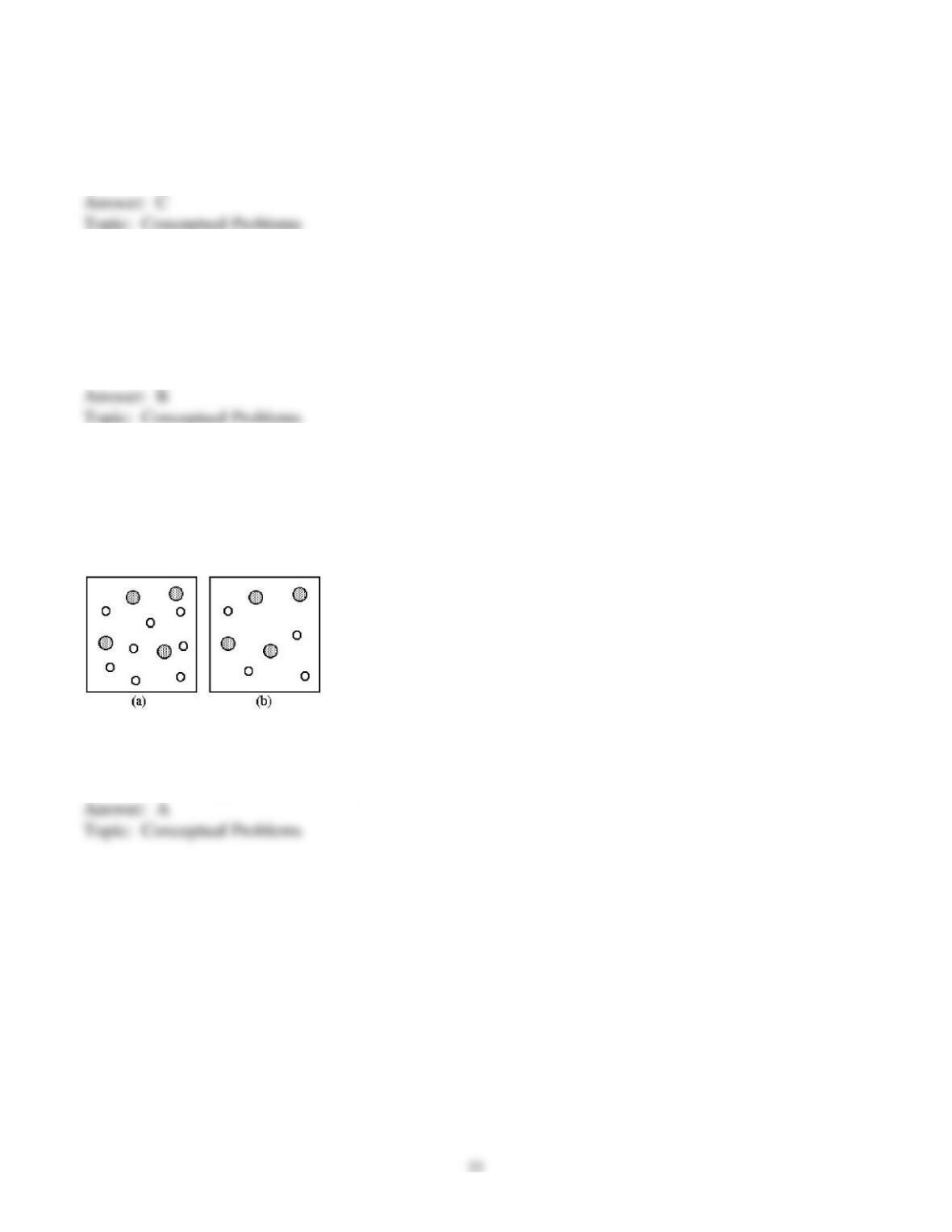
121) The following reaction is first order in A and first order in B:
A + B → Products Rate = k[A][B]
What is the initial rate of this reaction in vessel (b) relative to the initial rate of this reaction in vessel
(a)? Each vessel has the same volume. Shaded spheres represent A molecules, and unshaded spheres
represent B molecules present at the beginning of the reaction.
A) rate in vessel (b)/rate in vessel (a) = 1:2
B) rate in vessel (b)/rate in vessel (a) = 1:1
C) rate in vessel (b)/rate in vessel (a) = 2:1
D) rate in vessel (b)/rate in vessel (a) = 4:1
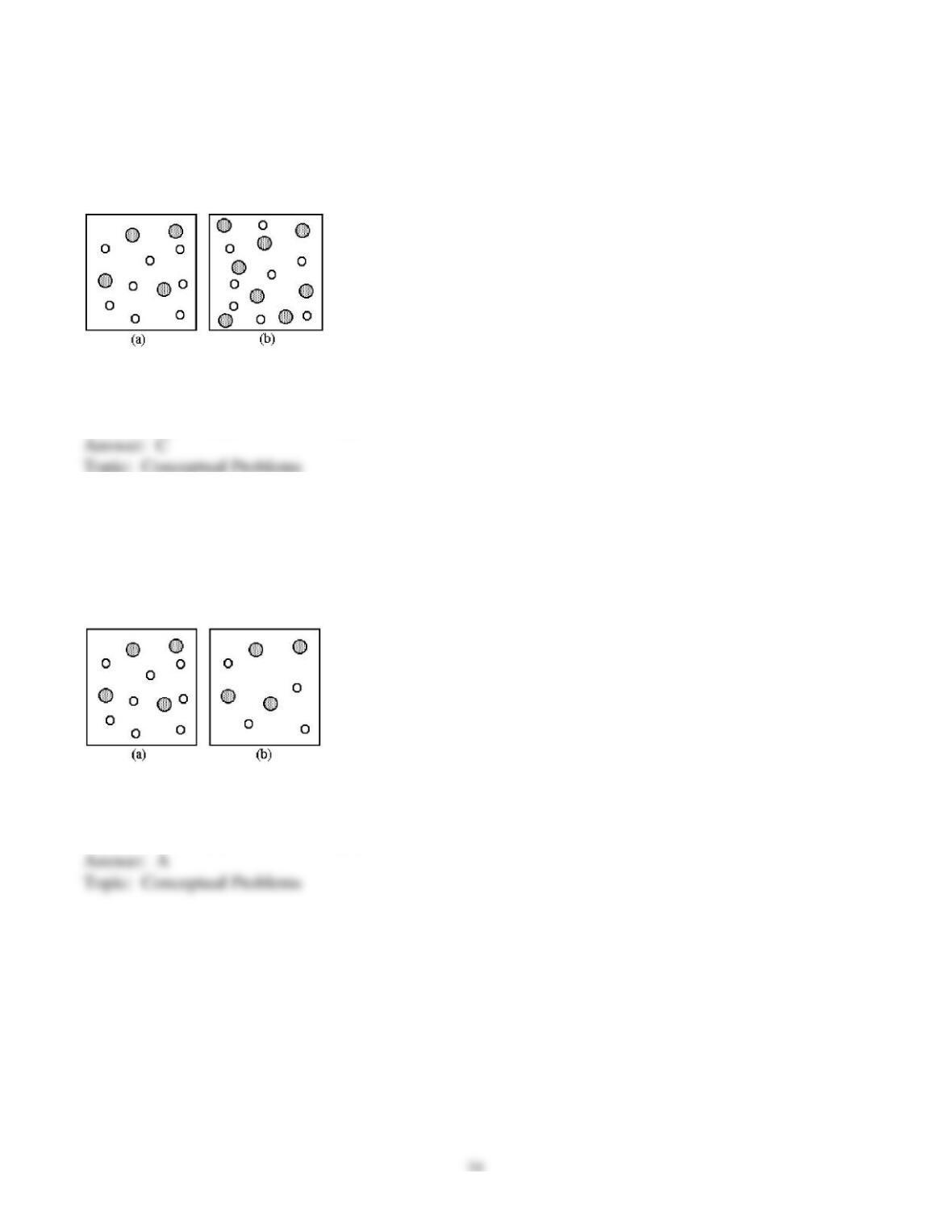
122) The following reaction is first order in A and first order in B:
A + B → Products Rate = k[A][B]
What is the initial rate of this reaction in vessel (b) relative to the initial rate of this reaction in vessel
(a)? Each vessel has the same volume. Shaded spheres represent A molecules, and unshaded spheres
represent B molecules present at the beginning of the reaction.
A) rate in vessel (b)/rate in vessel (a) = 1:2
B) rate in vessel (b)/rate in vessel (a) = 1:1
C) rate in vessel (b)/rate in vessel (a) = 2:1
D) rate in vessel (b)/rate in vessel (a) = 4:1
123) The following reaction is second order in A and first order in B:
A + B → Products Rate = k[A]2[B]
What is the initial rate of this reaction in vessel (b) relative to the initial rate of this reaction in vessel
(a)? Each vessel has the same volume. Shaded spheres represent A molecules, and unshaded spheres
represent B molecules present at the beginning of the reaction.
A) rate in vessel (b)/rate in vessel (a) = 1:2
B) rate in vessel (b)/rate in vessel (a) = 1:1
C) rate in vessel (b)/rate in vessel (a) = 2:1
D) rate in vessel (b)/rate in vessel (a) = 4:1
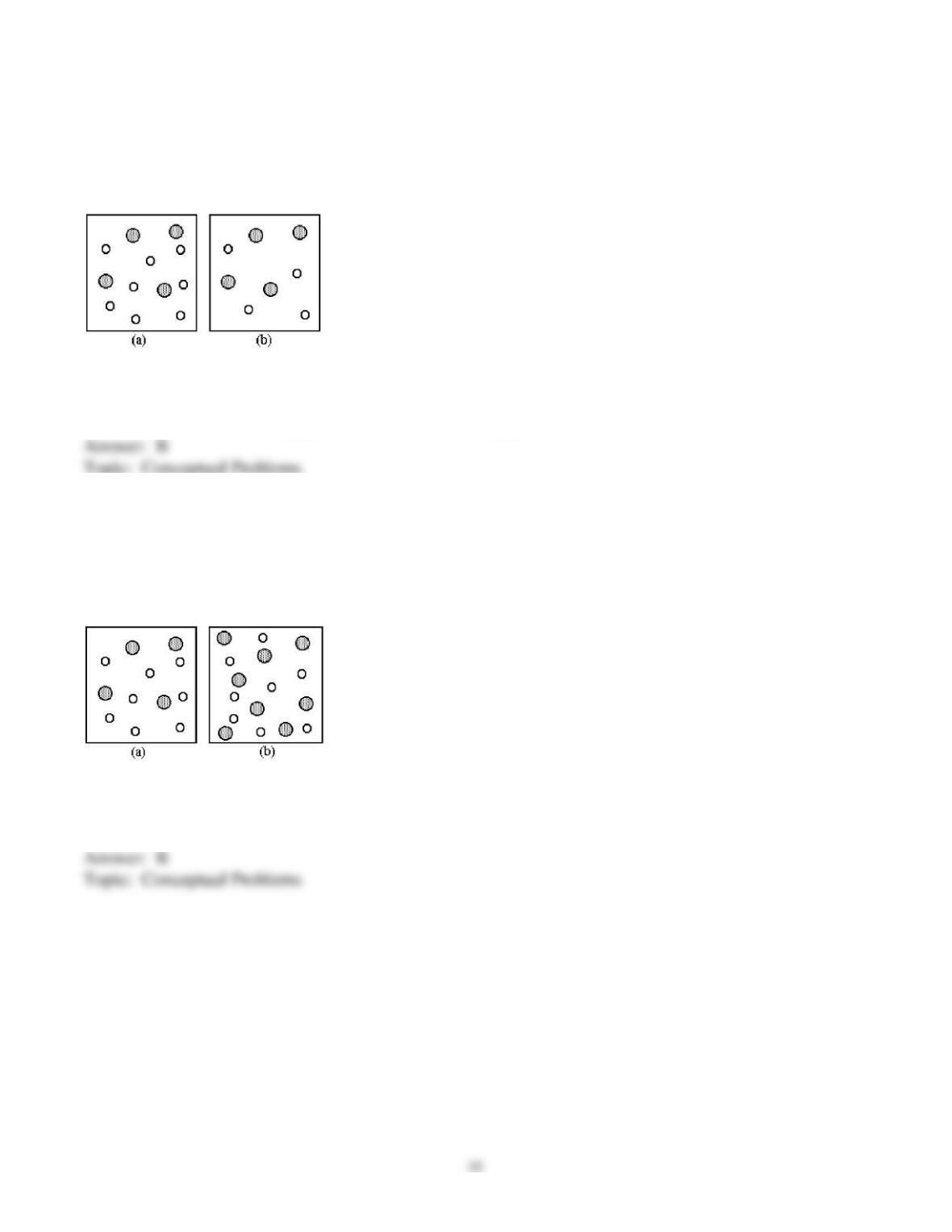
124) The following reaction is first order in A and first order in B:
A + B → Products Rate = k[A][B]
What is the rate constant k of this reaction in vessel (b) relative to the rate constant k of this reaction in
vessel (a)? Each vessel has the same volume. Shaded spheres represent A molecules, and unshaded
spheres represent B molecules.
A) rate constant k in vessel (b)/rate constant k in vessel (a) = 1:2
B) rate constant k in vessel (b)/rate constant k in vessel (a) = 1:1
C) rate constant k in vessel (b)/rate constant k in vessel (a) = 2:1
D) rate constant k in vessel (b)/rate constant k in vessel (a) = 4:1
125) The following reaction is first order in A and first order in B:
A + B → Products Rate = k[A][B]
What is the rate constant k of this reaction in vessel (b) relative to the rate constant k of this reaction in
vessel (a)? Each vessel has the same volume. Shaded spheres represent A molecules, and unshaded
spheres represent B molecules.
A) rate constant k in vessel (b)/rate constant k in vessel (a) = 1:2
B) rate constant k in vessel (b)/rate constant k in vessel (a) = 1:1
C) rate constant k in vessel (b)/rate constant k in vessel (a) = 2:1
D) rate constant k in vessel (b)/rate constant k in vessel (a) = 4:1
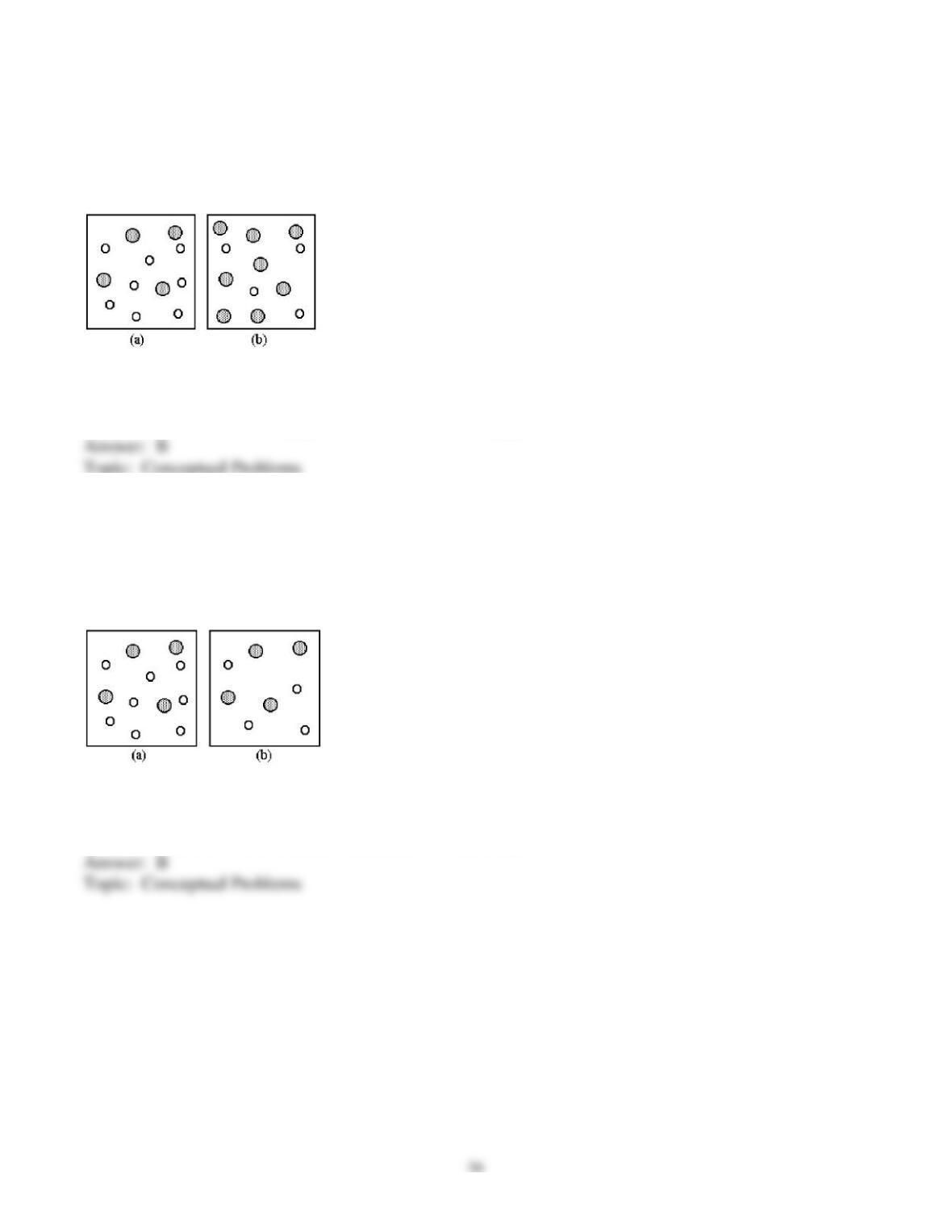
126) The following reaction is first order in A and first order in B:
A + B → Products Rate = k[A][B]
What is the rate constant k of this reaction in vessel (b) relative to the rate constant k of this reaction in
vessel (a)? Each vessel has the same volume. Shaded spheres represent A molecules, and unshaded
spheres represent B molecules.
A) rate constant k in vessel (b)/rate constant k in vessel (a) = 1:2
B) rate constant k in vessel (b)/rate constant k in vessel (a) = 1:1
C) rate constant k in vessel (b)/rate constant k in vessel (a) = 2:1
D) rate constant k in vessel (b)/rate constant k in vessel (a) = 4:1
127) The following reaction is second order in A and first order in B:
A + B → Products Rate = k[A]2[B]
What is the rate constant k of this reaction in vessel (b) relative to the rate constant k of this reaction in
vessel (a)? Each vessel has the same volume. Shaded spheres represent A molecules, and unshaded
spheres represent B molecules.
A) rate constant k in vessel (b)/rate constant k in vessel (a) = 1:2
B) rate constant k in vessel (b)/rate constant k in vessel (a) = 1:1
C) rate constant k in vessel (b)/rate constant k in vessel (a) = 2:1
D) rate constant k in vessel (b)/rate constant k in vessel (a) = 4:1
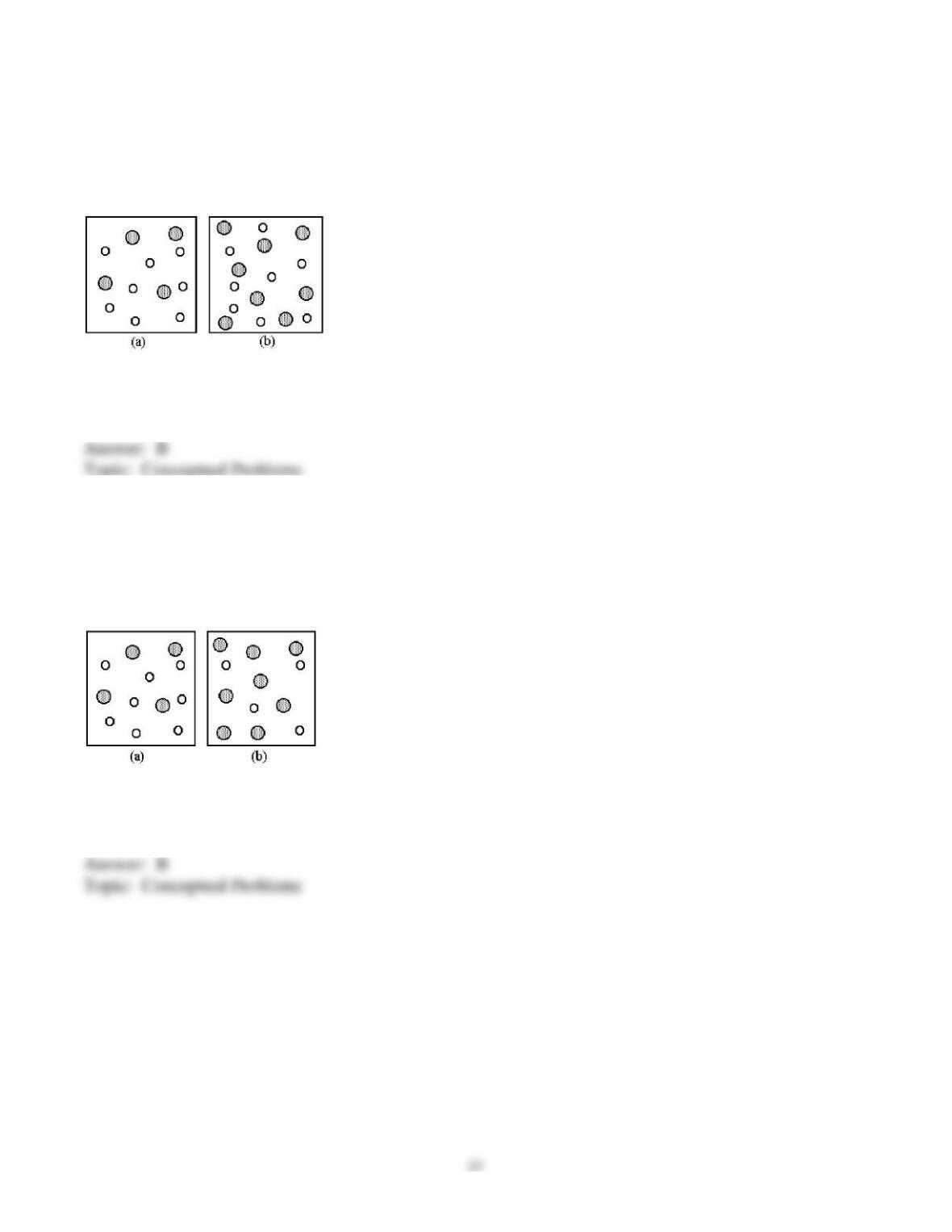
128) The following reaction is second order in A and first order in B:
A + B → Products Rate = k[A]2[B]
What is the rate constant k of this reaction in vessel (b) relative to the rate constant k of this reaction in
vessel (a)? Each vessel has the same volume. Shaded spheres represent A molecules, and unshaded
spheres represent B molecules.
A) rate constant k in vessel (b)/rate constant k in vessel (a) = 1:2
B) rate constant k in vessel (b)/rate constant k in vessel (a) = 1:1
C) rate constant k in vessel b)/rate constant k in vessel (a) = 2:1
D) rate constant k in vessel (b)/rate constant k in vessel (a) = 4:1
129) The following reaction is second order in A and first order in B:
A + B → Products Rate = k[A]2[B]
What is the rate constant k of this reaction in vessel (b) relative to the rate constant k of this reaction in
vessel (a)? Each vessel has the same volume. Shaded spheres represent A molecules, and unshaded
spheres represent B molecules.
A) rate constant k in vessel (b)/rate constant k in vessel (a) = 1:2
B) rate constant k in vessel (b)/rate constant k in vessel (a) = 1:1
C) rate constant k in vessel (b)/rate constant k in vessel (a) = 2:1
D) rate constant k in vessel (b)/rate constant k in vessel (a) = 4:1
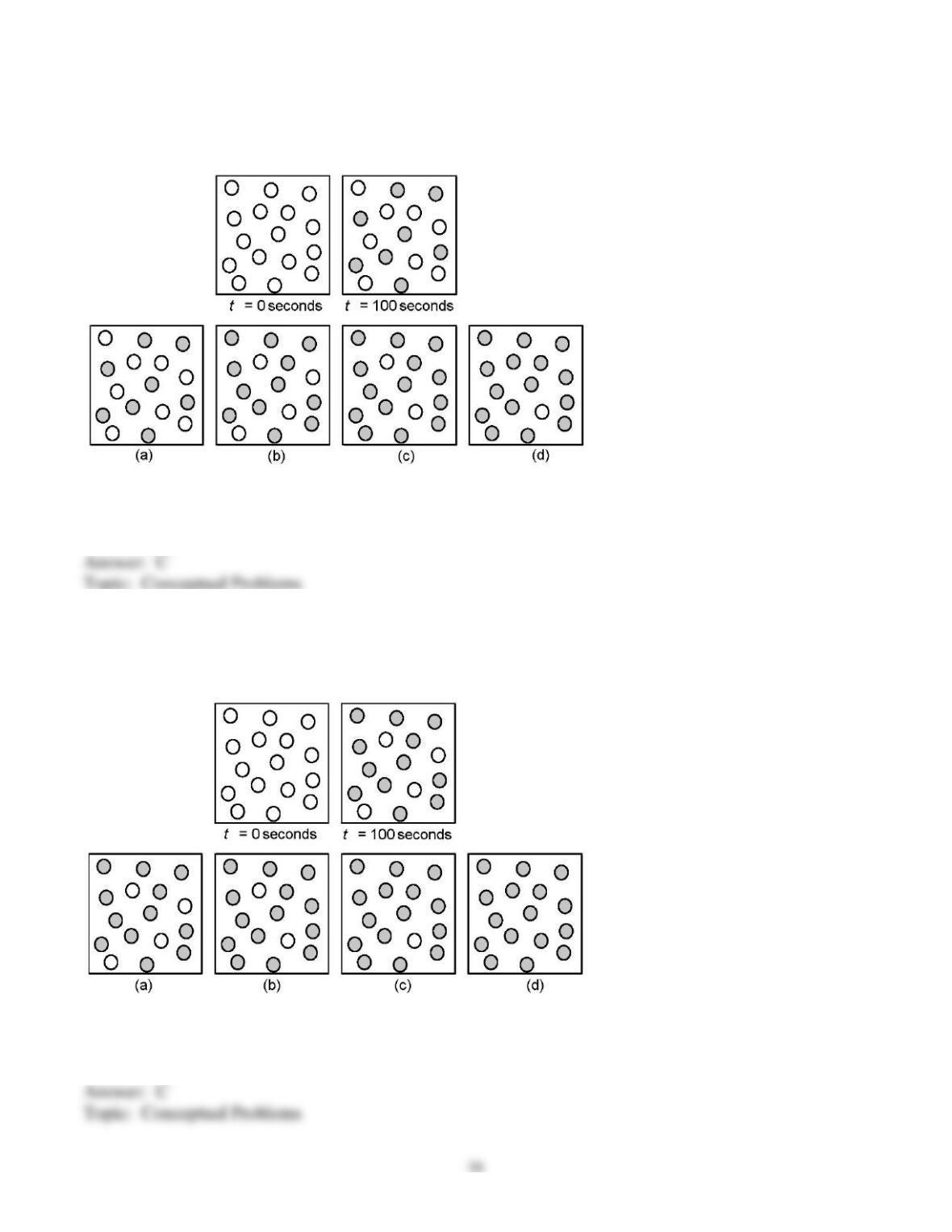
130) Consider the first-order reaction A → B in which A molecules (unshaded spheres) are converted to
B molecules (shaded spheres). Given the following pictures at t = 0 seconds and t = 100 seconds, which
picture represents the number of A and B molecules remaining at 300 seconds?
A) picture a)
B) picture b)
C) picture c)
D) picture d)
131) Consider the first-order reaction A → B in which A molecules (unshaded spheres) are converted to
B molecules (shaded spheres). Given the following pictures at t = 0 seconds and t = 100 seconds, which
picture represents the number of A and B molecules remaining at 200 seconds?
A) picture a)
B) picture b)
C) picture c)
D) picture d)
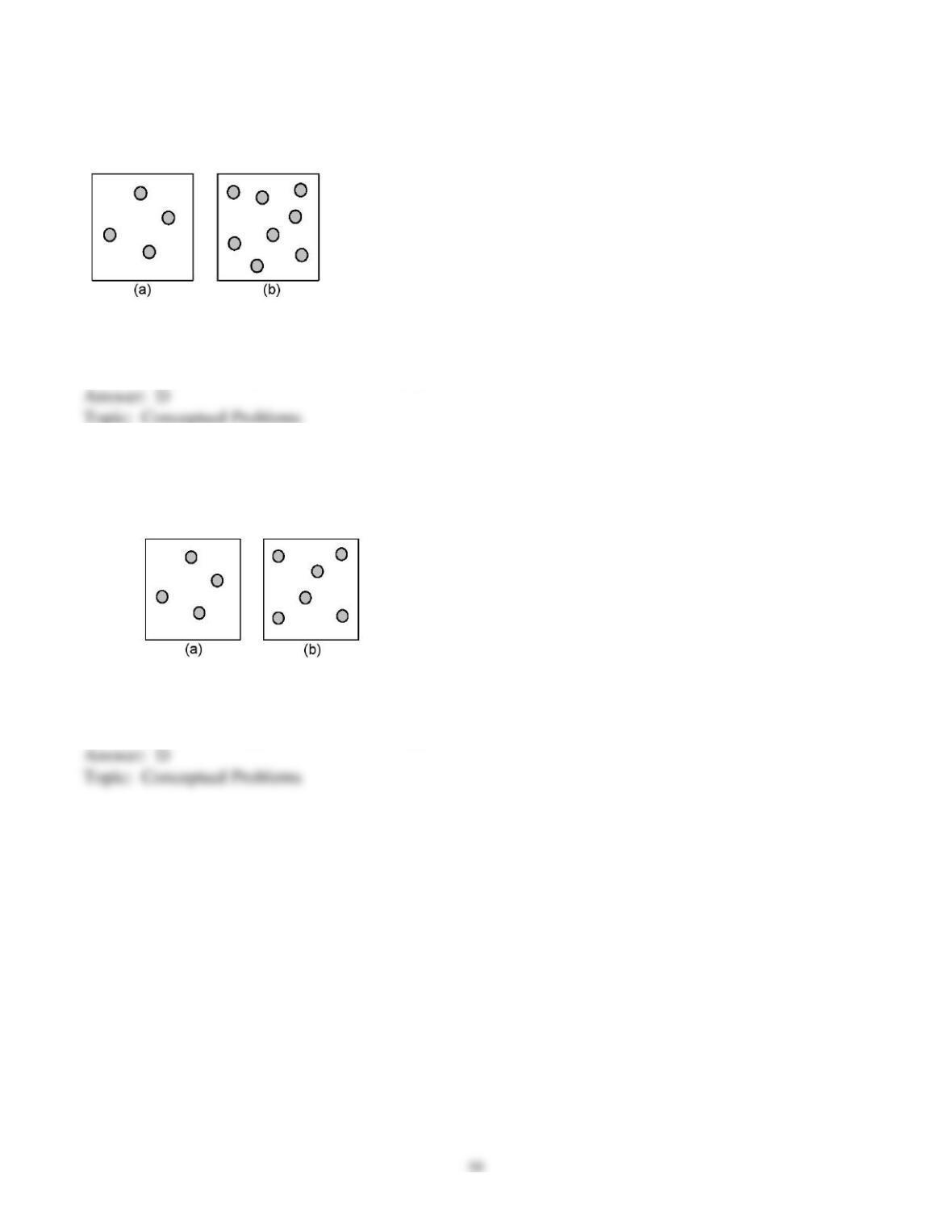
132) Consider the first-order decomposition of A molecules (shaded spheres) in two vessels of equal
volume. What is the half-life of decomposition in vessel (b) relative to the half-life of decomposition in
vessel (a)?
A) half-life in vessel (b)/half-life in vessel (a) = 4:1
B) half-life in vessel (b)/half-life in vessel (a) = 2:1
C) half-life in vessel (b)/half-life in vessel (a) = 3:2
D) half-life in vessel (b)/half-life in vessel (a) = 1:1
133) Consider the first-order decomposition of A molecules (shaded spheres) in two vessels of equal
volume. What is the half-life of decomposition in vessel (b) relative to the half-life of decomposition in
vessel (a)?
A) half-life in vessel (b)/half-life in vessel (a) = 4:1
B) half-life in vessel (b)/half-life in vessel (a) = 2:1
C) half-life in vessel (b)/half-life in vessel (a) = 3:2
D) half-life in vessel (b)/half-life in vessel (a) = 1:1